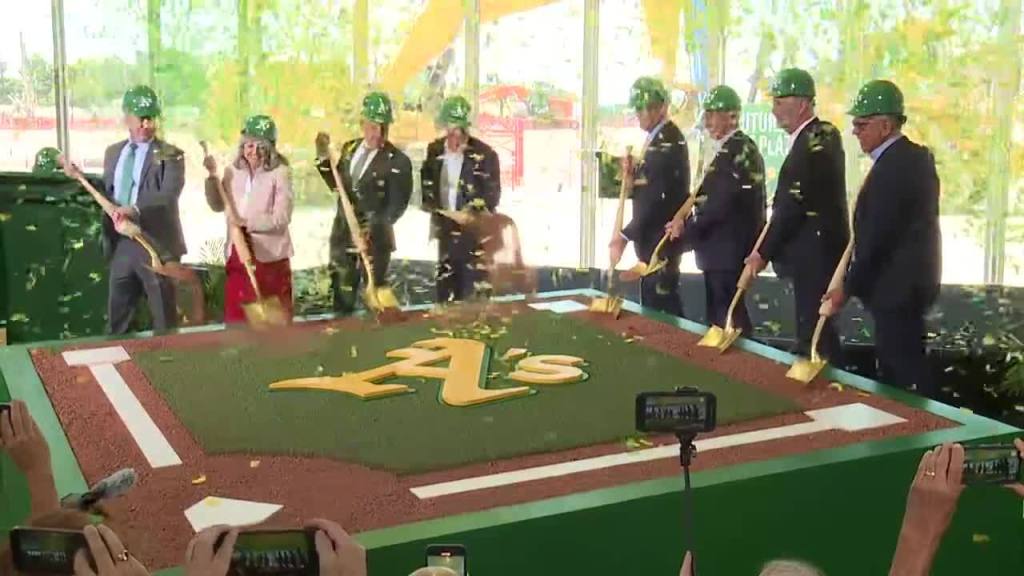
After some intrigue about when it would happen, the A’s chose today, June 23, to have a ceremonial groundbreaking ceremony at their ballpark site on the Vegas Strip. It happened to be a travel day for the team, embarking on a sure-to-be-crushing 10-day road trip to Detroit, New York, and Tampa Bay. A’s management gave the whole event a Vegas flair, with attendees bussed in from the MGM across the street. This makes sense in hindsight, since there’s been a decent amount of excavation on what is now a live construction site. It’s hard to tell how much dirt is removed from overhead views, but from the renderings it looked as if the field was going to be some 20 feet below street level. So while the ceremony was John Fisher and dignitaries shoveling a raised platform with a dirt planter, the A’s staged some yellow iron in front of the windowed event tent for show. Before the actual shoveling, the A’s showed a sizzle reel.
The emcee was Dallas Braden, which upset numerous Oakland partisans who called him a sell out. I mean, Dallas is an A’s employee. I’m sure he still feels bad for the East Bay, but eventually we all have to move on. Braden’s address preceded a number of project principals, including Fisher, who noted that Rickey Henderson attended the demolition of the Tropicana Hotel last summer prior to his untimely death. Steve Hill of LVCVA and Governor Joe Lombardo were also on hand and celebrated the ballpark like it was a rare event instead of yet another massive project going up on The Strip.
If the A’s face minimal delays, the ballpark construction schedule should follow this high-level timeline:
Of course, John Fisher knows stadium construction delays going back to PayPal Park. Baseball’s less likely to forgive mishaps or financial hiccups, though it’s unclear if MLB would provide much help or give Fisher a quick exit if worse came to worse. Sure enough, Rob Manfred was on hand to pump up the project and push for the 2028 opening.
It’s well known that Fisher, while a rich billionaire, is not particularly liquid. So it’s not surprising that he may be selling the San Jose Earthquakes, ostensibly to raise money for the Vegas ballpark. The aim is for a $600 million valuation for the soccer club and perhaps real estate interests such as PayPal Park. Would he be willing to sweeten the pot with a minority share of the Vegas A’s? Anything’s possible when you’re trying to bridge a nearly $1 Billion funding gap. I’m not going to get too much into the intricacies of funding the ballpark, simply because it’s very opaque at the moment, and also because Fisher appears to be doing something quite unusual: a pay-as-you-go model. He had $300 million to do the prep work and the initial concrete podium. After that he has Aramark, the State of Nevada, and Clark County chipping in, then whatever he needs to do to raise the rest, which will surely be over the $1.75 Billion mark when all is said and done. Most stadium projects are financed upfront and funded in tranches as different stages are reached. It will be most interesting to see if Fisher can pull this off, especially if he can avoid much higher interest rates and materials costs than what he probably had penciled in 2-3 years ago. Keep in mind that we haven’t talked about naming rights or other commercialization opportunities that will certainly become more important as the project becomes more… concrete.
For what it’s worth, Globe Life Field took 30 months to complete, with the official opening delayed by the pandemic. Nationals Park took only 26 months, though it is open-air park. LoanDepot Park took 32 months, Truist Park took 30. The A’s have 33 months from now to Opening Day 2028. I may occasionally check it out if I’m in town, though there’s plenty of regular YouTube videos and drone footage to satiate most interested fans.
Should Fisher see this all the way through, there are rules in place to ensure that whenever he sells the A’s, he’ll never have to worry about liquidity again.

 newballpark.org