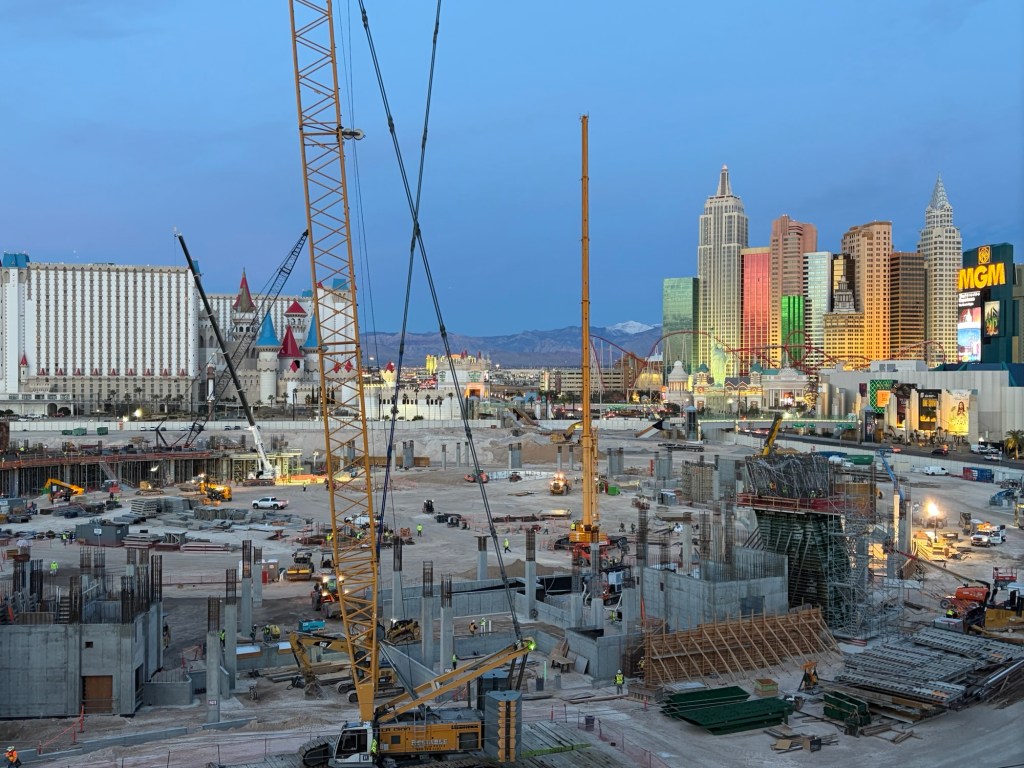
This morning I woke up before dawn to the cacophony of rumbling diesel engines and banging. When I looked outside a wave of relief – no, catharsis – washed over me because I saw this:
View of the Athletics Ballpark construction site from the Oyo Hotel ninth floor
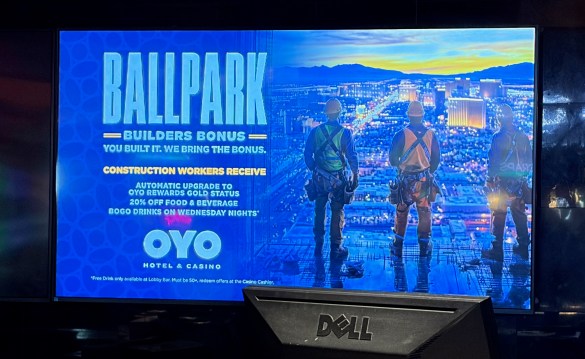
Greetings from the Oyo Hotel and Casino, just east of the A’s ballpark site on the Strip (formerly the Tropicana). I’m in Vegas for a family trip. Some flexibility allowed me to spend Monday night and Tuesday morning at Oyo, previously the Howard Johnson/San Remo/Hooters. If you’re not aware, Oyo is a multi-national hotel brand based in India. When I checked one of the signage displays behind the front desk briefly showed a promo for ballpark construction workers.
Anyway, my plans were to head out to the Athletics Ballpark Experience Center at uncommons in the southwest part of Las Vegas Valley. Unfortunately those plans were foiled by more important matters.
Sodey secured 🔒
We have agreed to terms with left fielder Tyler Soderstrom on a seven-year contract through the 2032 season with a club option for 2033. pic.twitter.com/Ykw9DQz8yJ
According to MLB.com’s Martin Gallegos, the press conference for the Soderstrom signing will be held at the Ballpark Experience Center, so they literally have bigger fish to fry. At least we’ll get to see video of Sodey in the virtual ballpark. I’ll be back later, when it’s fully open to the public. For now, I’ll settle for progress in the form of working construction crews on December 30, 2025. I spent twenty years on this website waiting seemingly in vain, plus ten more since the Raiders moved back to Oakland and destroyed the Coliseum. I can say with great certainty that I’ve been waiting my entire adult life for this moment as the A’s haven’t had a proper home since they left Shibe Park. I only wish the moment was in Oakland, San Jose, or Fremont instead. Alas.
I’ll spend the rest of the morning here before I meet with the fam at Treasure Island. I observed how fleeting this moment is.
As I write it occurred to me that 1) this view will be mostly obscured in a year by the enormity of the ballpark, and 2) Oyo itself probably won’t be standing in 20 years. #todaysperch#Athleticspic.twitter.com/EXT4jT1qrJ
My intent was for this post to be a year-in-review as you typically see after Christmas. Instead I’m going to have breakfast and coffee, enjoy this view and the noise for a few hours, then take the monorail to see my niece and nephew. I’ll do the wrap-up post later. I’ll have plenty of comments about the state of pro sports venue financing, the NBA in Vegas, and the future of pro sports in NorCal. It’ll be a doozy.
— Governor Joe Lombardo (@JosephMLombardo) June 24, 2025
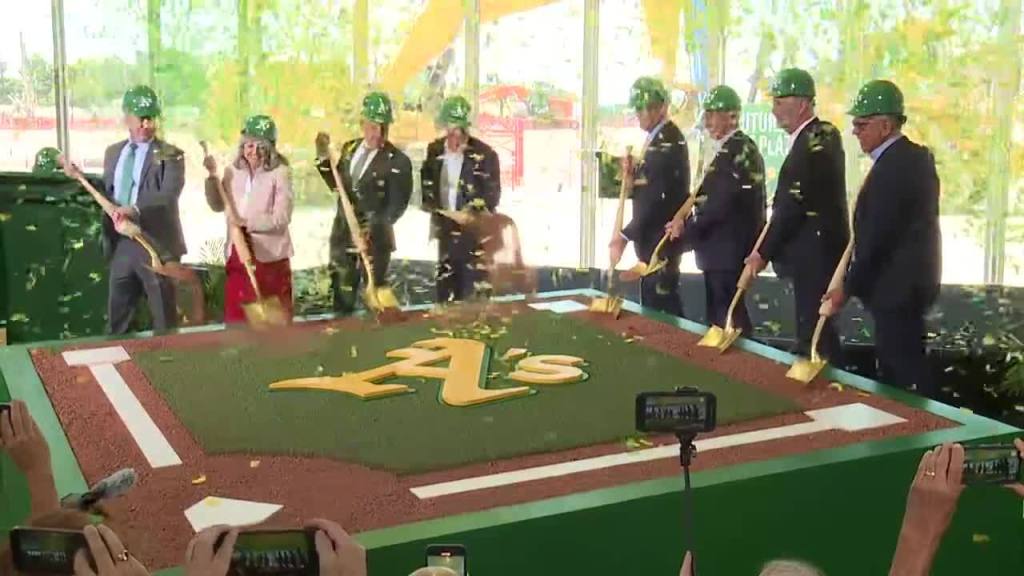
After some intrigue about when it would happen, the A’s chose today, June 23, to have a ceremonial groundbreaking ceremony at their ballpark site on the Vegas Strip. It happened to be a travel day for the team, embarking on a sure-to-be-crushing 10-day road trip to Detroit, New York, and Tampa Bay. A’s management gave the whole event a Vegas flair, with attendees bussed in from the MGM across the street. This makes sense in hindsight, since there’s been a decent amount of excavation on what is now a live construction site. It’s hard to tell how much dirt is removed from overhead views, but from the renderings it looked as if the field was going to be some 20 feet below street level. So while the ceremony was John Fisher and dignitaries shoveling a raised platform with a dirt planter, the A’s staged some yellow iron in front of the windowed event tent for show. Before the actual shoveling, the A’s showed a sizzle reel.
The emcee was Dallas Braden, which upset numerous Oakland partisans who called him a sell out. I mean, Dallas is an A’s employee. I’m sure he still feels bad for the East Bay, but eventually we all have to move on. Braden’s address preceded a number of project principals, including Fisher, who noted that Rickey Henderson attended the demolition of the Tropicana Hotel last summer prior to his untimely death. Steve Hill of LVCVA and Governor Joe Lombardo were also on hand and celebrated the ballpark like it was a rare event instead of yet another massive project going up on The Strip.
If the A’s face minimal delays, the ballpark construction schedule should follow this high-level timeline:
Of course, John Fisher knows stadium construction delays going back to PayPal Park. Baseball’s less likely to forgive mishaps or financial hiccups, though it’s unclear if MLB would provide much help or give Fisher a quick exit if worse came to worse. Sure enough, Rob Manfred was on hand to pump up the project and push for the 2028 opening.
It’s well known that Fisher, while a rich billionaire, is not particularly liquid. So it’s not surprising that he may be selling the San Jose Earthquakes, ostensibly to raise money for the Vegas ballpark. The aim is for a $600 million valuation for the soccer club and perhaps real estate interests such as PayPal Park. Would he be willing to sweeten the pot with a minority share of the Vegas A’s? Anything’s possible when you’re trying to bridge a nearly $1 Billion funding gap. I’m not going to get too much into the intricacies of funding the ballpark, simply because it’s very opaque at the moment, and also because Fisher appears to be doing something quite unusual: a pay-as-you-go model. He had $300 million to do the prep work and the initial concrete podium. After that he has Aramark, the State of Nevada, and Clark County chipping in, then whatever he needs to do to raise the rest, which will surely be over the $1.75 Billion mark when all is said and done. Most stadium projects are financed upfront and funded in tranches as different stages are reached. It will be most interesting to see if Fisher can pull this off, especially if he can avoid much higher interest rates and materials costs than what he probably had penciled in 2-3 years ago. Keep in mind that we haven’t talked about naming rights or other commercialization opportunities that will certainly become more important as the project becomes more… concrete.
For what it’s worth, Globe Life Field took 30 months to complete, with the official opening delayed by the pandemic. Nationals Park took only 26 months, though it is open-air park. LoanDepot Park took 32 months, Truist Park took 30. The A’s have 33 months from now to Opening Day 2028. I may occasionally check it out if I’m in town, though there’s plenty of regular YouTube videos and drone footage to satiate most interested fans.
Should Fisher see this all the way through, there are rules in place to ensure that whenever he sells the A’s, he’ll never have to worry about liquidity again.
There used to be a Bay Bridge Series featuring the two Bay Area MLB franchises, the Giants and A’s. It served as a ceremonial bridge between Spring Training and the long regular season. That’s gone, probably for good. It was replaced this year by some warmup games in Sacramento featuring the Giants and their AAA affiliate, the Sacramento River Cats. The A’s played out their Cactus League string in Arizona before starting the regular season on the road in Seattle.
Meanwhile in Oakland, the Coliseum hosted the Roots’ home opener against fellow USL Championship side San Antonio. The match brought in 26,000 fans who filled both the field and plaza levels. Next week’s game will have a much smaller crowd based on what sections are being sold. At least the sports-starved in the East Bay got a taste. And while there’s no longer a Bay Bridge Series, the San Jose Giants will host the Oakland Ballers in “Battle of the Bay 2.0” at Excite/SJ Muni on April 2nd. So there’s that.
Going back to Sacramento, the main question going into this season concerns the ability of Sutter Health Park’s grass field to withstand the nearly daily pounding of baseballs and baseball cleats.
The previous field was ripped out after the final River Cats game last season, replaced by a very high-tech solution called AirPAT from The Motz Group. AirPAT uses a combination of irrigation and aeration to the grass surface and roots to make for ideal outdoor maintenance conditions. The high-tech part comes from the use of various sensors and drones to monitor surface temperatures, hydration, and drainage. Coincidentally, a spring storm is blowing through California right now just to give the new field its first real test. The forecast calls for the rain to end shortly before first pitch, so we’ll get to see both the field and the grounds crew tested. Motz has a blog post explaining how their system works, though it’s curious that much of the expertise involves artificial turf fields – experience that maps better to Vegas or the original plan to replace grass at Sutter Health Park with a turf system. Motz isn’t bereft of grass experience, as they constructed the field at the Braves’ Truist Park.
Also I know many were curious about the field itself. “The installation of AirPAT technology will optimize root zone oxygenation, improve moisture management, and regulate subsurface temperatures – ensuring a healthier, more resilient playing surface year-round.” pic.twitter.com/3iJldu80J1
In any case, the first half of the 2025 is somewhat frontloaded with A’s games, 51 out of the scheduled 81. They won’t come back to West Sac until July 28, a full two weeks between home games. The River Cats will have nine games during that span, so they’ll get to break in a potentially resodded field just like they broke in the new field last weekend. If there are rainouts, they’re more likely to occur during this first opening series with Cubs than at any other time. That makes August and the first two weeks of September the crucial period for the grass to survive. The second half schedule has nine mutual off days to schedule makeup games if needed, though that may be more necessary for games on the East Coast. Should AirPAT work as advertised, the grass along the river will stay lush and green while much of the surrounding area turns brown.
I suppose I can ask now: Was the A’s tanking in the second half of 2021 and all of 2022 worth it if a Howard Terminal deal happened? Seemed like a lot of fans were hoping for exactly that to occur.
What’s that? There is no deal? Well, that complicates matters a bit. City staffers and the mayor finally conceded in the last few weeks that no deal is coming this year, barring a miracle.Any deal would have to be consummated in 2023 at the earliest, with no assurances that would happen given the changing political and economic landscape, along with the deal’s increasing complexity and cost.
I wrote in July that Oakland pols were mostly motivated by the fear of being blamed for the last major pro sports team leaving, and to that end they mostly succeeded. The unenviable responsibility will fall to the next Mayor and City Council, to be decided in two weeks. While some of the media try to position this as a sort of baton-passing exercise, anyone paying attention knows that a different mayor, with a different city council, is bound to have priorities that stray away from a $12 Billion mega-development project. Though perhaps it’s not that far off. Vice Mayor/CM Rebecca Kaplan posted a slide from a poll taken by the Mayor’s office on Oakland’s priorities. Look at where Howard Terminal lands in there.
A poll was taken (by Mayor), and what people most supported is Ceasefire to stop gun violence. This program was pushed by community with Mayor Jean Quan, and was cut by Mayor Schaaf. Schaaf claimed she cut Ceasefire because she couldn't find $, then I found $, and restored it. pic.twitter.com/OOFK259OaJ
— Rebecca Kaplan, Oakland Vice Mayor (@Kaplan4Oakland) October 19, 2022
Among Oakland initiatives, Howard Terminal comes EIGHTH in urgency
Whatever happens, Oakland’s looking at some serious regime change when 2023 rolls around (mayor, 2-3 council members), and no one should expect business as usual on the Howard Terminal front. Then again, Kaplan’s slide shows that HT doesn’t have the juice that outgoing Mayor Libby Schaaf liked to project. Perhaps following the script of pushing for incremental movement while hoping for a big breakthrough is staying the course, because what choice does Oakland have at this stage? What might change is the messaging. The Oakland populace has felt largely ignored by the mayor in her second term. A return to a more realistic approach may be in order, which may mean putting Howard Terminal on the back burner. At this point, who can really say? The building trades unions are certainly pumping enough money into this election to expect some sort of ROI. But the unexpected can and sometimes does happen in Oakland’s ranked choice elections. Maybe Ignacio De La Fuente will somehow sneak in.
The City of Oakland continues to make its procedural push, a double-edged sword which thankfully is not paid for by taxpayers but is being bankrolled by the A’s, creating its own apparent conflict of interest. Again, what choice does Oakland have? This is the game. Oakland chose to play it.
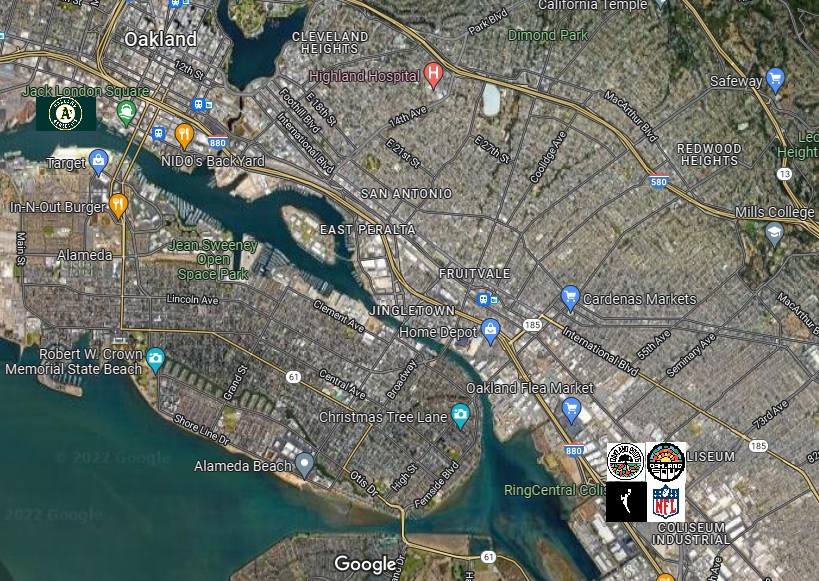
Now if you want a fully delusional view, I give you @As_Fan_Radio’s tweet from the summer, in which whichever account runner was working promoted FIVE teams in Oakland: the A’s, the return of the NFL to the Coliseum property, a WNBA team, plus the Roots and the Oakland Soul, a women’s pro soccer franchise owned by Roots ownership. Think about that for a moment. A city which 50 years ago made its name by being an easy-to-work-with landing spot for sports franchises spent the last decade running them out of town, yet still dreams it can easily retain or attract new ones. Sadly, they’re blind to two things: it’s harder to get things built now, and Oakland has been surpassed by many competing markets. Oakland is no longer a soft landing spot.
Looks a lot more like daydreaming than foresightRenaissance? Perhaps trying to maintain relevance is a more achievable goal
Obviously, the NFL is in no hurry to come back to Oakland since the City’s Hail Mary lawsuit against the league was recently dismissed by the US Supreme Court. Oakland, like St. Louis, argued for monetary damages because of the way it lost its NFL team for the second time. Unlike St. Louis’s successful lawsuit, the Court didn’t buy that the NFL hurt Oakland on antitrust grounds. STL actually produced a funded stadium option for the Rams, which Stan Kroenke and the NFL ignored as their sights were focused on re-entry to the LA market. Oakland, which had an EIR in place for Coliseum City (sound familiar?), didn’t have a funding plan in place. STL took the Rams/NFL to court first in 2015, Oakland later in 2018. Despite regular defeats on the bench, ambulance chasing law firms kept taking Oakland’s case on contingency.
On the other hand, WNBA could happen in Oakland since there’s already an excellent modern – though expensive to operate – venue in the Coliseum Arena. The issue there, as is the case for most WNBA franchises, is a matter of who’s going to pick up the operating costs. I argued previously that it was curious that Joe Lacob, who gained credibility in the pro sports world via his foray in the ABL, so far has only teased his involvement with a WNBA franchise. If the argument against has to do with defraying operating costs, I have to point out that the Warriors’ luxury tax bill will run into the nine figures for the next several seasons thanks to upcoming contract extensions. If anyone can afford the freight of running a WNBA team and its piddly $1 million annual payroll, it’s Joe Lacob and his partners, though chances are he’d prefer to play most of the games in the arena he runs across the Bay.
As for the Roots/Soul, they’re using the same playbook the A’s briefly (and successfully until it became unsustainable) used when the Raiders left. Despite the Roots’ recent success in North American second-tier league USL Championship, there’s still a way to go to establishing a permanent home away from Laney College, where the football stadium is being rented. The franchise is in talks to build a stadium on the Malibu lot next to the Coliseum, which is City-owned and not subject to City/County/JPA co-ownership stakes. If the HomeBase lot is included, the total land is about 20 acres -more than enough for the stadium and some ancillary development. The requirements for USL Championship (10,000-person stadium capacity) is roughly half that of MLS (20,000). One thing you have to keep in mind for these fledgling franchises is that their plans have to manage growth. They can’t simply build a 5k or 10k stadium and call it a day unless they don’t plan to bring in more fans than that on a regular basis. If their plan is to eventually build something attractive for promotion to MLS, that’s a completely different set of requirements or challenges.
Look, if you’ve been reading this far and reading my posts for some time, you know I’m not a person to provide easy answers or empty rah-rah homerism. I care about the deal and how it gets done, who wins and who loses. I didn’t care much about how the EIR and related approvals came through because I knew those proceedings had limited impact and had tons of strings attached. If the A’s announce they’re leaving for Las Vegas tomorrow, it’s not like whatever tentative approvals are in place at HT can be transferred to a hypothetical new MLB team, a soccer team, or god forbid, a NBA or NFL team. What people fail to understand about Oakland’s plight is that none of these leagues are going to wait too long for Oakland to get its shit together, only as long as a team is bound to a lease. The leagues allowed two Oakland teams to find better options outside of city limits, the same way they allowed the A’s to do “Parallel Paths.” If you believe MLB or anyone will exercise a great deal of patience for Oakland to come up with a perfect deal (Opening Day 2027, hello?), history shows that strategy doesn’t pay off for The Town. Which is somewhat ironic, because as Oakland loses team after team and fades from relevance on the national stage (I didn’t forget that Mills College merged with Northeastern University), “The Town” may be a more apt nickname than anything an overpaid consulting firm could come up with.
There’s always next year. Until then…
—
P.S. – In the summer of 2021 there was an arbitrary deadline to get a deal done between the A’s and the City. They made fundamentally different proposals and agreed to work on them, punting the deadline TBD. Early this year, the EIR and BCDC decisions were also pitched as critical. November’s election, and the end of the year, are similarly sold. Now that these dates have elapsed, what are the consequences for miscalculating the impact? Do the HT proponents tire of buying these arbitrary deadlines whole? Healthy skepticism never hurt anyone, especially when so much money is on the line.
Sometime before Thanksgiving, I reached out to Peterson Vollman, the City of Oakland’s planner overseeing the Howard Terminal ballpark project. I asked if there were any updates on the project. Vollman’s response:
We are anticipating publishing the DEIR in Q1 of 2021 pending AB734 Certification by the Governor.
Just so we’re clear, that’s thefirst quarter of 2021 for the Draft version of the document, pending the certification through AB734.
Anyway, those of you still on the HT bandwagon have the patience of saints.
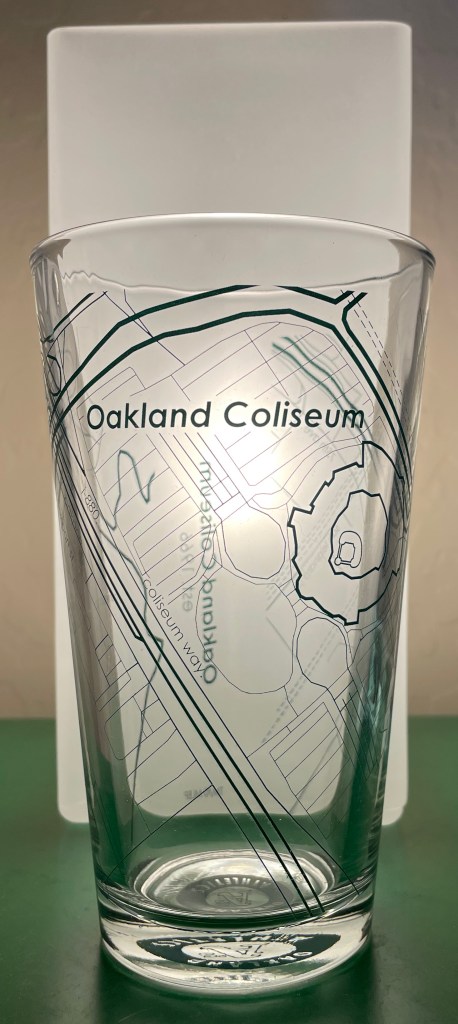
Thankgiving also happened to be my birthday. Somehow I managed to get presents, including this:
Pint glass from @welltolddesign
I would like to carry this pint glass everywhere I go, thank you very much.



 newballpark.org