— Governor Joe Lombardo (@JosephMLombardo) June 24, 2025
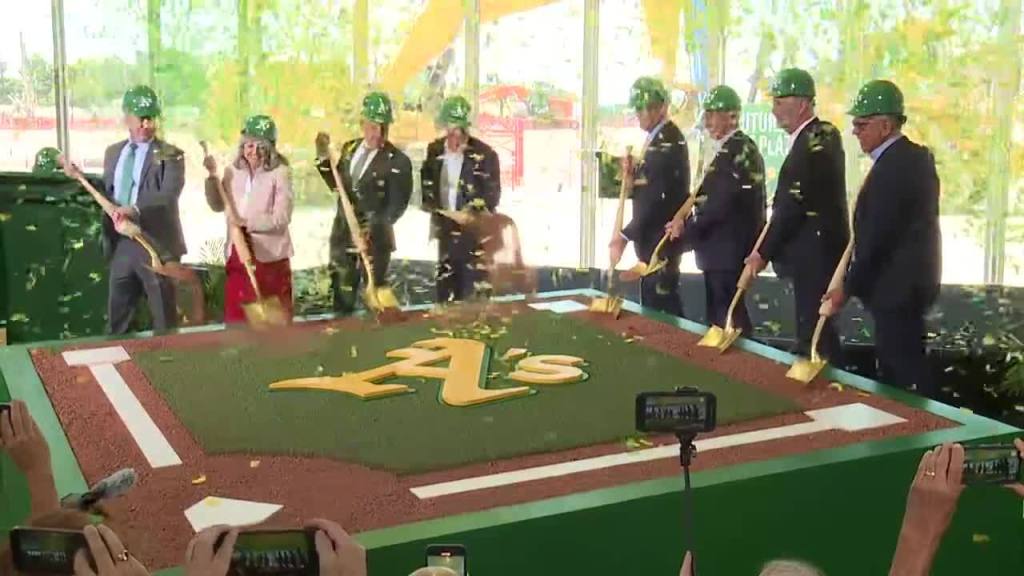
After some intrigue about when it would happen, the A’s chose today, June 23, to have a ceremonial groundbreaking ceremony at their ballpark site on the Vegas Strip. It happened to be a travel day for the team, embarking on a sure-to-be-crushing 10-day road trip to Detroit, New York, and Tampa Bay. A’s management gave the whole event a Vegas flair, with attendees bussed in from the MGM across the street. This makes sense in hindsight, since there’s been a decent amount of excavation on what is now a live construction site. It’s hard to tell how much dirt is removed from overhead views, but from the renderings it looked as if the field was going to be some 20 feet below street level. So while the ceremony was John Fisher and dignitaries shoveling a raised platform with a dirt planter, the A’s staged some yellow iron in front of the windowed event tent for show. Before the actual shoveling, the A’s showed a sizzle reel.
The emcee was Dallas Braden, which upset numerous Oakland partisans who called him a sell out. I mean, Dallas is an A’s employee. I’m sure he still feels bad for the East Bay, but eventually we all have to move on. Braden’s address preceded a number of project principals, including Fisher, who noted that Rickey Henderson attended the demolition of the Tropicana Hotel last summer prior to his untimely death. Steve Hill of LVCVA and Governor Joe Lombardo were also on hand and celebrated the ballpark like it was a rare event instead of yet another massive project going up on The Strip.
If the A’s face minimal delays, the ballpark construction schedule should follow this high-level timeline:
Of course, John Fisher knows stadium construction delays going back to PayPal Park. Baseball’s less likely to forgive mishaps or financial hiccups, though it’s unclear if MLB would provide much help or give Fisher a quick exit if worse came to worse. Sure enough, Rob Manfred was on hand to pump up the project and push for the 2028 opening.
It’s well known that Fisher, while a rich billionaire, is not particularly liquid. So it’s not surprising that he may be selling the San Jose Earthquakes, ostensibly to raise money for the Vegas ballpark. The aim is for a $600 million valuation for the soccer club and perhaps real estate interests such as PayPal Park. Would he be willing to sweeten the pot with a minority share of the Vegas A’s? Anything’s possible when you’re trying to bridge a nearly $1 Billion funding gap. I’m not going to get too much into the intricacies of funding the ballpark, simply because it’s very opaque at the moment, and also because Fisher appears to be doing something quite unusual: a pay-as-you-go model. He had $300 million to do the prep work and the initial concrete podium. After that he has Aramark, the State of Nevada, and Clark County chipping in, then whatever he needs to do to raise the rest, which will surely be over the $1.75 Billion mark when all is said and done. Most stadium projects are financed upfront and funded in tranches as different stages are reached. It will be most interesting to see if Fisher can pull this off, especially if he can avoid much higher interest rates and materials costs than what he probably had penciled in 2-3 years ago. Keep in mind that we haven’t talked about naming rights or other commercialization opportunities that will certainly become more important as the project becomes more… concrete.
For what it’s worth, Globe Life Field took 30 months to complete, with the official opening delayed by the pandemic. Nationals Park took only 26 months, though it is open-air park. LoanDepot Park took 32 months, Truist Park took 30. The A’s have 33 months from now to Opening Day 2028. I may occasionally check it out if I’m in town, though there’s plenty of regular YouTube videos and drone footage to satiate most interested fans.
Should Fisher see this all the way through, there are rules in place to ensure that whenever he sells the A’s, he’ll never have to worry about liquidity again.
Bad public news usually comes out after on Friday afternoon after the markets are closed. Bucking that tradition, this weekend Bay Area media got wind of an upcoming City of Oakland lease extension proposal to the A’s, which will be presented this Tuesday. The City is asking for the following:
$97 million from a 3-5 year lease term from the A’s ($19.4 million/year minimum)
A’s pay for field conversion costs for the Roots and Soul when they play in the Coliseum
Oakland is also asking for the rights to the Athletics franchise name and team colors, as well as a one-year exclusive agreement for Oakland to secure a potential owner for an expansion franchise or the purchase of the A’s.
Let’s take those last items first. With no sign that John Fisher plans to reverse course on the Las Vegas move or sell, any pitch for an A’s sale can only be characterized as the kind of Hail Mary not even Al Davis would have loved. The expansion promise is pointless, as no one actually believes Oakland will be able to put together real deal terms in only a year, including a billionaire willing to subsidize an Oakland team indefinitely while all of the details for the elusive dream ballpark plan come together. Besides that, who would be crazy enough to ink an exclusive negotiating agreement with Oakland, whose track record on such agreements is downright dreadful. ENAs can be a tool as long as they lead to real, measurable progress. Those ENAs are basically paper tigers, little more than talking points that act as a way to kick the can down the road. The City apparently has backed off these requests as an acknowledgment that they don’t have a strong hand in asking for any kind of team with Oakland in as bad of financial shape as it is, and that MLB pumped the brakes on expansion recently as bigger economic issues are resolved.
Asking for $97 million (or $19.4 million/year, non-negotiable) amounts to a 12x annual increase over the current lease. Not only that, the A’s already pay for field maintenance at the Coliseum, so having to foot the bill for the conversions will ultimately be more costly than regular field maintenance, which itself is costly. Conversions currently are a responsibility that the Coliseum Authority previously took on without question for Raiders games and concerts, and were so costly the JPA scheduled them to occur as infrequently as possible, twice during the football season and after a Monster Jam or SuperCross event after the football season ends.
If the A's and the Roots/Soul share the Coliseum in 2025, the soccer field will probably be set up much like the occasional Quakes game there. Via @wikipedia: pic.twitter.com/CUwd5rChgp
By now you’re probably aware that the only reason for the A’s to keep pursuing the Coliseum in any capacity is that their TV deal with NBC Sports California only pays around $70 million per year if the team stays in the Bay Area. When they go the Vegas it’s gone. If they play in Utah the deal breaks. Sacramento is a gray area currently under discussion, because the A’s wouldn’t be entitled to a full payment, maybe half or $35 million.
For their part, Sacramento is ready and willing to be a temporary A’s home for 3+ years while the Strip ballpark is under construction. Mayor Darrell Steinberg threw in his support, and River Cats/Kings/Sutter Health Park owner Vivek Ranadive is eager to lend a helping hand to his friend, John Fisher. Many in NorCal view this as a betrayal of Oakland and a hypocritical move to grease the skids for the A’s out of Oakland permanently. Ranadive, who is from the Bay Area and once held a minority share of the Warriors, now has control over Sacramento’s sports and event space outside of soccer and summer concerts in Wheatland. The combined public-private pitch is not just to the A’s, but also to impress MLB for a future expansion bid. And that, regardless of how this particular short-term agreement works out, is the real play. Because once Vegas has a team, expansion opportunities out west will be limited.
Salt Lake City remains in play thanks to its flexibility (two ballparks) and distance from the NorCal mess. From a ease-of-transition standpoint it’s by far the winner since no existing teams have to be displaced, and the A’s or whomever is helping them won’t have to face angry fans at every turn. The major caveat is that the A’s will have to forgo their NBCSCA TV rights check in exchange for a much smaller streaming and local TV revenue pool from a cobbled-together network of local affiliates. The A’s would presumably upgrade the new South Jordan ballpark to MLB clubhouse and training standards, which they could hand off to the AAA team in a few years. I’ve read that SLC’s biggest problem is a logistical one in that Sundays are effectively off limits since games aren’t played on the Sabbath. Frankly, the Salt Lake Bees have been playing on Sundays for years so I have no idea where that misinformation comes from.
Neither the Sacramento or Salt Lake City hosting gigs will put either city over the top in an expansion franchise bidding war. It would give them a leg up over other candidates in terms of showcasing each respective market’s viability to leagues and to the corporate and ticket-buying clientele they’re trying to impress. Given the scarcity of opportunities like this, it would be foolish not to bid for the A’s if the capital outlay to bring them in isn’t too high. Beyond that, you have to start thinking about the future of MLB: post-RSN, post-Rob Manfred, post-boom. If MLB is going to expand to 32 teams as they should, they will probably do so with an idea towards completing the consolidation they’ve been doing over the past few decades. Think about it. The American and National Leagues used to have their own league presidents, interleague play, umpiring crews, ways of counting attendance, and yes, the designated hitter in the AL. Over time all of those issues which gave the leagues district identities were streamlined away in favor of a more homogeneous baseball product. That leaves a handful of arcane issues to deal with, such as the curfew rules and realignment, which makes sense in a 32-team league which can be arranged in 4 divisions of 8 teams or 8 divisions of 4.
Realignment is where things truly get interesting, at least to me. Most fans don’t want to hear about something as mundane as multibillion-dollar franchises saving a few bucks by realigning to cut travel costs, but it’s a huge motivator. Consider how Fresno once had a AAA franchise, then lost it not because of its fairly new ballpark. Fresno lost AAA because it was too expensive to fly teams in and out of the Fresno-Yosemite airport, relegating the city to a California League (A) franchise where travel is mostly limited to buses within the state. The same fate is headed for MLB teams, which want nothing more than to limit the number of cross-country flights and total seasonal air miles, expenses which are all incurred by the parent MLB clubs regardless of movement elsewhere in their respective organizations. This also explains the culling of minor league teams and wholesale reorganization of the minors during the pandemic. In the long run it may further marginalize baseball in the eyes of the public. For the owners these are merely costs to cut.
2030 MLB realignment along purely geographical lines
With that in mind, take a look at this table of a future realigned MLB with 32 teams. The American and National Leagues are reconstructed along geographical lines like their counterparts in the NBA and NHL. Going from 30 to 32 teams requires the addition of two franchises. Conventional wisdom had Nashville and Las Vegas as the leading expansion bidders, but with Las Vegas getting the A’s, one spot remains out west to go along with Nashville. Or does it? Nate Silver took a stab at this over the weekend, coming up with some odd regional switches thanks to the strict geographical groupings he put together while maintaining the current AL/NL regime.
I took these a step further by ditching the current AL/NL distribution of teams and realigned as an Eastern-based National League and a Western-based American League. While exploring this, I ran into the problem of figuring out how to put 16 teams in the AL (West). It works best if the West includes the Chicago teams, Milwaukee, and St. Louis to keep the Cubs-Cards and Cubs-Brewers rivalries intact. That leaves 14 teams in the much more compact NL (East) plus two expansion teams in Nashville and either Charlotte, Raleigh-Durham, or Montreal. Those teams couldn’t occur before 2030, or at least not before the A’s and Rays stadium situations are determined. One of Rob Manfred’s remaining charges before he retires is to set the table for this long-awaited expansion round. MLB will have to think long and hard before diving into 32 teams, because there is no easy expansion or contraction once they reach that point. As the NFL found out, 32 is logistically the perfect number of teams to maintain rivalries, invigorate interest in wild card playoff runs via expanded playoff pools, and mitigate travel costs (except for Seattle, they’re always going to be screwed).
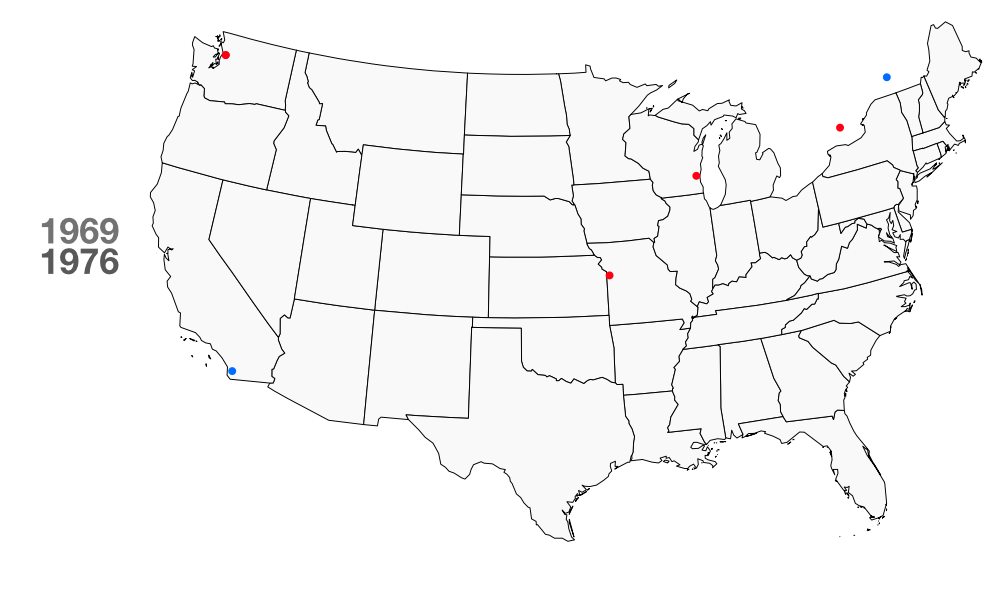
It’s possible that that the 32nd team could be a massive contest between the aforementioned Eastern cities and Western cities like Sacramento, Salt Lake City, Portland, and even Oakland. For now I’m going to posit that with the A’s bound for Vegas, MLB is done expanding in the West. If that sounds extreme, consider how expansion as progressed since 1967, when the A’s played their last season in Kansas City and MLB only had 20 teams. Then look at how it progressed to 1968 with the A’s move, 1969 and 1976 with arrival of six expansion teams (Seattle twice), and the current 30-team distribution. Viewed through that lens, there aren’t many holes left to address in the map once you get to 32 teams as I suggest in 2030. I told you folks last year that MLB viewed the A’s move a lateral one. So for any city to merit the 32nd team, they’re going to have to earn it. No shortcuts or giveaways. If you want in the Lodge, come strong or don’t come at all. Bring well-funded ownership bids and a publicly-funded stadium deal. That’s all.




 newballpark.org