A month ago I wrote about a solution to the Seattle-Sacramento fight over the Kings. It would’ve involved either keeping the team in town or moving them north, with the loser getting an expansion team. Key to the solution would be to use a portion of the expansion fee (~$500 million) to pay off the Silna brothers, who get a 3/5ths of a team share of the NBA’s national TV money even though they’ve never owned a NBA franchise.
While in Houston for All Star Weekend festivities, David Stern quashed any idea of an expansion-based solution that would provide teams in both cities. That’s not to say that expansion couldn’t be explored in the future. But for Stern, who is retiring just short of a year from now, it won’t happen on his watch.
For now, Stern has his sights set on two dates: March 15 as the deadline for Sacramento interests to submit a bid/plan for the Kings and a downtown arena, and April 18 for the Board of Governors meeting to hear everything out. Sacramento Mayor Kevin Johnson is in Houston to try to lobby other owners who are also taking in the festivities. As a former All Star player, KJ has a level of respect within the NBA that no other mayor can match. Whether that will mean anything in the end uncertain. KJ is not meeting with Stern during the weekend.
Stern has set the stage for the other owners to make a very tough decision. On one hand, many of them may want to correct the wrong that was allowing the Sonics to leave, and would love to have big money ownership like Steve Ballmer among their ranks. Yet they may not want to move the Kings from a market that has supported the team well despite the arena’s flaws and poor and mismanaged teams over the past several years.
The A’s and the City of Mesa are one small step closer to finalizing a deal to occupy Hohokam Stadium and Fitch Park. A month ago we did an overview of the renovation plans, which would entail a reduction in the number of seats and the addition of premium amenities such as bars.
To help cover Mesa’s $15 million commitment, the City is asking for $8 million from the Arizona Sports and Tourism Authority, the quasi-governmental corporation that runs University of Phoenix Stadium and provides funds for the renovation and maintenance of numerous Cactus League facilities. Back in January, some sort of request was expected, though the amount was not disclosed. $8 million would cover about half of Mesa’s initial commitment, with Mesa’s Enterprise Fund to cover the rest. Mesa received a preliminary approval for the request. That should clear the way for an official announcement towards the end of spring training.
Phoenix hasn’t allowed old Municipal Stadium to be abandoned. Last week, the Arizona Board of Regents approved a 25-year lease for Arizona State University’s baseball team to play at Muni, which is twice the size of on-campus Packard Stadium and has a proper press box for TV broadcasting purposes. One team’s trash is another one’s treasure, a them we as A’s fans are all to familiar with. If you love Muni, it’s sad that the A’s will only have two more seasons there. It’s good to know that Muni will have games from ASU and perhaps continued work with the Arizona Fall League.
File this one in the out-of-the-box department. A new pro football league calling itself the USFL wants to launch in 2014. Like the original USFL, the new league plans to play its games in the spring. Unlike the 80’s version of the USFL, the new league has set it sights a bit lower and broader. The new USFL expects to launch with eight teams in markets such as Southern California and Alabama.
The kicker to the league’s business plan is that the USFL has inked a deal with an unnamed national developer to build “villages” containing a 20,000-seat stadium for each franchise and ancillary commercial development to go with it. If successful, the business model would turn minor league sports inside-out. Building a stadium has been hard enough in the past, let alone building stuff to go beside it. While it’s doubtful that the additional development can be built and filled quickly enough to help defray the stadium cost in every case, there’s a chance that there could be one or two shining examples. In the South or Texas, where regulations are lax and zoning in some cases doesn’t exist, this can be fairly simple. In California, where CEQA looms large over everything, it might not be such an easy task.
Going with a 20,000-seat stadium plan for each franchise and a single-entity operations model makes the new USFL similar to the launch of MLS in 1996. MLS took numerous years of billionaire owners like Phil Anschutz pumping in money to keep the league afloat, though that was with soccer, not football. Even with the more familiar sport, Americans generally haven’t taken well to lesser-talent football, finding that the NFL and NCAA FBS serves most of America extremely well. Only the Arena Football League has survived long enough to fill that minor league niche, though it experienced its own financial problems during the recession.
The potentially problematic thing about the 20,000-seat plan is that MLS has already filled numerous markets with that size of stadium, driving up competition for decreasing numbers of 20,000-strong outdoor events. In the USFL’s press release it has indicated interest in Ohio. Columbus could be a spot but it has a stadium for the Columbus Crew MLS team. Cleveland, Cincinnati/Northern Kentucky, or Dayton may be better choices. Dallas and Houston also have those stadia, while San Antonio doesn’t. Alabama, Oklahoma, and Virginia seem to be ripe for this kind of thing, though the Virginia Beach UFL team hasn’t exactly made people sit up and notice.
If the UFL folds, the USFL would be poised to pick up the pieces and establish relationships. At the very least there will be some number of temporary stadia at which to play, though minor league football isn’t exactly the sexiest proposition. They’ll also be poised to become a feeder league for the NFL, a concept that generally failed to date (UFL, NFL Europe). The AFL has had a shaky record performing in this mode, and it plans to launch its own league in China in late 2014.
No element of the USFL’s plan is more mysterious than the partnership with the unnamed developer. It’ll be fascinating to see how aggressive each market’s deployment is, and whether each team is able to succeed quickly with its development goals. If it works, we may see many medium and smaller markets use this as an example on how to build the next generation of venues. If not, USFL2 will be relegated to the dustbin of history.
When the 49ers rolled out the final cost estimate on their Santa Clara stadium, many including yours truly were incredulous. We thought that the 49ers would need help to pay it off, probably from a partnership with the Raiders. With a $80 million per year mortgage to pay off, the challenge to bring in enough events to properly service the debt should bring the 49ers and Raiders together. Yet there’s plenty of reason to think that the two sides may have a difficult time making that pact.
It all started when the 49ers negotiated with the City of Santa Clara to control full rights to seek a second tenant. The 49ers can control the terms of the lease, covering rent payments and details, revenue sharing at the stadium, and coverage of costs to hold games at the stadium. The lease can go in any number of directions, making it difficult to determine what the lease might look like. If the Raiders had gotten in on the ground floor and committed to Santa Clara early, they might have been able to shape the discussion. However, they also might have been asked to shoulder half of that $80 million mortgage. Given the difficulty the team has in selling tickets and PSLs, that’s a huge gamble.
Instead, if the Raiders ask to be a tenant in Santa Clara, they could pay a flat rate per game or per season. Right now they only pay $1.5 million in rent at the Coliseum, but that masks the millions of dollars it costs to operate the stadium. The 49ers’ stadium lease has language that requires an additional $1 million annual payment if the Raiders move in. There are costs for utilities, insurance, hundreds of personnel for concessions, parking, and security, plus emergency services. It’s common for total operating expenses for a full season of NFL games to run in the $10 million range or more. So those costs could be factored into the rent payment, or they could be left for the Raiders to pay separately on top of a rent payment. Knowing that, $11 million should be the baseline for an all-inclusive lease for the Raiders.
Of course, we know that the 49ers aren’t going to allow the Raiders to merely cover operating costs. They need to pull their own weight. The Raiders may have to pay $20 million per year to play in Santa Clara, or alternately, $1 million per game while surrendering concessions revenue. If that were to happen, the Raiders could find themselves somewhat stifled in terms of maximizing revenue generation. Still, that could prove a better proposition than a brand new stadium in which the Raiders would have to cover all of the costs themselves.
Then there’s the issue of stadium capacity. With 68,500 seats, the Santa Clara stadium will sit in the middle of the pack among NFL stadia, and 1,500 seats less than Candlestick Park. The Raiders have been operating at the 63,000-seat Coliseum since they came back in 1995. Last week they decided to tarp 10,000 seats to create their own artificial scarcity. If the Raiders come to Santa Clara, they could artificially reduce capacity by adding their own tarps or move forward with 68,500. If they do the latter, it’ll be a tough sell given the team’s history of underwhelming ticket sales. It’s not a make-or-break scenario, but it wouldn’t look good if the Raiders had to immediately tarp sections of a new stadium once they moved in.
The Raiders are looking to hire a new executive, perhaps to assist Amy Trask and Mark Davis on what will surely be difficult review of the team’s future stadium options.
Update 2/24: I’ll put this up one more time, and that’s it. Thanks for your support. Please see below this post for new content.
The response to the donation request has been excellent so far. Thanks to all of you who have donated. I’ve been working hard on editing the blog archive, and I hope to have something for you shortly.
If you haven’t given yet, please consider it. The site won’t go dark without your donation, but every little bit will allow me to get a better hosting situation, cover gas and transit fare to meetings, and other expenses. Click on the Donate button to the left to get involved. You’ll get an e-book containing the best posts from this blog, and my humble gratitude.
We’ve talked a lot in the past year about how the Maloof family is broke and can’t do anything on their own, whether it’s funding their piece of a downtown arena or sell anymore pieces of the Kings without losing control of the franchise. Travel west along I-80, and you can see that Oakland and the Raiders are in the same situation. Oakland has had to rob Peter to pay Paul for the Raiders study, and the prospects for the Coliseum are bleak without some extremely creative (and probably public) financing. Al Davis had his estate structured so that his son Mark could keep control of the Raiders, but the Raiders can’t sell additional shares of the club without giving up control. Overextended as they all are, they’re still under the gun to come up with a future stadium solution that works for both parties, while not adding significantly to either party’s debt load.
That puts the Oakland/Alameda County and the Raiders in very tense dance over how much each side will pay to create an anchor for Coliseum City. Make no mistake, both sides will have to pay something, starting at $100 million depending on how extensive the project will be. If there’s a new stadium, especially one with a retractable roof, up to $200 million could be provided by the NFL. If it’s a redone Coliseum, the NFL will offer significantly less. It’s all based on the scale of the project.
$143.75 million from City of Charlotte/Mecklenburg County via a 1% food and beverage tax hike (47%)
$62.5 million from North Carolina (20%, pending state approval)
The actual improvements will cost $250 million, the rest will cover the establishment of a maintenance fund, costs associated with staging City/County events, and other gameday expenses such as traffic control. The stadium, which was privately built by Panthers owner Jerry Richardson, will not get any major structural changes such as the addition or elimination of seating decks. Accessibility will be improved by the addition of escalators. Video boards will be replaced. Obviously those items won’t cost $250 million by themselves, so there will be other buildouts elsewhere in the stadium. Perhaps they’ll expand concourses, build field suites, or create additional premium spaces inside the stadium. BofA Stadium still ranks as excellent in terms of design, sightlines, and amenities, so the new improvements may be what Richardson wants to make the venue a viable future Super Bowl candidate. The Panthers would be guaranteed to stay and additional 15 years if the deal is approved and improvements completed.
Sidebar: It was the enormous success of the Panthers’ initial PSL plan that helped sell the 1995 Coliseum renovation plans to Oakland/Alameda County and Al Davis. The Panthers paid for their entire stadium with PSLs and other private sources, with the City only providing a cheap land lease. Where the East Bay went wrong was in severely overestimating demand.
Earlier this morning, Andy Dolich spoke with the Rise Guys about the Raiders’ tarp news and the prospects of Coliseum City. While he continues to believe that the best place for the A’s and Raiders is the Coliseum, his vision has shifted a bit. In 2010 he talked about a new multipurpose stadium with “technology” that could accommodate both teams. Now he prefers a separate ballpark at the complex and a refurbished Coliseum, which he estimated to cost $300-400 million. My immediate response:
Dolich thinks that Raiders refurb would cost $300-400 million. I think that’s way too low. $500 mil to start + existing Mt Davis debt.
Considering what’s budgeted for the Panthers and the Bills, does anyone think a $300-400 million budget as realistic for what the Raiders and the NFL would want? Frankly, I think that by the time everything got going, $500 million may be undershooting it by quite a bit. Dolich also thinks the Diridon ballpark cost could rise to $600-700 million based on additional costs to get the site ready. I tend to disagree with that, though if this saga keeps dragging on $600 million is an easy reach. Even if the land is free, why would two-thirds of a larger football stadium cost half as much as a nearly half-capacity ballpark?
Also, consider that we explored a Coliseum refurb on this blog back in 2008. It would’ve involved gutting the original bowl and replacing it with a new West stand and a single deck of seats along each end zone.
Colors denote different seating decks or phases of development
The project as described back then would’ve taken two full NFL seasons and about 18 months to complete, with the Raiders playing in a 47,000-seat temporary configuration while construction work progressed, similar to their 1995 season at the Coliseum. Complicating matters is that Lew Wolff wants an out clause in his five-year lease extension request if the Raiders begin this very type of project. That makes sense, since there’s no way the stadium could host baseball during this period.
Let’s say that a refurb could be capped at $500 million. The breakdown of costs by party could look like this:
$200 million from Oakland/Alameda County (Coliseum Authority)
$200 million from Raiders
$100 million from NFL
The Coliseum Authority could get their piece from land leases, new stadium taxes, or other sources. However, they have factor in the remaining $100 million of debt on Mt. Davis since it affects City and County budgets every year ($20 million annual subsidy). The Raiders and the NFL could work together to sell new PSLs, naming rights, etc.
The NFL has two, maybe three $200 million slots in its G-4 program for new stadia, one already claimed by 49ers. Another could be the Vikings or Falcons. In theirs and the Raiders’ cases, the teams have to at least match the NFL spend, which means that they have to come up with $200 million of their own. The 49ers came up with closer to $800 million, though much of that is money borrowed through the quasi-governmental Santa Clara Stadium Authority. Chances are that the Coliseum City stadium project would borrow through the Coliseum Authority.
Oakland pols will want as much private funds going into the project as possible, but the Raiders will be wary of digging themselves too deep a hole. That stands to reason because of poor suite and club seat sales over the years, along with mediocre season ticket rolls. There’s been a lot of talk about Oakland not requiring a vote, none about how much it’s willing to invest besides land and infrastructure improvements. Unfortunately for Oakland, land and infrastructure only gets you in the door these days. How much skin will each side put into the game? The answer won’t be known without a (hopefully public) discussion about what it’ll take to make Coliseum City happen.
The San Jose Earthquakes are set to start building their 18,000-seat, $60 million soccer specific stadium on February 26, according to the Silicon Valley Business Journal’s Lauren Hepler. That comes four months after the venue’s world record groundbreaking ceremony.
Shovels set in the dirt prior to the October groundbreaking ceremony
The timing of the start of construction will give the Quakes roughly one year to complete the stadium. Major League Soccer’s regular season runs from the beginning of March until the end of December. The Quakes will want to do at least one preseason game that attracts as large a crowd as possible and another smaller event that it can use as a dry run. Plus there are those always fun “group flushing” tests and other tasks that need to be completed to properly test the facility’s readiness. A web cam will be placed at the site for fans to monitor construction progress.
Some smaller minor league ballparks have been built in a year or less, so it’s possible that the Quakes stadium can be finished in a year. By doing the bulk of the major work during the dry months, the last three winter months should be fine for buttoning up the building. Devcon, the same company working on the 49ers stadium in Santa Clara (along with Turner Construction), has long been tied to this project. If the progress in Santa Clara is any indicator, the Quakes’ new digs should proceed at a rapid pace. By comparison, Houston’s 22,000-seat BBVA Compass Stadium took 15 months to build, forcing the zombie-Quakes/Dynamo to play on the road for two months.
It’s funny that a stadium that will be about one-quarter the size of the 49ers’ stadium will also take 40% of the time to build. The Quakes stadium will be a far less complex building, with a single ground level concourse underneath the seating bowl. A long wait for the inordinately patient Earthquakes fanbase is nearing its end.
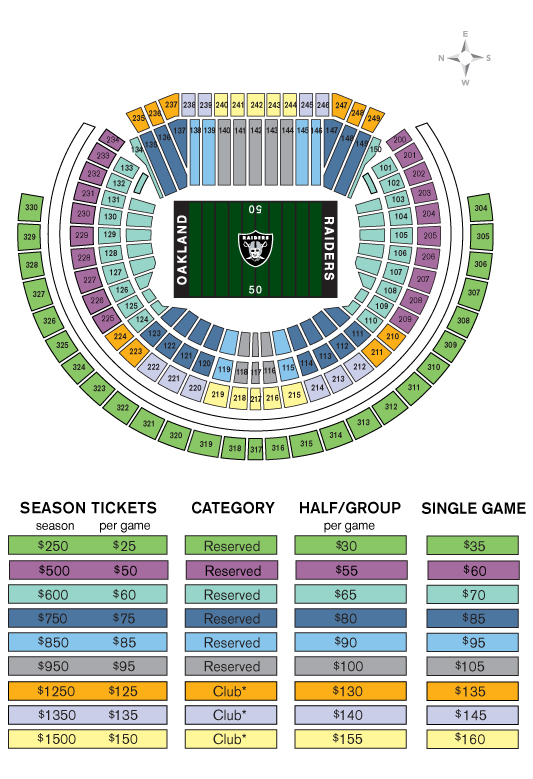
This week the Raiders released a seating map for their 2013 season. The startling revelation from this release is that the Mount Davis upper deck seats have been completely eliminated, as have the outer sections of the original third deck.
Sections for sale do not include the outer 4 sections of the original upper deck or the newer Mt. Davis sections
A look at 2012 attendance sheds some light on what the Raiders’ motivation may be. While the first two home games were considered sellouts (for blackout purposes, not complete sellouts), attendance dropped off quickly as an unappealing group of non-division opponents accompanied a six-game slide into irrelevance. Whatever goodwill was earned during the “Oakland Loves Its Sports Teams” rally was squandered by Thanksgiving, with many fans already looking forward to 2013 when the team was forgotten locally as the 49ers continued their surge into the playoffs.
2012 Raiders Home Attendance
The stated football capacity of the Coliseum 63,132 64,200according to the Raiders, already the second (or fifth) smallest stadium in the NFL. If Mt. Davis and the ends of the original upper deck are removed, the new capacity should will be 51,000 53,250, with Mt. Davis accounting for some 10,000 seats by itself. While this would increase the team’s chances of hitting every game’s blackout target, if the NFL approves this change it’s tantamount to admitting that those seats are unsellable, at least while the team remains mediocre. CSN’s Paul Gutierrez notes that there was only one home blackout in 2012 because of the Raiders’ use of the 85% rule, so blackouts may not the issue. Instead, the Raiders may be eschewing the 85% plan altogether, because it somewhat disincentivizes sales above the 85% mark of regular, non-club seats. Per the CBA, revenue from marginal sales above the 85% mark had to be split evenly between the Raiders and the visiting team. If the Raiders presell a ton of the best seats to Raider fans and not invading fans, they might be able to boost the home crowd feel even as fewer seats are available. That was certainly the case for the A’s at the end of the 2012 season and in the postseason.
HNTB, the firm that architected the Coliseum renovation in 1995, was commissioned by the Chargers to examine deficiencies at Qualcomm Stadium compared to other newer stadia. Interestingly, the study included the Coliseum, even though the Coliseum is less than half new. Included in the study was a measurement of the highest, farthest seat at the 50-yard line for each stadium. That seat on Mt. Davis is 336 feet from the 50, the farthest of the 10 venues in the comparison. While the same seat on the opposite side of the field was not measured, given what is known about the bowl that seat is probably 100 feet closer.
If there’s a winner in this, it’s the LA firm that Lew Wolff contracts to remove and replace the A’s tarps every season. Looks like they’ll be getting a new customer right quick. Fans also get very inexpensive seats in the process. Wolff himself is probably feeling rather victorious today. Losers? 11th hour or walkup ticket buyers. There will be a much smaller inventory for the secondary market, which in recent years had tickets on Mt. Davis for less than $10 on StubHub.
Raider fan, what do you think about this? Good/bad move? An admission that the team will be terrible? Sound off below.
Think about it. Barely over a year from now, a crew will assemble at Candlestick Point and take down the venerable, unlovable, frequently renamed Candlestick Park. Developer Lennar wants the land clear to redevelop as soon as possible, and that means reducing the drafty concrete bowl to dust. The 49ers’ Santa Clara stadium is moving forward by leaps and bounds, setting aside doubts about its readiness for the 2014 NFL season. As with most big demolition jobs, the ‘Stick’s destruction will have a ceremony for 49ers and Giants fans to remember the old stadium. The Giants moved over a decade ago and haven’t looked back, the 49ers appear to be doing the same in moving two counties south.
There’s time for a proper eulogy when the event actually occurs. For now, let’s look at the events that led up to this point.
It’s easy to forget that in 1997, the Eddie DeBartolo, Jr.-led 49ers proposed a new stadium flanked by a shopping mall and a massive garage (9,000+ spaces) at the ‘Stick. It’s all a very 90’s vision, with a large amount of public financing via sales tax increment, a grossly underestimated construction cost ($200 million added within a year), voting irregularities, and a new outlet mall designed to complement existing SF shopping districts such as Union Square. Voters approved the $100 million set aside for the plan, which languished for years as the 90’s dot-com boom went bust and DeBartolo was caught bribing former Louisiana governor Edwin Edwards $400,000 for a casino license. (Edwards, who is also infamous for his “live boy, dead girl” quote, has a reality show starting this month featuring him and his new wife, who is 50 years his junior.)
The 49ers’ Candlestick replacement/mall plan was oh-so-90’s
Even as the plan withered and died when DeBartolo’s less spendthrifty sister and brother-in-law took over the team, the $100 million remained there if someone, anyone was interested in taking over redevelopment of Candlestick Point. So when the team started talking with Santa Clara about building a stadium near the team’s headquarters, SF Mayor Gavin Newsom had the plan dusted off and brought in mega-developer Lennar to give it an update. Lennar moved the stadium site from Candlestick Point to Bayview/Hunters Point, dropped the mall idea, and replaced it with various income-level housing developments and an office park. A carveout for the stadium with a green parking lot was envisioned as a fallback plan just in case Santa Clara fell through. Voters in 2007 (10 years after Eddie D’s plan) approved the Lennar plan. The 49ers remained lukewarm to the stadium because of costs to cleanup contaminated land and the cost of a short bridge to bring vehicular traffic from the Candlestick side to the Bayview. Things only got worse when the stadium was pitched as the anchor for a future Summer Olympics hosting effort, the complexity and uncertainty of the bidding process scaring off the 49ers and the league.
Lennar’s Candlestick/Bayview/Hunter’s Point redevelopment plan
Newsom tried to “warn Santa Clara” not to tie up public funds on the stadium, while State Senator Carole Migden wrote SB 49, a Hail Mary of a bill designed to prevent teams from moving within 90 miles of their current home (within territory). That bill, like the stadium mall plan, went nowhere, leaving SF with no leverage and a still-uncertain plan to keep the team in town. The 49ers and the NFL went on the offensive in Santa Clara, went door-to-door to sell their stadium, and got voter approval in 2010. Since then it’s been all details such as the EIR process and a couple of NIMBY-related lawsuits, bringing everyone to last year’s groundbreaking ceremony and the impressively fast construction work since then.
A footnote to this story is the presence of one Fred Blackwell. Blackwell served as the SF Redevelopment Agency’s Executive Director from 2007 until 2011, then jumped across the bay to take Oakland’s Assistant City Administrator job (also redevelopment). While Mission Bay had most of SF’s redevelopment focus over the past decade or so, the ongoing state of affairs in the southeast part of the city always made it a target area. Mission Bay was always the one with real economic promise. Still, Blackwell oversaw much of the debate between Lennar, SF’s Board of Supervisors, and community groups all looking out for various interests and generally not getting very far very quickly. Eventually, the project’s EIR totaled 7,700 pages and Lennar shelled out millions to nonprofits in the name of affordable housing and other community benefits.
Blackwell may feel he’s in a similar position to 2007. During last month’s Coliseum Authority meeting, it was revealed that the Raiders and the NFL really just want to focus on a simple stadium, not the broad vision that the City of Oakland is considering. Like the scope creep that helped sink the SF stadium concept, a wide ranging and ultimately very complex redevelopment scheme in East Oakland may make it difficult for the Raiders to commit to staying if the vision remains fuzzy and exponentially more difficult to pull off than a stadium-only plan.
It’s easy to see why the Raiders want to narrow their scope. They’re not making claims of a renaissance in East Oakland. The last thing the team or league wants is to see the stadium jeopardized by a dependency on another component of which it has little or no control.
Getting the two visions (one is effectively a subset of the other) together will not be easy. A look at the pattern of NFL stadium development over the past 20 years shows that few have been part of any kind of urban renewal plan, unlike ballparks or arenas. With the limited number of football games in a season, this makes sense. The notable exception to this rule has been Lucas Oil Stadium in Indianapolis, which is not part of any redevelopment scheme, but rather an expansion of an existing convention center footprint. The Atlanta Falcons want to move to a site closer to the Georgia World Congress Center for a similar purpose. In Oakland, the stadium may have a retractable dome, which would inflate its cost significantly but also provide greater flexibility to hold different types of events. Even with ballparks, urban renewal is not a given. The St. Louis Cardinals’ Ballpark Village is finally starting construction nearly a decade after Busch Stadium opened.
Can Blackwell and Oakland pols pull together all of the resources, the financing, and the political will to execute a vision that’s projected to be twice as expensive as the scaled down Lennar-Bayview plan? Not even mighty SF could prevent the 49ers from escaping all of the craziness. It would be hard to blame the Raiders for following a similar, simpler path.
A lot to go over in this edition. Thanks to all who have been contributing. The response has been excellent so far, I hope it continues. I have a couple of surprises in store for you generous folks.
Update 2/5 12:00 PM – Sacramento Mayor Kevin Johnson had yet another press conference to give an update on the Kings/arena effort. The big takeaway is that there is not yet an announcement on a big money equity group. That may happen next week, in conjunction with the City submitting its arena plan to the NBA. Meanwhile, billionaire Ron Burkle looms larger than ever, as he has emerged as a potential bidder for AEG. Keep in mind that Burkle would have to partner with private equity to buy AEG. It would make sense for Mayor Johnson and Sacramento if Burkle, Mastrov, and silent money were to come in on a package deal for the team and arena, similar to Guggenheim Partners’ overwhelming bid for the Dodgers.
The Giants are reportedly being less strident in their concerns about a Warriors arena at Piers 30-32 in San Francisco. The sides are hashing out their differences with the City in the middle. 2013 must mark a new era of a “kinder, gentler Giants”. [SF Chronicle/John Coté, Neal J. Riley]
The 34-minute power outage at yesterday’s Super Bowl at the Superdome is being blamed for now on monitoring equipment that tripped a breaker after sensing an anomaly. Power outages happen from time to time at sporting events depending on load, grid, and stadium. The spectacular 2011 blackout from a 49ers home game was notable. I vaguely recall an A’s game that had the lights go out in 2012, though I can’t remember if it was a home or road game. While somewhat embarrassing for New Orleans, it seems unlikely that this mishap will affect future Super Bowls in NOLA, especially if the true cause can be properly identified and fixed. [LA Times/Patrick Kevin Day | Deadspin/Barry Petchesky]
If the problem is grid-related, the Santa Clara stadium shouldn’t be hit in the same way due to built-in redundancy with multiple substations next to the stadium. Santa Clara runs its own power utility, which allows for more leeway in utility planning than if it had to work with PG&E. [SJ Mercury News/Mike Rosenberg]
Somehow the Miami Marlins continue to make out well at their new ballpark despite their mistakes. The Marlins have paid only $102 million of the $131 million they were supposed to contribute. If the full project comes in below projected cost, the remaining money that’s supposed to come from the team will be rerouted to a capital improvements fund, instead of refunding Miami and Dade County taxpayers. [Miami Herald/Charles Rabin]
MLB executive Kim Ng toured Hermosillo, Mexico’s Estadio Sonora while checking out the Caribbean Series. The 16,000-seat stadium could potentially be used as a spring training home by Arizona Diamondbacks or another team. Hermosillo is 4.5 hours south of Tucson, inland of the Gulf of California. [MLB.com/Alden Gonzalez]
Reno’s City Council approved a subsidy plan to pay off Aces Ballpark, which will keep the D-backs’ AAA affiliate in Reno for the next 30 years. The subsidy will run approximately $1 million per year. [Reno Gazette Journal/Brian Duggan]
The Scranton-Wilkes Barre Railriders (AAA-Yankees) are moving into their completely rebuilt ballpark, PNC Field, after a year of barnstorming. [Scranton Times Tribune/Jim Lockwood]
A Mesa-based service organization called the Hohokams (natch) has long had a contract to provide manpower at Hohokam Stadium during spring training. As the Cubs complete work at their new park, no deal has been made for the new ballpark. [Arizona Republic/Editorial Board]
El Paso Union Depot
El Paso’s upcoming Populous-designed AAA ballpark will take stylistic cues from the city’s historic Union Depot train station. The ballpark, which will replace the not-that-old City Hall, is expected to open in time for the 2014 season. Meanwhile, a legal challenge to the $50 million deal has caused the city to halt an effort to issue bonds for the stadium. [El Paso Times/Cindy Ramirez, Zahira Torres]
A 100-feet-deep sinkhole found at the Birmingham Barons’ new ballpark site has put a snag in construction. Apparently sinkholes are quite common throughout Birmingham. [AL.com/Joseph D. Bryant]
Henderson, NV is suing developer Chris Milam and others over an alleged bait-and-switch scheme that involved 480 acres of land that was meant to be used for a stadium complex. Instead, Milam may be looking to build housing on the land. The City is suing to prevent that from happening based on the very low land sale price furnished to Milam. Caught up in all of this is former Bureau of Land Management director Bob Abbey, who signed off on the deal. [Las Vegas Review Journal/Alan Snel]




 newballpark.org