It starts with this.

Arrowhead Stadium prior to 2007 renovations
And ends (for now) with this.

Levi’s Stadium prior to August 2014 opening
These two stadia opened 42 years apart, yet bear a couple of important similarities. One that is fairly obvious when you compare the two pictures is that neither has an exterior façade. The other is that they were both designed by the engineering and architectural firm HNTB. Well, sort of. As I mentioned on Monday, Arrowhead Stadium’s original architects were Kivett and Myers. That firm was acquired by HNTB to form its sports practice in the late 70’s.
HNTB went on to do several football stadia in the 70’s and 80’s, including Giants Stadium and the Hoosier (RCA) Dome. Neither was known for being a great work of architecture, and both are now history. Until HNTB designed the Broncos’ new stadium, Sports Authority Field, it’s hard to point to any really striking sports architecture from the firm. More eye-catching examples have come in the form of minor league ballparks such as Raley Field and the twin Fifth Third Fields in Toledo and Dayton. Minor league ballparks don’t have nearly the scale and sense of mass as a pro football stadium, so it’s probably unwise to even compare.
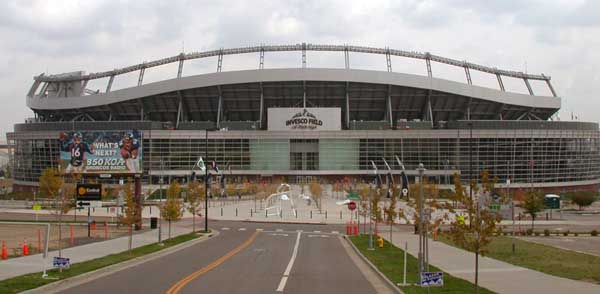
Sports Authority Field (formerly Invesco) at Mile High, photo by Matthew Trump
While Arrowhead and neighbor Kauffman Stadium were highly acclaimed, notable pieces of sports architecture, they weren’t flawless. That lack of exterior façade made for cold and wet occupants, which was more of a problem at the ballpark during the spring months than at Arrowhead during the football season, when it’s customary to bundle up. The 2010 renovation of Kauffman included a large structure behind the seating bowl that provided a great deal of weather protection for fans.
At snowy Denver, there’s plenty of cover thanks to glass curtainwall. The undulating, horseshoe-shaped upper deck both saluted and riffed off the old Mile High Stadium. Even so, the most interesting thing about the new stadium is its all-steel structure, which wasn’t limited to columns and trusses. Risers that would normally be built of precast concrete were also made of steel, which allowed the Broncos to make an extra noisy, feet-stomping seating bowl much like Mile High.
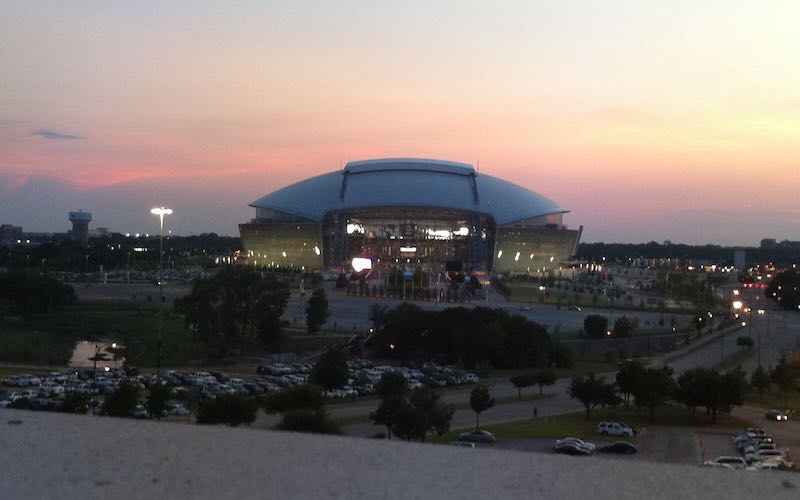
New NFL stadia over the last 20 years seemed to be constant acts of one-upmanship. Paul Brown Stadium was thought to be overly garish for conservative Cincinnati. HKS-designed Lucas Oil Stadium looks like an Indiana field house enlarged by nuclear radiation, the same way a puffer fish might have become twice the size at the Bikini Atoll. Another HKS product, AT&T (Cowboys) Stadium, is practically out of a sci-fi film and as I noted while I was at Rangers Ballpark to the east, appears ready to destroy its neighbor with lasers. The next HKS design for the Vikings looks like a crystal football cathedral.
As domed multipurpose stadia, the three HKS designs had to have some sort of skin. The fact that they are a bit over-the-top (360 Architecture is guilty of this too) is part of the celebration of football, the fans, and the home city. The other recently built West Coast NFL stadium, CenturyLink Field in Seattle, was built to protect fans from harsh, wet winters. But in California, is any façade necessary? Or is it just ornamentation?
At Levi’s Stadium, most of the suites are set in a single 8-story tower along the west sideline. It’s efficient packaging for sure, though it looks a lot like of the office buildings in Silicon Valley, which are similar in scale. The other three-quarters of the stadium is practically naked. HNTB and the 49ers chose to show off the structural steel that lifts up and rings the bowl. Whether that’s “enough” architecturally to work as aesthetic is largely subject to individual taste. So far most of the comments I’ve seen are to the effect of, It’s nice on the inside. Levi’s Stadium is a technological tour-de-force, and like many good technologies that come out of the Valley, is built with headroom and expansion in mind. What it lacks at the moment is a single element that makes it beautiful, unless you consider the suite tower that element. Arrowhead has the lovely, swooping upper deck at the end zones. It adds elegance to what otherwise would be character-less and overly brawny. Perhaps the signature element, a translucent image-projecting, shape-shifting material that clads the exterior, simply hasn’t been invented. Or maybe Levi’s Stadium is destined to be like many of HNTB’s post-Arrowhead work: serviceable at best, forgettable at worst.
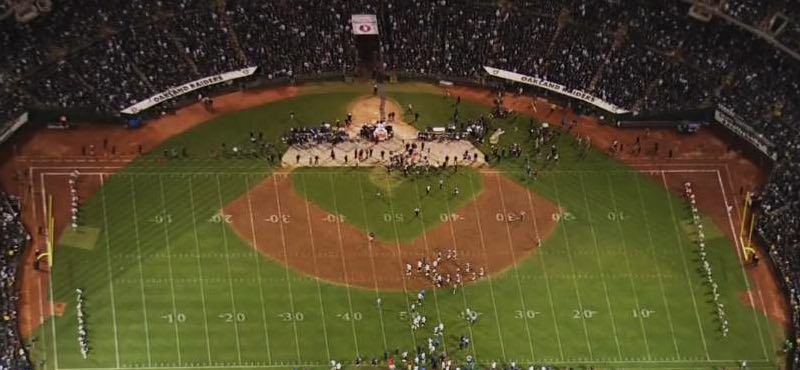
Let’s not forget that HNTB also designed Mount Davis. We know that aesthetic quite well, as our Oakland home is akin to a Supermax prison. HNTB is probably known more for their engineering work than their designs. They were hired by the City of Cupertino to do the lovely cable-stayed pedestrian bridge I mentioned in my “Rethinking Coliseum City…” post. They also designed the beautiful Zakim Bridge in Boston, along with a number of interchanges and airports. None of that sounds sexy, but they are important pieces of infrastructure that have to balance aesthetics and utility, not an easy task.
I suspect that Levi’s Stadium will undergo several minor and major revisions over the next 20 years as they iron out the rough spots and seek to enhance the experience even further. Levi’s Stadium is more than a place to watch football. It’s also a platform and brand. If there are bugs in 1.0, just wait for 1.1 or 2.0. It doesn’t get more Valley than that.
—
P.S. – This is not intended as a review. I’ll have one of those up in a month or so.


 newballpark.org