Former Assemblyman & Dublin Mayor Guy Houston in running for JPA Exec Director position

Rumors bubbled up last week on the inter webs about the Coliseum JPA potentially filling its vacant Executive Director position. BANG has reported further on it, lending the story credence. The leading (only?) candidate is Guy Houston, a Republican lobbyist who spent 6 years in the Assembly. Prior to that he was the mayor of Dublin.

Guy Houston

Deena McClain has been the Authority’s Interim Executive Director for some time, also serving as legal counsel. During the lease discussions over the summer, you may remember that she was the point person for any and all questions about the current lease terms, outstanding debt, and operations of the Coliseum complex. McClain, in concert with outside counsel, negotiated the A’s lease on the JPA’s side. That would be Houston’s role should he take the job.

Should the Raiders elect to stay in Oakland for however many additional years, Houston’s first task would be to negotiate that lease extension. Beyond that, he’d have to lead talks for the future of the complex, whether it’s Coliseum City or a successor plan. The position has been vacant for so long that it’s easy to forget its importance. Take a look this excerpt from the still-relevant-albeit-outdated job description:

The ideal candidate will:

  • Be a strong and visible leader;
  • Have very strong analytical and problem solving skills;
  • Be able to evaluate, analyze and interpret complex financial statements and reports;
  • Be able to develop, present and defend financial reports/profit loss statements;
  • Have excellent communication abilities both orally and in written form;
  • Be able to draft, interpret, negotiate and apply complex contract language;
  • Have strong facilitation and mediation skills;
  • Be a consensus builder;
  • Understand the political process and public meeting dynamics and requirements;
  • Identify and present the best business decisions and practices in a political environment;
  • Understand sports franchise businesses and the dynamics of their operation;
  • Understand comparable stadium/arena/entertainment facility operations;
  • Will know or be able to learn the market and the best practices;
  • Be able to build and maintain a good organizational public image;
  • Develop and maintain positive media relations.

Before any of you start emailing your resumes, there are also some specific requirements for the job:

MINIMUM REQUIREMENTS

  • A degree in business administration, public administration, economics, or another closely related field. An advanced degree is desirable.
  • Experience managing a similar revenue generating enterprise owned by a public entity or managing a facility comparable to the Coliseum Complex.
  • Experience demonstrating successful application of the abilities and traits of “The Ideal Candidate”.

If you’re still in college, or you work some midlevel position in the private sector, you need not apply.

Having served in the public sphere for well over a decade, Houston’s certainly qualified. The real questions are about his station within the JPA and his designs on the job. Houston was termed out of his Assembly District 15 job in 2008. He then ran for Contra Costa County Supervisor and lost, then went for the GOP chair job and lost. Since then he’s been a lobbyist, continuing to work out of Dublin. If he wanted to get back into elected office at some point, successfully negotiating new deals as the JPA’s Executive Director would be an excellent feather in his cap, though it’s unclear what elected offices he could capably shoot for as a Republican in Alameda County.

Houston’s reputation is very pro-business, developer-friendly. In the mid-2000’s he was caught up in a scandal involving his father, Fred Houston, who was accused defrauding senior citizens to the tune of $340,000. Fred Houston was also the longtime head coach of San Ramon Valley High’s football program. Zennie Abraham noted Guy Houston’s close ties to Alameda County Supervisor Scott Haggerty, who is also known as very pro-business.

The Executive Director serves at the behest of the JPA Board of Commissioners, so it’s not as if he/she can create an agenda and start dictating terms. However, the ED could certainly steer negotiations one way or another, based on ongoing evaluations of potential deals. As divided as the JPA has shown itself to be over the future of the Coliseum, it’ll be more important than anything for the ED to build consensus. Should Houston get the job, it’ll be no small feat if he gets everyone rowing in one direction.

Welcome to the Toto Neorest Center

The Warriors and Snøhetta continue to provide sketches and renderings of the planned Mission Bay arena. Socketsite showed them first. The overwhelming impression most everyone gets from these renderings is that it looks like a toilet. A fancy toilet, to be sure, but a toilet nonetheless. The “back” with its two wide supports definitely doesn’t help.

This slideshow requires JavaScript.

For reference, here is the product I referenced in the post title.

neorest_600

Toto Neorest

It used to be that most arenas were simple ovals or circles with some sort of façade. No more! In order to accommodate the growing need for auxiliary spaces inside each arena (offices, practice facilities, special hospitality areas, restaurants), just about every new arena has had a side section or wing grown onto it. The “appendage” trend started with Staples Center.

Staples Center with administrative building “appendage”

Architects have to solve the problem of integrating such structures into the arena footprint. Inevitably it all looks like some variant of an oval with something on the back. From the top Staples Center kind of looks like a record player. The new arena in Edmonton (architected by 360 Architecture) looks like a skillet. And then there’s the Warriors’ arena, whose resemblance to a toilet is rather uncanny.

new-edmonton-arena

Rogers Place in Edmonton is warming up for an order of sunny side-up eggs.

A big reason why a fairly up-to-date arena like Oracle is being dumped for a new home is this. And there’s a consistent effort to make such buildings less monolithic, a hallmark of many 60’s-80’s arenas. Different materials, surfaces, glass, and angles are designed to soften the appearance while making it an object of demand (if not desire). Most arenas are utilitarian in nature and don’t bring up the kinds of feelings of nostalgia or place as ballparks do so successfully. Really beautiful, transcendent works are few and far between. Even though Staples is only 15 years old, every time I pass by it I feel that it has aged 25 years.

Perhaps the role of an arena is to be of an era, to represent a time. I only hope that Snøhetta somehow gets rid of the unintentional comedy element in this design. There’s still time to do so.

Lew Wolff and Mark Davis meet with Coliseum JPA

The second item in the most recent Matier and Ross column is short albeit promising one.

It was a rare sight indeed — A’s co-ownerLew Wolff, Raiders owner Mark Davis and their advisers in the same room with members of the Oakland-Alameda County Coliseum Authority, talking about building separate stadiums on the Coliseum site.

Not much was said beyond that, especially from anyone on the JPA. Still, it’s an encouraging sign that the JPA and the two teams are on the road to a viable Coliseum City alternative. Even with this rather small step, it’s better partnership than Coliseum City, which has at been given a lukewarm response from Davis and a decided nay from Wolff.

I don’t expect any plans soon, but the winter would be a good time for an unveiling. Oakland would be past the election craziness and its holiday recess. Barring a lengthy last-minute ENA extension, it’s also likely that we’ll know the fate of Coliseum City.

If you want to dream about an Oakland ballpark in earnest, now’s a good time to start.

AAA Affiliate shuffle: Love the one you’re (not) with

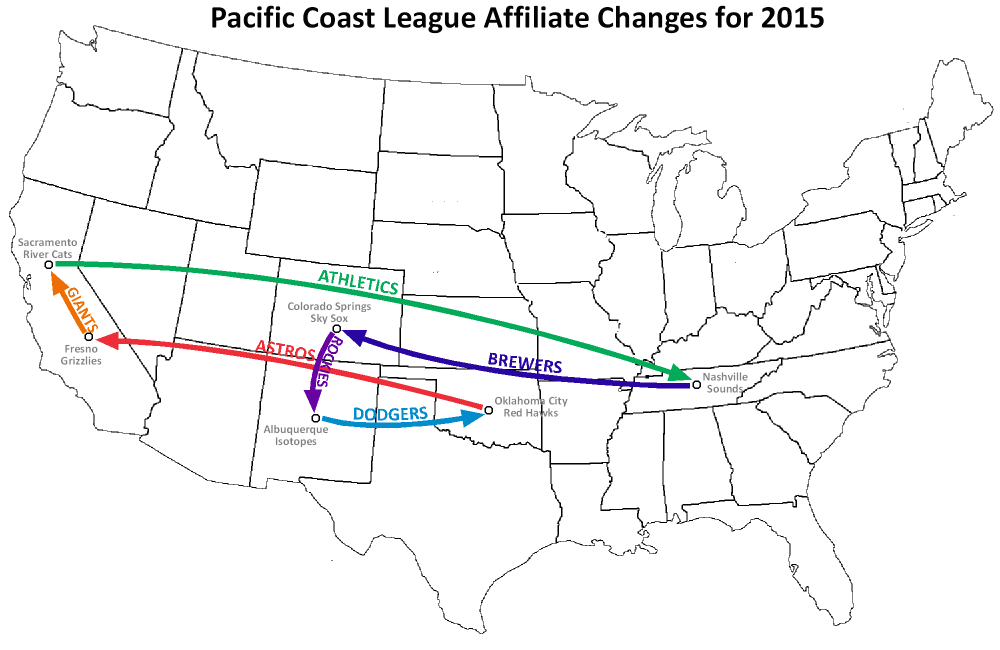
A flurry of PDC agreements came throughout the day. It seemed that the A’s kicked things off before 10 AM with their 4-year PDC with the Nashville Sounds. However, the Giants and Sacramento River Cats scheduled their own press conference, also at 10, to talk about their 2-year PDC. Then all the other affiliates and PDCs got in line, finishing with a hastily agreed upon agreement between the Brewers and Colorado Springs.

Brewers GM Doug Melvin even sounded like a spurned lover:

“Very disappointing. We gave them 10 years there. A number of times we had a chance to move and we were patient with (the Sounds). I’m just disappointed they wouldn’t have given us two [more] years for what we put up with there.”

There happens to be Greer Stadium, the aging, 36-year old ballpark south of downtown Nashville which is being replaced by shiny First Tennessee Park. The agreement’s only for 2 years, which may allow the Brewers to try another city, since Colorado Springs is only slightly above the seventh circle of hell when it comes to desirable affiliate cities because of park factors. That doesn’t explain why the Rockies were so eager to bolt for Albuquerque, a city that is more than a mile above sea level. The game of musical chairs, which was truly kicked off by the Dodgers when co-owner Peter Guber bought a 50% interest in the Oklahoma City Red Hawks last week. OKC will be the new AAA affiliate of the Dodgers, which left the Astros to hook up with the Fresno Grizzlies.

All of this was done in the last 24-48 hours

All of this was done in the last 24-48 hours

Sooooo…. Nashville? It’s nearly 2000 miles from Oakland with nary a direct flight link them together since neither city has a major hub airport. Nevertheless, the River Cats-turned-Sounds will be playing in a fabulous, Populous-architected ballpark next year. First Tennessee Park will be at Sulphur Dell, the site of an old ballpark (also named Sulphur Dell) that dates back to 1870. Like Sacramento pre-River Cats, Nashville had a lengthy gap in 60’s with no pro baseball in town after Sulphur Dell closed in the 60’s. Herschel Greer Stadium opened in 1978. The Brewers came calling in 2005 and have been there ever since. The Brewers, Sounds management, and civic leaders have been trying to get a new ballpark in Nashville since 2007 (sounds familiar), finally putting together a deal that raised $65 million in public bonds while tying Sounds ownership to some $37 million in private development surrounding the ballpark. It’s a deal similar in structure to Petco Park, though there is some fuzziness on whether that private investment truly has to come in and when. Construction only started in earnest in March, making the development time very short, much like El Paso, Reno, and Sacramento.

Certainly the A’s front office was attracted by a brand new ballpark, as it would make for an easy transition for players who don’t make the big club. Sounds owner Frank Ward was probably salivating at the prospect of a winning, contending team playing in his new digs, as the Brewers-affiliated Sounds haven’t gone to the postseason in eight years, a cumulative .504 winning percentage since becoming a AAA city in 1985. Coincidentally, the Sounds finished with a 77-67 record this season, good for second in the American Southern division, but the team has generally been inconsistent.

FTP is bounded by 5th Avenue N, 3rd Avenue N, Jackson and Harrison Streets. While a 1,000-space parking garage will be built next to the ballpark, the site is only three-quarters of a mile from Printer’s Alley, Nashville’s well known downtown nightlife area. Numerous hotels are located downtown, with several more located along Music Row to the southwest. Catch some live music, maybe a Predators game at Bridgestone Arena, or take a tour of legendary Ryman Auditorium, the former home of the Grand Ole Opry.

This slideshow requires JavaScript.

After going over several different design options, it was decided that the ballpark would be oriented south-southeast. The northern edge would have an entry gate behind home plate, but otherwise there wouldn’t be the usual contour following the seating bowl that you usually see at most minor league parks. The idea is that ancillary development would occur to the east and south, between the park and downtown. If done correctly, a “ballpark village” of sorts may emerge, capturing visitors and locals who may park downtown and walk to the park. Again, there are shades of Petco Park in the site plan, although at a much smaller scale.

The full Sounds 2015 schedule is not yet available on the team’s website. When it is I’ll put together some sample ballpark trips you may consider. Next summer I’d like to do a AAA trip consisting of Nashville, Memphis, Indianapolis, Louisville, and perhaps Columbus again. The closest cities (within a 4 hour drive) are Atlanta, Cincinnati, and St. Louis, so putting together trips that involve MLB teams, especially the A’s, will be tough. If you’re planning a trip, you may find yourself flying through ATL, so that may work to your advantage.

As for the River Cats? I wish them luck. Their PDC with the Giants is only 2 years, a somewhat surprisingly short term considering the fan cultivation effort that is obviously the goal of the affiliation switch. They should do fine in 2015 thanks to a honeymoon period of sorts. The River Cats have a good promotional machine that should crank up into high gear with the Giants involved. If they can regain some of the attendance losses they’ve suffered the last few years, the change will have been worth it.

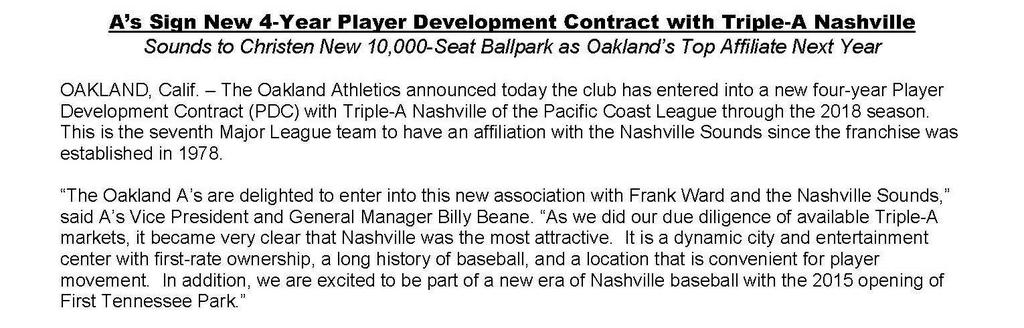
Official: A’s sign 4-year PDC with Nashville Sounds

Looks like I get to start planning my AAA ballpark trip for next year. Straight from the horse’s mouth:

image

The Sounds will visit Sacramento next May 25-28, if you want to check them out. I’ll have more on Nashville and the new First Tennessee Park later today.

SunTrust Park: The name is bland, the money is not

At some point during the 2017 baseball season, someone in the media is going to make a flub, calling the Braves’ new stadium “Sun Life Park.”

This slideshow requires JavaScript.

Who could blame the person? “SunLife Stadium” and “SunTrust Park” sound so very generically close to each other. The Braves and Atlanta-based bank SunTrust are moving forward anyway, with a 25-year deal whispered to be worth a whopping $250 million. That’s twice as much as the value of the Cisco naming rights deal struck in 2006 for the Pacific Commons ballpark. It would also place among the top five in the nation on an annual basis.

$10 million a year would go a long way towards financing the new Home of the Braves, where $622 million in development cost translates into $50 million a year for those 25 years. SunTrust will become the sixth bank to have naming rights at a Major League Baseball facility. Banks tend to be more regional than most national consumer brands, so they tend to partner up with teams in their respective backyards.

  • Chase Field, Phoenix – acquired naming rights in merger with BankOne, originally from Cleveland
  • Comerica Park, Detroit – originally from Detroit
  • Citi Field, New York – based in New York
  • Citizens Bank Park, Philadelphia – based in Providence, RI, claims Northeast as its region
  • PNC Park, Pittsburgh – based in Pittsburgh

Only one major bank is headquartered in the Bay Area, Wells Fargo. However, Wells Fargo already has naming rights deals with three arenas in Philadelphia, Des Moines, and Tempe (on the Arizona State University campus). There’s also one at a small arena in Dothan, Alabama, but who’s counting that? Wells Fargo could pursue naming rights at a new venue in the Bay Area, but with three already in place they may consider that enough.

As for the renderings? Looks a lot like the Braves’ current home from the outside.

River Cats to end affiliation with A’s

From the Chronicle’s/SFGate’s Susan Slusser:

The River Cats haven’t made any official announcements yet, other than some front office shuffling last week.

When the A’s announce a new PDC with a different AAA club (probably the Nashville Sounds), I’ll give that a little writeup. Otherwise, RIP River Cats we knew as A’s fans.

Reusing an abandoned arena

This post is not strictly related to the Coliseum City EIR, though the ideas within are somewhat germane.

It’s been a few months since the Warriors gave up their effort to build at Piers 30-32 in San Francisco, electing instead to buy land at Mission Rock to the south. So far, the team has received practically zero resistance from the parties that either opposed the waterfront arena or who would typically oppose such projects. From a regulatory standpoint, the arena should go as easily than Pac Bell Park went, perhaps easier since it’s technically not on the waterfront. While it’s too early to call the arena a slam dunk, it’s a good idea for Oakland and Alameda County to start thinking about what will happen to Oracle Arena after the W’s leave.

First, the JPA and the W’s will surely go to court over the $61 million in debt owed on the arena after 2017. Once that’s settled, a series of choices will need to be made. One possibility is to demolish the arena and reclaim the land, about 8 acres worth. Should the arena stay put, more choices will have to be made about what its purpose is and how to best utilize it.

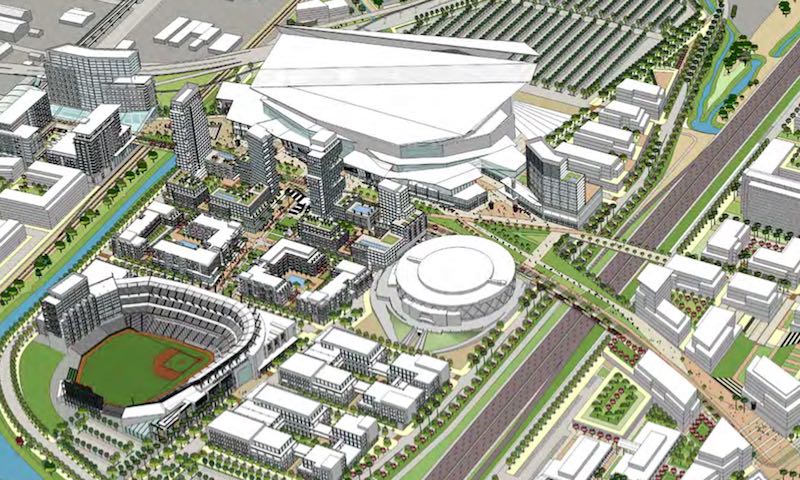
Alternative 2A: Two new stadia + existing arena

Alternative 2A: Two new stadia + existing arena

The market for a third 17,000+ capacity arena lacking an anchor tenant in the Bay Area is not good. The SF arena will be the new must-see, must-book venue in the Bay Area, with arenas in both Oakland and San Jose suffering to some degree. If the arena debt falls back on Oakland/Alameda County, operating costs can run as much as $17 million a year through 2027. With the arena in a prime site within the Coliseum City development, the temptation will be huge for O/AC to cut their losses and recoup whatever they can through redevelopment. Countering that will be pressure from the community and preservationists to keep the arena intact, as it retains significant historical value.

Functionally, the arena is still an excellent venue. Steady improvements have been made since the 1997 renovation, including new club areas and seating options, new scoreboards, and revamped technology inside the building. The biggest problem remains poor circulation, as the main concourse is narrow and cramped. While well appointed, the sideline club areas also have a tendency to feel congested. It also has way too many seats for anything other than a NBA or NHL franchise and should be downsized.

My first suggestion then, is to remove the upper seating bowl. The lower bowl has 10,000 seats on its own, plus another 1,000-2,000 available on the floor depending on configuration. That’s the perfect size for the sort of second-tier arena that every major market should have. For decades, that venue has been the Cow Palace, but the old joint is so antiquated and generally undesirable as an arena that acts avoid it like the plague. Besides the Grand National Rodeo and the usual touring circus, very little happens at the Cow Palace. Therefore it would appear that there is an opening in the market for a 10k arena. It’s the right size for the WNBA and minor league hockey. Most touring concert acts aren’t looking for 15k seats or more, 7-12k may be plenty sufficient. That venue doesn’t really exist in the Bay Area. SAP Center and the forthcoming SF arena will be able to reach that with curtaining or other tricks. The reconfigured Oakland arena should be able to hit that without any visual tricks.

Oakland Coliseum Arena shortly after construction was completed

Oakland Coliseum Arena shortly after construction was completed

You’re probably saying at this point, Okay but what about the upper deck? Glad you asked. The picture above illustrates how beautiful the arena used to be, with its sense of symmetry and different types of geometry. It also shows the amount of available vertical space. That largely went away with the renovation, but would be available again after the upper deck is lopped off. I’ll put out a couple different ways to utilize the space.

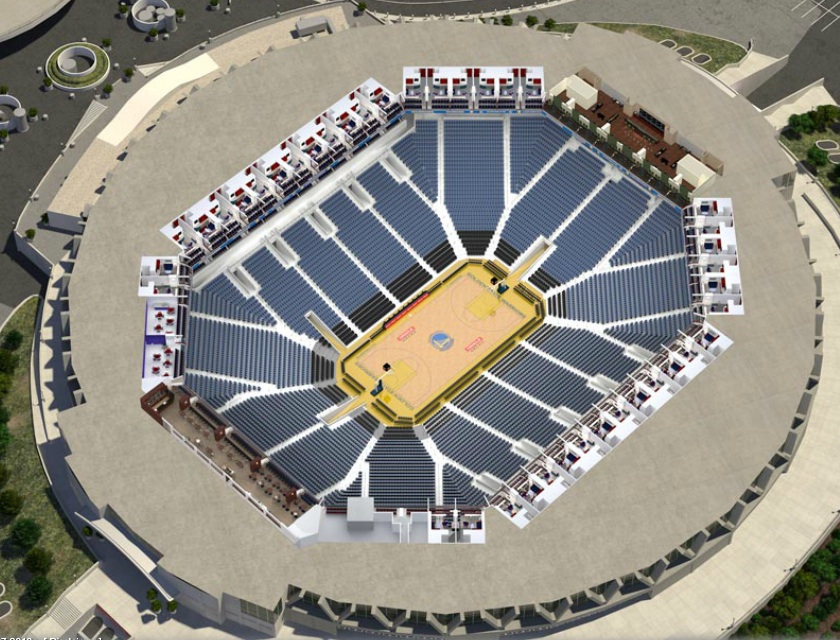
Arena lower bowl plus suite levels

Arena lower bowl plus suite levels (Image from Ballena Technologies)

One way is to put a new ceiling on the arena at the rim of the upper suite level. That would require putting in an extensive truss system to support the ceiling/roof and whatever is on top. Once that’s done, the upper level can be finished, leaving a 10,000-seat arena below and an exhibit space above. That exhibit hall could have a much as 100,000 square feet of clear span, column free space. That’s nearly twice as much as the downtown Oakland Convention Center, and more than Moscone West’s main hall. The drooping ceiling would create a weird visual effect for many (most similar buildings have an arched or flat ceiling). Beyond that, the new exhibit hall would fill a need not met by anything currently in the East Bay. The best part is that the arena could be run completely separately below or in conjunction with the exhibit hall, providing additional hospitality and exhibit space, the arena itself largely unchanged. Some new infrastructure would have to be built, such as a large freight elevator and ramps to the revamped upper level.

Old sketch of arena elevations, note drop ceiling

Old sketch of arena elevations, note drop ceiling

Another option is more conventional. In this case the seating bowl would be torn down but the upper concourse would be expanded to the perimeter of the building. There would be no second ceiling above the arena bowl. Available square footage would be cut down to 60,000 or less. Uses would be fairly limited, such as commercial (office) or even retail. If there ever was a natural spot for a movie theater multiplex, this is it. 15-20 screens could easily fit in the space, even an IMAX theater. Again, there’s a need that’s unfulfilled in Oakland right now, and Coliseum City would be well positioned to capture that market with its expected higher-income residents, office workers, and visitors. Cost would be fairly minimal for the JPA, as the theater operator would presumably bear the cost of constructing the auditoriums.

The name “Oracle Arena” is expected to expire after 2016, when the naming rights deal ends and the Warriors have construction underway. When that happens the name will probably change back to the Oakland Coliseum Arena, the venue’s original name. That’s fitting, whether the arena continues as is or is transformed in some manner. The building may not have seen much winning in its 40+ years, but it’s full of great memories and events. If there’s a way to keep it operating that works for the public, it should be explored to its fullest.

A’s extend PDC with Midland, Sacramento remains unclear

The A’s AA-Texas League affiliate, the Midland Rockhounds, is playing for the league crown tonight in Game 3 of a 5-game series with the Tulsa Drillers. That didn’t stop the team from getting together with the A’s to announce an extension to their Player Development Contract, which was set to expire at the end of this season. The extension will run another 2 years, to 2016.

As a result, 4 of the A’s minor league affiliates will have PDCs through at least 2016: Vermont (A- – Penn League), Beloit (A – Midwest League), Stockton (A – Cal League), Midland (AA – Texas League). That leaves the Sacramento River Cats as the lone outlier. Murmurs have only gotten louder about an upcoming deal with the Cats and the San Francisco Giants, so much that Sacramento Bee columnist Marcos Breton has come to River Cats’ ownership’s defense about the move. The change would force the A’s to affiliate with another Pacific Coast League city, likely Nashville or Fresno.

The “free agency” period for available affiliates starts next Monday, with announcements followed by a two week negotiation period. Consider it like the Winter Meetings, but for major and minor league teams instead of GMs and agents. If anything, as A’s fans we’d like to hear of an announcement early next week, which would mean that the A’s didn’t end up losing out on the biennial game of musical chairs that often occurs. While that’s somewhat rare among AAA teams, there may be numerous affiliates available, and some locales will be more popular than others (there seems to be a trend that disfavors high-altitude cities such as Albuquerque and Colorado Springs).


MLB 2015 Travel Grid (Schedule) Now Available

Every year it happens like clockwork. MLB releases its tentative schedule for the next year in early September, and I cut it up and remix to make something suitable for planning ballpark trips. I call it a Travel Grid. The Travel Grid is table of all games based on each team’s home schedule. One variant places the teams in regional clusters, allowing users to connect the dots to plan trips.

Sample of Travel Grid in PDF format

Sample of Travel Grid in PDF format

Want to do a 3-5 days seeing games from Washington to Boston? It’s possible. Want to catch games at both Chicago parks and Milwaukee? If it’s there you’ll see it. I started doing this a few years ago to help me plan my own trips. I hope it’ll help you plan yours.

The schedule starts a week later than what you’d usually expect, on April 6, and ends October 4. Every 5-6 years this reset has to occur, as we “lose” a day every year. The late start may help avoid more rain postponements that have seemed to be more frequent in recent years. The downside of that is the postseason running dangerously close to November. The All Star Break will be July 13-16. Much of the pain for the A’s will be frontloaded, as they’ll experience 2 of their 3 longest road trips (9-10 days) in April and May.

A’s interleague opponents will be the NL West, which will bring about a few changes. Instead of the 2+2 format the A’s and Giants series’ took on the last couple years, the teams will play 6 times, 3 in SF in the summer and 3 in Oakland as the last home series of the season. That sets up the possibility for some cool roadies. In mid-June the A’s will play 3 at the Angels and 2 at the Padres. If you’re looking for lengthy A’s East Coast trips, things don’t look as promising. Other than series at the Indians and Yankees to end the first half, there are few trips where you can stretch out and follow the team for a week unless you’re willing to take on multiple leg flight schedules. The team has a particularly brutal stretch next September when they visit the Rangers, then fly to Chicago to meet the White Sox, then back to Texas for a series against the Astros.

That said, if you’re looking to put together ballpark visits, the schedule’s pretty friendly. East Coast possibilities for 5-7 day trips (the length I like) are available pretty much every month. Similar length Midwest trips are ripe in June (Rust Belt) and July (Chi-StL).

The 2015 Travel Grid is available in two layouts: an alphabetically ordered (left-to-right) table and the aforementioned regional cluster layout. Both are available in Excel, CSV (comma delimited), and PDF (poster view) formats. Feel free to leave feedback in the comments or send me a tweet.

Regional

Alphabetical

Enjoy!