Great sentiment to take into a new season, isn’t it? Things may not seem that dire, but consider that I’ve been writing this blog for ten years and we’re no closer to a stadium than we were in 2005. As Howard Bryant explains in his latest ESPN The Magazine article, we may actually be further from a solution than before. There remains a single site in the Bay Area that baseball is willing to consider, and it is encumbered by a competing development process (Coliseum City). Everyone involved has acted and looked bad and has generally failed abysmally:
- A’s don’t want Oakland, still covet San Jose
- Giants remain greedy and recalcitrant
- MLB provides no leadership
- Oakland interests trashed A’s ownership, tried to force sale of A’s to no avail
- San Jose sued MLB, making them a non-entity in terms of negotiation while lawsuit was ongoing
Bryant goes on to explain that MLB is banking on the Coliseum City falling through and the Raiders leaving, which would leave the A’s at the Coliseum to work out a deal, a solution presenting itself with no intervention required on Commissioner Rob Manfred’s part. Convenient, right?
https://twitter.com/hbryant42/status/584208678024118273
Of course, progress made recently on the EIR process won’t necessarily translate into actual deal success. City archives all over the state are full of dead EIRs from projects that were never built.
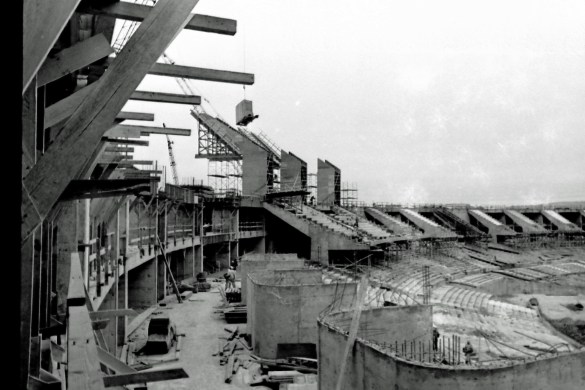
An under construction Coliseum in more hopeful times
Nevertheless, that’s the outcome MLB sees. It’s one that A’s management is willing to play along with, for now at least. It doesn’t mandate getting a ballpark built right away or even soon, thanks to a lease that can take the A’s through the 2024 season.
Like Lew Wolff assuming that The Lodge would work out a deal for San Jose, MLB assumes that the Raiders are in LA after 2015. But even that’s difficult to forecast at this point. Stan Kroenke’s Inglewood stadium plan has the most momentum at this point, and the Carson concept is being spearheaded by the Chargers. Both teams have plans to accommodate a second team, though they have both declared that a second team is not a necessity. The NFL wants no more than two teams in Southern California (including the San Diego market). Those two teams could be the ones spearheading separate stadium projects. Or they could partner together on a single stadium. The Raiders, not having their own stadium plan to push, have to hope that Kroenke’s plan falls through and Carson succeeds, allowing the Raiders and Chargers to be the LA teams. If Kroenke gets his stadium, it doesn’t matter whether the Chargers stay in San Diego, move to Carson in their own stadium, or partner at Inglewood, the Raiders are the odd man out. There’s the odd chance that either the Chargers or Raiders could move to St. Louis, but few outside of St. Louis are considering the idea seriously.
Therefore, MLB’s hopes rest with a very silent man who has little interest (and zero actual financial interest) in baseball. Kroenke owns or has owned franchises in every other major sport, including top tier English soccer (Arsenal).
Whither the A’s in all of this? As usual, that depends. If the Raiders are shut out of LA because of the Rams’ and Chargers’ activity, the Raiders would effectively be forced to work on a stadium in Oakland, ostensibly at the Coliseum. Naturally, that would conflict with the A’s and MLB’s plans. Don’t believe for a moment that either team or league is going to actively work with the other on a joint development plan. With no public subsidy in sight, the Raiders and A’s will look to horde whatever revenue-generating opportunities they can, whether we’re talking entitlements or parking. Either way, that will run into conflict with Oakland’s designs on the Coliseum land, which are to create a new neighborhood with up to 10,000 new residents. Strangely enough, a “same as existing” use plan for the Coliseum lands would work best for entrenched interests in the area, including East Oakland residents concerned about gentrification and businesses west of 880 fighting against losing industrial land.
Should the Raiders look elsewhere in the East Bay, the A’s would be in the driver’s seat for the Coliseum. Yet as previously investigated sites are eliminated – Camp Parks and Concord NWS have their own plans underway – the Raiders will be even more boxed in at the Coliseum. Worst case they stumble to Santa Clara, where they would play tenant to the 49ers instead of the JPA. Chances are that they’d partner with a developer (SunCal?) for the Coliseum. Finally, that choice that I’ve been talking about for years, the one nobody in the East Bay has wanted to talk about publicly, would have to be made.
That doesn’t mean any choice would be made immediately, let alone a stadium built. Look at what happened for the San Jose Earthquakes. The team was reborn in 2008, had a stadium promised in 2010, didn’t start construction until 2012, and didn’t open until 2015. Seven years, and for a city that Lew Wolff actually loves. It’s easier to start construction when you’re absolutely sure the checks will come in.
Having to privately finance an entire stadium is hard enough, now the A’s would have to do so in small market Oakland. It’s not even so much about whether Wolff and John Fisher want to do it, does MLB want to subsidize it for 30-40 years via revenue sharing? If the A’s are going to carry a big mortgage in Oakland with iffy corporate support, revenue sharing seems an absolute necessity to keep the A’s in good financial health. That’s the alternative to negotiating with the Giants.
And if the Raiders build at the Coliseum instead? Well, the A’s would be able to leave the Coliseum, but for where? San Jose is not a player in this scheme, but you’d be surprised at what avenues can open up once MLB runs out of options and leverage. That might mean Diridon, it might mean Howard Terminal. It would be fitting for MLB to actually do something after years of actively sitting on its hands. As long as the A’s remain in the Bay Area, even severely delayed progress would be well worth it.


 newballpark.org