Pumping up the antitrust threat

Today’s Merc has a column by Mark Purdy which talks up the possibility of San Jose filing an antitrust lawsuit against the Giants (and perhaps by extension, MLB) to force the team to come to the table regarding territorial rights.

Leading the charge is San Jose District 3 Councilman Sam Liccardo, who also happens to be a leading candidate in the city’s 2014 mayoral race. Liccardo has sounded the alarm before and has now provided a peek into the City’s potential legal strategy. The question is one of whether San Jose has standing in a case against the Giants. Liccardo argues that it does based on taxes that can never be collected because the privately-financed ballpark wasn’t built. Assuming the City wins and is awarded treble damages, the City could be awarded $90 million.

The clever thing about this argument is that it’s essentially the same one the City of San Francisco has used in defense of the Giants’ territorial rights: the Port/SF are at fiscal risk in terms of reduced rent and tax payments if T-rights are given up. The difference is that the Giants-SF arrangement is contractual, while the A’s-San Jose arrangement is a projection based on its negotiating principles and a 2009 economic impact report. How seriously should a court take economic projections? When I dissected the report in 2009, I found that the projections of tax revenue were realistic, even conservative, whereas the projections of economic growth via multipliers were far less credible. That aside, if the tenets of the Giants’ and A’s arguments are essentially the same, and SF’s argument has merit because of a contractual obligation, should SJ’s argument also have merit due to restraint of trade? Again, I’m not a legal expert, and those I’ve talked to haven’t found a precedent for this kind of case, but on the surface there could be something to it. From what I’ve heard, the City has been exploring different avenues to pursue a lawsuit for over a year, so it’s not as if they haven’t done their homework.

This is different from attacking the sacrosanct nature of territorial rights, which is probably a more difficult task. If they’re using “direct economic impact” as a narrow framework for the case, MLB and the owners may be less inclined to worry about T-rights as an institution being threatened as opposed to the Giants having to fight their own battle. On the other hand, the case could set a precedent for other cities trying to lure teams, but in their case they’d also have to have the combination of a willing ownership group and a ballpark deal basically set, compared to a purely speculative matter. Besides, in many other cities’ cases they’re offering up large loans and other public funds, which upends the argument of a City making money from the deal.

Of course, the flipside of pursuing a case in this manner is that it more-or-less names the price for Santa Clara County: $30 million over 30 years or $40 million over 50 years. When you think about the financial impact to the Giants, that’s extremely cheap. If a hypothetical lawsuit were to proceed to trial, what’s to stop the Giants from whipping out their checkbook to simply pay for San Jose? For San Jose that would be a terrible outcome because then T-rights would become a matter contract between the Giants and the City for very little money. On the other hand, MLB owners might frown upon that because doing that would actually name a price for a territory, when the owners have thrived over the past few decades from not having a price named on any specific territory.

General Fund projections for a San Jose ballpark

General Fund projections for a San Jose ballpark

One of the frequent arguments against the lawsuit is that it would cost taxpayers money. If Liccardo’s right, a very prominent trial lawyer (not Skadden’s Allen Ruby, someone else) would take the case on contingency, in which case it wouldn’t cost the City anything unless the City won or forced a settlement. Such an arrangement would eliminate the concerns about taxpayer funds, though it should be pointed out that Mayor Chuck Reed, himself a lawyer, hasn’t been shy about going to court (Measure B pension reform, redevelopment, City vs. County) in the last year. I figure that Reed’s and Lew Wolff’s restraint in pushing the case with Bud Selig have prevailed over more aggressive maneuvers. If Liccardo won the 2014 Mayor’s race or if Reed suddenly felt less gunshy, this whispered threat could transform into a real threat very quickly, especially if MLB were named in the suit. Now, that’s no way to make friends in MLB, but forces in Tampa Bay sued and they eventually got a team out of it. Strange then, that all these legal problems were precipitated by a move by the Giants. They don’t call it hardball for nothing.

—–

Bonus reading: While doing research for this post, I came across two old Chronicle articles about the development of AT&T Park. First is an article titled “How Will Team Pay Off Debt” by Edward Iwata and Lance Williams (yes, that Lance Williams) and “Giants’ Pricey New Park May Lower Team Quality” by Jon Swartz. The second article includes quotes from the late Walter Shorenstein, who split from the Giants’ ownership group when he felt that AT&T Park was considered too risky.
Estuary Park Presentation on A’s Fan Radio

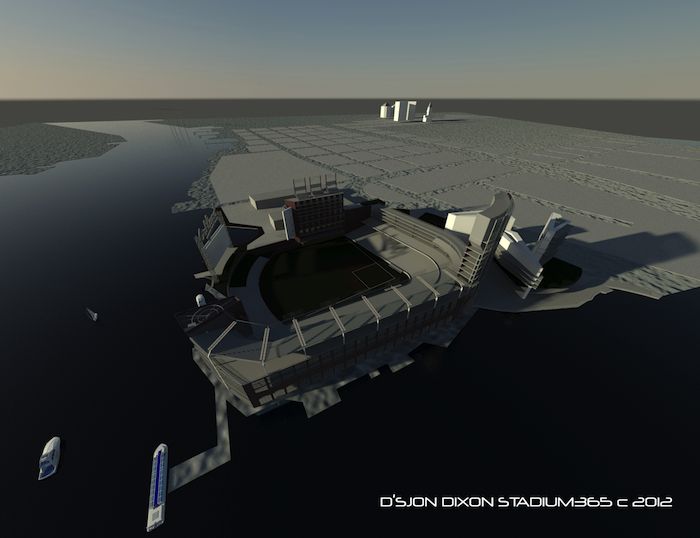
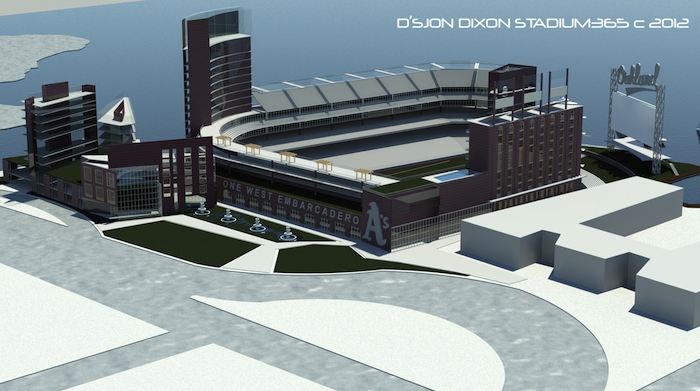
If someone – anyone – discovers a ballpark site is being discussed or presented, and he lets me know about it, I’ll take the time to cover it. Even though ownership is only focusing on one site and the City of Oakland has its own two sites in mind, it doesn’t hurt to be open-minded about others. We may find the best of breed or dismiss something entirely. Either way we’re getting educated and informed about it. I enjoy covering it, and I hope you enjoy reading about it. That brings me to the Estuary Waterfront Project, a ballpark concept by Oaklander D’Sjon Dixon. Dixon, a native East Bay guy by way of the University of Wisconsin (as he pointed out, like Bud Selig and Lew Wolff), is an excellent artist and has some brought some fresh thinking to the often static world of stadia. During his segment on A’s Fan Radio, Dixon frequently talked about his ballpark’s goals of sustainability and its ability to enhance both the waterfront and the city.

EstuaryPark-corner-med

D’Sjon Dixon’s Estuary Waterfront Project would place a ballpark on the site of Estuary Park and the Jack London Aquatic Center along the Embarcadero in Oakland

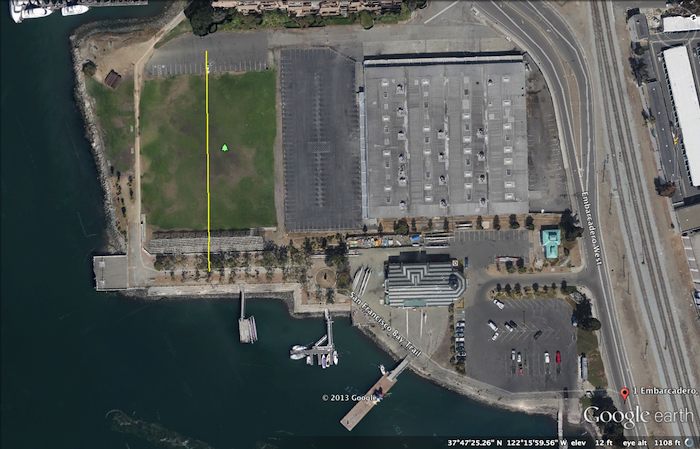
Over the years Estuary Park has aroused curiosity about its ability to work as a ballpark site. It’s located east of Jack London Square, across the tracks from Victory Court. I’ve gone there multiple times and several people have asked me about it over the years. My immediate answer to them is that it’s too small. The park measures roughly 400′ x 240′ plus some estuary frontage of varying width. The Jack London Aquatic Center, which opened in 2001, is a somewhat triangular piece of land that’s also 400′ long and 300′ wide at its widest point. JLAC has a boathouse with a community room that can be rented out for events. Rounding out the landscape is the old Cash and Carry warehouse, which the City bought through its old redevelopment arm a few years ago. That parcel, including a parking lot, measures 440′ x 340′. In all, the land (which is all city-owned at this point) totals just over seven acres.

EstuaryPark-overhead-med

Overhead picture of Estuary Park, the Jack London Aquatic Center (bottom right), and the vacant Cash & Carry building. Yellow line across field represents 400 feet.

It’s not small just because of the acreage, it’s small because of a single dimension. In the picture above, the yellow line represents a reasonable buildable width including mandated setbacks and easements for the water and the apartment complex to the west of the land (top). 400 feet is simply not wide enough to hold a ballpark. A grandstand including the concourse will measure around 170 feet deep. Add to that 50 feet from the first row to home plate, and then at least 300 feet for a short porch to right field, and the ballpark becomes 520 feet wide. There simply isn’t room for that kind of structure on the land, unless you do something unorthodox.

EstuaryPark-north-med

Water view shows footprint of ballpark extending beyond existing Estuary Park footprint

To address this, Dixon took two unorthodox approaches. First, he disregarded the Estuary Park limitations and simply built more of the ballpark out into the water. I didn’t notice this until I saw more images on the project website. Notice the second pic’s taper from JLAC to the park, and how that no longer exists with the ballpark. Anyone who has spent any time reviewing CEQA knows that building anything new over what is currently water is for all intents and purposes forbidden in California. Even the Warriors arena is getting a great deal of static for aiming to build on piers, which of course aren’t land. Additional creation of land in the Bay, regardless of purpose, practically requires an act of god to make it happen. Remember the plan to extend SFO’s runways a decade ago? That would’ve required bay fill. It died on the vine. A similar effort for this ballpark, even if it required only a 100′ x 400′ slab (1/2 acre), would be laughed out of committee or ripped to shreds by Save the Bay, Waterfront Action, or the BCDC if it ever got that far. The Bay is what makes our region distinct, and people and groups have shown that they’re willing to defend it endlessly and to the death. The other unusual step Dixon took that baseball fans noticed is that he oriented the ballpark west-southwest, so that it would face JLS, Alameda Point, and in the distance, San Francisco. As we’ve discussed several times, MLB prefers its ballparks to face east or northeast. In some instances such as domes it’s willing to have a ballpark aimed north or south. This is to ensure that the sun isn’t in the batter’s eyes during the day and to provide relatively predictable shadows during the season. Interestingly, Dixon tried to address this by placing an eight-story hotel tower in right field and a big scoreboard in center. Those measures will only work in certain sun-sky conditions. The ballpark could be re-oriented southeast to fix the sun problem, but it would take away from the view. Dixon couldn’t say what the ballpark’s capacity was or explain how much onsite parking would be there. The size of the ballpark would be “up to the developer”, though he also claimed he knew three people who could fund the ballpark. It all adds up to someone who has some great ideas and understands LEED, but knows next to nothing about CEQA. CEQA is the set of regulations that forces environmental review and places restrictions on what kinds of projects can be built in sensitive places. CEQA has led rise to hyper-NIMBYism in California. On the flip side, it has allowed our coasts to remain mostly in the public interest and not full of high-rises and private development. If this ballpark concept ever got off the ground, it would immediately have Bay and waterfront activists, open space and parks preservationists, boating enthusiasts, residents of the nearby apartment complex, and many others lined up to take it down. That doesn’t include the normal anti-stadium types or additional complications such as the PUC and other governmental agency interactions. This is the stuff that Lew Wolff talks about when he says that people can’t just point at a site and say that’s a site. There’s a ton of legwork that has to be done on each proposed site, and even more on the sites that actually get studied as alternatives. There are studies of noise and shade, seismicity and hydrology, cultural and paleontological resources, along with the more common traffic and transportation work. It’s a significant, seemingly endless amount of work, and the crazy thing is that a draft version of an EIR has not been finished for any ballpark site in Oakland: Victory Court, Howard Terminal, Coliseum City, this site or any other site. And it’s telling that Estuary Park, despite its rather prominent position where the Estuary meets Lake Merritt Channel, was never really considered a ballpark site in the past. That’s largely due to all of the issues identified in this post, and probably many more that I haven’t covered. Just a thousand feet across the Channel, HOK studied two sites at the Oak-to-Ninth (O29) site in 2001. That’s not to say that Dixon’s in the wrong. He has some great ideas, and the fact that he put he put his visual skills to use in fleshing them out can help a lot in terms of creating a real vision for Oakland going forward. If the concept ultimately serves as a catalyst, it would be incredibly productive for fans who want an Oakland ballpark and need a unified rallying point. This idea can be moved and modified to work at other sites. Dixon seems to like Coliseum City nearly as much as his own plan, as long as the A’s stay in town. If Save Oakland Sports and other groups can come to a consensus on one site that has energy behind it and has been properly vetted, they have a shot. If they stand by the City’s current vision of multiple sites being equal with no real consensus, there’s nothing to rally behind. They’re just circles on a map. —– Note: As I was writing this in the middle of the night, I did not ask Dixon for permission to use his images. I apologize for that in advance, though I also cite fair use as this is a review.

Shaikin stirs it up again

Amidst all of the Lettergate hubbub (credit to Mike @muppet151 for the term), now comes an article from LA Times writer Bill Shaikin called MLB gives tentative guidelines for potential move to San Jose. There’s nothing revelatory in the article, and nothing to indicate that anything would happen soon. Yet the headline, much like this headline, seems aimed to inflame or at the very least act as clickbait.

Then again, the information seems to back many of the assertions I made when I wrote about the territorial rights saga last month. Whether there’s real fire to this smoke or this is part of an ongoing misinformation campaign (also exercised by the other side), we won’t know for certain until it’s all over.

This got me thinking about how much compensation should cost. Shaikin notes that determination of any compensation award would be entirely within the purview of the commissioner’s office. Then it occurred to me that when Lew Wolff presented the San Jose concept, it was thought that the A’s might move to San Jose after the current Coliseum lease expires, or the 2014 season. With the A’s unlikely to be able to move until 2018, that’s four full seasons of forgone revenue at Cisco Field, while the Giants continue to lap it up at AT&T Park. That “opportunity cost” is offset somewhat by ongoing revenue sharing in Oakland, which would go away after the new ballpark opened.

With the Giants able to maximize their hegemony over the region and the A’s continuing to limp on at the Coliseum, any thought of the A’s being any kind of financial threat to the Giants has evaporated. And that, right there, may well be the compensation in a sort of unstated, off-the-books form. An extra $40 million to the A’s via San Jose doesn’t necessarily mean it’s $40 million less for the Giants. But it does mean that no money moves in the current situation, which is just fine with the Giants. $160 million for those four years, without Bud Selig having to make the tough decision? Sounds like how baseball would work.

What would happen in 2018? That would be up to whoever is the commissioner, probably not Bud Selig. Maybe there’s some nominal amount of compensation. My argument for a while has been that there won’t be, not because of what Wally Haas did for the Giants 20 years ago, but because MLB and the owners don’t want to set a price for a territory. Doing so would set a precedent for future moves into other territories. In the Giants-A’s case, the situation is unique enough to be difficult to duplicate, and by not setting a real price for Santa Clara County, the owners don’t create a market.

I’m not the only person who thinks compensation will be a trivial matter:


This is one of those times I wish I had a time machine so I could tell you how it works out. For now we wait. Forever we wait.

KHTK 1140 AM Sacramento will air 2013 A’s season

Two weeks ago, I tweeted this:

Today came this:


Which leads to this:

colbert-icalledit

There was some question as to whether KHTK would broadcast all 162 regular season games going into the announcement. Thankfully, it will be the full season. There are still some dead spots in parts of the East Bay and North Bay, but this is a huge improvement. The station may be looking to capitalize on the A’s recent success or is planning on replacement programming in case the Kings leave. In either case, it’s great news for A’s fans in Sacramento.


Save Oakland Sports meeting with Santana, Blackwell (Updated with Oakland apology)

Update 7:20 PM – Around 4:30 today, an article by the Trib’s Matthew Artz indicated that Oakland officials apologized to Lew Wolff for erroneously stating that the City and Mayor Jean Quan didn’t receive the letter. Wolff angrily replied (in ALL CAPS no less) that he did, in fact, send the letter, and later produced a letter of acknowledgment from Quan dated January 2. During the Bucher & Towny show on The Game, Townsend explained that his crew and Phoenix reporter Kevin Curran had launched their own inquiry into the status of this now mythical letter. Curran sent an email to the Mayor’s office asking for the letter since, by law, the City has to file all such communications. This afternoon the story from Artz broke, followed by an email reply from Quan spokesperson Sean Maher explaining the situation. Apparently the original email, which was also sent to numerous media, was buried in the “mountain of (holiday) furlough email” the City received. Because of this, news outlets reported on it first, giving City staff the impression that they didn’t receive it, when in fact, they did. The explanation was also a bit wishy-washy because the Mayor supposedly “eventually” received the letter, giving the impression that she didn’t receive it directly. Statements coming out of the Mayor’s office yesterday continued to press that they didn’t receive the letter. In any case, Oakland comes off highly incompetent at the very least and petty on top of it all, just because Santana decided to lash out at Wolff. That’s simply poor form. Obviously, that led to today’s apology.

—–

Monday’s much-delayed Save Oakland Sports meeting was held at La Estrellita in downtown Oakland. Though host Chris Dobbins was keen to not put City Administrators Deanna Santana and (Asst. Admin.) Fred Blackwell on the hot seat, to their credit the staffers addressed several lingering issues with some degree of frankness and a general lack of spin.

Blackwell gave an update on the state of the Coliseum City studies and EIR. The study work should be awarded in the next month, and documents should be ready by the end of the year. Because of the broad scope of the project, there will be a master plan for the 750 acres on both side of 880 and a specific plan for each side, the big focus being on the sports complex. Blackwell called Coliseum City the most dynamic project in the state in terms of size and transit access.

View from east towards Oakland Estuary. Image: JRDV

View from east towards Oakland Estuary. Image: JRDV

Based on JRDV’s newest renderings, he has a point. Much of the area on either side of the Nimitz would undergo a drastic transformation. While there would be a new football stadium in Lot B and a ballpark pushed up to the corner of Lot A, almost everything else would get torn down and replaced. Chief among the changes is a new arena, which would be placed west of 880, where Coliseum Lexus and another empty car dealership are situated. Low and mid rise buildings would be tightly packed from Oakport to the Estuary and in between the two stadia. Two new pedestrian bridges would cross 880. The BART bridge would be transformed into a huge plaza over the Union Pacific tracks. The only two legacy structures that would remain intact in the vision are the 12-story high-rise office building that briefly housed the Tribune and the newer Zhone building.

Before your eyes roll completely into the back of your head, let’s look at the three venues, starting with the ballpark. Blackwell continued previous talk of Oakland giving Lew Wolff information on Coliseum City and Howard Terminal, repeating Wolff’s continued rejection of both sites on financial grounds. Blackwell flat out said that new ownership may be required to get something done in Oakland, and that a MLB could act on behalf of a team to get a deal done. Of course, Blackwell cited Miami as an example of that working. “Working” meant taxpayers putting up 2/3 of the cost and politicians who approved the deal being run out of office. MLB wouldn’t do that unless it felt it could get several pounds of flesh. In Oakland, there is no flesh to take. The only thing MLB has offered so far is to negotiate the short-term lease at the current Coliseum.

As for the Raiders, Santana mentioned upfront that it took four months to get all of the right people (City, County, Raiders) named and set to negotiate the future stadium deal. Four months? You’d figure an e-mail thread and a conference call or two would take care of that.

In a refreshing bit of candor, Santana and Blackwell talked about the challenges facing the Raiders’ stadium piece. Santana said twice that any new project would have to bake in the $100 million of remaining debt (Mt. Davis). As I’ve mentioned before, any advantages Oakland has because of “cheap land” are wiped away because of this albatross. It also makes financing somewhat unclean, though that would depend on how current and future debt are structured. Right now, Mt. Davis debt is tied to the general fund of both City and County and was refinanced last summer. I imagine it could be complicated to restructure the debt to be paid solely by stadium/project revenues and would drive up the cost of borrowing to boot. Santana also talked about how the defeat of Measure B1 in November negatively impacted funding for Coliseum City to the tune of $40 million.

Blackwell admitted that the NFL may have a hard time giving the $200 million that Mayor Jean Quan is looking for, citing fan and corporate support. Why? The G-3 and G-4 loan programs are dependent on two specific revenue streams: national TV money and club seats. TV money is not that big a deal since it’s highly distributed, but the NFL is wary of teams running into blackouts. The Raiders are a particular high-risk case because even though the stadium doesn’t have a large capacity among NFL stadia, it’s had its share of blackouts and has a relatively low season ticket base (30,000). The recent tarping and pricing moves done by the Raiders are being done to grow the season ticket figure and reduce the chance of blackouts. In future seasons, the Raiders could increase capacity as the roll grows and the team performs better. Corporate support is another matter. Blackwell said that the NFL considers corporate support more important than regular fan support. The 49ers have done exceedingly well selling to businesses, which allowed the NFL to release $200 million for the Santa Clara stadium. Corporate support is not great in the East Bay, and the 49ers may have taken some East Bay business from the Raiders, putting the Silver and Black in a very tough position. Blackwell didn’t offer any answers on this, other than to say that the East Bay will have to step up to show it can support the Raiders in a new stadium. It’s a sobering but realistic view, not one to go rah-rah about.

On the Warriors front, Blackwell laid out the City’s case very plainly: Oakland would wait until W’s ownership got frustrated with the process of building something at Piers 30/32, then welcome the team back with open arms. With the A’s, ownership is certainly frustrated (with MLB and the Giants), not enough to run back to make a deal with Oakland. While working in SF, Blackwell saw the same strategy in place for the 49ers, only to see the team start building in the South Bay.

Things got a little strange with Santana laid into the A’s. Santana accused the A’s of playing games, claiming that the letter Wolff wrote requesting a five-year lease extension was only sent to the media, not to City or County. That’s rather confusing, because as the Merc’s John Woolfork wrote on 12/21:

If Wolff’s letter was discouraging to Oakland Mayor Jean Quan, she didn’t let on, saying in a statement that she was “pleased to receive Mr. Wolff’s letter stating his desire to stay in Oakland for five more years.”

Considering that it took four months to figure out who the players were in a negotiation, I wouldn’t be surprised if the letter was lost somewhere. One thing to keep in mind is that Wolff has already done two lease extensions at the Coliseum during his tenure. If there’s one real piece of stability here it’s Wolff, not the turnover in Oakland City Hall.

The tough part of all of this back-and-forth is that even if Oakland is resurgent as its supporters say it is, it’s not to the scale of SF and SJ. It may never be to the scale of SJ. That makes it easy to make a case against the future of pro sports in Oakland. Without some kind of miraculous public and/or private miracle to really boost Oakland, it’s hard to see how Oakland could get to its rivals’ level. Maybe the argument is that Coliseum City is that miracle. Oakland has had nearly 50 years to show that pro sports is an economic stimulator. There’s no reason to believe Coliseum City, even in its fully realized, pipe dream scenario, is the miracle Oakland is looking for. The track record – in and out of Oakland – doesn’t support it.

—–

More reading:

Note: Look at how different the two Tavares articles are. Editors rule!


Mesa looks for $8 million from AZ sports and tourism authority

The A’s and the City of Mesa are one small step closer to finalizing a deal to occupy Hohokam Stadium and Fitch Park. A month ago we did an overview of the renovation plans, which would entail a reduction in the number of seats and the addition of premium amenities such as bars.

To help cover Mesa’s $15 million commitment, the City is asking for $8 million from the Arizona Sports and Tourism Authority, the quasi-governmental corporation that runs University of Phoenix Stadium and provides funds for the renovation and maintenance of numerous Cactus League facilities. Back in January, some sort of request was expected, though the amount was not disclosed. $8 million would cover about half of Mesa’s initial commitment, with Mesa’s Enterprise Fund to cover the rest. Mesa received a preliminary approval for the request. That should clear the way for an official announcement towards the end of spring training.

Phoenix hasn’t allowed old Municipal Stadium to be abandoned. Last week, the Arizona Board of Regents approved a 25-year lease for Arizona State University’s baseball team to play at Muni, which is twice the size of on-campus Packard Stadium and has a proper press box for TV broadcasting purposes. One team’s trash is another one’s treasure, a them we as A’s fans are all to familiar with. If you love Muni, it’s sad that the A’s will only have two more seasons there. It’s good to know that Muni will have games from ASU and perhaps continued work with the Arizona Fall League.

Pay Up Or GTFO

We’ve talked a lot in the past year about how the Maloof family is broke and can’t do anything on their own, whether it’s funding their piece of a downtown arena or sell anymore pieces of the Kings without losing control of the franchise. Travel west along I-80, and you can see that Oakland and the Raiders are in the same situation. Oakland has had to rob Peter to pay Paul for the Raiders study, and the prospects for the Coliseum are bleak without some extremely creative (and probably public) financing. Al Davis had his estate structured so that his son Mark could keep control of the Raiders, but the Raiders can’t sell additional shares of the club without giving up control. Overextended as they all are, they’re still under the gun to come up with a future stadium solution that works for both parties, while not adding significantly to either party’s debt load.

That puts the Oakland/Alameda County and the Raiders in very tense dance over how much each side will pay to create an anchor for Coliseum City. Make no mistake, both sides will have to pay something, starting at $100 million depending on how extensive the project will be. If there’s a new stadium, especially one with a retractable roof, up to $200 million could be provided by the NFL. If it’s a redone Coliseum, the NFL will offer significantly less. It’s all based on the scale of the project.

For example, take the deal struck between the Carolina Panthers and the City of Charlotte. They’re partnering on a $302.5 million package of improvements for 17-year-old Bank of America Stadium. The breakdown looks like this:

  • $96.25 million from Panthers (33%)
  • $143.75 million from City of Charlotte/Mecklenburg County via a 1% food and beverage tax hike (47%)
  • $62.5 million from North Carolina (20%, pending state approval)

The actual improvements will cost $250 million, the rest will cover the establishment of a maintenance fund, costs associated with staging City/County events, and other gameday expenses such as traffic control. The stadium, which was privately built by Panthers owner Jerry Richardson, will not get any major structural changes such as the addition or elimination of seating decks. Accessibility will be improved by the addition of escalators. Video boards will be replaced. Obviously those items won’t cost $250 million by themselves, so there will be other buildouts elsewhere in the stadium. Perhaps they’ll expand concourses, build field suites, or create additional premium spaces inside the stadium. BofA Stadium still ranks as excellent in terms of design, sightlines, and amenities, so the new improvements may be what Richardson wants to make the venue a viable future Super Bowl candidate. The Panthers would be guaranteed to stay and additional 15 years if the deal is approved and improvements completed.

Sidebar: It was the enormous success of the Panthers’ initial PSL plan that helped sell the 1995 Coliseum renovation plans to Oakland/Alameda County and Al Davis. The Panthers paid for their entire stadium with PSLs and other private sources, with the City only providing a cheap land lease. Where the East Bay went wrong was in severely overestimating demand.

Earlier this morning, Andy Dolich spoke with the Rise Guys about the Raiders’ tarp news and the prospects of Coliseum City. While he continues to believe that the best place for the A’s and Raiders is the Coliseum, his vision has shifted a bit. In 2010 he talked about a new multipurpose stadium with “technology” that could accommodate both teams. Now he prefers a separate ballpark at the complex and a refurbished Coliseum, which he estimated to cost $300-400 million. My immediate response:

Considering what’s budgeted for the Panthers and the Bills, does anyone think a $300-400 million budget as realistic for what the Raiders and the NFL would want? Frankly, I think that by the time everything got going, $500 million may be undershooting it by quite a bit. Dolich also thinks the Diridon ballpark cost could rise to $600-700 million based on additional costs to get the site ready. I tend to disagree with that, though if this saga keeps dragging on $600 million is an easy reach. Even if the land is free, why would two-thirds of a larger football stadium cost half as much as a nearly half-capacity ballpark?

Also, consider that we explored a Coliseum refurb on this blog back in 2008. It would’ve involved gutting the original bowl and replacing it with a new West stand and a single deck of seats along each end zone.

2008-refurb_d

Colors denote different seating decks or phases of development

The project as described back then would’ve taken two full NFL seasons and about 18 months to complete, with the Raiders playing in a 47,000-seat temporary configuration while construction work progressed, similar to their 1995 season at the Coliseum. Complicating matters is that Lew Wolff wants an out clause in his five-year lease extension request if the Raiders begin this very type of project. That makes sense, since there’s no way the stadium could host baseball during this period.

Let’s say that a refurb could be capped at $500 million. The breakdown of costs by party could look like this:

  • $200 million from Oakland/Alameda County (Coliseum Authority)
  • $200 million from Raiders
  • $100 million from NFL

The Coliseum Authority could get their piece from land leases, new stadium taxes, or other sources. However, they have factor in the remaining $100 million of debt on Mt. Davis since it affects City and County budgets every year ($20 million annual subsidy). The Raiders and the NFL could work together to sell new PSLs, naming rights, etc.

The NFL has two, maybe three $200 million slots in its G-4 program for new stadia, one already claimed by 49ers. Another could be the Vikings or Falcons. In theirs and the Raiders’ cases, the teams have to at least match the NFL spend, which means that they have to come up with $200 million of their own. The 49ers came up with closer to $800 million, though much of that is money borrowed through the quasi-governmental Santa Clara Stadium Authority. Chances are that the Coliseum City stadium project would borrow through the Coliseum Authority.

Oakland pols will want as much private funds going into the project as possible, but the Raiders will be wary of digging themselves too deep a hole. That stands to reason because of poor suite and club seat sales over the years, along with mediocre season ticket rolls. There’s been a lot of talk about Oakland not requiring a vote, none about how much it’s willing to invest besides land and infrastructure improvements. Unfortunately for Oakland, land and infrastructure only gets you in the door these days. How much skin will each side put into the game? The answer won’t be known without a (hopefully public) discussion about what it’ll take to make Coliseum City happen.

Dodgers to become first $500 million franchise

You’re saying, “No that’s not right. Didn’t the Dodgers sell for $2.3 billion last year?” That’s absolutely right. What the headline is referring to is $500 million in annual revenue. That’s all thanks to the deal the team has signed with Time Warner to create Sportsnet LA. The new regional sports network is set to launch with the 2014 season, so for now the Dodgers will have to limp along with Fox Sports. Sportsnet LA will give the Dodgers at least $280 million per year. The deal will run 25 years and provide the Dodgers with control over the network’s programming.

To understand what this means for the franchise and baseball as a whole, let’s look at how the new TV money will fit into the team’s revenue picture.

  • $84 million in national revenue (much of it from new national TV contracts)
  • $150 million in tickets and parking (based on 3.5 million total attendance)
  • ~$30 million in additional local revenue (radio, sponsorships)
  • $280 million from Sportsnet LA

Final estimate for 2014: $544 million. That will absolutely blow the Yankees, the longtime standard bearer, out of the water. There’s only so much the team can do to affect payroll because of luxury tax implications. Still, it’s an impressive haul that has to keep Larry Baer and company awake at night. There’s nothing the Giants can do to get within shouting distance of that figure unless they cut ties with Comcast and start their own RSN.

As much as the Giants owners may cry foul, one man who isn’t is Lew Wolff. When asked by USA Today’s Bob Nightengale to comment on the Dodgers’ coming windfall, Wolff sounded circumspect:

“I don’t know the details of the (TV) deal,” Oakland Athletics owner Lew Wolff told USA TODAY Sports, “but it’s a magnificent transition in the respect of the value of baseball. I’m hoping that when good things happen, all ships rise.”

Even if the Dodgers are required to share their entire revenue, Wolff says he is not concerned about the gulf between small and large-market clubs.

“That’s always going to happen,” Wolff said “but the Yankees haven’t’ hurt baseball, in my opinion.

“They’ve made us a lot more valuable.”

Can’t hate the player or the game, I suppose.

Pending league approval of the deal, the one matter that remains is the impact of revenue sharing. A bankruptcy court ruled that the value of any TV contract subject to revenue sharing is only $84 million, not $280-320 million. MLB argues that all of the Sportsnet LA money is subject to sharing. With the revenue sharing formula set up as a sliding scale to hit big revenue teams harder, the potential impact to the league and the have-not teams could be huge. Take that $544 million figure above and remove central revenue. Under MLB’s formula, the Dodgers would have to share ~40% of $460 million, or $184 million. If the bankruptcy court ruling stands, the team would have to share 40% of $164 million, or $65.6 million. That’s a difference of $118.4 million. Now consider that the total value of funds redistributed in 2012 via revenue sharing and the luxury tax is estimated to be $400 million. That means the Dodgers alone would bump the pool by almost 30%.

And if you’re Lew Wolff and your franchise can continue to receive revenue sharing through at least 2016 while there is no new stadium, the A’s annual revenue sharing receipt could go up by at least $10 million. Without selling a ticket, A’s 2014 revenue could be in the neighborhood of $140 million – though much of that would come at the end of the year, applicable to the following year. No wonder Wolff’s supportive. It helps the bottom line and inflates franchise value, leaving a franchise sales price of $500 million in the dust. Who’s in a hurry to build a ballpark now? Then again, it’s not certain where the A’s will play after this season

FanFest grows, elbow room still scarce

When the A’s released the map for this year’s FanFest, I was curious as to how traffic would flow in the expanded footprint. Last year, the event was held entirely inside Oracle Arena. The stage was placed on the event floor, with queues at the corners for autographs and other lines along the concourses for photos, the World Series trophies, and other attractions. This time around, the A’s utilized parts of the stadium and the whole of Champions Plaza (between the venues) to create more queueing space. Did it work?

The entry gate was moved from Oracle Arena to the Plaza between the stadium and arena

The entry gate was moved from Oracle Arena to the Plaza between the stadium and arena

For the most part, spreading the crowd out accomplished its goal. Unlike last year, the crowds were much more bearable in the afternoon, with fewer choke points along the lower concourse. But there were still huge jams in the lower club, and the lines to get autographs and the clubhouse tour easily ran 45 minutes at times. The lines are a product of the 10,000-strong crowd, and there may not be much that can be done about it. Even the upper level of the arena was used for autograph lines. In the future, it’s probably best to move the whole thing back over to the stadium side. That may be difficult for the Coliseum Authority to do because the stadium holds the only annual Northern California stop of the AMA Supercross tour. Eventually, it’s all a matter of money.

Navigation signs like this one were badly needed

Navigation signs like this one were badly needed

I arrived at the arena too late to watch the player introductions, which were reportedly quite energetic. A blogger interview session was set up to start at 1, after the regular media interview session. This time we had Bob Melvin, David Forst, and Mike Gallego. We were also supposed to have Jarrod Parker. Unfortunately he was ill. No matter, as Melvin was his engaging, confident self. Forst gave all of us some roster and draft nuggets to chew on (hint: think college players), and Gags had great anecdotes about Loma Prieta and Walt Weiss. (BTW, Gallego is my spirit animal.)

fanfest13-trophies_behind

The line for pictures with the World Series trophies was long for the entire event

One particular advantage of the stadium is that it has two clubs of 20,000 and 40,000 square feet. Even the smaller of those, the West Side Club, is bigger than the two clubs at the arena combined. The one thing the stadium doesn’t have is the auditorium-like setup with the stage and the beautiful new displays at the arena. It’s nice, not a must-have.

There will always be a scheduling conflict regarding the Supercross event as long as it’s held in the stadium. The event has to be held after the last possible home playoff game for the Raiders (seriously), but with enough time for the grounds crew to clear everything out and start planting grass for the baseball season. At the same time, the organization wants to ensure player availability for the event, which can be difficult because players start reporting to camp in mid-February (the ones that aren’t already in Arizona). That leaves about a two-week window for FanFest to be held. The Giants appear to have left Supercross behind, choosing to maximize baseball operations once their bowl game is over in December. Speaking of which, the Kraft Fight Hunger Bowl will be played in Santa Clara starting in 2015. The 49ers stadium may eventually be the best place for Supercross in the future because of fewer potential conflicts on its schedule.

Stage setup had retractable seats folded up, exposing the ice rink footprint

Arena stage setup had retractable seats folded up, exposing the ice rink footprint

The Warriors are on a 4-game roadtrip around the Great Lakes, which explains why there’s no basketball floor visible in the picture above. Also, tomorrow is a scheduled concert by the band MUSE at the arena, so the arena had to be ready for a conversion to the end-stage configuration, in which a much larger stage would occupy the “open” end. This exposes the outline of the ice rink, which extends from the permanent seats on one end to the back of the retractable sections on the stage end. The first row above the retractable sections is row 17, 15 feet or more above the ice surface. If you’re wondering how compromised that would look for hockey, there you have it. Basically, if you’re at the retractable end behind the row 17, you’ll have trouble seeing the goalie or anything happening around the net.

Overall, there was a great sense of excitement and optimism this year that wasn’t present last year. Let’s all hope there’s even more reason for people to come back for next year’s FanFest.

—-

Note – Wonder what the Coliseum looks like during a Supercross? Here’s a peek.

Coliseum Authority raids scoreboard funds for Raiders study

I wasn’t able to attend this morning’s Coliseum Authority meeting. Thankfully for everyone, Steven Tavares of the East Bay Citizen was. And the story he got coming out of there was quite a doozy. The JPA approved a $1 million contract for additional studies on Coliseum City, which we figured would happen given the new pro-development makeup of the JPA board. What we didn’t see coming was just how the study would be paid for.

How the Authority will pay the $1 million in total costs for the two studies also rankled some commissioners. According to Alameda County Auditor-Controller Pat O’Connell, the Authority will “short” a $3.5 million capital improvements fund previously earmarked for a new scoreboard at O.co Coliseum. The Oakland Athletics and the Authority have been in negotiations to replace the out-of-date scoreboards, said Goodwin, and Friday’s decision may negatively impact relations with the A’s, also in search of a new ballpark.

“What’s the message we’re sending to the A’s?” Goodwin asked. According to staff, the A’s estimate the costs of the scoreboards to be $4 million. “Well, it better cost closer to $2.5 million, if we do what we’re about to do,” countered Haggerty. The alternative, said O’Connell, would be to ask the Alameda County Board of Supervisors and Oakland City Council for addition funds, a move likely unpopular on both fronts.

Maybe the shortfall will force the JPA to buy used. Whether that’s enough to get improvements or not, it’s a clear indicator that the East Bay is going forward on Coliseum City, cost uncertainty and other tenant issues be damned.

Worse, the retractable roof concept appears to have gained traction, even though it will surely inflate the project’s price tag. Assistant City Administrator Fred Blackwell was careful to note that all three current tenants would get new venues under the plan, though as usual, how that would all come together was not articulated. Even the Raiders are not a given in terms of paying for their part of the study, as the NFL and team are fashioning their own – for a stadium only with little ancillary development.

Doesn’t this seem like a lot of flailing right now? This is despite having the project under consideration for the better part of three years. Many in Oakland are quite convinced that this is the vision for the city’s future. What of the teams? Aren’t they supposed to be partners in this? Aren’t they paying the freight? Apparently that doesn’t matter, not as long as one great redevelopment plan remains out there for someone to stake their political career to.