Final 2013 Regular Season Schedule Released

If you have longed for the return the 1:05 Saturday game, your prayers have been answered. The 2013 home schedule for the A’s has, by my count, 25 1:05 PM start times, 10 of those on Saturdays. Last season there were only 16 weekend 1:05 starts. I’ve assembled the schedule into various download formats, which are available in the left sidebar towards the bottom.

A couple of changes occurred along the way to finalizing the schedule. The A’s and Giants switched their home-and-home halves of their 4-game interleague set, with the A’s half now coming first and the Giants’ half last. There are a few other quirks.

  • Another Saturday afternoon start against the Halos is set for 12:05 PM instead of 1:05. The game is on July 27.
  • The A’s head to Boston in late April, and none of the games in that weekday series will start later than 3:35 PT. Keep that in mind if you’re planning to listen on the radio during your afternoon commute.
  • With the Astros now in the division, you can nearly double the amount of 5 PM evening start times in division. In addition, in the summer Houston isn’t forced to have mostly 5:35 games like the Rangers because the Astros have a dome, so there will be more 11:10 AM getaway games than you’d expect in Arlington.

Other than that, there’s little out of the ordinary. National Opening Night is on March 31, an Rangers-Astros game in Houston.


Baer softens stance, new San Jose rumor emerges

Earlier today, Giants CEO Larry Baer was on the MLB Network show Clubhouse Confidential, reflecting on World Championships and Barry Bonds, when he spoke briefly about the A’s and their continuing ballpark problem. A couple of sharp observers were watching closely, including KCBS’s Joe Salvatore.

Fangraphs’ Wendy Thurm also picked up on this, and I was quick to reply:

I later qualified things:

So here’s what I know. Remember how Bud Selig imposed a gag order on both ownership groups going back over a year ago? That went part and parcel with the Commish bringing (forcing?) both parties to the table. Over the past couple of weeks I’ve heard from multiple sources that Selig apparently has other team owners lined up and ready to approve a move to San Jose. The remaining issue is, naturally, compensation to the Giants. Effectively, we can consider the battle half over for the pro-San Jose forces. Getting Giants ownership to back down from their no-negotiation stance is a major development. That said, determining proper compensation for the rights to the South Bay is not expected to be a picnic. Prior to this latest set of rumors, I had heard that the Giants were seeking $200 million or more to cede San Jose. In keeping with the A’s giving away the South Bay in the first place 20 years ago, A’s ownership wanted to keep the payment as close to $0 as possible. With such a huge gap, it’s hard to know what number would be mutually acceptable for both parties. They may be subject to binding arbitration, which is sometimes the case when settling team-team or team-league disputes.

The remaining issue is one of timing. Lew Wolff has been pushing out a San Jose ballpark opening date, first to 2016 and now 2018. Unless there’s some newfound sense of urgency on his part, he’s probably in no hurry to pay money for something he won’t be able to claim for several years. He’s probably not willing to make a huge lump sum payment for the privilege either. Then there’s this upcoming season, which is the last at the Coliseum without a new lease extension, and there have been no real talks about an extension to date other than Wolff’s request for a five-year deal. So there has to be determination of when to make an announcement that doesn’t impact the A’s finances and their status in Oakland in the interim. For those and related reasons, no one should expect an announcement anytime soon. Chronicle beat writer Susan Slusser checked in with Lew Wolff and another source, and got this out of the owner:

If it happens for real, we won’t hear about it until it’s all done, approved by the owners and Selig. Until then, keep dreaming.

Added: A transcribed snippet of the Larry Baer-Brian Kenny interview:

KENNY: What’s the club’s view on the Oakland A’s attempt to go to San Jose?

BAER: Our view is that it’s really up to the commissioner and the baseball processes. We’re not involved talking about it. It’s really something that the commissioner has to sort out. Obviously the A’s need a new ballpark and we hope that they get one.

Note: Clubhouse Confidential is on MLB Network today at 4:30 and 9:30 PM.

FanFest 2013 SOLD OUT

If you were waiting to buy tickets to FanFest this week or by walkup, you’re out of luck. The event’s 10,000 tickets are sold out. Just as with the playoffs, fans shouldn’t take ticket availability for granted. You snooze, you lose.

Of course, the announcement will bring about the usual grousing about how anti-fan A’s ownership is and such. That ignores two big issues.

  • The Coliseum is unavailable because of a motocross event on Saturday the 26th. Most teams that have FanFest in their own ballparks use the field as a huge concourse and staging area. The A’s won’t have that luxury since the field will be a big pile of mud. That would force fans into aisles and concourses, and we know damn well how congested the lower concourse gets at times. I once took an out-of-town friend to the Giants’ FanFest in 2008, which was held at AT&T Park. The field was also unavailable there due to a motocross event. It was a less-than-ideal situation and had all the feel of a hard hat construction zone.
  • Oracle Arena’s concourses were very congested last year at FanFest. While some people chose to sit and watch interviews, most were on the main concourse, inside the lower club, or in line for autographs. The upper deck was blocked off (familiar story). I suppose that the A’s could’ve thrown an Eric Sogard autograph line up there. Would that really help things?

2012 FanFest

When putting on one-off events like FanFest, the biggest wildcard is the impact of a previous season’s success on attendance. The Giants were overwhelmed by the response at their 2011 FanFest, causing extremely long lines and waits for autographs and World Series trophy pictures. You want to bring in as many people as possible because you can sell tickets, but you also don’t to create a situation were the experience sucks for fans. Oracle Arena would be a perfectly fine venue if it had more expansive concourses like HP Pavilion or Staples Center. That wasn’t in the cards for the 1997 renovation.

Perhaps the A’s could’ve held FanFest at Jack London Square or another large public space. That’s fine, though personally I like having the clubhouse tour right there at the Coliseum/Arena. That’s not possible at JLS. Tell you what: Don Knauss and his people could’ve offered to sponsor FanFest by underwriting the cost to hold it at JLS, right next to their preferred Howard Terminal ballpark site. Oh well. Maybe next year.

A’s look to trade Papago for a Grotto

No, we’re not talking about the BatCave or the Playboy Mansion, but it’s a grotto of a sort. The City of Mesa has approved a memorandum of understanding between the City and the A’s that outlines the terms of the A’s move to Hohokam Stadium starting in 2015. (If you haven’t been to Hohokam or would like a visual refresh, this photo blog is a good start.)

Per the terms in the MOU, the A’s would stay at a renovated Hohokam for 20 years initially, though they have the chance to break the lease after the 15th year as long as they pay $1 million for each year they don’t stay. There are also two 5-year options the team can exercise after the 20-year term is up. Hohokam Mesa was the A’s spring training home from 1969-78, much of the era spent at a place near downtown known as Rendezvous Park. After spending a few years in Scottsdale, the A’s moved to Phoenix Municipal Stadium. The 2013 season marks the 30th spring training spent at Muni, with only one more before the move 8 miles east to Mesa. The Cubs were granted major improvements to Hohokam/Fitch in 1997.

At 12,500 (or 13,000) seats, Hohokam has arguably the largest capacity of any spring training ballpark, Cactus or Grapefruit League. That stands to reason because the home team has long been the Cubs, whose large, multigenerational, national fanbase and eager snowbirds regularly put up league-leading attendance figures. For the A’s some of that capacity won’t be needed, so some of the seating sections will be removed or reduced in size, to be replaced by more premium, revenue-generating facilities.
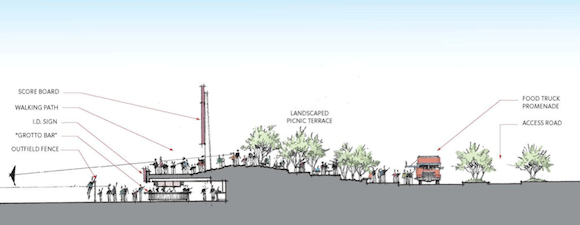
Renovated area beneath LF scoreboard includes “Grotto” bar at field level

Renovated area beneath LF scoreboard includes “Grotto” bar at field level

The biggest major change will be in left field, where the expansive berm will be significantly reduced if not altogether eliminated. Instead there will be two standing tiers, the lower one containing a dugout-like “Grotto bar”. This bar will be at field level, which means that the solid fence in left will be replaced by chain link to provide fans views from the bar. The upper tier leading up to the scoreboard is a smaller standing platform. Behind the scoreboard is a terraced picnic area leading down to a staging area for numerous food trucks. Though it’s not mentioned, I imagine that the scoreboard itself will receive some upgrades.
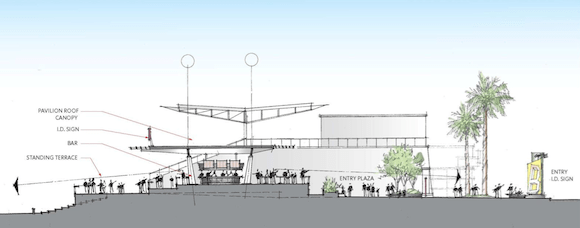
Down the LF line a set of bleachers will be replaced by a covered pavilion

Down the LF line a set of bleachers will be replaced by a covered pavilion

Another bar will take the place of a freestanding bleacher stand near the left field corner. It will be part of a covered pavilion whose standing terrace will replace several rows of seats down the line. The setup is very reminiscent of Raley Field’s beer garden, which is also down the left field line.

The drawings above are preliminary and are subject to change. They were the only two from the City Council presentation, with another slide devoted to changes at the nearby training facility, Fitch Park. Even with the reduced seating, I figure the capacity will be at or around 10,000, which would put Hohokam in the middle of the pack as far as the Cactus League goes. Unless the A’s make other changes, it appears that the other berm areas in center and right field will remain intact. Altogether, it’s a nice set of improvements from not only PHX Muni, but also from the current Hohokam. There will still be inexpensive and family-friendly options, along with more swanky facilities for fans. Fitch Park will get a clubhouse expansion. Even with the fairly restrained upgrades the A’s are getting compared to other teams with new spring training complexes, the Hohokam/Fitch combo will be superior to the Coliseum. There’s all sorts of just not right in that.

—-

The funding part is simple and straightforward. As we discussed two weeks ago, Mesa is paying for the first $15 million of the project. Mesa and the A’s split the cost from $15 million to $20 million, and the A’s will pay for the rest. What’s interesting about this is that the A’s aren’t paying any rent. For the three month period (January 15 to April 15) that the A’s occupy Hohokam/Fitch, they pull in and keep all revenues while paying for all costs. City controls revenue and pays for costs during the other nine months. Those costs include concessions, security, and parking personnel plus utilities. During spring training the A’s are responsible for repairs and maintenance inside the walls and fences so to speak, whereas City takes care of the surrounding grounds. Both sides are to contribute $25,000 annually to a capital improvements fund during the lease term, but that’s it as far as yearly obligations. Mesa has used a similar agreement for the Cubs for years.

Compare that to the now-dead lease extension agreement negotiated for PHX Muni. The A’s would’ve paid up to $500,000 per year plus a $50,000 capital improvements contribution through 2025. Assuming operating costs isn’t small potatoes, but it’s a preferable arrangement for any team since it has control over everything.

Why would the City of Mesa do the deal? City has been wanting to keep Hohokam/Fitch up-to-date even after the Cubs leave for nearby Riverview Park. They did a study to determine what the costs would be in three scenarios:

A: Do upgrades needed to make Hohokam/Fitch attractive for another team in the future, including teams currently in the Grapefruit League
B: Cease operating Hohokam/Fitch as a spring training facility and run it only as a public park
C: Do upgrades up to the A’s standards request
Turns out that the annual cost for Scenario C was $773,231, slightly more than half of Scenario B ($1,490,228) and slightly more than a third of the cost under Scenario A ($2,310,406). Those figures don’t include debt service on the $15-20 million of improvements. By that sort of limited perspective, having the A’s at Hohokam is better than the alternatives. It leaves one lingering question: Who’s paying for the $15-20 million?

Tourists and locals, that’s who. Funding for both Hohokam/Fitch and the Cubs’ $99 million Riverview Park (“Wrigleyvile West”) project will be covered by Mesa’s Enterprise Fund, which is essentially a big redevelopment fund bucket. Debt service is paid for by utility taxes on the 439,000 (bigger than Oakland) residents. Last year Mesa was able to refinance the existing fund debt, which could save Mesa up to $72 million over the next five years. Some money may also come from the Arizona Sports and Tourism Authority, the state-authorized body that boosted hotel and car rental taxes to help pay for numerous Cactus League ballparks and the market’s crown jewel, University of Phoenix Stadium.

While it’s not apples to apples, there may be some comparisons between the Hohokam/Fitch deal and whatever may be negotiated for the A’s at the Coliseum. Short of the Coliseum Authority giving the A’s an extension of the current deal and throwing in some improvements on top of that (fat chance), I can’t see how the A’s could get a better deal than what the team is getting in Mesa. Unless you’re the Cubs, that is. The Cubs are getting this:

Lew Wolff and Flip Maritz own a hotel in Mesa. Unfortunately for A’s fans, it’s 3.5 circuitous miles away from Hohokam. Luckily for Cubs fans and Maritz Wolff, the Hyatt Place is only a mile from Wrigleyville West, just off the top of the rendering above. I guess if Cubs fans are stuck with an eternally heartbreaking team, nice surroundings can provide some consolation.

=====

P.S. – If you’re going to the Valley of the Sun to catch some spring training action and you’re headed to Hohokam, you might want to check out the Mesa Historical Museum, which has an exhibition called “Play Ball: The Cactus League Experience“. The museum is located in downtown Mesa, 2 miles from Hohokam. Exhibits will include items and photos of the A’s first stay in Mesa.

Suggestion: Buy Used

Part of the game in the world of new stadia is the stadium improvements fund. It’s a set aside of stadium revenues from the partnership of team and city/county that is used to fix plumbing, lights, and seats. It’s also used in many cases to change other non-critical items that become obsolete over time, so that the partners can keep up with competitive venues and enhance fan experience. By enshrining the terms in a lease agreement, both sides can set proper expectations about what kind of maintenance and upgrades a venue will get over the short and long term.

To that end, the NFL stadia in Denver and Houston are getting fancy new LED displays as part of a $30 million audiovisual makeover. This makes sense both stadia are at least a decade old and display technology has advanced rapidly over the last several years. In Denver, the horseshoe shape at Sports Authority Field at Mile High means there are three boards of different sizes: one big board (27′ x 96′) on the open south end and two half-size boards in the north corners of the upper bowl. SAF@MH also lacks ribbon fascia boards, so one or two levels of LEDs are in the works there. Both the big displays and fascia boards will be capable of HD.

At least Denver’s displays are LED-based. Houston’s Reliant Stadium uses old CRT technology (like the Coliseum) and is finally moving into the 21st century with fully digital LED displays from Mitsubishi. The new displays will replace the old mix of incandescent, CRT, and static displays tucked under the stadium roof. When completed, each one will measure 52.5′ x 277′, officially longer and bigger than the center-hung boards at Cowboys Stadium (also built by Mitsubishi). Since the display is so long, only a portion of it will be used for replays, unlike Cowboys Stadium’s 16 x 9 boards. Despite that limitation, the new displays promise greater presentation flexibility for in-game information, video, and ads.

Compare that to what Raiders and A’s fans continue to live with at the Coliseum, and it starts to get depressing. Better than telling you, I’d rather show you via an infographic by reddit user dbeat.

nfl_scoreboard_sizes

Comparison of video displays in NFL stadia. Reliant Stadium’s new board will soon be the biggest. Denver’s is mid-sized. The Coliseum’s are among the smallest.

With the sad state of displays at the Coliseum and the cycle of change elsewhere, I got to thinking, What happens with the old displays? I’ve sent an inquiry into Denver’s Metropolitan Football Stadium District to find out (I’ll update here if I do). Some displays end up getting donated. Do they also get resold? LED lifespan is 50,000 hours, so unless you’re going for greater resolution the displays themselves should last the life of the stadium. Over 12 years at SAF@MH, it’s likely that the scoreboards were used only 500-1,000 hours per year.

Old displays at Denver stadium

Old display at Denver stadium

Denver would seem a prime candidate to get the scoreboards at a very good price. Why hated AFC West rival Denver? There are a few convenient reasons.

  • If the two north boards are put together into one board, the result is that each of the boards (north/south) measure 27′ x 96′. That would fit very nicely into the Coliseum’s existing scoreboard frames, which are about 40′ x 140′ not including the arched caps. Whether they’re each used as one contiguous display or split into two, it can work well while retaining static signage panels that currently populate the surround.
  • Since the both the Coliseum’s and SAF@MH’s old displays were manufactured by Mitsubishi’s Diamond Vision unit, it stands to reason that there will be some degree of interoperability.
  • Both the A’s and Raiders would welcome additional advertising opportunities on crisper displays.
  • SAF@MH’s monochrome scoreboards are also being replaced and even those would be an upgrade on what the Coliseum has.
  • As a secondhand product, the displays could be acquired at a significant discount, perhaps $1 million or less.
  • If the Coliseum is to be used for only 5-6 more years, it makes little sense to spend tens of millions on new displays.
coli-scoreboard_twilight-cropped

Current CRT video board and scoreboard system at the Coliseum

Seems like a decent idea, right? The difficulty comes when working among the Coliseum Authority, the Raiders, and the A’s. It would make sense to put something like this into a five year capital improvements plan. How it gets paid for, and how new revenues get divided, is the tough part. Divvying up signage revenue has long been a sticking point in the relationship, with the A’s getting the lion’s share of in-stadium revenue since the 1995 renovation. With all leases expiring, there’s a chance at a clean slate in negotiations. Would Lew Wolff forego an A’s-tilted ad revenue deal in order to get five fairly hassle-free years and opt-outs on a lease extension? Sounds like a deal point to me. It’s just a suggestion.

Imagine a Coliseum without Mount Davis

Following up Monday’s post about Mt. Davis, here are the specifications for the Coliseum if the Raiders did not come back in 1995. The ballpark boom had begun, but the Coliseum hadn’t yet been completely overshadowed by the retro mallpark. In 1993, the Coliseum complex won a statewide architectural award. Improvements conceived by both the Coliseum and the A’s were feasible and small in scale. Compared to the $80 million $100 million $200 million renovation for the Raiders, the changes for the A’s would have been fairly modest at the outset.

4. PLANNED STADIUM MODIFICATIONS

4.1 Stadium Improvement Plan. Licensor (Coliseum JPA) and Licensee (A’s) have approved a scope of improvements to the Stadium as set forth in Exhibit C. In the event the Raiders have not entered into or agreed to enter into an agreement for more than ten years with Licensor for the Raiders’ use of the Stadium on or before September 30, 1995, Licensee shall have the right in its sole discretion by notice given not later than September 30, 1995, to cause Licensor to complete Stadium improvements as follows:

[a] Construction of up to 5,000 club seats and a related club lounge, for completion by March 31, 1996, and as more particularly described in Exhibit C. The total cost of the stadium improvements plan will not exceed $10 million. Licensee’s representatives will be included in all design, planning and construction meetings.

[b] Stadium improvements described in [a] above will be financed through the issuance of bonds. The bonds will be authorized in 1995 and sold as construction is implemented. It is understood that Licensor’s existing bonds will be deceased.

[c] Licensee shall have the right, at Licensee’s sole cost and obligation, to finance and cause Lincesor to construct such additional Stadium improvements as Licensor and Licensee shall mutually agree in connection with the construction of the Stadium improvements and finance plan described above.

[d] On or after November 1, 1995, either Licensor or Licensee may request the other to negotiate in good faith to approve, in the sole discretion of both parties, respectively, a Stadium improvements and finance plan to provide for the construction of improvements in addition to those set forth in Section 4.1[a] and [c] above, in an amount not to exceed $60 million and under financing terms mutually agreeable to Licensor and Licensee, provided however, to the extent permitted by such financing, Licensee shall recover the actual cost of additional Stadium improvements financed by it under Section 4.1[c] above. Licensee’s sole remedy for the parties failure to approve such a plan shall be the early termination rights described in Section 7.3 below.

[e] In order to provide amortization of the existing bonds issued by Licensor and new improvement bonds, Licensor’s revenue from the Stadium naming rights, club seat premium, together with ticket surcharge revenues would be deposited into an improvements construction fund beginning in 1995.

[f] In addition to stadium improvements, a stadium maintenance fund shall be established and funded by Licensor in the amount of $500,000 annually beginning in 1996 and escalated at 5% per year thereafter. Stadium major maintenance would be paid for from this fund annually. In the event that the transfer in any year is less than the required annual contribution, then Licensor shall deposit the shortfall. Surpluses in the improvements construction fund which are available for the transfer shall be used to offset prior years deficits.

Effectively, the renovation project would have only consisted of what is now known as the West Side Club, for $10 million ($1.2 million/year). Another $50 million could have been available over time, which would’ve been used to replace all of the orange seats and bleachers, redo the clubhouses (maybe the A’s would’ve taken the old Exhibit Hall space instead of the Raiders) while adding a batting cage, build more field boxes, maybe even remove the outfield stairs and move the bullpens there. New scoreboards would’ve required a new agreement and new funding.

All of that would’ve been nice for the 10-year lease that was under consideration. By the end of that lease, December 2004, the pressure would’ve been on to replace the Coliseum. Why? At the time, all of the old cookie-cutter stadia were in the process of being replaced. While Three Rivers and Veterans didn’t get any improvements prior to their replacement, Busch Stadium was made more baseball friendly after the football Cardinals left for Arizona and the Rams played half of the 1995 season at Busch. That arrangement lasted a decade, setting up a transition period until the current Busch was funded and built.

What we don’t know is whether or not Oakland and Alameda County would’ve given up on trying to get the Raiders back. My guess is that the various forces working to bring the team back (Don Perata, Elilu Harris, George Vukasin Sr., Scott Haggerty) would’ve kept trying, at least until Harris gave way to anti-stadium Jerry Brown. Who knows? Oakland by now may have completely established its identity as a baseball town, instead of dealing with two unsatisfied teams in, what Monte Poole called, “a house without distinction”.

Mount Davis specifications

With all this talk of lease extensions, I decided to go back into the original 1995 lease the A’s had at the Coliseum (for my own edification). The document, which was signed by Wally Haas as he was selling the team, goes over two specific scenarios: what happens for the A’s if the Raiders return, and what happens for the A’s if the Raiders don’t return. That latter part will be covered soon. For now, take a look at the language that eventually resulted in what we now know as Mount Davis, the 10,000-seat, 90-skybox grandstand in the outfield. The language is copied verbatim, typos and all.

B. CENTER FIELD GRANDSTAND STRUCTURE PERFORMANCE SPECIFICATION

Design Intent:

Constructed in the 1960s, the Oakland-Alameda County Coliseum has its origins in the symmetrical, reinforced concrete modernist style engineering structure that was prevalent throughout this period. Of these parks, Oakland is singularly the best baseball park. This is a great place to see a game with the fan close to the action and comfortable in spite of the facility’s size. Seating surrounds the field, is intimate and humanly scaled. Circulation reinforces one’s location and orientation to the field at all areas nd levels.

The proposed centerfield grandstand structure must reinforce this environment. It cannot be a monolith looming over the outfield fence. Other than the playing field, it will be the natural focus of the stadium. Therefore, the structure’s size, shape and mass must provide a positive contribution to the stadium’s overall design.

Mass:

Mitigation of the structure’s mass, vacant stadium seating and vacant luxury boxes must be part of the overall design concept. The upper level seating shall be covered in the baseball configuration, this level and potentially elements of the vertical elevation shall incorporate team graphics, back-lighted advertizing signage and regional artwork to break up and reduce the structure’s scale. These elements shall become an integral part of the structure’s overall appearance. However, mitigation cannot rely on coverings and signage alone.

The structure shall relate to the existing stadium’s size and proportion, not exceeding it in overall height. This structure shall incorporate league scale design elements: a diverse, articulated, angular building profile with strong shadow lines, which diminish the overall mass of the structure. It shall present an appropriate character of scale, proportion, facade detail and material to compliment the park. The structure shall also incorporate small scale design elements to enhance the seating, circulation and the overall pedestrian environment through texture, materials, color and detail.

Scoreboard and video boards shall be placed on the structure for optimal baseball viewing. These will include:

• A scoreboard/message board fully populated scoreboard, zone mapped and broke out as required for both video and text display.
• A separate video board.
• A manually operated out-of-town scoreboard.

BART Entry:

This must be an appropriate statement of entry, creating a welcome statement with a sense of place, even though it is not the main entry to the stadium. The BART bridge shall terminate at a formal gate and lead to a roomy concourse(s). The plus 33 concourse should connect flush with the rest of the stadium at that level or by ramp. The plus 6 level must be continuous around the entire stadium. The BART entry shall present a pedestrian scaled environment low height lighting, attractive street furniture with integrated signage, attractive fencing to screen from view the slew/industrial beyond and mitigation of the overhanging upper deck structure. These pedestrian areas shall be part of a cohesive circulation system that leads the visitor to all services, facilities and concessions stands.

Program Elements:

Program elements shall be considered which influence the massing and appearance of the building. The outfield fence shall maintain its general configuration, 8 feet high padded, 300 down the lines, 375 at the power alleys and 400 at deep centerfield. An asymmetrical angular fence is encouraged. The 5000 “bleacher” seats shall be as close to the field as possible. These seats must have unobstructed sight lines of the field consistent with the existing seating areas. This seating shall be continuous behind the fence, interrupted only by the batter’s eye. The batter’s eye shall match the existing 40 feet high x 96 feet wide; height to be confirmed. Best efforts will be made so that the first row of seating shall be no more than four feet above the top of the fence, possibly separated from the fence with landscaping.

Two years after the structure was completed, Steve Schott and Ken Hofmann sued the Coliseum JPA over lost revenue related to the Mt. Davis addition and the compromising of the Coliseum as a baseball venue. The parties eventually settled, resulting in the sweetheart lease the A’s currently have.

“Temporary”

So what does “temporary” mean anyway?

For Lew Wolff, it means five years after 2013 spent at the Coliseum, followed by what he hopes is a smooth move to San Jose.

For Mark Davis, it means five more years at the Coliseum while a new Coliseum and village are built next door.

For the Coliseum Authority (JPA), it means… well, they haven’t exactly articulated what that means, have they? It may mean one new stadium, or two. It means having the Raiders and A’s pay more to stay temporarily at the Coliseum in order to reduce the subsidy Oakland and Alameda County currently pay to keep the place running. How much more? We don’t really know. It’s a delicate balancing act. In the previous post I alluded to Davis and Wolff not wanting significantly higher rents at the stadium, yet that’s exactly what will be required if the JPA is to reach its goal of offsetting costs better.

The Merc’s John Woolfork and the Chronicle’s John Shea have dug into the lease matter more, getting reaction from local pols.

Woolfork found that the lease extension talk started in July 2011, when A’s President Michael Crowley first requested a lease extension. With the negotiations going very slowly, the surprise is the MLB tried to help act as an intermediary in the discussions but was rejected by the A’s.

Shea’s big find was that Wolff, while preferring to stay in Oakland over a move to a “temporary home venue”, admitted that “there are options” for such a transitional home.

Those two new pieces of information are huge. Whether or not you believe Wolff is bluffing with the temporary venue idea, he just played that card. He’s thinking about it. And you can bet that he has at least one location in mind. It’s out of the standard team owner playbook. Many will feel that the A’s are locked into the East Bay thanks to territorial rights, and that more than anything should dictate how the A’s and MLB act. Most of the time, these positions are merely negotiating ploys to extract concessions. Playing the temporary venue card is a sure sign of desperation, which Wolff has displayed for some time. If it forces MLB to act on his request or the JPA to commit to a Raiders stadium that would remake the Coliseum complex (per the letter), it will have been well worth it. If it results in a “mutually beneficial” five year lease, it buys everyone time to figure out the next step.

There is a value proposition in play. In the short term (the length of the extension), the A’s will be averse to a lease that hurts their revenue position. For instance, the Warriors’ lease at Oracle Arena had the team pay $7.5 million for the 2011-12 season. That figure includes revenue sharing of club seat and suite sales, which helped finance the arena. The A’s rent for 2012 is $1 million, and they get to keep parking and some ad/concession revenues. If the A’s were forced to pay something closer to what the Warriors pay while giving up revenue, that’s up to a $10 million hit to team revenue, or -6% or so annually. Suddenly the lease extension isn’t just a matter of convenience, it’s a real question of cost-benefit. There is a point at which it costs too much to stay at the Coliseum, especially if there are no agreements on improvements to the old stadium such as scoreboards or even plumbing (those resources would be used on new stadia). I don’t think the A’s should get the sweetheart deal they’ve been on since 1995, but this seems like too much considering the age and state of the Coliseum.

That’s how the specter of a temporary home comes closer to being real. If the A’s are faced with having to forego $10 million in revenue each year for five years, would it make sense to invest that money in a different option? A temporary option?

One more to consider: If you attended a Warriors home game this year, you probably noticed the lovely, brand new high-definition, center-hung scoreboard. It’s part of an $8 million improvement plan at Oracle Arena that was implemented to upgrade technology. Half of the project was paid for by the W’s, and the rest was split between the JPA and AEG, the new arena operator. The bidding process for a new operator for both the Coliseum and Arena included a requirement that the winning bidder pay for improvements at Oracle Arena. The vendor for the arena’s technology package? Cisco. For whatever reason, there was no request to make any additional improvements to the Coliseum. New anything at the Coliseum could help convince either of the tenants to stay.

A’s ask for 5-year Coliseum lease extension (Updated to include Wolff’s letter)

At the end of the 2012 regular season, the Chronicle’s Matier and Ross wrote that the Coliseum Authority sent A’s owner Lew Wolff terms of a five year lease extension at the Coliseum. The purported catch was a $50 million exit fee should the A’s leave early for San Jose. Now the LA Times’ Bill Shaikin reports that Wolff has sent a letter to the Coliseum Authority (JPA) asking for – that’s right – a five year extension.

In a letter to the body that governs the Coliseum, A’s owner Lew Wolff agreed to keep the team in Oakland for at least five years “regardless of the outcome of our efforts to obtain a new facility in the City of San Jose.”

In the world of stadium negotiations, these are chess moves. It’s important to try to look multiple steps ahead. There are a lot of ways this could play out, though there is a complicating factor which I’ll get to in a bit.

First, as onerous as a $50 million early termination fee sounds, if Wolff is pushing back the opening date of Cisco Field to 2018 it’s not that big a deal, since Wolff won’t have any motivation to get it done early. On the surface, the JPA may be insistent on including the clause. Wolff may be just as determined to get it removed, simply because of the flexibility it provides. Why be encumbered by $50 million when you don’t have to be, and when historically that hasn’t been the case?

If there’s a threat, it comes in the form of something else Wolff alludes to.

“The A’s organization certainly prefers to remain in Oakland for the next five years rather than being forced into looking elsewhere for a temporary home venue. If possible, we should retain the 130 full-time jobs and the almost 800 union jobs that encompass a full baseball season, the fun of the A’s, and Major League Baseball in Oakland for five more years.

“I believe the A’s have a great deal to contribute to the area for the next five years, and even thereafter.”

“Being forced into looking elsewhere for a temporary home venue” is the threat. In August I wrote about the possibility of the A’s not being able to come to terms after 2013. It forces Commissioner Bud Selig’s hand. From the looks of things, MLB so far hasn’t been involved in lease discussions. This may force Selig to get involved directly, from negotiating the extension to figuring out a long term solution, which has been going on since Wolff joined the A’s in 2003.

Even if the parties (including MLB) only focus on the short-term, there is one other factor that comes into play: the Raiders. The Raiders have had more productive talks with the JPA regarding a lease extension, and something was supposed to be announced this fall, yet nothing has. The A’s currently pay higher rent than the Raiders, but the Raiders are obligated to share a small amount of in-stadium revenue annually, making their lease payment technically higher than their Coliseum-mates. Both the A’s and Raiders are keenly aware of each others’ desire to make whatever lease at the Coliseum as low as possible. Yet the JPA wants to rework the terms to help pay off more of the debt service and operating costs, which Bloomberg mentioned yesterday amount to a $17 million annual subsidy.

If the A’s are being asked to pay a $50 million exit fee, are the Raiders being asked to do the same? Are the terms on the table for both teams comparable, or do they favor one team over another? Neither owner wants to feel they’re being ripped off, and neither wants to feel locked in if it isn’t necessary. Strangely, the Raiders have more leverage than the A’s, since they could bolt for Santa Clara or even LA if things don’t work out. The A’s don’t have that luxury.

Just as the City of Oakland and Alameda County have to approve lease terms for Coliseum tenants, MLB has to at least informally green light any lease terms for the A’s. Selig will frown upon anything that looks like it’s trapping or penalizing the A’s, since a bad lease could negatively affect the A’s franchise value.

Maybe an A’s lease extension that’s agreeable for both them and the JPA will materialize quickly. Maybe not. If I’m reading the tea leaves on Wolff’s statement, though, he’s forcing the situation. And he’s doing it by not formally doing much at all.

Update 2:45 PMBANG got Wolff’s letter and posted it. I’ve copied the whole thing for your convenience:

December 21, 2012

To all concerned and interested:

I believe our organization has been and continues to be a positive member of the City of Oakland and Alameda County community.

Our policy regarding the JPA is to agree on the most mutually beneficial lease relationship to remain in the O.co Coliseum. To that end, we seek a lease extension that will allow us to remain here for the next five seasons. Our president, Mike Crowley, who has administrated our lease for the past 16 years, has full and complete authority to enter into a lease agreement that we hope will be beneficial to our fans, the City and County, and our organization.

Yes, we need a new baseball venue, and sadly, we have not found any path to one in the City of Oakland or in the City of Fremont. None of the three City of Oakland administrations that we have operated under has ever presented a realistic approach for a new ballpark to us. The lack of viable options here is not the fault of any public administration or private party, but rather is due to broader circumstances that impact the elements needed for a Major League Baseball venue.

Regardless of the outcome of our efforts to obtain a new facility in the City of San Jose, we would remain at our current venue for a minimum of five years. If an opportunity arises for the JPA to implement a new or renovated stadium for the Raiders or any other tenant, our lease would have a cancellation clause in favor of the JPA.

I stress that the A’s organization certainly prefers to remain in Oakland for the next five years rather than being forced into looking elsewhere for a temporary home venue. If possible, we should retain the 130 full-time jobs and the almost 800 union jobs that encompass a full baseball season, the fun of the A’s, and Major League Baseball in Oakland for five more years.

I believe the A’s have a great deal to contribute to the area for the next five years, and even thereafter. I further believe, and hope that having the benefit of a five year income stream and the jobs our organization brings in will be viewed as a benefit to the City and County. Simply, Mike Crowley needs an authorized party with whom he can negotiate and complete a new five year lease between the JPA and the A’s.

Thank you for any time and consideration you can afford this request.

Sincerely,

Lewis N. Wolff

LNW: sk

I have to reiterate that the JPA had sent the A’s lease terms before the end of the regular season, which Wolff obviously has not found acceptable, otherwise we’d have an announcement about a lease deal. The ball is now in Oakland/Alameda County’s court.

FanFest 2013 on January 27

Today the A’s announced that FanFest will be held on Sunday, January 27, 2013, from 10:30 AM to 3:30 PM. It appears that, like the 2012 event, the FanFest will be held mainly in Oracle Arena, with the A’s clubhouse in O.co Coliseum open for tours. It was a good setup, though lines tended to be long for autographs.

Tickets will be available to the public on January 11 for $10. Those who have placed a deposit on season tickets can buy tickets a week earlier, on January 4, for $5. Children 6 and under will be admitted for free.

The FanFest page warns that the event may sell out, which seems unlikely but with around 10,000 showing up for a team that at the time was pegged to lose 90+ games, interest should be greater coming off a blockbuster season. Oracle Arena’s capacity is 20,000.

I’m happy to pay the $5, but if there’s a blogger interview session like last January, I’m doing that (hint-hint, Adam Loberstein). New shortstop Hiroyuki Nakajima is expected to attend. It would also be great if Yoenis Cespedes was available for the blogger session too. Remember that Cespedes was signed in February after FanFest, as he was working on establishing residency. Cespedes will be at FanFest, along with half of the bullpen including Grant Balfour, Ryan Cook, Pat Neshek, and starter Tommy Milone.

Now, if you’re wondering about the Coliseum stadium, you should know that an AMA Supercross event is scheduled for the stadium on January 26. That’s practically an annual event on the tour, which allows the Coliseum’s grounds crew to plant new grass for the baseball season during the downtime between the end of the NFL season and MLB Opening Day. The arena is holding a concert by the British band MUSE on January 28, the day after FanFest.

If you didn’t have a chance to go to the last FanFest, you really should go to this next one. The level of optimism in the building should be off the charts high. The event is also an hour longer this time around.