It’s that time of year again. The Super Bowl takes over the nation’s imagination, followed by baseball, waking from its annual hibernation. That means FanFest, which will be held on Sunday, February 8. Last year’s FanFest was also held on February 8, which was a Saturday. The Giants chose to hold their FanFest on February 7 this year, so this avoids a date conflict.
BlogFest will also be held again, starting at 10 AM. Like last year, bloggers will be taken to a suite on the East Side, where we will be interviewing:
David Forst
Jesse Chavez
Ike Davis
Oh, the questions for Forst will come aplenty. The blogger interviews are usually held after the regular media session. And of course, there will be the regular player interviews and introductions held inside Oracle Arena. Tickets are still available online. Since the event was restarted in 2011 it has sold out. The Coliseum will also be used again, which will give everyone an opportunity to check out the state of the scoreboard project – though the system is not expected to be fully built or operational by Sunday.
A fairly heavy storm is forecast for the weekend in the Bay Area, so the soggy FanFest day tradition should continue. Check the weather reports and plan accordingly.
If anyone wants to meet up inside the Coliseum (not the arena which will be cramped) to talk stadia and Coliseum City, let me know.
McKibben says his goal is to “keep the A’s and Raiders in Oakland.” Having someone with sports experience not limited to negotiating leases is important for the Coliseum’s future.
Andy Dolich endorsed the hire, and McKibben apparently had several recommendations, far above and beyond the previous candidate, the controversial former Assemblyman Guy Houston.
Having McKibben in place will allow the JPA to move forward in concert with the City of Oakland and Alameda County, the partners in the JPA which have been at cross purposes throughout the Coliseum City process for the last three years. If McKibben can lead a team including McClain and the City and County working on the deal terms, they’ll have a much better chance at success. It’s a much better situation than a year ago.
—
More interesting is a tidbit from Steven Tavares at East Bay Citizen, referring to AlCo Supervisor Scott Haggerty:
However, Haggerty made it clear Raiders ownership does not favor an extension of the ENA. Over a lengthy lunch recently with Raiders owner Mark Davis, Haggerty said, the team lobbied for the county to vote against the extension with New City. Progress is being made, though, added Haggerty.
Why would the Raiders want to kill the ENA? They wanted to provide a competing bid at the last minute, which may indicate that they already have a developer on board for whatever they’re planning. If the Raiders (like the A’s) now want little to do with Coliseum City and New City Development, it would make sense to cut the middleman out altogether, though that would open up a lot of questions about how to steer redevelopment of the Coliseum. The EIR and Specific Plan are moving forward, and the latter piece is valuable to Oakland for planning purposes. But the feasibility studies that have been done on Coliseum City to date would be lost. New applicants like the A’s and Raiders would commission their own supporting work. It’s almost moot at this point since the ENA is set to be extended again, yet from now on it’s worth questioning the value of New City’s place in all of this if both teams would rather go it alone.
If the teams would prefer to not work with the Coliseum City team, it’ll be up to McKibben and the JPA to figure out a way to bring the teams together. In all likelihood, both teams will provide competing visions with little-to-no room for each other. How the two visions can be merged to both sides’ satisfaction along as the City/County – well, that’s not like scaling Mt. Davis. It’s more like trying to climb Mt. Everest.
—-
P.S. – Remember those shady looking campaign contributions from Lew Wolff to Rebecca Kaplan during last year’s mayoral campaign? Turns out they were legal. Oh well.
P.P.S. – The Orange County Register reports that Mark Davis teamed up with an investment firm last September in order to buy the Hollywood Park site. That attempt failed.
P.P.P.S. – Mark Purdy has a different telling of the ENA situation.
Info from a Raider source I trust: That report from Supe Scott Haggerty about Raiders not wanting Kephart to get ENA extended is not true.
This picture, posted to the Dodgers Photogblog on January 7, depicts new shortstop and Alameda native Jimmy Rollins yukking it up with GM (former A’s exec) Farhan Zaidi. There’s something else odd about this photo, which, when combined with those other two pieces of information, makes the photo look like an unintentionally epic piece of trolling. Unintentional, right? Yeah, completely unintentional.
When Coliseum City was originally conceived it was supposed to look something like this when fully completed, 800 acres in all.
800 acre concept
Last last year we heard from Floyd Kephart and others that the project would be scaled back to around 200 acres.
Coliseum City at 200 acres
Now we hear that it’s down to 120 acres, which is basically the original Coliseum complex plus the Malibu and HomeBase lots leading out to Hegenberger.
120 acres
With the Raiders and A’s signed up to offer competing bids, the team working on Coliseum City now plays the role of facilitator and competitor, all at once. A single stadium’s footprint will be 14-20 acres. Two stadia would cover 35 acres. When you add the necessary streets and easements for other infrastructure, that should leave 60-70 acres to develop. I was not terribly optimistic from the get-go about the financing coming through, so I wasn’t surprised when one financier after another bailed out on the project. Now that the project’s size has shrunk a whopping 85%, the questions about its viability are even more pointed, especially when trying to pitch it as a way to keep both the A’s and Raiders in town. Just as we saw over the last year, we’re going to let the numbers (or lack thereof) prove these concepts out. If the Raiders can make it work with whatever developer they’re trying to get onboard, bully for them. If the A’s plans prove most feasible, then they get the spoils of developing one of the last large infill developments in the Bay Area. And if Kephart’s New City group somehow gets capital and the teams on board, they will have truly worked a miracle.
However, ask yourself this: If capital wasn’t biting at 800 acres and two stadia, why would they bite at 120 acres and two stadia?
—
P.S. – The infrastructure price tag on the whole 800 acre project was supposed to be $344-425 million. Now that it’s 85% smaller, did that cost also proportionately decrease? Nope. The cost of infrastructure for the 120 acres, including the new transit hub and utility relocations, is $170 million. Factor that into your thinking. Some of that figure will be offset by grants, though really only for the transit hub. It’s still a nine figure infrastructure price tag.
Over the weekend, the commissioner’s torch was officially passed from Bud Selig to Rob Manfred, starting the Manfred era in earnest. Manfred’s tenure as commissioner will depend largely on how he deals with specific business and big picture issues the sport needs to address. Selig handed Manfred a highly effective business model, surpassing $9 billion in revenue in 2014 along with the lengthiest uninterrupted labor peace of the four major pro sports. Certainly, Manfred could keep the ship pointed in the same direction while keeping the motor running, and there would be few complaints from the owners who elected him. But people don’t get commissioner’s jobs just to be caretakers; they’re expected to have their own agenda to push baseball beyond its current audience. That’s the part we the public don’t know much about yet.
In Manfred’s letter to fans, he mentioned that his top priority is to bring more people into the game, by greater youth outreach to foster the next generation of players and by streamlining the game to make it more palatable to casual fans, especially younger ones. The letter is quite high-minded, masking Manfred’s reputation as a tough yet also conciliatory negotiator. Manfred’s in his mid-50’s, which places him in the baby boomer era, seeing the worst of the 60’s and 70’s as a youth: concrete multipurpose donut stadia. His predecessor helped get rid of nearly all of the cookie cutters, though Manfred played the heavy in many stadium talks. League attendance has largely plateaued with only Oakland and Tampa Bay stuck with bad parks, so if he and the other owners want to see continued growth at the turnstiles, they’ll have to do something about those two teams.
CBA talks will begin before or during the 2016 season, and unless it goes badly there should be a deal struck by the World Series. That’s 20 months away. If talks are contentious, they could take out the 2017 World Baseball Classic or worse. We shouldn’t expect to see contraction on the table, as it won’t help extort new stadia out of those two markets, plus it will only anger the player’s union, who will see 50-80 jobs (not including hundreds of minor league jobs) disappear. And no, adding a player or two to every roster is not a good substitute. There will be some calls for greater revenue sharing, along with greater pushback against it by the big market teams. Players will want earlier free agency, tweaks to arbitration, and other perks. Talk of a soft or hard salary cap has largely died. Umpires signed a new CBA over the weekend, allowing their agreement to run concurrent with Manfred’s term, one less hassle for the new commish.
That doesn’t mean it’s all smooth sailing. There remain numerous legal disputes to work out, internal ones like the Nats-O’s-MASN deal, and external issues like the minor league antitrust and television blackout lawsuits. As a long time insider, Manfred is keenly aware of these battles, and of the future CBA negotiations.
That leaves little room for Manfred to take on the A’s and Rays’ respective plights. Manfred and Selig have remained committed to the Bay Area while rather noncommittal to Oakland. Quoth Selig from John Shea’s sendoff profile:
“I think two teams can exist in the Bay Area. Certainly, (A’s owners John Fisher and Lew Wolff) want to stay in the Bay Area. When I say Bay Area, you understand there are several alternatives.”
Manfred from two weeks ago, asked by Bill Shaikin about the A’s:
Manfred: “Hopefully, this will be the end of the San Jose litigation.” Says need is to focus on new #Athletics park. In Oak? No comment.
Not much difference there. Manfred’s going to leave both Oakland and San Jose dangling, knowing he has a plan A in Oakland if public officials choose wisely, and a plan B in San Jose if not. Plan B is not considered an easy plan because of the Giants, yet if a solution can’t be found at the Coliseum, Manfred will have to come up with a solution that works for both the A’s and Giants.
This site is coming up on 10 years old. I never thought I’d be at it this long. As I’ve said on multiple occasions, I’ll keep following the story where it leads. That’s Oakland, San Jose, Fremont, Mesa (for spring training), wherever it may go. A’s fans deserve nothing less than as complete coverage as this site can provide. Thanks for hanging in there, friends.
—
P.S. – Manfred aroused discussion yesterday when he said that he’d like to forego defensive shifts. I don’t consider that much of an likelihood, since there really aren’t rules that dictate how to set up defenses right now, so creating new ones would be an inevitable mess that would be difficult to enforce – as if certain rules aren’t already improperly enforced. Instead, I look at Manfred’s statement as something that got baseball in the national discussion at the beginning of Super Bowl week, a difficult thing to do. It is Manfred’s job to help promote the sport, after all.
“I don’t think of the Oakland issue as Oakland-San Francisco. Oakland needs a new stadium. There’s a new mayor in Oakland. We just prevailed in the San Jose litigation, so things are moving around a little bit out there, and I’m hopeful we can make progress on getting a new stadium in Oakland in the relatively short term.”
In celebration of the reopening of Hohokam Stadium, the City of Mesa is holding an event at the ballpark titled A Day at the Diamond on Saturday, February 21 from 11 to 5. There will be tours of the stadium and attractions for the family, including a zip line and tethered hot air balloon rides. I’m going to be back and forth between the Bay Area and Arizona throughout February and March, but I’ll figure out a way to make sure I attend this cool event.
One of things to keep in mind about Hohokam and Fitch Park is that under the terms of the lease agreement, the facilities are essentially a co-op with the A’s running it throughout spring training (three months) while Mesa gets it the rest of the year. Mesa had to put up some money for improvements (as did the A’s), but budgetwise the deal projects better than with no tenant, where both facilities would slowly deteriorate with no funding for maintenance.
If you’re in the Bay Area, you probably won’t be out here for the event. I will and I plan to take lots of pictures. Here are some from earlier this week when I stopped by the yard.
Hat tip to Zennie Abraham, who posted this first and did a quick video blog about it.
MAYOR LIBBY SCHAAF, OAKLAND CITY COUNCIL PRESIDENT LYNETTE GIBSON MCELHANEY, COUNCIL PRESIDENT PRO TEMPS LARRY REID and SUPERVISOR NATE MILEY SUPPORT THE CITY AND COUNTY JOINTLY EXTENDING AGREEMENT WITH NEW CITY AND ADDING RAIDERS AND A’S TO NEGOTIATIONS
OAKLAND, CA – January 19, 2015 – Mayor Libby Schaaf, Council President Lynette Gibson McElhaney and Council President Pro Temps Larry Reid today announced their support for extending the negotiating agreement with New City, as well as bringing the A’s and Raiders to the table to discuss developing the coliseum land themselves. Mayor Schaaf has also secured a commitment from the Alameda County Board of Supervisors to consider formally joining the City of Oakland in this new approach at their next meeting January 27th. The Oakland City Council will vote in a closed session next Tuesday, January 20th, to extend the Exclusive Negotiating Agreement (ENA) for up to 90 days, with an express condition that the City may negotiate simultaneously with its sports teams about developing the entire coliseum site.
“I’m excited that, for the first time, both the Oakland Athletics and Oakland Raiders have expressed interest in coming to the table to join these serious discussions and that the City and County are poised to move forward together. This new approach represents real progress in crafting a project that protects the public dollar, retains our sports teams, and increases the economic vitality of the coliseum area,” said Mayor Libby Schaaf.
“Keeping our sports teams in Oakland with a world-class development is a top priority of these discussions,” said Oakland City Council President Lynette Gibson McElhaney. “As joint owners of the land in question, Alameda County will be a critical partner in the collaborative effort to retain our teams and determine the best way to build a state of the art complex that will be a beacon of civic pride for many years to come.”
“I appreciate Mayor Schaaf’s hard work to develop an approach that gets the city and county on the same page. I support the idea of signing onto the ENA with New City now that we will also start negotiating directly with our sports teams,” stated Supervisor and Coliseum Powers Authority Chair Nate Miley. “We’ll be doing our due diligence, but I’m optimistic that the City and County will start moving forward as a unified team after our January 27th action.”
Oakland Mayor Libby Schaaf wants to extend the Coliseum City ENA. But that comes with one huge condition. From BANG’s Matthew Artz:
“…the 90-day extension, expected to receive City Council backing on Tuesday, would come with a condition that the two teams are free to offer competing plans.”
In effect, the Raiders and A’s would be pitted against each other, and also against Coliseum City.
It’s a bold and wise move by Schaaf that’s likely to garner much broader support from Alameda County than Coliseum City has so far. It would also force Mark Davis off the sidelines, into a role with much greater involvement in the stadium process. Previously, Davis had been content to be mostly hands-off, allowing developers to sell him on their plans while remaining detached. This would also explain the promotion of Marc Badain to Raiders team president. Badain, the CFO and interim team president, was the lead in Oakland stadium talks to this point.
What does this mean for Coliseum City? That depends on how much lifting the Raiders want to do. Badain’s the long-time numbers guy for the team, not a developer. It seems most logical for the Raiders to partner with Coliseum City, since some $5 million has already been spent on studies for the project, including an in-progress EIR. The plan already favors the Raiders over the A’s, so unless Davis dislikes some part of the plan so severely that he’d rather strike out on his own, it makes the most sense for him to partner with CC. At the very least he’d have to sign a completely nonbinding letter of interest or something similar.
If the Raiders choose to craft their own plan, Coliseum City as we know it is dead, since it would be competing against the two teams it’s trying to sign. It’s unlikely that CC would be able to satisfy both teams and its own investors to all parties’ desired benefit, especially now that the amount of land being discussed is merely the 120-acre Coliseum complex (out to Hegenberger), no additional land involved. That’s also a game-changer, since shrinking the focus to 120 acres would preclude further public land acquisitions by the City, County, or JPA.
Meanwhile, the A’s have been waiting for this moment for more than a year. Lew Wolff, as well as most of the discerning public, knew for some time that Coliseum City was serious pipe. Wolff will legally have the opportunity to present his own plan, and the City/County can decide which plan is best, or if no presented plan works. There’s a series of questions everyone will have to answer before a single shovel can hit the ground. Among those questions:
1. Which of the venues will be demolished to make way for new development? Neither team wants to play in the Coliseum long term, yet neither wants to build a new stadium for the other since it would blow up their own respective budget. So it might make the most sense to allow the other team to stay at the Coliseum, which would be renovated to some degree (or not) to make it more suitable long-term. Naturally, the Coliseum’s current condition is much better suited for football than baseball thanks to Mount Davis. Plans could also call for the demolition of the arena, which represents 8 valuable acres within the complex.
2. Who pays for the infrastructure? While it was assumed that the City/County would pay for new infrastructure, the introduction of competitive bidding gives them some leverage in terms of allowing the developer to pay for some or all of that cost. That cost would eat into each bidder’s bottom line, so the challenge for the bidders is to balance that public desire with their own internal projections. For instance, a bidder could adjust to assuming infrastructure costs by adding additional square footage to offset. However, keep in mind that Coliseum City’s full buildout at the complex called for around $400 million in infrastructure.
Colored lines represent easements for utilities, some of which may have to be relocated. Cost could run into tens or hundreds of millions.
3. How much does one team’s plan respect the other team? Both owners have expressed an interest in limiting the construction of parking garages in order to preserve surface parking. That’s also valuable, developable land. Again, how does the bidder strike the balance? Does one team’s bid kick the other team to the curb?
4. Does either plan pay off the existing Coliseum debt load? The original Coliseum City plan had no provision to pay off the $100 million at the Coliseum. Floyd Kephart added that responsibility to his plan. Lew Wolff’s alternative also appears to take care of this. If the Raiders propose their own plan do they offer the same? And what about the $100 million owed on the arena, which may not be paid off if/when the Warriors leave?
5. How does the development fit in with Oakland’s planning strategy? A hidden issue in all this redevelopment talk is how the future Coliseum will affect Oakland, especially East Oakland. Will it add much needed affordable housing? Will it gentrify East Oakland? Could it attract one major employer in a campus setting, or numerous smaller companies? Would the retail component be targeted properly, or could it end up with a bunch of empty shell buildings bringing in few rents? What if the retail part is just more big box stores? And how does the plan work with Oakland’s desire to create a thriving transit hub? Does that plan compete with downtown Oakland?
This is finally the emergence of the adult conversation we have long been waiting for. Kudos to Mayor Schaaf for acting so quickly to allow that conversation to begin in earnest. There’s actually a decent chance that Oakland can come out of this looking good in that the City won’t be ripped off. It’s a better chance than it had previously. It gives Oakland new, real leverage. Oakland should approve the ENA with the new conditions, and let the best team win.
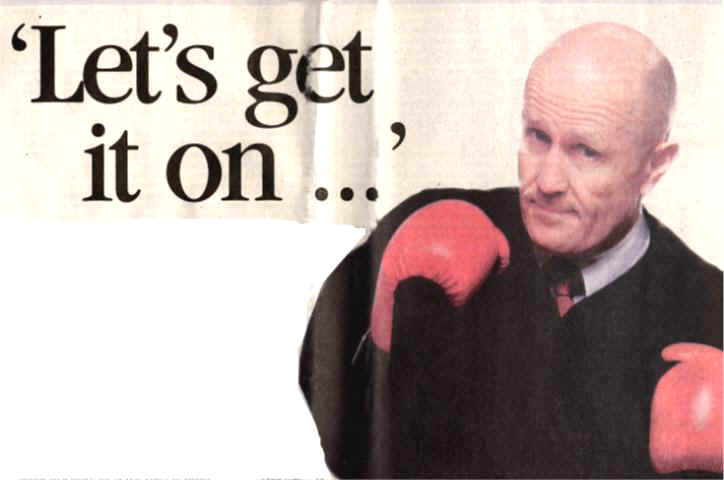
Perhaps the City should fly in Mills Lane to judge the proceedings
With the MLB-San Jose legal battle out of the way (for now), we can turn our attention back towards Oakland, where most of the news over the last two years has originated.
January 20 – Tuesday is the deadline for the Coliseum City three-month extension, granted to Floyd Kephart’s New City Development group when they took over the project. The Oakland City Council will take up the matter in the afternoon’s closed session. During the evening open session the Council is expected to report on Coliseum City’s progress.
Agenda item for 1/20 City Council meeting
If everything goes as expected, Kephart will get another extension of 3, 6, or 9 months so that he can try to rope the Raiders. The Raiders will probably be given another one-year lease extension, since Coliseum City is not yet a finished product and the Raiders have nowhere else to go for 2015. Mark Davis wants to retain maximum flexibility for his franchise, so a multiyear deal seems out of the question. Meanwhile, the A’s and Lew Wolff will be patiently waiting on the sidelines for Coliseum City to work itself out, wanting no part of the project.
—
February 8 – On Sunday comes FanFest. It’s worth going just to get acquainted with all of the A’s new players. If there’s a concurrent BlogFest event, there’ll be a post about it. Tickets are $10, and as usual you can expect a sellout.
On a personal note, this year’s FanFest will mark the first one since it came back that won’t be held on the same date as the Double IPA Festival, held at The Bistro in Hayward as part of SF Beer Week. Looking back, the doubleheader was truly my favorite day of the year. DIPA will be held the previous day, February 7 (Giants FanFest day). I may be draggin’ a bit during FanFest.
—
February 19 – Pitchers and Catchers report to Mesa, AZ. They’ll be at Fitch Park, as the renovated facility in Mesa has replaced Papago Park in Phoenix.
—-
March 3 – Spring Training Opening Day is a home game at Hohokam Stadium vs. the Giants. You might want to get your tickets in advance, or else the Giants fans will snatch them up. If you want to catch two games during a weekend, come to Phoenix the following weekend, March 7-8.
—–
March 13-14 – Want a different scene from laid back Arizona? The A’s and Cubs are playing a pair of spring training games at Cashman Field in Las Vegas. Yes, you can relive all the splendor that was the start of the 1996 season, then hit the craps tables and buffets.
——
April 6 – Opening Day at the Coliseum. We’ll see if Billy and Bob can work their magic again.
——-
Get comfortable, folks. We’re gonna be here a while.
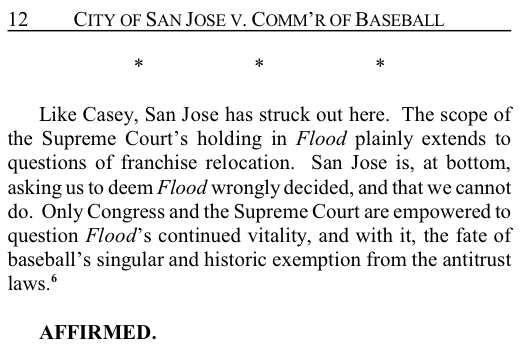
San Jose Mayor Sam Liccardo said shortly after the opinion’s release that he wants to take this up to the Supreme Court. The pressure, it would seem, is on him to “play nice” with Manfred and MLB by dropping the lawsuit.
The Merc’s Howard Mintz has a full writeup, including comments from Grow.
—
Liccardo’s office released the following statement:
When the City Council decided to pursue this lawsuit, we knew that success would likely require a ruling from the U.S. Supreme Court, because only the Supreme Court can revisit its century-old decision that created an anti-trust exemption that no American industry other than Major League Baseball enjoys. San Jose should be allowed to compete with other cities for major league teams, and I expect the U.S. Supreme Court to affirm the nation’s fundamental predisposition toward fair and free competition.
Since taxpayers do not have to foot the bill for this litigation, San Jose has nothing but upside to continue to pursue this to the Supreme Court, as a successful result will enable a half-billion dollar, privately-financed stadium in the heart of our city. A privately-funded stadium would also bring millions of dollars of tax revenues to help our City pay for more police officers, road repairs, libraries, and other critical services.”



 newballpark.org