Raiders not selling Mt. Davis in 2013

This week the Raiders released a seating map for their 2013 season. The startling revelation from this release is that the Mount Davis upper deck seats have been completely eliminated, as have the outer sections of the original third deck.
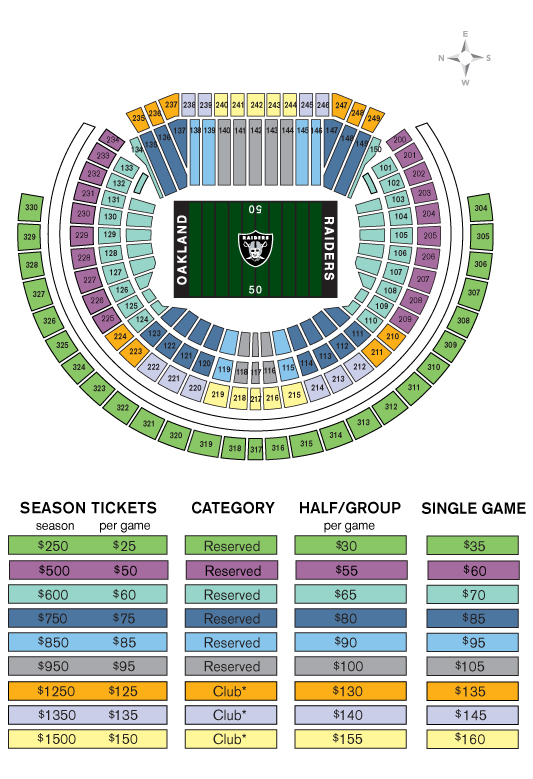
13_SEATINGPRICE_MAP2

Sections for sale do not include the outer 4 sections of the original upper deck or the newer Mt. Davis sections

A look at 2012 attendance sheds some light on what the Raiders’ motivation may be. While the first two home games were considered sellouts (for blackout purposes, not complete sellouts), attendance dropped off quickly as an unappealing group of non-division opponents accompanied a six-game slide into irrelevance. Whatever goodwill was earned during the “Oakland Loves Its Sports Teams” rally was squandered by Thanksgiving, with many fans already looking forward to 2013 when the team was forgotten locally as the 49ers continued their surge into the playoffs.

2012_attendance_raiders

2012 Raiders Home Attendance

The stated football capacity of the Coliseum 63,132 64,200 according to the Raiders, already the second (or fifth) smallest stadium in the NFL. If Mt. Davis and the ends of the original upper deck are removed, the new capacity should will be 51,000 53,250, with Mt. Davis accounting for some 10,000 seats by itself. While this would increase the team’s chances of hitting every game’s blackout target, if the NFL approves this change it’s tantamount to admitting that those seats are unsellable, at least while the team remains mediocre. CSN’s Paul Gutierrez notes that there was only one home blackout in 2012 because of the Raiders’ use of the 85% rule, so blackouts may not the issue. Instead, the Raiders may be eschewing the 85% plan altogether, because it somewhat disincentivizes sales above the 85% mark of regular, non-club seats. Per the CBA, revenue from marginal sales above the 85% mark had to be split evenly between the Raiders and the visiting team. If the Raiders presell a ton of the best seats to Raider fans and not invading fans, they might be able to boost the home crowd feel even as fewer seats are available. That was certainly the case for the A’s at the end of the 2012 season and in the postseason.

HNTB, the firm that architected the Coliseum renovation in 1995, was commissioned by the Chargers to examine deficiencies at Qualcomm Stadium compared to other newer stadia. Interestingly, the study included the Coliseum, even though the Coliseum is less than half new. Included in the study was a measurement of the highest, farthest seat at the 50-yard line for each stadium. That seat on Mt. Davis is 336 feet from the 50, the farthest of the 10 venues in the comparison. While the same seat on the opposite side of the field was not measured, given what is known about the bowl that seat is probably 100 feet closer.

If there’s a winner in this, it’s the LA firm that Lew Wolff contracts to remove and replace the A’s tarps every season. Looks like they’ll be getting a new customer right quick. Fans also get very inexpensive seats in the process. Wolff himself is probably feeling rather victorious today. Losers? 11th hour or walkup ticket buyers. There will be a much smaller inventory for the secondary market, which in recent years had tickets on Mt. Davis for less than $10 on StubHub.

Raider fan, what do you think about this? Good/bad move? An admission that the team will be terrible? Sound off below.

FanFest grows, elbow room still scarce

When the A’s released the map for this year’s FanFest, I was curious as to how traffic would flow in the expanded footprint. Last year, the event was held entirely inside Oracle Arena. The stage was placed on the event floor, with queues at the corners for autographs and other lines along the concourses for photos, the World Series trophies, and other attractions. This time around, the A’s utilized parts of the stadium and the whole of Champions Plaza (between the venues) to create more queueing space. Did it work?

The entry gate was moved from Oracle Arena to the Plaza between the stadium and arena

The entry gate was moved from Oracle Arena to the Plaza between the stadium and arena

For the most part, spreading the crowd out accomplished its goal. Unlike last year, the crowds were much more bearable in the afternoon, with fewer choke points along the lower concourse. But there were still huge jams in the lower club, and the lines to get autographs and the clubhouse tour easily ran 45 minutes at times. The lines are a product of the 10,000-strong crowd, and there may not be much that can be done about it. Even the upper level of the arena was used for autograph lines. In the future, it’s probably best to move the whole thing back over to the stadium side. That may be difficult for the Coliseum Authority to do because the stadium holds the only annual Northern California stop of the AMA Supercross tour. Eventually, it’s all a matter of money.

Navigation signs like this one were badly needed

Navigation signs like this one were badly needed

I arrived at the arena too late to watch the player introductions, which were reportedly quite energetic. A blogger interview session was set up to start at 1, after the regular media interview session. This time we had Bob Melvin, David Forst, and Mike Gallego. We were also supposed to have Jarrod Parker. Unfortunately he was ill. No matter, as Melvin was his engaging, confident self. Forst gave all of us some roster and draft nuggets to chew on (hint: think college players), and Gags had great anecdotes about Loma Prieta and Walt Weiss. (BTW, Gallego is my spirit animal.)

fanfest13-trophies_behind

The line for pictures with the World Series trophies was long for the entire event

One particular advantage of the stadium is that it has two clubs of 20,000 and 40,000 square feet. Even the smaller of those, the West Side Club, is bigger than the two clubs at the arena combined. The one thing the stadium doesn’t have is the auditorium-like setup with the stage and the beautiful new displays at the arena. It’s nice, not a must-have.

There will always be a scheduling conflict regarding the Supercross event as long as it’s held in the stadium. The event has to be held after the last possible home playoff game for the Raiders (seriously), but with enough time for the grounds crew to clear everything out and start planting grass for the baseball season. At the same time, the organization wants to ensure player availability for the event, which can be difficult because players start reporting to camp in mid-February (the ones that aren’t already in Arizona). That leaves about a two-week window for FanFest to be held. The Giants appear to have left Supercross behind, choosing to maximize baseball operations once their bowl game is over in December. Speaking of which, the Kraft Fight Hunger Bowl will be played in Santa Clara starting in 2015. The 49ers stadium may eventually be the best place for Supercross in the future because of fewer potential conflicts on its schedule.

Stage setup had retractable seats folded up, exposing the ice rink footprint

Arena stage setup had retractable seats folded up, exposing the ice rink footprint

The Warriors are on a 4-game roadtrip around the Great Lakes, which explains why there’s no basketball floor visible in the picture above. Also, tomorrow is a scheduled concert by the band MUSE at the arena, so the arena had to be ready for a conversion to the end-stage configuration, in which a much larger stage would occupy the “open” end. This exposes the outline of the ice rink, which extends from the permanent seats on one end to the back of the retractable sections on the stage end. The first row above the retractable sections is row 17, 15 feet or more above the ice surface. If you’re wondering how compromised that would look for hockey, there you have it. Basically, if you’re at the retractable end behind the row 17, you’ll have trouble seeing the goalie or anything happening around the net.

Overall, there was a great sense of excitement and optimism this year that wasn’t present last year. Let’s all hope there’s even more reason for people to come back for next year’s FanFest.

—-

Note – Wonder what the Coliseum looks like during a Supercross? Here’s a peek.

Coliseum Authority raids scoreboard funds for Raiders study

I wasn’t able to attend this morning’s Coliseum Authority meeting. Thankfully for everyone, Steven Tavares of the East Bay Citizen was. And the story he got coming out of there was quite a doozy. The JPA approved a $1 million contract for additional studies on Coliseum City, which we figured would happen given the new pro-development makeup of the JPA board. What we didn’t see coming was just how the study would be paid for.

How the Authority will pay the $1 million in total costs for the two studies also rankled some commissioners. According to Alameda County Auditor-Controller Pat O’Connell, the Authority will “short” a $3.5 million capital improvements fund previously earmarked for a new scoreboard at O.co Coliseum. The Oakland Athletics and the Authority have been in negotiations to replace the out-of-date scoreboards, said Goodwin, and Friday’s decision may negatively impact relations with the A’s, also in search of a new ballpark.

“What’s the message we’re sending to the A’s?” Goodwin asked. According to staff, the A’s estimate the costs of the scoreboards to be $4 million. “Well, it better cost closer to $2.5 million, if we do what we’re about to do,” countered Haggerty. The alternative, said O’Connell, would be to ask the Alameda County Board of Supervisors and Oakland City Council for addition funds, a move likely unpopular on both fronts.

Maybe the shortfall will force the JPA to buy used. Whether that’s enough to get improvements or not, it’s a clear indicator that the East Bay is going forward on Coliseum City, cost uncertainty and other tenant issues be damned.

Worse, the retractable roof concept appears to have gained traction, even though it will surely inflate the project’s price tag. Assistant City Administrator Fred Blackwell was careful to note that all three current tenants would get new venues under the plan, though as usual, how that would all come together was not articulated. Even the Raiders are not a given in terms of paying for their part of the study, as the NFL and team are fashioning their own – for a stadium only with little ancillary development.

Doesn’t this seem like a lot of flailing right now? This is despite having the project under consideration for the better part of three years. Many in Oakland are quite convinced that this is the vision for the city’s future. What of the teams? Aren’t they supposed to be partners in this? Aren’t they paying the freight? Apparently that doesn’t matter, not as long as one great redevelopment plan remains out there for someone to stake their political career to.

Final 2013 Regular Season Schedule Released

If you have longed for the return the 1:05 Saturday game, your prayers have been answered. The 2013 home schedule for the A’s has, by my count, 25 1:05 PM start times, 10 of those on Saturdays. Last season there were only 16 weekend 1:05 starts. I’ve assembled the schedule into various download formats, which are available in the left sidebar towards the bottom.

A couple of changes occurred along the way to finalizing the schedule. The A’s and Giants switched their home-and-home halves of their 4-game interleague set, with the A’s half now coming first and the Giants’ half last. There are a few other quirks.

  • Another Saturday afternoon start against the Halos is set for 12:05 PM instead of 1:05. The game is on July 27.
  • The A’s head to Boston in late April, and none of the games in that weekday series will start later than 3:35 PT. Keep that in mind if you’re planning to listen on the radio during your afternoon commute.
  • With the Astros now in the division, you can nearly double the amount of 5 PM evening start times in division. In addition, in the summer Houston isn’t forced to have mostly 5:35 games like the Rangers because the Astros have a dome, so there will be more 11:10 AM getaway games than you’d expect in Arlington.

Other than that, there’s little out of the ordinary. National Opening Night is on March 31, an Rangers-Astros game in Houston.


Oakland City Council session briefly upstaged by Coliseum JPA-related vote

So there I was Tuesday night, home sick with the flu instead of at my weekly Pub Trivia night. I figured that I’d keep an eye on the Oakland City Council session, because the debate regarding the William Bratton hiring was expected to be thick and fierce. To my surprise, the discourse was more civil and less disruptive (measured in degrees) than many #oakmtg sessions, As I write this, the meeting is still going on and there remains a large number of speaker cards, meaning the session may easily run past 1:30 AM.

There was one item of tangential interest to the crowd that reads this blog on the meeting’s agenda. That was the appointment of two City Council members to the Coliseum JPA’s 8-person Board of Commissioners. Former Councilperson Ignacio De La Fuente was the Chair until last weekend, while the other seat representing the City Council on the board is currently held by Desley Brooks. Larry Reid, who has previously served on the Board, was appointed without a hitch. That was no big deal because Reid is replacing De La Fuente. Brooks, on the other hand, had expected to remain in her capacity on the Board but was cast aside in favor of Rebecca Kaplan. After a motion was made to nominate Kaplan, a full 30 people came up to speak in support of Brooks. Many spoke about Brooks’ record supporting the black community. The Twitterverse blew up with jokes about Brooks, her colleagues in the Council, and the rather personal, catty, tense nature that the proceedings transformed into.

Brooks has been out of favor with Council President Pat Kernighan, who has the power to make appointments such as this one. A major criticism of Brooks that emanated from the debate (though not from the Council members themselves) was that Brooks’ abrasiveness makes her difficult to work with. Being an outsider to Oakland politics, I can’t substantiate that claim, or the undercurrent of corruption taint that follows Brooks. But there is some level of agreement within that Brooks’ attitude was an issue despite her legion of supporters. As an alternative, Kaplan’s more congenial nature was meant to improve working conditions inside the board. I guess.

Eventually the Council voted 7-0 to approve Reid and 6-1 to approve Kaplan, with Brooks being the dissenter on the Kaplan vote and Reid absent for both votes. The discussion leading up to those votes shed some light on the struggles in the JPA and the problems the City has having the $20 million annual subsidy for the JPA as the City’s albatross. In defending herself, Brooks noted that she brought AEG in to replace SMG. She mentioned that her focus has been to reduce the drain that the sports complex has on the City, even if that means forgoing certain opportunities that might come its way. For instance, remember how there was talk about having a WNBA team play in Oakland, especially after the Sacramento Monarchs franchise folded? Brooks argued that hosting a team would’ve cost $35,000 per game that the City didn’t have. That translates to $600,000 for a full season of games, plus whatever nominal costs would be associated with prepping the arena to host a team. (Obviously there’s more to having a WNBA team in Oakland, but we’re focusing solely on hosting the games right now.)

Who was the Oakland politician most gung-ho about bringing in a WNBA team? Kaplan. Who’s pushing Coliseum City the hardest? Kaplan. When it was Kaplan’s turn to speak on her nomination, she didn’t hesitate to bring up Coliseum City’s potential, though she qualified her words a little by saying that it wasn’t solely “about the sports (teams)”, it was as much about redeveloping an area that long needs it. As we all know by now, redevelopment as an institution has been blown up by Governor Brown, with mostly small-scale efforts like affordable housing left as available project types for cities to work on.

Just like that, two of the councilmembers who could be considered more skeptical of the sports-as-savior strategy (IDLF, Brooks) were replaced by two who are all for it (Kaplan, Reid). None of this means that anything substantial will happen with Coliseum City anytime soon. It’s still going to cost billions of dollars to pull off and will require commitments from at the very least the Raiders to have any shot of happening. However, if developers or AEG wanted a sign that things could go more smoothly on the political front for them, this is it.

The WNBA team idea, which has receded from consciousness in the Bay Area over time, sounds like a very good project for Oakland and its business community to pick up. A franchise is worth somewhere in the $10 million range, less than MLS. Player salaries are affordable. The schedule runs during the NBA’s offseason, so there are no date conflicts at Oracle Arena. Plus there’s the advantage of the Bay Area as something of a hotbed for women’s basketball, thanks to the stalwart Stanford program and a recently powerful Cal program. It’s achievable, doesn’t require ridiculous amounts of resources from the business community, and as has been demonstrated in Seattle, a franchise can survive and even thrive when its NBA brother leaves town. That’s not to say that Oakland should give up on the A’s/Raiders or even the Warriors. Far from it. It would show that Oakland and the East Bay can coalesce to get a team that the community can rally around. Even Mayor Quan has referred to that possibility. It’s kind of hard to know if Oakland is capable of big successes if it doesn’t have small ones to build upon, and its biggest success were decades ago. If you want a test case, well, there it is. Seize it.

No please, really, take your time Oakland

The Coliseum Authority released its agenda for the upcoming January 25th meeting. On the agenda is a procedural item of voting a new Chair and Vice-Chair. The other item, 6b, involves the following:

6b. Resolution of the Oakland Alameda County Coliseum Authority:
1. Waiving Competition and Authorizing Staff To Negotiate One or More Professional Services Contracts to Conduct

Studies for Site Planning and Development Scenarios, and to Create Estimates Of Building Budget And Profit And Loss Statements, For a Potential New Stadium and Related Development on Land Currently Owned By The Authority That Lies Within the Coliseum City Specific Plan Area, for a Total Amount Not To Exceed $500,000; and

2. Authorizing Staff To Competitively Procure and Negotiate One or More Professional Services Contracts to Conduct Studies of Revenue Potential and Market Demand From a Potential New Stadium and Related Development on Land Currently Owned By The Authority That Lies Within The Coliseum City Specific Plan Area, for a Total Amount Not To Exceed $500,000; and

3. Authorizing the Chair of the Oakland Alameda County Coliseum Authority to Execute Contracts for Services With Selected Consultants Without Returning to the Authority Board; and

4. Amending the Authority’s Budget to Allocate up to $1,000,000 in Available Oakland Alameda County Coliseum Authority Funding For These Purposes

Woah there, wait a second. Is the JPA really saying that it still has studies to complete? It needs to do financial projections and a development plan? And it’s executing this now without competitive bidding? You have got to be kidding me. This stuff was supposed to be done by now. Funding for Coliseum City was authorized in February 2010, almost three years ago. This is supposed to be the easy part.

Now, maybe the upshot is that the Raiders and JPA came to an agreement on a lease extension, allowing these funds to be freed up. But if anyone from the East Bay is looking for signs of progress soon, this certainly won’t help. At this rate the 49ers will have been at their Santa Clara stadium 7-10 years before anything gets built in Oakland. Also, note that the resolution says stadium in singular form. Will there be a two-stadium alternative, as some pols believe is the best option? Or are they talking about another multipurpose stadium? I can’t wait. Actually, I guess I can. I have no choice.

I suppose these “additional” studies can be completed by the end of the year. In a week full of unbelievable BS news in the sports world, this ranks up there, at least locally. Suspiciously, the JPA’s annual financials have not yet been released. They probably won’t show much in the way of funds spent on Coliseum City so far. This is so disappointing, and yet, par for the course. No wonder the Warriors plowed their own path. They can’t trust the JPA to make anything happen in a timely manner.

FanFest 2013 SOLD OUT

If you were waiting to buy tickets to FanFest this week or by walkup, you’re out of luck. The event’s 10,000 tickets are sold out. Just as with the playoffs, fans shouldn’t take ticket availability for granted. You snooze, you lose.

Of course, the announcement will bring about the usual grousing about how anti-fan A’s ownership is and such. That ignores two big issues.

  • The Coliseum is unavailable because of a motocross event on Saturday the 26th. Most teams that have FanFest in their own ballparks use the field as a huge concourse and staging area. The A’s won’t have that luxury since the field will be a big pile of mud. That would force fans into aisles and concourses, and we know damn well how congested the lower concourse gets at times. I once took an out-of-town friend to the Giants’ FanFest in 2008, which was held at AT&T Park. The field was also unavailable there due to a motocross event. It was a less-than-ideal situation and had all the feel of a hard hat construction zone.
  • Oracle Arena’s concourses were very congested last year at FanFest. While some people chose to sit and watch interviews, most were on the main concourse, inside the lower club, or in line for autographs. The upper deck was blocked off (familiar story). I suppose that the A’s could’ve thrown an Eric Sogard autograph line up there. Would that really help things?

2012 FanFest

When putting on one-off events like FanFest, the biggest wildcard is the impact of a previous season’s success on attendance. The Giants were overwhelmed by the response at their 2011 FanFest, causing extremely long lines and waits for autographs and World Series trophy pictures. You want to bring in as many people as possible because you can sell tickets, but you also don’t to create a situation were the experience sucks for fans. Oracle Arena would be a perfectly fine venue if it had more expansive concourses like HP Pavilion or Staples Center. That wasn’t in the cards for the 1997 renovation.

Perhaps the A’s could’ve held FanFest at Jack London Square or another large public space. That’s fine, though personally I like having the clubhouse tour right there at the Coliseum/Arena. That’s not possible at JLS. Tell you what: Don Knauss and his people could’ve offered to sponsor FanFest by underwriting the cost to hold it at JLS, right next to their preferred Howard Terminal ballpark site. Oh well. Maybe next year.

News for 1/8/13

The days are starting to get longer, and we’re five weeks from pitchers and catchers reporting. Huzzah.

  • The Alameda County Board of Supervisors is scheduled to meet in closed session today to talk about the Raiders’ lease. I wonder if they’ll also take up Lew Wolff’s recent request for an extension. [East Bay Citizen/Steven Tavares]
  • The Coliseum Authority hasn’t yet published its annual financials. In the past two years, that document has been available the first week of the year. Perhaps that will come out later today as well. The next open meeting is scheduled for 1/25.
  • The City of Oakland lost $3 million in previously used redevelopment funds to the state. That may cause a series of layoffs or other cuts. [SF Gate/Matthai Kuruvila]
  • Lew Wolff had a no-news interview in this week’s Silicon Valley Business Journal. (Note: “San Jose” has been dropped from publication title) [SV Business Journal/Greg Baumann]
  • Wolff’s real estate investment company Maritz Wolff sold another hotel last month. This time it was the Ritz Carlton in the St. Louis suburb of Clayton, MO. Price was not disclosed. In case you weren’t aware, Phil “Flip” Maritz, Wolff’s longtime partner, has a minority stake in the A’s. [St. Louis Post-Dispatch/Tim Bryant]
  • Dodgers ownership is said to be split on whether to partner up with Fox or Time Warner on a new RSN deal that could be worth upwards of $6 billion. [LA Times/Steve Dilbeck]
  • The Mets completed $450 million of desperately needed debt refinancing and got an infusion of $160 million that is expected to be used on day-to-day operations. The team now has $700 million in debt against the Mets’ network SNY alone. More analysis of the Mets’ financial picture here. [NY Times/Richard Sandomir | Capital New York/Howard Medgal]
  • Out of the fiscal cliff bill news was an item that aroused anger: $78 million in tax breaks for NASCAR racetracks. The crux of the deal is that track owners can accelerate writing off their investments in seven years as opposed to fifteen. [NY Times/Mary Pilon]
  • Virginia Beach Mayor Will Sessoms’ deadline seemed to come and go without an arena deal. He is expected to make a statement later today. Update 8:00 AM – Sessoms has declared the project dead for now as the city will not go to the state General Assembly to request $150 million in arena funding. [WAVY-10/Mila Mimica, Virginian-Pilot, Aaron Applegate]
  • San Diego power players including Steve Cushman are turning their attention to either a new or revamped Qualcomm Stadium at the current Mission Valley site. The new vision looks a lot like the Coliseum City plan, but with a large residential component. I think they could accomplish quite a bit at Qualcomm just by demolishing and rebuilding only the lower deck. [San Diego Union Tribune]
  • Talks are heating up to bring the Washington Redskins back to the District from the Maryland suburbs. There’s supposedly no public money to draw from as the District is running up against its own debt ceiling. That doesn’t mean someone couldn’t hatch his own Coliseum City plan at RFK. An idea being discussed is the sale of the Brutalist headquarters of the FBI, moving the Bureau out to the FedEx Field site, then taking the proceeds of land sales and development proceeds to build the new stadium at RFK. One of the people leading the charge: Marion Barry, who is on the DC City Council. [Washington Post/Tim Craig]
  • The Merc Editorial Board laments the true victims of the dysfunctional relationship between the NHL and its players, the businesses and workers near HP Pavilion. [SJ Mercury News]

More as it comes.

Suggestion: Buy Used

Part of the game in the world of new stadia is the stadium improvements fund. It’s a set aside of stadium revenues from the partnership of team and city/county that is used to fix plumbing, lights, and seats. It’s also used in many cases to change other non-critical items that become obsolete over time, so that the partners can keep up with competitive venues and enhance fan experience. By enshrining the terms in a lease agreement, both sides can set proper expectations about what kind of maintenance and upgrades a venue will get over the short and long term.

To that end, the NFL stadia in Denver and Houston are getting fancy new LED displays as part of a $30 million audiovisual makeover. This makes sense both stadia are at least a decade old and display technology has advanced rapidly over the last several years. In Denver, the horseshoe shape at Sports Authority Field at Mile High means there are three boards of different sizes: one big board (27′ x 96′) on the open south end and two half-size boards in the north corners of the upper bowl. SAF@MH also lacks ribbon fascia boards, so one or two levels of LEDs are in the works there. Both the big displays and fascia boards will be capable of HD.

At least Denver’s displays are LED-based. Houston’s Reliant Stadium uses old CRT technology (like the Coliseum) and is finally moving into the 21st century with fully digital LED displays from Mitsubishi. The new displays will replace the old mix of incandescent, CRT, and static displays tucked under the stadium roof. When completed, each one will measure 52.5′ x 277′, officially longer and bigger than the center-hung boards at Cowboys Stadium (also built by Mitsubishi). Since the display is so long, only a portion of it will be used for replays, unlike Cowboys Stadium’s 16 x 9 boards. Despite that limitation, the new displays promise greater presentation flexibility for in-game information, video, and ads.

Compare that to what Raiders and A’s fans continue to live with at the Coliseum, and it starts to get depressing. Better than telling you, I’d rather show you via an infographic by reddit user dbeat.

nfl_scoreboard_sizes

Comparison of video displays in NFL stadia. Reliant Stadium’s new board will soon be the biggest. Denver’s is mid-sized. The Coliseum’s are among the smallest.

With the sad state of displays at the Coliseum and the cycle of change elsewhere, I got to thinking, What happens with the old displays? I’ve sent an inquiry into Denver’s Metropolitan Football Stadium District to find out (I’ll update here if I do). Some displays end up getting donated. Do they also get resold? LED lifespan is 50,000 hours, so unless you’re going for greater resolution the displays themselves should last the life of the stadium. Over 12 years at SAF@MH, it’s likely that the scoreboards were used only 500-1,000 hours per year.

Old displays at Denver stadium

Old display at Denver stadium

Denver would seem a prime candidate to get the scoreboards at a very good price. Why hated AFC West rival Denver? There are a few convenient reasons.

  • If the two north boards are put together into one board, the result is that each of the boards (north/south) measure 27′ x 96′. That would fit very nicely into the Coliseum’s existing scoreboard frames, which are about 40′ x 140′ not including the arched caps. Whether they’re each used as one contiguous display or split into two, it can work well while retaining static signage panels that currently populate the surround.
  • Since the both the Coliseum’s and SAF@MH’s old displays were manufactured by Mitsubishi’s Diamond Vision unit, it stands to reason that there will be some degree of interoperability.
  • Both the A’s and Raiders would welcome additional advertising opportunities on crisper displays.
  • SAF@MH’s monochrome scoreboards are also being replaced and even those would be an upgrade on what the Coliseum has.
  • As a secondhand product, the displays could be acquired at a significant discount, perhaps $1 million or less.
  • If the Coliseum is to be used for only 5-6 more years, it makes little sense to spend tens of millions on new displays.
coli-scoreboard_twilight-cropped

Current CRT video board and scoreboard system at the Coliseum

Seems like a decent idea, right? The difficulty comes when working among the Coliseum Authority, the Raiders, and the A’s. It would make sense to put something like this into a five year capital improvements plan. How it gets paid for, and how new revenues get divided, is the tough part. Divvying up signage revenue has long been a sticking point in the relationship, with the A’s getting the lion’s share of in-stadium revenue since the 1995 renovation. With all leases expiring, there’s a chance at a clean slate in negotiations. Would Lew Wolff forego an A’s-tilted ad revenue deal in order to get five fairly hassle-free years and opt-outs on a lease extension? Sounds like a deal point to me. It’s just a suggestion.

Imagine a Coliseum without Mount Davis

Following up Monday’s post about Mt. Davis, here are the specifications for the Coliseum if the Raiders did not come back in 1995. The ballpark boom had begun, but the Coliseum hadn’t yet been completely overshadowed by the retro mallpark. In 1993, the Coliseum complex won a statewide architectural award. Improvements conceived by both the Coliseum and the A’s were feasible and small in scale. Compared to the $80 million $100 million $200 million renovation for the Raiders, the changes for the A’s would have been fairly modest at the outset.

4. PLANNED STADIUM MODIFICATIONS

4.1 Stadium Improvement Plan. Licensor (Coliseum JPA) and Licensee (A’s) have approved a scope of improvements to the Stadium as set forth in Exhibit C. In the event the Raiders have not entered into or agreed to enter into an agreement for more than ten years with Licensor for the Raiders’ use of the Stadium on or before September 30, 1995, Licensee shall have the right in its sole discretion by notice given not later than September 30, 1995, to cause Licensor to complete Stadium improvements as follows:

[a] Construction of up to 5,000 club seats and a related club lounge, for completion by March 31, 1996, and as more particularly described in Exhibit C. The total cost of the stadium improvements plan will not exceed $10 million. Licensee’s representatives will be included in all design, planning and construction meetings.

[b] Stadium improvements described in [a] above will be financed through the issuance of bonds. The bonds will be authorized in 1995 and sold as construction is implemented. It is understood that Licensor’s existing bonds will be deceased.

[c] Licensee shall have the right, at Licensee’s sole cost and obligation, to finance and cause Lincesor to construct such additional Stadium improvements as Licensor and Licensee shall mutually agree in connection with the construction of the Stadium improvements and finance plan described above.

[d] On or after November 1, 1995, either Licensor or Licensee may request the other to negotiate in good faith to approve, in the sole discretion of both parties, respectively, a Stadium improvements and finance plan to provide for the construction of improvements in addition to those set forth in Section 4.1[a] and [c] above, in an amount not to exceed $60 million and under financing terms mutually agreeable to Licensor and Licensee, provided however, to the extent permitted by such financing, Licensee shall recover the actual cost of additional Stadium improvements financed by it under Section 4.1[c] above. Licensee’s sole remedy for the parties failure to approve such a plan shall be the early termination rights described in Section 7.3 below.

[e] In order to provide amortization of the existing bonds issued by Licensor and new improvement bonds, Licensor’s revenue from the Stadium naming rights, club seat premium, together with ticket surcharge revenues would be deposited into an improvements construction fund beginning in 1995.

[f] In addition to stadium improvements, a stadium maintenance fund shall be established and funded by Licensor in the amount of $500,000 annually beginning in 1996 and escalated at 5% per year thereafter. Stadium major maintenance would be paid for from this fund annually. In the event that the transfer in any year is less than the required annual contribution, then Licensor shall deposit the shortfall. Surpluses in the improvements construction fund which are available for the transfer shall be used to offset prior years deficits.

Effectively, the renovation project would have only consisted of what is now known as the West Side Club, for $10 million ($1.2 million/year). Another $50 million could have been available over time, which would’ve been used to replace all of the orange seats and bleachers, redo the clubhouses (maybe the A’s would’ve taken the old Exhibit Hall space instead of the Raiders) while adding a batting cage, build more field boxes, maybe even remove the outfield stairs and move the bullpens there. New scoreboards would’ve required a new agreement and new funding.

All of that would’ve been nice for the 10-year lease that was under consideration. By the end of that lease, December 2004, the pressure would’ve been on to replace the Coliseum. Why? At the time, all of the old cookie-cutter stadia were in the process of being replaced. While Three Rivers and Veterans didn’t get any improvements prior to their replacement, Busch Stadium was made more baseball friendly after the football Cardinals left for Arizona and the Rams played half of the 1995 season at Busch. That arrangement lasted a decade, setting up a transition period until the current Busch was funded and built.

What we don’t know is whether or not Oakland and Alameda County would’ve given up on trying to get the Raiders back. My guess is that the various forces working to bring the team back (Don Perata, Elilu Harris, George Vukasin Sr., Scott Haggerty) would’ve kept trying, at least until Harris gave way to anti-stadium Jerry Brown. Who knows? Oakland by now may have completely established its identity as a baseball town, instead of dealing with two unsatisfied teams in, what Monte Poole called, “a house without distinction”.