At FanFest

I’m in, credentialed and good to go. Line wrapped from the arena entrance down through the north VIP parking lot. Gates opened at 10 sharp. I’m heading to the clubhouse tour right now. At 11 I’ll meet folks inside the entrance and to the right, where the Warriors inside ticket booth is.

20120129-101407.jpg

Update 12:50 – The retired player panel (Rudi, Tenace, Blue, Hatteberg, Justice) fielded a question about a move to San Jose. Many boos rained down. Rudi spoke up, saying that the Coliseum was ruined by the return of football (followed by applause) and a plea that the A’s need a ballpark, whether it’s in Oakland or not. Very diplomatic answer.

20120129-154156.jpg

20120129-154303.jpg

20120129-175320.jpg

More FanFest info

Today I and a half-dozen other bloggers got our info package via email from A’s Media Relations and Broadcasting coordinator Adam Loberstein. We’ll have the 1 PM hour dedicated a press conference with several A’s players and prospects. Here’s the schedule for FanFest on Sunday, January 29:

1:00 p.m.          Blogger/Interview Room Opens

1:15-1:30 p.m.   A’s Manager Bob Melvin

1:30-1:45 p.m.   Shortstop Cliff Pennington and pitcher Brandon McCarthy

1:45-2:00 p.m.   Outfielders Josh Reddick and Seth Smith

Smith replaced pitcher Brad Peacock. Maybe I’ll ask the OFs which one will kneecap the other first to get more PAs (I keed!). Because of this part of the event, I’d like to put the meetup between 11 and noon, inside the East entrance to Oracle Arena. I will be arriving at 9 to set up early and get a feel for the event. Plus, as BANG’s Joe Stiglich notes, Lew Wolff will be around from 9 to 10:30 throughout the event to answer fan questions via one-on-ones. Sign ups will occur from 9 to 10:30. Now that should be interesting, and well worth getting there early to watch.

Please comment with the following:

  • Questions for Melvin or the players
  • Whether or not the meetup time works for you, suggestions if it doesn’t
  • Whether or not you’re up for anything after FanFest, including a tailgate

The best thing to come out of this is that if this event goes well, it’ll be the first in a series of blogger events throughout the season. Now that sounds great and is something to look forward to.

Moneyball nominated for 6 Oscars, my DVD extras review

Today the Academy of Motion Picture Arts and Sciences announced that Moneyball was nominated for six Oscars. The film received four nominations in roughly the same categories that it received Golden Globe nominations:

  • Best Picture
  • Best Adapted Screenplay
  • Best Actor: Brad Pitt
  • Best Supporting Actor: Jonah Hill

Unfortunately, Moneyball didn’t win at the Globes, though that could be chalked up to the Hollywood Foreign Press not caring much about an American film about an American sport like baseball, instead favoring The DescendantsHugo, and The Artist. The latter two films were set in Europe or were produced outside of Hollywood. That’s not to say that those movies aren’t deserving, far from it. All three of those films are more deserving of Best Picture than Moneyball.

The other two nominations were technical: Editing and Sound Mixing. While not as showy as Hugo and The Artist, I think Moneyball has a shot at both of those awards. Real footage of the 2002 season was seamlessly integrated into the film, and the sounds of the game are better and more realistic than in any other sports film I’ve seen/heard.

Deleted scenes

  • Billy Tells Art: Play Bradford – Ambivalent. Leaving the scene in would’ve shed light on Mike Magnante’s issues, which weren’t covered in great depth in the movie. On the other hand, Beane comes off as mean, calculating, and unsympathetic. That’s probably not what they were going for, even if there’s some truth to it.
  • Tara and Billy Dinner – Was this the only deleted scene featuring Kathryn Morris? I knew going into Opening Day that her scenes were left on the cutting room floor. As much as I like Morris as an actress, it’s better that the character of Tara Beane is not in in the film. Some obsessives on the big screen do better with a good wife as emotional support. The Moneyball Beane is not one of them.
  • Peter Offered GM Job – Should’ve left it in. Another great bit of repartee between the two leads. Plus it’s closer to the actual truth.

Billy Beane: Re-Inventing the Game – Part epilogue, part Cliffs Notes version of Moneyball the book. More for the casual/non-A’s fan. A’s fans know this inside and out. Still good to have quotes from Michael Lewis, Aaron Sorkin, Beane. Plus props to the unseen Paul DePodesta. Includes a jarring, unwelcome interview with Alex Rodriguez, who arrogantly touts his “character”.

Drafting The Team – Emphasizes that many actual/former ballplayers were cast in player roles. Nice interviews with Stephen Bishop (David Justice) and Ken Medlock (Grady Fuson).

Moneyball – Playing the Game – My favorite featurette in the package. Covers set design, costumes, and cinematography. I really loved Wally Pfister’s (Christopher Nolan’s go-to cinematographer) explanation of how and why he shot the movie the way it was shot with lots of shadow and on film instead of digital video. When the A’s finally leave the Coliseum for a new ballpark somewhere, Moneyball will always be a reminder of how good the Coliseum could be.

Adapting Moneyball – A little back-and-forth among the team of screenwriters and the producer Rachael Horovitz. Watch it and read Roger Ebert’s recent blog post, which has a little inside baseball about how the script(s) came together.

The notable feature missing from the package is a commentary track, whether from the director or actors. The featurettes are a good substitute, but I really wanted a commentary to get a lot of the small details. That’s okay, maybe there’ll be a collector’s edition down the road. If the A’s hadn’t won a World Series in my lifetime, I might feel a little more bitter about how the 2002 season ended. But think about it for a second. One of our favorite teams of all time was documented in a bestselling, critically acclaimed book and a lovingly crafted movie adaptation. We’ll have that forever. How many teams get to have that? Nick Hornby’s Fever Pitch was a great memoir of his lifelong love of the Arsenal soccer club. The British film adaptation was not bad, though it strayed far from the book. The American adaptation was so terrible that the miracle of the Red Sox finally winning couldn’t salvage it. No, I don’t expect Moneyball to win the Best Picture Oscar. Is it the best baseball movie of all time? Most definitely. And that’s good enough for me.

P.S. – As of yesterday, Moneyball has made $106 million in domestic and foreign box office revenue. Someday the A’s payroll might actually approach that number.

Poole gets it terribly, horribly wrong

Monte Poole has written yet another screed about Lew Wolff and John Fisher. Three questions about this: 1) Would Poole be writing this if the Raiders had made the playoffs, giving him something to write about?, 2) Couldn’t he have bothered to ask Wolff about this?, and 3) Is Poole now tasked with the now-retired Dave Newhouse’s role as chief ownership critic?

Apparently the answer to the first two of those questions is a resounding NO. Poole’s grievous error comes down to this:

Months prior to taking co-ownership, while working as the A’s executive hired to find a suitable yard, Wolff proposed a “ballpark village” on land north of the current site. That’s rich. He realized such a project would require relocating 60 to 80 businesses. And, by the way, Wolff added that this village would require the creation of a new BART station, this one between the Coliseum and Fruitvale stations.

That was their pitch to Oakland. Judge for yourself the goodness of the faith within.

Meanwhile, Wolff said zilch about the land to the south, from the stadium perimeter through the parking lot and out to Hegenberger Road. There’s a Denny’s not much else, other than plenty of space, mostly paved.

Amazing how only a few years can bend someone’s memory. Here’s what really happened:

  • When he was working for Steve Schott and Ken Hofmann, Wolff suggested looking at the HomeBase site (a.k.a. “Coliseum South”). They wanted to split the cost on a $500k feasibility study there, with the Coliseum Authority (JPA) paying the other half. The Authority declined to pay for their share, and the idea died.
  • Wolff did not present the 66th-High “Coliseum North” concept until August 2005, five months after he took control of the franchise.
  • For whatever reason, even though Larry Reid and others from Oakland considered Coliseum South a possibility after Coliseum North collapsed, no one pursued the option.
  • The Coliseum eventually bought the property in 2010 years after HomeBase was destroyed in a fire, dedicating the land to a Raiders stadium redevelopment project.

All Poole needed to do was call or email Wolff. Or Guy Saperstein. Is it that hard? I suppose it is.

Mark Purdy gets a lot more of the history right, though he fails to include the Oakland/East Bay ballpark study of 2001.

What happens after 2013?

You’re probably aware that the leases for both the Raiders and A’s run out after their 2013 seasons are completed. Problem is for both that neither team can move into a new facility before 2015, whether it’s in Oakland, Santa Clara, or San Jose. Both teams have limited options to play elsewhere, and City and County still have a large mortgage to pay off. It would seem that a simple one-year extension – perhaps with an option year or two – would be simple to ratify.

However, things are not always that simple. The icy relationship between Oakland and the A’s has some within Oakland feeling that they were misled the last time the lease was negotiated, so they may be a much tougher nut to crack this time around. Chances are that the A’s will be paying a good deal more than the $1 million they’ve been averaging, if only to cover the cost of field conversion. The Coliseum Authority has been talking with the Raiders for some time, but Coliseum City doesn’t appear any closer to fruition now than it did over a year ago, when the Authority bought the Home Base site and unveiled the now-evolved plan. With all of that in mind, it’s a good time to explore the teams’ options after the 2013 season.

Raiders

No matter what the two football teams are saying about pursuing separate facilities or not sharing one somewhere, there’s no reason to think that they aren’t getting pressure from Roger Goodell and the other NFL team owners to shack up. There’s little practical reason for them not to do it, since they’d have less debt service to deal with and they would be able to join up instead of compete for precious limited G-4 loan money. Even if they came together, there’s still a year between the end of the Coliseum lease and a new one in Santa Clara or Oakland simply due to the required construction time. What to do then?

  • If a new stadium were being built at the Coliseum complex, it’d be simple. There’d already be a pre-arranged lease extension for the bridge year, and the new stadium would be configured to minimize impact on the existing Coliseum.
  • If the existing Coliseum were being gutted, the Raiders would have to endure one year of reduced capacity (47,000) and come back to a practically new stadium. 2014 could be the bridge year and leave 19-20 months to complete everything.
  • If the Raiders chose to go to Santa Clara, which to me would be a last-minute decision for the franchise, they could either rely on goodwill with Oakland and Alameda County to get the 2014 lease in place, especially if they “promise” that the Santa Clara move wasn’t permanent.
  • It seems highly unlikely that the Raiders would play 2014 in either Candlestick Park, Cal’s Memorial Stadium or Stanford Stadium. The colleges don’t want the headaches, and the ‘Stick would only be an option if the Coli were unavailable for some reason.

One strategic issue for me is, Did Oakland/Alameda County push for a Coliseum revamp? A new stadium may be prohibitively expensive, whereas a revamp could provide all of the necessary amenities for half the cost. Does the NFL consider the Coliseum damaged goods? The G-4 loan program specifies funding for existing facilities, and it’s believed that the Bills will try to use this funding for Buffalo’s Ralph Wilson Stadium, and that place can’t be measurably worse than the Coliseum (especially in its football guise).

The A’s could conceivably throw a wrench into the works by negotiating on a new facility at the Coliseum (like that’s going to happen under this ownership group). There would be enough land to build a new ballpark at the Home Base/Malibu site, and the existing Coliseum could be left intact for 2014. Or if the A’s tried to save money by leveraging what they could from the current Coliseum, the Raiders would be forced out.

Athletics

Mutual distrust between the team and City/County leads me to believe that any lease negotiations won’t be sunny. The A’s would need a facility for at least a year. Renting out Cashman Field for two series, as was done when Mt. Davis was being built, won’t fly for an entire season. Oakland wouldn’t have much incentive for renewal if they knew the team were leaving immediately after the lease was up, unless they got a lot of money for that one year or there was enough negative PR that came with refusing the A’s request out of spite. Unlike the Raiders, the A’s options would be wildly varied and mostly suboptimal.

  • Expansion of 4,200-seat San Jose Municipal Stadium to even 15-20,000 seats is impractical because the team facilities are clearly nowhere close to major league standards. Improving these enough to make it acceptable would probably cost $15-20 million, which would be crazy to pay for one year of play and little return on that investment.
  • The Earthquakes’ 18,000-seat stadium is soccer-specific, and MLS is not going to go along with sharing yet another facility.
  • Building another stadium alongside the Quakes’ stadium at Airport West would require a new EIR and probably wouldn’t go anywhere politically.
  • There’s the possibility of sharing AT&T Park for a year, but that would be entirely up to the Giants. There’s also a logistical issue at play. When Shea Stadium was used by both the Mets and Yankees for a year while Yankee Stadium was getting rebuilt, it already had enough team facilities because it was built as a multipurpose stadium. AT&T Park has only two clubhouses and scant room to build new ones. Where would the A’s or their road opponents go?
  • The A’s could play a season at the River Cats’ Raley Field in West Sacramento, but it’s even more limited than AT&T Park. At least there’d be a political path towards making it work as a temporary facility.
  • Candlestick’s pretty much “stuck” in its football configuration, so it’s unlikely that the A’s would play there.

The Raiders could throw a wrench into any 2014 lease plans if they agreed to rebuild the Coliseum, so that’s yet another complication. Unless cooler heads prevail, the A’s will be in a tough spot figuring out what to do for 2014. At this early juncture, my guess is that the A’s and the Coliseum Authority will figure something out, but the A’s will pay handsomely for the privilege. If something interferes, 2014 is up in the air for the A’s, and there’s no telling where they’d land. And if a delay forces them to not open Cisco Field until 2016? Yikes.

Taking stock as the post-redevelopment era begins

It’s never too early to declare winners and losers that were made as a result of today’s earthshattering news.

First the losers:

  • Backers of the Victory Court site. The site was heavily dependent on tax increment (redevelopment funds) to buy the land and pay for improvements. Now that’s out of the question.
  • The City of Oakland. Strategically, it chose to sit back and wait for the originally passed “pay-to-play” ransom plan, which was scuttled today. Now they not only have no way to do redevelopment, they’re stuck trying to figure out how to fill in major holes that have just opened in the City’s budget that were filled by a large redevelopment operating budget.
  • San Jose Redevelopment Agency. As far as old school redevelopment goes, the City is now handcuffed with no way to raise funds. Of course, the City had already been choking the life out of SJRA by finishing several projects, laying off staff, and not taking on new projects. One word: prescient.
  • Affordable housing advocates. Not directly related to stadium building, but it’s a big point of emphasis for redevelopment backers. And consider this: any large mixed-use plan including residential development in any major city in California would require an affordable housing component. Who’s gonna subsidize that now? Already, San Diego is looking for a legislative means to bring back a scaled down version of redevelopment with a focus on affordable housing.
  • Oakland Raiders. Any options the Raiders may have been considering elsewhere in Bay Area (aside from the Coliseum and Santa Clara) have to be considered nonstarters at this point.
  • Redevelopment agency employees. Many agencies had planned for the “pay-to-play” scenario. This is armageddon. Good luck to them.
  • Anyone with a downtown gentrification initiative. Those projects are now for the birds.

The winners:

  • Lew Wolff and Baseball San Jose. If Wolff and his people were secretly rooting for redevelopment to wither and die, they certainly weren’t showing it. But the decision today has such wide ranging, powerful effects on municipalities throughout the state, that’s it’s easy to envision Lew Wolff sitting in his office, thinking, Okay, that narrows the field. With the MLB panel’s report distributed prior to today’s news, they probably laid out several scenarios, and the owners have to be aware by now the ramifications – if not by the panel’s report, then by the news reports. And that plays right into Wolff’s plans. If there was ever a tipping point event for a decision on San Jose, this is it.
  • San Jose Mayor Chuck Reed. It was Reed who oversaw the winding down of SJRA and the creation of SJDDA (SJ Diridon Development Authority) to sidestep the state raid. There may be a legal challenge against SJDDA, but where will it come from? The State doesn’t have the resources to start going after dozens, if not hundreds of redevelopment agencies. Santa Clara County might, but it seems the County got what it wanted by having redevelopment eliminated. Everything else is a matter of negotiation. As noted before: prescient.
  • San Francisco 49ers and Santa Clara. They got their tasks done before the end of the year. Now it’s a matter of selling suites and seat licenses, plus getting the Raiders on board.
  • Your local municipality’s General Fund and local schools. While the State will get a portion of the newly realized tax increment, part of it will be returned to cities, counties, and school districts. For cities with very large redevelopment areas such as San Jose and Oakland, this could actually mean a windfall of sorts, or at least a way to shore up their budgets. How much will it help? That’s for the bean counters to figure out.
  • Governor Jerry Brown. The beautiful irony of this situation is that Jerry Brown used redevelopment in Oakland as a stepping stone to get him back in power in Sacramento. Now he’s killed redevelopment. That’s an experienced politician.

Too early to tell:

  • San Francisco Giants. The death of redevelopment may tip MLB in the A’s favor. Then again, it may not. One thing to consider: the Giants overtures towards the Warriors about getting an arena in Mission Bay may be negatively affected by the ruling.
  • Backers of the Coliseum City plan. The Coliseum is part of a separate joint-powers agreement which allows the Coliseum Authority to raise money for its own projects. The track record isn’t great (Mt. Davis) but the power remains. Still, Coliseum City came about as part of a major planning and redevelopment initiative in and around the Coliseum and Airport. Now at least half of that project has been rendered irrelevant, which could have cascading effects on the Coliseum. On one hand, the Coliseum could be considered one of the only places with land where something could get done. On the other hand, the Coliseum is still pretty much limited to contributing site and infrastructure improvements, with little ability to contribute directly to any new facility or refurbishment. It’s also at the mercy of private developers to flesh out Coliseum City, which given the area, is definitely not a given.

It was hard enough getting something built in California with the state of the economy. Now, if you don’t at least have something already underway or an existing facility or land from which to base improvements, you may as well not show up. Redevelopment as an industry is over. Now bring on the new industry of “creatively” financing traditionally redevelopment-oriented projects.

FanFest makes a comeback

The A’s have announced that there will be a FanFest prior to the 2012 season, and this time it’ll be a real event! FanFest 2012 will be held at Oracle Arena on Sunday, January 29, from 10 a.m. to 2 p.m. If you’re a season ticket holder or have made a deposit on season tickets for the 2012 season, you can RSVP for free tickets. If not, tickets are $8 for adults, $5 for kids. Parking is free.

In the past the A’s have struggled to get a corporate sponsor for the event, so it’s good to know that CSN California is doing the honors this time around – and hopefully for years to come.

Why Oracle Arena? According to the schedule, a Monster Energy AMA Supercross event is being held on January 28 at O.co Coliseum. Nothing like seeing hills of dirt instead of lush green grass to harsh one’s mellow.

Ruh Roh

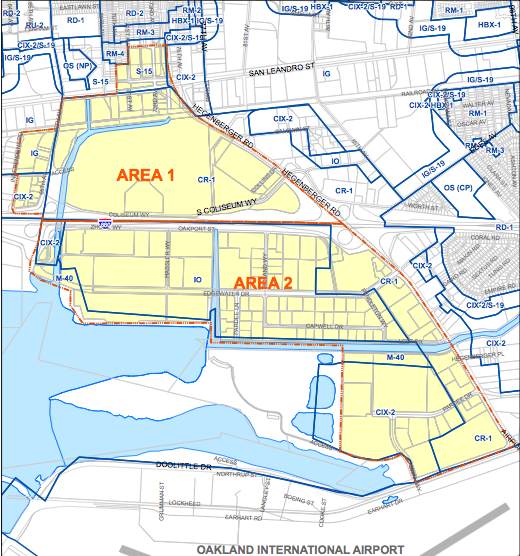
The future at the Coliseum boils down to this.

Two areas defined for the Coliseum redevelopment plan. Area 1 is called "Coliseum City". Dotted orange lines are borders, not solid blue lines (zoning).

area1-2

I’ve been reading the meat of the Oakland Coliseum Area Specific Plans RFP. It has some clearly outlined goals:

  • To maintain a world class sports and entertainment complex
  • To attract major technology or science employers to the campus across 880 from the Coliseum (a.k.a. Zhone)
  • Create jobs
  • Provide long-term benefits to the East Oakland community
  • Support the airport

During Friday’s press conference, Oakland Mayor Jean Quan revealed that six firms have submitted proposals based on the RFP. It wasn’t immediately clear if the bids were based on both areas (Coliseum City, Oakland Airport Business Park) or just one. Either way I’m interested in seeing what will happen. As I’ve written previously, the process is going to take some time to complete. This is not an environmental impact report. That, and EIRs for specific items if they are deemed large enough to require such studies, would come later. The scope is large, as it should be if it’s covering 750 acres. It includes an advisory that any consultants should plan for 25 project meetings with city staff, 8 community workshops, and 12 public meetings with the Planning Commission and City Council.

The interesting about the RFP is not that in the list of alternatives, it asks for one in which the A’s leave the Coliseum complex. In light of recent news about the Warriors being lured to SF and the possibility that the Raiders may join the 49ers in Santa Clara, what’s surprising is that there is no alternative that considers what would happen if all three tenant teams leave. At this admittedly early juncture, it seems a lot more likely that there will be only one or two teams left at the Coliseum in ten years than all three. It may be more likely that no teams will remain as opposed to the three.

In the City’s efforts to appease the Raiders, they’ve left huge openings for the Warriors and A’s to exploit if they wanted to leave. The Warriors have it good. The region is crazy for pro basketball as a product. The bar is astonishingly low for perceived success. Joe Lacob and Peter Guber (and Bob Piccinini, ahem) know that the Warrior fanbase will follow the team across the bay without batting an eyelash, and if some group of pro-Oakland fans chose to protest, they’d be easily replaced by fans in the West Bay. We’ve been chronicling the A’s efforts to stay and leave for over 6 1/2 years here, so I don’t need to rehash all of that. As for the Raiders, consider this: it was the NFL, not the 49ers, that put together much of the $850 million of financing for the Santa Clara stadium, including Goldman Sachs. Does anyone honestly think that the NFL and Goldman Sachs would do that if they weren’t going to lean heavily on the Raiders to play in Santa Clara, at least for a decade? The agreement drawn up with the City of Santa Clara supposedly has the team and the NFL on the hook for debt service, so it’s reasonable to think the Raiders will be nudged south. The NFL doesn’t give out it “G-3” loans to just anyone. It doesn’t want to do it twice in the Bay Area if it can help it, especially if another $150 million is in play for a stadium in either LA or San Diego.

A proactive, instead of reactive, government would at least explore the possibility of no teams at the Coliseum just to suss out the potential of the area post-pro sports. Pride and the lingering debt on the stadium and arena are pushing the City in a different direction that may not be very realistic. The challenges for Oakland in developing the Coliseum area are many:

  • Cost to build new stadia or significantly improve the arena have to be borne by the teams. At a half-billion for W’s or A’s and $1 billion for the Raiders, the cost gives an owner pause.
  • The likelihood for a big name employer to take the Zhone campus is slim. The City tried to pitch the campus as one of its two bids to lure the Lawrence Berkeley Labs second campus. That lost out to Brooklyn Basin Oak-to-Ninth, though LBL has delayed the announcement of the new campus location until next year.
  • With each tenant that leaves, that’s one less anchor to attract developers. Based on the number of games and usage, the Raiders should be the easiest one to let go of since they only play 10 games a year. A ballpark has 82 games, an arena 42+ and concerts and other events. That makes it doubly puzzling that they’d go so hard for the Raiders.

Let’s be clear about something. It makes sense for the City of Oakland to think about the future. They shouldn’t think with tunnel vision. The RFP mentions baseball twice, and specifically figures the Raiders in as part of the future. The City needs to work on all possibilities, not just the Raiders or a pie-in-the-sky Coliseum City development. No matter how Mayor Quan tries to spin the process in Oakland as “easy”, figuring out what to do the Coliseum 10, 20 years down the road is anything but. The plan needs to be comprehensive. As the process starts in earnest over the next year, I hope that Oakland residents start asking the tough questions. They deserve real answers. They’ll have their chance in the workshops and hearings.

Reopening an old wound

Mark Purdy’s newest column revisits a fuzzy period when the halcyon days of the Haas era were ending, and East Bay looked to bring the Raiders back to Oakland.

Reinsdorf’s statement about Oakland, meanwhile, outlines a chapter of the A’s stadium pursuit that many East Bay citizens either forget or refuse to acknowledge. The chapter dates to 1994, not long after the Haas family sold the team to Steve Schott and Ken Hofmann. The two men had big plans for remodeling the Coliseum into a fine baseball-only structure. They requested a meeting with the Coliseum commission.

“Here’s what we’d like to do,” Schott told the commission, outlining his remodeling ideas.

“That’s all very nice,” the commission replied, more or less. “But we have some news. The Raiders want to come back to Oakland, and we’ve got a financing plan to make it happen that will include building a new center field addition. You can’t fight this, because the important people in Oakland want it to happen and they’ll make it difficult on you if you try to get in the way.”

Schott and Hofmann acquiesced. From that moment forward, the A’s long-term future in Oakland was probably doomed. Years later, after Wolff and partner John Fisher bought the team, Wolff did assemble a new ballpark proposal near the Coliseum site. His plan involved mixed-use redevelopment and required Oakland’s assistance to acquire the necessary land. The project went nowhere when the city did not or could not cooperate. Wolff then looked south to Fremont and spent years on another failed plan before finally settling on San Jose as his last, not first, resort.

15-17 years doesn’t seem like that long ago. I have trouble remembering all of the details. Purdy’s account sounds roughly correct, though I’m not certain about how all of the dates fit together. There was a point after Schott’s proposal when the old Coliseum Commission came to an end in a political brouhaha, to be replaced by the Coliseum Authority (see “A Cup of Joe with the Georges” for George Vukasin Sr.’s take).

Fast-forward to last year, when the Coliseum Authority worked with the Raiders again on plans to redevelop the entire Coliseum area by constructing a new football stadium to replace the to-be-demolished old Coliseum. A proposal by Wolff when he worked for Schott and Hofmann went nowhere. I’m sure MLB cares not one whit about the apparent favorable treatment the Raiders repeatedly received over the A’s. It won’t affect their decision making at all. Water under the bridge, right?

Shea asks if the A’s could stay at the Coliseum if the Raiders leave

Sometimes I wonder if, given the lack of juicy topics, some of the local media default to writing about the A’s stadium situation. It’s not sexy, and it’s easy to write about without getting into any real depth. That’s exactly what Chronicle baseball writer John Shea did when opining about a new Coliseum ballpark.

Shea thinks that the possibility of a joint 49ers-Raiders stadium in Santa Clara should provide an opening for the A’s to stay there. The land is already there and paid for, as is BART and a ton of parking. Sounds simple enough, right?

Should the Raiders decide that they want to stay in Santa Clara long term, then yes, this could work out just fine and dandy. Except for a few minor details. Allow me to enumerate.

  1. The Raiders may only view Santa Clara as a temporary thing (10 years), with an eye towards building somewhere else in the future. The prime location would be the Coliseum, which as reported previously, has plans on the drawing board for a new football stadium and land purchased to support it.
  2. MLB wants this thing wrapped up by 2015. They’ve said so to both Oakland and San Jose officials. By waiting out the Raiders’ decision making process, they’re guaranteeing that a new ballpark for the A’s couldn’t open until 2017 or 2018 at the earliest.
  3. Why should MLB be subordinate to what the NFL is doing? The A’s have already suffered from that exact problem for the last 16 years.
  4. Who’s paying for the remaining debt at the Coliseum now? Certainly not MLB or the A’s.
  5. What happened to Victory Court? That’s the Oakland site that was chosen by both the City and MLB to move forward because of its location downtown. MLB has already dismissed the Coliseum and Oakland has gone along with it. Nothing has fundamentally changed to make the site more attractive. By going back and forth on sites like this, those involved look as if they’re not making a concerted effort. Instead, it looks like they’re grasping at straws.
  6. Wolff responds in the article to Shea’s idea by saying that he couldn’t privately finance it at the Coliseum site. And he’s right. A “rebuilt” Coliseum is out of the question since MLB would never go for it. And investing $450 million at the Coliseum is impossible for some time to come, given the state of stadium lending and the fact that it’s a “depressed area“.

The only thing that could drive this is if MLB outright rejected the A’s efforts to gain territorial rights in Santa Clara County. Even then, it really comes down to simple sentiment: Al Davis said before his passing that there could be a future for the Raiders at the Coliseum, whereas Lew Wolff doesn’t believe in such a future for the A’s. They’ve both spent a lot of time on this. After all this time, are they both wrong? Or is a quaint notion thrown out there on a whim more realistic? Somehow I find that hard to believe. Facts are inconvenient, I know.