Rebecca Kaplan Sports in Oakland Chat

I was able to get to the Linden Street Brewery near JLS just a minute or two before mayoral candidate Rebecca Kaplan started her speech on sports in Oakland. Mike Davie, who is a fairly prominent Keep the A’s in Oakland figure, is volunteering on Kaplan’s campaign and introduced her. The speech lasted about 25 minutes, after which I had to leave. Here are some of the nuggets I got from it.

  • She’d like to keep the A’s in town, have a rebuilt Coli be the home for both NFL franchises, bring a WNBA team to town, and attract more international soccer matches.
  • Kaplan talked up the potential of TOD developments, citing the Coliseum as a distinct site with potential. She joked about the BART bridge being a “walkway of chain link doom.”
  • She did not say it specifically, but I inferred that she would push for a A’s ballpark solution at the Coliseum, with new ancillary development around it to make it feel like a proper urban ballpark feel.
  • She did not mention any of the JLS sites. She tried to make a distinction between what she called the “Possible Dream” (something that is feasible) and the “Impossible Dream” (something that people simply keep talking about in circles). Does this mean that she’s not a shill for the JLS-area developers that want/need the ballpark to boost their ROI?

That’s what I got from it. About 50 people attended. I felt like a media person, so as much as it pained me I didn’t partake in any beer (big fan of Linden’s version of steam beer) or freshly grilled hot dogs. We’ll see if any of the other candidates hold a similar forum.

One Possible Future Revealed

As we all know, too well, at this point in time there is no real guarantee as to where the A’s will play their home games in the not too distant future. We all have opinions, we handicap the race, we rationalize away opposing views, etc. So for this post, let’s all take our  “bookmaking” hats off and just envision what it would be like to sit in the stadium that has been rendered…

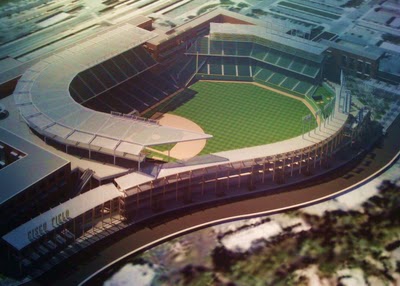
If it helps, just imagine it is at Jack London Square. We start with my favorite image…

Pictures Courtesy of probaseballforsanjose.com

Ignoring the question of “where,” two things seem to be on folks mind’s when thinking about this rendering of a new A’s stadium. Will it be a hitter, or pitcher, friendly stadium? And what the heck is that thing in Right Field?

Let’s start with the dimensions. From Left to Right, 309 LF Line, 375 LF Power Alley, 405 CF, 345 RF Alley, 300 RF Line (this number comes from a different picture). These dimensions, combined with the scarce foul ground, make me think it is safe to say that this park would be rather attractive to hitters. A few things we can’t really tell from the image above would be important in determining how friendly. Really, the most important thing we can’t necessarily tell is the height of the fences. Clearly, Left Field is lower than the rest. If I were to guess I would say that Center and Right Fields (minus the thing in Right Field) are 12-15 feet high. If these dimensions are really what will be in play, I hope it is 15 feet, or higher. Otherwise, there are gonna be A LOT of fly balls in the right field gap, that wouldn’t normally hit a warning track anywhere else, that are landing a few rows deep. Even then, those fly balls will probably be doubles instead of fly outs. I’m not sure how I feel about that.

After years of watching “Coliseum regulated offensive production” it might be nice to see some guys hit 50 HR’s on occasion. I mean, imagine if Eric Chavez played his pre-2006 career in this stadium. Holy cow he would have been a monster. Jason Giambi in 2000 could have over 50 HR’s in this place. The downside? Barry Zito wouldn’t have won a Cy Young. Well, this is all clearly meandering false revisionist history that can’t really be proven. But wait! Another picture:

That Thing in Right Field is kind of awkward. There. I said it. But it also has freaking huge potential. Looking at this image, three things jump out at me. The yellow line running up the brick portion of the wall. The concept of mini/convertible suites. The unfinished look to the architecture.

I may be legally blind, but even I can see that the distance to the corner appears to read “300.” The yellow line, about 45 feet in from the foul line and coinciding with the Crawford Box like seats in Right Center, that runs up the thing and kind of disappears about half way up drips with possibility. I imagine the HR line would run along the top of the brick line, it looks to be about 25 feet high, and allows for fans to sit just about in the field of play. 300 feet seems a bit short, no? Without a doubt it appears to be something below 310 feet, so it will require MLB approval. But this short distance offers opportunity in the form of premium seating.

The Thing in Right Field appears to be made up of suites. In the original Fremont design, the park had customizable minisuites. These appear to be the same concept, small configurable suites. The lower level, those covered with brick and in play, could easily be a larger version of the Virgin America Loft (pictures start on slide 6 in the link) over at AT&T Park. Everything above the line would be suites, customizable for groups from 4 to 16. It reminds me of many football stadiums I have been too, with the row of suites all on one side of the field, in a stacked formation.

The last thing, of course, is the stark look to The Thing in Right Field. It leaves a lot to the imagination. Don’t get me wrong, if it looks exactly like this drawing, it will be good as is, with it’s stark, modern feel. But imagine something like the Coliseum in Rome, with it’s arched breezeways. It could fit. Spanish-Mission Style rectangular windows. They fit. I like the blank slate.

I hope no matter where a stadium ends up, it has The Thing in Right Field. Just, maybe, 320 feet from home plate. Let’s look at another angle:

This is just a cool shot. The two things I really like are the building along the Left Field line and the Upper Deck in Left.

The Upper Deck in Left reminds me of my favorite old school park, Tiger Stadium. When the A’s used to go to Detroit, in the the pre Comerica Park days, I would run home from school to be home in time to turn on KAIL TV 53 and see if anyone could hit one into the Upper Deck. I would love to sit in a real Upper Deck in the middle of the outfield. Of course, these days I wouldn’t really have reason to wonder if anyone (in Green and Gold, anyway), would hit one into the Upper Deck. But maybe someday Chris Carter?

I imagine that building along the Left Field foul line, and then wrapping around behind the stadium, is an equivalent to the area outside Fenway Park on Yawkey Way. At least, it is envisioned as such, only bigger. With a High Speed Rail station somewhere nearby, it isn’t hard to see the vision: A transit hub/plaza/retail district that sits in between HP Pavillion and Cisco Field. It is a grand vision.

Is this vision be become reality? We all await your direction, Bud.

Juicy MLB team financials leaked

Deadspin received some very interesting, detailed financial statements from recent years for the Pirates, Mariners, Rays, Angels, and Marlins. As usual, Maury Brown already has an analysis up. Take a look at the docs if you have time, I’ll chime in shortly. Note: There is one team remaining to have its numbers leaked. Will it be the A’s?

I’ve taken the individual scans and put them into PDF format.

On a sad note, the great former KPIX anchor Dave McElhatton died earlier today from stroke-related illness. His jovial, normal guy nature was very different from the Tab Hunter-styled anchors we’re used to seeing. Condolences to his family.

News tidbits from Week of 8/20

I’m at a train “layover” in Spokane. They’re splitting the train so that one part goes to Seattle, the other to Portland (my half). Three more days, it’s been great so far.

  • So far, home teams are 1-8 in the games I have attended (or in the White Sox case, was prevented from attending). The first win came Wednesday night, as the Twins beat the White Sox in Target Field. BTW, I’ve already written the longish post for that one, but it’ll have to wait until after the other Wrigley Field and Miller Park posts are up. Next game is a AAA game in Portland later tonight, perhaps one of the last pro games in PDX for a while.
  • Lowell Cohn has another hit piece on A’s ownership, this time focused on the Fisher family’s vast art collection, which indicates they love art more than sports. Then he claims that ownership should be “sportspeople” as George Steinbrenner was. You know how good of a “sportsperson” The Boss was? He got New York State to fork over $160 million in public money to pay for Yankee Stadium in the mid-70’s. Hundreds of millions more in tax-free bonds were rammed through the legislature for the new Yankee Stadium. Do you think that any Bay Area owner is going to get a deal anywhere approaching that right now, Lowell? Hmmm???? Revenue sharing receipts are not a license to spend willy nilly. Major free agents aren’t coming here to sign long term deals (Rafael Furcal). Hell, they aren’t even going to the Giants. Here’s an proper response to Cohn’s non-sequitur:
  • Both the Las Vegas Review-Journal and the Las Vegas Sun are reporting that Mayor Oscar Goodman and Vegas interests are once again interested in a MLB franchise, possibly an AL team. Haven’t we heard this song before? And didn’t Goodman say barely two years ago that he didn’t want to be used as leverage against another city, say, St. Petersburg? Once he opens his mouth on the subject, which he is guaranteed to do shortly after someone calls, he and Vegas become leverage. Can’t blame him for wanting that legacy piece.
  • Speaking of St. Pete, Pinellas County (FL) extended an existing 1% bed or TOT tax originally used for funding the Tropicana Dome. The tax, which was set to expire in 2015, could potentially be used as a $4 million/year source of funding for a new Other Bay Area ballpark.
  • Finally, Baseball San Jose is organizing a Diridon site walking tour on August 30th at 6 PM. Jeffrey and I are both scheduled to attend. If you’re available, it should be informative. The prior tour I attended was a city-run affair and couldn’t address much about the baseball team and design in general. I’m hoping that because BBSJ’s booster status, we might get a little more specific. Side note: I’d love to do a walking tour of an Oakland ballpark site, though I’ve been told that there are no artist renderings of a ballpark site, nor has a site been specified (even though Victory Court is the big frontrunner).
  • Oakland Mayoral Candidate Rebecca Kaplan will have a talk on August 25th at Linden Street Brewery about sports and keeping franchises in Oakland. Sure to be top discussion topics will be the A’s and Raiders.
  • I’ve been sitting on the new pics from the San Jose Jazz Festival found at the Baseball San Jose blog. My only comment for now is that the RF addition, which would presumably follow the contour of Autumn Street/Parkway, is a good one. It’s a proper way to mitigate noise while adding revenue generating capabilities and even cheaper seats. However, it would likely require a major reconfiguration of the PG&E substation, instead of minor changes as has been discussed by San Jose Redevelopment. I’ll be pleasantly surprised if they figure out a way to shoehorn it in there. 10:00 AM – Now that I’ve seen the overhead render, I’m changing my mind. It does look like they’ve managed to shoehorn it in there. Clever. I should add that my previous sketches on this are largely based on stuff HOK/Populous has done, not the more radical with-column treatment that 360 and the A’s are attempting. Doing that could reduce the footprint some 10-20%, by my semi-educated estimate.

Anything else to report? Drop it in the comments and it’ll be added to the post.

Maury Brown on KNBR-1050

The Biz of Baseball‘s Maury Brown will be on The Ticket KNBR-1050 with Damon Bruce on Thursday at 1:30 PM. Don’t miss it, even though I will. Earlier in the week, Maury tried to make sense of the T-rights situation, covering all of the angles.

Consider this the open thread for whatever is discussed. I’ll try to participate once I hear the podcast version.

Quick aside: As I got into Dallas today, one of the big topics of conversation was a question posed to Rangers’ frontman Nolan Ryan about having a retractable roof on Rangers Ballpark. I tweeted Maury about this, he said he heard little, neither had I until today. Now it appears that the issue has legs, turning into a debate about what’s a more sensible investment: Cliff Lee or a roof? Or is it no Lee without a roof? I was there. In person I saw the seemingly indefatigable Lee run out of gas in the 7th, thanks to the nearly 50,000-person communal sauna enjoyed in Arlington tonight. Both teams’ closers are presumed to be unavailable for tomorrow, both bullpens are taxed. It’s what we’ve come to expect out of Texas in August.

Again I have to ask, “Is the process legitimate?”

Monte Poole has a column out tonight calling San Jose the “underdog,” which by extension would make Oakland the “favorite.” Which is fair, considering the amount of work that has to be done to get any team to move, let alone the A’s. There is something in the column around which I’d like to center the discussion.

“I’ll admit, 16 to 18 months ago, the team seemed on its way out of Oakland,” says Doug Boxer, vice chairman of the Oakland planning commission and co-founder of Let’s Go Oakland, a group formed to keep the A’s in the city. “We saw it as a ‘check the box’ process.

“But it has become apparent this is a real process. There has been correspondence with the commissioner. Oakland is providing relevant and real data showing the A’s can make it work here.”

Poole doesn’t say whether or not he thinks the process is legitimate. Boxer deserves credit for believing that it is.

However, there are lots of pro-Oakland folks who either believe that the whole thing is rigged and Oakland is doomed, or that it’s legitimate and Oakland will win out due to its work and difficulty in getting a San Jose deal to happen. The thing is, you can’t have it both ways. As outlined in my chart, if Oakland is deemed incapable of hosting the A’s long term, they will be out the door, by hook or crook. It may take several years, even a decade. An ownership change wouldn’t matter, since the problems would be related to the market, not an owner. Put it this way: the Giants got a lot of crap for financing $170 million for China Basin. Do you think MLB would approve a new pro-Oakland ownership group knowing that it would have to fund $350 million or more (after naming rights) for an Oakland ballpark, even if it felt that the regional support wasn’t there? Not likely.

The only way this works out the best for Oakland is if:

  • A) The process is real and legitimate
  • B) MLB rules that Oakland and the East Bay are enough to support the A’s
  • C) Wolff/Fisher are so frustrated that they sell instead of waiting it out until after the 2017 season, when debt service for AT&T Park would end

That’s a lot of “what-ifs” to hinge your hopes on. If this is all legitimate, that’s what you have to believe. You can’t have it both ways. You can’t say, “I trust MLB to do the right thing” and then claim that it’s rigged if the decision doesn’t come out your way. If it’s fair, you should be prepared to live with the ruling, good or bad. And if it isn’t, you should be calling B.S. on the whole thing from when the charade started in March 2009. Otherwise, your so-called principles don’t amount to a hill of beans.

Stay classy, Rangers + Greenberg-Ryan group wins

After tonight’s EXTREMELY frustrating effort, my heart has been somewhat warmed by this letter to the editor of the Ft. Worth Star Telegram:

I want my brick back

Way back when the Rangers’ ballpark was built, there was a public campaign requesting donations for bricks near the entrance to the stadium. I was a willing donor, and my donated bricks were inscribed with names of several of my granddaughters.

Attending a recent game with my oldest granddaughter, my wife noticed the bricks are missing, and she was told the brick surfaces became uneven and were replaced with pavement.

Am I on the list of Rangers creditors?

— Jan Fersing, Fort Worth

Wow. Just wow. I bet some bean counter saw a number of complaints about the uneven surfaces and felt that there was a lawsuit risk, thereby justifying the paving over of the bricks. I will be investigating this on my visit.

Update on Rangers auction: After much delay this morning, the auction has begun. Despite what appeared to be a last-minute deal put together by the Greenberg-Ryan group, the auction opened with two groups: Greenberg-Ryan and a group with one-time suitor Jim Crane and Mark Cuban. Follow Maury Brown (@BizballMaury) and the Star Telegram’s Anthony Andro (@aandro) for play-by-play.

Update 8/4 10:47 PM – Greenberg-Ryan group has won. Crane-Cuban group had one last chance but backed off. Final tally: $385 million in cash, plus $12 million in escrow and $220 million in assumed debt.

News for the week of 8/1

This may be the only post of the week from me. I’ve got a lot of work to cram before I head out on the trip.

And now for the news:

The Merc’s Scott Herhold analyzes the political calculus of San Jose’s efforts of the last week.

Matier and Ross report on AT&T playing hardball with San Jose on the $12 million Diridon property.

City Councilman Sam Liccardo, whose downtown district includes the ballpark site near Diridon Station, says it’s troubling that a company “that depends so heavily on public good will” would attempt to “rake taxpayers over the coals.”

Nonsense, says AT&T California spokesman Ryan Rauzon. He says the center – which employs more than 100 people and serves as a maintenance and storage yard for a fleet of vehicles – is vital “to making sure we take care of our customers.”

“The land obviously is not for sale,” he said.

Councilman Liccardo might be better served finding a suitable landing spot for AT&T. I’ve mentioned before that I’ve been in work centers like the one that’s in question here. They are not central offices, so they don’t have tons of expensive switching equipment. They are, ironically, offices, with training facilities and conference rooms. More importantly, they have large parking lots to hold the various trucks that run around the service area. San Jose will either have to put resources into finding another centrally located spot with enough parking to make it work, or use eminent domain, which would be approved with the March vote. Note: AT&T is a sponsor of both the A’s and Giants, so it’s not a situation where the company is beholden to one team or another.

Over at The Biz of Baseball, Maury Brown’s covering the Rangers’ ownership debacle like a champ. There’s coverage of Mark Cuban and FOX perhaps being bidders on Wednesday. Get your popcorn ready. There are even threats that the Rangers would lose Josh Hamilton and Cliff Lee if the Greenberg-Ryan group were not the winner. Whatever, given the incredible job that FOX did owning the Dodgers, GOOOOOOO FOXXXXXXXX!!!!!

If you didn’t catch it last week, ESPN has a feature on health code violations by stadiums in the US and Canada. Bay Area facilities tended to perform among the best in the nation, though the Coliseum was the worst at 34%.

FWIW, I’m bringing in food tonight.

Reed pulls measure from November ballot

The press release in its entirety is quoted below.

Mayor Reed Pulls Proposal to Place Downtown Ballpark Measure on November Ballot

Decision comes after Major League Baseball offers to help cover the added cost for a possible special election and hints that a decision on territorial rights may come in time for a spring vote

San Jose, Calif. – Mayor Chuck Reed has announced that he is pulling his request that the city’s Rules Committee place a downtown ballpark initiative on the November 2, 2010 ballot, following a discussion with A’s owner Lew Wolff. The decision comes after Major League Baseball (MLB) President Bob DuPuy, speaking on behalf of MLB Commissioner Bud Selig, also agreed to help cover the taxpayer cost if a special election is required in the spring.

“I pursued a November election because I believe the citizens of San Jose deserve to have their voices heard.  We have strong community support to build a privately-funded ballpark, which would be a catalyst for thousands of jobs and millions of dollars in revenue to fund vital city services,” said Mayor Chuck Reed.  “After discussing our options with Lew Wolff, other elected officials and members of Pro Baseball San Jose, we have decided to forgo a November ballot measure.”

Mayor Reed will still be asking the City Council to adopt a resolution of support for allowing the Athletics to move to San Jose that incorporates the Mayor’s proposed amendments to the city’s ballpark Negotiating Principles.

Lew Wolff praised the strong leadership of Mayor Reed. “I’m grateful that San Jose has shown a gritty determination to help us build a new ballpark for our franchise. We appreciate the strong leadership of both the Mayor and Commissioner Selig,” Wolff said. “We look forward to a final decision from the Commissioner, and will vigorously pursue an election next year if that decision is a positive one,” he added.

Since April 2009, city leaders have been working in partnership with the Athletics on a possible relocation to San Jose. In that time, the city has developed a set of negotiating principles for a new stadium, completed an economic analysis and environmental impact review for a downtown ballpark, and met with members of a special MLB Committee formed to study ballpark options for the Athletics. However, city leaders have been waiting for a response from MLB regarding territorial rights that currently prevent the Athletics from moving to San Jose.

“The initial push to hold a November vote sent a strong signal to league officials that San Jose is serious about attracting a Major League ballclub and that it’s time to move forward with the process,” said San Jose City Councilmember Sam Liccardo, who represents downtown. “The Commissioner’s offer to help pay for a possible election in the spring was the first indication that the league is inching closer to a decision on territorial rights.”

Mayor Reed and Councilmembers Rose Herrera, Sam Liccardo and Nancy Pyle had originally proposed placing the San Jose Downtown Ballpark and Jobs Measure on the November 2010 ballot to avoid the added expense of a special election. Placing a measure on this November’s ballot would have cost several hundred thousand dollars while holding a special election is estimated to cost more than one million dollars.  Specific estimates are set by the Santa Clara County Registrar of Voters when a measure is submitted for placement on the ballot.  Voter approval is required to use city land or funds in conjunction with a downtown ballpark, and after this November, the next regularly-scheduled election in San Jose is not until June 2012.

Background:

The San Jose Downtown Ballpark and Jobs Measure required that the A’s would be responsible for 100% of the cost of building, operating and maintaining a new Major League Baseball ballpark. No new taxes could be raised to bring baseball to San Jose.

Ballpark Economic Impacts

A September 2009 Economic Impact Study commissioned by the City of San Jose states that the estimated $490 million private investment in a new downtown ballpark would bring positive economic benefits to the City:
–          More than 2,000 annual jobs (full, part-time, seasonal) of which 970 would be new jobs in San Jose as a result of the project
–          $2.9 billion total economic output for the local economy over a 30-year period
–          128 million in annual net economic impact as a result of direct spending on operations (that is partially re-spent in San Jose)
–          $5 million in annual revenues for local governments, including approximately $3 million to the City of San Jose’s General Fund and Redevelopment Agency

Following a discussion with Athletics owner Lew Wolff, Mayor Reed informed MLB President Bob DuPuy of his decision this morning and will rescind his request that the Rules Committee place the ballpark ballot measure on the agenda for the August 3 City Council Meeting. The Rules Committee will still decide today whether to place the proposed ballpark Negotiating Principles amendments on the August 3 agenda.
The Rules Committee will still meet today to discuss four other proposed ballot measures:
1. Reforming binding arbitration for police officers and firefighters;
2. Instituting a tax on medical marijuana;
3. Raising the sales tax by ¼ percent; and
4. Changing minimum benefits and contribution formulas for employee pensions

Now I can have lunch.

Regionality: The New Revenue Stream

Is it possible that the A’s v. Giants rumble for the South Bay is a lot more complex than we even imagined? I mean, Bud Selig keeps saying so. Should we not believe him? Is it possible that the concept of MLB territory is evolving and this dispute is less about right now and more about an emerging revenue stream?

I caught myself pondering this question last week as the All Star Game was struggling to keep my attention. Honestly, my pondering began with a question like “When was the last time I cared about an All Star Game?” Oddly enough, I thought of the 1988 Triple A All Star Game in Buffalo, New York. It was the first Triple A All Star Game to feature all 26 Triple A affiliates and it was televised on ESPN. I remember waiting for the game to start as I sat in a 1950’s era ranch style San Lorenzo home staring at my grandparents 20 inch TV. Jim Kaat and Gary Thorne were waxing poetic about the beautiful new Pilot Field in Downtown Buffalo and the future stars about to take the field.

At the time, my main reason for being so excited was that I would get to see the player I thought would be the 4th Rookie of the Year (after Canseco, McGwire and Weiss) in a row for our Green and Gold heroes, Lance Blankenship. As a baseball card collector, I was also interested in seeing one Gregg Jefferies, a player I had heard about in card shops as a rookie card one needed to possess. They didn’t disappoint! Blankenship was 1 for 3 with a stolen base, while Jefferies was 1 for 2 with a Home Run. Other notable names that participated in the game? Bob Geren, Geronimo Berroa, Mike Devereaux, Joey Cora and Sandy Alomar.

Thinking about the game reminded me how much minor league baseball has changed.  It seemed that, back then, MLB teams didn’t think much about how the distance between the parent club and it’s top affiliate impacted business. The A’s Triple A team was 772 miles away in Tacoma, WA, for example. While that seems like quite a distance, it was nothing when compared with the over 3000 miles that separated the Chicago White Sox and their top affiliate in Vancouver, BC. I threw a quick spreadsheet together and discovered that in 1988, the median distance between a Major League team and it’s Triple A affiliate was 559 miles. (ed. note- This number is based on Google maps and is hardly precise, but close enough to illustrate the point)

If we juxtapose the conditions in 1988 with the conditions in 2009, it is easy to see a trend towards greater regionalization. Consider these things:

  • The median distance between MLB teams and their top affiliate is now only 315 miles.
  • In 1988, there were 2 Triple A affiliates that played within 200 miles of their parent club. Today there are 12.
  • Today there are 3 teams with their top affiliate over 1000 miles away, the greatest distance being the 3600 miles that are between Toronto and Las Vegas. In 1988, there were 6 teams that were separated from their top affiliate by more than 1000 miles, 2 well over 2000 miles.
  • The Braves moved their Triple A affiliate from Richmond, VA after 43 years. The Gwinnett County Braves are just over 30 miles from the parent club
  • The San Diego Padres (or at least some members of the teams ownership group) are actively working to bring the current Portland Beavers (next season Tuscon?) closer to the mothership. Possibly as close as San Marcos (36 mi.) or Escondido (31 mi.).

With MLB Advanced Media generating profits from the web, Fox Sports paying big bucks to broadcast national games, the advent of MLB Network, Regional Sports Networks extending the reach and frequency of each teams broadcasts, and most teams having a newish piggy bank for a stadium… Are minor league affiliates the next money maker for the MLB clubs? Or could there be a different reason for the decline in median distance? Is the shrinking distance between the clubs and their affiliates  about efficiency or marketing or both? Or could it be simply that expansion in the 90’s brought big league baseball closer to existing Triple A cities?

It seems to be all three. Teams are investing in minor league affiliates to make money, closer affiliates help the baseball operations staff by allowing for things like more efficient use of scouts or potentially quicker player call ups and the MLB expansion of the 90’s created the opportunity for MLB Clubs and their Triple A affiliates to move closer together.

Minor League Investments

The Padres are just one of a growing number of ownership groups that are finding it beneficial to invest in the minor leagues. The Braves, Giants, and Red Sox have all made investments in minor league teams at some point in the last decade. While I don’t expect that every team will be out buying up the 150 or so major league affiliated minor league teams across the country, I imagine most are kicking the tires on limited investments.

I find this particular quote from the above linked article to be telling:

“We’re on the record and excited about operating a Triple-A franchise in Padres’ territory,” Moorad said. “And we want to break ground, start turning shovels of dirt within four to six months.

“To be clear, though, our ownership group — not the Padres — will make the deal that makes sense to all parties.”

Is it possible that this view of expanding the reach within their territory by collocating a Triple A franchise is one of the issues that the Selig Panel is reporting on? It seems so.

Efficiency of Baseball Operations

Picture this hypothetical situation that a GM might face. The trade deadline is fast approaching and you are not sure yet if you are a buyer or seller so you need to get good scouting reports on potential targets as well as understand the recent performance of your minor league assets. Your top free agent acquisition is about to go on the shelf with elbow trouble and you aren’t sure who to bring up to take his roster spot. You want to send your most trusted scout to report on both scenarios. If your Triple A team is 80 miles away, and playing at home, and your High A affiliate is even closer, and playing a potential trading partner… It suddenly becomes a few days of driving around the adjacent Metro Area to get an on the ground report rather than a series of plane flights all over the country and back, assuming the two affiliates are playing nearby.

It’s less expensive, your scout is presumably more alert and when you call him on a whim and say, “Ben Sheets elbow is barking, should we call up Bowers, Mortenson, or someone else?” You can expect to get a better answer.

In a scenario that probably more applies to our A’s… Rehab assignments can be monitored by the GM himself if he wants, for crying out loud.

The Changes Since Expansion

Of the markets that hosted Triple A teams in 1988, 2 (Phoenix and Denver) were “promoted” to the bigs and 6 (Calgary, Edmonton, Richmond, Old Orchard Beach Maine, Tuscon and Vancouver) were “demoted” on out of Triple A baseball.

With 4 new Major League teams creating a need for 4 additional Triple A markets, the total new Triple A cities in the past two decades is 12. The new cities, since 1988, are Charlotte, Durham, Fresno, Lawrenceville (Gwinnett County, GA), Allentown (Lehigh Valley, PA),  Memphis, New Orleans, Reno, Round Rock (TX), Sacramento, Salt Lake City and Scranton/ Wilkes-Barre.

With Triple A teams dropping below the Canadian border, and closer to existing MLB franchises, all while new MLB teams were being established closer to existing Triple A cities (Colorado Springs/Denver), it seems only natural that teams would look to realign their minor league affiliations to take advantage of the opportunity to expand their reach into adjacent metropolitan areas. With the growth of Regional Sports Networks, minor league affiliates outside of traditional MLB territory, but inside an expanded TV market, became of greater strategic value.

In conclusion, it is all speculation as to what role this evolving view of the value of minor league affiliates in an extended metro area may hold for big league clubs. That said, it is clear that even small market teams are looking to the minor leagues as potential sources of future revenue. While I am not sure this is something that Selig’s panel is looking into, thinking about it (and mentally squinting really hard) definitely makes me understand some of the delay.