NFL Town Halls: Three days of talking around a problem

They came, they saw, they empathized.

As part of NFL’s relocation evaluation process, the league is required to hold public meetings in the cities from where incumbent teams are threatening to move. Despite the fact none of the three teams considered part this discussion – Raiders, Chargers, Rams  – have actually filed a request for relocation (they aren’t allowed until January), the NFL decided to hold these meetings well in advance of all three teams’ expected applications to leave.

That left the NFL to announce three weeks ago that they would send a team of executives, fronted by Eric Grubman, to the threatened cities to hear from fans and discuss each city’s situation. Grubman was accompanied at each stop by fellow VPs Chris Hardart and Cynthia Hogan, plus league attorney Jay Bauman. All four sat in directors chairs on a blacked out stage, while fans sat in the lower auditorium levels, waiting to speak at podiums placed in each aisle. Politicians and team owners, even Raiders owner Mark Davis, sat among the riffraff.

St. Louis and San Diego share a common problem, in that their respective teams have not participated at all in recent stadium development efforts at home. Local sentiment reflected that, with fans lustily booing the Rams’ Kevin Demoff and the Chargers’ Marc Fabiani, both of whom have openly pooh-poohed those 11th-hour attempts in favor of stadium projects in the LA area. Feeling powerless, fans in both cities sang a common refrain: bring Stan Kroenke and Dean Spanos back to the table so that we can make stadium deals in STL/SD. And as each story about generational bonding or heartbreak was heard, the more it sounded like groveling. That’s what the owners and the NFL have reduced fans to doing: begging to keep the team in town. It’s a common story, at least in North American pro sports, and this won’t be the last time it happens. Some guy within NFL Films will be tasked with editing the combined nine hours of testimony down to probably 30 minutes that will be consumed by the collective 32 NFL owners at a future league meeting. I don’t envy that person one bit.

upintheair

George Clooney and Anna Kendrick in 2009 film “Up in the Air”

Grubman, who made most of the responses to fan questions, reminded me a lot of Ryan Bingham, the slick, well-compensated corporate hatchet man from the Walter Kirn novel Up in the Air. The film adaptation in 2009 starred George Clooney as Bingham, a man who lived a thoroughly hollow personal existence while obsessing over a quest to reach one ten million frequent flyer miles. That’s not to say that Grubman’s like Bingham personally. From all appearances Grubman is a family man. He even joked in Oakland that he was missing his wedding anniversary for that night’s hearing. Nevertheless, Grubman’s ability to empathize with every fan and speaker was amazing to watch. Veterans and government employees received laudatory Thank you for your service salutations. Several times he prefaced a remark with, I know what it’s like to be a fan. It was as breathtaking and sickening a performance as I’ve ever seen – including Clooney’s, which netted him an Oscar nomination. Then again, Grubman apparently gets paid at least $4.4 million a year as an executive VP in the NFL. Like Bingham with his delegating boss, Grubman is compensated well to, among other responsibilities, take Roger Goodell’s arrows.

Davis has also been an active participant in the joint stadium effort in Carson, though Raider fans and city officials have given him some credit for participating to a degree with the now shitcanned Coliseum City project. He received a largely warm reception from the roughly 400 Raiders fans at the Paramount Theatre in Oakland. He made some opening remarks, stating that the Raiders wouldn’t answer questions at the session. Couple that with Grubman’s admission that the NFL had no solutions for Oakland, and you might think that the whole thing was a charade. You would be mostly right.

When challenged about the Raiders paying only $300 million (plus the NFL’s $200 million in G4 money) towards a $900 million stadium, Davis responded.

That’s basically what Davis has been saying for the last six months. He’s not willing to stake additional stadium revenues to make an Oakland stadium deal happen, as the 49ers did with Levi’s Stadium. Hard selling with ultra-expensive seat licenses and ticket prices works as long as the team is good, but as we’ve seen so far in the 49ers’ tenure in Santa Clara, fans will ditch the team in droves if the team isn’t competitive. Even the Raiders had trouble selling out until the upper deck of Mt. Davis was tapped off. No one wants to be left with the check at the end of the night, whether it’s Davis and his ownership partners, the City of Oakland and Alameda County, or stadium financiers. This is not a trivial amount of money – $400 million – that we’re talking about. Fans need to stop treating this issue like it is.

Yet there were calls for crowdfunding to help bridge the funding gap. Before anyone creates a Raiders stadium Kickstarter, you all should know that there already exists a sort of primitive form of stadium crowdfunding. It’s called a brick campaign. Fans buy custom engraved bricks that end up in a plaza or on a wall at the stadium. Even successful brick campaigns won’t pull in more than around $25 million, a relative pittance compared to the total project cost. The Green Bay Packers held a stock sale in 2011 to finance renovations at Lambeau Field. That effort raised $64 million, from sales of 280,000 shares costing $250 each. If the NFL allowed Raiders fans to make a similar effort (even though the Raiders are not a publicly-owned corporation), the effort would have to sell around 1.8 million shares at $250 apiece to raise $400 million (after overhead and fees). That’s simply an infeasible goal for any team, not just the Raiders.
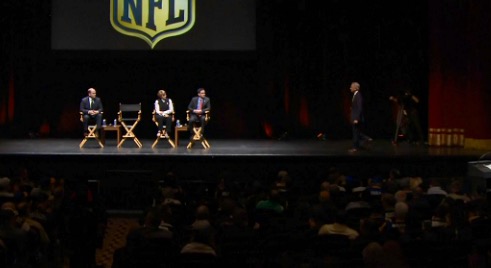
NFL exec VP Eric Grubman stands on stage while answering a question at the Oakland Town Hall

NFL exec VP Eric Grubman stands on stage at the Paramount Theatre while answering a question at the Oakland Town Hall on Thursday

Last but not least, Oakland Mayor Libby Schaaf was in the house. Schaaf thanked the NFL and fans for showing up. Yesterday, Matier and Ross led off their column with a note about yet another consultant being brought in to put together a package that might sway the Raiders and the NFL. That package could provide infrastructure and potential tax breaks for a stadium deal. While that might sound promising, it’s really just formalizing what Oakland’s willing to offer, which is limited help and no public money. That won’t work for the NFL because the league considers infrastructure and free land little more than table stakes. St. Louis and San Diego are providing real public money towards construction, just as every previous NFL stadium project has in the past. If public money isn’t on the table, there’s little reason to expect the NFL to respond positively. Grubman explained that every stadium deal has three financing parts: the team, the league, and the local piece. Historically that local piece has consisted of public loans or bonds. The NFL has already rejected the Coliseum City plan. The NFL has its script and it’s sticking to it. Oakland is no special case here. If Oakland really wants to keep the Raiders, they need to put some skin in the game. Given what happened with the Mt. Davis debacle, that skin may end up being Oakland’s scalp. Schaaf is right to be cautious and not desperate as her counterparts have been. How do those positions get reconciled? Someone will have to give in, and the NFL has not shown a track record of making concessions.

NFL to hold town hall meetings in St. Louis, San Diego, Oakland

Image from Barcroft Media

St. Louis on Tuesday, Peabody Opera House, 7 PM CT

San Diego on Wednesday, Spreckels Theatre, 7 PM PT

Oakland on Thursday, Paramount Theatre, 7 PM PT

Stream should be available at nfl.com/publichearings.

Commentary to come after final session in Oakland. Watch the Twitter feed for live coverage.

Manfred: I want the A’s to stay in Oakland

Look, there’s little point to writing about San Jose. Other than the antitrust lawsuit, San Jose hasn’t been a player in the A’s stadium discussions for at least a year. I haven’t written about it much, yet I’m supposed to be San Jose’s greatest champion. Mayor Sam Liccardo appears ready to move on. The A’s may control some of the land into the future in case Oakland somehow screws the pooch. Absent that, all eyes should be focused on Oakland, the A’s, and unfortunately, the Raiders. We’ll know more about how the Raiders actions affect the A’s in due course.

RIP Cisco Field

RIP Cisco Field

No, I wanted to wait until I heard from the person who’s eventually going to drive this effort, if for no other reason than pent-up frustration. That man would be Commissioner Rob Manfred, courtesy of the LA Times’ Bill Shaikin. Shaikin got an A’s question in with the Commish today, and Manfred put it in no uncertain terms.

Shaikin: On Monday, the Supreme Court declined to hear San Jose’s appeal of its lawsuit against MLB. You had said you would not hold any discussions with San Jose about its interest in building a ballpark for the Athletics so long as the city was suing the league. Now that the suit is done, would you talk with San Jose, or do you want the A’s to stay in Oakland?

Manfred: I want the A’s to stay in Oakland. It’s a very fundamental policy of baseball. We favor franchise stability. I think it is possible to get a stadium done in Oakland, and that remains my preference.

That’s the most public support Oakland has gotten from a pro sports commissioner in 25 years. It’s meaningful. Most importantly, it’s a message to both the A’s and Oakland to git er done. Manfred has already mentioned pushing the A’s to do more on their own. This very visible support for Oakland is a way for Manfred to say to Oakland, I believe in you, now take this goodwill and do something with it.

Okay, but When? you ask. Well, if I’m going by how the A’s and the City of Oakland operate, I suspect things can start to go public in either November or December. The A’s have done past stadium presentations and info releases in November, clear of the World Series and around the busy fall/winter meetings timeframe. The City of Oakland seems to prefer dropping info in December, right before City Hall goes on recess.

The road to getting a stadium deal done is a long one. Thankfully, many of the process steps have already been done. There’s no need for a new EIR if, as Lew Wolff desires, a new A’s ballpark eventually replaces the Coliseum as the only stadium in the complex. The one tangible benefit from the Coliseum City debacle is a certified plan for the land in and around the Coliseum, which should streamline the process for a third venue. The only thing holding up matters, much to Manfred’s chagrin, is the Raiders.

Manfred would love for the A’s to be more proactive in making a deal. He’d also love for Oakland to kick the Raiders to the curb, but we all know the City is not going to do that first. Oakland would much rather let the NFL make a decision for them. Since that decision could come in only four months, there’s no real harm in waiting. The A’s have a lease for several more years, so they don’t have to rush.

And if I’m Lew Wolff, I want to have some idea what the future holds for the A’s via the collective bargaining agreement, the current version of which is set to expire after next season. It would behoove Wolff to show enough progress on the stadium front to convince Manfred and the Lodge to support some form of financial backstop for the team, whether via extended revenue sharing or a stadium loan. While there is no NFL-style G-4 stadium loan infrastructure for MLB teams, there is a league credit facility that can provide up to $100 million for various operating costs. As for a cap on revenue sharing, there is this entry I keep forgetting to cite from the current CBA:

(10) The “Base Plan” shall be a 34% straight pool plan… For purposes of the Base Plan in the 2012 Revenue Sharing Year only, the Miami Marlins’ Net Local Revenue will be $100 million.

Basically, local revenue above that $100 million mark would’ve been exempt from revenue sharing (paying 34% of it into the pool), though I’m not sure that the Marlins actually reached $100 million local revenue that year. In any case, the language and mechanism are there to support such a request. That’s important, though not so much for the initial years of the stadium and the expected honeymoon effect, but for later years when the effect wears off. Look at the two teams with the newest ballparks, the Marlins and Twins. Neither became huge successes when their parks opened, allowing revenue sharing to be a welcome safety net for both despite heavy public subsidies. The A’s should be given the same treatment from MLB, provided that it sunsets in a reasonably short period, say, for the length of the next CBA. After all, the A’s were given a sunset provision for revenue sharing in the current CBA, which would’ve kicked in if they opened a ballpark between 2011 and 2016.

People tend to remember stadium drives for groundbreaking ceremonies and impactful city council votes. But it’s all about the process, having a good working relationship, and the team and city presenting a united front. We know that Oakland is where the commish wants the ballpark to be. We know that the current atmosphere in City Hall is more hospitable to the A’s than it has been in previous administrations. It’s going to take a while to settle the land issues, to get the various details right. There is a recipe for a successful ballpark deal. It won’t happen overnight. If you have any hang-ups about Oakland or Lew Wolff and John Fisher, best to leave them at the door. They’re the dealmakers, like it or not.

San Jose’s antitrust case denied by SCOTUS

Today was supposed to be doomsday for San Jose’s Supreme Court case against MLB. Now we know for sure:

Here’s the list of which petitions were granted certiorari (PDF).

The Supreme Court started going through petitions Monday, with the expectation that we’d know the fate of the case sometime towards the end of the week. (SCOTUSblog details the process here.) While the case is still pending, it is being left to wither and die as there are no plans for the Court to take it up.

Now that this chapter is effectively over, MLB, the A’s, and San Jose can move on, which means watching Oakland try to get a ballpark deal in place for the A’s. That’s where the attention has been for the last 18 months, anyway. San Jose doesn’t re-enter the picture unless the A’s and Oakland aren’t able to work something out.

Reactions to be added to this post as they come.

Update 1:30 PM – Professor Nathaniel Grow chimed in further:

What to expect when you’re not expecting

Word came Friday that Floyd Kephart is out from the Coliseum City project, which, you might think, should lead to the demise of Coliseum City.

With Kephart’s negotiating rights set to expire on Thursday, the Oakland City Council and Alameda County Board of Supervisors agreed in separate closed door meetings this week to cut ties and send him a letter outlining deficiencies in his latest proposal, said several officials who asked not to be named because the talks were private.

So that’s that. The deficiencies were largely financial, as we’ve discussed ad nauseum. Having three separate groups try and fail at making Coliseum City work is a clear indicator that there’s really nothing that will make it work, at least the way Oakland wants it to. Part of that is the Raiders’ and A’s insistence on maintaining surface parking instead of allowing for a bunch of development surrounding the stadia. Another factor is the extremely limited public resources on hand, especially in the face of outstanding debt on both the old stadium and arena. The stadium debt is not only an obstacle, it is a potential showstopper. Nine figures of debt doesn’t simply get written off if you’re a municipality.

coliseum-city2-sm

Add this rendering to the long and growing list of failed stadium projects

Oakland and Alameda County continue to talk to the teams, while also exploring a buyout of the County. Alright, before any proposals are made or any substantive talks are to begin with either team, the buyout situation absolutely has to be sussed out. The uncertainty regarding the County’s involvement, which lingered in the background for over a year before becoming a front-and-center in January and remains an unresolved issue to this day, cannot be allowed to complicate any future stadium talks. Either the County is fully out or it will be a partner. There is no in-between. If it comes up again, it will show the NFL and MLB that the East Bay can’t get its act together and can’t be taken seriously. It’s that important.

The buyout is not going to be easy. Normally these types of deals are worked out through swaps of real estate, since municipalities tend to be cash-strapped. Whether that’s workable for the County is another matter, since there is actual cash to be paid out on an annual basis by both parties. If both parties decide to follow through on the County’s wishes, I would expect the deal to be wrapped up in the next six months.

Next, all of the important players are going to have to step it up to a degree that they haven’t displayed so far. That includes:

  • Lew Wolff and/or Mark Davis
  • Oakland Mayor Libby Schaaf
  • Scott Haggerty, Alameda County Supervisor and President of the BoS (if County continues to be involved)

Wolff and Davis will have to provide detailed plans for whatever they want to build at and around the Coliseum. That’s not a problem for Wolff, since he already has HOK working on it. On the other hand, Davis has no such experience and will have to rely heavily on a third party to work out the details. That is, if the Raiders are still staying in Oakland past January. Davis is actively involved in the Carson stadium project. If the NFL puts off the LA decision for a year, or tells Davis to stay put for a while, Oakland will have no choice but to work with him on whatever stadium idea he’s thinking of. Schaaf will have to become a much more visible champion of the project, similar to what Quan did for Coliseum City. Haggerty, who was a leading public figure for the Fremont stadium project, would likely do the same here, with the possibility of fellow supe Nate Miley partnering or taking the lead. Basically, both the public and private sector will need champions, willing to bear the scrutiny and spend money/assign resources to get the project(s) through the planning process.

There’s no timetable for any of this to happen thus far. We may hear more towards the end of the year. I sort of expect the A’s to release renderings and initial plans sometime after the season ends, though I wouldn’t be surprised if that didn’t happen. Procedurally, everyone’s still at the mercy of the NFL, since it actually has its a timetable – one subject to delay – but a timetable nevertheless. Sure, the path towards a new stadium at the Coliseum is less complex with Coliseum City out of the way. Don’t mistake that as being close to a deal. There’s still an extremely long way to go, and many complications to resolve.

P.S. – I neglected to mention the status of the Coliseum land. Ten or twenty years ago, the notion of giving away or highly discounting public land in order to ink a stadium deal was considered a mere cost of doing business. It was the much more politically expedient concept to giving away both the land and a heavy construction subsidy, which most cities were and still are doing. Over the last year groups have protested giving away the 120+ acres at the Coliseum because it represents a giveaway to billionaires, while also not properly addressing the growing housing crunch and concerns about gentrification in East Oakland. What was once practically a given (as it was for the SF Giants in 1997) is now shaping up to be political land mine if not handled properly. As Schaaf and the City Council work out the land DDA (development and disposition agreement), they’ll have to be mindful of how the deal looks to the public. That’s sometimes what happens when parties (cities, teams) don’t act quickly enough. It only gets harder.

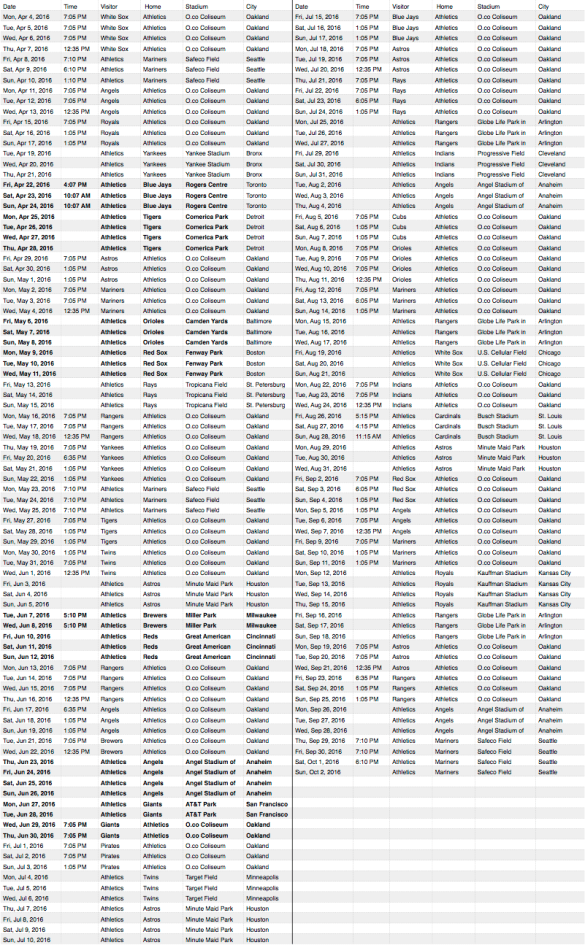
Tentative 2016 schedule released, A’s screwed over

The A’s got a look at the 2016 schedule a while back, and they were concerned enough to lobby MLB in an attempt to make the travel a little easier. They being the A’s, of course, their concerns fell on deaf ears. Now you may be thinking, These guys fly chartered jets and stay in five star hotels, what are they complaining about? True, big time pro athletes travel quite well. The media and fans that follow them don’t. It’s still a grind, and in 2016 the grind is palpably worse than it has been in recent memory.

2016-all

What stands out for 2016 compared to previous years is the number of lengthy road trips and homestands. In baseball, fans are used to the idea of the team being home for a week, then leaving for a week, cycle repeating for six months. For the A’s scheduling is a bit extreme, with three homestands of 9 games or longer and a separate stretch consisting of 13 of 16 dates at home.

stretch

On the road the A’s scheduling woes are marked by a particularly horrific final two weeks in August, in which they go on the road to Arlington and Chicago, come home for a short series with Seattle, then go back out to the Central time zone to face St. Louis and Houston. Worse, the Texas and Houston series aren’t coupled, which would allow for short trips between the cities (made popular by the NBA’s Texas Triangle of Dallas, Houston, and San Antonio). Instead the team will have to go on six separate trips to the state of Texas, none earlier than June. All three trips to visit the Rangers will occur after the All Star break, when the ballpark will be at its least hospitable.

The AL West is slated to play the NL Central this year, with the A’s at home vs. the Cubs and Pirates, on the road vs. the Reds and Cardinals, plus a 2+2 home-and-home set against the Brewers. Another 2+2 is scheduled against the Giants, ending for now the separate 3-game sets against the cross-bay rivals.

Last time the A’s played the NL Central in 2013 the schedule makers were much kinder to the A’s. One of the road trips had the A’s knocking out series against the Rangers and Astros in one week. Another involving interleague play had the A’s in Milwaukee before busing it down to Chicago. I took in part of that trip, watching a four game A’s-White Sox series on the South Side while also catching a game at Wrigley, plus a game at Miller Park. Nothing like that is available for fans in 2016. Arguably the best trip features Toronto and Detroit early in the season, and only because the two cities are about five hours apart. The more doable, stress-free trip involves the A’s visiting Baltimore and Boston in the same week (May 6-11). That’s easily covered by Amtrak, with the option of stopping in Philadelphia and New York along the way. The O’s are going to make some changes to Camden Yards in the offseason, so even if you’ve been to OPaCY in the past, it may be worth another visit next spring.

Speaking of spring, the A’s also released their home schedule at Hohokam for 2016. It was a nice surprise. For Bay Area A’s fans the schedule is much more flexible than the regular season ordeal. There are home games scheduled at Hohokam every weekend. The second weekend looks especially good, as it includes a home date vs. the Cubs on Sunday with a road game on Saturday.

As usual, I’ll compile the complete MLB schedule and work out a full travel grid for the ballpark junkies out there. Look for that towards the end of the week.

Raiders gave Kephart and Oakland just enough rope

Last year the Raiders’ stadium funding gap was $400 million.

Today? Still $400 million.

And that may be the undoing of Coliseum City, just as was predicted many times since the start of the process.

BANG’s Matthew Artz got ahold of a letter written by Marc Badain to Floyd Kephart in April. Despite Kephart’s spin, the letter is incredibly damaging. The crux of it is this:

What is not clear is what the Developer, City, and County are willing to contribute. The Raiders’ $500,000,000 contribution leaves a funding gap of at least $400,000,000 required to build a new stadium. Simply put, the “terms required for the Raiders to commit to remaining in Oakland” are a plan that fills that funding gap without stripping revenues from the stadium and preserves the current level of surface parking. We have seen no progress toward understanding what the Developer, City, or County is willing to contribute and have received no proposals. As a result, there are no “terms” for the Raiders to evaluate nor are there “terms” for the Developer to communicate to the City and County.

You may come away from that thinking that the Raiders demands – all revenue, protected parking, capped contribution – are ridiculous, and in a sense you’d be right. The problem is that it is now abundantly clear that Badain and Mark Davis are comparing proposals, and whatever Oakland is putting forth is being compared to what is being offered in Carson. And Oakland so far is offering… nothing specific. Land? Not really anymore. Infrastructure? Depends on how much. Due to circumstance, Oakland has regressed in terms of what it can offer, a point that Eric Grubman famously made in the spring.

Ridiculous or not, Badain has a point that the G-4 loan money is tied to various team and stadium revenue streams. Fans tend to gloss over the reality. G-4 is a loan program, not a grant. With ties to luxury seating and TV money set in stone, any team receiving G-4 funds is naturally going to fight any attempt to repurpose any other stadium revenue for paying for the stadium, especially if the Raiders have their own projections. Thankfully for the Raiders, exploding league revenue has expanded G-4 to the point that a nearly $2 billion mega-stadium is more than merely plausible.

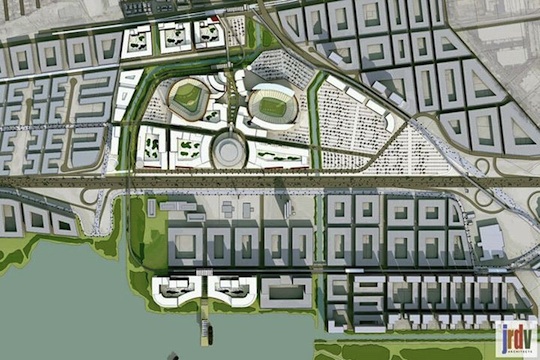
Chances are whatever gets built at the Coliseum won't look like this

Chances are whatever gets built at the Coliseum won’t look like this

Throughout the rest of the letter, Badain offered plenty of examples of how the Raiders have cooperated with the process. They met with developers. They laid out their demands wish list. They met with Kephart, and they continue to meet with Oakland on another track. They haven’t taken the lead on any specific stadium proposal. Then again they haven’t done that with Carson or San Antonio, and they surely won’t be leading the pack on Inglewood. Davis appears to be content to play second fiddle, as long as he gets a good deal for his team. That shouldn’t be too difficult since Davis isn’t going for quite as ostentatious a new home as what Stan Kroenke or Dean Spanos are trying to build. Yet since Davis isn’t driving the bus, he doesn’t get to say much about how nice it should be. FUD is emerging about Davis not being able to afford Carson just as he couldn’t afford to do more in Oakland, but remember, selling a piece of the team is his ace-in-the-hole. In the letter Badain admits that equity in the team is available, but only as a way to bridge the funding gap. Whatever the size of that limited stake, whether 10% or 20%, it’s worth perhaps twice as much in LA as it is in Oakland.

The parking situation also seems to be a nonstarter. It was during the spring that both Davis and Lew Wolff indicated that they wanted to preserve surface parking, even if that means severely curtailing development. Even the final proposal from Kephart does little to address the teams’ parking demands, filling half the space with garages and commercial buildout.

By the end of this project, some $5 million will have been spent on Coliseum City, only to find out that the Raiders’ and A’s stadium goals run counter to the broader planning objectives of Oakland pols. A stadium surrounded by parking is not the kind of high-density, constant-use plan envisioned for the Coliseum. Of course, so far we’ve barely scratched the surface of the other side of the debate: fear of gentrification. With so many bargaining chips taken away over the course of the last several months, how much is left to offer? More importantly, is that enough to get a football stadium deal done? My guess it’s not even close to enough. A ballpark is less expensive and gets used more. It’s getting close to the time when Oakland will need to shift the conversation. They’ve done a good job stalling so far. We can only hope that what remains isn’t scorched earth.

Kephart plays out the string

After reading tweets and reactions, and finally listening to Floyd Kephart’s spiel at Lungomare today, I can use one word to describe the whole affair.

Perfunctory

Unlike Kephart’s 50/50-or-less assessment of the project at this late stage, I can say with greater confidence – 80/20 – that this will be the last time you see Floyd Kephart in Oakland. He said that he’ll be there through the early part of October, but that doesn’t mean he has to come back if all signs point to no on the City’s part.

There’s a rendering. It looks modern. Great. The next one’s more interesting.

After reading Kephart’s spoken points and digesting them for a bit, I realized that what Kephart presented today, warts and all, was the most honest proposal anyone’s ever given in the four year saga of Coliseum City. Here’s why:

  1. It acknowledges that the A’s are likely to stay at the Coliseum for a considerable period, so the Coliseum stays intact.
  2. The arena stays as well, because the City wants it even if the Warriors leave.
  3. The project area was downsized to 132 acres, no planned phase west of the Nimitz.
  4. The funding gap, which according to Kephart would be $300 million, would be funded by a City-sponsored conduit bond.

The conduit bond is a tricky thing. This kind of financing has the tax-free, low borrowing cost benefits of regular municipal bonds, but municipalities aren’t on the hook for repayment, as Oakland and Alameda County were with Mt. Davis’s general obligation bonds. Instead, revenues from the development, such as naming rights and certain forms of tax increment on the project area would be used to the tune of $20 million per year. If this sounds familiar, that’s because it’s similar to the way the 49ers financed their gap through Goldman Sachs. During the pre-Harbaugh era, there was a legitimate question about whether the stadium could be paid for this way. A few playoff runs and highly renewed interest later and the 49ers were able to pull it off. The Raiders, well, they’re not in that position. The makes me wonder how the financing would work if there were revenue shortfalls. Who would be responsible, the Raiders? What if they defaulted? And why would the Raiders or the NFL approve such a plan, given the revenue uncertainty?

Kephart said a few other things I found noteworthy.

“Purchase of the (Coliseum) land is key to us staying. In the event that the Council says no…we’re not going to do the development.”

The land purchase is contingent on the City and County coming to an agreement on Oakland buying out Alameda County’s half.

“I’m on my 4th city administrator and 2nd mayor in 10 months. I’m under the 2nd ENA and I haven’t negotiated one significant thing except the ENA.”

That would’ve been a drop-the-mic moment if he was so frustrated that he wanted to quit. He wasn’t. But that’s a stunning admission of how little has actually been done. Kephart has been quick to blame the City, County, and team for his failure. Ultimately, it is his failure since he was brought aboard to bring everyone to the table and work out the deal, so this grousing seems like sour grapes. He made one more observation:

“I’m not the problem, and I’m not the solution.”

Kephart also claimed that it was the City’s responsibility, not his, to get the Raiders, A’s, or Warriors on board. That’s a complete backpedal on his part. Per the ENA, as part of the initial submittal due June 21:

(b) Proposed terms and conditions required to obtain a commitment from one or more of the Oakland Raiders, the Oakland Athletics, and/or the Golden State Warriors to the Project with an update on status of negotiations between New City and each team regarding its commitment to participate in the Project;

I don’t know when this all changed, but I got a hint of it a few weeks ago when NFL point man Eric Grubman was talking about Oakland on Fred Roggin’s LA radio show. Grubman mentioned that the City hadn’t presented anything to the Raiders, which sounded strange since I too thought that New City was responsible for signing the Raiders. Now it makes sense in terms of process, though no light was shed on why it evolved this way. Exactly how was the City selling this to the Raiders? And wouldn’t those efforts run in conflict with the City’s desire to “open” the process for alternatives?

Near the end, Kephart had a sort of kiss-off moment.

“While everybody might think that Oakland is the garden spot of the world, we have projects in three different continents and around the country. And I have lots to do.”

It’s true. The ponies aren’t going to wait for Floyd to come back to Del Mar, you know.

The Oakland Dilemma

Frankly, I’m tired of writing about Coliseum City, what’s (not) happening. Instead of devoting 500 words to running out the clock or whatever metaphor you feel is most appropriate, I’ll simply leave this here:

chicken-and-egg

Oakland, the non-entity

They didn’t come, they didn’t see, and they didn’t conquer.

That was Oakland’s vibe at the NFL owners meetings. St. Louis made its stadium presentation previously, while San Diego did theirs yesterday and Carson made their preso today. It’s even possible that, unless Oakland pulls a rabbit out of its hat, it may not be invited to make a presentation in October either.

One of the many versions of Coliseum City that didn't solidify into a proposal

One of the many versions of Coliseum City that didn’t solidify into a proposal

Look, the bad news was known weeks before this week’s meetings. Oakland was not invited to make a presentation in front of the owners in suburban Chicago this week, because, to put it mildly, the NFL didn’t believe Oakland had a presentation to make. Here’s how you know how bad it is – in April Mayor Libby Schaaf hired one-time planning director Claudia Cappio to be the new assistant city administrator in charge of development. Among other responsibilities, Cappio became the de facto spokesperson for the project. That’s never a good sign, because when the City puts out a staffer and not a single Oakland politician wants to lay claim to the project, you know it’s in bad shape. What happened to Fred Blackwell? Remember him? Is he no longer consulting for the project? Oh that’s right, he left for a private sector gig. Blackwell clearly saw the writing on the wall.

The most damning statement came from NFL point man-cum-hatchet man Eric Grubman, who said this about Oakland’s situation:

‘The Oakland Raiders have great fans in Oakland city and the county of Oakland and a lot broader territory, but the facts on the ground are that there’s been no viable proposal that’s been made to the Raiders,’ Grubman said. ‘We’ve said one thing consistently to any of the markets that have been engaged in trying to put forth a proposal and it really rests on a couple of pillars. One of them is that a proposal has to be specific. The second is that it has to be attractive to a team and the third is it has to be actionable.

‘What actionable means is it can’t just be an idea to the extent that there is enabling legislation or enabling financing activities or there are litigation threats or anything of that nature, anything that needs to be assembled in a time frame where a club can act on it. Thus far, those sorts of tests have not been made in Oakland so as of yet, there is no proposal for the Raiders to consider.’

The irony of this is if the words above were uttered by Lew Wolff he would be ripped in column after column by the usual lazy critics. Wolff’s statements about Oakland in the past have largely had a similar tone and verbiage. But since Grubman doesn’t represent a specific team, and is in fact an arbiter of sorts for the NFL, these words will be met with little debate by potential critics, and mostly resigned disappointment by others. Yet look at that second paragraph. It is on par with Wolff saying that people can’t just point to a site and hope it into becoming viable. It needs to pencil out. And for three years and counting, Oakland has not made Coliseum City pencil out, not to any appreciable degree.

Thing is, I agree to some extent with what Oakland’s doing. It tried, it found out that the NFL wasn’t interested in a complex developer-finance scheme, it looked for alternatives and found nothing but resistance. All that’s left is to give up or wait for the NFL to kill Oakland. The former provides some (though not much) political cover for pols regarding constituents who want to see the City move on from Coliseum City. The latter provides cover when facing Raiders fans. In the meantime Oakland can finish the process, since it won’t hurt to do so with 10 or 40 days left in the ENA. Two months until the next meetings is not enough to rally the resources to make Coliseum City or an alternative happen, especially if Mark Davis isn’t committed to the effort.

There also has to be some detached bemusement coming from Rob Manfred and the Lodge. Unless Manfred worked out some sort of wink-nudge deal with Oakland, Manfred has to be wondering what kind of effort and political will he can expect out of Oakland for a ballpark. Observers have been poking holes in Coliseum City for years, and Oakland has done little to prove them wrong. Consider that the main accomplishment at Coliseum City was the passage of a planning-oriented EIR. That’s a procedural step, not a truly major milestone. Manfred will certainly play nice with Oakland once a ballpark process begins, but if he doesn’t like what he hears, don’t be surprised if he turns the heat up on the City and even Wolff. Manfred’s previous job was to get the best deals out of everyone MLB worked with, from cities to media outlets.

For now, desperate Raiders fans are left to criticize other cities’ stadium proposals in hopes that their success or failure will “trap” the Raiders in Oakland. It’s hard to come up with a concept more absurd than that. The NFL wants results, and if Oakland can’t provide them, the league is not going to sympathize. It will move on.