Warriors to hold victory parade in Oakland on Friday

Shortly after the Warriors finished off Cavs in Game 6 of the NBA Finals tonight, Yahoo Sports’ Marc Spears sent out this tweet:

There you have it. A parade in Oakland, a nice route to traverse through downtown, uptown, and Lake Merritt. It should be savored, for not only is this the first Warriors’ title in 40 years, this will be the first parade in Oakland in 34 years. The somber tone that came with Loma Prieta’s interruption of the 1989 World Series led to no parade to celebrate. The 1975 Warriors’ championship was not only played at the Cow Palace due to scheduling conflicts with an ice show at the Coliseum Arena, the championship parade was held in downtown San Francisco. That makes the last Oakland championship parade the one that followed the last Oakland Raiders Super Bowl win, in 1981.

Then, like now, the champions intend to leave Oakland. Though the preferred destination for the Dubs is only across the bay and not Los Angeles, there is a palpable tentativeness to the situation that has created tension among some of the region’s fans. The same goes for the Raiders and A’s. Thankfully, that can all subside as the celebration continues throughout the summer.

Normally a momentous occasion like this gives a host city a boost of political will that can be used to push a stadium campaign. Not in the Warriors’ case. The Dubs are taking all the goodwill and using it for their own political fight against arena opponents in San Francisco. It’s not unlike the 49ers, who used a string of playoff appearances to solidify the ticket base enough to fund Levi’s Stadium. Then again, the new stadium honeymoon period sometimes isn’t all it’s cracked up to be, ask the Niners.

It’s fitting that the parade route will end at the Henry J. Kaiser Convention Center, an old building that lays dormant while developers figure out how to rehabilitate the landmark and make it profitable. HJKCC was an occasional alternate home venue during the Warriors’ first few years in San Francisco, before the Warriors started playing games at the Coliseum Arena. The Dubs permanently moved there in 1971. Now they’re planning to move back to SF. It all seems so cyclical, doesn’t it?

Glendale, AZ voids lease with NHL Coyotes, leaving team’s future uncertain

The City of Glendale, Arizona called an emergency city council meeting tonight for one purpose: to vote on terminating the Arizona Coyotes’ lease at Gila River Arena. You may remember two years ago, when the Coyotes seemed bound for anywhere but the desert as the franchise’s reported financial losses piled up and the city faced bankruptcy in what could be considered the worst stadium deal in North America.

The Coyotes' demise in the desert is at hand

You may not see that banner up there for much longer

The NHL even bought the team and operated it for a while, waiting for an ownership group to come in and operate the team, hopefully not at a loss. The deal struck included a payment from Glendale to the Coyote owners’ arena management wing of $15 million per year over 15 years on top of $50 million in subsidies up front. That’s right, the city is paying the team to stay. Glendale was supposed to get limited event revenues, and because the team’s future was supposed to be secure, there were fewer worries about the city’s ability to handle ongoing arena debt. Eventually the team would start winning again and the money would roll in for both parties.

That money never came. The Coyotes haven’t averaged more than 13,000 per game in attendance since 2009. They haven’t been in the playoffs since 2012. Other than the small number of hardcore fans, no one came. The $15 million operating subsidy from the city roughly covers the lost revenue from 4,000 empty seats every home game when compared to other teams. No one’s happy. The current mayor and council have expressed displeasure with the Coyotes, the NFL over the Super Bowl, and its two spring training MLB tenants, the Dodgers and White Sox (at Camelback Ranch). Glendale has overextended itself time and time again, spending so much on pro sports and getting less than zero out of it. And unlike the arrangement at the Coliseum for the two venues there, Glendale, a city about the same size as Fremont, funded the arena itself.

All of this drama set the stage for the big vote. Supporters of the Coyotes came in from all around the West Valley to denounce the plan to kill the lease. The trigger for the lease termination was not about the losses, though the Coyotes have the ability to leave on their own if they accrue $50 million in losses over five years. Instead, Glendale cited a conflict of interest, which allegedly occurred when Glendale’s former city attorney took a position with the Coyotes shortly after the lease was approved in 2013.

After public testimony was cut off, those on the dais made a few comments, culminating with a 5-2 vote to terminate the lease. The Coyotes responded within minutes, threatening to sue Glendale for up to $200 million.

FOR IMMEDIATE RELEASE:
Wednesday, June 10, 2015

GLENDALE, ARIZONA — Arizona Coyotes Co-Owner, President and CEO Anthony LeBlanc issued the following statement following tonight’s Glendale City Council meeting.

‘We are disappointed with the city’s decision to violate its obligations under the agreement that was entered into and duly approved only two years ago. We will exhaust any and all legal remedies against the city of Glendale for this blatant violation of its contractual obligations to us.’

One thing to note is that the Coyotes had themselves reported $34.8 million in losses for 2014-15 season alone. The team’s well on its way to hitting that $50 million mark, and the only consolation it can provide to Glendale is that the city’s loss will be $6 million as opposed to the projected $7 million before the season.

Coyotes fans don’t deserve to go through all of the drama built up over the past decade. Yet they’re powerless, as fans often are. Their limited numbers don’t impress NHL brass, who stalled as long as they could while fighting off relocation rumors and threats. Right now three cities are considered frontrunners for a move, which could come this fall.

  • Las Vegas – A new arena on the Strip is being built by MGM and AEG. While its primary purpose is to be a major concert venue, it will have the capacity to host NHL and NBA teams. The arena won’t be ready until 2016, so a relocated Coyotes squad would play at the MGM Grand Garden Arena or Thomas and Mack Center for a year or so.
  • Seattle – Arena efforts have largely stalled since efforts to buy and move the Kings to the Emerald City died. NHL is also on the radar, though basketball is clearly the primary focus. A rival arena plan has been proposed for Tukwila, not far from SeaTac airport.
  • Quebec City – A brand new venue is nearing completion, and could be ready to host the Coyotes in September. The downside is that a move to Quebec would also cause the league to embark on another round of realignment. The already shorthanded Western Conference (14 teams) would send another one to the East (16 teams), forcing another team to move to the West.

Northern California cities such as San Francisco and Sacramento are not in the offing because both have built-in revenue competition from basketball teams, and the Warriors’ and Kings’ new venues won’t be optimized for hockey. If the NHL is going to move the Coyotes, they’ll go to a place that has minimal competition and an arena with few scheduling conflicts.

The Coyotes and Glendale could also reach some sort of truce, allowing both to co-exist and renew their partnership. It’s hard to see that as every bridge has been burned. The team is bringing legal action Thursday, so the battle is just beginning.

Oakland Mayor Schaaf to speak with MLB, NFL commissioners in NYC next week

BANG reported yesterday that Oakland Mayor Libby Schaaf will meet with the commissioners of MLB and NFL next week, as part of a trip to New York for the World Cities Summit Mayors Forum.

Chances are that she will provide an update on Coliseum City, while explaining to both commissioners that the project is the best chance to keep either team despite misgivings on the part of Lew Wolff and Mark Davis. What the commissioners will probably ask – and this is the challenge for Schaaf – was what happens after Coliseum City. Whether Floyd Kephart some or all of the deliverables expected on June 21 (he won’t be able to provide the biggest, a commitment from a team), Schaaf and the City Council will be under pressure from both leagues to cut bait and start looking at alternatives. Those options are expected to be proposals from Wolff and Davis, though neither has offered one yet.

Let’s be clear about one thing – Schaaf’s talks with Roger Goodell and Rob Manfred will not be negotiating sessions. Neither league is participating in the Coliseum City process, and no other proposals are on the table, so there are no points to negotiate. Schaaf has remained adamant that Oakland can’t incur additional debt in the effort to retain any teams. Council member Noel Gallo took that no-giveaway notion a step further, announcing earlier this week that he’s against selling public land.

The problem is that everyone involved is talking around the problem at this point. Goodall and Manfred should by now be well aware of Schaaf’s no-subsidy stance. The land giveaway idea is practically a moot point. Neither team wants to extensively develop the Coliseum complex, so there’s no point to selling the land or figuring out a way to fund costly infrastructure when none will be built. Coliseum City point man Floyd Kephart keeps plugging away, even though he’s close to achieving persona non grata status in some circles. Manfred indicates that the A’s shouldn’t worry about what’s happening with the Raiders, though the current arrangement has their fates in Oakland intertwined and he knows it. Neither commissioner is going to tell Schaaf to boot the other’s team off the Coliseum property, yet that’s exactly what it will take for something to move forward. And neither is currently offering a solution for any funding gaps (NFL G-4 funds are limited, keeping the A’s on baseball’s revenue sharing plan is a subject for the next CBA talks in 2016).

What can we expect, then? Some words of encouragement. Renewed talk of urgency, moreso on the NFL’s part. The City of Oakland will probably keep its June 21 and August 21 deadlines, since they have little to lose over the next three months. It will be in their best interest to start formulating an exit strategy and plans to accommodate both teams on different sites if they haven’t done so already. That may be why the BANG item mentioned Howard Terminal. Dismissed out of hand from the start and declared dead last year, Howard Terminal is the only available large patch of land outside the Coliseum complex. It remains a difficult site to pull off because of regulatory hurdles and major infrastructure costs, but it’s something. And if someone can figure out how to pay for all of it, it may be viable after all. But who’s going to do that? No one talking in NYC next week will. Neither will either team.

Again, where are we with all of this?

Mark Davis revises his Coliseum “vision”

In a fairly lengthy interview with ESPN’s John Clayton yesterday, Raiders owner Mark Davis held court on his team’s stadium issues. While much of it was a rehash for those who have been following this saga intensely, it was good for casual fans and observers to get even the tiniest bit clarity. In any case, the Raiders saw fit to republish it on their own website so it must have the boss’s approval.

What caught my attention was a change in how he saw the Coliseum being developed. While continuing to call for the Coliseum’s demolition, Davis dreamed out loud of a dual-stadium concept in the old venue’s place (emphasis mine).

One of the challenges we have with that is that we share the stadium with the Oakland A’s. The Oakland A’s have a 10-year lease to remain in the Coliseum. One of the plans that they’re talking about is, is us building the stadium in the corner of a parking lot and then once our new stadium is built, then they would rip down the stadium and build the new one for the A’s and build housing and all of that stuff. That just isn’t a situation that I want to get us into. I would like for, if possible, the Raiders and the A’s to stay on that site and that the Raiders and A’s vacate the Coliseum for the next two or three years. We build a brand new football stadium and a brand new baseball stadium on the site and then we’d come back and begin playing in two brand new stadiums without construction going on around us, in brand new stadiums.

The desire to avoid construction zone headaches remains steady for Davis. Plus in this concept Davis would preserve surface parking, a goal shared by A’s owner Lew Wolff. Wolff doesn’t think the place can properly support more than one stadium project, so how could something like this be done? It’s nothing like Coliseum City, which has planned phases. Both stadia would be done simultaneously, like Arrowhead Stadium and Kauffman Stadium in Kansas City. Let’s imagine a timeline for Davis, assuming no legal, logistical, or financial obstacles (follow me on this).

  • End of 2015 – Coliseum City is scrapped. Raiders play their last game at the Coliseum in December. Raiders and A’s hammer out stadium development deals with Oakland/Alameda County. Partial demolition begins (ironically) with the newest part of the Coliseum, Mt. Davis, returning the venue to its 1995-96 state – but with the Oakland Hills back in full view. That occurs from November 2015 to March 2016.
  • 2016 – A’s play their last season in the old Coliseum in reduced facility. A’s lease is revised (with no penalty to anyone) to reflect this. Raiders and A’s finalize their financing plans for their respective venues.
  • November 2016 – Demolition of rest of the Coliseum begins, which should take 6 months to complete including grading for new venues (use drawn out Candlestick Park demolition for reference).
  • April 2017 – Construction starts on both stadia, with a planned completion of Spring 2019 for the A’s, Summer/Fall 2019 for the Raiders. Both teams use smaller footprint, simpler plans and Levi’s Stadium-style incentive/penalty system to execute those accelerated schedules (24 months for A’s, 28 months for Raiders).
  • 2018-2019 – Warriors vacate Oracle/Coliseum Arena for San Francisco. Decision is made on whether to keep arena or demolish it to make way for other development.
  • April 2019 – A’s ballpark opens
  • August 2019 – Raiders stadium opens

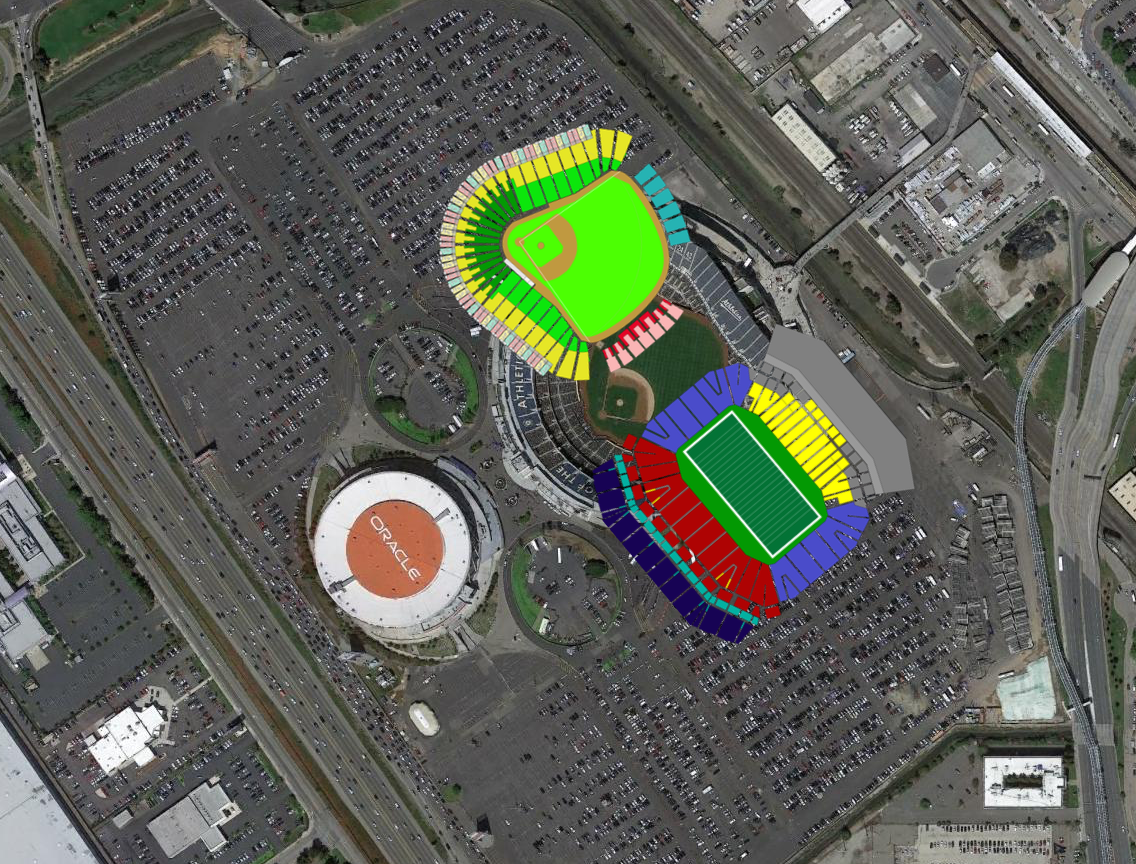
The finished product(s) would look like this:

Two new venues on a slightly larger footprint than the original

Two new venues on a slightly larger footprint than the original

The Raiders would have to play at a temporary facility for three seasons, the A’s for two. AT&T Park would have to be a considered a frontrunner for both, oddly enough. Memorial Stadium remains off limits to the Raiders thanks to a legal agreement between UC and the City of Berkeley, and Stanford Stadium is a nonstarter for both the university and City of Palo Alto. Davis doesn’t want to play at Levi’s Stadium for his stated reasons, though it must also have something to do with the 49ers’ desire to have a tenant for at least a decade in order to pay for the second home team locker room.

That brings me to the real problem in all of this, the financing. Tallying up all of the associated costs, we come to:

  • $900+ million – Raiders
  • $600+ million – A’s
  • $100 million – Remaining Coliseum debt including interest
  • $65 million – Remaining Arena debt in 2018

Final total, not including the planned work on the Coliseum transit hub, is $1.665 Billion. Obviously, much of that would be covered by the teams, the NFL, and perhaps third parties, but the gap for the Raiders remains, and the need to retire the legacy debt from project sources without hitting either Oakland’s or Alameda County’s general funds means that the public sector would have to give up something. For now it’s unclear what that is since the Coliseum’s land is not going to be that public contribution.

Price tag aside it’s a tantalizing vision for fans, and one that runs counter to planning and growth goals for Oakland and Alameda County. From a broad perspective, the public sector wants housing of different kinds and price ranges to ease the current crunch. Pols may see this as nothing more than doubling down on the stadium deals of 20 years ago, which brought only fiscal pain and little real security with regards to the teams staying in Oakland. The people who might like it the most are workers at the Coliseum complex and businesses west of the Nimitz who thought their livelihoods were being threatened by Oakland’s sweeping zoning change proposals. As for East Oakland residents, well, how much has this hulking pro sports complex improved their lives in nearly 50 years?


Adventures in NFL stadium financing, San Diego edition

We’re still several months from the NFL and its constituent owners making any decisions on team relocations, yet the league and Roger Goodell are getting exactly what they want. San Diego and St. Louis are bending over backwards to make please the kings, Carson and Inglewood are having their own battle over the presumptive single Los Angeles stadium slot, and Oakland is, well, treading water I guess.

San Diego’s CSAG (Citizen’s Stadium Advisory Group) released its plan in time for the owners meetings in San Francisco. As expected, it focused on building at the current Qualcomm/Mission Valley site instead of the downtown site the Chargers preferred in prior years. The cost is expected to be $1.4 billion, broken down into various revenue sources:

sd-financing

The plan proudly proclaims no new taxes, which is technically true, but it neglects to mention that it’s carrying over an ongoing operating subsidy, split equally by the City and County, that was negotiated to keep the Chargers at Qualcomm. So right off the bat that’s $242 million in present value subsidy, plus the sale of 75 acres at the stadium for $225 million. Field of Schemes has the total subsidy at $647 million, I’ll call it $467 million as I won’t count the various rents as subsidies (you might) or . $500 million would come from the Chargers (60%) and the NFL’s G-4 fund (40%) in the plan, though the Chargers’ recent disinterest in the deal may indicate a dissatisfaction in their $300 million piece. Since PSL revenue ($150 million) would be limited and is already accounted for, the Chargers would have to come up with $200-210 million on their own from non-PSL sources like tickets, concessions, and some luxury seating proceeds. That translates into a $12 million/year of revenue required of the Chargers along with $10 million/year for rent, assuming that San Diego hits its fundraising targets for PSLs. For reference, the 49ers pay roughly $24 million/year in rent at Levi’s Stadium. To help offset that cost to the team, the Chargers would have control of naming rights. A $12 million/year naming rights deal for 30 years (both optimistic projections) would effectively cancel out the $300 million team contribution.

A special infrastructure financing district would be created to allow for future ancillary development to take place. That would be worth $116 million, though that money wouldn’t go towards construction of the stadium. Another $40 million come from future hotel taxes to fund a hotel next to the stadium. To many stadium advocates, hotel and car rental taxes are not considered a true subsidies since they aren’t levied on locals. They’re still taxes.

Two parts of the plan struck me immediately. $225 million from the land sale may well be appropriate for the area, which has a trolley station that could anchor some transit-oriented development. The more important takeaway is that $225 million now sets a bar for Coliseum City, in that San Diego is now offering up land for free to fund the stadium’s construction, so Oakland and Alameda County will be expected to do something similar. This is despite the fact that the NFL has recently frowned upon real estate development acting as a funding source in favor of less speculative revenue streams – as if PSL sales aren’t speculative.

The other question mark is operating costs. CSAG claims that based on examples like AT&T Stadium in Dallas, revenue from a year-round event schedule would make the stadium self-sustaining. I find this assertion highly optimistic at best. The fact is that a stadium will cost $7-10 million per year to operate just for the NFL games. If that isn’t accounted for, why should anyone believe that revenue from other much smaller events will make up for that operating cost, not to mention the cost associated with running those smaller events?

The total cost of the project is $1.4 billion with a $1.1 billion construction cost, so perhaps that “buffer” will take care of the subsidy. If it doesn’t, chances are taxpayers will foot the bill, adding another $121+ million to the public side of the ledger.

I’ll do a proper comparison of San Diego vs. St. Louis and the two LA plans plus Oakland when those come out. For now I encourage you to assess San Diego’s plan on its own merits. CSAG’s plan appears meant to be in line with the stadium financing structures for Minneapolis and Santa Clara, at least in terms of public share. If that’s the case, the NFL should be able to pivot and align with the plan they way the same are posturing to do with St. Louis. Is it a good deal? Not really, but this is the NFL we’re talking about. As usual, they hold the cards.

Davis affirms desire to tear down Coliseum

As the NFL owners meetings get underway at the Ritz Carlton in SF, KTVU reporter Noelle Walker caught up with Raiders owner Mark Davis, who made it abundantly clear that he wants the Coliseum complex for himself:

Davis confirmed that if a Coliseum City plan goes forward at the current Coliseum site, he wants the old stadium demolished before a new one is built.

‘If we’re going to build on that 120 acre site, we would have to tear down one stadium to build another one in that same place,’ Davis said. ‘I don’t want to build a brand new stadium and then have it be in a construction zone for next two, three, four years.’

Davis doesn’t want a construction zone around a new stadium. Wolff put in the A’s lease terms that would give the team an out if their operations were impacted by the Raiders’ stadium (construction taking out parking). If by now you haven’t come to terms with the need for Oakland to make a choice (or else have a choice made for them), make yourself a pot of coffee in the morning and breathe in its aroma deeply.

In her report Walker termed the dilemma Oakland’s “Sophie’s Choice.” Call it that, a Catch-22, Kobayashi Maru, Hail Mary. whatever construct you like that doesn’t exactly fit but helps explain the dilemma. Oakland has chosen to try to juggle both teams. In the process it has looked indecisive. The NFL disapproves. And so Oakland’s best hope is in that very same NFL keeping the Raiders from moving because it deems Oakland’s proposal at least compelling, if not altogether sufficient. Might need to throw in an Act of Contrition on top of that Hail Mary.

SC County Judge declares A’s-San Jose land option illegal

Just in from Santa Clara County Superior Court: Judge Joseph Huber, who has presided over the smaller Stand for San Jose-vs.-City of San Jose case for a few years now, has called the land option agreement between the City and the A’s against the law. Wrote Huber:

“The city is and has been in violation of (the law) for several years and it does not appear it will comply with the terms in the foreseeable future.”

Combine that with the blows that San Jose has received in federal court, and you have to think that any chance of a ballpark happening in the South Bay is toast, short of a miracle. Yet it all comes down to some serious strategic errors on San Jose’s part that could have strengthen their case, in this local venue and the federal one.

Remember that it was former mayor Chuck Reed who wanted to go to the ballot box in November 2009 (!), then March 2010. The deal would’ve set up the possibility of a voter-approved stadium deal in San Jose. Instead, he had a discussion with former MLB president Bob DuPuy, who relayed then-MLB commissioner Bud Selig’s desires to keep the deal on the shelf. Reed complied, there was never a referendum or initiative, and San Jose’s position has looked significantly worse ever since. All San Jose has right now is a prayer for SCOTUS to take the case, which isn’t likely. Throughout all of the various legal battles, at different levels, the weakness of the option agreement has been cited. The A’s have little vested interest in San Jose, and the City is no closer to putting together a deal than it was six years ago.

Now that even Lew Wolff has for all intents and purposes given up on San Jose, the spotlight is on Oakland, where that city faces an uphill battle at Coliseum City and could entertain an A’s proposal should the football stadium plan fizzle out. That brings to mind three scenarios.

  1. If Oakland can’t get Coliseum City done and the NFL doesn’t allow the Raiders to move to LA, the Raiders would either be forced to limp along at the Coliseum indefinitely or consider a move to either San Antonio or even St. Louis. The former would be a continuation of the awkward status quo, with no new venues in sight for either the Raiders or A’s.
  2. Should the Raiders vacate, they would clear the path for the A’s to build a new ballpark at the Coliseum, infrastructure or other public contributions to be up for significant debate. Or maybe no new infrastructure (no baseball village) because no one has figured out how to pay for it.
  3. If Oakland gets Coliseum City to work out with only a football stadium (the NFL’s and the Raiders’ preference – no one sane is buying into the multi-venue fantasy at this point, right?), the A’s are pushed out (per lease terms) and have no obvious backup plan. Would MLB direct the A’s to start looking in the East Bay and maybe the broader Bay Area for ever diminishing land opportunities, or start playing hardball and making threats as it does with so many other markets? How does a stifled San Jose factor in? And what of the Giants?

It’s just as well, we’re so overdue at this stage for a stadium that San Jose will soon have to deal with Sharks owner Hasso Plattner on his designs for a makeover at the 21-year-old arena that bears his company’s name. And if the goal is to get on par with the best new hockey arenas, it won’t be cheap. That discussion is for another day.

P.S. – The scant output over the last month was an intentional move on my part to see what would happen if I chose not to be swayed by every little gesticulation in the media over the A’s or Raiders. While readership was down a little, I felt it was the right move because there was no need to blog about mostly vague details or the rumor mill. Therefore I’m getting to stick to publishing 2-3 times a week while using Twitter to get out quick notes or retweets. If you haven’t already, follow the feed. Things should pick up again in June with the next set of Coliseum City deliverables is expected to be released.

Grubman: In Three Years Oakland Has Gone Backwards

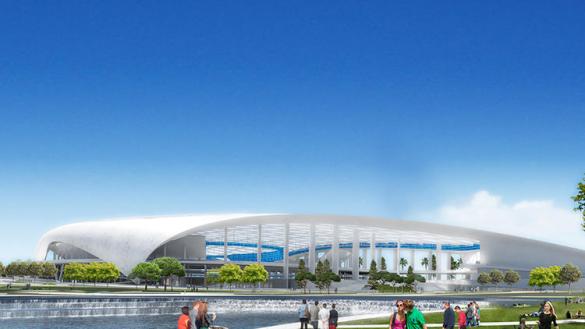
Stan Kroenke's planned indoor stadium in Inglewood

Stan Kroenke’s planned indoor stadium in Inglewood

The NFL’s man in charge of potential relocations, Eric Grubman, called into to LA sportscaster Fred Roggin’s radio show today. Grubman fielded a lot of questions, including Roggin’s asking him to assess Oakland’s chances of getting a stadium deal done:

I’ve had multiple visits to Oakland. And in those visits – each of those for the past three years – I visited with with public officials, and I feel like we’ve gone backwards. So I feel like we’ve lost years and gone backwards. And that usually doesn’t bode well.

Grubman’s talking about the same Oakland that passed zoning changes and an EIR for Coliseum City, so from the process standpoint Oakland hasn’t gone backwards in the slightest. The financing piece is what remains a mystery, and I think I know why.
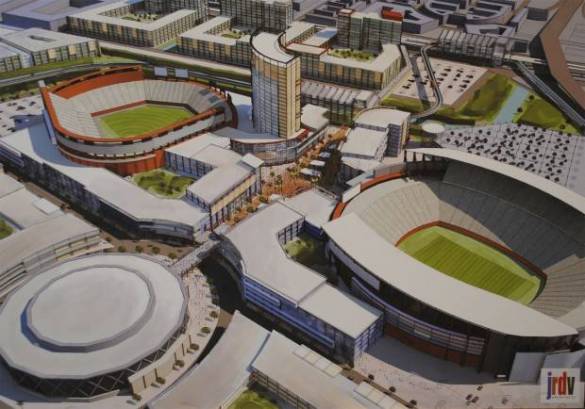
Coliseum City in dreamier times

Coliseum City in dreamier times

Three years ago, the big money tied to Coliseum City was Forest City, a proven mega-developer. They determined early in the vetting period that they weren’t going to make money, so they cut their losses. Colony Capital and HayaH Holdings took Forest City’s place. Rumors of other kinds of exotic financing surfaced (EB-5 visas, Crown Prince of Dubai). In the end, Colony Capital give up too, leaving Oakland scrambling to find someone to pick up the pieces.

Eventually that savior came in the form of Floyd Kephart. Kephart’s an adviser to the money, not the actual money guy, an added factor in an already complicated deal (his company gets a small cut). Over the past several months Grubman has dropped hints that the NFL prefers to have a simpler deal in Oakland, one without a middle man and preferably one not so contingent upon pie-in-the-sky development plans to help pay for a stadium. The league and the Raiders went into Coliseum City wanting a simpler, smaller outdoor stadium, a concept that didn’t take hold with Oakland until last fall. Even now there’s a lack of consensus about what the actual plan is, which probably frustrates the NFL to no end. If you don’t have a set concept for a stadium, you can’t have a cost estimate, and you can’t nail down the financing. Meanwhile, Stan Kroenke has financing down in Inglewood, the NFL is giving credit to St. Louis on its efforts to get public financing, and newcomer Carson, which has numerous details not in place, at least has Goldman Sachs working with the Chargers and the Raiders on 49ers-style financing for the shared stadium.

Over time the big question overshadowing Coliseum City has only gotten bigger. Everyone involved with Coliseum City knows this, you and I know this, and most importantly the NFL knows this. I’ve heard so many Oakland fans talking about how the NFL will provide $200 million or Davis can put together $400 million or even more. But anyone who has observed the NFL stadium loan process knows that the money is anything but a given. It’s directly tied to achievable stadium revenues, and is not the foundation upon which a stadium financing plan is built. Other financing has to be the foundation. The NFL awards a G-4 loan only after everything else is secured. Maybe Kephart has an ace up his sleeve that will help him deliver the project. Right now it’s easy to peg Oakland as the most behind the eight-ball in terms of actually building a stadium. Despite that gloomy outlook, things may play out in a way that keeps the team in Oakland – even without a new stadium on the horizon. Grubman advised against anyone putting forth definitive statements about any team’s future, and I agree completely. There are too many variables, too many possibilities to say anything with real confidence.

The other thing I’ve noticed over the past few weeks is how the media has covered the teams’ stadium prospects in the different markets. LA media is fired up about at least one team coming as they haven’t been in 20 years, with the Daily News and the Times providing unrelenting coverage and talking heads like Roggin regularly talking about it on the radio. San Diego sports radio has tried to prop up site alternatives in the city while the Union Tribune has constantly beat the stadium drum, led by columnist Nick Canepa. The Post Dispatch has worked the St. Louis and State of Missouri efforts, with Bernie Miklasz writing quite a bit about the Rams’ travails – at least until spring training started.

In the Bay Area? You have news coverage from the Chronicle and BANG, plus in-depth stuff from Bizjournals. Columns and radio air time have been remarkably light on the Raiders’ stadium issue, especially when compared to the 49ers’ move to Santa Clara and the A’s efforts to leave Oakland. I can’t figure out exactly why. Sure, the nomadic history of the Raiders has to be a factor, as is the Davis name. There has to be more to it, though. Are people tired of the stadium saga? Are they coming to grips with the idea that at least one team will leave the Coliseum complex? There are supporting fan/civic groups in the East Bay, but they don’t have big voices. In the past Dave Newhouse would’ve been the guy screaming bloody murder about it all, these days it’s Matier & Ross sprinkling in a scare once in a while. The loudest voice is a college-aged superfan from the Sacramento area who knows little about politics, especially Bay Area politics. If a decision is made to move the Raiders in the next year or so, many will be left wondering how it all happened, and they can start with the media. The flip side of this light coverage is that there are no frequent calls to provide public financing, a refreshing change of pace.

Hell, I’m only interested in the Raiders insofar as it affects the A’s. If the Raiders leave in 2016, that’s fine with me since I can focus on what it’ll take to build a new ballpark for the A’s at the Coliseum. I’d love to be more empathetic, but frankly I’ve been waiting 20 years for a proper ballpark for the A’s, half of those years writing this blog. The quicker the A’s can determine their own future the better. And if that means the Raiders are gone, so be it.

The Five Story Makeover

Progressive Field reopened for business this week after a $25 million renovation, most of the focus on the outfield. I agree with this comparison:

It has everything to do with those terraces on the upper deck. Designed for groups of standing fans, the effect was supposed to be a series of patios leisurely overlooking the field. Instead there are these blocky mini-façades that are both overly busy and distracting. While some unifying paint work will soften the look, I can’t help but think that these terraces are little more than glorified seat coverings – not as bad as tarps, but not much better.

Unlike Coors Field, where much of the RF upper deck was ripped out to accommodate a lengthy outdoor bar, at Progressive Field the Indians choose not to remove the upper deck risers, which would’ve freed up space and eliminated the need to build around them. So while the capacity has dropped to around 37,000, it could go back up if team saw the need to “expand.”

Photo from “Did The Tribe Win Last Night?” blog


Much better conceived is the two-story “Corner Bar” along the main concourse. Several rows of seats in the RF corner were replaced with standing areas, the bar itself having its own patios. And the RF gate has been rearranged, allowing for direct views from the expanded entry plaza instead of the very broken up look it used to have.

As part of the redone outfield, the visiting bullpen has been moved to CF in a stacked configuration. The old bullpen bench and access to it remain, allowing fans to wander in and sit there for a spell. It’s a neat “new” feature to give to fans.

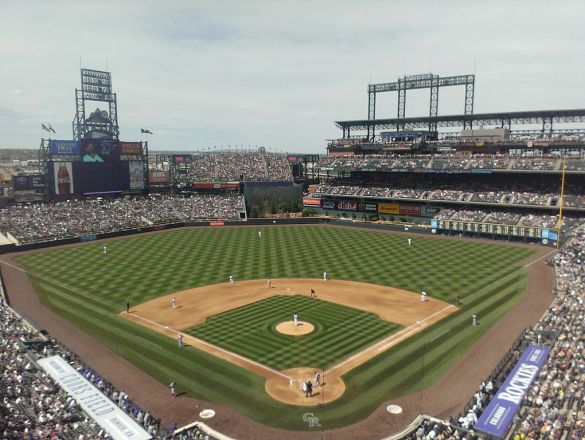
Coors Field in 2014, Rooftop Bar in RF upper deck

Coors Field in 2014, Rooftop Bar in RF upper deck

The Jake and Coors were well known in the 90’s for great attendance records, both teams surpassing 3.5 million in season attendance on multiple occasions. As the novelty wore off, both venues started to look cavernous. It took the better part of a decade for ownership to figure out how to adapt the parks to an evolving fanbase. The Coors project perhaps looks more appealing, but the work at Progressive is more comprehensive. Either way, it’s nice to see both parks keeping up with the times.

Opening Day success, Wolff says San Jose “Not worth nasty battle”

Well, that was nice. The A’s finally won on Opening Day for the first time in forever, Sonny Gray nearly pitched a no-no, the scoreboards were a huge success (with a few hiccups), and many new A’s made solid debuts.

Off the field, Lew Wolff broke his own news, courtesy of Phil Matier:

Oakland A’s owner Lew Wolff said a possible move to San Jose is ‘not worth a nasty battle’ over territorial rights with the San Francisco Giants, and is hopeful the city’s new mayor can helpthem get a new stadium built in Oakland.

Wolff also fought back against the constant critics, while reserving praise for Oakland Mayor Libby Schaaf. I’m not sure what’s going to convince the critics that Wolff is serious besides an actual groundbreaking ceremony. I’m glad that at the very least Schaaf doesn’t have the same combative tone as her predecessor.

Whether Wolff was told outright by The Lodge or not, San Jose is not in the plans anytime soon. And if Wolff actually wants to get this done while’s he still breathing (something he’s alluded to in jest more than once), Oakland’s the only path. The only way San Jose opens up is if a Raiders’ plan is approved, kicking the A’s out. Then you have to deal with the payout, the CBA, all these things that The Lodge has avoided like the plague over the last two CBA ratifications and would prefer to avoid again. Of course, many of the A’s brass are totally on board with building in Oakland. Broadcasting veep Ken Pries, from last July:

From our position, we just don’t think that (Raiders project) is going to happen – we are betting it doesn’t.

This isn’t hard to figure out. A’s ownership knows that the money is in San Jose. Anyone with a brain can figure that out. Wolff and Fisher also know that they are boxed in, try as they did to escape that box. With the Raiders’ future up in the air, the A’s should take advantage of a potential Raiders departure. As I mentioned Saturday, there are still issues to work out in terms of revenue sharing, but they’re minor compared to a T-rights fight, whatever that may entail.

Unlike Coliseum City, there’s no real timeline or framework for the A’s to do anything. So far their strategy is to wait the Coliseum City process out. If they, like MLB, are gambling on Coliseum City failing, the Coliseum should be delivered on a silver platter. Then again, Wolff did hedge a bit by re-signing that land option in San Jose.

Hey, Lew’s gotta have a Plan A and Plan B, right?