Selig succession committee appointed

Only 8 months from the end of Bud Selig’s lengthy term as MLB Commissioner, a succession committee has been formed to search for Selig’s successor. Not surprisingly, the committee is formed of nothing but owners.

EXECUTIVE COUNCIL FORMS SUCCESSION COMMITTEE FOR NEXT COMMISSIONER

Seven-Member Committee Will Be Chaired by Cardinals’ Bill DeWitt, Jr.

Baseball Commissioner Allan H. (Bud) Selig and the Major League Executive Council announced today the formation of a succession committee, whose work will include the selection process of the game’s next Commissioner.

The Executive Council has convened several times in recent months regarding the procedural steps ahead. As a result of those meetings, a new seven-member committee has been formed to act on behalf of the Executive Council in overseeing the succession process and collecting the input of all 30 Major League Clubs.

The committee will be chaired by William O. (Bill) DeWitt, Jr., Principal Owner and Chief Executive Officer of the St. Louis Cardinals. The other members are Colorado Rockies Owner/Chairman & CEO Dick Monfort; Philadelphia Phillies General Partner, President & CEO David Montgomery; Los Angeles Angels of Anaheim Owner Arte Moreno; Pittsburgh Pirates Chairman of the Board Bob Nutting; Minnesota Twins CEO Jim Pohlad; and Chicago White Sox Chairman Jerry Reinsdorf.

DeWitt said: “Our committee will conduct a thorough, discreet process and ultimately will provide guidance to the Executive Council on identifying a successor. All of the parties involved share the goal of acting in our game’s best interests, and thus we will refrain from commenting out of respect for the confidentiality of the process.”

Commissioner Selig has led Major League Baseball since September 9, 1992, when, as Chairman of the Executive Council, he became interim Commissioner. He was unanimously elected Baseball’s ninth Commissioner on July 9, 1998. On September 26, 2013, Selig announced his plans to retire upon the completion of his current term, which runs through January 24, 2015.

Surprisingly, only two members of the committee are big market owners: Arte Moreno and Jerry Reinsdorf. Philadelphia could also qualify to an extent. Neither New York team is represented, and owners of teams that are currently embroiled in territorial disputes (O’s/Nats TV deal, A’s-Giants T-rights) are also not in the committee. For the most part the owners are of medium market teams with no wedge issues to potentially drive their own respective agendas. Unfortunately there are no former players, coaches, or front office staff in the committee, which speaks volumes about what the of candidates we can expect to see.

Going in it was thought that the job was MLB COO Rob Manfred’s to lose. The committee is shaping this as a legitimate, thorough process, though the lack of transparency will automatically make many outsiders suspicious. There are at most three owners meetings sessions left before Selig retires, so they had better get a move on.
New Braves ballpark renderings released

The Atlanta Braves released a new set of renderings for their 60-acre ballpark village concept, set to open in 2017 in Cobb County, Georgia. A quick roundup of features:

  • 41,000-seat ballpark
  • 6,000 parking spaces
  • 500 residences
  • A boutique hotel
  • Retail and office space

Populous is designing the ballpark. Something bugged me about the look when I first saw the pictures this morning, but I couldn’t put my finger on it. Then I realized that the bowl looks like two-thirds of a football or soccer stadium. The “C” shape with its curving corners are as inoffensive as Wonder Bread. It has three seating decks, or four if you count the split upper deck/single concourse as two decks. Club seats and suites are packed behind the plate, as is the case with so many recent Populous parks. Firm principals Joe Spear and Earl Santee (lead) talked specifically about not having the park resemble other previous work. I suppose they can’t avoid it. The Chop House restaurant in right field resembles a similar feature in left at Target Field. Cantilevering is modest, except for the 90-foot long roof, which will be great for fans in the upper deck.

This slideshow requires JavaScript.

The big change is of the orientation to nearly true south. No current park has such an angle, the closest being Comerica Park’s south-southeast orientation. While that shouldn’t have much of effect on the game on the field, fans along the third base line could be subject to some difficult sun in the afternoons (or nice sunsets in the evening). Previously the ballpark faced southeast. Northeast is the preferred orientation by MLB.

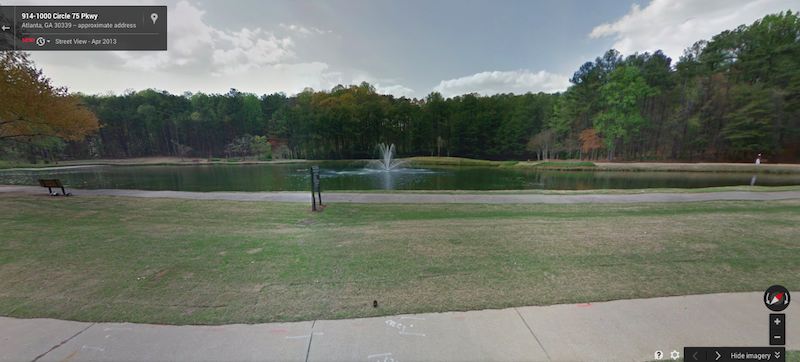
Lake on property with fountain

Lake on property with fountain

By changing the orientation, Populous can take advantage of an already existing feature on the mostly undeveloped land: a lake with a fountain. That lake will be transformed to fit the development, yet it will remain just beyond the outfield and near the big entry plaza. Populous is also utilizing topography, by nestling the grandstand into a hill that rises 70 feet from the lowest point on the property.

Parking will be situated at the western and eastern ends of the property. They’ll need garages to get to 6,000 spaces, otherwise that much parking would require 46 acres of surface lots. It would seem appropriate for traffic planners to route fans from the north to one end, while fans from the south use parking lots at the other end. The Braves are also claiming that they’ll have parking available from parking lots surrounding the village, which tends to lead to overly optimistic projections. The ballpark will be one of the least public transit accessible parks in the majors, which translates to the team needing more than 10,000 spaces at a close proximity. 6,000 won’t cut it.

All told, the Braves’ plans bear a keen resemblance to Lew Wolff’s failed ballpark village efforts in Oakland and Fremont. The key difference is that the ballpark in this case feels tangential to the rest of the development, not wholly integrated. A bolder approach would’ve been to put the ballpark on the western end, parking on the east end, and allow fans to walk 1,000 feet to the ballpark through the village. The ballpark could be oriented to the east and Populous could even take advantage of a small hill on the western end. Oh well.

Major League? Oakland can’t even get Little League fields going.

Update 5/14The Bushrod field project could be back on if the City can take care of the red tape, according to the A’s.

—-

Over the years the A’s have worked with the Good Tidings Foundation and numerous Little League and community groups to rehabilitate baseball fields all over the East Bay. The high profile projects have included Rickey Henderson Field in Oakland and Dennis Eckersley Field in Fremont. Since then they done work on one field a year, lately with the help of PG&E and always with hundreds of volunteers. Understanding that the projects would be funded by donations and the work done by volunteers, it should be an easy task for cities to simply issue permits to clear the way for the rehab, right?

Not when the City of Oakland is involved.

Matier and Ross report today that the City has bungled a plan to fix up a field at Bushrod Park in North Oakland. The field is used primarily by North Oakland Little League (NOLL), which spearheaded the project.

First the problem was that the field had to be maintained by the City, but they didn’t have enough money to do it. Nor could they allow volunteers to do it because of labor concerns.

Then they couldn’t expedite permits for installation of a sprinkler system.

Then they had problems with the field’s Little League size, citing flexibility concerns.

The City’s Parks department at least owned up to the delays, asking for more time. Frustrated, the A’s looked elsewhere and found a willing partner in Richmond, whose MLK Park needed work. For now, NOLL will have to apply for next year’s effort. Maybe Oakland can figure out its part by then.

If you thought that was bad, consider the possibility that another North Oakland field (also named after Rickey Henderson) that was previously rehabbed in this program may get repurposed. This time it’s Oakland Unified School District with the brilliant plan, as they moved Oakland International High School there (good) but want to replace the grass field with artificial turf (terrible) for year-round soccer. If this happens, NOLL and Oakland Tech will be short two fields. The road to hell really is paved with good intentions.

And it isn’t just Oakland falling down when it comes to bureaucratic nightmares. The City of San Jose famously spent thirteen years figuring out where to put a huge softball complex. They only figured it out in February. At least they didn’t burn any volunteers or community groups in the process.

Capitol Corridor train-pedestrian accident kills 1 in Fremont

I’ve been making the habit of taking Capitol Corridor from the South Bay more frequently this season. It’s a bit of hassle coming back since I actually have to take BART to a bus, but if I’m not going with a lot of people it’s usually the least stressful way to travel to and from the Coliseum. I had the option of taking a earlier 4:20 train out of Diridon or a 5:50 train. I chose the latter.

The ride was uneventful until the train turned away from the Bay and traveled into Fremont proper. At 6:20 or so, the train struck a man who was apparently walking on the tracks as the train approached. From BANG:

The train’s conductor told police that before the impact, he watched a man walking in the tracks towards the train.

“The conductor laid down the horn, but the man would not move and was struck by the train,” (Lt. John) Harnett said.

The identity of the man was not immediately known, police said.

It’s important to note that the man was trespassing on the tracks, which are owned by Union Pacific. Why? I don’t know. Now I know that many of you will immediately call the deceased an idiot or wonder what he was thinking. That really doesn’t matter anymore. The fact is that whether it was intentional or not, he got hit by a train. It’s something that happens all over America every week. It happens because pedestrians don’t pay attention. Or they play chicken with the train. It happens because we have thousands upon thousands of at grade crossings where accidents like this can happen. Or because someone has a death wish. Sometimes trains even hit each other.

Police and Fire assembled on Blacow Road in Fremont. Accident victim was found in area to the right along tracks.

Police and Fire assembled on Blacow Road in Fremont. Accident victim was found in area to the right along tracks. Traffic was cleared to the next major intersection.

The point is that these accidents happen all too frequently, and they will continue to happen as long as the current rail infrastructure remains as is. Even light rail, which has lighter trains and more ability to stop them, has its accidents. While train accidents are avoidable, they are still an all too common occurrence.

I had not even noticed that there was accident at first. I was seated, looking down at my phone and laptop. I was also in the middle of purchasing a seat upgrade for the game, a sweet $14 move to Section 111, Row 1. When I saw that the train was in an accident, I knew that I wouldn’t be getting to the Coliseum anytime soon. Of course, a man had just died so to bemoan my situation would’ve been crass or shallow. So I didn’t. Eventually I got to the game in the 6th inning, after the A’s unleashed an offensive barrage against Doug Fister. Just happy to be here, I told myself.

Fremont police arrived on the scene quickly. The train was stopped at an intersection, so vehicular traffic queued on both sides of the train. Police blocked off the area and rerouted traffic. Paramedics arrived and left fairly quickly, leaving the coroner to arrive around the time we started moving again. We passengers were forced to disembark and board the next scheduled train that was coming from the south. Delays on the Union Pacific-owned tracks were experienced elsewhere on the Capitol Corridor and ACE Rail systems.

The delay ran 1:40. Now imagine a scenario where that happens in front of a Howard Terminal ballpark after a game (a regularly scheduled train leaves Jack London Square for Sacramento at 10:05 every weekday), either with a pedestrian feeling some liquid courage or a foolish driver trying to beat an automated gate.

Now imagine that the entire team, VIPs and dignitaries are stuck for nearly two hours as the train blocks access.

Now imagine that someone at the ballpark has a medical emergency during that wait, and an ambulance needs to take this person to Highland Hospital.

These are all worst-case scenarios that need to be addressed as part of planning for a Howard Terminal ballpark. There is ZERO chance that ballpark proponents will be able to shortcut this just by sweet-talking some elected officials. There’s liability on the part of Union Pacific, the Port of Oakland, and the City of Oakland and Alameda County. The California Public Utilities Commission will be involved, as will the Federal Rail Administration and probably Caltrans.

The March letter from concerned JLS neighbors considered these issues:

Short-sighted designs and plans which create chronically unsafe interactions between incompatible modes of transportation and conflicting uses unfortunately result in thousands of accidents every year. The odds of unsafe activity by pedestrians and passenger automobiles around heavy machinery, like trains and trucks, increases exponentially around crowds, congestion, and alcohol which we would expect to see at the proposed baseball stadium. This is especially disturbing given the proposal’s goal of creating a neighborhood, street scene activated in the vicinity. What specific considerations would ensure pedestrian, motorist, rail and truck safety?

Indeed, what specific considerations would ensure pedestrian, motorist, rail and truck safety? Grade separation? Bridges? Sounds like a start. We should be having this discussion. We should be figuring out what it will take. Howard Terminal is not just a waterfront ballpark site. It’s port land designed to have easy rail access. If that isn’t dealt with properly, a ballpark there will suffer its own death by a thousand paper cuts.

Levi’s Stadium picks up additional events, outlines tour costs (Update: Pac-12 game added)

Update 5/15 – The Pac-12 Conference has announced that the annual football conference championship game will be held at Levi’s Stadium. That means that Levi’s Stadium will have 15 events in the final 5 months of 2014, or 3 per month.

—-

Less than three months before the first event at Levi’s Stadium, the allure of hosting an event there is proving strong. Already, the Earthquakes and Cal football will have games there. Last week, the CCS (Central Coast Section) approved local high school Wilcox the opportunity to play a home game on August 29 at Levi’s. The game vs. visiting Manteca will be part of a high school doubleheader, which may also include powerhouse De La Salle of Concord.

The schedule of events for the fall at Levi’s Stadium will look like this:

  • 8/2 – Seattle Sounders vs. San Jose Earthquakes
  • 8/17 – Broncos at 49ers (preseason)
  • 8/24 – Chargers at 49ers (preseason)
  • 8/29 – High School football – Merced vs. Wilcox, TBA vs. De La Salle
  • 9/14 – Bears at 49ers (regular season home opener)
  • 9/28 – Eagles at 49ers
  • 10/5 – Chiefs at 49ers
  • 10/24 – Oregon vs. Cal
  • 11/2 – Rams at 49ers
  • 11/23 – Redskins at 49ers
  • 11/27 – Seahawks at 49ers (Thanksgiving game)
  • 12/5 – Pac-12 championship game (added 5/15)
  • 12/20 – Chargers at 49ers
  • 12/28 – Cardinals at 49ers
  • 12/? – Fight Hunger Bowl (date TBA)

The MLS match and the HS football doubleheader present a couple of chances for the 49ers to not only break in the stadium but also to stage events with less than a full house. For the Quakes game, the upper deck is not being sold. Chances are that the same will happen for the high school games. Levi’s Stadium is also getting into bidding for the CIF State football championships, which have long been played at StubHub Center (formerly Home Depot Center) in Carson. Personally, I’d like to see the CCS championships at the new digs too. The top division games are played at San Jose City College.

Levi’s Stadium is also making itself available as a future site of the Pac-12 football championship game. Since the restructuring of the conference, the Pac-12 has chosen to stage the game at the home of the team with the best record among the North and South division leaders. The schools seem to like the home-hosting situation, which should mean some resistance towards a neutral site championship. Of course, the other big time FBS conferences have neutral site championship games with the exception of the Big 12, which no longer needs one due to having only 10 teams. The Pac-12 is rather spread out geographically, making it difficult to arrange for fans to fly into the Bay Area on short notice, especially for cheap.

At least for this year, the Santa Clara venue will miss out on the International Champions Cup, a series of soccer exhibitions by top European clubs (at least in name if not by roster). Instead, the one West Coast match will be played at Cal’s Memorial Stadium, which I suppose makes for a fair trade if Cal’s going to lose a home game by rescheduling it in Santa Clara. Other soccer matches are sure to follow, and don’t forget Wrestlemania, which will be played at Levi’s Stadium next March.

For those who simply want to visit the stadium, the team has been giving hard hat tours to VIPs and others who can arrange group outings. Regular public tours will begin in August at $25 per person. If you think that’s expensive – well, it is. Cowboys Stadium tours start at $17.50, and MetLife Stadium tours cost $20. Cost to visit the new 49ers museum, which does not include a stadium tour, is $15.

Former Giants owner Lurie to be inducted into BASHOF

Bob Lurie spent much of his tenure as San Francisco Giants owner being vilified. After saving the team from moving to Toronto with his purchase of the franchise from Horace Stoneham in 1976, Lurie lost money nearly every year since then, declaring as early as 1984 that he was ready to sell the team. Despite having more competitive teams in the late 80’s, Lurie could not build enough goodwill to pass stadium proposals in San Francisco (twice failed), Santa Clara County and San Jose (once each). So when the 1992 season came and went and the Giants were headed towards a 90-loss season, a deal struck in the summer to sell the team to Tampa Bay interests appeared to seal the team’s fate. The $115 million sale price, which had the blessing of MLB Commissioner Fay Vincent, only required a vote of National League owners to move the team. When those winter meetings came around, the sale was rejected by a 9-4 vote, allowing SF interests one last chance to put together a local ownership group and creating a legal mess for MLB to untangle many years later.

During that ordeal, Lurie famously got the blessing of A’s owner Walter Haas to pursue the South Bay, which was during the late 80’s undesignated territory for MLB. After Lurie twice struck out in the South Bay and Peter Magowan’s group purchased the Giants for a lesser sum of $100 million (including $10 million of Lurie’s own money), the incoming group had South Bay territorial rights grandfathered. For years, the Giants have changed their rationale for keeping the territory, starting with the claimed inability to cover debt service payments on AT&T Park. Now the reasoning has settled with “half of the fan base” coming from the South Bay, or the Peninsula, or something else that sounds good. Lurie had something to say about that as well:

“It is the Giants’ territory, and they’ll certainly protect it. We used to draw at least half our attendance from the Peninsula, and I know the Giants don’t want to lose that association. At the same time, the A’s definitely deserve a much better stadium.”

In Lurie’s advanced age, he’s deserved the right to voice whatever opinion he likes about this and many other subjects, whether he sounds strident or diplomatic. Nevertheless, it’s interesting that he singled out the Peninsula, not the South Bay, which may sound like distinct areas but in terms of mindset have a tendency to blur.

Historically, the definition of the Peninsula begins with the northern limit of San Mateo County (Daly City, Brisbane) south along 101 and 280, past the Palo Alto-Menlo Park border (county line) and down to Mountain View. For many the Valley (somewhat synonymous with the South Bay) begins at Sunnyvale and Cupertino and covers the rest of Santa Clara County. Of course, Silicon Valley has an even more amorphous definition, with some saying it extends up to Redwood City, San Bruno, or even San Francisco. All of this confusion only adds to the sense of provinciality that pervades much of the Bay Area.

Lurie’s quote provides little insight into the inner workings of baseball, except that there’s something to be said for what may happen to your own initiative if MLB decides to wait a while. Perhaps someone at the BASHOF induction ceremony can ask Corey Busch about that. Busch, you may remember, is part of the three-man “Blue Ribbon” panel figuring out what to do with the A’s.

P.S. – Speaking of opinions, Murray Chass has his own about Bud Selig and the mess the A’s are in. (Thanks Tony)

They’ll get around to it

Remember that press release from the beginning of the season that trumpeted all of the fan-friendly improvements that were done at the Coliseum? There’s another set of improvements coming that are also pretty important. Check out the bottom of this list:

aeg-gm_coliseum

AEG Management report detailing improvements and repairs for the Coliseum complex

Glad to see that the JPA is getting around to dealing with that clubhouse sewage problem.

AEG & MGM start $375 million Vegas arena

Casino giant MGM/Mirage and arena giant AEG broke ground today on a $375 million arena in Las Vegas. The new venue, which is being designed by Populous, will have a maximum capacity of 20,000 and is expected to open in spring of 2016.

The site of the arena is a back parking lot between the New York New York and Monte Carlo casinos, both of which are already MGM properties. Upon completion, the as-yet unnamed arena will replace the MGM Grand Garden Arena on the other side of the Strip as Las Vegas’s flagship arena.

AEG-MGM arena as seen from across I-15

AEG-MGM arena as seen from across I-15

There’s no shortage of large venues in Vegas, with the Grand Garden Arena at 16,800 seats. The Mandalay Bay Events Center, also an MGM property, has a capacity of 12,000. The largest venue in the area has long been UNLV’s Thomas & Mack Center, which holds 19,500 for concerts. Orleans Arena’s capacity is 9,500. Concert halls at The Palms and the Hard Rock support 4,000 or so. Vegas mayor Carolyn Goodman supports an arena in downtown Las Vegas, but with the new arena coming on line there’s more than enough capacity. Both that project and the UNLV Now! arena/stadium combo require a significant amount of public funding, and could lose support over time. Thomas & Mack is expected to undergo $60 million in renovations to support the National Finals Rodeo, a longtime tenant that signed a 10-year extension to stay in the city (not necessarily at the arena).

For now, AEG and MGM have discounted any possibility of luring a pro sports franchise from either the NBA or NHL, preferring to have maximum scheduling flexibility for concerts and marquee events. It’s a similar model to what AEG is doing in Kansas City, though the big difference there is that KC is paying the debt service on Sprint Center, while AEG is merely paying rent – not enough to pay off the debt service.

The fate of the Grand Garden Arena appears uncertain, as it would naturally compete with the new arena for events. Lacking in premium facilities, the old arena was rather spartan. The big concerts, boxing and MMA events will definitely move across the street. Perhaps MGM will take the opportunity to downsize Grand Garden or add some premium features, though there’s already significant competition for such facilities in the market. AEG, which has the Grammys as a key anchor event for Staples Center, could have one or more signature events for the Las Vegas arena, such as the Billboard Music Awards or other award shows. The X-Games just left a lengthy commitment to Los Angeles, and will be held in Austin this year. Residencies for artists seem unlikely, as those are usually better for smaller venues directly attached to casinos.

At $375 million for construction cost, this arena will come in much lower than the planned arenas in Sacramento and San Francisco. It goes to show how budget-conscious companies can be when they’re building their own venues.

NBA Commissioner Adam Silver bans LA Clippers owner Donald Sterling for life

Some of you may not be aware that I am every bit as much a basketball fan as I am a baseball fan. It is with that fanaticism that I am proud that NBA Commissioner Adam Silver has banned LA Clippers owner Donald Sterling for racist remarks made on tape that were released over the weekend. There is no place for these kinds of comments in pro sports, let alone the NBA. Commissioner Silver may have only been on the job for three months, but he has already leapt above the other Big 4 commissioners in terms of forcefulness. Thanks, commish.

There will be plenty of time in the future to speculate on the fate of the Clippers, Sterling, or new ownership. For now let’s reflect on where we are as a society in terms of race relations, and remember that sport in its purest form transcends race.

The $978 million, 50,000-seat NFL stadium

Yesterday the second of two public outreach meetings for Coliseum City was held at Oakland City Hall. I was flying in during the afternoon, so I wasn’t able to make it. Thankfully, @greenkozi (the macinator) put together a Storify compilation of tweets related to the meeting. It should give you a good sense of what was being discussed during the meeting.

Unable to attend, I’ve focused over the last few days on the just-released Coliseum City Football Stadium Revenue Study. The 177-page document covers a variety of funding scenarios for the Raiders stadium, including public and private options. Some of the key takeaways:

  • The full development could generate $22-26 million of annual tax revenue for the project, including ticket, sales, property, and hotel taxes.
  • That tax revenue would support $120-140 million of public debt for the project.
  • Ancillary development, even with three teams remaining at the Coliseum, looks rather modest.
ancillary

Ancillary buildout potential at Coliseum City

  • Economic impact for the both the stadium and ancillary development is estimated at $2.8 billion.
  • Operating income (private) for the development is estimated at $49 million per year, which would support $300 million in debt. Combined with the public portion, a total of $420 million of debt could be supported. That would leave a nearly $700 million funding gap.
  • The stadium would have a capacity of 50,000, including 75 suites, 4,700 club seats, 200 loge seats, and would cost $978 million to construct.

AECOM’s previous study from last summer had the stadium also at 50,000 including premium seats, a number that was debated. This confirms the number, though the stadium cost has jumped from $700 million to $978 million (and rising) in a matter of months.

A 50,000-seat stadium is a rather alarming figure. People should be asking why the team and market can’t support a larger stadium. 50,000 seats won’t bring in a Super Bowl, and any new stadium has already lost the prestige battle with Levi’s Stadium, which will have a Super Bowl, bowl game, Wrestlemania, and a number of other events. While this study has looked into a number of new development scenarios involving 1-3 new venues, there is no discussion of incorporating any part of the existing Coliseum, nor is there any mention of the existing Coliseum debt. The most cost-efficient route for the Raiders for a “new” venue would be to rebuild the old bowl of the Coliseum and refurbish Mt. Davis, while lopping off the upper deck. That could be done for less than half the cost being considered, while providing an opportunity for ancillary development with an A’s stadium or something else.

A renovated Coliseum could be done in phases in a much more economical manner than a $1 billion new stadium

Maybe the NFL and the Raiders have considered this idea a nonstarter, so the JPA and BayIG aren’t going there. The aesthetics of the Coliseum aren’t great for transit-oriented development. But considering the growing funding gaps and the enormous obstacles to getting just the stadium built, it’s crazy that a renovated Coliseum isn’t under consideration. All they’d have to do is build roughly half a new stadium. There’s no situation where that’s more expensive than, oh, a whole new stadium. Seriously, am I missing something here?