Presented without comment.
Category Archives: News
Coliseum Authority approves Raiders/A’s lease extensions
Update 11/25 9:10 AM – Resolutions passed nearly unanimously, with one vote against.
@Athletics extension includes passage prohibiting “unfactual” statements about @OdotCoCOLISEUM. #oaccamtg
— Steven Tavares (@eastbaycitizen) November 25, 2013
#Oakland CM Larry Reid tells Coliseum City lead investor to “show me the money.” #oaccamtg
— Steven Tavares (@eastbaycitizen) November 25, 2013
Commish Goodwin says Coliseum Authority members labeled both deals less than satisfactory. “I don’t vote for bad deals.” @Athletics @RAIDERS
— Steven Tavares (@eastbaycitizen) November 25, 2013
=====
Original post from Saturday:
In your typical Friday disclosure before a hastily called meeting, the Coliseum Authority (JPA) released its agenda for a Monday board meeting in which it will vote on short-term lease extensions for both the Athletics and Raiders. It’s funny to see how the negotiations have progressed. The A’s offered up a 5-year deal last year which the JPA ignored because it thought it had leverage, only to be that perceived leverage taken away by MLB two weeks ago. The Raiders have talked up a long-term deal, but only if it came with a serious plan for a new stadium. The resolutions that the JPA board is looking to pass will undoubtedly amplify the uncertainty surrounding the two franchises. Highlights:
- The A’s will get a two-year extension with no additional option years, thus extending the lease through December 31, 2015.
- The A’s would pay a slightly higher rent payment than previously negotiated at $1.5 million per year.
- In addition, the A’s would pay a mere $250,000 to maintain control over concessions.
- The parking revenue dispute between the A’s and JPA would go to arbitration, which should be decided before the end of 2014. The A’s would agree to put the disputed amount (not disclosed) in escrow.
It’s good to see that the parking issue will be resolved soon. Apparently the A’s are raising parking prices for 2014, which makes the actions seem linked. The big takeaway is that the JPA caved on concessions. Under the new terms, the A’s have the right to choose a new concessionaire, whose contract may long extend past the A’s stay in the Coliseum. However, you have to think that any concessions contract has to factor in the significantly lower value of the Coliseum should the A’s and/or Raiders leave. Yes, this could mean Aramark is replaced by someone else.
- The Raiders have a one-year deal for the 2014-15 season. The Raiders would pay $400,000 in addition to the revenue splits they currently share with the JPA. The end of the lease is described as 45 days after the end of the team’s season.
- The Raiders could pay up to $525,000 per year to use their Harbor Bay headquarters in Alameda.
- The lease terms acknowledge that the Raiders may play one regular season or preseason home game away from the Coliseum (London in 2014).
Also wrapped up in the Raiders’ extension language is something that I’d like to call the Santa Clara clause.
7.5 Additional Payments for Use of Permanent Training Facility and Training Site. If the Raiders announce a relocation or sign a lease to play football games outside of the City of Oakland or Alameda County for the 2015 season prior to March 1, 2015, then, commencing on March 1, 2015, Raiders shall have the option of continuing to use the Permanent Training Facility and Training Site for up to twenty-four (24) months, up to and including February 28, 2017 as determined in Raiders’ discretion and Raiders shall make an additional payment to Licensor each month for continued use of the Permanent Training Facility and Training Site in an amount equal to the fair market rental value of the Permanent Training Facility and Training Site on a monthly basis, as determined by a mutually agreeable licensed commercial real estate broker based on comparable rental space. Raiders and Licensor agree that the fair market rental value shall not exceed $525,000 per year. In the event the Raiders are engaged in good faith discussions concerning an extension of the Operating License or other arrangement for the Raiders to play future Football Events in the OACC Stadium as of March 1, 2015, any obligation to make payments shall not commence while such discussions are continuing and the twenty-four (24) month period and obligation to make additional payments shall begin when Raiders agrees to play football games at a location other than OACC Stadium for the 2015 seasonal provided, however, that if Raiders agrees to play football at such other location, Raiders shall pay such rental payments retroactively from March 1, 2015.
Got that? The Raiders won’t be charged to use the Alameda headquarters as long as they’re in talks about Coliseum City, even if they’re playing somewhere other than the Coliseum for 2015 and 2016. If the Raiders play elsewhere while using HQ and aren’t in talks over Coliseum City, they pay $525,000 annually. Obviously, the only place where they could play in this scenario (and while the Coliseum is demolished, presumably) is Santa Clara. UC Berkeley is forbidden by legal settlement from hosting NFL games, and Palo Alto would sue Stanford to high heaven for even considering it.
Both extensions should be easily passed, unless one or more of the commissioners complain that the terms are too favorable to the teams. The teams are effectively trading rent payments, and the JPA’s incoming revenues will not make much of a dent in ongoing debt service. At least the JPA will get the parking revenue they’ve clamoring for, which at the very least should help pay for additional Coliseum City studies or minimal prep work. As for scoreboards – you weren’t banking on that, were you?
—
P.S. – The resolutions would have to be passed by Oakland’s City Council and Alameda’s Board of Supervisors shortly after JPA approval.
Cobb County is the new Fremont
The story is familiar. An out-of-town ownership group sees a development opportunity on cheap land and a chance to build a ballpark in tandem. At the same time it moves away from its long-time home to a location with more money. No, I’m not talking about the Braves moving 12 miles to Cobb County. I’m talking about the A’s moving to Fremont.
Conceived in 2006, the Cisco Field/Ballpark Village concept had support from the Mayor and City Council of Fremont. Cisco went to A’s ownership and suggested the deal, which included the ballpark’s naming rights in partial exchange for heavily discounted land it controlled in south Fremont, near what was then the NUMMI plant. After negotiations stalled with landowner ProLogis and several retailers in the area, the A’s looked across the Nimitz to Warm Springs before giving up on Fremont completely.
Some blame the demise of Fremont on NIMBY concerns. While that had something to do with it, the biggest problem was the impact of the recession. As new home starts ground to a halt with the collapse of the real estate market, mega-developments like Pacific Commons failed to pencil out. That project and many others of similar scope sat dormant for several years, or died on the vine.
In 2013, the real estate market is recovering even if the broader economy is still somewhat stalled. In hot markets like the Bay Area and DC we’re back to real estate boom times. Investors from China and India are swooping in to make cash offers on houses sight unseen, and foreign money is coming in to support big projects such as Brooklyn Basin in Oakland.
It’s that backdrop that has allowed the Atlanta Braves to seek out their own mega-development in Cobb County, just in the suburbs outside Atlanta city limits. A more affluent area closer to corporate interests and away from mass transit? What you or I would call white flight, the Braves would call working to remain competitive.
The Braves, owned by DirecTV owner Liberty Media, recently moved a package of TV game broadcasts from local independent station Peachtree TV (WPCH) to Fox Sports South and SportSouth, the sister Fox-run RSNs in Georgia. While that will help boost revenues, it’s not nearly as lucrative as the single-RSN deals that the Mets have and the Phillies are seeking. To help their own revenue streams, Braves ownership are looking at the next avenues, a new ballpark and ancillary development.
Yesterday an article by the New York Times’ Atlanta bureau chief Kim Severson asked a question that seems relevant for the times: what defines urban and suburban areas? While Turner Field (and Atlanta-Fulton County Stadium previously) were in the middle of Atlanta, the location didn’t match what many would consider urban. Far from transit and surrounded by large parking lots, the neighborhood wasn’t vibrant the way we expect urban ballpark surroundings to be. Similarly, the Oakland Coliseum is set in a hundred acres of parking, and while its connectivity to BART is excellent, the neighborhood leaves much to be desired. The Braves are planning a dense, walkable community that should be largely self-contained, though again it’s far from MARTA. For years either new communities or established smaller cities and towns have used redevelopment funds to create the kind of urban environment that could attract new residents – or at least a subset of that urban environment.
There’s no clear definition of a properly urban neighborhood. Oakland has plenty of excellent established neighborhoods, such as Rockridge, Montclair, and Grand Lake. San Jose has Willow Glen, Rose Garden, and Naglee Park. None of those places have 12-15 open acres for a ballpark. Nor do they have a citizenry who won’t fight tooth and nail over parking and traffic concerns. Often developers will work for years to create that neighborhood feel and it doesn’t work out. Witness how Jack London Square developer Ellis Partners has practically thrown in the towel on making JLS an energetic retail district, electing to push for more housing instead. San Jose has an unquestioned success in the form of Santana Row, though it may not have been possible without Valley Fair already there across the street. With Coliseum City (and to an extent, Howard Terminal), Oakland is attempting to create that vibrance where none currently exists. The list of failures is long: Fremont, Arlington, and Coliseum North to name a few. Will Atlanta and Anaheim prove successful and create the blueprint?
And what of the white flight element? Atlanta and the Braves have jointly, proudly displayed their heritage regarding race in baseball. With the Braves poised to move to a decidedly more white, more moneyed location closer to most of the team’s ticket buyers, what will this mean for the Braves’ legacy?
While deflecting criticism over the Braves’ pending move, Atlanta Mayor Kasim Reed made one of the more magnanimous statements about cities I’ve read in some time:
“We’ve got to make a decision — either we’re going to be a region or we’re not. It bothers me that we have not come far enough as a community that people feel that a team moving 12 miles is a loss to the city of Atlanta.”
Of course, Reid just helped Atlanta give away the farm for the Falcons and their coming new uber-dome. Other motivations were at work to keep the Falcons downtown while allowing the Braves move to Cumberland, such as lobbying from the Georgia World Congress Center. The Braves weren’t allowed to get control over the land around Turner Field, so they looked for greener pastures. Which is how this sort of deal often gets started.
Atlanta’s population is just slightly above 430,000, which makes the city a little larger than Oakland. In California, Atlanta’s size would supplant Oakland as 8th-largest in the state, below Long Beach. Even though Atlanta is arguably the most prominent city in the South (non-Texas), it’s much smaller than other Southern cities such as Louisville and Charlotte. The Atlanta metro has over 5 million residents in area 20% larger than the Bay Area metro. Yet Atlanta remains the historical and cultural hub of the region and of the state, a claim that can only be made by LA and SF in California. Pushing for regional unity is easy when you don’t have to worry about a team changing names. That’s definitely where the comparison with the Bay Area ends.
Creating a temporary stadium blueprint
Lost in all the owners’ meetings, MVP awards and other sports news was a little story out of Sacramento. It involves a stadium for a second-tier soccer team – that will be built in five months.
That’s right, five months. And it was only announced today. The stadium will have a capacity of 8,000 and be constructed on a parking lot at Cal Expo for the Sacramento Republic soccer club. The Republic is aiming to become a future expansion team in MLS. By building this 8,000-seat facility (nearly the size of Buck Shaw Stadium), the hope is that MLS will be impressed enough to grant the franchise’s “promotion”, leading to a deal for a larger MLS stadium in a few years. The neat trick to the deal is that the club is partnering with Cal Expo’s concessionaire to build the stadium, a potential win-win for both parties.

8,000-seat soccer-specific stadium concept at Cal Expo
How could all of this come together in only five months? The stadium is considered temporary. When we envision stadium projects, we usually see the dark side of environmental review because these structures are meant to last for 30-40 years or longer. However, if you build a temporary facility, you can largely sidestep CEQA law. After all, the point of CEQA is to understand and mitigate against long-term environmental impacts, so if you can prove that your project won’t have a huge impact, you may be able to get a CEQA exception. One of those exceptions is for temporary or seasonal structures. They’re planning to put in the stadium, which will only be used 15-20 times per year during a 6-7 month window, and take it apart when the new stadium is ready. Project proponents can argue that there’s little impact since the stadium site is already a parking lot. Stretching the definition of temporary to nine years in this case is a little suspect, but there isn’t a hard and fast definition to use. Here’s what the law says:
15304. Minor Alterations to Land
(e) Minor temporary use of land having negligible or no permanent effects on the environment, including carnivals, sales of Christmas trees, etc;
Similar exceptions are available for additions to existing structures, such as the musical chairs situation I described last month. It would involve temporary additions to Raley Field and San Jose Municipal Stadium. A tougher case could even be made for a larger, 20,000-seat ballpark in San Jose. Let’s say that there’s some currently undeveloped or underutilized but properly entitled land somewhere within San Jose city limits. It could be publicly or privately owned. If the A’s struck a deal with the landowner, they could get permitted to build a temporary ballpark on that land. Sites could include the Airport West site near the Earthquakes stadium (though we’ve seen the difficulty building there), the County Fairgrounds, or other privately owned land. There are even sites near downtown.
That said, we’re at a late enough stage that it’s practically impossible to pull off a temporary new ballpark in time for the 2014 season. Expanding Raley would make more sense in that timeframe. As transient the whole thing sounds, it’s definitely a path of relatively little bureaucratic resistance as long as you get willing partners. Since it wouldn’t involve public money, a referendum wouldn’t be required.
What could this mean?
The Merc’s John Woolfolk (recently assigned the the City beat), tweeted this about the San Jose-MLB case less than an hour ago.
San Jose, MLB lawyers agree to put off mediation on remaining claims in city suit over A's move (tht MLB allegedly messed w/bpark land opt.)
— John Woolfolk (@JohnWoolfolk1) November 12, 2013
I’m not going to go so far as to say that there’s a deal in the works, but there has to be a reason for both sides to agree to postpone mediation. Certainly San Jose’s stance has been to get depositions and open the books to make MLB squirm a little. MLB’s desire is to get rid of the lawsuit altogether. Something’s up. The owners’ meetings are happening this week.
Woolfolk responded to this post with another tweet:
@newballpark my guess, both sides see greater potential in taking remaining case to trial at this point than settling.
— John Woolfolk (@JohnWoolfolk1) November 12, 2013
If true, well, thanks for trying to get the two sides to hash it out Judge Whyte.
—–
UPDATE 11/13 1:55 PM – The Coliseum Authority cancelled a previously scheduled Friday meeting. It’s probably related to the ongoing lease negotiations.
In the meantime, San Jose lead attorney Joe Cotchett said this at a San Jose Rotary Club function (courtesy of Merc columnist Sal Pizarro):
Attorney Joe Cotchett makes bold prediction to San Jose Rotary that SJ will have an MLB team or a contract to get one within 2 years.
— Sal Pizarro (@spizarro) November 13, 2013
More bluster? Or something else?
Braves to move into new stadium in 2017
I ended my review of Turner Field from two weeks ago saluting the innovative way it was designed and repurposed, plus its status as a permanent baseball-only home.
Oops.
Turns out that today the Braves announced plans to move to suburban Cobb County, just on the outside of the Perimeter (I-285). Historically, the suburbs north of Atlanta are where most of the fan base is located, so the Braves are strategically making the move to be closer to them. Attendance at Turner Field started with four straight seasons with over 3 million fans. Since then attendance has hovered around 2.5 million. That’s good, but the Braves’ brass think they can do better.
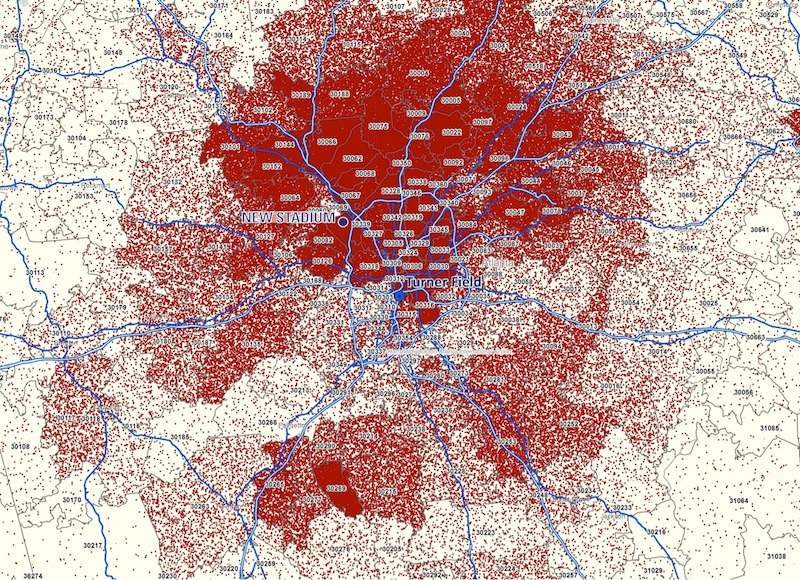
Map of locations of ticket purchasers for Braves games
According to the Braves’ new stadium website, Turner field has $150 million in infrastructure improvements that would be needed, yet aren’t enough to enhance the fan experience. Those additional improvements would make the project cost rise above $200 million.
On the other hand, the new stadium would cost $672 million to construct. The 60 acres of land on which the ballpark would sit has been “secured” according to the Braves. Cobb County would invest $450 million in the stadium, while the Braves would put in $200 million at the start and be responsible for cost overruns. The Braves would be the lead developer for the ancillary “ballpark village” adjacent to the stadium.
This announced move follows a string of other regional defections. Three performing arts organizations (Atlanta Ballet, Atlanta Opera, Atlanta Lyric Theatre) have already moved to or are in the process of moving to Cobb County, not far from the Braves’ planned stadium site.
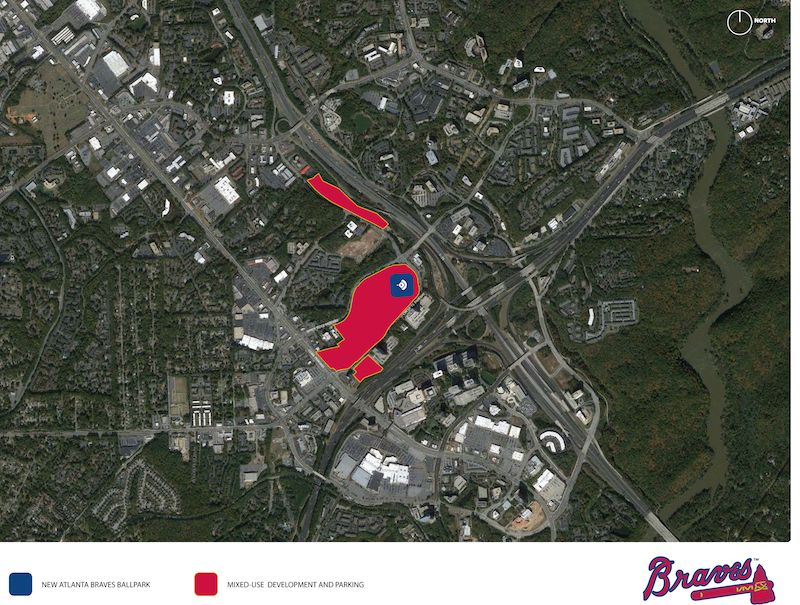
Braves ballpark site is in the Cumberland near the I-75/I-285 junction in Cobb County
White flight? Follow the money? Yes and yes. As outrageous as this announcement and the Falcons’ plans are to replace fairly new, modern stadia, if they can sucker partner with some municipality to foot the bill for a move, they’re going to do it every time.
Should the Braves be successful in their move, it would mark the first urban-to-suburban franchise move since 1973, when the Royals left temporary home Municipal Stadium for the Harry S. Truman Sports Complex, a similar distance away from Kansas City’s downtown core as the Braves’ site is from downtown Atlanta. The team plans to start play at the new ballpark in 2017. The current lease at Turner Field ends in 2016.
2014 A’s Spring Training schedule released
As the hubbub and posturing over the Coliseum lease subsides, today we got some good news: the A’s spring training schedule has been released! It’s a momentous spring, too, since it’ll be the last at venerable Phoenix Municipal Stadium before the A’s move 10 miles east to Hohokam Stadium in Mesa. Hohokam is vacant in 2014 as crews make changes to accommodate the A’s after the departure of the Cubs.
Speaking of the Cubs, they’re set to open their Wrigleyville West, also in Mesa, in 2014. That’ll be worth checking out. The A’s play only one split-squad game at the Cubs’ yet-unnamed ballpark on March 5. Even if you miss that, don’t fret because the great thing about the Cactus League is that all of the parks are within a reasonable driving distance of each other. While there’s no neat sideshow like the World Baseball Classic in 2014, there’s still plenty to watch.
If you’re interested in visiting, remember that the A’s work out at the ballfields at Papago Park, which is nearly 2 miles north on the other side of the park from Muni. One thing I’ve never done is walk from Papago (where minor league camp games are held) to Muni, so I might do that this year.

Oakland Athletics 2014 Cactus League Schedule (last 3 games are Bay Bridge series). All times Pacific.
Looking to check out several Cactus League ballparks? Consider that the 10 parks are set up in two clusters of five, to the west and east of downtown Phoenix. The east cluster, which Phoenix Muni is part of, is less spread out than the west cluster. Best to divide and conquer.
I’m targeting the 4-day weekend of March 13 through 16. The A’s play a rare night game at Muni. If I get there in the morning I can take in a game nearby in the afternoon before heading to Muni. There’s also a split-squad opportunity on Sunday the 16th, starting with a game in Muni and ending with the A’s taking on the Giants in Scottsdale.
There’s no league wide schedule available yet, as the teams are given the responsibility to arrange their schedules among themselves and publish when they’re ready. At this early stage, only a handful of teams such as the A’s and Giants have published theirs. Soon I’ll get all of them and put together a grid, the same way I did for the regular season.
One last note – keep in mind that Daylight Savings Time goes into effect on March 9, about two weeks into the schedule. That means all games before March 9 are an hour ahead of the Pacific time zone. From March 9 forward, games in Arizona are at the same time as California because Arizona doesn’t observe DST. The schedule shown is in Pacific time. If you’re planning to attend a game before March 9 and are traveling the same day, remember the time change.
MLB breaks out stadium negotiating playbook in Coliseum lease talks
Last week I received a flyer from the A’s urging me to get my season ticket plans wrapped up soon, as early as mid-November. Thanks to a Sunday report from Matier & Ross about MLB’s entree into the Coliseum lease discussions, I expect the A’s Ticket Services department to get a lot of angry, misdirected phone calls starting tomorrow morning. And I feel bad for them for having to deal with it.
The fact is that until recently, MLB has stayed out of the lease negotiations at Lew Wolff’s behest. As the lease comes closer to expiring with the two sides still far apart on the terms, baseball has decided to start playing the heavy. As we’ve seen in Miami and many other cities, MLB doesn’t play nice. That doesn’t mean that they’re going to start asking for hundreds of millions for a ballpark. Instead they’re playing the leverage game, threatening to move the A’s across the bay to AT&T Park if the Coliseum Authority won’t relent.
We’re told MLB is also demanding that the Coliseum give the A’s just a two-year lease extension – not the five- to eight-year deal the authority has been pushing.
The short-term lease would give the A’s more flexibility should the team’s owners swing a deal to move to San Jose – or beyond.
Let’s be clear about one thing: this is not MLB’s preferred option. They’d rather have the A’s and Giants play in their own ballparks, because getting them to share is messy when it comes to logistics, scheduling, and revenue sharing. While sharing has happened in the past, it hasn’t happened in almost 40 years. Plus the last thing MLB would want is to have a situation where the experiment goes so well that the Bay Area populace is convinced that there’s no need for two parks, or that the A’s seriously eat into the Giants’ revenue. Just as in other stadium negotiations, MLB has never been afraid to rattle sabers when it feels it can work to the benefit of one of its franchises. From this point forward, don’t expect anything less. Chances are that the JPA will buckle, because they know that the A’s tentatively playing away from Oakland can easily transform into the A’s permanently playing away from Oakland. From MLB’s standpoint, this is a question of loyalty. Oakland and Alameda County shown repeatedly that they’re willing to spend money and make things work for the Raiders. They have also demonstrated that they’ve been willing to move the A’s (and MLB) to the back burner at the most inopportune times. If the JPA doesn’t make concessions for the A’s, that’s just more proof that they aren’t truly willing to make the A’s a priority, which would make MLB less motivated to back Oakland’s efforts to forge a long-term deal. Raiders owner Mark Davis seems to prefer that they start working on a replacement Coliseum on the site of a demolished Coliseum, which if granted would leave the A’s without a place to play. Without a lease extension tied to a well-developed stadium plan, the Raiders would prefer to go year-to-year. The A’s would like to do a five-year deal with early termination if they’re impacted by construction of a new Raiders stadium. The challenge for the JPA is to put together a deal that caters to MLB’s needs while not jeopardizing their relationship with the Raiders and the NFL.
For the time being, Giants chief Larry Baer has stayed silent, probably at Bud Selig’s request. To say they wouldn’t accommodate the A’s would torpedo baseball’s plans and leverage, the same way Wally Haas and then-AL President Bobby Brown rejected Bob Lurie’s plans to share the Coliseum while SF figured out a downtown ballpark plan. That occurred in 1985. Now that MLB is a singular governing body with less stated conflict between the two constituent leagues, the Commissioner has the ability and power to influence the Giants. However, Selig’s track record has been to stall regarding the A’s for nearly five years. Now that a “manufactured” crisis may arise, could Selig be more inclined to come up a with a solution? I’m not holding my breath.
Logistically, sharing the stadium could be difficult for the teams. Naturally there are only two clubhouses at AT&T Park, unlike the more flexible setups at many arenas and new football stadia. The visiting clubhouse would have to be converted into the A’s temporary home while the Giants’ clubhouse would be used for A’s home opponents. There are also 10 potential date conflicts (not 9 as M&R reported): May 12-14, May 26-28, June 13-15, and July 3. That last date is the end of a Giants homestand and the beginning of an A’s homestand. Offloading those conflicts to Raley Field would be difficult because the River Cats already have the first two series and July 3 already booked at home. Day/night doubleheaders would be difficult to make work because of game days can easily stretch beyond eight hours for players and personnel because of warmup/reporting times.
Then there’s also the appeal for AT&T and the various other sponsors in China Basin. AT&T would undoubtedly love double the home dates and exposure. So would Virgin America, Intel, and ironically, GAP competitor Levi Strauss. That and many more subjects (concessions shares, non-game event revenue, ticket pricing) would be up for debate. In the end, the A’s would pay a handsome rent payment and surrender a big chunk of non-ticket revenues. Both teams would deduct stadium expenses against their revenue sharing payments. One way to look at is that the A’s rent would effectively be a rebate against the Giants’ revenue sharing payment – assuming it was structured to fit within the CBA appropriately. Selig doesn’t seem inclined to force the Giants to share, but he can work with the rest of the owners to make it worth the Giants’ while.
Already I’ve seen a lot of anger from fans swearing that they’d never see an A’s home game in SF, or that they’ll cancel their season tickets posthaste. There’s another angle to consider if the A’s were given this two-year window at AT&T Park. The A’s have never called a modern ballpark home, so any serious revenue-generating potential at a new ballpark remains theoretical at best. What if the window was MLB’s opportunity to prove (or disprove) the A’s viability as the second team in the Bay Area? It’s not the same as having a new ballpark to themselves, but the better amenities and location should be attractive to many fans and companies that normally don’t attend A’s games en masse. After all, the city with the most ticket-buying A’s fans (number, not percentage) is San Francisco, not Oakland or San Jose. If the two-year window fails to positively affect the A’s bottom line, The Lodge may be more inclined to allow the team to move out of the Bay Area. While M&R hinted at a move as a product of failed stadium plans, I think this could be a bigger reason.
MLB has entered the fray, and they’re getting ready to lay down the hammer. For that we can thank A’s and Giants ownership for their stubbornness, Oakland and Alameda County politicians for their lack of urgency, and Bud Selig for not resolving this sooner when he had all the time to do so. Unless a Coliseum lease gets struck in the next month, this is only going to get uglier. A “silly” idea like sharing AT&T Park may turn into something quite sensible. The big issue looming is the endgame, which as Ray Ratto points out, is the can that gets kicked down the road for two years.
FCC to consider eliminating its own sports blackout rules
Don’t get your hopes up yet. Well, maybe a little. FCC Acting Chairperson Mignon L. Clyburn wants the agency to consider eliminating its sports blackout rules. This isn’t your typical Friday afternoon, sweep-it-under-the-rug type of press release.
ACTING FCC CHAIRWOMAN CLYBURN STATEMENT ON TAKING ACTION TO ADDRESS THE AGENCY’S SPORTS BLACKOUT RULES
“Today, I circulated a Notice of Proposed Rulemaking proposing to eliminate the Commission’s nearly 40-year old sports blackout rules.
“Changes in the marketplace have raised questions about whether these rules are still in the public interest, particularly at a time when high ticket prices and the economy make it difficult for many sports fans to attend games. Elimination of our sports blackout rules will not prevent the sports leagues, broadcasters, and cable and satellite providers from privately negotiating agreements to black out certain sports events.
“Nevertheless, if the record in this proceeding shows that the rules are no longer justified, the Commission’s involvement in this area should end.”
The language in the release emphasizes that many sports leagues enter into their own blackout agreements that are often the cause of blackouts. However, it’s the NFL that most often comes under fire when local games incur blackouts, and it’s the FCC’s rules that govern those instances. MLB gets protection thanks to its antitrust exemption, which has resulted in the teams creating the Byzantine TV territories and rules that we all know and love. Both the NFL and MLB are facing a class action lawsuit over blackouts.
Mostly, it’s the leagues’ various exclusivity agreements with the national networks that have dictated blackouts. Asked to respond, the NFL stated that a change would “undermine the retransmission-consent regime and give cable and satellite operators excessive leverage in retransmission-consent negotiations.”
The National Association of Broadcasters (NAB), also discourages eliminating the rules:
“…However, we’re concerned that today’s proposal may hasten the migration of sports to pay-TV platforms, and will disadvantage the growing number of people who rely on free, over-the-air television as their primary source for sports. Allowing importation of sports programming on pay-TV platforms while denying that same programming to broadcast-only homes would erode the economic underpinning that sustains local broadcasting and our service to community.”
Moreover, Clyburn made this move on her way out the door, as her tenure as acting chair ends Monday. It’ll be up to the next chair and Congressional muscle to push this through, which will be tough given the networks’ and leagues’ gargantuan lobbying efforts. Still, it’s a step forward for fan and viewer-oriented groups looking to fight back against the unwieldy beast that is TV.
The FCC last visited the rules in 2000. Naturally, nothing came of the inquiry, which helped get the ball rolling on TV mega-deals.
Bloomberg pegs A’s franchise value at $590 million
In what will probably become an annual study, Bloomberg released MLB franchise valuations today. The timing, prior to the first World Series game, stands in contrast to Forbes’ release, which is usually on Opening Day. While there will continue to be heavy debate as to the veracity of the valuations (MLB financials are not public data), having a second set of numbers released is good at least for discussion purposes. Besides, the bubble effect we’ve seen with valuations the past several years has allowed Forbes to set a baseline for franchise sales, whether teams and leagues want to acknowledge the data or not.
There’s also a very useful, colorful, interactive info graphic that breaks down both franchise valuations and revenue sources. The former includes $110 million for each club’s 1/30th share of MLB Advanced Media, the league’s digital media arm. The latter indicates which teams have shares in regional sports networks, along with revenue sharing payers and receivers.
The A’s ended up 26th in the rankings with a $590 million valuation. That’s 26% higher than Forbes’ spring figure. Methodology is rather murky, but the two outlets seem to be using similar types of data (if not datasets). Bloomberg also has the A’s tied for 1st (with the Royals) among revenue sharing recipients with $36 million. That’s more than the $33 million the A’s brought in via ticket sales. The Giants, who were valued at $1.23 billion, paid in $21 million to the $480 million revenue sharing pool. The Giants may be worth more than twice the A’s value, but the media revenues aren’t as big a gap as you might think. Bloomberg has the Giants at $88 million via their evergreen deals with CSN Bay Area and KNBR, whereas the A’s pulled in $65 million thanks to new deals with CSN California and Entercom’s KGMZ over the last few years.
Curiously, quotes from A’s PR man Bob Rose and Giants control person Larry Baer provide some owner insight. While in the past Lew Wolff may have argued against the numbers due to perceived discrepancies in local revenue (Wolff thought they were overstated), Rose offers up the notion that the valuation may be low. If revenue is $175 million, Rose argues, then the team is worth 4x that amount, or $700 million. Previously I had multiples at 3x for low-revenue teams and 2x for high-revenue teams. Perhaps a rethinking is in order.
If Rose is correct, the cost to buy the A’s and build a stadium would cost upwards of $1.2 billion, not including land and infrastructure. Chances are they could get it, considering the attractiveness of MLB revenue streams. Of course, future value of the A’s would be heavily tied to whatever ballpark deal is made. If the A’s stay in a ballpark they largely have to pay for themselves, that would limit revenue potential. A publicly subsidized venue would make things easier on the A’s balance sheet.
All in all, it’s more reason for Lew Wolff and John Fisher to hold onto the club despite the ballpark territory stalemate. Then again, without a lease we may see that coming to a head soon enough.
 newballpark.org