Farmers Field stalling is a short-term win for Oakland, San Diego

Yahoo! Sports’ Jason Cole wrote last night that the NFL is souring on AEG’s Farmers Field stadium plan for downtown Los Angeles. That may sound revelatory, but in reality the landscape hasn’t changed much since he wrote an article in October 2011 claiming that the NFL doesn’t like AEG’s terms for hosting a team (or two) at Farmers Field. With AEG’s future up in the air pending a possible sale, Farmers Field appears to be stalled. But this was to be expected with the sale, so why is this news? It isn’t. That shouldn’t stop us from trying to understand the NFL’s misgivings.

First, let’s start off with the supposition that Farmers Field is to be operated similarly to Staples Center. AEG wants as many tenants as possible using the stadium, taking up dates on the schedule. It also wants the flexibility to hold non-football events, hence the desire for a retractable dome to make the stadium an enormous exhibit hall for the LA Convention Center. There’s the potential for numerous sports events outside of a regular season NFL slate, such as the Super Bowl, NCAA Final Four or regionals, a bowl game, fights, soccer and rugby matches, plus motocross and monster truck raillies. Add a bunch of conventions and the schedule should be full, right?

The problem is that the Staples Center model isn’t congruent with the uses of a large stadium. Staples is famous for being able to hold two events in a single day thanks to its seating flexibility and existing infrastructure. For football, hosting a game takes a full day, and the Saturday and Monday surrounding a game can be expected to be blocked out because of the time required to install and remove a football field. Since the venue will be positioned to go after the largest, most lucrative events, prep time may not be that big a deal. Still, it’s indicative that the Staples model doesn’t exactly scale.

AEG has advertised for some time that the now-$1.8 billion stadium would be fully privately funded, the most expensive stadium ever built. Assuming that AEG would build the stadium without the benefit of low interest, tax-free bonds, the onus is squarely on AEG and its tenants to ensure that the place is paid for. AEG’s model takes a cut of a team’s stadium revenue instead of requiring a rent payment. AEG has apparently backed off its demands of a percentage interest in any team looking to move to Farmers Field. Either way, they’re getting their money upfront or at the back end. Essentially, AEG is taking the place of a large public subsidy, and unlike municipalities they need to make a profit. That’s understandable for everyone except the NFL and interested owners. Roger Goodell’s memo from last summer detailed the process for any team applying for relocation to LA in 2013, suggesting that two teams call the stadium home in order to defray the cost. Again, that would be compatible with what AEG is looking for, but as long as AEG and the NFL are in a stalemate over the terms of the revenue split, there’s no deal.

A stalemate downtown should create better chances for the other LA stadium plan, Ed Roski’s City of Industry stadium. However, Roski is mired in a dispute with the state over TIF that’s earmarked for $180 million worth of improvements to the undeveloped hillside stadium site. The state says that because the project didn’t finalize contracts and measures that were to be taken to fulfill environmental requirements, the deal doesn’t fall under the category of an “enforceable obligation” and didn’t need to be honored by the state. There’s no reason to think the state will lose that debate, so it’s a mystery how that infrastructure will be paid for.

The NFL is actively looking for other potential partners and stadium sites, pursuing the Dodger Stadium site through Guggenheim Partners and Frank McCourt. A discussed site swap to build a new ballpark downtown and a football stadium at Chavez Ravine seems like even more of a pipe dream due to the complexity and cost. That leaves a few sites in further out locales such as Carson. Roger Goodell would prefer more competition and more lucrative bids before seriously entertaining a franchise relocation or expansion (or both). The problem is that as rich as the LA area is, a stadium is so expensive that if there aren’t enough huge money stakeholders to carry some of the weight, that stadium can be termed in a similar state to so many other Hollywood projects: development hell.

For cities with old or “outdated” stadia and teams trying to get better stadia, LA’s struggles represent a bit of a reprieve. St. Louis, still reeling from arbitrators siding with the Rams, doesn’t need to fear the team pulling up stakes immediately. San Diego area interests can go back to working on yet another stadium proposal. And the Raiders and Oakland/Alameda County can continue to try to get on the same page. For the Oakland/Alameda County, the impact is different. If a retractable dome/convention center concept doesn’t work in LA due to the cost, why would it work in Oakland? AEG already operates the Coliseum complex, and if they were to partner on this they’d want the same deal in Oakland that they were offering in LA. If anything, this development is great for the Raiders since they can try to shift the discussion to a new outdoor stadium, which is what they and the NFL really want. The financing part is still severely problematic, but at least the parties could hone in on a singular vision they could all agree on moving forward. The big question is whether the public side (Oak/AC) decides the most cost-effective option is a renovated Coliseum as opposed to an entirely new stadium. If so, they’re all back at square one.

Fox Sports 1 to launch 8/17, take on ESPN

Remember 1996? It was a pretty cool year. The Cowboys last won a Super Bowl in ’96. The internet was about to blow up and lead to the dot-com boom. Alanis Morissette won a Grammy for writing a song about a failed relationship with Joey from Full House. There was that cute dancing baby. The first digital HDTV broadcast was made in North Carolina, setting the stage for a new broadcasting world. And until 1996, ESPN ruled the national cable sports world, with regional channels like MSG and SportsChannel satisfied to reign over their fiefdoms.

Two heavy hitters decided to enter the scene. Turner launched CNN/SI, an all-sports-news network to compete with the also-1996 launch of ESPNews. Fox decided to buy stakes in a bunch of regional sports networks (like SportsChannel) and rebrand them as Fox Sports Net. Tied together by a handful of national sports news shows, FSN had a difficult time finding a balance between locally-oriented content and genericized national content. Fox Sports head David Hill famously called sports “tribal” and favored his company’s confederacy-like approach as a challenger to ESPN. Hill hired Keith Olbermann, Jim Rome, and Van Earl Wright to bring in big names with bombastic voices. Eventually the bombast faded away and viewers watched the same thing on FSN they’d always watched: their teams and pre/postgame shows. Fox sold some of the RSNs to partners such as Comcast. Meanwhile, ESPN continued to gobble up national broadcast rights to numerous properties and made huge shifts in the process (signing the NBA, dropping the NHL, giving up SNF for MNF) and established a market power and hegemony that is easy to hate and impossible to ignore.

Now, in 2013, Fox has belatedly decided to launch a new national sports network of its own. Launching in time for the NFL season, Fox Sports 1 will start broadcasting on August 17 in 90 million households, replacing racing-focused Speed. FS1 will find itself surrounded by competition, as it will be the 20th English-language national sports network in the US, with potentially more to come.

List does not include Spanish language sports networks, regional sports networks, or secondary channels

List does not include Spanish language sports networks, regional sports networks, or secondary channels

As a Johnny-come-lately, FS1 can’t sew up the kinds of long-term content deals ESPN or even slightly newer networks like NBCSN and CBSSN has. The latter two are dealing with their own growing pains and identity crises, as they struggle to find meaningful content that doesn’t come in the form of game telecasts. NBCSN made the biggest coup of the 2012 by stealing future Premier League seasons from Fox Soccer Channel, which may force Fox the reevaluate how it uses that slot. For now all of these media companies can be thankful that there is so much content from colleges and conferences to make deals for. Still, ESPN has the cream-of-the-crop, getting rights for the BCS, SEC football night games, and Big East and Big Ten basketball. That’s not to ignore the role of the big four broadcast networks, who have the biggest deals, and other national cable players who have their own rights secured (TNT, TBS, FX).

What does that leave for Fox Sports 1? Well, if you believe the press release, quite a lot.

  • MLB – Some League Divisional Series and League Championship Series games, plus regular season games on 26 Saturdays. Putting a few LDS games on FS1 makes sense considering the spread among the networks, but the LCS? Not sure how that’s going to work between FS1 and the Fox broadcast network. On one hand, maintaining cable control over some series may push cable providers to carry the networks. On the other hand, limited carriage may cause reduced ratings, which would piss off MLB and its advertisers.
  • NFL – No games, but FS1 will have its own hourlong NFL news show just like every other network.
  • NCAA Football/Basketball – Mostly remainders of non-premier games not carried by other broadcast and cable networks. Key to this observation: the press release features Conference USA. Meh.
  • NASCAR – Speedweeks leading up to the Daytona 500, some Sprint Cup and Camping World Truck Series races, daily and weekly news shows. For a couple of years there was talk that Fox and NASCAR would launch a NASCAR-branded network, which may have led to the delay in launching FS1. In any event, the NASCAR network didn’t come to fruition, and Fox Sports 1 appears to be taking on additional NASCAR programming, so that looks like the compromise struck between the two.
  • Soccer – While Fox Soccer Channel lost the Premier League, UEFA Champions League and Europa League matches will move over to FS1
  • UFC – Wednesday Fight Night, a card on the network’s launch day, and a weekly news show.
  • Sports news and original programming – Fox Sports Live to go head-to-head against SportsCenter, Rush Hour, an afternoon talk show hosted by Regis Philbin designed to compete with the Around the Horn/Pardon the Interruption combo, and a series of documentaries that look a little like the “30-for-30” series.

Fox claims that over 5,000 hours of live programming will air every year, which means more than half of the network’s slate will be live or original broadcasts. FS1 is trying to grab a bunch of niches, which should help it build a solid niche fanbase while it waits for less sport-specific fans to tune in. Frankly, I’m surprised that none of these networks has tried a show that would appeal to sabermetricians and numbers geeks in other sports (no, ESPN’s lightweight “Numbers Never Lie” doesn’t count). Eventually, the extreme sports-focused Fuel is expected to switch over to a Fox Sports 2 branding, though it will probably continue to carry extreme sports. If Fox can angle its programming in a less self-referencing, self-promoting hypefest manner than ESPN, it can lure fans who have been alienated by ESPN’s presentation. Of course, NBCSN and CBSSN are trying to do the same and are struggling to gain traction. As a sports fan who doesn’t hate ESPN, I still want at least one of these networks to succeed if only to make ESPN honest and more competitive. Otherwise we’ll get our sports through one national filter. When that happens, you get a host talking hockey when he clearly has no expertise to do so. We deserve better.

Mesa approves A’s Hohokam deal

Update 8:40 PM – According to KJZZ’s Dennis Lambert, the Mesa City Council approved the deal. See y’all in Mesa in 2015!

Original post:

At tonight’s Mesa City Council meeting (can’t get enough of city council meetings), item 13-1321 on the agenda is simply thus:

Resolution – Approving and authorizing the City Manager to execute a Facilities Use Agreement with The Athletics Investment Group LLC, for use of Hohokam Stadium and Fitch Park as their Spring Training facilities.

The link above also has attachments so that you can say what’s under consideration. According to the East Valley Tribune, a Study Session was held last Thursday to go over the details. $8.2 million in funding from the Arizona Sports and Tourism Authority was approved and accepted last month, though the Hohokam renovations project will have to wait in line to receive the funding. We’ve talked about that funding mechanism and the improvements planned for Hohokam Stadium and Fitch Park in previous posts.

What will the A’s get for the roughly $20 million being spent? Exhibit B has the laundry list:

    HOHOKAM PARK
    EXHIBIT B FACILITIES IMPROVEMENTS

  1. RECONFIGURE OUTFIELD FENCE
  2. REPLACE INFIELD MIX & RESOD MAIN FIELD
  3. REPAIR EXISTING SECURITY FENCE & SUNSCREEN
  4. REPLACE FENCE/RAIL PADDING & PAINT FIELD WALLS
  5. RAISE & REPLACE DUGOUT BENCHES
  6. PAINT INTERIOR OF STADIUM BOWL & DUGOUTS
  7. PAINT ALL STEEL BOWL COL, BEAMS, SUNSCREEN
  8. PAINT EXTERIOR OF STADIUM
  9. PAINT & CARPET BROADCAST & OFFICES ADJACENT TO SKYBOXES
  10. PAINT INTERIOR OF CONCOURSE AREAS
  11. TEAM SHOP RENOVATIONS
  12. EXPAND PLAYER’S & COACH’S PARKING LOT
  13. ADD SKYBOX
  14. CARPET AND PAINT EXISTING OFFICES
  15. PAINT INTERIOR & EXTERIOR OF EXISTING MAINTENANCE BUILDING
  16. EXTEND OUTDOOR PATIO DECK AT TEAM SUITE
  17. OUTDOOR PAVILIONS AT RIGHT & LEFT FIELDS
  18. CONCRETE PATCHING & EPOXY COATING
  19. ASSESS GENERAL & FIELD LIGHTING & SOUND SYSTEMS
  20. ASSESS MECHANICAL SYSTEMS
  21. ASSESS ALL LOW VOLTAGE SPECIAL SYSTEMS
  22. NEW FIBER OPTICS AND CAMERAS
  23. STADIUM SIGNAGE ALLOWANCE
  24. NEW OAKLAND A’S MONUMENT ENTRY SIGN
  25. NEW TEAM ID 3D SIGN IN OUTFIELD
  26. OUTFIELD CONCRETE PATH
  27. NEW FAN BULLPEN AREA
  28. NEW FLAG COURT
  29. ADD MORE PRACTICE BULL PENS & EXPAND ROOF
  30. TAIL-GATE PATIO
  31. EXPAND LANDSCAPING AT OUTFIELD & BALLPARK FAÇADE
  32. GROTO (sic) BAR & SCOREBOARD W/GREEN ROOF
  33. FOOD TRUCK ACCESS ROAD
  34. REPLACE/ADD WINDSCREEN AT PRACTICE FIELDS
  35. REPLACE INFIELD MIX/SOD PRACTICE FIELDS
  36. NEW WIDER ENTRANCE AT EAST MAINTENANCE FOR BUSSES
  37. ASSESS BATTING CAGE LIGHTING, NETTING, ETC.
  38. NEW ID SIGNS ON TOP OF BATTER’S EYE
  39. RELOCATE HALF FIELD 35′ TO EAST
  40. REPLACE RIGHT FIELD BLEACHERS
    FITCH PARK

  1. RENOVATE & EXPAND EXISTING CLUB HOUSE
  2. PAINT EXTERIOR OF ALL EXISTING BUILDINGS
  3. RENOVATE OBSERVATION TOWER
  4. REPAIR OR REPLACE OUTFIELD WALL PADDING, SCREENING, & FENCING
  5. UPDATE BATTERS EYE SCREEN & FENCING
  6. GENERAL PATCHING & EPOXY COATING WORK
  7. FIBER OPTIC CABLING & CAMERAS TO FIELD & CAGES
  8. ASSESS ALL LOW VOLTAGE SYSTEMS
  9. ASSESS EXISTING MECHANICAL SYSTEMS
  10. NEW WAYFINDING, ENTRY, ID, & SPECIALTY SIGNAGE
  11. RENOVATE & PAINT EXISTING MAINTENANCE FAC.
  12. PROVIDE PHONE & INTERNET-TECH UPGRADES
  13. ASSESS FIELD LIGHTING – POOR LIGHTING
  14. REMOVE 10″, REPLACE SOD & INFIELD MIX – ALL FIELDS
  15. INFILL OPEN BATTING CAGES W/GARAGE DOORS
  16. REPLACE PITCHING MOUNDS WITH AGILITY FIELD
  17. PROVIDE NEW MEDICINE BALL CMU WALL
  18. REDUCE 10-PACK MOUND AREA TO 6-PACK
  19. RELOCATE BULLPENS OFF FIELD IN CHAIN LINK FENCE
  20. ADD BLEACHER SEATING & SHADE STRUCTURES TO FOUR FIELDS
  21. PATCH & SEAL CONCRETE DUGOUTS
  22. PROVIDE TWO MONUMENTAL SIGNS
  23. ASSESS FLOOD IRRIGATION & REPLACE
  24. ASSESS SCOREBOARDS AT ALL FIELDS
  25. REMOVE IVY FROM FIELD 1 & 4 CHAIN LINK FENCING
  26. RECONFIGURE OUTFIELD WALLS AT FIELDS 2 & 3
  27. PROVIDE NEW BAT & HAT RACKS IN ALL DUGOUTS

That’s a lot of small improvements among a handful of huge improvements. The work is expected to begin shortly after spring training ends, running through 2014 and finishing in time for the 2015 spring training session. I figure the bulk of the work should be completed long before 2015. 2014 will mark the A’s last season at Phoenix Municipal Stadium, with Arizona State’s baseball program moving in after the A’s and the Cubs leaving for Wrigleyville West in 2014.

The council session won’t be broadcast live except on local Mesa cable TV, so yours truly won’t have the chance to cover it as it happens. Nevertheless, there should be some news emanating from there shortly after the vote, so check back here later tonight for an update.

Wolff releases statement on antitrust lawsuit rumors

In case anyone was wondering if Lew Wolff was behind or approves of (tacitly) the recent antitrust lawsuit rumor (via the Chronicle’s John Shea):

20130304-170707.jpg
Draw what conclusions you will from that.

Pumping up the antitrust threat

Today’s Merc has a column by Mark Purdy which talks up the possibility of San Jose filing an antitrust lawsuit against the Giants (and perhaps by extension, MLB) to force the team to come to the table regarding territorial rights.

Leading the charge is San Jose District 3 Councilman Sam Liccardo, who also happens to be a leading candidate in the city’s 2014 mayoral race. Liccardo has sounded the alarm before and has now provided a peek into the City’s potential legal strategy. The question is one of whether San Jose has standing in a case against the Giants. Liccardo argues that it does based on taxes that can never be collected because the privately-financed ballpark wasn’t built. Assuming the City wins and is awarded treble damages, the City could be awarded $90 million.

The clever thing about this argument is that it’s essentially the same one the City of San Francisco has used in defense of the Giants’ territorial rights: the Port/SF are at fiscal risk in terms of reduced rent and tax payments if T-rights are given up. The difference is that the Giants-SF arrangement is contractual, while the A’s-San Jose arrangement is a projection based on its negotiating principles and a 2009 economic impact report. How seriously should a court take economic projections? When I dissected the report in 2009, I found that the projections of tax revenue were realistic, even conservative, whereas the projections of economic growth via multipliers were far less credible. That aside, if the tenets of the Giants’ and A’s arguments are essentially the same, and SF’s argument has merit because of a contractual obligation, should SJ’s argument also have merit due to restraint of trade? Again, I’m not a legal expert, and those I’ve talked to haven’t found a precedent for this kind of case, but on the surface there could be something to it. From what I’ve heard, the City has been exploring different avenues to pursue a lawsuit for over a year, so it’s not as if they haven’t done their homework.

This is different from attacking the sacrosanct nature of territorial rights, which is probably a more difficult task. If they’re using “direct economic impact” as a narrow framework for the case, MLB and the owners may be less inclined to worry about T-rights as an institution being threatened as opposed to the Giants having to fight their own battle. On the other hand, the case could set a precedent for other cities trying to lure teams, but in their case they’d also have to have the combination of a willing ownership group and a ballpark deal basically set, compared to a purely speculative matter. Besides, in many other cities’ cases they’re offering up large loans and other public funds, which upends the argument of a City making money from the deal.

Of course, the flipside of pursuing a case in this manner is that it more-or-less names the price for Santa Clara County: $30 million over 30 years or $40 million over 50 years. When you think about the financial impact to the Giants, that’s extremely cheap. If a hypothetical lawsuit were to proceed to trial, what’s to stop the Giants from whipping out their checkbook to simply pay for San Jose? For San Jose that would be a terrible outcome because then T-rights would become a matter contract between the Giants and the City for very little money. On the other hand, MLB owners might frown upon that because doing that would actually name a price for a territory, when the owners have thrived over the past few decades from not having a price named on any specific territory.

General Fund projections for a San Jose ballpark

General Fund projections for a San Jose ballpark

One of the frequent arguments against the lawsuit is that it would cost taxpayers money. If Liccardo’s right, a very prominent trial lawyer (not Skadden’s Allen Ruby, someone else) would take the case on contingency, in which case it wouldn’t cost the City anything unless the City won or forced a settlement. Such an arrangement would eliminate the concerns about taxpayer funds, though it should be pointed out that Mayor Chuck Reed, himself a lawyer, hasn’t been shy about going to court (Measure B pension reform, redevelopment, City vs. County) in the last year. I figure that Reed’s and Lew Wolff’s restraint in pushing the case with Bud Selig have prevailed over more aggressive maneuvers. If Liccardo won the 2014 Mayor’s race or if Reed suddenly felt less gunshy, this whispered threat could transform into a real threat very quickly, especially if MLB were named in the suit. Now, that’s no way to make friends in MLB, but forces in Tampa Bay sued and they eventually got a team out of it. Strange then, that all these legal problems were precipitated by a move by the Giants. They don’t call it hardball for nothing.

—–

Bonus reading: While doing research for this post, I came across two old Chronicle articles about the development of AT&T Park. First is an article titled “How Will Team Pay Off Debt” by Edward Iwata and Lance Williams (yes, that Lance Williams) and “Giants’ Pricey New Park May Lower Team Quality” by Jon Swartz. The second article includes quotes from the late Walter Shorenstein, who split from the Giants’ ownership group when he felt that AT&T Park was considered too risky.

The old point guard comes through

In 12 seasons as a point guard in the NBA, Kevin Johnson averaged 9.1 assists per game. Even though he’s 13 years removed from his last game in a Phoenix Suns uniform, KJ has shown throughout this drive to keep the Kings that he can still run the point and dish out dimes like he was 26, not 46. KJ deserves credit for putting together the coalition of civic and business leaders, outside big money private equity investors (whales), and his owners of other teams that he has been lobbying to Sacramento’s cause.

That’s not to say that KJ has complete control of the situation. He still faces a formidable bid from a Seattle group that has already done the paperwork necessary to buy the team from the Maloof family. All KJ can do as mayor is to put together the best possible presentation and the most credible group to represent Sacramento. Everything else falls to the NBA and David Stern to decide.

During Thursday’s State of the City address, KJ finally revealed the names of the equity partners, along with other details important to the Sacramento bid. Let’s dispense with that information quickly:

  • Mark Mastrov will head the group attempting to buy the club.
  • Ron Burkle will head the group looking to build a new downtown arena.
  • The site being considered is Downtown Plaza, where a mall is currently located.
  • The city and the NBA still expects the arena to be a public-private partnership.
  • The previously divulged 20 local business leaders looking to invest $1 million apiece for a share of the team are all going in on the 7% minority share currently tied up in bankruptcy court.
  • Former Kings great Mitch Richmond is one of the group of 20.
  • The bid will also attempt to bring back the Sacramento Monarchs WNBA franchise, which folded in 2009 as the Maloof family started to go into the red.
  • The city intends to get its $75 million loan paid in full, and redevelop the Natomas area (where Sleep Train Pavilion is located) as part of a long range plan.
  • The city will put together a deal that involves no new taxes and has no negative impact on the general fund.

While the presence of Mastrov and Burkle were the worst-kept secret of the whole affair, the structure of their relationship to the deal is a surprise. The thought going in was that they might go in together on the team and arena. Instead, by splitting the tasks, it allows the two alpha dogs to bring in their own people for the part they’re most interested in. Mastrov could revive the group that he put together to bid on the Warriors for $420 million in 2010. The fact that Mastrov’s group made it to the final round of bidding should show to the owners and Stern that they can be comfortable with Mastrov. In addition, if Mastrov is bidding on 50-65% of the team as Hansen-Ballmer were doing, the group’s outlay should be less than what they offered for the W’s, along the lines of $300 million is my guess. Mastrov had this to say about his bid:

“This is about building a winning franchise for a winning community. Sacramento has proven time and time again to be a great NBA market. As a longtime resident of Northern California with deep ties to Sacramento, I am thrilled to be a part of an effort to do something special for the region.”

Burkle gets to bring in his friends at AEG to work on the arena project. This would be synergistic with a rumored bid for AEG by Burkle. The AEG sale is still up in the air as offers are not coming close to the $8 billion that Phil Anschutz is seeking. As of today, those monitoring the AEG horserace have real estate investment giant Colony Capital in the lead. The structure also allows one degree of separation between Burkle and the Maloofs, who aren’t exactly buddies after Burkle helped block the Maloofs’ attempt to move the Kings to Anaheim a year ago. Burkle had his own quote about the news:

“I am excited about the economic possibilities for the arena and for downtown Sacramento as a whole. We have an opportunity to transform downtown into a vibrant hub of economic and cultural activity that will create jobs and generate a positive economic impact for years to come.”

Downtown Plaza has languished for some time, and calls for a serious revamping regardless of whether or not there’s an arena. Interestingly, one of the tenants is a 24 Hour Fitness center that only opened in 2011 (update: reopened after closing). It’s one of thirteen in the Sacramento region and the only one anywhere near downtown. I would imagine that even with an arena, the 24 Hour Fitness location would be preserved at Mastrov’s behest, perhaps even expanded to include a new Kings practice facility. It also seems likely that Macy’s would stay put, at least the main (women’s) store on one of the six blocks that make up Downtown Plaza. One complicating factor is that there are 3,700 parking spaces underneath the mall. While those spaces would be extremely helpful for arena infrastructure, the NBA apparently doesn’t want parking directly underneath an arena, so those spaces will have to go. That could create a big sticking point when EIR time rolls around, since something will be needed to backfill the lost capacity. Knowing a little about the layout, the plan that would make the most sense would be to demolish the center of the mall, build the arena there, then continue to use the 24 Hour Fitness, multiplex, Macy’s, and food court, while buying additional property on the fringes to build parking garages and additional commercial space.

Will all of this be enough? Based on history, the odds remain stacked against Sacramento. At least the city and KJ are putting the best deal possible in front of the NBA. KJ even sounded highly magnanimous in his address, as he took time to thank the Maloofs for their contributions to the region over the years. He didn’t have to do that as the Maloofs are already one foot out the door. But he did, and it showed the kind of diplomacy and class one would expect of a prominent leader. In his time in the Association, KJ learned a thing or two about working the refs. It works. That’s a stark contrast from Wednesday’s SotC speech by Oakland Mayor Jean Quan, which contained yet another minor snipe at Lew Wolff (she described her meeting with Wolff as “a tough day” in line with the more difficult moments of Occupy movement). One of the frequent refrains I hear from the Oakland-only crowd is, “You can lead a horse to water but you can’t make him drink.” That’s fair. How about another popular adage, “You catch more flies with honey than with vinegar.” You want to rise above? How about rising above the fray? Food for thought, Oakland.

Update 2:30 PM – Sacramento reporter and occasional River Cats fill-in play-by-play man Rob McAllister reports that AEG is not involved with Burkle on the arena side. 

Sacramento City Council votes to start arena negotiations

The Sacramento City Council voted 7-2 to approve ongoing discussions and negotiations to keep the Kings in the capital city. That wasn’t a surprise. What was a surprise was that another group created by minority partner John Kehriotis emerged that could put together a $750 million bid to buy the team and build an arena with City funding. For now, that bid has been relegated to Plan B, as the principals are working towards a public-private partnership on a new arena deal downtown.

For now, Kehriotis has demurred on giving details, allowing some in the media to push the presumed “whale” group to the top of the heap. There are so many variables and uncertainties in the plain that it’s impossible to tell who go-to group will be. If the “whale” group finds the project too expensive, the Kehriotis group will presumably be ready to go.

The vote authorized $150,000 to start consulting work and negotiations with the ownership group(s). The City is guided by certain negotiating principles, which were enumerated in the motion:

  • Protect the Taxpayer   No new or increased taxes will be considered for the financing of the ESC. Those who use or directly benefit from the ESC may be asked to contribute through ticket surcharges or benefit assessments.
  • Retire the Existing City Loan to the Kings   The existing City lease-revenue bond financing (loan) to the Kings must be retired. Any refinancing of the loan must be fully secured and collateralized to minimize the risk to the City.
  • New Entertainment and Sports Center Must be Located Downtown   To achieve the greatest community benefit, the new ESC must be located downtown and provide for further economic development opportunity. The City and team owners will agree on a location that best meets the interests and goals of the City and stakeholders.
  • Long-Term Commitment to Keep the Kings in Sacramento   In exchange for the City’s financial contributions there must be a secure, long-term commitment to keep the Kings in Sacramento.
  • City Will Consider Investing Net Value of its Parking, Land and Other Assets   Consistent with the 2012 financing plan and terms the City will consider investing the net value of its parking, land and other assets. Best practices for the monetization of the parking assets will be utilized to provide the greatest value to the City, its businesses and customers, with the shortest possible term while providing the greatest support for the development of the ESC. Any losses to the General Fund that result from parking monetization must be backfilled by new and reliable revenues. In consideration of the City’s financial contribution, the City will own the new ESC.
  • Public-Private Partnership   The project must be a true public-private partnership where both the City and the team share in the investment and returns of a new entertainment and sports center.
  • Natomas Arena Site Economic Reuse   The economic reuse of the existing arena site in Natomas is a critical element in defining success.

That’s a lot of moving parts. To be fair, no one expects all of this stuff to be figured out right away. The NBA will want that arena piece well scoped, since that is the main sticking point for both Sacramento and Seattle going forward. The Kehriotis bid throws a wrench in there with its right-of-first-refusal and the interest in going with a fully private arena. In last night’s discussion there was a good amount of noise regarding Kehriotis. A fully private arena may look more politically expedient than a public-private arena, even if it means building at the current Natomas/Sleep Train Arena site instead of a downtown. Even the Natomas option is problematic because of a ban on construction in the area. Mayor Kevin Johnson has been working overtime to rally the resources in preparation for the Board of Governors meeting in April. Picking a horse (ownership group) was probably not on Johnson’s list of tasks. If both bids are legitimate, it’s a good problem to have. If not, the NBA could see Seattle as the easiest path. It promises to be a crazy next six weeks in Sacramento.

When you can’t attack the plan, attack the man

This is a good example of the crap I occasionally have to put up with. From the A’s Fan Radio Facebook page:

attack

The most interesting thing about that last AFR broadcast was that at one time the most simultaneous viewers was fewer than 10. At least half of those were readers of this site who were curious about D’Sjon Dixon’s Estuary Park plan. They and I care about the future of the A’s in the Bay Area. Apparently many AFR viewers and listeners (however many there actually are) don’t.

Enjoy the small amount of attention your trolling caused, Keith Salminen.

—–

Update 3:00 PM – Good to know that Salminen reads the site. They all do even though they hate the viewpoint. If only there were someone from the Oakland-only camp who cared enough to provide thorough information and analysis. Anyway, here’s his latest ranting.

attack2

I don’t quite get his obsession with doing things face-to-face. After all, if he was really that upset before he could’ve come up to me at FanFest, a Save Oakland Sports meeting last year, at a game. If Salminen wants to have a chat over a beer at the West Side Club, I’m down. If not, well, his nonsensical posts will continue to provide comedic fodder for this site.

Back to real news later tonight as I’ll be covering the Sacramento City Council meeting. As you were.

New Sacramento-based bidding group for Kings emerges

In what has to be considered a potential game changer, a Sacramento group wants to buy the Kings and build a privately-financed arena to keep the team in town. The kicker is that the group is headed by current Kings minority partner John Kehriotis, who owns 12.2% of the franchise. According to FOX 40 in Sacramento, the plan is to spend $750 million to buy the Kings and build an arena at either of the downtown sites or elsewhere in the region. The group claims that their plan won’t require any public money, such as the pledging of parking revenues from the 2012 arena plan.

This surprise news comes before the expected unveiling of the “whales” group which could contain Ron Burkle and/or Mark Mastrov. That’s supposed to happen towards the end of the week, when the league-imposed deadline for Sacramento to make a proposal (March 1) comes. The City-backed plan includes a public-private partnership on a downtown arena.

An unnamed source within the Kehriotis group explained that the group has $350 million in hand and a verbal commitment for the remaining $400 million. The key to the Kehriotis group’s bid is that Kehriotis, as a minority partner, has a right-of-first-refusal clause for any team sale. When this was revealed last month, it wasn’t clear that any of the minority partners would be able to put together the resources to put in a bid. If Kehriotis can pull this off, it could be the best and most politically easy way to keep the Kings in the capital. As big as $750 million, it’s well under the $1 billion Seattle and the Hansen-Ballmer group expected to put into Sonics 2.0. In addition, I’ve thought for some time that the cost estimates for a Sacramento were lowball, with the true cost of the arena approaching $500 million when completed.

The Kehriotis bid would also have to come under scrutiny first. The list of failed NBA team buyers is long and generally forgotten, and in a competitive situation, ROFR doesn’t necessarily mean the Kehriotis bid will be accepted. The group will undergo the same kind of vetting Hansen-Ballmer is getting, though Kehriotis’s status as a partner in the Kings should automatically generate some goodwill. The issue for the NBA will be the group’s ability to pull together all of its financing plan, which considering the size of the market, is extremely aggressive. It even contradicts a City staff report released Monday ahead of Tuesday’s city council meeting, which states that a fully private arena would not be “not economically viable” in Sacramento.

Unlike the NFL and MLB, there are a number of privately financed and owned arenas throughout the NBA, spanning both older venues (Madison Square Garden, The Palace of Auburn Hills, EnergySolutions Arena) to newer ones (Staples Center, Rose Garden). The Warriors plan to build their own privately financed arena with the league’s approval. If the Kehriotis group can make the numbers work, David Stern and the Board of Governors may see the arena as the path of least resistance. Both the Seattle arena plan and the main Sacramento plan involve large pledges of public money, which are subject to public review and referenda in all likelihood.

Ironically, the Kehriotis bid is sort of a double-edged sword for Sacramento, whose Mayor, Kevin Johnson, has been making the rounds and working the phones to put together a big bid of their own. With a public that is already predisposed to oppose a large public investment for an arena, citizens could easily look at Kehriotis and proclaim him the savior, rendering the “whales” bid and public arena investment unnecessary. There’s a delicate bit of negotiating at work here in that if both Sacramento groups’ ultimate goal is to keep the team in town without breaking the bank, one may have to step aside to avoid their own internal bidding war. Another possibility is the merging of groups to lighten the load, but if both have fundamentally different new arena plans and financing approaches, it may be difficult to come to a consensus. Besides, it’s a bit late to start merging plans.

Like the very hot Warriors sale situation in 2010, I would expect Stern and the BOG to simply pick the bid that works best for the league and the Maloofs. That means dollars, dollars, dollars. Stern will wake Tuesday morning to news of the Kehriotis bid, and I can’t imagine that he’ll be frowning about it.

Estuary Park Presentation on A’s Fan Radio

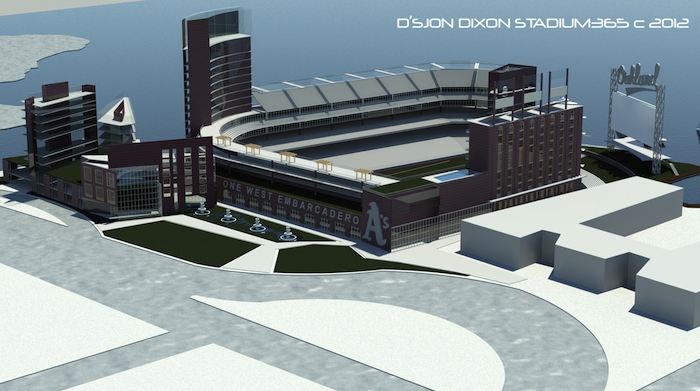
If someone – anyone – discovers a ballpark site is being discussed or presented, and he lets me know about it, I’ll take the time to cover it. Even though ownership is only focusing on one site and the City of Oakland has its own two sites in mind, it doesn’t hurt to be open-minded about others. We may find the best of breed or dismiss something entirely. Either way we’re getting educated and informed about it. I enjoy covering it, and I hope you enjoy reading about it. That brings me to the Estuary Waterfront Project, a ballpark concept by Oaklander D’Sjon Dixon. Dixon, a native East Bay guy by way of the University of Wisconsin (as he pointed out, like Bud Selig and Lew Wolff), is an excellent artist and has some brought some fresh thinking to the often static world of stadia. During his segment on A’s Fan Radio, Dixon frequently talked about his ballpark’s goals of sustainability and its ability to enhance both the waterfront and the city.

EstuaryPark-corner-med

D’Sjon Dixon’s Estuary Waterfront Project would place a ballpark on the site of Estuary Park and the Jack London Aquatic Center along the Embarcadero in Oakland

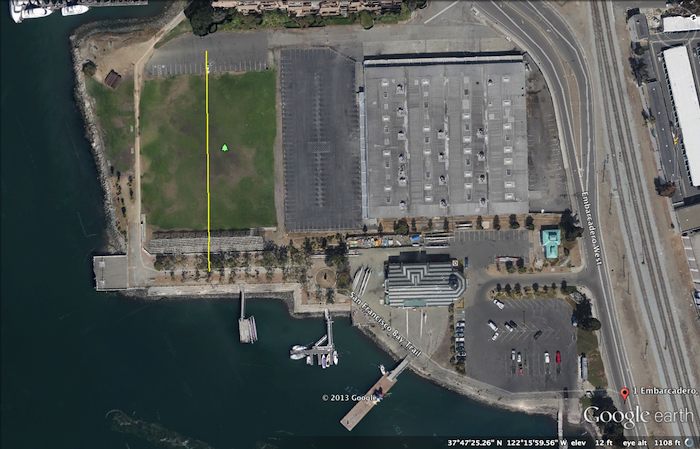
Over the years Estuary Park has aroused curiosity about its ability to work as a ballpark site. It’s located east of Jack London Square, across the tracks from Victory Court. I’ve gone there multiple times and several people have asked me about it over the years. My immediate answer to them is that it’s too small. The park measures roughly 400′ x 240′ plus some estuary frontage of varying width. The Jack London Aquatic Center, which opened in 2001, is a somewhat triangular piece of land that’s also 400′ long and 300′ wide at its widest point. JLAC has a boathouse with a community room that can be rented out for events. Rounding out the landscape is the old Cash and Carry warehouse, which the City bought through its old redevelopment arm a few years ago. That parcel, including a parking lot, measures 440′ x 340′. In all, the land (which is all city-owned at this point) totals just over seven acres.

EstuaryPark-overhead-med

Overhead picture of Estuary Park, the Jack London Aquatic Center (bottom right), and the vacant Cash & Carry building. Yellow line across field represents 400 feet.

It’s not small just because of the acreage, it’s small because of a single dimension. In the picture above, the yellow line represents a reasonable buildable width including mandated setbacks and easements for the water and the apartment complex to the west of the land (top). 400 feet is simply not wide enough to hold a ballpark. A grandstand including the concourse will measure around 170 feet deep. Add to that 50 feet from the first row to home plate, and then at least 300 feet for a short porch to right field, and the ballpark becomes 520 feet wide. There simply isn’t room for that kind of structure on the land, unless you do something unorthodox.

EstuaryPark-north-med

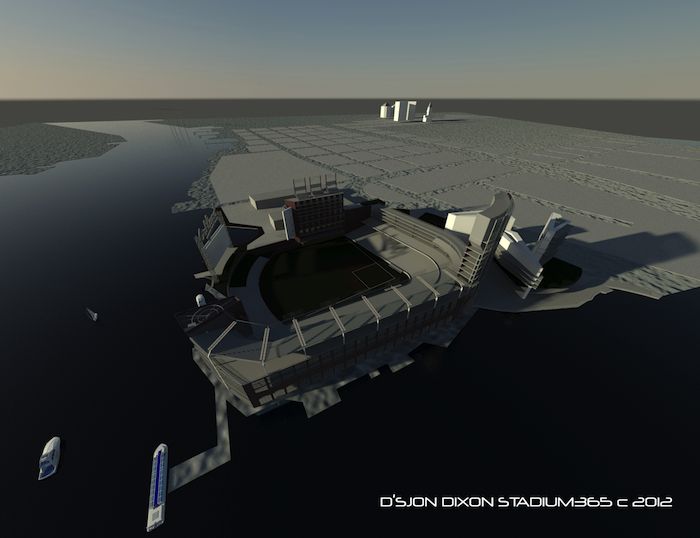
Water view shows footprint of ballpark extending beyond existing Estuary Park footprint

To address this, Dixon took two unorthodox approaches. First, he disregarded the Estuary Park limitations and simply built more of the ballpark out into the water. I didn’t notice this until I saw more images on the project website. Notice the second pic’s taper from JLAC to the park, and how that no longer exists with the ballpark. Anyone who has spent any time reviewing CEQA knows that building anything new over what is currently water is for all intents and purposes forbidden in California. Even the Warriors arena is getting a great deal of static for aiming to build on piers, which of course aren’t land. Additional creation of land in the Bay, regardless of purpose, practically requires an act of god to make it happen. Remember the plan to extend SFO’s runways a decade ago? That would’ve required bay fill. It died on the vine. A similar effort for this ballpark, even if it required only a 100′ x 400′ slab (1/2 acre), would be laughed out of committee or ripped to shreds by Save the Bay, Waterfront Action, or the BCDC if it ever got that far. The Bay is what makes our region distinct, and people and groups have shown that they’re willing to defend it endlessly and to the death. The other unusual step Dixon took that baseball fans noticed is that he oriented the ballpark west-southwest, so that it would face JLS, Alameda Point, and in the distance, San Francisco. As we’ve discussed several times, MLB prefers its ballparks to face east or northeast. In some instances such as domes it’s willing to have a ballpark aimed north or south. This is to ensure that the sun isn’t in the batter’s eyes during the day and to provide relatively predictable shadows during the season. Interestingly, Dixon tried to address this by placing an eight-story hotel tower in right field and a big scoreboard in center. Those measures will only work in certain sun-sky conditions. The ballpark could be re-oriented southeast to fix the sun problem, but it would take away from the view. Dixon couldn’t say what the ballpark’s capacity was or explain how much onsite parking would be there. The size of the ballpark would be “up to the developer”, though he also claimed he knew three people who could fund the ballpark. It all adds up to someone who has some great ideas and understands LEED, but knows next to nothing about CEQA. CEQA is the set of regulations that forces environmental review and places restrictions on what kinds of projects can be built in sensitive places. CEQA has led rise to hyper-NIMBYism in California. On the flip side, it has allowed our coasts to remain mostly in the public interest and not full of high-rises and private development. If this ballpark concept ever got off the ground, it would immediately have Bay and waterfront activists, open space and parks preservationists, boating enthusiasts, residents of the nearby apartment complex, and many others lined up to take it down. That doesn’t include the normal anti-stadium types or additional complications such as the PUC and other governmental agency interactions. This is the stuff that Lew Wolff talks about when he says that people can’t just point at a site and say that’s a site. There’s a ton of legwork that has to be done on each proposed site, and even more on the sites that actually get studied as alternatives. There are studies of noise and shade, seismicity and hydrology, cultural and paleontological resources, along with the more common traffic and transportation work. It’s a significant, seemingly endless amount of work, and the crazy thing is that a draft version of an EIR has not been finished for any ballpark site in Oakland: Victory Court, Howard Terminal, Coliseum City, this site or any other site. And it’s telling that Estuary Park, despite its rather prominent position where the Estuary meets Lake Merritt Channel, was never really considered a ballpark site in the past. That’s largely due to all of the issues identified in this post, and probably many more that I haven’t covered. Just a thousand feet across the Channel, HOK studied two sites at the Oak-to-Ninth (O29) site in 2001. That’s not to say that Dixon’s in the wrong. He has some great ideas, and the fact that he put he put his visual skills to use in fleshing them out can help a lot in terms of creating a real vision for Oakland going forward. If the concept ultimately serves as a catalyst, it would be incredibly productive for fans who want an Oakland ballpark and need a unified rallying point. This idea can be moved and modified to work at other sites. Dixon seems to like Coliseum City nearly as much as his own plan, as long as the A’s stay in town. If Save Oakland Sports and other groups can come to a consensus on one site that has energy behind it and has been properly vetted, they have a shot. If they stand by the City’s current vision of multiple sites being equal with no real consensus, there’s nothing to rally behind. They’re just circles on a map. —– Note: As I was writing this in the middle of the night, I did not ask Dixon for permission to use his images. I apologize for that in advance, though I also cite fair use as this is a review.