Environmental concerns threaten Howard Terminal

Friday’s newswrap included a bit from @muppet151, who inquired about Howard Terminal’s costs associated with toxic cleanup at the site. As part of its use as a working port, numerous substances were capped by asphalt concrete and parts of the site were filled with concrete to prevent leaching into groundwater. Again, here’s a snippet of his letter to Oakland and Alameda County officials:

In 2002 the Department of Toxic Substances Control released an investigative study on the Howard Terminal site, a follow up to previous investigations that took place in 1998 and 2000. The study showed that having been a manufactured gas plant from 1902 to about 1960 an “area of aged hydrocarbon fuel, about three inches thick, was found in the groundwater in the southwestern corner of the Site.” This contamination does not pose an immediate risk because of an existing asphalt concrete cap. However the study concluded “that the construction activities that would breach the asphalt concrete cap would cause excessive exposure. Therefore all construction would need to be performed in accordance with a Health and Safety Plan.”

A Removal Action Work plan (RAW) was drawn up, and the RAW leads to several questions that have yet to be discussed publically by officials who have spoken in favor of an A’s stadium at the Howard Terminal site, more specifically the role City and County governments would play in regards to the RAW.

The RAW states that should these asphalt concrete caps break, the removal of contamination would cost “in excess of $100 million. It would also require the terminal to shut down for a long period of time.” If the caps were to be broken during the building of a stadium, I don’t think it’s a stretch to say cost over runs could be in the neighborhood of $200 million (contamination removal and stadium building costs), and could delay the opening of a Howard Terminal stadium by at least a year and possibly longer. The worst case scenario being the project being permanently shut down causing the A’s to leave the Bay Area altogether. Such an accident would undoubtedly find its way into a court room as well.

Late Sunday, responses started to come in. The first was from Oakland District 3 Councilperson Nancy Nadel, in whose district (West Oakland) Howard Terminal resides. If you’re not aware, Nadel has never been much of a pro sports supporter, especially when it comes to providing anything for new or improved facilities. Nadel’s response:

Dear Patrick,

Thank you for your message. I see your enthusiasm for the A’s.

You ask excellent questions to which I do not have the answers. I was unaware of such extensive contamination at the Howard Terminal site. Therefore I will have to ask the questions too.

However, since the demise of Redevelopment, there is no city money at all for a baseball only stadium in the Jack London area. I hesitate to go deep into the toxics issues unless there is some movement on the part of the owner of the A’s or MLB. I will make city staff aware of the toxics presence to be sure it’s on their radar screen, if they are doing any feasibility costing of that site, unbeknownst to me.

Our most financially sensible location for sports facilities is the Coliseum, at the expense of the teams and private parties.

Have a great evening,

Nancy Nadel

Maybe Nadel couldn’t recall the cleanup issues at Howard Terminal because they were addressed a decade ago. But she’s been in office since 1996 and Howard Terminal has aroused a good deal of attention at different points throughout her Council tenure. In any case, it’s a curious response.

That was followed up by a response from fellow Councilmember Desley Brooks (East Oakland):

Dear Patrick.

Thank you for your email and the issues you raise. I was not aware of the howard terminal issues that you raise.

I am forwarding your questions to the city administrator so she, or the appropriate staff, can respond.

Please let me know if you have not heard from her by Friday.

Best regards,

Desley

In December 2010, Oakland authorized up to $750,000 to study Victory Court and the surrounding area, including Howard Terminal. Much of that money has been spent on studies, even though the public hasn’t seen a single page produced from the work. While much of the information gathered from traffic and parking studies can be used for HT, environmental concerns about the site may require a new and larger expenditure which would be covered by a full EIR. Oakland could choose not to act on that until it hears something positive from MLB. However, if the basic principles regarding cap breach remain, site costs would double overnight, from under $100 million just for infrastructure to $200 million or more including cleanup, and that’s if the work goes smoothly (not a given). Howard Terminal’s supposed to be the cheap site, right?

Even with the cap in place, several types of buildings can’t be built on top of Howard Terminal, thanks to the Port’s 2003 Land Use Covenant.

  • Residential property of any kind
  • School
  • Day care center
  • Hospital
  • Park or open space created by excavating the cap

Where does a stadium fit into that? That’s for the state to decide. We discussed this issue in a previous comments thread, and Howard Terminal has some special similarities to AT&T Park: both are on liquefaction-prone land, and both sites were well contaminated and required cleanup before a stadium could be built. This isn’t like putting up a double-wide trailer on some blocks. It’s a cost that will need to be addressed if Howard Terminal is to be the site MLB chooses moving forward.

…..

Many thanks to muppet151 for taking the initiative to ask elected officials the right questions. We hope to get responses soon.

News for 10/5/12

It’s been a couple of weeks since I’ve done one of these. Time to catch up.

  • The A’s finished the season with a total attendance of 1,678,913, an average 20,727 per game. Not including the first two home games in Japan, the total attendance is 1,591,295 (20,143 average). That’s an increase of more than 200,000 fans over 2011, and the best number since 2007. MLB’s total attendance rose nearly 2% to 74,859,268, propelled largely by the opening of Marlins Park. If you assume that each ticket costs the FCI average of $27 and comes with $11 in additional spending (concessions, parking), MLB gets $2.84 billion in stadium revenue. If we project $7.7 billion for the 2012 season, then regular season stadium revenue accounts for 36.9% of total revenue. Wendy Thurm from Fangraphs/Hanging Sliders has more in-depth analysis. [MLB, Fangraphs]
  • TV ratings are out too. While the A’s showed marginal improvement throughout the year on CSN California (1.27 rating, 32,000 households), Wednesday’s AL West title showdown pulled an incredible 4.72 rating in the Bay Area (172,000 households), the highest rating since 2008. If the A’s could pull in half that number on a regular basis, they’d be in much better shape financially. [Sports Business Journal/John Ourand & David Broughton, Comcast SportsNet California]
  • Like the A’s and Giants, rivals Baltimore and Washington are also in the postseason. Their rivalry extends to off the field, as their ongoing battle over the Nats’ TV rights value on MASN continues. As part of the deal to move the Expos to DC, O’s owner Peter Angeles was allowed to set up MASN and own Nats’ broadcast rights, to which the O’s pay around $30 million per year. Angelos wants to raise the rights fee to $35 million, whereas Nats owner Ted Lerner is holding out for $100 million, which would put the team among the largest markets in terms of TV revenue. That number may not be feasible without a sizable bump in subscriber fees for MASN, which would get the channel into another battle with Comcast over carriage costs. ([Forbes/Mike Ozanian, Press Box/Tim Richardson]
  • The website UFE (Urine Feces Everywhere) did its own annual study of ballpark cleanliness, surveying all 30 MLB ballparks throughout the year. The Coliseum came in 4th worst in baseball (F grade), thanks to those oh-so-charming trough urinals and an embarrassing 56% of men not washing their hands. You people are disgusting pigs. For shame. The best ballpark? Busch Stadium. The worst? Wrigley Field (maybe that’s symbolic). AT&T Park came in 8th best, its only demerit being the composite trough sinks it uses (didn’t realize those were a problem). [UFE]
  • muppet151 sent a well-worded letter to City of Oakland and Alameda County officials asking about cleanup costs associated with the Howard Terminal site. I can’t say I have confidence it’ll be answered, considering how this week the City started limiting access to City Council sessions. We’ve discussed contamination and cleanup at Howard Terminal before. Furthermore, the Howard Terminal Land Use Covenant severely restricts what can be built on the site. Prohibited uses include residences, a hospital, a school or a day care center, or a park or open space (if the ground is uncapped). Here’s some relevant text from the request: [Twitter, TwitLonger, SFGate/Mattai Kuruvila]

A Removal Action Work plan (RAW) was drawn up, and the RAW leads to several questions that have yet to be discussed publically by officials who have spoken in favor of an A’s stadium at the Howard Terminal site, more specifically the role City and County governments would play in regards to the RAW.

The RAW states that should these asphalt concrete caps break, the removal of contamination would cost “in excess of $100 million. It would also require the terminal to shut down for a long period of time.” If the caps were to be broken during the building of a stadium, I don’t think it’s a stretch to say cost over runs could be in the neighborhood of $200 million (contamination removal and stadium building costs), and could delay the opening of a Howard Terminal stadium by at least a year and possibly longer. The worst case scenario being the project being permanently shut down causing the A’s to leave the Bay Area altogether. Such an accident would undoubtedly find its way into a court room as well. 

  • Arizona State University is in the middle of the Phoenix-Mesa spring training game of musical chairs. The school is looking for a much larger home than its on-campus facilities, so it is looking to either share the new Cubs’ ballpark in Mesa or move into Phoenix Municipal Stadium if the A’s vacate Muni and move to HoHoKam in Mesa. [Phoenix Business Journal/Mike Sunnucks]
  • Before the end of September, Governor Jerry Brown vetoed a series of bills meant to revive redevelopment in one form or another. Brown didn’t rule out some of the ideas completely, giving credence to the notion that some aspects of redevelopment could be restored once the state’s budget shortfalls are resolved after the old institutions of redevelopment are completely eliminated (good luck with that). Meanwhile, the League of California Cities filed a lawsuit challenging last summer’s redevelopment laws. [LA Times/Patrick McGreevy, AP/Bloomberg Businessweek]
  • Tarps continue to be a sore spot, as the A’s refuse to remove tarps for the ALDS and will only consider removing them from the ALCS. Back in 2006 was when I had first heard of a MLB rule restricting capacity. If it’s entirely the domain of the team, then why not just take some or all the tarps off? Who is it going to hurt? Let’s Go Oakland has started an online petition, though that’s not going to actually get the tarps removed. The numbers on the petition will end up on some letter to the commissioner. Frankly, if people really want to get the tarps removed, they should show up outside the Coliseum Box Office/Ticket Services with news crews in tow. Get 2,000 people there who have been shut out of buying tickets. Protest. If you’re going to get ownership to budge or MLB to push ownership, the only way may be to put real pressure on them via the media. Otherwise this is little more than political fodder. [SFGate/Carolyn Jones, Let’s Go Oakland]
  • An rally for the A’s will be held outside Oakland City Hall on Monday at 5:30 PM. The rally will be held despite the fact that Monday is a city government furlough day.
More as it comes.

Prayers for Pat and Stephanee Neshek

A’s reliever Pat Neshek left the team to go on paternity leave, as his wife Stephanee gave birth Tuesday. Their son, Gehrig John, passed away 23 hours after birth with no explanation as to why. We can talk about the team’s and individuals’ struggles. Nothing compares to the loss of a child. Baseball can wait. It’s time to grieve, and to heal.

Coliseum Authority, MLB, A’s considering up to 5-year extension

The Chronicle’s Matier and Ross are reporting that the A’s and the Coliseum JPA are in talks regarding what could be a five-year extension at the Coliseum. As expected, MLB is facilitating the negotiations, which is sensible considering the sides’ general chilliness towards one another. There are a couple of interesting bits to the talks:

The lease was handed over to the team three weeks ago, and while details are still to be worked out, A’s managing partner Lew Wolff told us that he is “absolutely” interested in reaching an agreement.

“Even if we were building a new ballpark, it wouldn’t be ready until then anyway,” Wolff said.

According to insiders, one possible problem may be the $50 million penalty the Coliseum wants if the team leaves early for San Jose.

First of all, Wolff is basically admitting that a ballpark wouldn’t be ready until 2018. That’s a two-year slip from previous statements. Whether that’s a process issue or more a Giants mortgage issue isn’t clear. In any case it’s a long ways off.

The $50 million exit penalty is a potential showstopper. The A’s have had exit penalties in previous lease extension, but those simply had the A’s pay the remainder of the lease upfront (plus perhaps a nominal fee) to get out. In this case the JPA is using leverage (no other MLB ballpark in the A’s territory) to effectively force the A’s to stay or pay off more of the horrendously bad Mt. Davis deal.

Wolff, for his part, says he’s interested in reaching a deal. Probably not this deal, though. He probably wants something more along the lines of the three-year deals (plus two one-year options) he bargained for previously. And a $50 million exit penalty is not something I can see either Wolff or MLB approving. To put it in perspective: the A’s haven’t paid $50 million combined in rent since Mt. Davis was built, and that was 17 years ago.

The Coliseum Authority could be playing hardball here, or it could be starting off asking for the moon. It’s the first step of a negotiation that could last all winter, and could get very testy as it moves along. We’re a long way from the situation I described in August, but if that exit penalty is real and the JPA isn’t budging on it, MLB could very well get the impetus it needs to look elsewhere.

Blips and trends

A popular refrain is emerging from the Oakland-only camp, in which the A’s should stay in Oakland because the team’s playoff run, thereby proving that the team can be competitive in Oakland. During the Wheelhouse today, Greg Papa and John Lund mentioned Chris Townsend’s argument that Wolff could go to Selig and the owners and claim, “This is as good as it gets, now let me move the team.” Both arguments are guilty of the most shallow, gut-reaction analysis and are as strong as a wet paper bag. In fact it was Papa who, when Lund asked him if the A’s resurgence changes the equation in any way, correctly pronounced that this season is meaningless in terms of the Oakland/San Jose debate because it doesn’t take into account the big picture.

The fatal flaw with the Oakland-only argument is that they’re arguing against something that wasn’t ownership’s argument to begin with. One season is an outlier, an anomaly. It may start a trend of great success, which would in turn engender greater fan support, which would be great if that happened. If the team can continue to be successful, if it can get season ticket subscriptions past 10,000 for next season, then there’s a very good argument that the fanbase can not only support the team by the loudness of their voices, but also by their sheer numbers. The success may also be a blip, in the way that success couldn’t be sustained over multiple or even consecutive years. No owner, no matter how much he spends on payroll, can guarantee playoff appearances let alone championships, every single year. To expect that of any owner is wholly unrealistic.

Ownership’s argument about moving to Silicon Valley’s better economic environment has always been about being able to sustain a competitive team. Any team can be successful for a year – Oakland and Baltimore this season are testaments to that kind of randomness. It takes incredible skill, luck, and just as important, money to sustain success. Anyone who has been a lifelong fan of A’s baseball has seen this play out several times. Over their 45 years in Oakland, the A’s have lost Catfish Hunter, Reggie Jackson, Rickey Henderson (twice), Jose Canseco, Mark McGwire, Jason Giambi, Miguel Tejada, the Big Three, and most recently Gio Gonzalez because of ostensibly economic reasons. No ownership group was immune from this inevitability, including the great Walter Haas. If the A’s don’t have a ballpark deal in place the next couple of years, guess who’s going to join that illustrious list? Yoenis Cespedes and Josh Reddick, they of the nearly 8 fWAR combined this season. They’re both young, cost-controlled, and will net significant young assets in trade.

The A’s celebrate in front of an announced crowd of 21,162. The crowd appeared much larger – but why?

Now maybe there’s a legitimate economic argument to keep the A’s in Oakland. If there is, it needs to involve vastly improving season tickets and FTEs (full-season equivalents) past that 10k figure. The Giants are flirting with 30k season tickets thanks to their ballpark and World Series win. The A’s don’t need to match that number, but they need to get to something approaching 20k if anyone wants to take them seriously, whether they’re talking Oakland or San Jose. The thing that is killing the A’s right now is the major swings in attendance. Sure, we can pull in a full house for a Star Wars fireworks night, or what appeared to be 27k for last night’s wild card game clincher. The problem is that the baseline attendance is that season ticket/advance sales figure, which absent of promotions or giveaways hovers around the 10k level. Last night the paid attendance was 21k, including 5,000 walkups. The crowd looked fuller, which can be explained several ways:

  • $10 Plaza Level/Outfield seats from the night’s Dynamic Deal
  • Much of the Field Level outfield seats taken by season ticket holders who redeemed unused tickets for the last available, designated home date for exchanges. Those tickets count as comps, not as new paid admissions. (thanks to Lone Stranger for that observation)
  • Great weather inviting more people out to the yard on a warm, indian summer night
  • A meaningful game against a division rival

That said, the 27k I cite is just an estimate based on previous observations of crowds. The Coliseum’s capacity is 35,077. So why wasn’t it completely full? Well, you can’t count on 15k walkups for an A’s game at the Coliseum, no matter how good the team is. Where were all the empty seats, then? Take a look…

The Plaza Reserved level, practically empty for Monday night

No discounts were available for the Plaza Reserved tier, though the A’s will frequently fill the deck when discounts are made. Tonight a similar Dynamic Deal to last night’s was made available. Couple that with the ritual free parking on Tuesdays, and it’s easy to see the announced attendance tonight being 28-30k. These loud, and potentially sizable crowds don’t prove anything other than that people will come out to see a good A’s team when the conditions and price are right. To prove that the market is viable will take a much greater commitment among the fanbase. Don’t call a blip a trend, Start a trend. Without that measurable improvement, that greater commitment, there’s really no discussion to be had.

…..

P.S. – Tomorrow I’ll discuss a way to make improve attendance and renew fan goodwill. Yes, it will involve removing tarps.

Wolff claims ballpark could boost A’s revenue almost $100 million annually

Last Friday, Lew Wolff was interviewed on an episode of CNBC Sports Biz, which you may have missed because it airs on NBC Sports Network instead of CNBC (what?). The show also is one of the few NBC properties that can’t be pulled up via streaming. Maybe the identity problem has something to do with it.

Anyway, in the interview, Wolff told CNBC’s Brian Shactman (who took over the spot from now-ESPNer Darren Rovell) that the A’s annual revenue could rise by almost $100 million with a new ballpark.

Asked to further clarify Wolff’s comment, Shactman followed up with another tweet.

Since we can’t see the interview (reruns only played over the weekend with none scheduled this week), we don’t know what Wolff’s context is. Is he referring to a revenue rise without the $30+ million revenue sharing check? The revenue sharing check that’s supposed to go away with a new ballpark, after 2016? That’s the only way the number makes sense to me, though clearly I don’t have access to the books. When I talked to Wolff over a year ago, he suggested that numbers proffered by Forbes overstated the A’s actual revenues.

In any case, Wolff is probably using that figure to press the case with the other owners and with the national media. Whether that makes any difference – well, we’ll see about that.

The Ballad of Mark Davis

Imagine that you’re Raiders owner Mark Davis. It’s December and your team is already out of the playoff hunt, headed towards a losing season and a top 10 draft pick. The team has one more season on its lease at the Oakland Coliseum, and while negotiations and studies are ongoing with Oakland and Alameda County, it’s not like you’re not taking calls from interested parties in LA. The 49ers are progressing quickly on their own stadium, which could be a decent temporary landing spot.

In other words, you have options. Prudent financial planning on your parents’ part appears to have kept the controlling interest of the team within the family, though there isn’t the money to put up a huge share towards construction of a new stadium. You could work a two or three-year deal to keep the team in Oakland while things are worked out, or experiment in Santa Clara for a few years.

At the same time, government handouts for stadia have all but dried up, at least in California. The growing number of minority partners will want their piece of whatever deal is made. The Raiders are currently the third least valuable team in the NFL, mostly due to the lack of revenue generated at O.co Coliseum. The 49ers, who were in similar straits a few years ago, are now worth $1.2 billion thanks to their coming stadium and a deep playoff run that generated enough interest and upfront sales to help pay for the stadium. Those upfront sales, which include an alleged $500k/year for high end suite leases, are the replacement for the big government handout.

That’s all well and good when you’re the 49ers and can tap into wealthy San Francisco and Silicon Valley, and have first-mover advantage to boot. When you’re Mark Davis, only a fraction of that kind of money is available to you – at least in the Bay Area. The 49ers are sucking much of the air out of the market. In Los Angeles that money’s there in spades. And with Phil Anschutz exiting stage left, negotiations with a stadium operator may not be as difficult as they were with Anschutz on board.

Problem for you, Mark, is that if you want to be a first mover on LA, you might want to act when the NFL opens its six-week relocation application window on New Year’s Day, 2013 (or if no one applies in 2013, 1/1/2014). Acting first could provide distinct advantages, such as better lease terms and preferred scheduling if a second team (Chargers, Rams) were to come in. Of course, other teams will be thinking the same thing so that may want to move early too. There’s also the problem of playing one or two years at an interim facility like the LA Coliseum. If you apply for an LA move, it’s almost a certainty that Oakland officials will cease work on Coliseum City, at least the football-centered version of it.

Better to keep your cards close to the vest. Good job on that, for now.

Tampa Bay developer presents ballpark vision

.

View from beyond outfield, within greater footprint

Today’s the day that the Tampa Bay Rays and the City of St. Petersburg were scheduled to hear about a ballpark plan that is located within the city, yet is more convenient to Tampa and Clearwater. The site is in Carillon, a mixed commercial development at the foot of the Sunshine Skyway Howard Frankland Bridge. Because of Carillon’s proximity to Tampa and Clearwater (north of downtown St. Pete), nearly double the population is within a 30 minute drive of the ballpark site compared to Tropicana Field.

Carillon site within the Tampa Bay metro

Carillon is already largely built out, and the developer, CityScape, has only 17+ acres on which to build the ballpark. Since regional public transportation is severely limited, the ballpark will require a significant amount of existing or new parking to meet potential demand. To that end, _ has identified 14,000 parking spaces within the Carillon development. As we’ve seen with Fremont’s Pacific Commons, negotiating parking rights can be very tricky.

Fixed roof Carillon ballpark option

Five ballpark configurations were presented, two with a fixed roof, two with a retractable roof, and one that’s open air. The roof options have either a fixed or retractable outfield wall, the latter of which adds an estimated $8 million to the cost. Open air is the cheapest option at $424 million, whereas the retractable roof/wall version will cost an estimated $577 million.

Various options for outfitting the ballpark

Within those 13 acres is one of the more interesting ballpark concepts presented recently. Hotels and offices loom above and behind the upper deck. A large parklike area sits beyond the outfield, surrounded by more offices. If Rogers Centre (SkyDome) mated with Rangers Ballpark, the offspring might look something like this. At only 35,000 seats it would be the smallest ballpark in MLB, depending on Cisco Field’s final capacity.

Retractable roof option

The proposal is being pitched by a third party, not the City or the Rays, so there’s an extra element of complication if something like this were to be executed successfully. Both the team and developer will want to make the most money possible, yet there’s a $250 million funding gap – and that’s if St. Pete allows the Trop tax to fund Carillon. At the moment Carillon appears to be the only new ballpark option emerging from St. Pete and has some support from the mayor and some members of the city council. Will that be good enough for Stuart Sternberg, who has wanted to explore Tampa along as St. Pete? We’ll see.

Hearing to compel deposition (S4SJ lawsuit)

Today’s hearing was brief at only 20 minutes. Attorneys for the City/A’s and S4SJ/Giants made their cases to Judge Joseph H. Huber. Quick rehash: City/S4SJ requests a deposition of the lawsuit petitioners (S4SJ and 5 individuals) to determine if they have standing. S4SJ/Giants believe that because of CEQA law, standing is already there. A secondary argument is whether or not the business relationship the Giants have with S4SJ represents a conflict of interest.

Judge Huber will decide if the deposition request will be granted. The decision will be made in the next couple of days. Regarding the business relationship, the judge noted that many cases involve outright competitors even if a legal challenge was first made on non-competitive grounds. I suspect that he’s leaning to allow the case to move forward without narrowing the scope to just CEQA issues. As for the deposition, we’ll just have to wait for his ruling.

Again, I have to question the wisdom of the City striking the discounted land deal with the A’s. If the land option were granted at “fair market value” S4SJ wouldn’t have been able to add that issue to the case. Assuming that the redevelopment land transfer legality matter were resolved in the near future, that would’ve left only CEQA and the referendum question as the main tenets of the case. As it stands it’s a muddled mess, with the judge wondering what the next steps are as there are no additional hearings or procedural items scheduled at this point. The wheels of justice only turn so swiftly.

—–

Side note: The attorney for the City/A’s mentioned that one of the lawsuit petitioners actually supported the A’s move to San Jose during a previous hearing. Curious.

The 2014 MLB TV Windfall

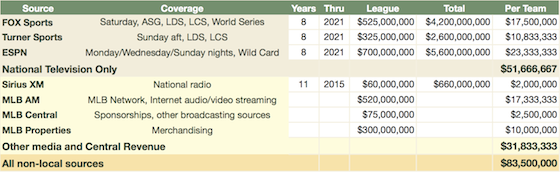
Today’s report from Sports Business Journal’s John Ourand indicates that MLB’s national television deals are just about locked in. We’ve discussed this a couple times now. I’ve done some rough math on it, and the financial picture looks even healthier than I previously projected. Sure, the TV deals will more than double in value, from $660 million to $1.55 billion. But it’s when that figure is coupled with all other sources of national revenue that the picture starts to really brighten.

Come 2014, every team could rake well over $80 million per year without selling a single ticket.

Come 2014, every team could rake well over $80 million per year without selling a single ticket.

The table above reflects rising revenues from every source except for Sirius XM, whose deal was locked in years ago with the money paid in advance. MLB Advanced Media, the internet and broadcasting subsidiary of MLB, admitted last year that it was hitting nearly $500 million in revenue just for 2010. Combine each team’s share with other non-TV sources (adjusted for inflation), and each team comes away with $31.8 million per year. All told, that’s an estimated $83.5 million per year.

That doesn’t even include the dividend each team ownership group gets as an equity partner in MLB AM.

Every team is going to get this windfall, so it’s not as if the A’s or Rays are getting some great competitive advantage. It will allow both teams to be able to confidently offer FA-competitive long-term deals to their own free agents, though $100 million payrolls are still probably beyond reach. To get $100 or $110 million payrolls, both teams will need new stadia. The impressive thing about these bumps is that the A’s will get $10-15 million more via Central Revenue than they get from playing in the Coliseum. Add in local TV/radio and the usual $30 million or so in annual revenue sharing, and the A’s should net $180-185 million per year starting in 2014. Not rich compared to the other teams, but a far cry from destitute.