Might as well dream big

Coliseum City strikes me as the City of Oakland’s equivalent of playing a big lottery like Mega Millions or Powerball. The chances are infinitesimal at best, yet they can’t win if they don’t play. So they’re putting in a few million dollars to get some studies done in hopes of a lot of circumstances falling very neatly for them to keep the three current tenants at the Coliseum complex.

Never was this more evident than in the Oakland Planning Commission meeting on Wednesday, when the City gave more details on the plan. It’s expansive, to put it mildly.
  • 68 – 72,000 seat NFL stadium with 1.8-2.2 million square feet of space, covering 12.6 acres
  • 35 – 39,000 seat ballpark with 1.2 million square feet of space, covering 12.3 acres
  • 18 – 20,000 seat arena with 850,000 square feet space, covering 5 acres
  • 14 million square feet of office, R&D, commercial, and retail space
  • 6,370 housing units
  • 15,000 parking spaces at Coliseum site (mostly through garages, existing site has 10,000 spaces)
The word expansive is often trailed closely by the word expensive. At a conservative $150 per square foot, the non-parking buildout alone hits $2.1 billion, closer to $3 billion when including the additional stadium development costs. Either is an astounding figure, and for anyone who actually operates in the commercial real estate development world or has even basic knowledge of the Oakland market, a truly puzzling one. This is redevelopment era thinking in a post-redevelopment world.
Coliseum City Specific Plan

Coliseum City Specific Plan

The facilities described in the project summary would be among the largest and most expensive in the nation respectively. The football stadium would rival Cowboys Stadium in scope, and while there’s no mention of a dome, there’s no way to get the kind of flexibility the City is aiming for without a dome. Cowboys Stadium was built with a $300 million loan from the City of Arlington, yet City Administrator Fred Blackwell “defiantly” stated that the era of publicly financed stadia was over. All Mayor Jean Quan talks about so far is EB-5 funding or grants to provide infrastructure. Infrastructure will probably end up being 10% of the cost of the project in the end. From the looks of things that will include:
  • A new transit hub, including a widened, more pedestrian-friendly bridge from the BART station to the stadium complex
  • Two additional bridges that span I-880 to the arena and greater development west of the freeway
  • An elevated, landscaped public space that connects everything
  • A revitalized Damon Slough
  • A new water inlet leading from San Leandro Bay to the arena
  • Many new garages
Just this list of items is going to run into the hundreds of millions of dollars. It’s a lot of new concrete construction – particularly the bridges, plus land acquisitions, and reshaping of waterfront areas. And let’s also consider the whopping 6,310 housing units. That’s twice as big as the finally reborn Brooklyn Basin project and nearly two-thirds of the way to Jerry Brown’s famed 10k plan, which was largely done under redevelopment. And note that in the map there’s a Ballpark District, which contains housing. Any chance of that getting built if the A’s aren’t there? Not likely.
Furthermore, how on earth is any of this going to be paid for? Something has to drive private development to gamble its own money on the other 90%, and it’s not clear what that is. East Bay Citizen noted that a meeting of East Bay business luminaries will be held to assess corporate capabilities in the region for the Raiders stadium. That’s a start. The stadium will be at least $1 billion to construct. Understand, however, that the East Bay alone isn’t going to cut it. Anyone without blinders on knows that the East Bay’s corporate strength is not a strong suit. Similar to what Kevin Johnson did in Sacramento, East Bay interests need to attract a lot of money from within the Greater Bay Area and outside it to convince anyone that the stadium is feasible. It’s going to be even tougher because the stadium will be twice as expensive as the planned arena.
Some on the Planning Commission rightly asked about how anything would be paid for, a question that went without a real response. Oakland officials can keep talking hope and pie-in-the-sky concepts as much as they want. They can only duck behind that for so long. Eventually they’ll need to reveal the price tag. When they do, they’ll have no place to hide.

Coliseum lease negotiations stall over parking taxes

It was bound to happen. As the Coliseum JPA and the A’s got further into lease extension talks, they were sure to hit a snag. KTVU reports that after year of ongoing dialog, talks halted last week over the requirement for the A’s to pay $7 million in parking taxes. (Note: Six weeks ago, Matier & Ross had the number owed at only $3 million.) The issue goes back to when Oakland, looking for a way to boost tax revenues, started to enforce a 18.5% parking levy in 2009. All three tenant teams boosted rates to cover the tax, including the A’s charging $17 instead of the $15 they had charged previously. Unlike the Raiders and Warriors, the A’s pocketed the hike while the City and Alameda County fought it out over how much money the two parties and the JPA should get.

The Authority has been asking the A’s for the money for a few years, with Lew Wolff focused chiefly on plans to move to San Jose, only in the last year or so turning towards an extension at the Coliseum. Both sides indicated that discussions were going well, but it’s probably difficult to come to an agreement over $7 million when that’s more than the A’s have paid in rent the past five years. The A’s say that they don’t owe money but will pay the tax moving forward, which sounds thoroughly disingenuous considering they raised the parking rate in response to the imposition of the tax.

The County wants a bigger cut of concessions revenue, which was practically signed away to the A’s when the team and the JPA settled their post-Mount Davis lawsuit. The A’s were also burned by the JPA when they chose to take money meant to replace scoreboards and rerouted it towards the Coliseum City study.

For their part, the A’s will only say that “The disputed items are subject to arbitration or possibly incorporated in a new five-year lease extension.” Arbitration could easily put the A’s on the losing end, paying the full $7 million, but if they’re aware of that and they could somehow get less through negotiation or arbitration, holding out is not a bad tactic. They know that the City’s and County’s stance is to go ofter them hard as the A’s have really nowhere to go while a move to San Jose sits in limbo.

The A’s abruptly cut off talks for now, which itself may be a negotiation tactic of sorts. Is Wolff willing this to go straight to arbitration, or does he want to wait until after the baseball ends to pick up talks again? If they, it’s not likely that everyone at the table will suddenly become nicer.

—–

P.S. – I did some quick and dirty math on this. The City imposed the tax start in July 2009. That left 3.5 years of tax accrual before the start of the 2013 season. 5000 spaces * 3.5 years * 82 games * 18.5% = $4.5 million. Not $3 million, not $7 million. Free Parking Tuesdays and last year’s playoff parking revenue are not accounted for.

Raiders moving to The Game starting with 2013 season

The Raiders and A’s share a stadium. Now they’ll also share a radio station. It took a couple years, but the Silver and Black will finally start having their games broadcast on 95.7 The Game starting with the upcoming 2013 NFL season. It’s a move that has been speculated since the station launched as the A’s flagship.

While the Raiders’ coverage will decrease in comparison to former home KSFO on the AM side, the sports radio station’s programming is far and away more compatible, especially because play-by-play man Greg Papa is already a fixture in The Wheelhouse’s noon timeslot. Non-game coverage will expand, with the Raiders displacing the 49ers in the Monday themed day, good for armchair QB-ing and GM-ing. Previously the Raiders’ day was Friday.

In the event of a conflict with the A’s, Raiders broadcasts will be on 102.1/98.5 KFOX, home of the Sharks and Entercom stablemate. KFOX has a better coverage footprint than KGMZ (The Game), which leads me to think that the Raiders actually negotiated this provision knowing that it was available via Entercom.

Potential for some conflict is high, though not so much in head-to-head timeslot situations. Mostly it’s a case of an A’s game finishing just before the start of a Raiders game during preseason or early during the regular season.

Overlap in A's and Raiders schedules. Raiders games will be broadcast on KFOX-FM (102.1/98.5) in case of a conflict.

Overlap in A’s and Raiders schedules. Raiders games will be broadcast on KFOX-FM (102.1/98.5) in cases of conflicts.

Since the Raiders are expected to have full pre and postgame coverage for each game, it’s likely that all of the weeks above will be on KFOX, with the exception of the 8/29 game against the Seahawks.

Eventually, fans may clamor for more games on KFOX due to the better distributed signal. Of course, that will run into further conflicts with the Sharks, whose season starts in October as the baseball season ends. The 2013-14 NHL schedule, which will be the first under the new realignment scheme, has not yet been released.

Conflicts or not, it’s good that the Raiders are back on a sports station, which they haven’t been since they left 1050 years ago. Whether this will turn The Game into a proper East Bay-focused station is up to Entercom, whose station management has been careful to cater to all Bay Area fans much to the dismay of A’s and Raiders fans. In turn, the Raiders may have to beef up their affiliate network to compensate for The Game’s less signal.

To kick off the new relationship, Raiders draft day coverage is being held today on The Game.

Oakland Fan Pledge seeks to garner interest in an Oakland ballpark

A pair of Oakland A’s fans and longtime readers of this site have started a site called Oakland Fan Pledge. The purpose is to gauge interest in tickets and different seating options at a hypothetical Oakland ballpark, either at the Coliseum complex or Howard Terminal. Results of this survey may be shared with MLB, public officials, and the A’s if the team ever decides to stay in Oakland.

This new effort follows similar campaigns in Sacramento and Seattle to build interest in a new arenas in those cities. Sacramento’s Here We Buy has received more than 11,000 season ticket pledges so far. A similar drive in Seattle claimed more than 44,000 season ticket pledges and 268 suites. Obviously a pledge is not the same as a binding contract to purchase tickets, but as long as people are being honest about their levels of commitment, the information gathered from these kinds of campaigns can be useful. Interestingly, because Seattle and Sacramento were so public about their efforts, it’s likely that Oakland Fan Pledge may be compared to the cities fighting over the Kings/Sonics, however unfair that may seem. Here’s the press release from the group.

FOR IMMEDIATE RELEASE
April 22, 2013
John Hansen
John Jackson
info@oaklandfanpledge.com

Oakland Baseball Fans Launch Campaign for New Stadium
April 22, 2013

Oakland, CA – Baseball fans who want the A’s to stay in the East Bay have a new way to show their support: pledging to buy ticket plans at a potential new baseball-only stadium in Oakland. Oakland Fan Pledge (www.OaklandFanPledge.com) is a new independent website created by A’s fans to show Major League Baseball, A’s ownership, and Oakland city officials that local fans will support a new ballpark in Oakland by pledging their dollars to buy tickets.

On the website fans can choose from various ticket plans and pricing levels at a hypothetical ballpark. While no monetary transaction takes place, those who pledge are asked to be realistic about what they could afford if a new stadium were to be built. Ticket prices are based on averages of other recently-opened stadiums throughout Major League Baseball (MLB). Premium seats include a separate fee for ‘seat rights,’ similar to what was done for the Giants’ opening of Pacific Bell Park in 2000, a standard for a privately-financed stadium. The full list of tickets and money pledged will be continuously updated on the site and shared with MLB, city officials in Oakland, and the A’s. If the time comes that the current, or future, A’s owners commit to a stadium in Oakland, the site’s owners plan to share their list of pledges.

Oakland city officials have identified two possible sites for a new baseball stadium within city limits: one at the existing Coliseum complex and another on port-owned land near Jack London Square in downtown Oakland. Oakland Fan Pledge provides a clear way for A’s supporters in the region to weigh in. By committing to buy ticket plans at a new Oakland baseball stadium, fans can rally around keeping their team in town by sending a clear message. “The A’s owners have told the team’s fans for years that the A’s are as good as gone from Oakland, and it’s frustrating,” says John Jackson, a lifelong fan who is helping to organize Oakland Fan Pledge. “There are tens of thousands of fans that would open their wallets and buy ticket plans if a long term commitment to Oakland was made and a new stadium was built.”

Oakland Fan Pledge began as a grassroots response to frustration around the team’s uncertain future in Oakland and lack of progress in building a new stadium for the team. Major League Baseball has spent over four years reviewing potential Bay Area stadium sites without making a decision. Meanwhile, the A’s ownership has alienated much of the team’s local fan base by repeatedly expressing their desire to abandon the East Bay for Santa Clara County, which is currently under the control of the San Francisco Giants through MLB territorial rights.

“Oakland Fan Pledge is more than a way for A’s fans to show a financial commitment to their team and to Oakland,” says John Hansen, another organizer of the site. “It gives fans a way to move beyond being told their team is done in Oakland, and visualize a new hometown stadium the team’s current owners have tried to convince them isn’t possible. We believe not only is a new stadium in Oakland possible, but that local fans are ready by the thousands to fill it up. Through Oakland Fan Pledge, we look forward to sending this message loud and clear to Major League Baseball and the team’s owners, and dispelling the myth that Oakland is anything but an extremely viable home for the A’s for decades to come.”

I’ll be sure to fill out my survey ASAP.

Giants refinancing ballpark debt to fund other development

The Chronicle’s John Shea confirmed something I had heard about the reasoning for the Giants’ AT&T Park debt refinancing.

The Giants’ plan to pay off their stadium debt by 2017? No longer in the works, we hear. There have been steps to refinance the $170 million loan to help fund their proposed development on parking lot A across from McCovey Cove. There was a time the Giants said they had to limit their payroll because of the $20 million annual mortgage.

Remember how, in 2009, SF City Attorney Dennis Herrera threatened to sue baseball over the perceived financial threat posed to the City if the A’s were granted territorial rights to the South Bay? Well, I’m glad for everyone’s sake that the Giants feel it’s safe enough to take on even greater debt to grow their empire. I was so worried for a while there.

Meanwhile, a group of East Bay mayors including Oakland’s Jean Quan and Berkeley’s Tom Bates are trying to upend legislation introduced by SF assemblyman Phil Ting that would help smooth (or bypass) some of the environmental review and approval process for the Warriors’ arena. It’s not strange that they would pursue this route, since it is local politics at work. The irony is that whatever new law helps the W’s arena could provide a blueprint and pave the way for an A’s ballpark at Howard Terminal, which makes sense because both are on waterfront sites and face the same restrictions.

Of course, if Howard Terminal never gets past the talking points stage no one ever has to find out how expensive it’ll be to build there.

Oakland gets some good news and bad news

When Oakland Mayor Jean Quan revealed plans to take advantage of the federal government’s EB-5 visa/foreign investment program, I called it creative and a good potential source of funds to replace redevelopment. What was missing prior to this year was a healthy, rebounding real estate market to encourage investment. That moment has come, culminating with Governor Jerry Brown’s announcement in Beijing of the Brooklyn Basin development, formerly Oak-to-Ninth (or “O29”). I don’t know for certain that Chinese firm Zarsion Holdings Group Ltd. is a pool of EB-5 investors, but considering the lack of information about the company and the City’s push to get EB-5 investment in China, it seems quite likely. The first phase of the project will include 1,300 of the planned 3,100 housing units.

Brooklyn Basin, comprised of two small peninsulas jutting into the Estuary to the east of Jack London Square, has undergone a painful and grueling process to get to this point. Formally initiated in 2006, the mixed-use development plan went through multiple lawsuits, EIR challenges, and even required legislation to make the land transaction work. When the recession hit, any hope of the project breaking ground before the end of the decade was dashed. Former councilman Ignacio De La Fuente occasionally spoke out for a ballpark as a favor to his developer friends at Signature Properties, to no avail. The land was included in the 2001 HOK study, coming up short compared to Uptown and other sites. I visited community meetings in 2006 to gauge sentiment on a ballpark there, and it was not met with much support due to the infrastructure problems that exist along the Embarcadero. In addition, not all of the land was available, as Oakland landowner J.W. Silveira fired off lawsuits against Oakland to send a message that their slice was not up for sale or eminent domain.

So no, Brooklyn Basin has never been considered a serious ballpark site contender. Could it be a catalyst to complement a ballpark at Howard Terminal? Perhaps. The question at Howard Terminal, as ever, is how will any of it get paid for. The East Bay Express reported yesterday that the Port of Oakland, which controls Howard Terminal, is in debt up to its eyeballs. This is a problem, because the loss of funds from redevelopment could be backfilled by additional debt on the Port. If the Port is strapped for cash, it’ll be hard to build the proper infrastructure that would be required to support a ballpark. Even AT&T Park got help from San Francisco on the infrastructure front. Victory Court died partly because costs to prep the site far surpassed the $85 million that was originally budgeted for the site. The loss of redevelopment money was the final nail in the coffin. At this point there is no true cost estimate for Howard Terminal, and there won’t be unless an EIR is done there to ascertain the cost of cleaning up the site in advance of a ballpark’s foundation work.

Mayor Quan has talked about Coliseum City as a candidate for EB-5 funding, which I can see happening. While that’s promising, it’s important to keep EB-5’s impact in perspective. For the first phase of Brooklyn Basin, Zarsion is only putting in $28 million, or less than 2% of the entire project’s cost. With Coliseum City’s much larger price tag, developers and the City will have to either get foreign investors to bump up their share (which may be limited by how EB-5 works) or find other sources which don’t include redevelopment, state, and perhaps even sales tax money. In the end it all has to pencil out. It’s unclear how either site pencils out with the limitations set on the City and County.

Quan warns Oakland of state cash raid

straightcash

When the City of Oakland sold the Henry J. Kaiser Convention Center to the City’s dying redevelopment agency for $29 million last May, most observers saw through the shell game and figured that it would only be a matter of time before the state’s Department of Finance came looking for the money. Now we know that the raid is happening, thanks to Mayor Jean Quan’s warnings to the City Council this week. For more background on what got Oakland to this point, I’ll point you to two past blog posts.

As Oakland scrambled to deal with the ramifications of redevelopment’s demise, the City sought creative ways to move money around to fund basic city services. Methods included using redevelopment money to pay for items that would have normally be covered by the general fund, and transfers like HJKCC. State Controller John Chiang warned cities doing such transfers that if they felt that assets would be at risk for seizure, those assets should be placed in a reserve, which Oakland did to the tune of $30 million. In 2012, the City received a large uptick in tax revenues, bringing its surplus to over $80 million including the reserve. Quan expressed confidence about the surplus.

Even under the worst-case scenario, we have $45 million in reserves. We can cover this.

That worst-case scenario is approaching soon, as the seizures will occur, short-term benefits deals cut with unions to help balance the budget are set to expire, major unfunded pension liabilities loom, and the City works to maintain and add to police staffing. During Tuesday’s City Council meeting, a large union contingent was in attendance to protest any notions of prolonged or additional concessions.

Oakland made a huge mistake in 2011 in assuming that a crippled form of redevelopment would be allowed if bills AB 1x 26 & 27 passed. The nightmare scenario came to fruition when AB 1X 27 was ruled unconstitutional, leaving no avenue for future RDA activities. In addition to the state coming down on the HJKCC deal, the DoF asked Oakland to return $18 million of RDA money in January. All told, Oakland could be dealing with a new $50+ million hole that will go straight to future budgets. Unlike some of the other illegal transfers such as the ballpark land in San Jose, Oakland’s problems are related to cash that was either allocated or spent. The City still has the reserve that can backfill most of the hole, but it will put other parts of the budget at risk and jeopardize other projects, including broad development initiatives such as Coliseum City. Land transfers are a different case in that they don’t have to be liquidated unless the DoF determines that a city has come up so short that a fire sale is needed. In many cases, it’s merely a matter of determining that a piece of land has to be taxed normally instead of being placed in a RDA-style tax increment scenario.

Howard Terminal is owned by the Port while the Coliseum is jointly owned by the City and Alameda County. Neither HT nor Coliseum City are at greater risk in terms of feasibility due to the coming raid. However, it’s possible that the budget crunch will cause additional funding for pre-dev work at HT or CC to be rerouted elsewhere as both fall down the priority list in favor of more pressing matters. That already happened once with Victory Court in 2011, and we all know what happened with that plan.

The full impact of the RDA seizure and clawback won’t be known until the DoF releases its final report on Oakland and the City bakes the impact into its next budget.

Good cop, bad cop, legacy (Updated to include Mayor’s letter)

Added 1:00 PM – I’ve taken the liberty of posting the text of Mayor Reed’s letter to Commissioner Selig.

Mr. Bud Selig, Commissioner
Major League Baseball
777 E. Wisconsin Avenue, Ste. 3060
Milwaukee, WI 53202

Dear Commissioner Selig:

When will the A’s be moving to San Jose? That’s the question that is most often asked of me by CEOs of Silicon Valley companies competing to retain and attract global talent, by youngsters excited about competing in little league baseball, and by fans throughout San Jose.

The A’s ownership continues to express its desire to locate the team in San Jose and I strongly endorse that outcome. There should be no doubt of San Jose’s ability to be a great host city for the team and for Major League Baseball. There should also be no doubt that the stadium could have been under construction by now.

We respect your desire to examine fully all aspects of allowing the A’s to move to Northern California’s largest city. In 2011, former MLB President Bob Dupuy, speaking on behalf of your office, asked that our City Council delay approving a public vote to advance a planned stadium project in Downtown San Jose. We abided by that request. Mr. Dupuy also indicated that you would soon make a final decision and, if favorable towards San Jose, the MLB would assist the City with the costs of a future election. Two years have passed since. As you know, we have been contacted many times by the MLB’s Blue Ribbon Panel and we have responded promptly and thoroughly in every instance. Meanwhile, we continue to communicate with leaders in the community and are prepared to advance implementation actions to the City Council following your decision.

Direct communication between us will help resolve any lingering issues about our commitment to having the A’s home plate located in San Jose and could reduce the probability for additional litigation. I’d appreciate an opportunity to discuss this with you and have asked my Chief of Staff, Pete Furman, to contact your office regarding scheduling a meeting with you. I hope you will look favorably upon the request.

Best Wishes,

Chuck Reed
Mayor

c: Lew Wolff

—–

It’s probably not a coincidence that in the span of two hours, Lew Wolff spoke for the first time this regular season about the stadium situation on Chronicle Live!, followed by San Jose Mayor Chuck Reed asking for a meeting with Bud Selig via a one-page letter sent to  the Commissioner’s office.

Reed is positioning the requested meeting as something that could head off future litigation. Over the last year, San Jose has become more vocal about challenging MLB through the courts. So far MLB hasn’t budged. I can’t imagine that this will work either. Regardless of whether San Jose actually has standing in a case against baseball, the sport still has the lion’s share of leverage. If granted the meeting, maybe Reed will come with a phalanx of high-profile lawyers to shake down Selig. More likely is the idea that Reed will continue to pitch San Jose’s positives (of which there are many) and try to allay any fears that the A’s can be self-sustaining in the long run. Remember, they have to be off revenue sharing in a new Bay Area stadium.

As for Wolff, he was peppered with a lot of questions by ChronLive’s Jim Kozimor. Unfortunately, Wolff refused to talk about any progress on the decision-making front for a stadium location, citing the Selig-imposed gag order on both teams. He was able to comment on other matters. On the prospects of the five year lease Wolff requested last year:

The environment of getting a (lease extension) is very positive.

That’s encouraging. All A’s fans hope that the flying rhetoric stops and the team and the JPA can work out an extension that benefits both sides. That’s not going to be easy with the Raiders asking for more revenue control. We’ll see over the coming months if a proper agreement can be worked out for all sides.

Asked if Wolff and the Fisher family would consider selling the team if Wolff doesn’t get his wish to move the franchise to San Jose:

The answer is no… we want to keep this generational.

Following the 14-minute interview, in-studio guest Mark Purdy further elaborated on the “generational” aspect. Purdy indicated that Lew could cede more of the stadium effort in the coming years, as he approaches 80. Next in line is Lew’s son Keith Wolff, who has been working on plans for Cisco Field and the Earthquakes Stadium, where major site work started happening in the last week. Lew says that the Quakes stadium is on track, but process could slow it down. For now he says that the Quakes stadium should be open for the 2014 MLS season, conceding that there could be delays in completing the project. I figure that once that venue is up and running, Keith Wolff will assume his father’s place as the public face of the stadium effort, if not the franchise itself. With the recent trend of teams acting as investment vehicles and development anchors, this is naturally hard-to-believe. Considering how Wolff views his ownership of the franchise and how he attends games frequently with his grandson, it’s not necessarily that far-fetched. Wolff dismissed Kozimor’s suggestion that the team is just fine collecting revenue sharing checks, responding that he wanted to leave the team and the sport in a better place than he found it. As long as there continues to be an impasse vis-à-vis San Jose, that’s inconceivable.

Forbes ranks A’s 28th in team valuations at $468 million

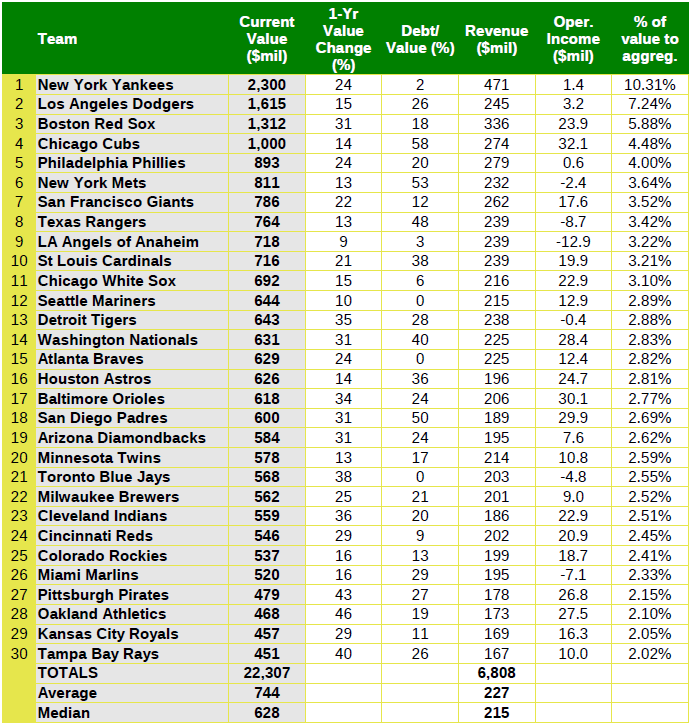
For me, when the Forbes MLB valuations are published every March, it’s like Christmas nine months early. Forbes goes to the trouble of sleuthing around baseball even as team financials are meant to be heavily safeguarded. It provides this blog and others with that last bit of off-the-field news just before the season starts in earnest. Thanks to Mike Ozanian and Kurt Badenhausen for putting the 2013 edition and previous editions together (full list).

2013_valuations

2013 Forbes franchise valuations with some additional extrapolation

As expected, the combination of the Dodgers ($2.1 billion) and Padres ($600 million) sales plus new TV contracts on the horizon pushed franchise values up. Way up. No team has a valuation lower than $450 million. Credit also goes to MLB Advanced Media, whose expanding product line includes MLB.tv, the At Bat apps for phones and tablets, and Tickets.com. Forbes estimates that if it were public, MLB AM could be worth $6 billion on its own. Slow, deliberate baseball is not the kind of enterprise one thinks of when looking for examples of startup culture, yet the success of MLB AM is undeniable and felt in every owner’s pocketbook every year.

These new valuations result in an aggregate $3.5 billion rise over last year. The A’s, who were last in 2012 with a $321 million valuation, are now 28th with a $468 million valuation. That’s a whopping 45.8% gain, all without negotiating any lucrative new media deals or the benefit of new ballpark revenues. $468 million is reflective of the new national TV deals that MLB will receive starting with the 2014 season. Even with the increase, the A’s are $160 million below the media franchise value and $276 million below the average valuation. For reference, the big market Giants got a $143 million boost and moved from 9th to 7th place. As we observed last year, the bubble is real. Thanks to baseball’s solid, diverse revenues, the bubble is also not going to burst anytime soon.

Debt that the A’s are carrying appears to be unchanged at around $90 million. This is no surprise because haven’t signed any big contracts since Yoenis Cespedes. By staying put, the debt-to-value ratio has gone down from 28% to 19%. That’s important because if Lew Wolff is going to build a new stadium in the next several years, it’s best to keep debt relatively low and operating income high so that they can borrow big for a ballpark. The downside of that conservative approach is that much of the A’s young talent could be out the door sooner rather than later, as we’ve seen frequently over the years.

Forbes also explained a little of their methodology this go-around.

Our team valuations are enterprise values (equity plus debt) and are calculated using multiples of revenue. Thus while teams value MLBAM and BELP on their balance sheets on a “cost basis,” which understates their true value, we incorporate market value estimates for those assets. Two more significant ways our accounting differs from the P&L statements of many teams: we include revenue teams keep from concerts, soccer games and other events at their ballparks; and we deduct from revenue stadium debt payments that are paid with stadium revenue. In short, our team values are meant to reflect what a buyer would be willing to pay in an arms-length transaction and our operating income measures are meant to indicate how much cash is generated.

Basically, Forbes is making the distinction that their numbers are reflective of how each team is run as a business, as opposed to P&Ls reported to baseball which may be products of arrangements designed to hide or minimize secondary revenue sources and expenses. While commissioner Bud Selig and the owners will downplay or write off Forbes’ figures, we can feel a little more confident in their soundness based on what they’ve dug up and the new industry information that has come in over the last two years.

Wait, what’s that BELP thing? BELP stands for Baseball Endowment Limited Partners, a sort of internal baseball hedge fund. It was started when the owners collected the franchise fee for the Washington Nationals into another partnership called Baseball Expos Limited Partners. The owners and Selig decided to reinvest that $500 million instead of distributing it to each ownership group. The strategy has literally paid dividends for the owners, because once money from BELP I was rolled over into BELP II, baseball started getting major profits from the fund. BELP was first exposed a few years ago when Deadspin received leaked financials from several teams, but the kinds of investments BELP chose to venture into were kept under wraps. In the past, I’ve put BELP in the category of “Other” when accounting for Central Revenue. I’ll probably break it out going forward, though that will be based entirely on estimates since BELP isn’t public.

The main article ends with a few notes on the A’s, which is somewhat unusual. It’s pointed out that the A’s got another fat revenue sharing check of over $30 million, and an attendance boost coinciding with the team’s division crown. Local revenues continue to lag, so revenue sharing and central revenues are (more than) keeping the team afloat. That’s a double-edged sword, as it gives critics of Wolff and John Fisher ammo to say the team is again being “cheap” with regards to how it runs the team. Now that payroll is taking up less than 40% of revenues, it’s worth asking if the team is saving money – perhaps for a ballpark. If the marginal cost per win in terms of talent is difficult to justify (see: $11 million/year for Kyle Lohse), filling the piggy bank for a ballpark wouldn’t be a bad way to go.

Of course, there’s another side to the revenue-payroll debate. With all of the money that’s coming in, Wolff, Fisher, and the other partners would have to be absolutely nuts to sell the team. They’ll only get more money next year, which they can invest in one of their cornerstone players. The windfall also makes it even more difficult for interested East Bay parties such as Don Knauss to get the team. Last year, as the Dodgers and Padres sales happened, I predicted that the A’s value would hit at least $500 million. They haven’t that number yet, but they’re almost guaranteed to hit it in 2014. So again, that puts the cost to keep the A’s in Oakland at $1 billion: $500 million for the team + $500 million for the ballpark. Good luck with that.

Albatross

When the season starts and you notice the A’s-themed tarps that will stay up the entire year except when replaced by Raiders-themed tarps, remember this:

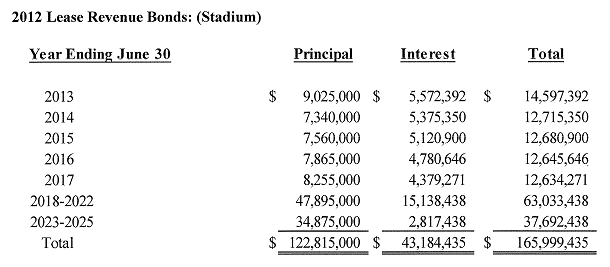
Payment schedule of Coliseum bonds

Payment schedule of Coliseum bonds

Last year the Coliseum JPA sought to refinance the stadium debt in order to switch the debt from variable to fixed rate. New bonds were issued in September.

It can’t be emphasized enough that whatever is planned in the future for the Coliseum, this debt has to be factored in. The City and County will want to repackage the debt in a way that takes the burden away from their respective general funds. Naturally, the A’s and Raiders probably want no part of this, considering how expensive it already is to privately build anything. Even if nothing gets built until 2018, $100 million in debt will remain, making that a sort of tax on any new stadium(s). The JPA is asking the A’s to pay more in rent, reportedly up to $3 million a year. Even then a substantial subsidy will be required. Ultimately, no deal on Coliseum City – no matter the size or scale – will go anywhere unless the outstanding debt at the Coliseum is addressed to all parties’ satisfaction. That’s a challenge as towering as Mt. Davis itself.

—–

Added 11:30 AM – Matier and Ross have an item covering the JPA’s ongoing lease negotiations with the A’s and Raiders. 

The tug-of-war for the five-year extension is over the $3 million in parking taxes that Oakland says the team owes, and over the A’s claim to about a third of the beer sales at the Coliseum – be they at an A’s game, a Raiders game, a U2 concert or any other event.

The tightrope is with the Raiders, who don’t like giving the A’s the beer money and don’t appreciate the A’s request for ballpark “improvements” that may come at the Raiders’ expense.

The parking tax referred to in the piece dates back to 2009, when Oakland unilaterally decided to enforce a long-dormant 18.75% tax per car at the Coliseum. The A’s hiked up parking fees from $15 to $17, and the price stayed there ever since. However, the A’s sat on the additional revenue while other details shook out, such as a revenue split between Oakland and Alameda County that was only settled last year. Assuming that a 2014-18 (or longer) lease extension can be worked out, the parking tax would be yet another detail to negotiate. The beer revenue split goes back to when the A’s sued the Coliseum Authority and received lease concessions, including a split on pouring rights for all events and some advertising revenues. As for the baseball-specific improvements that the Raiders may be resisting, I’m not clear on those. I’ll try to dig that up. All I know at the moment is that Lew Wolff has wanted an escape clause if the Coliseum undergoes changes for the Raiders. 

Finally, M&R end on a vague note – MLB might look favorably on Oakland if a short-term deal can be worked with Wolff/Fisher or “a new set of local owners”. Perhaps, but let’s be clear on a couple of things. First, even if Wolff were to declare today that the he and John Fisher were putting the team up for sale, the actual process to vet prospective bidders (such as a Don Knauss & Co. bid) and then complete the sale would take the better part of a year or more to complete, which is of no help to the A’s immediately as they try to work out a short-term extension. Second, MLB won’t approve a sale to an East Bay-focused group unless there is an ironclad ballpark deal in place. Otherwise there’s no point because the A’s would remain revenue sharing recipients indefinitely, even though it’s written into the CBA that they’re supposed to be off revenue sharing in the next several years. Third, MLB has offered to insert itself into the lease discussions, only to be told no by Wolff. Wolff’s making a leverage play here. He did well in getting a ton of flexibility in the last two lease negotiations. This time, talks are sure to be more rancorous. If MLB wants to float a feel good item to help soften up the JPA, I’m sure Wolff won’t mind. Finally, there’s the issue that appearing to help the A’s and MLB may send the wrong message to the Raiders, who are the only team directly working with the JPA and Oakland at the moment. It’s a very fragile, fluid situation. No one said it’d be easy.