News for 1/17/12

Today I did an TV interview on Get Real with Brian Stuckey, a show produced out of CreaTV San Jose. CreaTV is a non-profit to whom Comcast has farmed out all of their public access programming for much of the South Bay. The segment will air January 30 on Comcast channel 15 with a web stream simulcast, so my ugly mug won’t show up until then. I doubt anything will have fundamentally changed by then, but you never know.

On to the news.

  • Matier and Ross report that nothing official happened on the A’s-to-San Jose front. That’s true at least when it comes to making a decision or coming to a compromise plan. We set those expectations going into the owners meetings. Yet background work did occur, including the presentation to the executive committee and Selig’s statement that the A’s are now on the front burner. Write that off all you want, it’s movement that wasn’t happening six, nine, twelve months ago. Remember that as incalcitrant the Giants are, there’s always the threat of binding arbitration to force the Giants’ hand. Commissioner Selig won’t give San Jose a greenlight for a vote (for either MLB owners or the city referendum) unless the Giants drop their lawsuit, making the legal action the last real weapon in the Giants’ arsenal to block the A’s efforts.
  • While the Giants are doing everything possible to stop A’s ownership, they’re actively encouraging new arena deals. We all know about their overtures towards the Warriors. Yesterday, Larry Baer gave a pep talk to Sacramento civic leaders pushing for a new downtown Kings arena. Baer said that after four defeats at the ballot box, the effort to get a ballpark going was “worth the fight.” I imagine that Lew Wolff feels the exact same way, Larry.

“It can be done, don’t give up,” Baer said. “You must persevere, you must exercise patience, you must have strong leadership in the private and public sector.”

When a man’s right, he’s right.

  • While the Oakland-only crowd was eager to jump on a graf in the M&R report, they buried the lead: Thanks to the death of redevelopment, the City of Oakland will have to cut 200 jobs and hand out 1,500 pink slips. The Mayor and City Council may also have to take huge cuts in pay on top of cuts already taken last year. How does this affect San Jose? Not that much, since as of the end of 2011 there were only about 10-12 people left in SJRA, with budget cuts and changes already enacted. Not that San Jose actually anticipated the change. SJRA’s fiscal issues forced it shut down early.
  • Less than three months from the opening of the Marlins Ballpark in Miami, and there’s no solution for funding transit options that can bring fans from downtown or the nearest Metrorail (BART-like) station.
  • The Cubs are replacing their right field bleacher section with a Green Monster Seats-style party deck, fronted by one of those new-fangled LED scoreboards.
  • Santa Clara’s City Attorney declared a petition effort by 49er stadium opponents illegal. That doesn’t mean the opponents can’t sue. We’ll see if they have the resources to sue for the right. We’ve seen this happen before.

On a lighter note – since Jeffrey and I will both be at FanFest, would any readers like to do a meetup? Not exactly sure of where we could do it, we can talk through the details.

Somebody needs to fix the LGO website

Update 8:54 PM – Doug Boxer sent me a note saying that the Let’s Go Oakland website is now back up properly with the graphics and style sheets in tow. Apparently some servers were moved recently and… you know what can happen when you move servers.

Friday while I was doing some site maintenance, I did my occasional check of the links in the sidebar. When I clicked on the Let’s Go Oakland website I saw this:

Something's missing here.

What happened to the colorful background graphic? The Facebook link? The petition form still seems to work, so it’s not as if the site is broken. I don’t get it. Can someone explain what happened?

How the environmental process hurts design

On the northwest corner of West Santa Clara Street and North San Pedro Street in downtown San Jose, Baseball San Jose put up a series of Cisco Field renderings, many of which you’ve already seen. The renderings are blown up to poster size, which allows people to study them for details that may not be readily apparent when viewing small versions in a browser.

Cisco Field as it hugs Autumn Parkway

The aerial view above may be my favorite simply because it fully displays the one distinctive architectural element of the ballpark, the “colonnade” along Autumn Parkway. Maybe the colonnade was designed to integrate the ballpark with the rest of the neighborhood. Thing is, there is no semblance of a neighborhood along this block of Autumn, which is populated by nondescript office buildings and an auto parts store-turned-marijuana dispensary. It’s possible that the colonnade was not borne of some desire to create a snaking, thin colonnade structure. It may have been the product of designing to reduce the visual impact of the stadium. Light will be able to go right through the structure from inside the stadium to the street (and vice-versa), which should in theory make the structure less imposing from the outside. That, coupled with the lower profile of a smaller, double-deck seating bowl, makes Cisco Field the least imposing ballpark since Fenway Park.

As I studied the renderings for the umpteenth time, I couldn’t help but wonder if the CEQA process, which governs all environmental review in the state, artificially constrained the design. When 360 architecture was commissioned to design the ballpark by A’s ownership, they were already dealing with a number of major constraints:

  • An irregularly shaped lot, which could limit the ballpark’s size and field dimensions
  • FAA restrictions on building height
  • Uniform code and standards on setbacks (for sidewalks and such)
  • Budget limitations
  • A desire by civic leaders for a large entry plaza, preferably in the outfield

That’s a lot to design around and come up with something cohesive, which to 360’s credit they’ve done an amazing job conceiving. I still wonder if something more distinctive is possible. In my interview with Lew Wolff, he intimated that the design, which is largely coming from John Fisher, could be moreso. My untrained eye and lack of imagination can’t see where the change can happen other than some façade treatments and cladding, which has given many of the HOK/Populous brick ballparks their faux monolithic look. I think 360 and the A’s can do better.

A place like San Jose, with its many short buildings dating from the 50’s forward, is architecturally drab. Sink Combs Dethlefs was only partly successful in evoking trains via HP Pavilion’s steel siding. The way light shimmers off the panels is beautiful at night and in twilight, during the day it looks a uniformly dull gray. In downtown there are very few truly interesting buildings, except for some built largely with public money such as the Rep, Tech Museum, and Children’s Discovery Museum. Even the latter two were tamed after recently deceased Mexican architect Ricardo Legorreta ran into a brick wall regarding the lively color palette he wanted to use for those buildings. As hearing after hearing, committee after committee waters down vision into a muddled mess, what citizens are left with is something more utilitarian in feel than imaginative. That’s a shame because it only furthers the perception that San Jose is a sleepy, uninspiring place.

If you’re looking for something more imposing at Cisco Field, a brick façade covers the walls behind the seating bowl. It matches well with the long Plant 51 building on the other side of the railroad tracks. Plant 51 was formerly a Del Monte cannery which has been repurposed into lofts and condos.

Pre-existing Plant 51 brick exterior with additional levels in a recessed, modern treatment. Caltrain is on the other side of the wall to the left.

You might think that in the above picture, the upper two levels were photoshopped onto the lower levels. It’s every bit real, and done to reduce the impact of the modern additions compared to the historic original building. The whole lacks unity and despite the intent, does little to preserve the integrity of the building. For me, it actually makes the building weaker.

Panoramic view towards downtown from a townhouse in Cahill Park. Cisco Field's brick façade would fill right half.

With redevelopment dead and its powers significantly curtailed, there are now fewer chances to create bold architecture other than in the private sector. I’m not asking for a Bird’s Nest here, the proportions and size of the stadium won’t allow for that. There is room for something bold and beautiful at Diridon. Aspirational should be achievable. If bold is good enough for the Fishers’ SFMOMA expansion, it’s good enough for Cisco Field.

Mesa deal closer, San Jose deal not

Update 11:00 PM – Mark Purdy has a recap of today’s “events”.

MLB.com’s Barry M. Bloom reports that while Commissioner Bud Selig’s three-man panel made a presentation to the Executive Council today, there was nothing new to report on the Oakland/San Jose situation. The panel has presented information at different intervals, so this is no surprise. However, remember that everything comes from the top down: panel presents to Executive Committee, then the issue (probably) goes to the Relocation Committee, then to all of the owners for a vote (if it gets that far).

Spring training homes have no expressed territorial rights, so Lew Wolff’s efforts to put together a deal with Mesa at HoHokam Stadium continue unabated. According to Bloom, improvements to Hohokam would cost $10-15 million, with the city footing 60% of the bill and the A’s 40%. I look forward to seeing the plans, and will dissect them as you’d expect me to when the time comes.

News for 1/10/12

Didn’t expect to have so much news this week, and it’s only Tuesday. Here we go.

  • MLB Commissioner Bud Selig is expected to accept a two-year extension to his current term, which expires after the 2012 season. If Selig looks at the A’s as unfinished business, then it’s good he’s staying on instead of throwing the A’s over the fence for the next commissioner.
  • U.S. Department of Transportation officials were expected today to recommend $900 million in federal matching funds for the BART-to-Silicon Valley Phase I extension, which would terminate at the San Jose Flea Market. The decision would then move to Congress to approve, which was characterized by Gary Richards as a “formality”.
  • During the Raiders press conference introducing new GM Reggie McKenzie, team owner Mark Davis fielded a few questions about the stadium situation. He maintained a similar stance to his father about stadium prospects: “We’re going to try to get something done here (in Oakland) but if we can’t we have to get something done somewhere.” Oakland, Santa Clara, and LA are under consideration, without Davis committing to any specific site. The hiring of McKenzie will allow Davis to focus on the stadium search. One thing I took away from the presser: Mark Davis is committed to owning the team in the long run and considers it his family.
  • Oracle is opening a new office in downtown San Jose, in the same building as accounting firm PriceWaterhouseCoopers. The office could have 265-440 employees. Oracle owns the building as part of its acquisition of BEA Systems.
  • SF Planning Commissioner Mike Antonini has been working with architecture firm HKS (Rangers Ballpark, Miller Park) and a financial services firm who could provide up to $600 million for the forlorn 49ers Hunters Point stadium project. Antonini is trying to raise $1 million from private sources to complete a study.
  • Oakland’s City Council is discussing (right now!) how to deal with the end of redevelopment. There is talk about a successor agency, which would be very limited in scope (affordable housing mostly). Oakland North has an excellent infographic explaining where the redevelopment budget goes. Oakland appears to have two choices: A) allow the successor agency to be created but not with enough money to properly operate, or B) let it expire completely and lose all control or powers normally attributed to redevelopment agencies. They have until Friday to make their decision.

More as it comes. Owners meetings start tomorrow, with the A’s not on the agenda. The Merc’s Tracy Seipel has an overview of the current situation.

Poole gets it terribly, horribly wrong

Monte Poole has written yet another screed about Lew Wolff and John Fisher. Three questions about this: 1) Would Poole be writing this if the Raiders had made the playoffs, giving him something to write about?, 2) Couldn’t he have bothered to ask Wolff about this?, and 3) Is Poole now tasked with the now-retired Dave Newhouse’s role as chief ownership critic?

Apparently the answer to the first two of those questions is a resounding NO. Poole’s grievous error comes down to this:

Months prior to taking co-ownership, while working as the A’s executive hired to find a suitable yard, Wolff proposed a “ballpark village” on land north of the current site. That’s rich. He realized such a project would require relocating 60 to 80 businesses. And, by the way, Wolff added that this village would require the creation of a new BART station, this one between the Coliseum and Fruitvale stations.

That was their pitch to Oakland. Judge for yourself the goodness of the faith within.

Meanwhile, Wolff said zilch about the land to the south, from the stadium perimeter through the parking lot and out to Hegenberger Road. There’s a Denny’s not much else, other than plenty of space, mostly paved.

Amazing how only a few years can bend someone’s memory. Here’s what really happened:

  • When he was working for Steve Schott and Ken Hofmann, Wolff suggested looking at the HomeBase site (a.k.a. “Coliseum South”). They wanted to split the cost on a $500k feasibility study there, with the Coliseum Authority (JPA) paying the other half. The Authority declined to pay for their share, and the idea died.
  • Wolff did not present the 66th-High “Coliseum North” concept until August 2005, five months after he took control of the franchise.
  • For whatever reason, even though Larry Reid and others from Oakland considered Coliseum South a possibility after Coliseum North collapsed, no one pursued the option.
  • The Coliseum eventually bought the property in 2010 years after HomeBase was destroyed in a fire, dedicating the land to a Raiders stadium redevelopment project.

All Poole needed to do was call or email Wolff. Or Guy Saperstein. Is it that hard? I suppose it is.

Mark Purdy gets a lot more of the history right, though he fails to include the Oakland/East Bay ballpark study of 2001.

Oakland focuses on EB-5 program to replace redevelopment funding

We now know how Oakland will replace all of those lost redevelopment dollars: Foreigners! At least that’s the program according to today’s Trib report by Angela Woodall.

Before I go further, I have to give credit to Oakland Mayor Jean Quan for going this route. It has some potential, and it’s something that we’ve discussed on the blog previously as it pertains to a foreign investment in a new Sacramento Kings arena. While it’s unfortunate that neither she nor the City Council have had the “adult conversation” I argued for in the post, at least Oakland’s been resourceful enough to identify a path forward.

It makes sense for Oakland to look for creative, out-of-the-box methods to attract investment to the City, and the federal government’s EB-5 program is one of them. Quan has gone to China to look for investors, and may be onto something with EB-5. The program allows immigrants a green card if they put $1 million or more into a new or “troubled” American businesses. Investors also have to create 10 full-time jobs with each application. That money requirement goes down to $500,000 in the case of rural or high unemployment areas, Oakland being one of the latter. Pool enough of these together and a company may have enough capital to move forward.

The Bay Area Regional Center is a government-certified investment firm whose charter is to bring in foreign investment under the EB-5 program. Its service area is most of the Bay Area and Sacramento. Yet the projects it identifies as most ready for investment are three in Oakland. That’s not surprising because BARC is based in Jack London Square, with one of its principals being Oakland developer Jim Falaschi. In fact, BARC is trying to bring in nearly $70 million for Signature’s stalled Oak-to-9th project. (Signature is also trying to get Lawrence Berkeley Laboratory to build its next campus there too.) The Trib article notes that BARC was involved in the $8 million Tribune Tower deal, though records of actual foreign investment in the project are murky. An admission that BARC “is still looking” for a project 2 1/2 years after opening, while honest, is not encouraging.

That’s not to say that EB-5 programs don’t attract investment. Chinese investors put $249 million into the Atlantic Yards project in Brooklyn, though that money didn’t go directly into the Barclays Center arena. According to Bloomberg Businessweek, $1.5 billion has come into the U.S. from foreign investors through EB-5. Like any government program, it’s rife with bureaucratic delay. Applications have often taken months to process. One report this week indicates there are some kinks to work out as the program grows. It can be difficult for foreign investors to separate the good investments from the poor ones based on sales pitches from needy businesses who could easily inflate their projects’ potential.

As cities start to look for alternate avenues for investment, the market for foreign investment will start to get competitive. For Oakland, the biggest issue may be, well, Oakland. Foreigners can understand investing in New York, Los Angeles, or San Francisco. They also get things like ski resorts or wineries. Oakland, for obvious reasons, is a tougher sell. It’s possible that Oakland will need to claim multiple success stories before they can attract enough investors for a major project like Coliseum City. There’s still the problem of getting team owners and leagues to buy in. They’re the head while the foreign investors are the tail. Every application is an investment, not just $500k for a green card. It’s going to take a lot of selling – and even more believing – for Oakland to pull off major funding with EB-5. Or as economist Scott Barnhart, writing for EB5info, wrote in response to a NY Times editorial:

For example, if the 34 floor tower typically used for retail, office space and/or residential purposes did not qualify in New York, one can be assured that states with the highest unemployment levels are not likely close substitutes for a Manhattan address for either the developer or prospective investors, so this project would likely be shelved. Similarly, a large condominium in Florida will not sell if located in a high unemployment area away from the coast instead of a lower unemployment area on the coast, yet the labor will be imported to the site.

There’s a reason why O29 isn’t taking off. And it’s the same reason why Victory Court and Coliseum City probably won’t take off either. It’s still worth a shot, at least from the City’s perspective.

Finally, the EB-5 program is limited to 10,000 approved visas per year, potentially limiting investment. Compared to going the regular (and now shuttered) redevelopment route with its self-contained process, EB-5, with all of its marketing, multiple stakeholders, and delay, may be tantamount to climbing Mt. Everest.

.

To read more about EB-5, check out the EB5news site and Twitter feed, and EB5info.

Unintentional funny of the week

There’s a podcast called A’s Fan Radio which I listen to once in a while. I try to catch as many as I can: Athletics After Dark and the new Tarp Talk being two others. A’s Fan Radio is not bad when they’re covering on-field stuff. As for the off-field and business stuff, I mostly tune into AFR because of the sheer unintentional comedy (warning: explicit language) of it all.

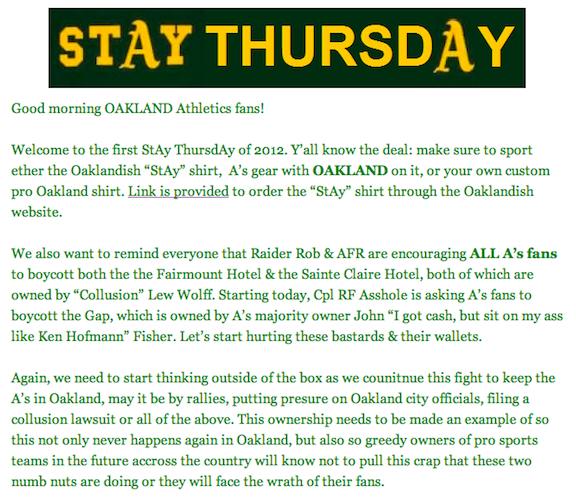
Perhaps the best moment in the short history of A’s Fan Radio came Thursday, when the siterunners asked A’s fans to boycott various businesses owned (or not owned) by Lew Wolff, John Fisher, and company. Here’s the hearty request:

stay-thursday

Surely there’s a meme that could come from this.

There is one GAP store in Oakland, so the boycott there might have some effect. At least it might draw attention. Then there’s the request to boycott the “Fairmount Hotel” and “Sainte Claire Hotel.” The Hotel Sainte Claire recently received some pub for being bought by a coalition including the Wolff family. The “Fairmount” is obviously a misspelling of the Fairmont chain, which has the flagship in San Francisco and another location in San Jose. Surely they can’t be referring to the Fairmount Apartments in Portland, which were converted from a hotel, or the 37-room Fairmount Hotel in San Antonio. That hotel is so cute it has its own dog mascot, Luke Tips, who greets guests and can be requested to stay in a guest room if a guest is lonesome for his/her dog at home (huge thumbs up from me in that regard).

Go ahead. Boycott this. I dare you.

Then again, maybe efforts would be better focused on “putting pressure on Oakland city officials” because when you look back on everything that’s happened related to retaining teams over the last year, it’s clearly evident that the nonexistent effort to keep the A’s in town is related to the nonexistent pressure to keep the A’s in town. As for filing a collusion lawsuit, there are plenty of lawyers affiliated with Let’s Go Oakland. Maybe one of them could take it up. I’m sure the Giants will be happy to pitch in. On second thought, that might come off as collusive.

Chances are that these boycott attempts will have the same effect as most ill-conceived boycotts: zero. After all, there’s no Fairmont or Sainte Claire in Oakland, and many of the Oakland-only crowd claim that there are very few A’s fans in the South Bay, so how much of an impact could it possibly have? Nevermind that most of the guests are out-of-town business travelers who have no clue who owns the hotels. Prove your point and hurt those bastards! And their wallets! Good luck. Oh, and make sure to wear your shirt for maximum impact. Yeah, that’s it. Try this on for size:

#OccupyColiseum

An article with actual substance is due later today. Until then, enjoy your Friday.

P.S. Having an elephant take “batting practice” at the Marlins Stadium is so not cool.

KQED Forum talks franchises

Last week I got a call from the folks at KQED’s Forum program to see if I’d be interested in being on today’s show. Then yesterday, I received word that their panel was full so I wouldn’t be needed for the show. That’s just as well, because it was a pretty good show hosted by Joshua Johnson and with guests Susan Slusser, Mark Purdy, and Glenn Dickey. Giants CEO Larry Baer also chimes in later in the hour. If you haven’t listened to it yet, do so. Below are the embedded player and an MP3 link.

MP3 Audio

A couple of observations:

  • Purdy mentioned that he talked to sources on the MLB panel. According to them, the Giants’ contractually are not tied to South Bay territorial rights.
  • Baer is content with a two-team market as long as the market definitions stay as is. Pressed on what defines the South Bay, Baer hemmed and hawed, finally mumbling that it includes San Mateo and Santa Clara Counties. He also talked Warriors, saying that he’s going along with the process to evaluate options in both Oakland and San Francisco.
  • The 49ers and the potential for a new referendum on the revised stadium deal were discussed, especially by callers. I don’t think there’s enough political will to make that happen, but you never know.

I need to do a full relisten to see if there’s anything else, as I didn’t bother to take notes.

Will reason win out?

In light of the big redevelopment news, it might be easy to forget that there was plenty of other news from earlier in the week. Susan Slusser’s article featuring Peter Magowan had a poll attached. Normally I don’t bother with polls (notice how there haven’t been any on this site for a long time). In this case the poll had over 2,000 respondents, plus the question and responses were well-phrased, so I’ve been following the results (it’s still up if you haven’t voted).

Results as of 12/30, approximately 11:00 AM

The three camps are pretty well delineated: the pragmatists/realists, the Giants-only crowd, and Oakland holdouts. At this point, the pragmatists hold a sizable lead over everyone else, albeit a plurality, not a majority. The holdouts are in the Quan position, though there’s no instant runoff here. And the SF-only voters simply need to have some sense knocked into them because they’re greedy dickheads.

Sure, there are a lot of people in the leading group who are not actually pragmatic, they’re really pro-San Jose. Many are longtime A’s fans, many are not. I can tell you that most of the people I correspond with are silent majority types – they are overly vocal or passionate about either San Jose or Oakland. They just want this whole ordeal sorted out so they can get back to cheering on the green and gold. The real danger is in losing a large percentage of these fans to apathy or disgust. At Mayor Quan’s press conference, Doug Boxer told me that among the parties working to move or keep the team, there is no one with clean hands, which is absolutely correct. It’s all this out-in-the-open maneuvering – done by A’s ownership, Giants ownership, and the cities – that is chipping away at the fanbase.

Do the owners of either team care? Obviously not, as ends justify means here for whomever wins. The cities? Sure, insofar as they’re buddying up with business and civic leaders, not so much citizens. I’ve mentioned before that the Athletics-Oakland saga is akin to a divorce, so it was going to get messy. Signs are pointing to some kind of resolution soon. After that, the big issue will be dealing with the mess all of this has created. It may take an entire generation to wash the stink out of this.

I don’t have children, but a lot of the regulars here have multiple kids that they’re raising as A’s fans. I want there to be an A’s in the Bay Area for those kids as much as for myself. That’s why I keep doing this. Compared to everything else that’s happening in the world it’s beyond trivial, I know. The A’s are still a big part of the community, and of my life. Hopefully 2012 will mark an end to the politics, one way or another. Here’s to hope. Catch you next year.