Albatross

When the season starts and you notice the A’s-themed tarps that will stay up the entire year except when replaced by Raiders-themed tarps, remember this:
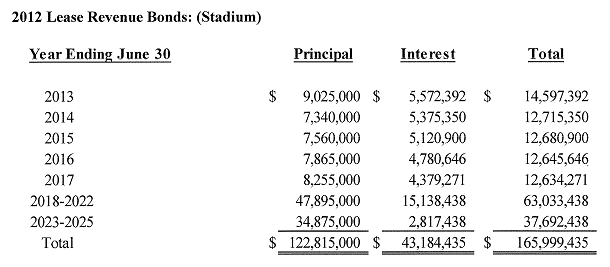
Payment schedule of Coliseum bonds

Payment schedule of Coliseum bonds

Last year the Coliseum JPA sought to refinance the stadium debt in order to switch the debt from variable to fixed rate. New bonds were issued in September.

It can’t be emphasized enough that whatever is planned in the future for the Coliseum, this debt has to be factored in. The City and County will want to repackage the debt in a way that takes the burden away from their respective general funds. Naturally, the A’s and Raiders probably want no part of this, considering how expensive it already is to privately build anything. Even if nothing gets built until 2018, $100 million in debt will remain, making that a sort of tax on any new stadium(s). The JPA is asking the A’s to pay more in rent, reportedly up to $3 million a year. Even then a substantial subsidy will be required. Ultimately, no deal on Coliseum City – no matter the size or scale – will go anywhere unless the outstanding debt at the Coliseum is addressed to all parties’ satisfaction. That’s a challenge as towering as Mt. Davis itself.

—–

Added 11:30 AM – Matier and Ross have an item covering the JPA’s ongoing lease negotiations with the A’s and Raiders. 

The tug-of-war for the five-year extension is over the $3 million in parking taxes that Oakland says the team owes, and over the A’s claim to about a third of the beer sales at the Coliseum – be they at an A’s game, a Raiders game, a U2 concert or any other event.

The tightrope is with the Raiders, who don’t like giving the A’s the beer money and don’t appreciate the A’s request for ballpark “improvements” that may come at the Raiders’ expense.

The parking tax referred to in the piece dates back to 2009, when Oakland unilaterally decided to enforce a long-dormant 18.75% tax per car at the Coliseum. The A’s hiked up parking fees from $15 to $17, and the price stayed there ever since. However, the A’s sat on the additional revenue while other details shook out, such as a revenue split between Oakland and Alameda County that was only settled last year. Assuming that a 2014-18 (or longer) lease extension can be worked out, the parking tax would be yet another detail to negotiate. The beer revenue split goes back to when the A’s sued the Coliseum Authority and received lease concessions, including a split on pouring rights for all events and some advertising revenues. As for the baseball-specific improvements that the Raiders may be resisting, I’m not clear on those. I’ll try to dig that up. All I know at the moment is that Lew Wolff has wanted an escape clause if the Coliseum undergoes changes for the Raiders. 

Finally, M&R end on a vague note – MLB might look favorably on Oakland if a short-term deal can be worked with Wolff/Fisher or “a new set of local owners”. Perhaps, but let’s be clear on a couple of things. First, even if Wolff were to declare today that the he and John Fisher were putting the team up for sale, the actual process to vet prospective bidders (such as a Don Knauss & Co. bid) and then complete the sale would take the better part of a year or more to complete, which is of no help to the A’s immediately as they try to work out a short-term extension. Second, MLB won’t approve a sale to an East Bay-focused group unless there is an ironclad ballpark deal in place. Otherwise there’s no point because the A’s would remain revenue sharing recipients indefinitely, even though it’s written into the CBA that they’re supposed to be off revenue sharing in the next several years. Third, MLB has offered to insert itself into the lease discussions, only to be told no by Wolff. Wolff’s making a leverage play here. He did well in getting a ton of flexibility in the last two lease negotiations. This time, talks are sure to be more rancorous. If MLB wants to float a feel good item to help soften up the JPA, I’m sure Wolff won’t mind. Finally, there’s the issue that appearing to help the A’s and MLB may send the wrong message to the Raiders, who are the only team directly working with the JPA and Oakland at the moment. It’s a very fragile, fluid situation. No one said it’d be easy.

Stern goes Mutombo on Mastrov bid, rules out expansion in Bay Area

NBA commissioner David Stern made a trip out to Oakland to talk up the Warriors as a “model franchise” and the team’s trip next fall to China, where they’ll play preseason games against the Lakers. Stern’s event had another large contingent of media from Sacramento, who wanted to hear Stern’s take on last week’s bid to save the Kings by Mark Mastrov and company. NBA Commissioner David Stern says Sacramento bid is “not quite there” financially compared to Seattle. He’s hopeful it will be eventually. To ensure that Sacramento lines up its (final?) bid properly, the NBA will hold a meeting on April 3 so that everyone has their ducks in a row in advance of the Board of Governors meetings on April 12-13.

That, folks, marks the end of the short period of Stern as bystanding non-arbiter. In case anyone thought that this was about anything other than getting the biggest, best bid possible for the sale of the Kings, it isn’t. The owners want to see their franchise values grow. If the McCourt disaster did it for baseball franchises, the Maloof debacle could certainly do it for hoops. Earlier this week a rumor was floated that the Hansen-Ballmer group might have to pay a $75 million relocation fee, instead of an amount closer to the $30 million Clay Bennett paid to move the Sonics to Oklahoma City. The owners want their piece, and David Stern’s last major effort as the commissioner will be to facilitate that. The man has played the whole thing perfectly. Now, the NBA and the bidders have kept the details close to their respective vests, so we can’t say for certain how low the bid was or how much it needs to be raised. I know this much: Mastrov put in a $420 million bid for the Warriors nearly three years ago. Stern and the owners know that Mastrov can raise capital, whether they’re bidding for 100% or 65% of the Kings. Fortunately for the Sacramento bid, there’s a few weeks left to raise the bid. Now it’s a lot like competing bids for a house in a seller’s market. The best offer with the most cash wins. You know what they say on the court: Come strong or don’t come at all.

Stern was also asked about the chances of a second Bay Area team coming via expansion if the Kings left, and he swatted that notion away. Stern left it to the Board of Governors (owners) and his successor to wrestle with that concept.

“I don’t think that we’re in for expansion of the league, any time soon. That’s just the way it is. … There are no territorial rights barriers. The only barrier is a vote by the NBA’s Board of Governors, but they’re being convened to consider the application to sell the Kings and to move the Kings.”

There’s no incentive to entertain talk of expansion as long as this bidding war – and it is indeed a bidding war – is on. Maybe after April the NBA and the losing city/bidder can talk about a framework to get an expansion or future relocated team. Chances are that even then, that losing city/bidder will be left to lick their wounds, and if it’s Sacramento/Mastrov, after having being on the losing end twice (last year for Sac when the Maloofs reneged, Mastrov in 2010 with the W’s), everyone may want to take some time to determine how much effort they want to put into this yet again. There’s just as much emotion that goes into these efforts as there is money.

I’ve thought that the horse race mentality that some of the Seattle and Sacramento partisans recently have taken on was silly, but this news  certainly makes the proceedings feel like a horse race. One of these cities will have a lot of broken hearts in early April.

Big fish, small pond (and vice-versa)

USA Today NBA writer Sam Amick has a 2-for-1 today in the form of a solid interview with USC Sports Business Institute’s David Carter prefaced by a recap of the ongoing Seattle-vs.-Sacramento drama. Carter tries to get to the heart of the issue facing NBA owners next month: Is it better to be the 5th team in a larger market (SEA) or the only team in a smaller market (SAC)? Carter doesn’t take sides, instead choosing to lay out the cases for both. He also expanded the discussion to include the implications of trying to build something in California, where public funding for stadia is difficult to attain. The end of the interview has a response that encapsulates the issues in Sacramento and throughout the state so well that I had to quote it here. (Questions come from Amick, answers from Carter)

Q: I’ve been hearing a few things about the public subsidy coming into play with Sacramento’s offer, potentially around $255 million that they would put into the arena, and the idea that the NBA has concern about walking away from that type of public contribution – especially in California – where it’s so tough to get public contributions. If they walk away from it, they lose a blueprint they’d like to use moving forward. Does that pass your smell test?

A: “That’s a great observation. We’ve seen that with not just teams, but teams and venues throughout the state – from San Diego to obviously now Sacramento. The Bay Area is a good example, and LA has been at the center of it. These leagues want to be able to extract public subsidies, and if they don’t do that then it gives other cities the opportunity to point the finger and say, ‘Well they didn’t kick in tax dollars over there, why should we here?

“If it’s a quality, free-standing business that’s going to be competitive in the marketplace, then it should be able to survive on its own. That would be one side of the argument. The other side of the argument, from these owners – and it’s a good one – is that there are a lot of people who are enjoying our product and not paying directly for it. You have a sense of pride in your city, even if you don’t attend a game or you don’t watch too many of them on television. Someone needs to pay for that externality, for that benefit that the community is getting for having this company in town. You could argue that that subsidy is supposed to cover that benefit people are getting from having the team there. Maybe it’s more of theoretical bump than anything else, but it’s fair to say, ‘What’s Green Bay without the Packers?’ That’s truly a sports company town.

“Maybe if it’s an amenity, or if it’s a resource that a lot of people want and can identify with, then maybe people should be paying for someone living vicariously through their product but not paying for it.”

Take that into your weekend. I’m going to refrain from commenting on it for now, as I’d like to see what responses are elicited first.

Carolina (Panthers) on everyone’s mind

Before you read the rest of this post, head over to Deadspin and read about the Carolina Panthers’ leaked financials from the last two years.

Then read the Charlotte Observer’s piece, which includes a response by the Panthers.

—–

The leaked document came from Deloitte, and there’s nothing to indicate that it’s inaccurate. In fact, the Panthers didn’t deny the report, only saying that the document presented “an incomplete picture” of the team’s profitability. According to the team, the missing context was the uncertainty surrounding the league lockout preceding the 2011 season. It’s not unusual these days for teams to considerably shrink operations during a lockout, establishing a sort of bunker mentality. The consequences can be cruel, as it usually means laying off dozens if not hundreds of “non-essential” personnel. In the Panthers’ case, they decided that they’d be best off reducing player payroll. And so they did with a $77 million roster, $43 million short of the $120 million salary cap set for 2011. Philosophically all of this probably made sense back then, as the team was in rebuilding mode with #1 draft pick Cam Newton and Ron Rivera replacing John Fox at head coach. Newton’s Rookie-of-the-Year campaign juiced the loyal fanbase enough to boost the following year’s payroll to $100 million. Despite that uptick, the Panthers’ record only improved by one win last season. The team finished 3rd in the NFC South, going 7-9. The NFLPA predicts that the 2013 cap will be $123 million.

Carolina Panthers 2011/12 balance sheet from leaked Deloitte & Touche audit

Carolina Panthers 2011/12 balance sheet summary from leaked Deloitte audit

The Panthers are ranked #16 in the Forbes NFL valuations list with an estimated revenue of $269 million for the 2012 season and a valuation of just over $1 billion. Not knowing Forbes’ exact formula and numbers, I imagine that the discrepancy is mostly a matter of accounting, depending on whether partner distributions (profit-taking) and other maneuvers with team revenue are counted. Distributions amounted to $12,228,541 for both years, or roughly a 6% return on the original $206 million franchise price. That leaves a rather large net income amount that they can do whatever they want with.

One of those things they can do with the money is fund the improvements they are requesting for Bank of America Stadium. You may remember that a month ago, the team struck a deal with the City of Charlotte and Mecklenburg County for a package of improvements that would total $300 million. This week the state balked at giving the share it was expected to provide ($62.5 million), and the leak certainly won’t help Panthers owner Jerry Richardson’s case for a handout. It’ll be interesting to see if new pressure mounts to have the local public funding aspect of the deal reversed, since it’s clear that the team can pay its own way. To do so may require scaling things back a bit, but really, why on earth is $250-300 million necessary for a stadium that’s only 17 years old and is one of the better designed and maintained facilities in the league? The Panthers had expected to pay $96 million of the project cost. If the City/County reneg on their part, Richardson could be forced to scale back the project to, say, half the size and cost at $125 million. That amount in a loan for 25 years at 6% runs $9.3 million per year. With what we’ve learned this week, Richardson and the Panthers can afford it. Of course, this news didn’t come in time before Atlanta officials announced that a deal has been struck for the Falcons’ $1 billion retractable dome plan, which will include $200 million in public funding.

—–

What does this mean for the Raiders? Politically, it’s terrible. Not only will the memory of the Mt. Davis debacle not go away, now comes this news that should cast doubt on any team crying poor and looking for a public handout.

Except for one thing. When the Raiders cry poor, they are in fact, poor. Not poor as in sleeping on the street, but poor in terms of losing money on a regular basis. Forbes noted that the Raiders posted losses last year and in 2009. The Oregon professor consulted by Deadspin for the article, Dennis Howard, mentioned that when he looked at league financials a decade ago, the Raiders lost money then. Considering how bad a deal Mt. Davis has been for all concerned parties, it could be the worst all-around stadium deal in the history of sports. Nevertheless, the fundamentals are that the Raiders continue to come up short in the revenue game in Oakland. Worse, they don’t have the cash reserves or cash flow to bankroll a significant new stadium project. Perhaps they don’t even have enough to fund a revamped Coliseum as I’ve suggested. Season ticket rolls going into the new tarped-off Coliseum were lower than another Raiders team – the Texas Tech Red Raiders, who hit over 30,000 season tickets last year – and that’s an also-ran program in the Big 12.

The NFL is giving the Raiders guidance and the Raiders are taking steps to boost revenue, but as we know in the Bay Area, they’re not going to see big returns unless the team starts winning as it did a decade ago. It’s hard to see how this can be turned around as long as the dependency is there. No wonder the NFL is skittish about earmarking G-4 money for a Raiders stadium project. We know that in the short term the Raiders will have two choices: stay at the Coliseum while working out a venue deal in Oakland, or go to Santa Clara for 5-10 years. I wrote a month ago that the costs could prove prohibitive in Santa Clara if they were to pay for the true cost to stage the games, compared to continuing to get a large subsidy from Oakland/Alameda County. Ultimately, the cheapest option may be for the Raiders to limp along in the Coliseum as is while the parties wait for the fanbase to grow as the team improves. Hopefully, this doesn’t also mean that the A’s will have to keep sharing the Coliseum indefinitely. That’s not something that either the NFL or MLB want.

=====

Added 11:00 AM – Deadspin just completed a reader chat with University of Michigan sports economics professor Rodney Fort. Some of it is good reading.

Farmers Field stalling is a short-term win for Oakland, San Diego

Yahoo! Sports’ Jason Cole wrote last night that the NFL is souring on AEG’s Farmers Field stadium plan for downtown Los Angeles. That may sound revelatory, but in reality the landscape hasn’t changed much since he wrote an article in October 2011 claiming that the NFL doesn’t like AEG’s terms for hosting a team (or two) at Farmers Field. With AEG’s future up in the air pending a possible sale, Farmers Field appears to be stalled. But this was to be expected with the sale, so why is this news? It isn’t. That shouldn’t stop us from trying to understand the NFL’s misgivings.

First, let’s start off with the supposition that Farmers Field is to be operated similarly to Staples Center. AEG wants as many tenants as possible using the stadium, taking up dates on the schedule. It also wants the flexibility to hold non-football events, hence the desire for a retractable dome to make the stadium an enormous exhibit hall for the LA Convention Center. There’s the potential for numerous sports events outside of a regular season NFL slate, such as the Super Bowl, NCAA Final Four or regionals, a bowl game, fights, soccer and rugby matches, plus motocross and monster truck raillies. Add a bunch of conventions and the schedule should be full, right?

The problem is that the Staples Center model isn’t congruent with the uses of a large stadium. Staples is famous for being able to hold two events in a single day thanks to its seating flexibility and existing infrastructure. For football, hosting a game takes a full day, and the Saturday and Monday surrounding a game can be expected to be blocked out because of the time required to install and remove a football field. Since the venue will be positioned to go after the largest, most lucrative events, prep time may not be that big a deal. Still, it’s indicative that the Staples model doesn’t exactly scale.

AEG has advertised for some time that the now-$1.8 billion stadium would be fully privately funded, the most expensive stadium ever built. Assuming that AEG would build the stadium without the benefit of low interest, tax-free bonds, the onus is squarely on AEG and its tenants to ensure that the place is paid for. AEG’s model takes a cut of a team’s stadium revenue instead of requiring a rent payment. AEG has apparently backed off its demands of a percentage interest in any team looking to move to Farmers Field. Either way, they’re getting their money upfront or at the back end. Essentially, AEG is taking the place of a large public subsidy, and unlike municipalities they need to make a profit. That’s understandable for everyone except the NFL and interested owners. Roger Goodell’s memo from last summer detailed the process for any team applying for relocation to LA in 2013, suggesting that two teams call the stadium home in order to defray the cost. Again, that would be compatible with what AEG is looking for, but as long as AEG and the NFL are in a stalemate over the terms of the revenue split, there’s no deal.

A stalemate downtown should create better chances for the other LA stadium plan, Ed Roski’s City of Industry stadium. However, Roski is mired in a dispute with the state over TIF that’s earmarked for $180 million worth of improvements to the undeveloped hillside stadium site. The state says that because the project didn’t finalize contracts and measures that were to be taken to fulfill environmental requirements, the deal doesn’t fall under the category of an “enforceable obligation” and didn’t need to be honored by the state. There’s no reason to think the state will lose that debate, so it’s a mystery how that infrastructure will be paid for.

The NFL is actively looking for other potential partners and stadium sites, pursuing the Dodger Stadium site through Guggenheim Partners and Frank McCourt. A discussed site swap to build a new ballpark downtown and a football stadium at Chavez Ravine seems like even more of a pipe dream due to the complexity and cost. That leaves a few sites in further out locales such as Carson. Roger Goodell would prefer more competition and more lucrative bids before seriously entertaining a franchise relocation or expansion (or both). The problem is that as rich as the LA area is, a stadium is so expensive that if there aren’t enough huge money stakeholders to carry some of the weight, that stadium can be termed in a similar state to so many other Hollywood projects: development hell.

For cities with old or “outdated” stadia and teams trying to get better stadia, LA’s struggles represent a bit of a reprieve. St. Louis, still reeling from arbitrators siding with the Rams, doesn’t need to fear the team pulling up stakes immediately. San Diego area interests can go back to working on yet another stadium proposal. And the Raiders and Oakland/Alameda County can continue to try to get on the same page. For the Oakland/Alameda County, the impact is different. If a retractable dome/convention center concept doesn’t work in LA due to the cost, why would it work in Oakland? AEG already operates the Coliseum complex, and if they were to partner on this they’d want the same deal in Oakland that they were offering in LA. If anything, this development is great for the Raiders since they can try to shift the discussion to a new outdoor stadium, which is what they and the NFL really want. The financing part is still severely problematic, but at least the parties could hone in on a singular vision they could all agree on moving forward. The big question is whether the public side (Oak/AC) decides the most cost-effective option is a renovated Coliseum as opposed to an entirely new stadium. If so, they’re all back at square one.

Mesa approves A’s Hohokam deal

Update 8:40 PM – According to KJZZ’s Dennis Lambert, the Mesa City Council approved the deal. See y’all in Mesa in 2015!

Original post:

At tonight’s Mesa City Council meeting (can’t get enough of city council meetings), item 13-1321 on the agenda is simply thus:

Resolution – Approving and authorizing the City Manager to execute a Facilities Use Agreement with The Athletics Investment Group LLC, for use of Hohokam Stadium and Fitch Park as their Spring Training facilities.

The link above also has attachments so that you can say what’s under consideration. According to the East Valley Tribune, a Study Session was held last Thursday to go over the details. $8.2 million in funding from the Arizona Sports and Tourism Authority was approved and accepted last month, though the Hohokam renovations project will have to wait in line to receive the funding. We’ve talked about that funding mechanism and the improvements planned for Hohokam Stadium and Fitch Park in previous posts.

What will the A’s get for the roughly $20 million being spent? Exhibit B has the laundry list:

    HOHOKAM PARK
    EXHIBIT B FACILITIES IMPROVEMENTS

  1. RECONFIGURE OUTFIELD FENCE
  2. REPLACE INFIELD MIX & RESOD MAIN FIELD
  3. REPAIR EXISTING SECURITY FENCE & SUNSCREEN
  4. REPLACE FENCE/RAIL PADDING & PAINT FIELD WALLS
  5. RAISE & REPLACE DUGOUT BENCHES
  6. PAINT INTERIOR OF STADIUM BOWL & DUGOUTS
  7. PAINT ALL STEEL BOWL COL, BEAMS, SUNSCREEN
  8. PAINT EXTERIOR OF STADIUM
  9. PAINT & CARPET BROADCAST & OFFICES ADJACENT TO SKYBOXES
  10. PAINT INTERIOR OF CONCOURSE AREAS
  11. TEAM SHOP RENOVATIONS
  12. EXPAND PLAYER’S & COACH’S PARKING LOT
  13. ADD SKYBOX
  14. CARPET AND PAINT EXISTING OFFICES
  15. PAINT INTERIOR & EXTERIOR OF EXISTING MAINTENANCE BUILDING
  16. EXTEND OUTDOOR PATIO DECK AT TEAM SUITE
  17. OUTDOOR PAVILIONS AT RIGHT & LEFT FIELDS
  18. CONCRETE PATCHING & EPOXY COATING
  19. ASSESS GENERAL & FIELD LIGHTING & SOUND SYSTEMS
  20. ASSESS MECHANICAL SYSTEMS
  21. ASSESS ALL LOW VOLTAGE SPECIAL SYSTEMS
  22. NEW FIBER OPTICS AND CAMERAS
  23. STADIUM SIGNAGE ALLOWANCE
  24. NEW OAKLAND A’S MONUMENT ENTRY SIGN
  25. NEW TEAM ID 3D SIGN IN OUTFIELD
  26. OUTFIELD CONCRETE PATH
  27. NEW FAN BULLPEN AREA
  28. NEW FLAG COURT
  29. ADD MORE PRACTICE BULL PENS & EXPAND ROOF
  30. TAIL-GATE PATIO
  31. EXPAND LANDSCAPING AT OUTFIELD & BALLPARK FAÇADE
  32. GROTO (sic) BAR & SCOREBOARD W/GREEN ROOF
  33. FOOD TRUCK ACCESS ROAD
  34. REPLACE/ADD WINDSCREEN AT PRACTICE FIELDS
  35. REPLACE INFIELD MIX/SOD PRACTICE FIELDS
  36. NEW WIDER ENTRANCE AT EAST MAINTENANCE FOR BUSSES
  37. ASSESS BATTING CAGE LIGHTING, NETTING, ETC.
  38. NEW ID SIGNS ON TOP OF BATTER’S EYE
  39. RELOCATE HALF FIELD 35′ TO EAST
  40. REPLACE RIGHT FIELD BLEACHERS
    FITCH PARK

  1. RENOVATE & EXPAND EXISTING CLUB HOUSE
  2. PAINT EXTERIOR OF ALL EXISTING BUILDINGS
  3. RENOVATE OBSERVATION TOWER
  4. REPAIR OR REPLACE OUTFIELD WALL PADDING, SCREENING, & FENCING
  5. UPDATE BATTERS EYE SCREEN & FENCING
  6. GENERAL PATCHING & EPOXY COATING WORK
  7. FIBER OPTIC CABLING & CAMERAS TO FIELD & CAGES
  8. ASSESS ALL LOW VOLTAGE SYSTEMS
  9. ASSESS EXISTING MECHANICAL SYSTEMS
  10. NEW WAYFINDING, ENTRY, ID, & SPECIALTY SIGNAGE
  11. RENOVATE & PAINT EXISTING MAINTENANCE FAC.
  12. PROVIDE PHONE & INTERNET-TECH UPGRADES
  13. ASSESS FIELD LIGHTING – POOR LIGHTING
  14. REMOVE 10″, REPLACE SOD & INFIELD MIX – ALL FIELDS
  15. INFILL OPEN BATTING CAGES W/GARAGE DOORS
  16. REPLACE PITCHING MOUNDS WITH AGILITY FIELD
  17. PROVIDE NEW MEDICINE BALL CMU WALL
  18. REDUCE 10-PACK MOUND AREA TO 6-PACK
  19. RELOCATE BULLPENS OFF FIELD IN CHAIN LINK FENCE
  20. ADD BLEACHER SEATING & SHADE STRUCTURES TO FOUR FIELDS
  21. PATCH & SEAL CONCRETE DUGOUTS
  22. PROVIDE TWO MONUMENTAL SIGNS
  23. ASSESS FLOOD IRRIGATION & REPLACE
  24. ASSESS SCOREBOARDS AT ALL FIELDS
  25. REMOVE IVY FROM FIELD 1 & 4 CHAIN LINK FENCING
  26. RECONFIGURE OUTFIELD WALLS AT FIELDS 2 & 3
  27. PROVIDE NEW BAT & HAT RACKS IN ALL DUGOUTS

That’s a lot of small improvements among a handful of huge improvements. The work is expected to begin shortly after spring training ends, running through 2014 and finishing in time for the 2015 spring training session. I figure the bulk of the work should be completed long before 2015. 2014 will mark the A’s last season at Phoenix Municipal Stadium, with Arizona State’s baseball program moving in after the A’s and the Cubs leaving for Wrigleyville West in 2014.

The council session won’t be broadcast live except on local Mesa cable TV, so yours truly won’t have the chance to cover it as it happens. Nevertheless, there should be some news emanating from there shortly after the vote, so check back here later tonight for an update.

Pumping up the antitrust threat

Today’s Merc has a column by Mark Purdy which talks up the possibility of San Jose filing an antitrust lawsuit against the Giants (and perhaps by extension, MLB) to force the team to come to the table regarding territorial rights.

Leading the charge is San Jose District 3 Councilman Sam Liccardo, who also happens to be a leading candidate in the city’s 2014 mayoral race. Liccardo has sounded the alarm before and has now provided a peek into the City’s potential legal strategy. The question is one of whether San Jose has standing in a case against the Giants. Liccardo argues that it does based on taxes that can never be collected because the privately-financed ballpark wasn’t built. Assuming the City wins and is awarded treble damages, the City could be awarded $90 million.

The clever thing about this argument is that it’s essentially the same one the City of San Francisco has used in defense of the Giants’ territorial rights: the Port/SF are at fiscal risk in terms of reduced rent and tax payments if T-rights are given up. The difference is that the Giants-SF arrangement is contractual, while the A’s-San Jose arrangement is a projection based on its negotiating principles and a 2009 economic impact report. How seriously should a court take economic projections? When I dissected the report in 2009, I found that the projections of tax revenue were realistic, even conservative, whereas the projections of economic growth via multipliers were far less credible. That aside, if the tenets of the Giants’ and A’s arguments are essentially the same, and SF’s argument has merit because of a contractual obligation, should SJ’s argument also have merit due to restraint of trade? Again, I’m not a legal expert, and those I’ve talked to haven’t found a precedent for this kind of case, but on the surface there could be something to it. From what I’ve heard, the City has been exploring different avenues to pursue a lawsuit for over a year, so it’s not as if they haven’t done their homework.

This is different from attacking the sacrosanct nature of territorial rights, which is probably a more difficult task. If they’re using “direct economic impact” as a narrow framework for the case, MLB and the owners may be less inclined to worry about T-rights as an institution being threatened as opposed to the Giants having to fight their own battle. On the other hand, the case could set a precedent for other cities trying to lure teams, but in their case they’d also have to have the combination of a willing ownership group and a ballpark deal basically set, compared to a purely speculative matter. Besides, in many other cities’ cases they’re offering up large loans and other public funds, which upends the argument of a City making money from the deal.

Of course, the flipside of pursuing a case in this manner is that it more-or-less names the price for Santa Clara County: $30 million over 30 years or $40 million over 50 years. When you think about the financial impact to the Giants, that’s extremely cheap. If a hypothetical lawsuit were to proceed to trial, what’s to stop the Giants from whipping out their checkbook to simply pay for San Jose? For San Jose that would be a terrible outcome because then T-rights would become a matter contract between the Giants and the City for very little money. On the other hand, MLB owners might frown upon that because doing that would actually name a price for a territory, when the owners have thrived over the past few decades from not having a price named on any specific territory.

General Fund projections for a San Jose ballpark

General Fund projections for a San Jose ballpark

One of the frequent arguments against the lawsuit is that it would cost taxpayers money. If Liccardo’s right, a very prominent trial lawyer (not Skadden’s Allen Ruby, someone else) would take the case on contingency, in which case it wouldn’t cost the City anything unless the City won or forced a settlement. Such an arrangement would eliminate the concerns about taxpayer funds, though it should be pointed out that Mayor Chuck Reed, himself a lawyer, hasn’t been shy about going to court (Measure B pension reform, redevelopment, City vs. County) in the last year. I figure that Reed’s and Lew Wolff’s restraint in pushing the case with Bud Selig have prevailed over more aggressive maneuvers. If Liccardo won the 2014 Mayor’s race or if Reed suddenly felt less gunshy, this whispered threat could transform into a real threat very quickly, especially if MLB were named in the suit. Now, that’s no way to make friends in MLB, but forces in Tampa Bay sued and they eventually got a team out of it. Strange then, that all these legal problems were precipitated by a move by the Giants. They don’t call it hardball for nothing.

—–

Bonus reading: While doing research for this post, I came across two old Chronicle articles about the development of AT&T Park. First is an article titled “How Will Team Pay Off Debt” by Edward Iwata and Lance Williams (yes, that Lance Williams) and “Giants’ Pricey New Park May Lower Team Quality” by Jon Swartz. The second article includes quotes from the late Walter Shorenstein, who split from the Giants’ ownership group when he felt that AT&T Park was considered too risky.

The old point guard comes through

In 12 seasons as a point guard in the NBA, Kevin Johnson averaged 9.1 assists per game. Even though he’s 13 years removed from his last game in a Phoenix Suns uniform, KJ has shown throughout this drive to keep the Kings that he can still run the point and dish out dimes like he was 26, not 46. KJ deserves credit for putting together the coalition of civic and business leaders, outside big money private equity investors (whales), and his owners of other teams that he has been lobbying to Sacramento’s cause.

That’s not to say that KJ has complete control of the situation. He still faces a formidable bid from a Seattle group that has already done the paperwork necessary to buy the team from the Maloof family. All KJ can do as mayor is to put together the best possible presentation and the most credible group to represent Sacramento. Everything else falls to the NBA and David Stern to decide.

During Thursday’s State of the City address, KJ finally revealed the names of the equity partners, along with other details important to the Sacramento bid. Let’s dispense with that information quickly:

  • Mark Mastrov will head the group attempting to buy the club.
  • Ron Burkle will head the group looking to build a new downtown arena.
  • The site being considered is Downtown Plaza, where a mall is currently located.
  • The city and the NBA still expects the arena to be a public-private partnership.
  • The previously divulged 20 local business leaders looking to invest $1 million apiece for a share of the team are all going in on the 7% minority share currently tied up in bankruptcy court.
  • Former Kings great Mitch Richmond is one of the group of 20.
  • The bid will also attempt to bring back the Sacramento Monarchs WNBA franchise, which folded in 2009 as the Maloof family started to go into the red.
  • The city intends to get its $75 million loan paid in full, and redevelop the Natomas area (where Sleep Train Pavilion is located) as part of a long range plan.
  • The city will put together a deal that involves no new taxes and has no negative impact on the general fund.

While the presence of Mastrov and Burkle were the worst-kept secret of the whole affair, the structure of their relationship to the deal is a surprise. The thought going in was that they might go in together on the team and arena. Instead, by splitting the tasks, it allows the two alpha dogs to bring in their own people for the part they’re most interested in. Mastrov could revive the group that he put together to bid on the Warriors for $420 million in 2010. The fact that Mastrov’s group made it to the final round of bidding should show to the owners and Stern that they can be comfortable with Mastrov. In addition, if Mastrov is bidding on 50-65% of the team as Hansen-Ballmer were doing, the group’s outlay should be less than what they offered for the W’s, along the lines of $300 million is my guess. Mastrov had this to say about his bid:

“This is about building a winning franchise for a winning community. Sacramento has proven time and time again to be a great NBA market. As a longtime resident of Northern California with deep ties to Sacramento, I am thrilled to be a part of an effort to do something special for the region.”

Burkle gets to bring in his friends at AEG to work on the arena project. This would be synergistic with a rumored bid for AEG by Burkle. The AEG sale is still up in the air as offers are not coming close to the $8 billion that Phil Anschutz is seeking. As of today, those monitoring the AEG horserace have real estate investment giant Colony Capital in the lead. The structure also allows one degree of separation between Burkle and the Maloofs, who aren’t exactly buddies after Burkle helped block the Maloofs’ attempt to move the Kings to Anaheim a year ago. Burkle had his own quote about the news:

“I am excited about the economic possibilities for the arena and for downtown Sacramento as a whole. We have an opportunity to transform downtown into a vibrant hub of economic and cultural activity that will create jobs and generate a positive economic impact for years to come.”

Downtown Plaza has languished for some time, and calls for a serious revamping regardless of whether or not there’s an arena. Interestingly, one of the tenants is a 24 Hour Fitness center that only opened in 2011 (update: reopened after closing). It’s one of thirteen in the Sacramento region and the only one anywhere near downtown. I would imagine that even with an arena, the 24 Hour Fitness location would be preserved at Mastrov’s behest, perhaps even expanded to include a new Kings practice facility. It also seems likely that Macy’s would stay put, at least the main (women’s) store on one of the six blocks that make up Downtown Plaza. One complicating factor is that there are 3,700 parking spaces underneath the mall. While those spaces would be extremely helpful for arena infrastructure, the NBA apparently doesn’t want parking directly underneath an arena, so those spaces will have to go. That could create a big sticking point when EIR time rolls around, since something will be needed to backfill the lost capacity. Knowing a little about the layout, the plan that would make the most sense would be to demolish the center of the mall, build the arena there, then continue to use the 24 Hour Fitness, multiplex, Macy’s, and food court, while buying additional property on the fringes to build parking garages and additional commercial space.

Will all of this be enough? Based on history, the odds remain stacked against Sacramento. At least the city and KJ are putting the best deal possible in front of the NBA. KJ even sounded highly magnanimous in his address, as he took time to thank the Maloofs for their contributions to the region over the years. He didn’t have to do that as the Maloofs are already one foot out the door. But he did, and it showed the kind of diplomacy and class one would expect of a prominent leader. In his time in the Association, KJ learned a thing or two about working the refs. It works. That’s a stark contrast from Wednesday’s SotC speech by Oakland Mayor Jean Quan, which contained yet another minor snipe at Lew Wolff (she described her meeting with Wolff as “a tough day” in line with the more difficult moments of Occupy movement). One of the frequent refrains I hear from the Oakland-only crowd is, “You can lead a horse to water but you can’t make him drink.” That’s fair. How about another popular adage, “You catch more flies with honey than with vinegar.” You want to rise above? How about rising above the fray? Food for thought, Oakland.

Update 2:30 PM – Sacramento reporter and occasional River Cats fill-in play-by-play man Rob McAllister reports that AEG is not involved with Burkle on the arena side. 

Playing the FUD game

Earlier today, a report from an Orlando sports talk show cast doubt on the Seattle Hansen-Ballmer bid, because according to the report, the $30 million nonrefundable deposit was never paid by the February 1 deadline. The “news” created a minor kerfuffle as fans and media in Seattle and Sacramento tried to make sense of it.

A few hours later, outgoing Kings co-owner Joe Maloof chimed in with his first statement to the media in months: The $30 million deposit was, in fact, paid.

The Orlando talk show host, David Baumann, hasn’t updated his story or tweeted any kind of response to this clarification. By the end of business Wednesday, the focus was on Sacramento Mayor Kevin Johnson’s State of the City speech on Thursday, during which he is expected to reveal names from the local ownership group (a.k.a “whales”).

Wednesday’s histrionics were a classic example of FUD (Fear, Uncertainty, Doubt). Someone misreports something or leaks info that could prove damaging to a competitor. The same thing happened last week with Deanna Santana’s gaffe regarding Lew Wolff’s Coliseum extension letter. Misinformation grabs headlines and spreads throughout the country and industry quickly. Timed strategically in an ongoing campaign, FUD can generate enough negative attention to sink many projects and initiatives.

That brings us to Andy Dolich, who has taken on the role of Comcast Sportsnet Bay Area’s “Business Insider”. As an experienced executive in the NFL, NBA, and MLB, Dolich is well-positioned to speak authoritatively on such matters. He’s seen it all – teams thriving (80’s A’s) and floundering (49ers, Vancouver-Memphis Grizzlies), franchise moves (Grizzlies again), and new venue development (also Grizzlies). He’s extremely well-connected and is still well-networked in the Bay Area, where he maintains his office in Los Altos.

At CSN, Dolich has taken on the role of Doubting Thomas regarding two of his former employers that are seeking new homes in different cities. The Warriors are planning their San Francisco waterfront arena, going so far as to ask for state legislation to help ease some of the red tape they’ll inevitably face on the road to a new venue. The A’s continue to be stuck in Lew Wolff’s quest to move the team to San Jose, dogged by the Giants territorial rights and uncertainty regarding the team’s (and city’s) ability to take all of the necessary steps to make the move. Time and time again, Dolich trots out claims that both projects, just like the 49ers stadium, will be too expensive, too fraught with legal booby traps, too difficult to pull off. He’s probably not intentionally doing this under some unsaid agenda, but what he’s doing right now is spreading FUD. It’s FUD that provides a glimmer of hope to Oakland fans and politicians hoping to keep teams at the Coliseum. Absent any real details for Coliseum City, it’s not difficult to see why some would latch onto negative notions of competing visions as hope.

For years, Dolich has been upfront in his desire to see teams stay in their cities, whether we’re talking about the Bay Area teams or the Sacramento Kings. Strangely, while he willingly presents a case for why a move can’t happen due to various obstacles, he nearly glosses over reasons why a team could stay long-term. Sure, Cisco Field could cost $600 million or more when factoring in all of the prep work. But an Oakland ballpark won’t? Howard Terminal’s costs will be huge and could spiral out of control just like Victory Court. A ballpark at Coliseum City, even if it’s by itself with no other tenants, will have to factor in the $100 million albatross of Mt. Davis debt. That’s not FUD. That’s reality. FUD comes from a vacuum of information related to any particular situation. Dolich even makes the mistaken claim that Cisco Field would require an EIR, even though one has been certified twice by San Jose to cover different capacities and use cases. That heavy lifting is over, with only an addendum required to address the actual stadium in finished form.

Going back to the money issue, that’s where we on this site frequently bang the drum against Oakland. It’s no secret that Oakland itself is an economic weak link compared to the powerhouses in San Francisco and the South Bay. When we talk about the uphill battle Oakland faces, that can be interpreted as FUD. Even so, it’s a consensus view that has been confirmed by city staff as recently as last week. Locals know it, the national media knows it, everyone knows it. It’s incumbent upon Oakland and its supporters to change that perspective – not by talking up the city, but by taking real actions to make people believe in the city. In the end, team owners need to figure out how to pay for their privately funded facilities. To cast doubt on Oakland may seem unfair, but it’s not as if it comes from a position of naïveté. Down in San Jose, we’ve talked about the challenges for some time: redevelopment, lack of city funds for infrastructure, territorial rights, land remaining to be acquired. Daunting as those may seem, they can be overcome via procedural means and nominal investment. That’s different from Oakland, where economic concerns make investors skittish about the market. It all boils down to a simple question: If you’re going to spend $500+ million on a stadium and you can’t depend on a public subsidy, wouldn’t you want to put the stadium in a place where you can ensure you can pay it off? If MLB has concerns about Wolff hitting projections on a San Jose ballpark, what must they think about the prospects of a ballpark in Oakland?

As long as we don’t see ground broken on a ballpark for the A’s, the war of words and FUD will continue. When San Jose Arena was built, the FUD surrounding the project quickly died. Same thing for AT&T Park and now the 49ers stadium in Santa Clara. The only way to kill FUD is to prove that that it’s baseless. By working. By thriving. By building.

Sacramento City Council votes to start arena negotiations

The Sacramento City Council voted 7-2 to approve ongoing discussions and negotiations to keep the Kings in the capital city. That wasn’t a surprise. What was a surprise was that another group created by minority partner John Kehriotis emerged that could put together a $750 million bid to buy the team and build an arena with City funding. For now, that bid has been relegated to Plan B, as the principals are working towards a public-private partnership on a new arena deal downtown.

For now, Kehriotis has demurred on giving details, allowing some in the media to push the presumed “whale” group to the top of the heap. There are so many variables and uncertainties in the plain that it’s impossible to tell who go-to group will be. If the “whale” group finds the project too expensive, the Kehriotis group will presumably be ready to go.

The vote authorized $150,000 to start consulting work and negotiations with the ownership group(s). The City is guided by certain negotiating principles, which were enumerated in the motion:

  • Protect the Taxpayer   No new or increased taxes will be considered for the financing of the ESC. Those who use or directly benefit from the ESC may be asked to contribute through ticket surcharges or benefit assessments.
  • Retire the Existing City Loan to the Kings   The existing City lease-revenue bond financing (loan) to the Kings must be retired. Any refinancing of the loan must be fully secured and collateralized to minimize the risk to the City.
  • New Entertainment and Sports Center Must be Located Downtown   To achieve the greatest community benefit, the new ESC must be located downtown and provide for further economic development opportunity. The City and team owners will agree on a location that best meets the interests and goals of the City and stakeholders.
  • Long-Term Commitment to Keep the Kings in Sacramento   In exchange for the City’s financial contributions there must be a secure, long-term commitment to keep the Kings in Sacramento.
  • City Will Consider Investing Net Value of its Parking, Land and Other Assets   Consistent with the 2012 financing plan and terms the City will consider investing the net value of its parking, land and other assets. Best practices for the monetization of the parking assets will be utilized to provide the greatest value to the City, its businesses and customers, with the shortest possible term while providing the greatest support for the development of the ESC. Any losses to the General Fund that result from parking monetization must be backfilled by new and reliable revenues. In consideration of the City’s financial contribution, the City will own the new ESC.
  • Public-Private Partnership   The project must be a true public-private partnership where both the City and the team share in the investment and returns of a new entertainment and sports center.
  • Natomas Arena Site Economic Reuse   The economic reuse of the existing arena site in Natomas is a critical element in defining success.

That’s a lot of moving parts. To be fair, no one expects all of this stuff to be figured out right away. The NBA will want that arena piece well scoped, since that is the main sticking point for both Sacramento and Seattle going forward. The Kehriotis bid throws a wrench in there with its right-of-first-refusal and the interest in going with a fully private arena. In last night’s discussion there was a good amount of noise regarding Kehriotis. A fully private arena may look more politically expedient than a public-private arena, even if it means building at the current Natomas/Sleep Train Arena site instead of a downtown. Even the Natomas option is problematic because of a ban on construction in the area. Mayor Kevin Johnson has been working overtime to rally the resources in preparation for the Board of Governors meeting in April. Picking a horse (ownership group) was probably not on Johnson’s list of tasks. If both bids are legitimate, it’s a good problem to have. If not, the NBA could see Seattle as the easiest path. It promises to be a crazy next six weeks in Sacramento.