Juicy MLB team financials leaked

Deadspin received some very interesting, detailed financial statements from recent years for the Pirates, Mariners, Rays, Angels, and Marlins. As usual, Maury Brown already has an analysis up. Take a look at the docs if you have time, I’ll chime in shortly. Note: There is one team remaining to have its numbers leaked. Will it be the A’s?

I’ve taken the individual scans and put them into PDF format.

On a sad note, the great former KPIX anchor Dave McElhatton died earlier today from stroke-related illness. His jovial, normal guy nature was very different from the Tab Hunter-styled anchors we’re used to seeing. Condolences to his family.

News tidbits from Week of 8/20

I’m at a train “layover” in Spokane. They’re splitting the train so that one part goes to Seattle, the other to Portland (my half). Three more days, it’s been great so far.

  • So far, home teams are 1-8 in the games I have attended (or in the White Sox case, was prevented from attending). The first win came Wednesday night, as the Twins beat the White Sox in Target Field. BTW, I’ve already written the longish post for that one, but it’ll have to wait until after the other Wrigley Field and Miller Park posts are up. Next game is a AAA game in Portland later tonight, perhaps one of the last pro games in PDX for a while.
  • Lowell Cohn has another hit piece on A’s ownership, this time focused on the Fisher family’s vast art collection, which indicates they love art more than sports. Then he claims that ownership should be “sportspeople” as George Steinbrenner was. You know how good of a “sportsperson” The Boss was? He got New York State to fork over $160 million in public money to pay for Yankee Stadium in the mid-70’s. Hundreds of millions more in tax-free bonds were rammed through the legislature for the new Yankee Stadium. Do you think that any Bay Area owner is going to get a deal anywhere approaching that right now, Lowell? Hmmm???? Revenue sharing receipts are not a license to spend willy nilly. Major free agents aren’t coming here to sign long term deals (Rafael Furcal). Hell, they aren’t even going to the Giants. Here’s an proper response to Cohn’s non-sequitur:
  • Both the Las Vegas Review-Journal and the Las Vegas Sun are reporting that Mayor Oscar Goodman and Vegas interests are once again interested in a MLB franchise, possibly an AL team. Haven’t we heard this song before? And didn’t Goodman say barely two years ago that he didn’t want to be used as leverage against another city, say, St. Petersburg? Once he opens his mouth on the subject, which he is guaranteed to do shortly after someone calls, he and Vegas become leverage. Can’t blame him for wanting that legacy piece.
  • Speaking of St. Pete, Pinellas County (FL) extended an existing 1% bed or TOT tax originally used for funding the Tropicana Dome. The tax, which was set to expire in 2015, could potentially be used as a $4 million/year source of funding for a new Other Bay Area ballpark.
  • Finally, Baseball San Jose is organizing a Diridon site walking tour on August 30th at 6 PM. Jeffrey and I are both scheduled to attend. If you’re available, it should be informative. The prior tour I attended was a city-run affair and couldn’t address much about the baseball team and design in general. I’m hoping that because BBSJ’s booster status, we might get a little more specific. Side note: I’d love to do a walking tour of an Oakland ballpark site, though I’ve been told that there are no artist renderings of a ballpark site, nor has a site been specified (even though Victory Court is the big frontrunner).
  • Oakland Mayoral Candidate Rebecca Kaplan will have a talk on August 25th at Linden Street Brewery about sports and keeping franchises in Oakland. Sure to be top discussion topics will be the A’s and Raiders.
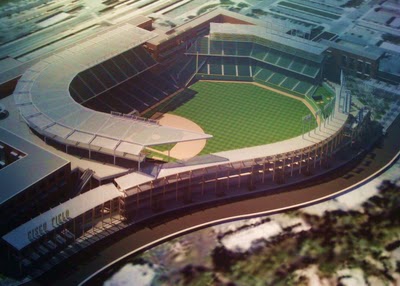
  • I’ve been sitting on the new pics from the San Jose Jazz Festival found at the Baseball San Jose blog. My only comment for now is that the RF addition, which would presumably follow the contour of Autumn Street/Parkway, is a good one. It’s a proper way to mitigate noise while adding revenue generating capabilities and even cheaper seats. However, it would likely require a major reconfiguration of the PG&E substation, instead of minor changes as has been discussed by San Jose Redevelopment. I’ll be pleasantly surprised if they figure out a way to shoehorn it in there. 10:00 AM – Now that I’ve seen the overhead render, I’m changing my mind. It does look like they’ve managed to shoehorn it in there. Clever. I should add that my previous sketches on this are largely based on stuff HOK/Populous has done, not the more radical with-column treatment that 360 and the A’s are attempting. Doing that could reduce the footprint some 10-20%, by my semi-educated estimate.

Anything else to report? Drop it in the comments and it’ll be added to the post.

Regionality II: Verticals

Last week I speculated that perhaps MLB teams were changing the way they thought about their Territories. Specifically, I was referencing the San Diego Padres push to have a Triple A team in their territory. The Braves recent move of their Triple A franchise to within 30ish miles also serves as evidence. In a more generic sense, I was talking about Verticals.

I reasoned that minor league franchises could become a revenue stream for big league clubs by allowing them to stretch their TV viewership in outlying areas of their territory and/or extended media markets. The minor league teams also could help the bottom line by reducing the cost of minor league operations. But a recent development has me thinking of another potential revenue stream and verticals.

All of these new stadiums cost a lot of money. To go to any number of games, you have to have a bit of a bigger bank account than I do, at least if you are paying your own way. So what do I do? How do I expose my family to the kind of memory building experiences that I want them to have? I mean, now that we built a snowman and all, baseball is all that’s left. It’s a question everyone keeps hitting on here at New A’s Ballpark, just packaged differently. If the new stadiums are mostly for rich folk… then we ask:

“Who will serve the common man?!?!?!?”

I see an answer! Well, an answer for Sonoma County fans, that is.

The Town of Windsor, a suburb of Santa Rosa (just north on 101), is conducting a feasibility study to evaluate the potential economic impact of a privately financed Single A type baseball stadium. While there is no team identified as a potential tenant, any number of teams could be potential targets. The Town Council only seems to be specifying that any minor league team that plays in the hamlet, on land purchased with RDA funds, have a major league affiliate (excluding the Golden Baseball League, thanks for coming!).There was no mention of where a stadium site might be, though I can imagine some very cool looking possibilites adjacent to the Town Green.

Just to paint a picture, let’s pretend the A’s are in the market for a Single A team and they decide that they want their new investment to play in Wine Country. There are several ways this could work to enhance the fan experience for the average suburbanite, but the team will be thinking about ways to increase ticket sales.

How would minor league teams, seemingly competition for the ticket dollar, benefit big league team’s ticket sales? It seems kind of counterintuitive, I admit.

An example of how this might work in the not so distant future: You live in Santa Rosa and you love the A’s. You’d love to have season tickets, but they are way too steep and you live far enough away that going to the game is an undertaking and expensive (especially since by now they are either in JLS or at Diridon, we hope). What if you could get a cheap package where you could go and watch a game (on the cheap) on weeknights, close to home , and a few times in the season, off in the big city?

The adventurous could even mix in a weekend or two in Sacramento. Mix the idea of consumer choice with demand based pricing and there are any number of ticket packages that can be thrown together for numerous types of budgets up and down the ticket buying market. Now imagine the minor league teams are much closer to the parent club than Windsor is to Sacramento or either is to Oakland. What if the team is in Walnut Creek, Pleasanton, Concord, Livemore, Fremont, Milpitas, or anywhere else in the metro area? How would time and distance from the parent club impact the effectiveness of this approach? What is too close? Should the team be on the edge of the metro, or more towards the centers of population? These are questions without answers, but I am sure someone is trying to answer them in at least one of 30 MLB team’s front office.

With the right ticket packages in place, there is a real opportunity to expand the market. There would need to be a few more dominoes to fall (starting with the TR decision from Bud) before this scenario could really play out.

Assuming Bud’s decision doesn’t rip a gaping gash in the fabric of the space time continuum (highly unlikely), and MLB’s teams are mostly unaffected by the A’s v Giants settlement (or lack of a…) of 2010 the next step would be more MLB teams investing in the business side of minor league teams. The MLB teams could pull the Gap model and own each of the brands targeted at specific demographics. For each and every A’s/Banana Republic full season ticket holder/khaki pant buyer, you find 10 Windsor Ausprey/Old Navy partial ticket buyers/khaki pant buyers.

Or teams could choose to establish separate ownership groups, like the Padres have done in their pursuit of the Portland Beavers, and create a partnership. Or, they could just sign joint marketing agreements, or invest in a small portion (around 10%) of the minor league team, sort of like Daimler Chrysler once did with Hyundai, in the early part of this decade, so they could both profit from the top to the bottom of the market. For every Benz driving full season ticket holding Padres fan you have 5 Elantra driving Solana Beach Sharks partial season ticket holders, or so the analogy goes. Again, any number of combinations could be worked based on supply and demand across the entire market, top to bottom.

However they get into the minor league game, I don’t doubt that the trend will continue. Not when you consider that Windsor is looking into buying land to lease to have a Single A stadium and selling it as a stimulus like plan. If you consider MLB owners sharks (which I don’t), then you can consider this sort of development as blood in the water. No longer do they have to build mega stadiums with $500 Million. No more pushing hard for huge public checks. Instead, pushing small governments for smaller checks. Sure there is less upside, but with less upside comes less volatility. Think of the minor leagues as the twisted equivalent of  bonds to the big leagues stocks.

The teams already own the players rights and have a fixed payroll. They already run the baseball side of the operation. How much larger of an investment would it take to make the minor league system, at least partially, a profit center instead of money drain? I am pretty sure several teams are crunching the numbers on this as the stadium boom, media explosion and league expansion money making programs are less of a boon and more of “been there, done that.”

Maury Brown on KNBR-1050

The Biz of Baseball‘s Maury Brown will be on The Ticket KNBR-1050 with Damon Bruce on Thursday at 1:30 PM. Don’t miss it, even though I will. Earlier in the week, Maury tried to make sense of the T-rights situation, covering all of the angles.

Consider this the open thread for whatever is discussed. I’ll try to participate once I hear the podcast version.

Quick aside: As I got into Dallas today, one of the big topics of conversation was a question posed to Rangers’ frontman Nolan Ryan about having a retractable roof on Rangers Ballpark. I tweeted Maury about this, he said he heard little, neither had I until today. Now it appears that the issue has legs, turning into a debate about what’s a more sensible investment: Cliff Lee or a roof? Or is it no Lee without a roof? I was there. In person I saw the seemingly indefatigable Lee run out of gas in the 7th, thanks to the nearly 50,000-person communal sauna enjoyed in Arlington tonight. Both teams’ closers are presumed to be unavailable for tomorrow, both bullpens are taxed. It’s what we’ve come to expect out of Texas in August.

Again I have to ask, “Is the process legitimate?”

Monte Poole has a column out tonight calling San Jose the “underdog,” which by extension would make Oakland the “favorite.” Which is fair, considering the amount of work that has to be done to get any team to move, let alone the A’s. There is something in the column around which I’d like to center the discussion.

“I’ll admit, 16 to 18 months ago, the team seemed on its way out of Oakland,” says Doug Boxer, vice chairman of the Oakland planning commission and co-founder of Let’s Go Oakland, a group formed to keep the A’s in the city. “We saw it as a ‘check the box’ process.

“But it has become apparent this is a real process. There has been correspondence with the commissioner. Oakland is providing relevant and real data showing the A’s can make it work here.”

Poole doesn’t say whether or not he thinks the process is legitimate. Boxer deserves credit for believing that it is.

However, there are lots of pro-Oakland folks who either believe that the whole thing is rigged and Oakland is doomed, or that it’s legitimate and Oakland will win out due to its work and difficulty in getting a San Jose deal to happen. The thing is, you can’t have it both ways. As outlined in my chart, if Oakland is deemed incapable of hosting the A’s long term, they will be out the door, by hook or crook. It may take several years, even a decade. An ownership change wouldn’t matter, since the problems would be related to the market, not an owner. Put it this way: the Giants got a lot of crap for financing $170 million for China Basin. Do you think MLB would approve a new pro-Oakland ownership group knowing that it would have to fund $350 million or more (after naming rights) for an Oakland ballpark, even if it felt that the regional support wasn’t there? Not likely.

The only way this works out the best for Oakland is if:

  • A) The process is real and legitimate
  • B) MLB rules that Oakland and the East Bay are enough to support the A’s
  • C) Wolff/Fisher are so frustrated that they sell instead of waiting it out until after the 2017 season, when debt service for AT&T Park would end

That’s a lot of “what-ifs” to hinge your hopes on. If this is all legitimate, that’s what you have to believe. You can’t have it both ways. You can’t say, “I trust MLB to do the right thing” and then claim that it’s rigged if the decision doesn’t come out your way. If it’s fair, you should be prepared to live with the ruling, good or bad. And if it isn’t, you should be calling B.S. on the whole thing from when the charade started in March 2009. Otherwise, your so-called principles don’t amount to a hill of beans.

A session for concessions

As was advertised last week, San Jose Mayor Chuck Reed met with MLB COO Bob DuPuy to clear the air about the City’s move towards a November vote. What came out of it was an urging by DuPuy and his boss, Commissioner Bud Selig, to delay the vote until next March, which MLB promised it would partially fund. The idea is that Selig’s panel would complete its work and then allow him to render a decision which would allow San Jose to move forward (or not).

Unfortunately, no one in my household was a fly on the wall for the proceedings, so we have no idea what was said outside of the statement. What was said (and not printed) is the real story. Thing is, you could fill in the gaps there largely based on your own A’s worldview, framed by a simple question:

Is this process truly legitimate?

(I started out with some paragraphs explaining this, then scrapped them in favor of a table.)

Chances are that you fall into one of the green or yellow cells, depending on which city you are leaning towards. In organizing views in this manner, there is no obvious middle ground even though there are many that fill the “keep ’em in the Bay Area” crowd. The point of the table is that if you spend enough time analyzing the issues and assigning values to the various challenges and benefits each city carries, you’ll probably see yourself on one side of the fence or another. You may waver from time to time depending on the news cycle, which is perfectly acceptable given the lack of real insight the public has into the situation. If there’s anything we’ve learned throughout all of this, it’s that city governments have the transparency of an eggshell, whereas MLB has that of a brick wall.

(Note: Contraction is off the table for now. That doesn’t mean it couldn’t be revisited by 2013, though I’m sticking with my thought that it’s too expensive to pull off for MLB – for the owners and legally for the league.)

All right, so I’ve set up everyone’s relative worldview. Whatever your thinking is, it colors the way you view today’s news. In the immediate moments after the Mayor’s press release, I checked to see what the fallout would be here and in the media. SJ Councilman Sam Liccardo was quick to spin the news as positive for the city, in that it forced MLB to act. Mark Purdy just came out with a column in agreement with the councilman. And late last week, Oakland Mayor Ron Dellums and City Council President Jane Brunner jointly released a letter to MLB outlining the steps that the City has taken to retain the A’s. Here are the bullet points of the letter (made available to BANG late today):

  • Met with your Committee extensively over the 16 month period Identified three waterfront sites which each meet the physical and infrastructural needs for a 21st Century ballpark as identified by your Committee Generated detailed diligence materials on each of the three sites regarding
    o environmental conditions
    o infrastructure conditions
    o transportation access
    o parking studies
  • Generated a detailed land-use plan identifying key milestones and reviewing Oakland’s entitlement processes
  • Demonstrated that the City/Redevelopment Agency has the financial capacity to uphold its end of any negotiated transaction
  • Generated over 130 letters of support for keeping the A’s in Oakland from members of the East Bay private sector including business, labor and community leaders
  • Secured over $500,000 in deposits from 35 corporate entities expressing interest in luxury suites, sponsorship opportunities and, most significantly, naming rights for a new waterfront ballpark
  • Organized a grass-roots effort through Facebook with over 40,000 members committed to keeping the A’s in Oakland (see http://www.facebook.com/letsgooakland)
  • Commissioned and published an Economic and Fiscal study which found that a new waterfront ballpark in Oakland would generate thousands of jobs, generate $2.6 billion in economic activity, increase property values around the ballpark by $4.7 billion, and generate over $240 million for Oakland’s general fund

When you add up the avalanche of press releases and responses, the picture starts to become clear. The horserace that wasn’t supposed to happen, that MLB was supposedly trying to avoid, is here. And now’s when it gets interesting. It’s a mistake to read too much into the little machinations that occur. For instance, MLB offering money for a spring 2011 election is nothing as it’ll come out of Selig’s enormous discretionary fund. It just means that the pro and anti-ballpark forces will have 6 more months to add to their campaign warchests. It’s also a mistake to think that either Oakland or San Jose are in an advantageous position relative to each other.

What’s going to happen? Well, first I expect the SJ City Council to put off the vote, as suggested by Selig/DuPuy. And yes, they’ll take up the offer because it’s free money for what could be a one-issue special election. At the same time, Oakland will get its shot to put together the JLS ballpark deal. The schedule probably won’t be kind, maybe 12-18 months. Maybe as little as 9 months. It may or may not be enough to complete and certify an EIR. More important, they’ll be asked to line up those sponsors and business interests, as referred to in the Dellums/Brunner letter. It’ll be imperative that they execute on this, though I expect that if Don Perata is elected Mayor, his willingness to get in the machine will help. (It should be pointed out that the keeping the A’s is not a plank in any of the leading mayoral candidates’ platforms.) As a concession, MLB may ask Oakland and the Coliseum JPA to add 1-2 years to the A’s lease, which is due to expire after the 2013 season. This would have several cascading effects:

  • The A’s could move into an JLS ballpark in 2015 or 2016 if necessary. Or a San Jose ballpark if it doesn’t work out.
  • The Raiders would suddenly be in a pickle, as they probably don’t want to stay in the current Coliseum config for 2 more years beyond their lease. They could either move to Santa Clara if the 49ers’ stadium is built, or they could play hardball with the JPA and push for a revamped/new Coliseum. Then Oakland and the JPA would have to choose between the two teams.
  • Discussions with Oakland/East Bay-based sponsors, which until now have been under wraps, will have to be more public. Especially the naming rights sponsor, which would probably have to replace Cisco (I’d expect them to go with the Niners stadium instead).
  • Oakland interests could no longer claim that MLB hasn’t given The Town a shot.

None of that is good news if you’re Lew Wolff or a Baseball San Jose booster. Assuming that the process does have integrity, it’s the best way to be above reproach. However, Oakland will have little time to get everything together, a process that has taken San Jose fits and starts totaling 5 years. Oakland pols will have to somehow avoid the idea that they’re ramming a stadium deal through, in a city that is already enormously sensitive to bad stadium deals and doubly sensitive to huge budget cuts. Make enough early mistakes and MLB could kill the contest early. Keep in mind that as nice as 35 corporate sponsors and $500k in deposits sounds, Oakland’s going to need a lot more than that to make the math work on a $450 million ballpark, perhaps $20 million a year in commitments. For now a good first step would be to authorize an EIR. Some of the pledged sponsor money redirected towards the EIR would be a good gesture as it wouldn’t hurt the City fiscally.

Of course, if you think that MLB is prone to cronyism or otherwise rigged this, the endgame is quite different. Rigged for what, though? After all, the whole time San Jose will still be there, sitting and waiting for Oakland to fail, with MLB given a few more months to come up with a T-rights settlement between the Giants and A’s.

Major release from MLB: SJ, stop the vote

So it turns out Bud Selig isn’t Claude Rains after all. I had asked why MLB hadn’t simply requested that San Jose delay the vote, and it turns out that it took a weekend for them to make the call. From Mayor Reed’s office:

MLB President Bob DuPuy informed me today that Commissioner Selig has requested that the San Jose City Council refrain from placing a Downtown Ballpark Measure on the November 2010 ballot so that MLB’s special committee can complete its work. He also committed that, if a special election is required in the spring, MLB would help pay for it.

Mr. DuPuy also shared that he appreciated the amount of work the City has done and the level of excitement that the San Jose community has shown in attracting a Major League ballclub.

I informed Mr. DuPuy that I would consider the league’s request and talk with Lew Wolff. We also pledged to continue our conversation in the coming days.

How ’bout dem apples?

Regionality: The New Revenue Stream

Is it possible that the A’s v. Giants rumble for the South Bay is a lot more complex than we even imagined? I mean, Bud Selig keeps saying so. Should we not believe him? Is it possible that the concept of MLB territory is evolving and this dispute is less about right now and more about an emerging revenue stream?

I caught myself pondering this question last week as the All Star Game was struggling to keep my attention. Honestly, my pondering began with a question like “When was the last time I cared about an All Star Game?” Oddly enough, I thought of the 1988 Triple A All Star Game in Buffalo, New York. It was the first Triple A All Star Game to feature all 26 Triple A affiliates and it was televised on ESPN. I remember waiting for the game to start as I sat in a 1950’s era ranch style San Lorenzo home staring at my grandparents 20 inch TV. Jim Kaat and Gary Thorne were waxing poetic about the beautiful new Pilot Field in Downtown Buffalo and the future stars about to take the field.

At the time, my main reason for being so excited was that I would get to see the player I thought would be the 4th Rookie of the Year (after Canseco, McGwire and Weiss) in a row for our Green and Gold heroes, Lance Blankenship. As a baseball card collector, I was also interested in seeing one Gregg Jefferies, a player I had heard about in card shops as a rookie card one needed to possess. They didn’t disappoint! Blankenship was 1 for 3 with a stolen base, while Jefferies was 1 for 2 with a Home Run. Other notable names that participated in the game? Bob Geren, Geronimo Berroa, Mike Devereaux, Joey Cora and Sandy Alomar.

Thinking about the game reminded me how much minor league baseball has changed.  It seemed that, back then, MLB teams didn’t think much about how the distance between the parent club and it’s top affiliate impacted business. The A’s Triple A team was 772 miles away in Tacoma, WA, for example. While that seems like quite a distance, it was nothing when compared with the over 3000 miles that separated the Chicago White Sox and their top affiliate in Vancouver, BC. I threw a quick spreadsheet together and discovered that in 1988, the median distance between a Major League team and it’s Triple A affiliate was 559 miles. (ed. note- This number is based on Google maps and is hardly precise, but close enough to illustrate the point)

If we juxtapose the conditions in 1988 with the conditions in 2009, it is easy to see a trend towards greater regionalization. Consider these things:

  • The median distance between MLB teams and their top affiliate is now only 315 miles.
  • In 1988, there were 2 Triple A affiliates that played within 200 miles of their parent club. Today there are 12.
  • Today there are 3 teams with their top affiliate over 1000 miles away, the greatest distance being the 3600 miles that are between Toronto and Las Vegas. In 1988, there were 6 teams that were separated from their top affiliate by more than 1000 miles, 2 well over 2000 miles.
  • The Braves moved their Triple A affiliate from Richmond, VA after 43 years. The Gwinnett County Braves are just over 30 miles from the parent club
  • The San Diego Padres (or at least some members of the teams ownership group) are actively working to bring the current Portland Beavers (next season Tuscon?) closer to the mothership. Possibly as close as San Marcos (36 mi.) or Escondido (31 mi.).

With MLB Advanced Media generating profits from the web, Fox Sports paying big bucks to broadcast national games, the advent of MLB Network, Regional Sports Networks extending the reach and frequency of each teams broadcasts, and most teams having a newish piggy bank for a stadium… Are minor league affiliates the next money maker for the MLB clubs? Or could there be a different reason for the decline in median distance? Is the shrinking distance between the clubs and their affiliates  about efficiency or marketing or both? Or could it be simply that expansion in the 90’s brought big league baseball closer to existing Triple A cities?

It seems to be all three. Teams are investing in minor league affiliates to make money, closer affiliates help the baseball operations staff by allowing for things like more efficient use of scouts or potentially quicker player call ups and the MLB expansion of the 90’s created the opportunity for MLB Clubs and their Triple A affiliates to move closer together.

Minor League Investments

The Padres are just one of a growing number of ownership groups that are finding it beneficial to invest in the minor leagues. The Braves, Giants, and Red Sox have all made investments in minor league teams at some point in the last decade. While I don’t expect that every team will be out buying up the 150 or so major league affiliated minor league teams across the country, I imagine most are kicking the tires on limited investments.

I find this particular quote from the above linked article to be telling:

“We’re on the record and excited about operating a Triple-A franchise in Padres’ territory,” Moorad said. “And we want to break ground, start turning shovels of dirt within four to six months.

“To be clear, though, our ownership group — not the Padres — will make the deal that makes sense to all parties.”

Is it possible that this view of expanding the reach within their territory by collocating a Triple A franchise is one of the issues that the Selig Panel is reporting on? It seems so.

Efficiency of Baseball Operations

Picture this hypothetical situation that a GM might face. The trade deadline is fast approaching and you are not sure yet if you are a buyer or seller so you need to get good scouting reports on potential targets as well as understand the recent performance of your minor league assets. Your top free agent acquisition is about to go on the shelf with elbow trouble and you aren’t sure who to bring up to take his roster spot. You want to send your most trusted scout to report on both scenarios. If your Triple A team is 80 miles away, and playing at home, and your High A affiliate is even closer, and playing a potential trading partner… It suddenly becomes a few days of driving around the adjacent Metro Area to get an on the ground report rather than a series of plane flights all over the country and back, assuming the two affiliates are playing nearby.

It’s less expensive, your scout is presumably more alert and when you call him on a whim and say, “Ben Sheets elbow is barking, should we call up Bowers, Mortenson, or someone else?” You can expect to get a better answer.

In a scenario that probably more applies to our A’s… Rehab assignments can be monitored by the GM himself if he wants, for crying out loud.

The Changes Since Expansion

Of the markets that hosted Triple A teams in 1988, 2 (Phoenix and Denver) were “promoted” to the bigs and 6 (Calgary, Edmonton, Richmond, Old Orchard Beach Maine, Tuscon and Vancouver) were “demoted” on out of Triple A baseball.

With 4 new Major League teams creating a need for 4 additional Triple A markets, the total new Triple A cities in the past two decades is 12. The new cities, since 1988, are Charlotte, Durham, Fresno, Lawrenceville (Gwinnett County, GA), Allentown (Lehigh Valley, PA),  Memphis, New Orleans, Reno, Round Rock (TX), Sacramento, Salt Lake City and Scranton/ Wilkes-Barre.

With Triple A teams dropping below the Canadian border, and closer to existing MLB franchises, all while new MLB teams were being established closer to existing Triple A cities (Colorado Springs/Denver), it seems only natural that teams would look to realign their minor league affiliations to take advantage of the opportunity to expand their reach into adjacent metropolitan areas. With the growth of Regional Sports Networks, minor league affiliates outside of traditional MLB territory, but inside an expanded TV market, became of greater strategic value.

In conclusion, it is all speculation as to what role this evolving view of the value of minor league affiliates in an extended metro area may hold for big league clubs. That said, it is clear that even small market teams are looking to the minor leagues as potential sources of future revenue. While I am not sure this is something that Selig’s panel is looking into, thinking about it (and mentally squinting really hard) definitely makes me understand some of the delay.
More whining + CFL building boom, who knew?

With newspapers laying off employees left and right and slimming down the old broadsheet, you’d think that precious inches wouldn’t be wasted on, well, no new news.

Since there isn’t any news, scribes are forced to get comments from Lew Wolff and Jorge Leon/Doug Boxer, who have have a nicely adversarial relationship. This time, Chronicle baseball writer John Shea and Merc columnist Bruce Newman take stabs at the issue. I had warned you good readers a couple of weeks ago that we were heading into a quiet period. Too bad that’s not stopping the media. If anything substantive happens before August 3, I’ll be shocked.

Well, here’s one rumor that’s a good likelihood: Expect that August 3rd vote to move a ballpark initiative forward. As much as San Jose is whining about the commish and his panel, they’re not going to risk losing all momentum by trying to wait MLB out in vain.

….

Up in the Great White North, various CFL cities are in the process of replacing their oft-utillitarian stadia with updated or new venues. Whether they’re talking amenities in Calgary and Edmonton or new digs in Regina and Winnipeg, it sure looks like the CFL is undergoing a cycle of building similar to that seen with the four major sports leagues. While stadia in large markets (Toronto, Montreal, Vancouver) have usually been domes, the smaller markets typically had outdoor, 30-35,000 seat venues with minimal creature comforts. (Keep in mind that this is a sport with a $4 million salary cap.) Most of these upgrades look either partly or entirely government-funded, which doesn’t look so great.

Quick sidebar: Years ago I went on a series of business trips to Calgary. One of my contacts there was a guy who was also a high school football head coach. Curious about this, I asked which rules the team played by, Canadian or American. He laughed and replied, “American.”

7/21 10:30 AM – You might like ESPN SportsTravel’s article on the farthest seats in baseball. With distances! And pictures!

W’s New Owner Is… Not Who You Think

Just coming across the wire is a report by CNBC sports business stud Darren Rovell, who says that the Golden State Warriors are being sold for a a record $450 million. While it was almost assumed that the winning bid would be put forth by Oracle head honcho and billionaire Larry Ellison, it now appears that the winner is a group headed by Kleiner Perkins managing partner Joe Lacob and Peter Guber of Mandalay Entertainment.

Mandalay is the interesting piece here, since they’ve been acquiring minor league franchises by the truckload over the last several years. They even have a history in the Bay Area, as they almost bought the A’s from Schott/Hofmann in 2001. Now that they’re in charge, it’ll be interesting to see what they do with it. Note: Mandalay is not affiliated with the Mandalay Bay casino, which is owned by MGM/Mirage.

Update 1:13 PM – Now the other shoe drops. Tim Kawakami has just posted a Twitter update with a quote from Larry Ellison:

Whoa. Ellison statement: “Although I was the highest bidder, Chris Cohan decided to sell to someone else.”

Kawakami also has a blog post explaining further, with a full statement:

“Although I was the highest bidder, Chris Cohan decided to sell to someone else.  In my experience this is a bit unusual.  Nonetheless, I wish the Warriors and their fans nothing but success under their new ownership,” said Larry Ellison.

Cohan decides not to sell to Ellison out of spite? What a jerk.

Update 1:27 PM – Damon Bruce is lining up Sal Galatioto, head of Galatioto Sports Partners, the firm hired to broker the sale. Also, Darren Rovell has a followup on Twitter:

Ellison’s bid was a few million more, but it was too late. Bid was put in hours before agreement was signed w/Lacob+Guber

Hours before? Something smells fishy…

Update 1:49 PM – Galatioto was just interviewed on KNBR-1050 by Damon Bruce. He refuted Ellison’s assertion, saying that Ellison’s bad was late by weeks, not by hours. He said that Ellison tried to disrupt the negotiation process after the bids were submitted and narrowed down. If true, it seems to fit Ellison’s M.O. Not saying that this doesn’t happen from time to time, it’s just that Galatioto Sports had to follow its own rules. Better luck next time, Larry.

Just wondering: What happens to naming rights on the arena?