What happens after 2013?

You’re probably aware that the leases for both the Raiders and A’s run out after their 2013 seasons are completed. Problem is for both that neither team can move into a new facility before 2015, whether it’s in Oakland, Santa Clara, or San Jose. Both teams have limited options to play elsewhere, and City and County still have a large mortgage to pay off. It would seem that a simple one-year extension – perhaps with an option year or two – would be simple to ratify.

However, things are not always that simple. The icy relationship between Oakland and the A’s has some within Oakland feeling that they were misled the last time the lease was negotiated, so they may be a much tougher nut to crack this time around. Chances are that the A’s will be paying a good deal more than the $1 million they’ve been averaging, if only to cover the cost of field conversion. The Coliseum Authority has been talking with the Raiders for some time, but Coliseum City doesn’t appear any closer to fruition now than it did over a year ago, when the Authority bought the Home Base site and unveiled the now-evolved plan. With all of that in mind, it’s a good time to explore the teams’ options after the 2013 season.

Raiders

No matter what the two football teams are saying about pursuing separate facilities or not sharing one somewhere, there’s no reason to think that they aren’t getting pressure from Roger Goodell and the other NFL team owners to shack up. There’s little practical reason for them not to do it, since they’d have less debt service to deal with and they would be able to join up instead of compete for precious limited G-4 loan money. Even if they came together, there’s still a year between the end of the Coliseum lease and a new one in Santa Clara or Oakland simply due to the required construction time. What to do then?

  • If a new stadium were being built at the Coliseum complex, it’d be simple. There’d already be a pre-arranged lease extension for the bridge year, and the new stadium would be configured to minimize impact on the existing Coliseum.
  • If the existing Coliseum were being gutted, the Raiders would have to endure one year of reduced capacity (47,000) and come back to a practically new stadium. 2014 could be the bridge year and leave 19-20 months to complete everything.
  • If the Raiders chose to go to Santa Clara, which to me would be a last-minute decision for the franchise, they could either rely on goodwill with Oakland and Alameda County to get the 2014 lease in place, especially if they “promise” that the Santa Clara move wasn’t permanent.
  • It seems highly unlikely that the Raiders would play 2014 in either Candlestick Park, Cal’s Memorial Stadium or Stanford Stadium. The colleges don’t want the headaches, and the ‘Stick would only be an option if the Coli were unavailable for some reason.

One strategic issue for me is, Did Oakland/Alameda County push for a Coliseum revamp? A new stadium may be prohibitively expensive, whereas a revamp could provide all of the necessary amenities for half the cost. Does the NFL consider the Coliseum damaged goods? The G-4 loan program specifies funding for existing facilities, and it’s believed that the Bills will try to use this funding for Buffalo’s Ralph Wilson Stadium, and that place can’t be measurably worse than the Coliseum (especially in its football guise).

The A’s could conceivably throw a wrench into the works by negotiating on a new facility at the Coliseum (like that’s going to happen under this ownership group). There would be enough land to build a new ballpark at the Home Base/Malibu site, and the existing Coliseum could be left intact for 2014. Or if the A’s tried to save money by leveraging what they could from the current Coliseum, the Raiders would be forced out.

Athletics

Mutual distrust between the team and City/County leads me to believe that any lease negotiations won’t be sunny. The A’s would need a facility for at least a year. Renting out Cashman Field for two series, as was done when Mt. Davis was being built, won’t fly for an entire season. Oakland wouldn’t have much incentive for renewal if they knew the team were leaving immediately after the lease was up, unless they got a lot of money for that one year or there was enough negative PR that came with refusing the A’s request out of spite. Unlike the Raiders, the A’s options would be wildly varied and mostly suboptimal.

  • Expansion of 4,200-seat San Jose Municipal Stadium to even 15-20,000 seats is impractical because the team facilities are clearly nowhere close to major league standards. Improving these enough to make it acceptable would probably cost $15-20 million, which would be crazy to pay for one year of play and little return on that investment.
  • The Earthquakes’ 18,000-seat stadium is soccer-specific, and MLS is not going to go along with sharing yet another facility.
  • Building another stadium alongside the Quakes’ stadium at Airport West would require a new EIR and probably wouldn’t go anywhere politically.
  • There’s the possibility of sharing AT&T Park for a year, but that would be entirely up to the Giants. There’s also a logistical issue at play. When Shea Stadium was used by both the Mets and Yankees for a year while Yankee Stadium was getting rebuilt, it already had enough team facilities because it was built as a multipurpose stadium. AT&T Park has only two clubhouses and scant room to build new ones. Where would the A’s or their road opponents go?
  • The A’s could play a season at the River Cats’ Raley Field in West Sacramento, but it’s even more limited than AT&T Park. At least there’d be a political path towards making it work as a temporary facility.
  • Candlestick’s pretty much “stuck” in its football configuration, so it’s unlikely that the A’s would play there.

The Raiders could throw a wrench into any 2014 lease plans if they agreed to rebuild the Coliseum, so that’s yet another complication. Unless cooler heads prevail, the A’s will be in a tough spot figuring out what to do for 2014. At this early juncture, my guess is that the A’s and the Coliseum Authority will figure something out, but the A’s will pay handsomely for the privilege. If something interferes, 2014 is up in the air for the A’s, and there’s no telling where they’d land. And if a delay forces them to not open Cisco Field until 2016? Yikes.
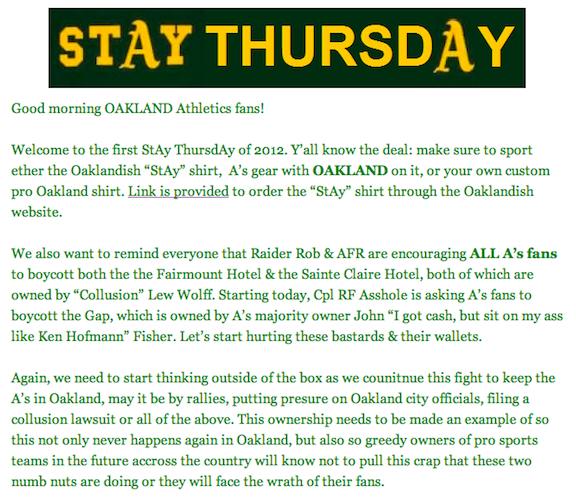
Unintentional funny of the week

There’s a podcast called A’s Fan Radio which I listen to once in a while. I try to catch as many as I can: Athletics After Dark and the new Tarp Talk being two others. A’s Fan Radio is not bad when they’re covering on-field stuff. As for the off-field and business stuff, I mostly tune into AFR because of the sheer unintentional comedy (warning: explicit language) of it all.

Perhaps the best moment in the short history of A’s Fan Radio came Thursday, when the siterunners asked A’s fans to boycott various businesses owned (or not owned) by Lew Wolff, John Fisher, and company. Here’s the hearty request:

stay-thursday

Surely there’s a meme that could come from this.

There is one GAP store in Oakland, so the boycott there might have some effect. At least it might draw attention. Then there’s the request to boycott the “Fairmount Hotel” and “Sainte Claire Hotel.” The Hotel Sainte Claire recently received some pub for being bought by a coalition including the Wolff family. The “Fairmount” is obviously a misspelling of the Fairmont chain, which has the flagship in San Francisco and another location in San Jose. Surely they can’t be referring to the Fairmount Apartments in Portland, which were converted from a hotel, or the 37-room Fairmount Hotel in San Antonio. That hotel is so cute it has its own dog mascot, Luke Tips, who greets guests and can be requested to stay in a guest room if a guest is lonesome for his/her dog at home (huge thumbs up from me in that regard).

Go ahead. Boycott this. I dare you.

Then again, maybe efforts would be better focused on “putting pressure on Oakland city officials” because when you look back on everything that’s happened related to retaining teams over the last year, it’s clearly evident that the nonexistent effort to keep the A’s in town is related to the nonexistent pressure to keep the A’s in town. As for filing a collusion lawsuit, there are plenty of lawyers affiliated with Let’s Go Oakland. Maybe one of them could take it up. I’m sure the Giants will be happy to pitch in. On second thought, that might come off as collusive.

Chances are that these boycott attempts will have the same effect as most ill-conceived boycotts: zero. After all, there’s no Fairmont or Sainte Claire in Oakland, and many of the Oakland-only crowd claim that there are very few A’s fans in the South Bay, so how much of an impact could it possibly have? Nevermind that most of the guests are out-of-town business travelers who have no clue who owns the hotels. Prove your point and hurt those bastards! And their wallets! Good luck. Oh, and make sure to wear your shirt for maximum impact. Yeah, that’s it. Try this on for size:

#OccupyColiseum

An article with actual substance is due later today. Until then, enjoy your Friday.

P.S. Having an elephant take “batting practice” at the Marlins Stadium is so not cool.

KQED Forum talks franchises

Last week I got a call from the folks at KQED’s Forum program to see if I’d be interested in being on today’s show. Then yesterday, I received word that their panel was full so I wouldn’t be needed for the show. That’s just as well, because it was a pretty good show hosted by Joshua Johnson and with guests Susan Slusser, Mark Purdy, and Glenn Dickey. Giants CEO Larry Baer also chimes in later in the hour. If you haven’t listened to it yet, do so. Below are the embedded player and an MP3 link.

MP3 Audio

A couple of observations:

  • Purdy mentioned that he talked to sources on the MLB panel. According to them, the Giants’ contractually are not tied to South Bay territorial rights.
  • Baer is content with a two-team market as long as the market definitions stay as is. Pressed on what defines the South Bay, Baer hemmed and hawed, finally mumbling that it includes San Mateo and Santa Clara Counties. He also talked Warriors, saying that he’s going along with the process to evaluate options in both Oakland and San Francisco.
  • The 49ers and the potential for a new referendum on the revised stadium deal were discussed, especially by callers. I don’t think there’s enough political will to make that happen, but you never know.

I need to do a full relisten to see if there’s anything else, as I didn’t bother to take notes.

Ballpark on layaway

The new CBA has a major change to its debt rule that will affect the A’s as they try to put a ballpark deal together.

The Debt Service Rule will be maintained, but the default EBITDA multiplier has been lowered from ten to eight, and from fifteen to twelve for Clubs incurring stadium-related debt in the first ten years of a new or renovated stadium.

Questions about the commissioner’s actual enforcement of the rule aside, suddenly the A’s have a little less of a ceiling to play with when it comes to building a stadium. For Wolff/Fisher, debt will be limited to 12x the team’s gross income, which according to Forbes has been $22-23 million for the past two seasons, and probably won’t change significantly this year. Should that hold steady, the maximum debt the owners could incur is $270 million. The team already has $90 million on the books, which reduces to available figure to $180 million. Let’s say the team pays down $20 million in the next year. That would put the ceiling at $200 million…

…Unless something were to change dramatically for the A’s. As Billy Beane gets rid of arbitration-year guys like they’re going out of style, the effect is that it can drive up the team’s EBITDA/gross profit. Right now the A’s payroll projects at $24 million unless they sign a series of one-year veteran deals.  Beane told Murray Chass that he’s willing to go with a payroll in the $50+ million range, which would immediately turn into roughly $10 million of additional gross profit. If the A’s maintain that level over the next two seasons, the A’s profit figure will hit $30 million or more, which would put make their debt ceiling as much as $360 million, assuming the team pays down some of its existing debt (which it can do thanks to the saved payroll).

That extra $100-150 million is a huge difference, perhaps large enough to be difference between financing the ballpark and not financing it. We should remember a few basic things about how the A’s would move forward with a ballpark, regardless of location:

  • The projected cost was $450 million for the smaller, 32,000-seat stadium. Now that MLB has pushed for a larger park (35-36,000), the cost will go up to around $500 million.
  • Cisco’s naming rights deal in Fremont was worth $4 million per year for 30 years, or $60 million in net present value against the construction cost. I think the rights are worth more in San Jose than in Fremont, which could translate into $5 million a year or $75 million NPV if the A’s wanted to reopen the discussion.
  • Wolff/Fisher have to set aside additional money for the remaining land acquisitions and infrastructure work. Depending on what’s negotiated, that could be $50-75 million.

The total cost of the stadium is well above the team’s debt ceiling, however I think a little creative accounting is at play. Financing for any stadium usually falls into two debt buckets: one that is easily secured (naming rights, sponsorships, pouring and concessionaire rights, etc.) and one that is not (tickets, actual concession sales). The easily secured stuff can have a 5% or 6% interest rate, plus in some cases (East Coast) the team is able to sucker a city or county into raising tax exempt bonds, or some other instrument which can save millions. The other stuff often hits at 7-8%, or in the 49ers case, as much as 8.5%. That’s junk bond grade debt. It’s absolutely critical that the A’s structure their debt that as little as possible is at the higher rate, which is an automatic limiting factor (this is a good thing). For that reason, I can’t see the applicable stadium debt being any higher than $250 million. Everything else will either be paid down early or locked into the “first bucket” revenue streams. MLB doesn’t appear to be as worried about the first bucket as it is the second, which also goes for the banks that will eventually provide construction loans.

$250 million at 7% over 25 years translates into $20 million in annual debt service. It’s a lot, but it’s manageable. One thing to consider is that A’s tickets, with the exception the Diamond Level seats, are generally 25-50% lower than comparable tickets at other ballparks. That leaves a ton of headroom in ticket prices that the A’s can use when establishing their 2015 Cisco Field pricing structure. Yesterday I did a quick survey of 2012 season ticket prices for several non-New York ballparks.

2012 Season Ticket Prices for several MLB teams. Dodgers prices include large discounts which may only be in effect for 2012.

Now let’s take a look what happens if the A’s, entering the 2015 season, priced tickets more in line with (but slightly less than) the going market trend.

2015 estimated prices, factoring in 4% annual inflation

What does it mean for annual revenue? If the A’s sell 2.5 million tickets, they’ll rake in over $78 million just in tickets. If they sell out the season, that jumps up to $91 million. That doesn’t include proceeds from concessions or  parking, which are worth at least $30 million more in annual revenue, or $12-15 million in profit assuming a 40% margin.

2015 projected revenue with two scenarios: total attendance of 3 million (37,000/game) and 2.5 million (30,500/game)

Now you’re getting to a magical number of $1 million in ticket revenue per game. The challenge here is to maintain at least 2.5 million in annual attendance. If attendance drops to 2.2 million per game, that’s $8-9 million in revenue not realized, and that’s when the mortgage starts to hurt. Historically, the A’s have gotten 2.5 million fans or more only three teams in their tenure in Oakland, and never prior to that. The team will be highly dependent on new fans, casual fans, and existing fans who are so turned off by the Coliseum that they don’t bother going. Overcoming that stigma will be a challenge to say the least. If the Giants, Cardinals, and Phillies are successful examples of how to deal with an eight-figure annual debt service, it’s definitely feasible.


Will reason win out?

In light of the big redevelopment news, it might be easy to forget that there was plenty of other news from earlier in the week. Susan Slusser’s article featuring Peter Magowan had a poll attached. Normally I don’t bother with polls (notice how there haven’t been any on this site for a long time). In this case the poll had over 2,000 respondents, plus the question and responses were well-phrased, so I’ve been following the results (it’s still up if you haven’t voted).

Results as of 12/30, approximately 11:00 AM

The three camps are pretty well delineated: the pragmatists/realists, the Giants-only crowd, and Oakland holdouts. At this point, the pragmatists hold a sizable lead over everyone else, albeit a plurality, not a majority. The holdouts are in the Quan position, though there’s no instant runoff here. And the SF-only voters simply need to have some sense knocked into them because they’re greedy dickheads.

Sure, there are a lot of people in the leading group who are not actually pragmatic, they’re really pro-San Jose. Many are longtime A’s fans, many are not. I can tell you that most of the people I correspond with are silent majority types – they are overly vocal or passionate about either San Jose or Oakland. They just want this whole ordeal sorted out so they can get back to cheering on the green and gold. The real danger is in losing a large percentage of these fans to apathy or disgust. At Mayor Quan’s press conference, Doug Boxer told me that among the parties working to move or keep the team, there is no one with clean hands, which is absolutely correct. It’s all this out-in-the-open maneuvering – done by A’s ownership, Giants ownership, and the cities – that is chipping away at the fanbase.

Do the owners of either team care? Obviously not, as ends justify means here for whomever wins. The cities? Sure, insofar as they’re buddying up with business and civic leaders, not so much citizens. I’ve mentioned before that the Athletics-Oakland saga is akin to a divorce, so it was going to get messy. Signs are pointing to some kind of resolution soon. After that, the big issue will be dealing with the mess all of this has created. It may take an entire generation to wash the stink out of this.

I don’t have children, but a lot of the regulars here have multiple kids that they’re raising as A’s fans. I want there to be an A’s in the Bay Area for those kids as much as for myself. That’s why I keep doing this. Compared to everything else that’s happening in the world it’s beyond trivial, I know. The A’s are still a big part of the community, and of my life. Hopefully 2012 will mark an end to the politics, one way or another. Here’s to hope. Catch you next year.

Taking stock as the post-redevelopment era begins

It’s never too early to declare winners and losers that were made as a result of today’s earthshattering news.

First the losers:

  • Backers of the Victory Court site. The site was heavily dependent on tax increment (redevelopment funds) to buy the land and pay for improvements. Now that’s out of the question.
  • The City of Oakland. Strategically, it chose to sit back and wait for the originally passed “pay-to-play” ransom plan, which was scuttled today. Now they not only have no way to do redevelopment, they’re stuck trying to figure out how to fill in major holes that have just opened in the City’s budget that were filled by a large redevelopment operating budget.
  • San Jose Redevelopment Agency. As far as old school redevelopment goes, the City is now handcuffed with no way to raise funds. Of course, the City had already been choking the life out of SJRA by finishing several projects, laying off staff, and not taking on new projects. One word: prescient.
  • Affordable housing advocates. Not directly related to stadium building, but it’s a big point of emphasis for redevelopment backers. And consider this: any large mixed-use plan including residential development in any major city in California would require an affordable housing component. Who’s gonna subsidize that now? Already, San Diego is looking for a legislative means to bring back a scaled down version of redevelopment with a focus on affordable housing.
  • Oakland Raiders. Any options the Raiders may have been considering elsewhere in Bay Area (aside from the Coliseum and Santa Clara) have to be considered nonstarters at this point.
  • Redevelopment agency employees. Many agencies had planned for the “pay-to-play” scenario. This is armageddon. Good luck to them.
  • Anyone with a downtown gentrification initiative. Those projects are now for the birds.

The winners:

  • Lew Wolff and Baseball San Jose. If Wolff and his people were secretly rooting for redevelopment to wither and die, they certainly weren’t showing it. But the decision today has such wide ranging, powerful effects on municipalities throughout the state, that’s it’s easy to envision Lew Wolff sitting in his office, thinking, Okay, that narrows the field. With the MLB panel’s report distributed prior to today’s news, they probably laid out several scenarios, and the owners have to be aware by now the ramifications – if not by the panel’s report, then by the news reports. And that plays right into Wolff’s plans. If there was ever a tipping point event for a decision on San Jose, this is it.
  • San Jose Mayor Chuck Reed. It was Reed who oversaw the winding down of SJRA and the creation of SJDDA (SJ Diridon Development Authority) to sidestep the state raid. There may be a legal challenge against SJDDA, but where will it come from? The State doesn’t have the resources to start going after dozens, if not hundreds of redevelopment agencies. Santa Clara County might, but it seems the County got what it wanted by having redevelopment eliminated. Everything else is a matter of negotiation. As noted before: prescient.
  • San Francisco 49ers and Santa Clara. They got their tasks done before the end of the year. Now it’s a matter of selling suites and seat licenses, plus getting the Raiders on board.
  • Your local municipality’s General Fund and local schools. While the State will get a portion of the newly realized tax increment, part of it will be returned to cities, counties, and school districts. For cities with very large redevelopment areas such as San Jose and Oakland, this could actually mean a windfall of sorts, or at least a way to shore up their budgets. How much will it help? That’s for the bean counters to figure out.
  • Governor Jerry Brown. The beautiful irony of this situation is that Jerry Brown used redevelopment in Oakland as a stepping stone to get him back in power in Sacramento. Now he’s killed redevelopment. That’s an experienced politician.

Too early to tell:

  • San Francisco Giants. The death of redevelopment may tip MLB in the A’s favor. Then again, it may not. One thing to consider: the Giants overtures towards the Warriors about getting an arena in Mission Bay may be negatively affected by the ruling.
  • Backers of the Coliseum City plan. The Coliseum is part of a separate joint-powers agreement which allows the Coliseum Authority to raise money for its own projects. The track record isn’t great (Mt. Davis) but the power remains. Still, Coliseum City came about as part of a major planning and redevelopment initiative in and around the Coliseum and Airport. Now at least half of that project has been rendered irrelevant, which could have cascading effects on the Coliseum. On one hand, the Coliseum could be considered one of the only places with land where something could get done. On the other hand, the Coliseum is still pretty much limited to contributing site and infrastructure improvements, with little ability to contribute directly to any new facility or refurbishment. It’s also at the mercy of private developers to flesh out Coliseum City, which given the area, is definitely not a given.

It was hard enough getting something built in California with the state of the economy. Now, if you don’t at least have something already underway or an existing facility or land from which to base improvements, you may as well not show up. Redevelopment as an industry is over. Now bring on the new industry of “creatively” financing traditionally redevelopment-oriented projects.

Official: Redevelopment is DEAD

This story will be updated throughout the day as analyses and reactions come in.

News links:

Added 3:37 PM – A brief blurb of my interview with KQED-FM is now up.

Added 3:40 PM – Fremont Mayor Bob Wasserman passed away today at the age of 77. Condolences go out to his family.

.

The Supreme Court just came down with an 83-page ruling on the legality of ABX26 and 27, the redevelopment killing and reforming bills passed during the summer budget battle. Here’s the nitty gritty:

We consider whether under the state Constitution (1) redevelopment agencies, once created and engaged in redevelopment plans, have a protected right to exist that immunizes them from statutory dissolution by the Legislature; and (2) redevelopment agencies and their sponsoring communities have a protected right not to make payments to various funds benefiting schools and special districts as a condition of continued operation. Answering the first question “no” and the second “yes” we largely uphold Assembly Bill 1X 26 and invalidate Assembly Bill 1X 27.

Assembly Bill 1X 26, the dissolution measure, is a proper exercise of the legislative power vested in the Legislature by the state Constitution. That power includes the authority to create entities, such as redevelopment agencies, to carry out the state‘s ends and the corollary power to dissolve those same entities when the Legislature deems it necessary and proper. Proposition 22, while it amended the state Constitution to impose new limits on the Legislature‘s fiscal powers, neither explicitly nor implicitly rescinded the Legislature‘s power to dissolve redevelopment agencies. Nor does article XVI, section 16 of the state Constitution, which authorizes the allocation of property tax revenues to redevelopment agencies, impair that power.

A different conclusion is required with respect to Assembly Bill 1X 27, the measure conditioning further redevelopment agency operations on additional payments by an agency‘s community sponsors to state funds benefiting schools and special districts. Proposition 22 (specifically Cal. Const., art. XIII, § 25.5, subd. (a)(7)) expressly forbids the Legislature from requiring such payments.

Matosantos‘s argument that the payments are valid because technically voluntary cannot be reconciled with the fact that the payments are a requirement of continued operation. Because the flawed provisions of Assembly Bill 1X 27 are not severable from other parts of that measure, the measure is invalid in its entirety.

In short, the Court ruled that redevelopment was created by the legislature, so it can be taken away by the legislature at any point. This is the worst possible outcome for redevelopment agencies all over the state. They are effectively dissolved and have no mechanism for reconstituting themselves.

What does this mean for the various cities? Let’s do a roll call:

  • San Jose Redevelopment Agency is done. Dead. The agency owed the City $80-90 million and that’s gone. Start the procession.
  • San Jose Diridon Development Agency exists in a sort of gray area. Its charter is to oversee development in its defined area and it controls land, but it is not expressly a redevelopment agency. We’ll see if it gets (and withstands) any legal challenges in the future. As long as Lew Wolff maintains his stance that he can pay for the rest of the land/infrastructure and, more importantly, follows through on that pledge, the ballpark project is safe. Unfortunately for Wolff, the price tag continues to grow.
  • Oakland’s plans for Coliseum City and Victory Court have to go back to the drawing board, because they were largely dependent on ABX27 passing so that they could continue operation. Now that redevelopment is dead, they’ll have to come up with extremely creative ways to fund their infrastructure projects, and considering how large they are ($250 million for VC, a similar or greater amount for CC) there’s no telling how they’ll do it. That $36 million reserve that Mayor Jean Quan was crowing about? That’s all they have at this point.
  • Santa Clara is safe simply because they got a bunch of contract and lending stuff done before the end of the year. Now their only worry is the fact that their Stadium Authority is liable for $850 million in loans, despite assurances from the 49ers and NFL that they’ll take care of debt service.
  • Sacramento is in a slightly more advanced position than Oakland, because they’ve been exploring alternative ways to finance a Kings arena, such as selling advance parking revenue.
  • The downtown LA football stadium, Farmers Field, was not dependent on tax increment or redevelopment funds. It was to be paid for by increased convention center use and other events at the domed stadium.
  • The City of Industry football stadium was originally highly dependent on redevelopment money (mixed use). I had heard that the funding mix had been altered in light of the new political realities. It seems that with each passing month this project slips further into oblivion.
  • San Diego’s football stadium was also expected to use redevelopment funds. It’s hard to see how they’ll pull it off now.
  • Escondido’s AAA ballpark plan for the Padres is dead.

The only hope redevelopment has now is to lobby hard in Sacramento to reform it through the legislature. At this point, there’s no telling how or when that will happen. During the oral argument, the justices talked about a system in which projects would be voted on by their communities. That may be the future of redevelopment, not the mostly unchecked power of the past. It’s a new day in California. Good luck getting your stadium built.

Who said there’s no news at the end of the year, eh?

Note: I did an interview with KQED-FM shortly after the ruling was handed down. Hopefully part of it will show up later today or tomorrow.

P.S.: I have to clip something off the last Baseball Oakland post, full of sunshine and unicorns:

One final point about the money that would be used for Oakland’s plan. Much of it would come from redevelopment funds. Some of you might be concerned that the state will all destroy redevelopment agencies. However, I asked Fred Blackwell about this at the end of the press conference. He explained that, based on the expected upcoming ruling of a lawsuit filed by California’s cities, redevelopment agencies will continue to exist as normal and everything around ballpark financing would go as planned. If the cites lose, then they will have to make a payment to the state. Blackwell says that Oakland plans on making its payment and still can issue the needed bonds to complete its proposed projects. So, any concerns about the death of redevelopment agencies should alleviated.

Everything’s gonna be fine. Right?

Wolff finalizes Hotel Sainte Claire purchase

As mentioned at the beginning of the month, an investor group including Lew and Keith Wolff has purchased the Hotel Sainte Claire in Downtown San Jose from Larkspur Hotels and Restaurants. The final price is reportedly under $18 million ($105,000 per room), a major discount from the market value of $34-42 million ($250-300,000 per room) for the 171 room, boutique hotel.

sainte claire hotel

Hotel Sainte Claire at night. Credit: Ed Schipul (flickr)

If, as I speculated then, the purpose of the acquisition was to redo the hotel to host visiting MLB teams, buying the place for only $18 million leaves a pretty nice budget available to turn the place into a five-star joint, if the investment group were interested in doing so. I had also heard that certain unnamed MLB executives are in the investment group, which would make it seem like baseball has a vested interest in having the hotel succeed along with a ballpark in downtown San Jose. For his part, Wolff told reporter George Avalos that the purchase has nothing to do with the A’s potentially moving south. Wolff’s group also owns the nearby Fairmont, and a few years back sold the Hilton next to the convention center.

Wolff also had a curious quote:

“Cities like San Jose and Oakland are in the path of growth,” said Wolff, a principal executive with Los Angeles-based Wolff Urban Development, in explaining some of the reasons behind the purchase. “San Jose has a fairly strong downtown.”

Interesting that Wolff is working hotel deals in San Jose, but not Oakland. Perhaps a move in Oakland is in the future?

Reminder: Athletics After Dark interview

I just finished my interview with Athletics After Dark‘s Dale Tafoya. It lasted a little less than a half hour, which is how long AAD’s episodes usually run. The episode is up. Enjoy.

Update 12/27 5:40 PM – A report at MLB.com has Lew Wolff saying there is no movement on the stadium front yet. Yet.

Update 9:58 PM – Susan Slusser gets Peter Magowan’s take take on the matter. There’s also a poll.

Results of the poll so far:

The Payoff

Update 12/27 5:40 PM – A report at MLB.com has Lew Wolff saying there is no movement on the stadium front yet. Yet.

Update 8:54 PM – Interviewed by Rick Tittle and John Dickinson on The Game (MP3), Bob Nightengale has the estimate at $50-100 million, which would fall in line with the other cases listed below. Nightengale guesses that the number will be less than what the O’s received, with some chance to compensate the Giants for lost attendance. (Thanks letsgoas)

There’s been plenty of discussion about a the A’s leaving Oakland for San Jose. Little has been said or written about what deal will have to be struck to make the move happen. The Giants have consistently said there is no acceptable price for ceding the South Bay, while the A’s would prefer they get the Valley for the same price Wally Haas gave it up in the first place: zero. Obviously, that’s a massive gap to bridge and neither side is going to get exactly what they want, so a compromise is in order. As much as I’d like to think Commissioner Bud Selig has spent significant effort in crafting a solution, I can’t help but think that he’ll simply go with whatever his handpicked panel put together (probably as early as 18-24 months ago).

The Giants believe the South Bay market is practically priceless, though they’ve surely been pressed privately by MLB, and upon being pressed, the market for them is worth nine figures. My semi-educated guess is that they said $200-250 million, which is representative of potential franchise value change for both the Giants and A’s. I mentioned in the last post that some within the Giants camp believe that if the A’s left the Bay Area altogether, the Giants’ valuation could jump as much as $500 million, making them a superteam with the Yankees, Red Sox, and the LA teams.

Roger Noll has estimated the value at $20-30 million, which has to be at the low end of the spectrum (I can’t see $0 happening). Some recent owner compensation examples also exist:

  • 2005: Peter Angelos (Orioles) gets a guarantee of at least $365 million for a future franchise sale price and $75 million to start a new regional sports network that would carry both the O’s and the soon-to-be Nationals. Half of the $75 million came from MLB, the rest came from the future owners of the Nats. The Orioles did not technically have territorial rights to DC.
  • 2011: Jim Crane (Astros) gets a $70 million discount from the original $680 million price for the franchise. Again, half came from MLB, the other half came from seller Drayton McLane. The discount was negotiated as the price to move the Astros from the National League Central to the American League West. The discount doesn’t necessarily mean any cash changed hands.

So it seems that MLB has a sort of standard in place when it comes to offering a compromise: fund half and make the desirous party pay the other half. Both the Giants and A’s know this, and it’s possible that Selig, wanting to cut to the chase, has already offered something to this effect. That brings us back to the number. Territorial rights (with regards to stadium placement) were at stake into the two aforementioned scenarios, which means they can’t be counted on as exact precedent. The method is in place, so there’s at least indicator of what could be done. While many fans and much of the media think of Selig’s panel as either a ruse or a joke, I think they’re quite important in terms of determining a fair value. That’s what’s really at stake here, not so much whether the Giants’ entitlement to the South Bay or A’s request for it are valid.

In August I brought up the Zito trade option again. He’s owed $19 million next season, $20 million in 2013, and either an $18 million full salary in 2014 (unlikely at this rate) or a $7 million buyout. That’s $46 million guaranteed to the former Cy Young winner, whose combined WAR in five seasons in orange and black is 6.6. I’m not particularly interested in a Zito return to the A’s other than it’s a business win-win for both teams. That the $46 million is essentially equivalent to $90 million in revenue over those three years based on how much revenue is allocated to team payroll, which is more meaningful in terms of putting together assets for a T-rights exchange agreement than a specific bottom line argument. In any case, moving Zito will make it much easier for the Giants to swallow the likely $20+ million arbitration award Tim Lincecum will get next month, and long term, easier to sign both Lincecum and Matt Cain for the next five years or so (combined: $350 million?). I’m the only person with any standing talking about this, so I won’t belabor the point any further.

Then there’s the issue of the remaining debt service on AT&T Park. Remember that this was the original argument put forth by the Giants, and it’s a valid one: $20 million per year through 2017. They even took it a step further by having SF City Attorney Dennis Herrera threaten MLB with a lawsuit because a move by the A’s to San Jose would hamper the Giants’ ability to pay SF its measly $2,000,000 in land rent, along with property and sales taxes. Legal sabre-rattling aside, what it comes down to is the years 2015 through 2017, which if a San Jose Athletics ballpark were to move forward, would be the years when debt service for both venues would be in play. The Giants argue that half of their fanbase and revenue comes from south of San Francisco, which means that their ability to pay half of the debt service would be in jeopardy. Taken at face value, the risk is $30 million, which may be where Noll gets his compensation estimate.

The big takeaway rumor I got from the GM Winter meetings a three weeks ago was that supposedly the Selig panel report was made available. If so, it probably has one or more recommendations on moving forward, including a primary consensus-building option that Selig has rubber-stamped. Only The Lodge knows what that is. Personally, I hope it’s something creative and not a simple cash payment, since that may not properly address both teams’ concerns and may handicap the A’s unnecessarily. The A’s are a gimp as they are right now.

At The Biz of Baseball, Maury Brown thinks that if the two sides can’t hammer out a compromise on T-rights, binding arbitration may be in order. That could explain why there’s talk of a final February solution. Player arbitration occurs during the first three weeks of February, so it wouldn’t be out of line for MLB to use the same resources take care of the A’s and Giants once and for all. Certainly there isn’t much in terms of precedent compared to negotiating a deal with a Super Two, but the principle is the same: the two parties name their figures, and a judge reviews the situation and picks a winner based on the one that is closest to market value. No appeals, no lawsuits (per ML Constitution), no whining. The important thing there is that since the winner is based on the appraised market value, there’s a sort of built-in protection from the sides making overly outlandish offers, since an unreasonable offer is more likely to be dismissed.

That leaves one question: Why has it taken this long? I suppose the reasoning is twofold. MLB wanted to defer to the Giants, who are still paying for China Basin and as mentioned, have six years left on the mortgage there. That ties into making the pain of compensation by the A’s (and MLB?) less since with every year that elapses, another $20 million comes off the ledger. That’s a big deal. Imagine if the A’s started playing in San Jose this past season. MLB would’ve had to account for seven years of debt service at AT&T Park, or $140 million. Even if that’s split in half, that’s nearly as much as the highest payroll in A’s history. Unfortunately, the collateral damage for the delay becomes the excruciatingly ongoing limbo of the have-not A’s. At least an end is in sight.