US Cellular Field (New Comiskey)

In a previous installment of this year’s Chicago travelogue, I described what it was like to go to both Wrigley Field and US Cellular Field on the same day thanks to a scheduled Chi-town doubleheader. While I went into some length about my experience on the South side, I wanted to save the bulk of my observations for a proper review, especially because I wanted to compare the current version to what I saw in 1996, five years after the park opened as New Comiskey Park.

us_cellular-04-outfield_view-sm

View from right field seats

Until the extensive, multiyear renovations package (done by HKS) was completed in 2012, the Cell had earned a somewhat unearned reputation as outdated. This wasn’t entirely HOK’s (Populous) or Jerry Reinsdorf’s fault. Reinsdorf wanted a modern edifice and used Royals (Kauffman) Stadium as his inspiration. The result was nothing like old Comiskey, cramped and dank. The new Comiskey was spacious, exclusive, and packed full of what was then the newest technology outside of a retractable roof. When Oriole Park at Camden Yards debuted the following year, starting the retro ballpark craze, all of the features that made New Comiskey modern made it look fan unfriendly and lacking in intimacy. If that meant outdated, so be it. They lacked the foresight to go retro? Fine. The O’s earned great acclaim for their small urban ballpark, while the White Sox and the City of Chicago spent much of the next two decades playing catchup to the Camden Yards and just about every other new park.

Visiting (Athletics) bullpen

Visiting (Athletics) bullpen, John Jaso (right) getting ready to take some warmup tosses

A look at the bones of the Cell should tell you the era it comes from. There’s a lot of bulky prestressed, pretensioned concrete in the supports and columns. The only structural steel you’ll see is in the upper deck, holding up the roof. The massive pole-to-pole structure backing the outfield concourse holds the scoreboards and numerous ads. If the park were built a few years later, Reinsdorf might have considered turning the ballpark north to take advantage of a great view of the Chicago skyline. Architect Philip Bess offered up his own alternative to New Comiskey in 80’s and in his book City Baseball Magic. Bess’s plan, called Armour Field, was more like Old Comiskey and even more retro than Camden Yards, with extremely shallow dimensions in the corners and a grandstand shape that evoked the Polo Grounds in New York. The park would’ve had a northern orientation, providing fabulous views of the Loop from inside the park. Instead, Reinsdorf chose the parking lot across the street from the old one and oriented the new one southeast towards Bronzeville. Call it a missed opportunity.

Arches evoke old Comiskey Park. White panels cover previously open upper concourse.

Arches evoke old Comiskey Park. White panels cover previously open upper concourse.

New Comiskey was criticized immediately for having a very steep upper deck that was also far removed from the action since it is placed atop two suite levels and a club level (sandwiched between the suites). In hindsight, this critique was perhaps a bit too heavy-handed as many Populous-conceived parks have used variations of this placement. Some may use a large club mezzanine backed by suites (Camden Yards, Petco Park). Another variant had a large club mezzanine, then a glassed-in concourse, then the suites, then the upper deck (AT&T Park, Safeco Field, Coors Field). Others utilized a triple deck of suites on one side and a club section on the other (Progressive Field). Now that we’ve seen 20 years of ballpark development, it’s easier to be kind to the Cell. In actuality, the biggest problem with New Comiskey was that there were too many rows in the upper deck, a chief complaint of the park’s inspiration, Royals Stadium. The latter day renovations chopped the top eight rows off the upper deck and enclosed the upper concourse in translucent glass. A much more substantial roof replaced the previous version and was heavy enough that it had to be supported by the aforementioned steel columns. Curiously, these columns also introduced something that Reinsdorf had worked hard to eliminate: obstructed views. The obstructions only occur in the furthest reaches of the upper deck, and you’ll be hard-pressed to find anyone who says the new structure properly evokes Old Comiskey. Still, it adds definition to a part of the stadium that sorely lacked definition.

Upper concourse at U.S. Cellular Field

Upper concourse at U.S. Cellular Field. Steel beams are meant to support roof, not seats

Obvious nods to Old Comiskey come in the form of arched windows and openings in the facade, and the big scoreboard in center, complete with the multi-colored pinwheels and fireworks that go off after every White Sox home run. The board is flanked by screens in left and right, which are perfectly functional but not complete despite the number and size of the screens. Out-of-town scores are pretty much an afterthought. The arches, while a tasteful treatment, are nothing compared to the hulking network of ramps that nearly encompasses the Cell. The only thing that makes these ramps an improvement over previous cookie-cutter ramp structures is that they’re somewhat removed from the stadium. The problem with that implementation is that since fans enter at gates attached to these ramps, there’s no way for anyone to easily move between the different decks. To this day the White Sox maintain a policy that a fan’s ticket restricts him/her to a specific level. Fortunately, I was taking in three games of the A’s four-game set in Chicago, so I had a chance to roam around all of the non-premium areas. The White Sox have said that they plan to open up the park more in the future to allow for the kind of in-game circulation experienced at other parks. Even if they do that, moving among the decks will still be a pain because of the ramp system. At least at Gate 5, there’s a bar to accept fans pre and post-game.

View from behind the plate at dusk.

View from behind the plate at dusk.

At least the various food options have improved. The lower concourse has long had a good variety of concessions, including the staple Chicago dog and popular nachos stands. With the upper deck revamp came a number of new selections, including wings from Hooters and several open grills. I had a piled high Chicago dog, just as I did at Wrigley, and I liked the South side version more. A Jimmy John’s ad on the outfield fence teases about sandwich availability at the Cell, unfortunately the only Jimmy John’s is two blocks away along 35th Street, near the El and Metra stops. Outside food is allowed.

The outfield concourse, which has always been reminiscent of the old bleachers at the pre-Mt. Davis Coliseum, is as spacious and friendly as ever. The bullpens have moved from the former slots to Fenway-like spaces along the outfield fence. A patio area sits next to the visiting bullpen in right. The bleachers, which used to occupy both left-center and right-center, are solely in the former. A multi-level outfield platform was erected in the LF corner. Atop this deck is the Comcast-sponsored FUNdamentals children’s play area. Like everywhere else in the park, it has an usher or two to grant access, and when I approached to take look I was naturally looked upon suspiciously as no child was accompanying me.

Ramps and escalators are separate from concourses. This ramp set at Gate 5 is also separated by 35th Street.

Ramps and escalators are separate from concourses. This ramp set at Gate 5 is also separated by 35th Street.

Which brings me to the biggest issue I have with the Cell. The place has staff everywhere. Every aisle has an usher, every open stand (most) has a big crew. Normally that’s a good thing when you need help. At the Cell, it feels more like Jerry Reinsdorf doesn’t trust his fans and chose to have eyes everywhere. Most of the staff were friendly enough, but not to the level of either Miller Park or Wrigley Field. During the game, the upper deck ushers will watch the seats to make sure that fans don’t roam around, say, to the top of the stands. This results in a situation where sneaking down is very difficult. Your best bet for a good ticket below face value may be to find seats on Stubhub or via a scalper. US Cellular Field is the most overstaffed ballpark in the majors by far, and needlessly so.

Night view of... mostly ramps

Night view of… mostly ramps

The neighborhood is still not great. The Sox have gone so far as to point out neighborhood restaurants and bars in the vicinity, though none of them are right at the park other than the aforementioned attached Bacardi Bar. After the Saturday game we walked to Mitchell’s Tap, which has a pretty good beer selection including multiple selections from Founders (which is not available on the West Coast). Even so we eventually traveled back to the North side, ending up at the wonderful Hopleaf in Andersonville. The transitioning (or gentrification) process around the Cell is very much a work in progress.

A decade after opening in 1991, New Comiskey/US Cellular Field has undergone major, near constant changes. It started out with 42,000 seats, moved up to 47,000 seats, then dropped down to the current 40,000+.  Royal blue seats were switched to green, while the white outfield framework was painted black. The upper concourse looks nothing like it used to. Ultra premium seats and a club were added behind the plate. The outfield was changed, foul territory was reduced, and the ballpark was made to resemble its predecessor more than the original vision would have suggested. That’s not enough to place it among the top 10 ballparks on my list. It’s enough to make the Cell a very respectable, functional ballpark that should last another 20 years without major changes. After that? It’ll be up to Reinsdorf’s sons.

—–

P.S. – Many thanks to all of the readers and good people I met out there including Shane/Zonis, Nick, Joe, Derek, Mike, Tom, and everyone else I failed to mention here. All of you made the weekend even better than I expected. I’ll definitely put together a full meetup the next time I’m in town.

P.P.S. – As I’m planning a trip for New York over Labor Day weekend, after that’s completed I’ll do a feature that focuses on the ballparks for the premier teams in the two-team markets, and then another feature on the second banana ballparks (like the Coliseum and the Cell).

News for 7/3/13

There’s a lot of news during this holiday week. I figured it would be best to drop it all in here. First up, A’s news.

MLB announced today that it has retained John Keker of SF firm Keker & Van Nest to represent baseball in the San Jose antitrust lawsuit. Keker has a long and colorful history as one of the country’s top trial lawyers, and would be a formidable opponent for Joe Cotchett if the suit ever went to trial. Or, as a former partner at KVN, Wendy Thurm (@hangingsliders), put it:

Keker’s first statement about the case description of himself as a frequent defense lawyer is also colorful:

Keker also has his hands full defending Standard & Poor’s in the federal government’s lawsuit over allegedly fraudulent practices. Let the games begin, I say.

Besides MLB announcement, if you were worried that the lawsuit would leave the news cycle, there are new articles from the LA Times and Forbes covering the matter. In other news:

  • Members of the ILWU (Longeshoremen’s Union) are opposing the SSA settlement, which would close Howard Terminal and potentially convert it to a ballpark site. The union’s complaint is that the net effect of the settlement and consolidation is the loss of union jobs. This contention has evidently forced the Port of Oakland to again delay voting on the settlement to July 11.
  • BART’s still on strike. Last night’s announced attendance was 17,273, the smallest crowd since the end of May. Tonight’s a fireworks game with the 4th tomorrow, so crowds should be hefty despite the lack of BART.

—–

Away from the A’s…

  • The City of Glendale, Arizona, approved a 15-year lease deal to further subsidize the Coyotes NHL club, keeping them in town until at least 2018. The team has an out clause after only five years if they demonstrate they’ve lost $50 million over those first five years. In return, the team will be renamed the Arizona Coyotes. While the NHL continues to own the team in the interim until a purchase is finalized by Renaissance Sports & Entertainment, a new arena operator has been found in titan Global Spectrum.
  • Folks in Seattle were following the happenings in Glendale closely and were ready to pounce if no agreement could be made. Now the Emerald City and Chris Hansen are officially 0-for-2 in attempts to lure franchises to Puget Sound.
  • The City of Anaheim and the Angels are jointly funding a study to determine the cost to keep Angel Stadium up-to-date. Initial estimates have the cost to renovate Angel Stadium at $120-150 million. After the Dodgers spent $100 million to renovate clubhouses and scoreboards, I’d be surprised if the Angel Stadium tab was only $150 million.
  • As the cost to build a AAA ballpark in El Paso rises, the new owners of the franchise backed away from giving $12 million in personal guarantees towards the project.
  • Curbed has a neat pictorial retrospective on the various ballparks that have called New York home over the decades.

And a quick announcement: I plan to be in New York for a few days around August 24-25 Labor Day weekend. I’m still locking down the plans. The Yankees are in town that weekend and the Mets prior to that. I’m working to take in games at both ballparks, and some US Open tennis action if I can fit it in. If you’re there at that time, drop me a line (email, Twitter) and we can have a chat and/or take in a game.

Miller Park (The Return)

Upper deck behind home plate with the roof open

Upper deck behind home plate with the roof open

Last time I visited Miller Park in 2010, I had scheduled a stadium tour followed by a night game at Wrigley. On the way back on I-94, I was pulled over for speeding. The patrolman asked why I going 78 in a 65 mph zone. I replied that I was in a hurry to make a game at Wrigley. We then spent a minute talking about the differences between Miller Park and Wrigley Field. Other friends from Chicago have commented at times about enjoying games at Miller Park, whether or not those games involved the Cubs. Curiosity piqued, I vowed to return to understand why people from all over the Midwest liked Miller Park so much. After spending a day there, it’s easy to see why. It fills a niche that no other park fills for a thousand miles.

A cheery atmosphere on the approach to Miller Park

A cheery atmosphere on the approach to Miller Park

Lest we forget, the two Chicago ballparks are outdoors. Even if you aren’t stuck under an overhang at Wrigley with the wind whipping around, April and May games can be brutally cold at times. Milwaukee has it slightly worse being 90 miles north of Chicago. And now that the Twins have moved outdoors, Miller Park is the only stadium in the Midwest that provides a comfortable domed environment for those occasional inclement weather games.

Not that the dome was needed during my visit. The temperature on Sunday was 70 with clear skies. The game would’ve been perfect at old County Stadium. Over 30,000 came to watch a tanking Brewers club take on an aging Phillies squad. It was a perfect matchup in 2010. Now it’s a matchup of also-rans. Fans came out to get a Carlos Gomez bobblehead, and unlike many other ballparks I’ve been to, there was a huge supply available at any gate even at first pitch.

miller_park-04-harley_gate-sm

Just outside the left field entrance. Bernie Brewer’s home run slide visible on the right.

Before I entered the stadium, I drove to the general parking lot on the east bank of the Menomenee River. A pair pedestrian bridges connect the stadium to the general lots, with preferred lots located closer. It’s easy to be distracted by the various types of tailgating arrangements on display in the general lots. Orderly clusters lined each row with precision, while larger staging areas were set up next to the river. A live cover band played 90’s hits. Klement’s, the sausage company that makes the meat tubes for the Brewers and sponsors the famed sausage race, has its own outpost on the east bank. The pedestrian bridges, while short, created that processional feel that we A’s fans know from walking on the BART bridge. The Miller Park scenery is far less foreboding than industrial East Oakland, and Wisconsin even landscaped Hank Aaron State Trail along the river. The sausage racers were assembled on the bridges, posing for pictures with fans. The whole thing was friendly, friendly, friendly.

Right field lower concourse plaza

Right field lower concourse plaza

Enter the park at either the left or right field corners and you’re greeted by a wide concourse that feels equal parts arcade, state fair, and ballpark. The concourses are so wide that each corner has its own mini food court. Attractions for kids are everywhere along the outfield. The scene becomes less interesting around the infield, where suites and restrooms line the lower concourse, pushing fans out to the glass skin enveloping the ballpark. Behind home plate the fair resumes and views of the field are available.

Numerous escalators fill the space, and they’re necessary since there are four full levels of seats. The field (lower) deck has at most 26 rows. The loge (second) deck has less than 20. Each has its own full concourse. The loge deck has minimal cantilever over the field deck, extending well back over the lower concourse. A short club/suite level is sandwiched between the loge deck and the 20-row terrace (upper) deck. As if often the case in domes, the limited footprint required to conserve space forces more vertical construction. The upper deck is chock full of Uecker seats. I went up to Section 404 in the RF corner and took pictures from the top. It didn’t seem quite as high or cavernous as Chase Field, but it was close. At least from the bird’s eye view I got a real appreciation for how the roof was put together. A unique, five-panel fan shape, the roof has a pivot point behind the plate and travels on guides atop the outfield wall. Mitsubishi was forced to replace the bogies that move the roof panels in 2006 for over $13 million. The roof was open during the game, which allowed light to flood in from the top and through the large clerestory arches down both baselines. The windows in the outfield were also open. Although the roof’s mammoth presence tends to dominate the landscape from outside Miller Park, it manages to be somewhat minimized inside. It also helps that outfield signage is mostly limited to the center field scoreboard. After the game the roof was promptly closed.

Behind the batter's eye

Behind the batter’s eye

Just beyond the outfield fence are a series of party spaces. In left are the T.G.I.Friday’s bar and the Harley-Davidson Deck, plus Bernie Brewer’s slide, which the mascot uses whenever the home team hits a home run. In right is the Mountain Dew “Dew Deck” and field level seats behind the bullpen. There’s also a patio immediately behind the outfield fence with a full bar.

millerpark-13-bullpen_patiobar-sm

Right field fence party patio

No Brewers game would be complete without a Klement’s bratwurst, which I scarfed down after throwing some secret stadium sauce on it. At $4.25 it’s a good deal, if a bit small. I also got a swirl frozen custard for $4.75. Given the poor craft beer choices and the fact that I had to immediately drive back to Chicago, I decided against getting a beer. One thing I noticed is that Miller Park’s concessions, run by Delaware North, are part of that growing trend of using volunteers with nonprofits as labor. I’m sure it’s a good way to raise money, and the staff were plenty competent, but I always come away from the experience feeling that teams only follow this practice to make some extra bucks.

Roof closed after the game

Roof closed after the game

If there’s a big negative, it’s that sneaking down is pretty difficult. The public service announcement for fans entering the ballpark urges them to stay in their assigned seat only. Ushers at every aisle checked tickets rigorously and repeatedly, even through the 7th inning. Maybe it’s easier with a smaller crowd, but while I was there enforcement was strong enough to be a serious deterrent.

View of Miller Park from Helfaer Field

View of Miller Park from Helfaer Field. Area outside 1B line is a designated legal ticket resale (scalping) area

When I visited Miller Park three years ago, I came away feeling it was too big, too gimmicky, and not intimate enough. While those points stand, they’ve been softened a little upon further review. Miller Park may be the friendliest ballpark in the majors, whether we’re talking about fans or staff. Sometimes people make all the difference. That’s definitely the case in Milwaukee.

The reactionary stadium (Chicago doubleheader)

I should go, see you in June – Smashing Pumpkins, “Rhinoceros”

us_cellular-09-skyline_sunset-sm

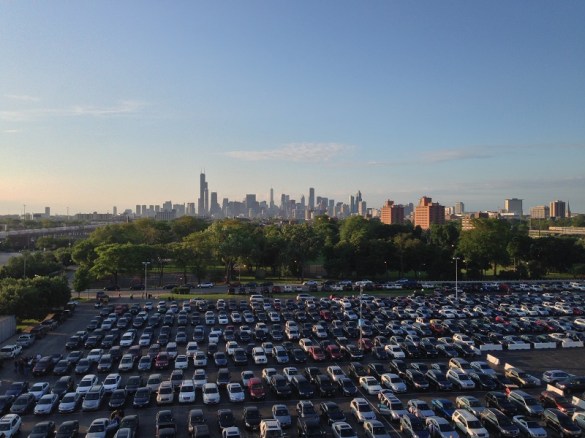
Chicago skyline from Gate 5 at U.S. Cellular Field

As a born-and-bred West Coast, California kid, I gleefully admit to my various friends my general ignorance about other climates around North America. Many of my friends are transplants who casually talk about missing seasons while secretly celebrating not needing air conditioning (or much heating) where they currently live in the Bay Area. I’m smug and glib about it, I know. So it’s those times when I go out of my comfort zone that I learn a lot more about baseball and the way it’s enjoyed in other parts of the country.

Midwesterners tell me all the time about weird summer weather and turning leaves. None of it is a good substitute for me experiencing that weather. So it was with a little disappointment that I learned just prior to this weekend’s Chicago trip that the weather would be mostly overcast or partly sunny during the day with highs in the upper-60’s/low-70’s, lows in the low-50’s. I thought to myself, That’s the weather I’m USED to, I didn’t bargain for this. Rain would not be a factor in any of the five games on my slate, with only a tease of thunderstorms on the way in and out of Chicago. Alas.

View from my seat of Wrigley Field grandstand. Ramps and fence behind grandstand are visible.

View from my seat of Wrigley Field grandstand. Ramps and fence behind grandstand are visible.

Still, since I was in the area four days, there was time to experience the game at a less rushed pace. Friday was the big doubleheader, a 1:20 game on the North Side and a 7:10 tilt on the South Side. I went to the Cubs game solo and the A’s-White Sox game with Zonis, who lent me a day parking pass for his street just three blocks from Wrigley Field. I had been so used to taking the El up to Wrigley Field that I wanted a different experience, and there was no way I would pass this up. Safe navigation to Zonis’s house completed and after a chat with the young man and his dad (they had just completed their own mini ballpark trip to Milwaukee and Beloit), I walked out of Zonis’s house and started the three block walk.

Vinyl covered exterior seems loud, no?

Vinyl covered exterior seems loud, no?

Then I heard it. The pregame organ. It’s a siren song to the residents of the neighborhood, telling everyone that’s okay to come out and play, to cut school or work, to enjoy a day at the yard. It’s something that often gets ignored coming from the Addison Red Line station because of train and crowd noise. In the comparatively tranquil setting of the Lakeview neighborhood, the organ made me feel like I was already there, that the neighborhood was a big theme park where all the streets would eventually lead me to Wrigley. No other urban ballpark is as integrated to its environs as Wrigley Field is. Fenway comes second at night when it turns into Red Sox game mode, but Wrigley really shines for these day games, making Fenway a distant second. Nothing else comes close, because of the way new ballparks are designed to be insular.

Wrigley Field exterior along Addison Street

Wrigley Field exterior along Addison Street

Wrigley famously has very little façade. Behind home plate is the light gray concrete structure accented by green and the distinctive red marquee. It’s not brick or sandstone, and there’s little to write home about. At some point recently the Cubs decided to have huge vinyl signs of the players cover up much of the concrete, as many newer parks have done. As much as I appreciate the blast of color, I miss the old humble concrete. Along the first and third baselines are chain link fences, so the back of each deck is exposed to the street it faces. Narrow ramps and corridors fill some of the space along the fences, creating numerous places for fans to stand. The back of the lower deck is also a great place to catch some sun, especially if you don’t have the gift of a sun-kissed seat close to the field (or the bleachers for that matter). One of the downsides of the open back is the lack of wind buffeting. Throughout the back of the grandstand the wind has a tendency to swirl, whereas close to the field the conditions are downright placid. An open back design would never pass muster in the current era. Potential neighbors would complain about the lack of noise insulation that a façade and other elements provide. Owners and architects would push for a design with more heft, and that requires a façade whether it’s stone, brick, or glass.

Gate 5 at U.S. Cellular Field is separated from the ballpark by 35th Street. Fans who enter here use footbridges to enter ballpark.

Gate 5 at U.S. Cellular Field is separated from the ballpark by 35th Street. Fans who enter here use footbridges to enter ballpark.

I had a seat in section/aisle 223, row 27, which had me hopelessly stuck under the upper deck overhang with a column in plain view (but not obstructing). As the winds swirled around and brought the shade temperature down to the mid-50’s, my jacket-less and goosebump-ridden self started to look for ways to warm. The back of the lower deck was nice option. Wrigley’s compact design and unique network of ramps makes it easy to move among the decks. There’s only one concourse at street level, beneath the 200-level seats on the lower deck. I made my typical shutterbug walk in the 4th inning to capture as much with my camera as I could.

The true beauty of Wrigley reveals itself best when emerging from one of the tunnels in either the left or right field corners. Up a long stairway, suddenly you’re among the lucky sun-drenched fans. Ferris Bueller and his friends made the LF corner idyllic, whereas Steve Bartman made it notorious. You go there and then you figure out ways to stay there forever. As the shadows move during the game, those further away from the field down the 3B line get their sun taken away, a cruel tease.

wrigley-03-seatview-sm

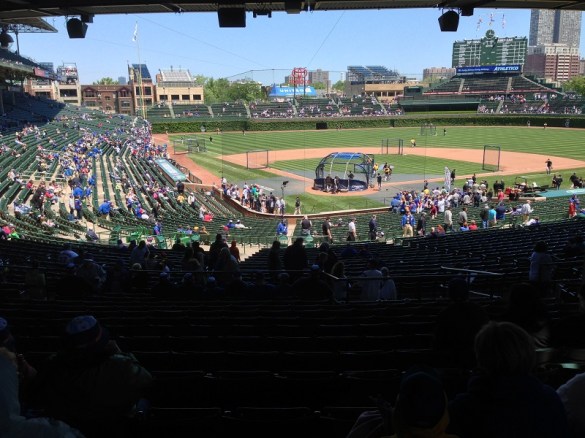
View of home plate from my seat at Wrigley Field

Old Comiskey Park was even worse from a sun standpoint. The upper deck was only 16 rows from the field in foul territory, and completely hung over the lower deck in fair territory. While Wrigley was “wide open” behind the lower deck, Comiskey had windows to let some natural light in. Nevertheless, Comiskey’s reputation was always darker and more foreboding, an image owed to numerous factors such as the South Side location, the catacomb bullpens, and the generally darker, danker atmosphere.

View of home plate from my seat at U.S. Cellular Field (night game)

View of home plate from my seat at U.S. Cellular Field (night game)

Knowing what Sox fans had experienced for decades, Sox owner Jerry Reinsdorf would give fans coming to the new Comiskey Park (nee U.S. Cellular Field) a much sunnier, wide open experience. The suite/upper deck cantilever is only a few rows above the back of the lower deck. Initially there was only a small roof covering the upper rows the upper deck. With a modern design derived from Kansas City’s Royals Stadium, New Comiskey was to be the more family-friendly albeit less intimate experience. Ramps were well removed from the concourse, especially the ones on the 3B side (across 35th Street). Escalators brought fans to their exclusive levels on three seating levels, with no way for fans to move from one level to another without proper admission. Seating sections were narrow to provide better access. The outfield seats were a single level, fully exposed like the Wrigley bleachers, and had full concessions plus a huge concourse. Enormous scoreboards and a video board were placed along the outfield, blocking much of the view of the less-than-desirable neighborhood to the southeast.

us_cellular-14-sunset-sm

Upper concourse at U.S. Cellular Field

The upper deck concourse was also exposed, with only the tall seating bowl providing protection from the elements. That was changed in the 2004 renovations, when the concourse enclosed with translucent windows providing natural light. The Gate 3 ramps provided gorgeous views of The Loop, but the ballpark was built in the era before recognizing skylines, so New Comiskey turned its back to the city. Reinsdorf eventually reduced the park’s capacity while introducing touches reminiscent of Old Comiskey, such as the more extensive roof.

And so we have the starkest contrasts in ballpark building (multipurpose stadia don’t count as ballparks per se), mere minutes from each other on the Red Line. There’s “The Cell” with its hulking, seemingly impenetrable concrete edifice, and Wrigley, where the boundary between the ballpark and its neighborhood almost doesn’t exist. The former advances sun at the expense of intimacy, the latter brought intimacy well before anyone cared to consider ballparks as intimate or not intimate. We’ve seen the era of multipurpose stadia rise and fall, to be replaced by retro ballparks that feign intimacy while providing virtue for sun-seekers. It’s a summer sport, and in a place where summer really exists for only three months, we’ve seen owners and fans take great care to appreciate every bit of summer they can get. While Californians take summer for granted, those in the Continental climate savor it just a little more than we do. Therefore I can’t blame new ballparks like The Cell or Comerica for not being intimate. They’re just trying to give as much summer to as many fans as they can bring into the ballpark. As much as I prefer an aggressive cantilever to bring upper deck fans closer, I can see the argument against it. It took a trip to Chicago to fully understand the dilemma.

Chicago-Milwaukee trip redux

Originally I had planned to be in Chicago through Sunday. Thanks to some work-related trip changes (this was entirely a leisure trip and it makes more sense than flying home and flying back to the Midwest during the week), I’ll be here through Monday. That last-minute change has allowed me to reshuffle my schedule while I’m here. Good thing I didn’t buy tickets too far in advance. Here’s my revised schedule:

  • Thursday, June 6, 7:10 PM – A’s @ White Sox. No promotion. Ticket purchased.
  • Friday, June 7, 1:20 PM – Pirates @ Cubs. Promotion: Cubs floppy hat (fishing cap), first 20,000 fans. Ticket purchased.
  • Friday, June 7, 7:10 PM – A’s @ White Sox. Promotion: Fireworks
  • Saturday, June 8, 3:10 PM – A’s @ White Sox. Promotion: 1983 White Sox T-shirt, first 20,000 fans [I loved the old logo BTW]
  • Sunday, June 9, 1:10 PM – Braves @ Brewers. Promotion: Carlos Gomez bobblehead

I realize that I haven’t followed up much on meeting up with the Chi-town faithful. I’m also in Milwaukee for Sunday night (what-what). Please reach out to me in the comments or via e-mail/Twitter and we can figure something out. See you at the yard.

Marlins Park

Note: For more pictures, check out the Flickr set I uploaded from the weekend. I’ll be doing this for all future ballpark visits. When I have time I’ll add old ones too.

View from RF corner at Marlins Park

View from RF corner at Marlins Park

Ever since the first indoor major league baseball game was played at the bold, brash Astrodome in 1965, purists have lamented the absence of character and quality in the domed game. Too loud, many said. Artificial, especially with the advent of fake turf. Aesthetics were brutally utilitarian because all of the early domes were multipurpose. Trading in difficult climates for air-conditioned perfection meant a lack of natural light and the regular smells and sounds of the outdoor game. In 1989, SkyDome took a big step forward with its retractable roof, even as all of the other dome elements remained the same. Eventually technology evolved to the point where there are now five newer retractable roof ballparks in Phoenix, Seattle, Houston, Milwaukee, and as of last year, Miami. The political side of how Marlins Park was built and funded has been well documented, so I won’t cover it here. Instead, I’ll focus mostly on the ballpark itself: how well it does hosting ballgames and how well it’s integrated into the neighborhood and city.

marlinspark-26-littlehavana-sm

View from near where I parked my car west of Marlins Park

I had driven 4 hours from Tampa to Miami in a beat-up rental, battling torrential (yet normal) rains along Alligator Alley. Marlins Park is set in Little Havana at the former site of the Orange Bowl. I could come here a thousand times and still be struck by the juxtaposition of this enormous, gleaming edifice dominating the landscape against low-slung, generally low-income housing. When the Orange Bowl was there it all seemed the fit – a rickety old stadium set among rickety old houses. There’s no worry about gentrification here, as Little Havana will have no trouble retaining all of its old charm and character. Great, inexpensive food from just about everywhere in Latin America abounds within a mile or two of the park. And the unique parking situation, carried over from the Orange Bowl, remains completely intact. Anyone driving through the surrounding neighborhood on game day will see a multitude of flag-waving residents luring cars to their yards with the promise of cheaper parking. The official garages charge $20, within a block it’s only $10. If you’re willing to go a block further, like me, you can find parking for $5. I found an older Cuban gentleman sitting on a chair next to his corner lot, and when he said parking was only $5 I was sold. Many of the yards are partly paved to accommodate cars so they’re prepared for this, and street parking is a no-go for non-residents, so cough up the $5 and walk the two blocks.

Triangular ramp at first base gate

Triangular ramp at first base gate

Two monuments commemorate the old football stadium: a painted column on the lower deck commemorating the old stadium’s history, and the arrangement of the distinctive “Orange Bowl” letters on the east side of the ballpark. It’s not much to show for all of the history the stadium has experienced as the host of a major bowl game and the University of Miami Hurricanes, but it’ll have to do. The ‘Canes have swapped places with the Marlins, playing their home games up north at Dolphins Stadium.

First pitch for the Mets-Marlins tilt was set for shortly after 4 PM, perfect for the retiree set. I had been told that there’s absolutely no reason to buy a walkup ticket at the box office. That assessment was proven correct as there were numerous scalpers assembled along the streets leading to the main plaza behind home plate, west of the stadium. $10 later (should’ve been $5) and I had a seat in the outfield at field level. Apparently the Marlins are giving away blocks of promotional tickets to get people in the park. On both Saturday and Sunday the tickets I bought were marked “promo”.

Main concourse

Main concourse

The plaza is certainly friendly enough, with lots of open space and numerous tents and stages set up most weekends. Saturday had a performance by Cirque after the game in the plaza, whereas Sunday had a large tent setup for a pet adoption drive. The tents and canopies helped soften up the plaza, which is flanked on the north and south ends by the concrete tracks that guide the rolling roof. The first time I saw those tracks in the original renderings I swore they were inspired by the USS Enterprise. Two restaurants are tucked into the street level facade, along with the team store and a cell phone outlet. The home plate gate is nothing to write home about, with simple gates leading straight to escalators that go up to the promenade (main level). The third base gate (SW corner) has a unique triangular ramp structure, perhaps the most elegant architectural element at Marlins Park. Its support columns are on the inside of the triangle, giving the appearance of the segments floating in mid-air. Unlike most other stadia, the ramps had limited access. The club, suite, and other premium levels were not accessible from the ramps, which was perhaps the first indicator of Jeff Loria’s disdain for the regular fan.

Outfield at Marlins Park

Outfield at Marlins Park

Neither gate has much in the way of a grand entrance into the concourse. It felt like entering a mall through one of the side entrances. Once inside, however, the space opened up fully and looked magnificent. Wayfinding signs were set just so, and the place had a very museum-like quality to it, precise yet inviting (fitting considering Loria is an art dealer). The promenade was at least 40 feet wide everywhere, with the concourse floor covered in a colored, textured surface resembling terrazzo. Regions of the concourse were color-coded in bright primary colors. Strangely, even though the Marlins adopted orange as one of its main colors in its image revamp prior to the opening of Marlins Park, there is precious little orange inside the stadium. Concourses, walls, and tiles are blue, red, yellow, and green. Everything else is museum white. Teal, the team’s former main color, has been banished. Loria left the garish treatment for the lime green outfield walls and the ever controversial home run scuplture by Red Grooms, a painted steel ode to sealife that resembles the backdrop of a pinball machine.

Seating bowl from center field

Seating bowl from center field

Concessions are surprisingly ho-hum. There is a “Taste of Miami” food court area, and a concessions stand in right center serves up pressed Cubano sandwiches, but everything else is fairly standard, uninteresting fare. Although pre-made, the Cubano was better than I expected. There’s no carvery or wok station like Target Field. There aren’t even any portable grills for fresh hot dogs, or a single permanent grill like the Saag’s stand at the Coliseum. It’s not just that the grill provides a better tasting sausage, it also contributes to the ballpark atmosphere via the wonderful aroma of grilled hot dogs, Italians and brats. Without that element, the air inside smelled a little too clean and conditioned. It felt  arena-like.

With food and beverage in hand, I passed up my seat beyond the bullpen in right and looked for the best sneakdown opportunity I could find. I found one in section 3, about 15 rows up from the RF line. Pretty much everyone was sneaking down at some point, and I had no idea why the hundred or so people sitting in the upper deck were still there. After the sandwich was consumed I walked around the full length of the concourse, which has a view to the field from every section including center field. An enormous Budweiser bar stands in center and was quite popular. The Bacardi bar on the other side looked downright desolate, despite both having many of the same offerings. If anything the Budweiser bar benefits from being backed by the huge glass curtainwall doors in left field. The doors and roof weren’t open as there was some rain in the forecast and the temperature was 86 degrees outside. (By the way, the beer selection at Marlins Park is terrible, as one would expect from South Florida.)

marlinspark-07-columns_roof-sm

A good look at how the roof column and truss system is put together, cutting into the seating bowl

A long escalator in left took me to the upper deck, which was depressingly empty. For both games, only a single concession stand was open. I saw directly behind home plate in the fourth row and liked the view (and the A/C effectiveness) better than at Minute Maid Park. The Marlins chose to stack most of the luxury suites behind the plate, with only a handful along the baselines at club level. That makes the first row of the upper deck behind home plate roughly five stories above the promenade, a somewhat common Populous practice these days (Progressive Field, Busch Stadium). The cantilever of the club and upper decks is not particularly dramatic, so it doesn’t feel very intimate despite the relatively low seating capacity (37k). Regardless, the upper deck didn’t have bad seats, and there didn’t seem to be any obstructed views. There are huge columns that interrupt the upper reserve seats down the third base line, but there seemed to be enough space to prevent obstructed views.

Those columns probably made the roof system a lot cheaper to build, as a much shorter than usual truss system was constructed. The roof itself is similar to those at Safeco or Minute Maid, a two-way multi-panel rolling structure that retracts to one end of the stadium (in this case, behind the first base line). The roof is tilted slightly from north to south, and the ceiling panels are steel, which contributes mightily to a serious amplification effect. Even though there were less than 20,000 at both games, when they got loud it sounded like 40,000 thanks to the roof. This effect was needlessly enhanced by the extremely loud PA system, which Fangraphs’ Wendy Thurm (@hangingsliders) complained about bitterly on Sunday. Worse, the PA had the most unconscionable practice of playing piped-in boos over the loudspeakers when the Mets homered. The sound was unmistakeable as it sounded like two or three guys booing into a microphone. No way that was the crowd. The PA certainly didn’t lend any organic crowd feel to Marlins Park, that’s for sure.

The Clevelander after the game

The Clevelander after the game

I didn’t have access to the club levels so I can’t comment on what goes on there. I did check out The Clevelander in left field after the game. A branch of the popular South Beach bar, The Clevelander has very expensive tickets ($50 seats, $30 SRO) during the game, but has free admission after the game. I followed much of the younger crowd to the club and marveled at how perfectly Miami the setting was inside a ballpark. DJ? Check. Dancers? Check. Full bar? Check. Pool? Check. Multiple lounge areas and a patio? Got that too. The Marlins and The Clevelander have to make an extra five figures just by having the place open after games. It’s not for the purist, but for the casual fan, it’s a must-see.

Despite the convertible nature of today’s dome, any domed ballpark has to be judged differently from open-air parks. The ability to control the environment is simply too much of a factor to compare fairly to open-air parks. As it stands, Marlins Park reminds me of a brand new Rawlings baseball, fresh out of the box. It needs to rubbed up with a little mud. It needs some character. Perhaps if the team didn’t go bust in 2012 and there was some carryover to 2013, I could describe the feel more positively. For now Marlins Park is a place with a good bones, waiting for a good team and a good crowd to arrive.

Panorama from upper deck

Panorama from upper deck

A quick visit to Tropicana Field and the Tampa Bay market’s problems

If you’ve never visited the Tampa Bay Area and you know little about the market, you might be inclined to think that St. Petersburg is an excellent, central location to place a ballpark for the Rays. Tropicana Field is roughly 30 miles from the northern end of Pinellas and Hillsborough counties and 30 miles from Sarasota, whose separate MSA (Bradenton-Sarasota) holds another 688,000 residents. All told that 3.6 million citizens in the eight-county group is often considered a better representation of the full market than what we usually read in the media or in studies. It’s roughly 120 miles north-to-south and 50 miles east-to-west, plus the bay to displace it. By comparison, the nine-county San Francisco Bay Area is around 150 miles north-to-south and 50-70 miles east-to-west, certainly larger in area by not appreciably given the diminishing rural population at the fringes. One key difference is that the SF Bay Area has twice the population, 7.2 million. And in its oft-criticized yet mostly functional public transportation system, the San Francisco Bay Area has a secret weapon that Tampa Bay doesn’t have, one that could really help fans get to a ballpark more easily. Even if only 20% of A’s fans make it to the Coliseum via BART, having that option removes some friction because there’s always the option not to drive.

Tropicana Field looks central in this view

Tropicana Field looks central in this view

Local pols in Pinellas and Hillsborough counties are trying to put together a regional transit coalition that would widen some key bridges and construct a light rail system. Something like BART would be far too expensive in this era, which is a big reason why you see light rail being deployed in emerging metros and not electric third rail systems like BART. Even if they are successful, the place would have to become much more densely populated to properly support a major league team on a 2.5 million season attendance clip (30k/game). St. Petersburg is particularly not dense, with an area slightly 25% larger than the City of San Francisco and less than one-third SF’s population.

With so many numbers and issues swimming around in my head, I took some downtime while I was in the Tampa Bay area to properly drive around and get a feel for the market – as good as I could for several hours. I stayed a night near the St. Petersburg-Clearwater airport. The hotel was across the way from the Carillon business park, touted last year as a potential Rays ballpark site. The site was close to equidistant from downtown Tampa, St. Pete, and Clearwater, which should have made it convenient for about 2 million of the region’s population. Alas, the concept died, leaving Rays owner Stuart Sternberg still pining for Tampa and St. Pete Mayor Bill Foster shutting down any talks with the rival city.

Friday night I stayed in the Westshore area of Tampa near the airport. Westshore is at the eastern end of the Howard Frankland Bridge, the non-toll span of I-275 that carries the bulk of the traffic between Tampa and St. Pete. It’s where you can find Tampa International Airport and Raymond James Stadium. 5 miles west of downtown Tampa and Ybor City, it’s as close as you can get to being in St. Pete while actually being in Tampa. Around 5:30 I was trying to figure out what to do. The Rays were in Cleveland, and the only Florida State League team hosting a game was Dunedin, several miles north of Clearwater. A trip that normally would take 30 minutes was advertised as taking 50 minutes due to the rush hour commute, so I decided to pass. Pinellas County is notorious for having few freeways, making commutes in much of the peninsula much like crosstown commutes in San Francisco – slow and arduous. Thankfully, Cigar City Brewing was closeby so I could work on my beer appreciation.

Saturday morning I took the 20+ minute drive to Tropicana Field. Before I got there, I drove through a rather depressed neighborhood north of the stadium. Notable businesses nearby include a government health clinic, U-Haul truck center, and a strip mall with a check cashing shop and a dollar store. No event was being held at the Trop, but there were cars in the parking lot so I parked and went to the entrance to take a look.

Ebbets Field? Um, maybe not.

The security guard was nice enough to let me take a few pictures of the rotunda

Tropicana Field, formerly known as the Florida Suncoast Dome, was built without any specific guidance by a MLB team, and it shows. It opened at the end of the static dome era, a year after SkyDome (now Rogers Centre) dazzled fans with its moving roof and other technology. It has a moat around the outfield exterior and a rotunda that was added to resemble that of Ebbets Field. Sadly the rotunda looks more like a library foyer than the inspiration. It’s the main entrance to the stadium, as most of the parking is on the east side of the Trop. I couldn’t go any further than this, which is unfortunate as I would’ve like to take some new pictures of the main concourse, which reminds me of an 80’s mall arcade without the carpet.

Gate 1 at Tropicana Field

Gate 1 at Tropicana Field

Inside, Sternberg has done about as much as he could to put lipstick on this pig. There’s lots of color everywhere. Party boxes were placed down each foul line to cut into the foul territory. Astroturf was replaced by more grass-like Astroturf, which somehow looks worse on TV than the old stuff due to its weird sheen. Tarps were placed in the upper nosebleeds to reduce capacity, and like the A’s it hasn’t helped attendance. Little has worked. The atmosphere is still dreary, the catwalks still strange and frustrating. Sternberg wants out and he has reason to want out, but the alternatives are not cheap or easy. No city is going to build the Rays a ballpark for free, including cities outside the market. The team is stuck at the Trop until 2027 unless Sternberg chooses an expensive buyout after 2017. Plans to turn the Trop into a redevelopment zone have gone nowhere. The Rays are in an arguably worse position than the A’s stadium-wise, since the Rays are bound by the lease and Sternberg can’t formally speak to Tampa about new digs.

Worse, it’s easy to get the sense that as far as baseball goes, the Rays have to fight just to be recognized in the region. Despite their recent World Series appearance and multiple playoff appearances, the team has to compete with 4 Florida State League teams in the market, and the Yankees, who have a radio affiliate and their spring training facility in Tampa. Plus there are all those other Grapefruit League teams quenching any early baseball thirst in March. Maybe the Rays would have a better chance if there wasn’t as much competition. A new ballpark could help as long as the franchise wasn’t saddled with debt. No wonder then, that Bud Selig hasn’t exactly pushed hard on this one. That M.O. sounds familiar…

Angel Stadium of Anaheim

angel_stadium-08-seating_bowl_night

Angel Stadium during the early May-laise.

People ask me all the time if the Oakland Coliseum could ever be converted to a ballpark the same way Angel Stadium was in the mid-90’s. My reply is always the same: No. The secret to why the Angel Stadium conversion worked is simple. It was a ballpark from the beginning. The Coliseum started out as a football stadium that was converted to serve as a ballpark, whereas Angel Stadium (nee Anaheim Stadium) went through the opposite transformation. Anaheim’s case was that of an appendage that could be discarded. Oakland’s was the case of a round peg fitting into a square hole.

angel_stadium-01-lot_exterior

Pleasant pregame environs in Anaheim.

Completed in 1964 1966 at Gene Autry‘s behest, Anaheim Stadium was arguably a more Californian vision of a modern ballpark than Dodger Stadium to the north. Parking was and still is smoother and more efficient than in Chavez Ravine, and the site is close to three freeways (5, 57, 55, 22). It had somewhat remote views of the San Gabriel Mountains.  Other tourist attractions like Disneyland and Knott’s Berry Farm a stone’s throw away. Like Dodger Stadium it had low wall and wraparound lower deck in the corners. The biggest difference in Anaheim was the wider-angled bowl, which made the neck-craning effect more severe down the lines but significantly reduced foul territory in the process. When the Rams vacated the Los Angeles Memorial Coliseum for Anaheim in 1980, Angels fans got their own version of Mt. Davis – a complete enclosure of the stadium and Candlestick-like foldout seats in right field.That made the capacity of the stadium a cavernous 65,000, with little hope of filling that on a regular basis during the 80’s. The Rams only stayed at the football-expanded Big A for 15 seasons, after which native Missourian Georgia Frontiere took the team to St. Louis. That gave Disney, which assumed control of the franchise in the mid-90’s, the opportunity to remake the stadium the theme park-like manner one would expect of the company. A man-made rockpile was placed in center field as the focal point of the renovation. The iconic “Big A” structure which once dominated the outfield stayed in the parking lot, to many fans’ chagrin. Walls inside the stadium were given a sand color with red accents while the plazas outside the regular concourse were freshened up to hide the numerous ramps and exterior concrete. A Metrolink (commuter train) station was added at the outskirts of the parking lot, providing an alternative to driving and parking.

angel_stadium-04-outfield1

The distinctive albeit kitschy outfield

Walk into the Big A and you can see why the conversion worked. If you squint a little, you can see the same main seating deck layout as the one found at Camden Yards. In both places, the field level deck is split into two, with the concourse set around row 23 and a back seating section (in Anaheim known as the Field Terrace) providing 10 more rows of seats. A club level with eight rows rises above the Field Terrace, and suites are tucked behind the club seats. Above the premium facilities is the upper deck, which is also split into lower and upper tiers. The arrangement proved so successful that it was used in Baltimore and at the new Busch Stadium. Not bad for a stadium that will turn 50 next year.

angel_stadium-03-club_concourse1

Club/suite concourse

Yet there is a sense that, despite how good the bones are at the Big A, it’s falling behind the rest of baseball. Most of the work completed by Disney in 1997 focused on getting rid of the football seats in the outfield and the creation of multiple club facilities in the regular bowl. Arte Moreno even moved the writers’ press box from its prime location behind the plate to down the right field line. Even with the various incremental improvements, it’s hard to get past the main deficiency within: the concourses are narrow and are disconnected from the action. That’s a problem at both Busch and Camden Yards as well. At Busch, the Cardinals chose to punch large holes in the upper half of the field level to provide some views from the concourse. Don’t get me wrong – I’d switch the Coliseum for the Big A in a heartbeat – but in the face of the continuing evolution at Dodger Stadium, Moreno’s going to push hard to create an optimal environment for the Angels and fans.

angel_stadium-06-knothole_club

Knothole Club, the only indoor restaurant on the club level, is way in the right field corner

A few weeks ago I took in a game in the club level, which has wait service. Cheap bastard that I usually am, I usually bypass such options at a ballpark. Since this was on the company dime, how could I resist? The loaded chicken nachos I had weighed 5 pounds and felt like it half-finished in my subsequently unsettled gut. The concessionaire is Aramark, and if you’re wondering if things improved by going to a bigger, richer market, they didn’t. Aramark provides tiers of service and options, so I know they’re better than this. Still, it sure seems like competitors like Centerplate are eating Aramark’s lunch, so to speak. Beer selection is also wanting, easily the worst among the West Coast major league parks.

When Moreno took over the team after the 2002 World Series victory, he grew the fan base by lowering ticket, concessions, and beer prices. Already the family-friendly alternative to the Dodgers, the Angels quickly jumped beyond the 3 million attendance mark annually and stayed there for years to come. Moreno’s hunger for a World Series of his own and to compete head on with the Dodgers fueled huge free agent purchases, including Vlad Guerrero, Torii Hunter, and Vernon Wells. Moreno never quite got the brass ring, which led to the bat-oriented spending spree of the last two seasons, Albert Pujols and Josh Hamilton. The Angels’ payroll this year is $137 million, not including whatever pitching acquisitions they have to make at midseason if they decide that they want to chase the pennant despite their awful April. Even though the franchise is bolstered by a $150 million per year TV contract with Fox Sports (that’s as much as the A’s make from ALL local revenue sources), they continue to raise ticket prices well beyond what would be considered affordable.

Like the A’s, the Angels are hurtling towards the end of their lease, this one in 2016. There is an extension that could keep the team in Anaheim until 2031, but no one expects Moreno to pick up that option unless some additional, major changes are made at Angel Stadium. Moreno has been quiet on the prospects for Angel Stadium or a new ballpark somewhere in the area. Tensions between him and the City of Anaheim over the team name have calmed. Chances are that if Moreno wanted a new ballpark, he’d have to make it happen at the current 100+ acre site. With redevelopment’s dissolution, there’s little available in the way of public financing. Even in 1997, the $117 million renovation (a huge success compared to the Mt. Davis debacle) was 82% financed by Disney, with the public portion already paid for. There’s enough goodwill to do another major renovation along the lines of what the Dodgers did during the offseason, but Moreno will have to pay for it himself. If he wants to talk about a new ballpark, the only site outside Anaheim that could remotely support it is the City of Industry site being pitched for a NFL stadium. Talk about that came and went quickly last year. AEG’s downtown site has also been pitched as a relocation spot, but a retractable baseball dome is so highly incompatible with AEG’s plans that it’s hard to take such an idea seriously. If Moreno has designs on a park elsewhere in the market, he’s being very coy about it.

The Angels’ future is secure thanks to their whopping TV deal and their solid fanbase. The franchise is worth well over a billion dollars at this point (thanks Dodgers) and there’s little reason to leave Anaheim. The stadium could benefit from revamped clubhouses and improvements to the rather barren club/suite level. In right field is the oft-forgotten Exhibition Center, a 29,000 square foot space that would probably be better used partly as a baseball museum that could attract fans 365 days a year. Moreno could spend $100 million on such changes, with some development rights to the land as the City’s contribution, and the ballpark would be roughly on par with Dodger Stadium, if not the newest parks. That fairly modest investment from both sides should keep everyone happy for decades to come, pennants and World Series trophies notwithstanding. Is that enough for Arte Moreno? Only he knows.

Chicago-Milwaukee trip

The flights for the Chicago-Milwaukee trip have been booked. Barring any unforeseen changes, I’ll be flying in Wednesday evening, June 5th, coming back June 9th. Here’s the game itinerary:

  • Thursday, June 6, 7:10 PM – Phillies @ Brewers. Promotion: Harley Davidson Crew H-D night.$18 upper deck ticket + free admission to Harley Davidson museum. 
  • Friday, June 7, 1:20 PM – Pirates @ Cubs. Promotion: Cubs floppy hat (fishing cap), first 20,000 fans
  • Friday, June 7, 7:10 PM – A’s @ White Sox. Promotion: Fireworks
  • Saturday, June 8, 3:10 PM – A’s @ White Sox. Promotion: 1983 White Sox T-shirt, first 20,000 fans [I loved the old logo BTW]
  • Sunday, June 9, 1:10 PM – A’s @ White Sox. Promotion: N/A

It’s sure to be good times. If you live in either the Chicagoland or Milwaukee areas or happen to be passing through, let me know and we can have a chat over a beer (or several).

Dodger Stadium post-renovations

The middle game of a three-night set at Dodger Stadium had thousands of discounted tickets available on StubHub, a reminder that even for teams with $200 million payrolls and season attendance totals surpassing 3 million almost regularly, it’s still possible to find a deal. Or in Tuesday night’s case, an empty house.

I came because I happened to be in town for a week and I wanted to catch a game at either Chavez Ravine or Anaheim. I also wanted to take the Dodger Stadium Express, the bus that runs directly from Union Station to Dodger Stadium. This year there was also the added benefit of a bus-only lane going up Elysian Park Drive to help speed up the trip. I calculated that it took 15 minutes to get from Union Station to the intersection of Sunset and Elysian Park, then less than 5 minutes to get to the final destination behind centerfield. As you can see from the picture below, the buses get packed. It’s a good option for those who want to take Metro or a Metrolink train in. The $1.50 fare is waived if you show a ticket on the way in. The driver doesn’t bother to check for anything on the way back.

Inside a packed Dodger Stadium Express bus

The Tuesday night game had no giveaway and was billed as Taiwan night. Pre-game festivities included a traditional band from Taiwan who played a mournful version of The Star Spangled Banner. Since this is Hollywood, there was also a purely commercial wrinkle as the American band Fall Out Boy was on hand to promote their new record. Pete Wentz threw the ceremonial first pitch. I entered the stadium greeted by this view.

Before sunset with the normally late-arriving crowd

There isn’t much else to say about the experience, other than that the scoreboards by ANC Sports are quite impressive. Circulation between the levels is still impossible, and since I got the $11 ticket near the RF foul pole, I couldn’t go any higher than the club concourse. The final crowd (announced 35,898) was not much better than what you see above. I assume that the events surrounding the Boston Marathon incident may have scared some people off. The Padres dropped a 4-spot on the Dodgers in the first inning off Chris Capuano, so the small crowd that showed up wasn’t tempted to stick around for long. Security didn’t seem heightened to a great degree.

A new display set above the RF Pavilion

The best way to describe the new scoreboards is to think of them as a set of three. The lower part along the outfield fence is an out-of-town board and a State Farm ad. When a Dodger comes up to bat it usually changes to an animated intro. This is mirrored on the small display underneath the diamond/hexagon large display. The strip is a great addition because it’s the perfect spot for a perpetual in-game line score. Unfortunately, the geniuses at Dodger Stadium don’t keep it perpetual at all, instead choosing to include the strip as part of the ongoing multimedia presentation. The big board is very impressive. Even the funky shape works to the team’s advantage, as there are little nooks for the clock, the on-base situation, even logos for the teams above the lineups. When a Dodger comes up to hit, the LF board shows a big picture (in keeping with the old setup) and on the bottom corner is the player’s Twitter handle. Statistical presentation is clean and modern, though it could use more advanced stats.

I was eventually able to sneak down to the field club seat area down the lines. By the 8th inning everyone wanted to go home. An attempt to sing Sweet Caroline in honor of Boston was met with a big SoCal “meh”. WiFi was supposed to be better, but I couldn’t tell. Who knows what would’ve happened if the game were better? We’ll never know. Maybe the next time I go to Dodger Stadium, someone will give a damn.