Turner Field and Chase Field opened for baseball in 1997 and 1998, respectively. Turner Field was a gift to Atlanta courtesy of the 1996 Summer Olympics, whereas Chase Field was a domed stadium borne of necessity in order to host the expansion team in the searing Sonoran Desert summer. Both are in the 15-20 year-old range, putting squarely in a sort of venue midlife crisis.
The Braves are leaving Turner for the richer suburbs in Cobb County. Turner will be renovated again and reborn as a football stadium for Georgia State University’s growing program. Georgia State had been playing its home games at the far-too-large Georgia Dome. They’ll play one more season there. Come Fall 2017, they’ll play in the reconfigured (and soon-to-be-renamed?) Turner, where much of the baseball grandstand will remain intact. The seats in right field will be ripped out, replaced by a new smaller grandstand that will run parallel to the sideline. Georgia State bought both the stadium and the surrounding parking lots for $30 million, all of which will be transformed into additional athletic facilities, dormitories, and academic buildings. GSU’s main campus is in downtown Atlanta, a similar distance between San Jose State’s main campus and its south campus, where Spartan Stadium and other outdoor facilities are located. Final capacity of the redone stadium will be around 30,000, 33% smaller than Turner’s baseball capacity and less than half of the Olympic stadium configuration.

Turner Field renovation for Georgia State University football
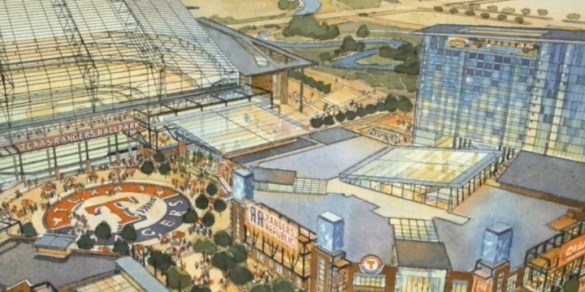
Speaking of 30,000, that could be the new capacity of Chase Field, if an investment group that wants to buy and renovate the ballpark has its way. A partnership headed by Integral Group wants to modernize Chase and develop a few blocks of unrealized potential between the ballpark and Talking Stick Resort Arena down the street. Plans were approved for redevelopment of that area outside the ballpark in 2008, squashed by the recession. Integral is notable for being one of the partners in Ronnie Lott’s plans for the Coliseum which will include at the very least a new Raiders stadium. There are also plans (or at least space) for a ballpark should the A’s have any interest, though it’s unclear how that would pencil out.
To push the Chase concept further, Maricopa County is looking to sell Chase Field for at least $60 million, depending on appraised value. That value could include those additional blocks along Jackson St. Phoenix is undergoing a resurgence which started in earnest around 2013, thanks to numerous tech companies opening campuses near Tempe and Scottsdale, along with gentrification of some of the older neighborhoods in Phoenix. The County’s motivation isn’t primarily to spur development. They’ve been in quite a battle with Dbacks ownership over who’s responsible for $65-137 million in improvements to the stadium. They already rejected the lower figure, meant to cover peripheral items like scoreboards, suite refurbishment, and cosmetics. Major projects such as reimagining the upper deck and outfield concourse are well down the road.
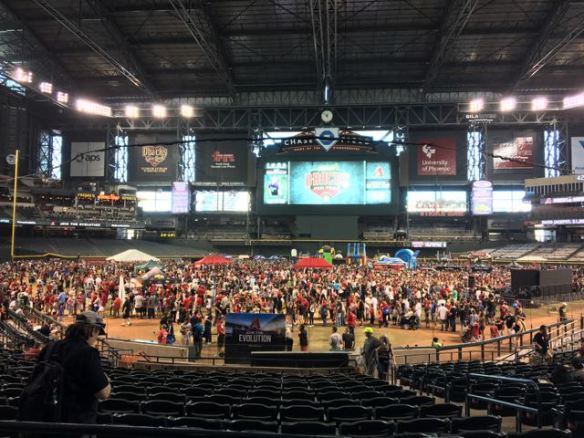
Diamondbacks FanFest with Chase Field roof closed
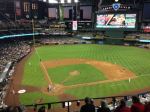
If I were looking to rework Chase, I’d look entirely at the block containing the stadium. There are 3-4 acres of additional space outside the walls that isn’t properly used. The photo above shows what it looks like with the roof closed. Gigantic ads that double as windows (when the weather cooperates) dominate the view. When the roof is open for games, the place transforms into an almost fully outdoor park. It’s not as complete a transformation as Safeco Field or Minute Maid Park, but it’s close.
-
-
Chase Field – Roof closed
-
-
Chase Field – Open windows
-

-
Chase Field – Open roof
Limitations imposed by the building’s design and the need for an air-conditioning environment prevent a full opening of the outfield. The contents could be rebuilt to great effect. A gym exists in center behind the batter’s eye, with parking dedicated to it. All of that should be scrapped and rebuilt as a children’s play area and a midway with rides and a carousel. The current children’s area is in the upper deck left field corner, notable only for having the stadium organ located there as well.
The main plaza on the west side where most of the gates are is also wasted space. It deserves a revamp with restaurants and bars that are open more than on game days. There should also be a way to directly connect the buildings in the plaza to the ballpark so that the whole area can be navigated outside the stadium.

Then there’s that 30,000 figure. That doesn’t happen without knocking down most of the upper deck. Like US Cellular Field, that should help to make the place look less cavernous. Once that’s done they’ll have to put something behind the seats to fill that space. They don’t need more suites or amenities up there. Tacky looking signage? Curtains a la an arena? A second partial roof inside the original roof? It’s a tough task to make Chase Field look intimate.
While the Phoenix market’s economy has rebounded, downtown near the sports venues is still not a hotspot despite the numerous venues (ballpark, arena, convention center, theater, ASU’s downtown campus, museums). It’s largely event-driven, with more interesting restaurants and bars on the other side of downtown. It goes to show that no matter how much money and resources is thrown at a neighborhood it doesn’t always translate into a lively district.
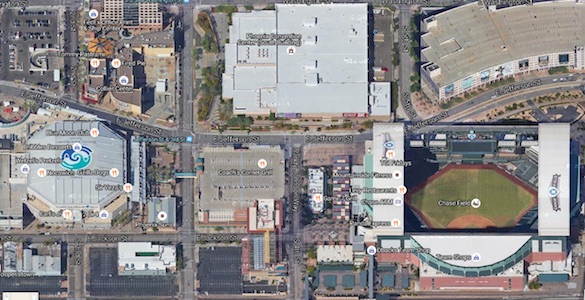
20 years later, the area between the ballpark and arena remains mostly parking
Fortunately for everyone involved, the ballpark is debt-free and has been for years. Same goes for the arena. Like Oakland, Phoenix and Maricopa County find itself trying to please two teams looking for new venues at the same time. There’s no inherent competition between the teams for sites or land, but they will be pushing for resources. In the past Maricopa County financed numerous sports facilities using a car rental tax, which has now been deemed unconstitutional. A similar tax just for the City of Phoenix is also being challenged. Phoenix owns Talking Stick Resort Arena. And finally, the Dbacks have the option to veto any purchase of the stadium by a third party. The Dbacks previously discussed buying the park from Maricopa County, which seemed like that most natural route at the time. Let the team make the investments since they’ll get all of the proceeds. The process may end up with such a deal happening since the Dbacks are the linchpin to everything. That doesn’t mean it’ll be easy. The Dbacks could attempt to leave Chase Field completely in search of a location outside downtown Phoenix, but without the aforementioned tax revenue streams a move threat doesn’t have legs. There’s a really good shell at Chase that could be fixed up into a fairly intimate ballpark for far less than the cost of a new ballpark.





 newballpark.org