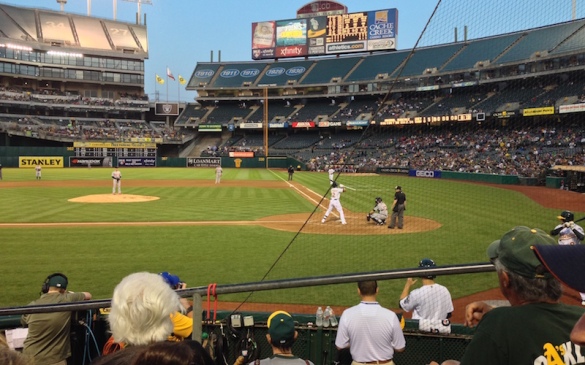
Manfred addresses ballpark topic

Yahoo Sports’ Jeff Passan held a wide ranging interview with MLB Commissioner Rob Manfred, published earlier today. Included in the questions were a couple about the stadium situations for the A’s and Rays:

Two NFL teams are about to move. Baseball is the sport that has gone the longest since a franchise relocated. Are you nearing that situation with Tampa Bay or Oakland?

It remains my strong preference, because I think it’s a policy that has served baseball really well over time, to stay in the markets where we’re located. We’re going to exhaust every possibility to get stadiums done in Tampa Bay and Oakland. But clearly you would think I was sort of la-la if I didn’t recognize at some point in time it may be necessary to consider alternatives.

No one should be terribly encouraged or discouraged by this. Manfred will clearly let this process play out and see where it leads, even if that means a dead end in either market. When that runs its course, we’ll see what (if anything) opens up. San Jose partisans may look at this as good sign for them, but that’s waaaaaaaayyyyyyy down the road.

I’m more encouraged that Manfred is clear about his position. He’s not mincing words like his predecessor, or saying “it’s complicated” or uttering expletives when asked. Manfred’s too early in his tenure to be worn down about the issue as Bud Selig. Check in again in five years. Manfred is happy that the Rays will get to explore all of the Tampa Bay area, even if the financing picture there remains bleak. As for Oakland, there’s this:

One step forward, two steps back for Port of Oakland as major terminal operator ends lease

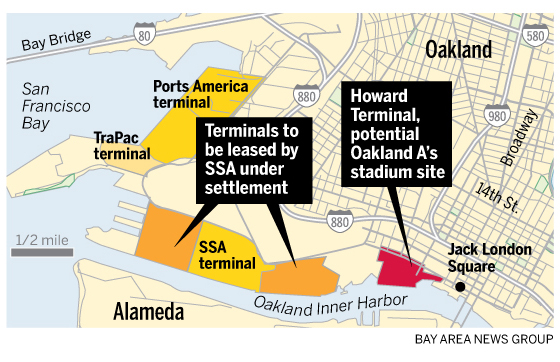
As the hubbub surrounding Howard Terminal grew to include a major deal between the Port of Oakland and shipping giants Matson and SSA, I wrote about a piece about potential fallout from the deal. If Matson and SSA were to get a favorable deal from the Port, what would happen to Ports America, which operates an even larger terminal in the Outer Harbor, near the Bay Bridge?
Credit: BANG

Ports America property near Bay Bridge to be vacated. Credit: BANG

In 2013, Ports America threatened to sue the Port over the SSA settlement because it threatened their own deal. This week the company decided to terminate its 50-year lease at the Port of Oakland, pulling out of the Port entirely. PA was only 6 years into that 50 year lease. The company chose to expand operations at other West Coast terminals at Tacoma, Los Angeles, and Long Beach.

At a State of the Port address, officials tried to spin the departure as a way to benefit the other remaining operators, who are below capacity and could use the business Ports America is vacating to improve profitability. TraPac, which runs a terminal adjacent to Ports America’s Outer Harbor facility, is nearing a deal with the Port to take over a 44-acre section from PA.

That would leave 166 acres vacant, potentially available for another operator, other types of cargo (bulk, cars), or as Commissioner Bryan Parker indicated, for a ballpark or stadium. That’s in addition to the 50-acre Howard Terminal, which has been targeted time and time again as potential ballpark location. On the other hand, the shipping of coal has been an idea vigorously debated for some time, even floated as an option for HT. I hope it never happens because of serious local environmental issues (West Oakland deals with enough now), but the revenue situation may eventually cause the Port and City to consider it. PA was expected to provide more than $35 million to the Port this year, a quarter of the Port’s projected revenues.

At first glance, 166 acres looks appealing because of its size. That would be plenty for a Raiders stadium and parking. The location at the foot of the Bay Bridge has its appeal. But it’s 2 miles from the West Oakland BART station, and although the BART tracks run next to the property, they’re always on an incline because that’s where the aerial section transitions to the Transbay Tube, so no infill station there. The location is also quite windy.

The Coliseum’s fate notwithstanding, Raiders and A’s fans might welcome the possibility of large, publicly owned parcels like this. However, “free” land isn’t really free. It comes with a price, measured in the number of jobs lost at the Port (up to 1,000 at PAOHT) and lost revenues. San Francisco endured the transition by going whole hog on giving up shipping completely, allowing Oakland to expand and consolidate. Despite efforts to modernize facilities and transform unused lands like the Oakland Army Base to better accommodate the shipping and logistics industry, Oakland finds itself having to make compromises and decisions that negatively affect operations at the Port.  And if a Raiders stadium is proposed at the Outer Harbor, it will surely be challenged by the other shipping companies that surround the property.

Add this location to the list of options, I guess. I know this much: there’s no way in hell the Port is going to get $35 million a year from something sports related, even if they have three stadia on Port property.

P.S. – Before you ask – NO, A BALLPARK CANNOT FACE WEST. Unless you like bad shadows and batters not being able to pick up the ball properly.

News for the week: Tommy Boy Edition (1/16/16)

While Mark Davis drowns his sorrows with some beer and wings, pondering his next move, we should consider what else has been happening this week. After all, unless either the Chargers decide to stay in San Diego, Davis is more-or-less stuck in Oakland. He could conceivably apply to move to a vacated San Diego or San Antonio, but that require going through this rigmarole again with a much smaller payoff. So we’ll let whole football thing settle down for a few weeks. If you want to understand what Oakland is getting ready to offer the Raiders, read my post from November.

Matier and Ross reported earlier this week that Oakland Mayor Libby Schaaf is pushing Howard Terminal hard for a new ballpark, which is no secret. Included was this nugget:

The city would probably also have to come up with at least $90 million in infrastructure improvements, including funding for a car and foot bridge connecting Howard Terminal to Market Street east of the railroad tracks.

That $90 million figure is no accident. Schaaf is offering the Raiders the same amount for infrastructure at the Coliseum. She’s trying not to play favorites with either team. Of course, there is the danger of spiraling costs, and Oakland is putting itself in the position to carry the debt burden all by itself, since it’s nearing a deal to buy out Alameda County. As costs rise, the question will linger over how much Schaaf is willing to support before the projects become untenable. At least her staff has acknowledged the need for an overpass at Market Street, which was a major issue for me. Frankly, I think they need two overpasses because of Market Street’s location well away from Jack London Square. If you want to get reacquainted with Howard Terminal, read my various posts about the site.

Other news:

  • The City of St. Petersburg’s City Council approved by a 5-3 vote to allow the Rays to explore other stadium sites outside the city limits. That includes all of Pinellas County (St. Pete is the county seat), and neighboring Tampa and Hillsborough County. It’s too early to tell whether this will ultimately lead to the end of the Rays’ tenure in St. Pete, but proponents are at the outset painting this as the team’s best chance to stay in the 4.3 million-strong Tampa Bay Area, which has proved poor for attendance and excellent for TV ratings. As always, the biggest issue is figuring out how to pay for it. Head over to Noah Pransky’s Shadow of the Stadium for complete coverage.
  • The Warriors are pushing back the opening of their arena to 2019 to accommodate the legal challenge by the anti-arena Mission Bay Alliance. MBA also sued UCSF’s Chancellor and now has two lawsuits against the arena project in different jurisdictions. It’s a legal Hail Mary that will largely depend on whether the arena will be afforded an expedited legal review. (SFGate, LA Daily News)
  • The new arena near the The Strip in Las Vegas has a $6 million per year naming rights deal with wireless carrier T-Mobile. (Las Vegas Review Journal)
  • Hartford’s downtown ballpark is delayed and has $10 million, for which no one has figured out how to pay. Thanks to the delays, the AA (Eastern League) Yard Goats will be forced to play on the road for the first six weeks of the season. (Hartford Courant)
  • Walmart announced a slew of store closures, including a store in south San Jose and the Oakland store on Hegenberger near the Coliseum. The store will close Sunday, which led @fanpledge to wonder if it could work as an A’s ballpark site.

Most importantly, the In-N-Out in the northeast corner can stay intact. I’ll cover this site in greater depth later.

Rams win LA, Chargers and Raiders in limbo, reactions

At the very least, you have to give it to the NFL owners for being decisive. They wanted a team in LA. They wanted a team with strong (rich) ownership in LA. They got it. Everything else is unresolved. Here are the big takeaways from today’s LA-centric owners meetings:

  • Earlier in the afternoon, the LA Committee voted 5-1 in favor of the Carson proposal.
  • After a few hours, an initial full ownership vote favored Inglewood over Carson 20-12, not enough votes to win outright
  • After some additional horse trading, the owners held a final vote before 8 PM local time (Central). The outcome was 30-2 in favor of the Rams moving to LA in 2016 with the Inglewood stadium being their future permanent home starting in 2019. The Chargers can also move to LA. The Raiders withdrew from consideration for LA.
  • The Chargers were given first dibs at being the Rams’ tenant in Inglewood. They could also choose to stay in San Diego with an extra $100 million (aside from G-4 loans, I’m assuming) towards a local stadium.
  • The Raiders will also get an extra $100 million to use in Oakland. In a post-vote press conference, Commissioner Roger Goodell said, “We want to incentivize the community to get the stadium the Raiders need. That’s what the $100 million is for.”
  • Chargers have 1 year to decide on moving to LA. If at any point they balk, the Raiders will have 1 year from that point to decide on whether to move to LA.
  • Nothing precludes either the Raiders or Chargers from considering other markets. What is not clear is whether either team will get any sort of discount or waiver from a relocation fee for other non-LA markets.

Reactions, first from the Raiders:

raiders.jpg

Chargers owner Dean Spanos:

spanos

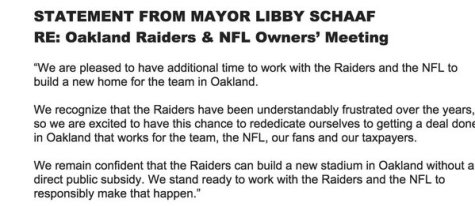
Oakland Mayor Libby Schaaf:

oak-mayor

The Coliseum JPA:

jpa

San Diego Mayor Kevin Faulconer:

sd-mayor

The winners here are Stan Kroenke, since he clearly won the deal, and to a lesser extent the NFL, because it got a team back in the #2 media market and a future LA Super Bowl home, along with a new headquarters for the NFL Network.

The Raiders and Chargers are both serve in heaven, rule in hell positions. Either they figure out how to get additional public money from their respective cities, or they agree to be tenants in LA. They could also look at San Antonio or St. Louis, but that’s for another day. The $100 million the NFL pledged to the Raiders is far short of the $400-500 million funding gap. The new money could help in San Diego, where the plan is more fleshed out, though it’s too early to call that until the Chargers’ stadium vote goes through in July.

Most importantly, both teams and the NFL have lost LA as a reliable, utterly predictable stalking horse. St. Louis and San Antonio don’t inspire the kind of fear that Los Angeles does. Neither Spanos nor Davis talked much about their current cities. Davis evaded questions about San Diego and San Antonio after the presser, summing up his options in clumsily grand fashion.

“America, the world is a possibility for the Raider Nation.”

The Inglewood Compromise

“Inglewood Compromise” sounds more like a Cold War era weapons treaty than a pact between football teams, yet the latter is what we’re facing. Now that it’s clear that Cowboys owner Jerry Jones has pushed for such a concept and that it may be gaining momentum, it’s time to start thinking about what it could mean for the teams at the center of the debate, and of course, our beloved Oakland Athletics.

Of the two Los Angeles stadium plans, Stan Kroenke’s vision at Hollywood Park (next to the Forum in Inglewood) is furthest along. Most of the land there has been cleared, including the area set aside for stadium construction. The same can’t be said for the land in Carson, which needs a final round of remediation before any construction can begin there. Inglewood is encountering some resistance in the form of FAA objections over the height of the stadium and the materials used for it, but these issues can be mitigated. Besides, other stadia have been built beneath airport landing approaches before, including SAP Center and Levi’s Stadium.

This slideshow requires JavaScript.

While the NFL is pushing for 50/50 partnerships regardless of site, it’s clear that Kroenke would run the show in Inglewood whereas Dean Spanos would do the same in Carson. That goes for stadium design to some level of revenue control. If Mark Davis could find a way in he’d be happy with the arrangement, if only because his team’s revenue-generating capacity would be so much more than the abysmal figures he’s been pulling down in Oakland. The thinking is that under the Inglewood Compromise, Kroenke would provide concessions that Spanos needs to ditch the Carson plan, whatever that entails.

That would leave Davis as the odd man out, locked out of the LA market perhaps forever. The Raiders would be stuck with Bay Area, namely Oakland, as its best local hope for a new stadium. Oakland has been largely consistent in saying it would provide no public money, though it has gone a little softer in opening the doors for infrastructure financing.

Assuming the Inglewood Compromise moves forward and crystallizes, the options the NFL could provide to the Raiders could come in a number of forms, even taken separately or together.

  1. The simplest option would be an extension of current talks between the Raiders and Oakland. At the moment there remains a $400-500 million funding gap on a $900 million stadium that would be the smallest in the league while not having the amenities or cachet necessary to host a Super Bowl. Raider fans are holding out hope that some of the potential $1.1 Billion in relocation fees paid by the Rams and Chargers could be rerouted to Oakland. Given that Roger Goodell shot down a similar idea floated by St. Louis stadium principals, it seems unlikely at this stage or Oakland. Goodell also dismissed the initial framework of Oakland’s proposal for the Raiders, calling it insufficient. More fleshed out proposals from St. Louis and San Diego were also considered insufficient as well. If it wanted, the NFL could create a new funding mechanism outside the existing G-4 loan program to help bridge the gap. However, I suspect that the NFL won’t consider loosening the purse strings unless the City of Oakland at least matches that extra money. By that I don’t mean land rights or sales, since land is considered table stakes for any stadium deal. I mean cold hard cash. So if Davis comes up with $200 million and the NFL matches it, the league could provide another $100 million or more but only if Oakland also matches that piece, $100+ million. Without that, I can’t see how the NFL could take Oakland’s overtures seriously.
  2. When the 49ers’ stadium project in Santa Clara started to come to fruition, the NFL tried to lean on Davis to partner up to allow for two teams at what would eventually be named Levi’s Stadium. Davis considered Santa Clara too far from Oakland so the talks never went anywhere. The NFL left Davis to work with Oakland, and we all know how that worked out. With a reset in talks coming for those two, the NFL could introduce Santa Clara again as a short term or long term play. The NFL remains concerned about revenue for the Raiders. Levi’s would be the most direct way to provide a boost. If Davis is more concerned about the atmosphere and experience in Oakland, then talks would prove fruitless again. But with the league bringing in those relocation fees, it could take $100 million, build out the second home team locker room in Levi’s, and provide enough money to make the stadium more Raiders-friendly through new flexible signage and other elements. Previously there was talk that the Raiders would be a mere tenant with the 49ers getting most of the revenue including for Raiders games. The NFL could grant a partial renovation G-4 loan to the Raiders for the renovations, making them more of a partner for the stadium. The NFL could also lean on the 49ers to provide more revenue to the Raiders, since the 49ers wouldn’t be on the hook for the renovation project. The 49ers had sought a minimum 10-year lease term to make the second team scenario work financially. If the NFL and the Raiders are footing the bill that’s no longer an issue. The Raiders could stay for a 5-10 year lease, with the ability to leave if an Oakland stadium opens during that time frame. Or the Raiders could find out over time that the arrangement actually works the best for them and forgo an Oakland stadium completely, as the Jets eventually did after they moved to New Jersey.
  3. Then there are the other relocation alternatives. San Antonio continues to be the city that tries to get noticed in all of this. That all seems in vain, though who knows what could happen when LA shakes out? Davis has friends in San Antonio, and he could use them to either bargain a stadium deal out of Oakland or to move to the Alamo City in earnest. There has been talk that St. Louis could try to attract the Raiders after being spurned by the Rams, but the NFL seems unwilling to accept their proposal regardless of which team the city tries to attract.

After trying to piece through all of that, Davis may decide that the status quo is the best plan at least for the short term. He could go back to Alameda to consider what he’ll truly need to commit to get a stadium deal done, and whether it’s worth it. As a man who has never built anything significant on his own, it has to be at the very least a somewhat appealing (and comforting) option. As I noted in the previous post, Davis hasn’t burned all his bridges yet as his counterparts Kroenke and Spanos have.

Poor, Poor Mark Davis

Judging from various media reports, Mark Davis is about to be rejected by the NFL in his LA pursuit, leaving him as the loser while the Rams and Chargers work out details of a shared stadium in Inglewood. I have no sense of the validity of that story, but there is something interesting about the process that came out of an article in the Orange County Register yesterday. To wit:

While Kroenke is adamant about moving and Spanos has accepted the fact that a move to Los Angeles is essential for the Chargers’ financial health, Davis has hurt himself with some NFL owners by wavering between Carson and publicly stating he wants to stay in Oakland. In particular, Davis undermined his argument for relocation during an emotional appearance at an October town hall meeting in Oakland set up by the NFL.

All three owners have pitched LA to their peers, with Kroenke and Spanos the most strident about not staying. But if I’m reading this correctly, Davis is actually getting punished for showing even the slightest amount of loyalty to Oakland. Kroenke may win in part by deploying a scorched earth campaign in which the Rams pump up San Diego and Oakland by claiming that Oakland will surpass San Francisco in gross domestic product in 10-15 years.

Maybe Davis simply hasn’t made a good enough case for his team compared to Kroenke and Spanos. It’s possible that Davis’s strategy, to play second banana to either team’s project while stating he was a full partner in Carson, was a foolish gambit. Apparently the owners feel that’s wishy washy. In the end Oakland may get to keep the Raiders after all, though there’s plenty of uncertainty still remaining about that.

The lesson? If you’re going to succeed in this game you have to be cutthroat. Empathy is a sign of weakness. That’s the NFL, folks.

End of 2015 Poll: When will the A’s move into a new ballpark?

Setting Terms: A Commitment to Exodus

Okay, there was real news about the Raiders and Oakland today, not rumors, so I feel compelled to write about it. I’m over the soap opera news cycle of the last year, looking forward to January, when something LA might (not) be resolved to the NFL’s satisfaction.

As St. Louis and San Diego provided stadium financing plans pledging $350-400 million in public funds for their respective stadia, Oakland officials offered a mere five-page letter promising no public money for construction, hoping that the NFL’s respect of legacy and history would help keep the Raiders in the East Bay. The NFL’s reaction was that the letter was expected, while Mark Davis expressed befuddled disappointment.

At this point, you have to think that based on the efforts City of Oakland and Mark Davis, few people within the NFL believe that any new stadium is going to happen in Oakland. The City has no will to do it, and Davis has spent far more time and effort on Carson than Oakland. The NFL will have to gauge the owner’s interest in resolving the Raiders’ situation against resolving the dilemma in Oakland. Of course, many within the league previously preferred to have the Raiders share Levi’s Stadium with the 49ers, the same way the Giants and Jets share MetLife Stadium. Even with Davis continually dismissing the idea, the concept remains a viable backup plan should nothing continue to happen at the Coliseum.

But again, my beat isn’t the Raiders except in how the Raiders’ plans might affect the A’s. From today we got a big list of deal terms the City is willing to make in the pursuit of the Raiders’ new stadium. Whether or not the Raiders stay, regardless of the Coliseum’s future as the home of the A’s, the numbers are effectively setting the bar for future stadium deals for either team. What is Oakland willing to provide? Let’s take a look at the “concepts” presented to the Raiders.

  1. 69 total acres in and around the Coliseum, including the “South 60” consisting of the B & C parking lots, plus the Malibu and HomeBase parcels. Also included are 9 acres of publicly owned land near Coliseum BART could be used for a hotel or other commercial development adjacent to an expanded BART station and transit hub. The Raiders and a partner developer would receive development rights based on the Coliseum City rezoning effort.
  2.  $90 million in infrastructure, to be designed and approved by the City of Oakland.
  3. No public money towards construction of the $900 million, 55,000-seat stadium. The Raiders would be responsible for all stadium construction costs, including overruns.
  4. At least 8,000 surface parking spots with minimal ancillary development.
  5. Raiders would own the stadium, City and/or County would own the land underneath. That would set up recurring ground lease and possessory interest tax (PIT) payments.
  6. Raiders would take in all stadium revenues while assuming all operating costs.
  7. City’s promised defeasance of the outstanding Coliseum debt (worth $100+ million now, goes down over time).
  8. Construction to start in 2017, stadium opening in 2019.

Per the A’s current lease at the Coliseum, if they are to be evicted because of new stadium construction for the Raiders, the Coliseum JPA has to give the A’s at least two full seasons at the Coliseum while they figure out where to play next. The lease terms also call for the A’s to be compensated for the scoreboards and for lost revenue associated with new football stadium construction.

If we’re to assume that the A’s should get a similarly valued deal to the Raiders in order to stay in Oakland, the deal would be worth $200 million straight away because of the debt and infrastructure costs, plus the value of any development rights wherever the A’s end up, whether that’s at the Howard Terminal, Uptown somewhere, or the Coliseum. That’s the price Oakland will have to pay, and MLB will be happy to press Oakland hard on that. The A’s are expected to build their ballpark entirely with their own money, so it should in theory be a pretty clean deal with no intrusions or complications created by new, single-purpose quasi-governmental agencies like stadium authorities.

Just to be clear, that’s $200 million in value, not cash. The A’s would never see that money except in terms of the completed infrastructure. It could be that certain sites have such high infrastructure costs that they could approach $200 million on their own. New parking garages, the community benefits agreements and PITs Mayor Libby Schaaf mentioned during tonight’s press conference – they’re all worth something. Will Oakland show as much restraint for the A’s as they have displayed with the Raiders? I imagine they would, though it’s far too early to speculate. For the time being, let’s continue to watch how the NFL-LA business shakes out, and see where the Raiders end up as a result.

A’s get an early Christmas present from Oakland

As rumors and nostalgia swirled around the Raiders and what might have been their last game at the Coliseum, the City of Oakland provided some news on the ballpark front as well. According to BANG’s Matt Artz, a 21-page report detailing several potential ballpark sites was sent to A’s ownership for their review. (PDF download)

City staff apparently scoured the city limits looking for sites. Some of them had already been studied in the past. Others haven’t been studied, though we have covered them here sometime in the past. The study is in an early enough stage that many property owners haven’t been contacted about land availability. It’s quite likely that many sites in the current study will drop off quickly, while others have yet to be discovered. Regardless, this is an exciting development that should hopefully lead to some productive talks.

From the quotes and the tone of the article, I expected little more than a rehash of previously dismissed sites. While that’s all there (Victory Court, Howard Terminal), the City included a total of 10 sites, including a couple of alternatives that have been mostly discussed on this blog and not much elsewhere. To me that’s a huge positive, because it shows that the City is willing to consider sites outside the normal developer/booster group focus. It’s a necessary step.

oakland

Four of the ten ballpark sites highlighted within Oakland

We’ll go over all of these in detail. But first I want to spend a moment discussing the USPS site in West Oakland. The 22-acre sorting facility, which you might see as one of the first things in Oakland as your BART train exits the Transbay Tube, is not going to happen. As noted in the document, the USPS site is not for sale. It might only be under consideration because of a twice-delayed initiative by the Postal Service to reduce the number of retail locations and sorting facilities like this one.

In the Bay Area there are a handful of these facilities in San Francisco, Oakland, San Jose, Richmond, and Petaluma. A list of closure candidates indicated that if any facility were to be eliminated or consolidated, it would be Petaluma. Oakland or Richmond could then benefit as it took on Petaluma’s capacity. In any case it’s highly unlikely that the Oakland facility would close down, making the site unavailable for future development.

Over the next few weeks you can expect a few hundred words on every site, including sites I’ve already written about several times. At the same time, keep in mind that unlike the Raiders’ situation, there is no deadline to providing anything to the A’s or MLB. The process is expected to work out much more slowly, which, quite frankly, is the only way to do this right.

P.S. – Bonus points for anyone who can identify a site in the list that I proposed a while back.

Baseball makes net expansion official

MLB continues to try to strike the balance between views and safety. Baseball announced recommendations for netting behind the plate, essentially extending the backstop to the inside edges of each dugout. Implementation of the new standard will be up to each club, since ballparks aren’t exactly uniform in terms of dimensions, even behind the plate. The press release:

MLB issues fan safety recommendations

Fan safety initiative leads to new netting recommendations for next year

Press Release December 9th, 2015

The Office of the Commissioner of Baseball has issued recommendations to all 30 Major League Clubs aimed at enhancing the safety of fans attending Major League Baseball games, while also preserving the interactive elements that are integral to the baseball fan experience.

The recommendations — which resulted from a review that began earlier this summer — include the following:

• Clubs are encouraged to implement or maintain netting (or another effective protective screen or barrier of their choosing) that shields from line-drive foul balls all field-level seats that are located between the near ends of both dugouts (i.e., the ends of the dugouts located closest to home plate, inclusive of any adjacent camera wells) and within 70 feet of home plate. The Commissioner’s Office has retained a consultant specializing in stadium architecture and protective netting to assist interested Clubs in implementing this recommendation.

• Although Clubs already provide warnings to fans about the dangers posed by batted balls and bats entering the stands and the need to pay attention to the action on the field during each at-bat, the Commissioner’s Office recommends that Clubs continue to explore ways to educate their fans on these issues and is providing Clubs with resources to assist them in this area.

• The Commissioner’s Office will be working with the Clubs and online ticketing sellers to identify ways to provide customers with additional information at the point of sale about which seats are (and are not) behind netting.

Commissioner Robert D. Manfred, Jr. said: “Major League Baseball prides itself on providing fans in our ballparks with unparalleled proximity and access to our players and the game taking place on the field. At the same time, it is important that fans have the option to sit behind protective netting or in other areas of the ballpark where foul balls and bats are less likely to enter. This recommendation attempts to balance the need for an adequate number of seating options with our desire to preserve the interactive pre-game and in-game fan experience that often centers around the dugouts, where fans can catch foul balls, see their favorite players up close and, if they are lucky, catch a tossed ball or other souvenir.

“I am confident that this recommendation will result not only in additional netting at Major League ballparks but also draw additional attention to the need for fans who make the choice not to sit behind netting to be prepared for the possibility of foul balls and bats entering the stands.”

The consultant not named in the release is expected to be Populous. The A’s and Giants are committed to making the change, though it may take some weeks before we hear specific plans. The Phillies are looking at a thinner material to use for the netting. I’m interested to see what it looks like.

Part of the view from Section 119 is "obstructed" by the backstop net

Part of the view from Section 119 is “obstructed” by the backstop net

Extension to the inside ends of the dugouts is unlikely to tamp down interest in complete netting from foul pole to foul pole, or at least in line with the edge of the infield down both lines.