What does it look like when the rich folks don’t show up?

It looks like this.

wbc-01-sections_top_sm

Club sections and suites were curiously empty for tonight’s WBC semifinal

For Sunday’s World Baseball Classic semifinal matchup between Japan and Puerto Rico, most of the suites at AT&T Park went unused, while both the field level and mezzanine clubs were full of fans disguised as empty seats. Announced attendance for the game was 33,683, at the low end of the Giants’ projections and well below the 36,000 I figured would show up. I went over some of the reasons why attendance could lag for the WBC in the last post, but I definitely didn’t expect to see no lights on in so many of the suites.

Considering that Japan was in the matchup and was expected to make it all the way to the final, I figured that there’d be more Japanese corporate presence in the park. That was evidently not the case, though Japanese fans seemed to outnumber Puerto Rico fans by a healthy margin. Monday’s game is expected to have lower attendance than Sunday, so a similar scene in the high-roller seats should play out.

A view from my seat early in the game

A view from my seat early in the game

Obviously, I’m oversimplifying things a little by only pointing to club seats and suites. Some well-to-do fans and perhaps some companies bought strips of regular seats. But it was clear from the start that all of facilities that the Giants and other MLB teams use to make their money weren’t in use tonight, including the aforementioned premium accommodations and the Virgin America Loft down the right field line. Some suites may have been used in Miami and Phoenix, but frankly I wasn’t paying that much attention since I hadn’t attended games in either location.

Some questions I have going forward:

  • Does this matter at all to the WBC and MLB?
  • Did the WBC overprice premium facilities along the lines of the advance ticket strips?
  • Are they even selling suites?
  • Who conceived the failed ticket pricing scheme?
  • What adjustments does the WBC need to make?

I took away two other observations from the game. First, even though the crowd was loud and boisterous, it may have also been the most polite, friendly baseball crowd of that size I’ve ever been in. The two nations were in it to win it, yet there was no visible animosity. Maybe that will change if PR meets the Dominican Republic in the final. It was a refreshing departure from some of the bitter Giants-Dodgers and A’s-Yankees crowds experienced over the years. Second, staffing for the game was much smaller than for a typical Giants game, suites notwithstanding. Even as the crowd was 8,000 smaller than for a sold out Giants game, it looked like up to a third of the concession stands were closed, especially on the View Level. I imagine that this had to do with the projected crowd. Maybe it also had to do with possible budgetary constraints set by the WBC for the host Giants. Either way, it was not something I was used to, and it looked similar to the upper deck(s) at the Coliseum. One of my friends in the upper deck left to get a craft beer in the 5th inning and had to go down to main concourse to find one, missing two innings in the process.

Did you watch the game on TV or in person? What did you take away from the game?

—–

I’ll be back Monday night for the Netherlands-Dominican Republic matchup. Bleacher tickets can be had for as little as $5.

World Baseball Classic tickets discounted to as little as $8

Tickets for the championship rounds of the World Baseball Classic at AT&T Park were priced quite heavily when they went on sale in December, often forcing fans to buy three-game strips for hundreds of dollars. That price gouging, in conjunction with Team USA getting eliminated last night by Puerto Rico, has caused the WBC to heavily discount numerous blocks of tickets in the last couple of days.

Prices for the two semifinal matchups were as low as $15 yesterday for nosebleed sections in left field and the back of the bleachers. Today the WBC dropped prices on better seats and locations for both games to just $8, a loss leader price if I ever heard of one. That is sure to upset folks who bought early, but it will delight casual fans and followers of the remaining teams (Japan, Netherlands, Dominican Republic, Puerto Rico) who are in town or are willing to make the trip cross-country.

wbc-late_pricing

Snapshot on 3/16 of severely reduced pricing on several sections with big unsold inventory

While premium sections are staying expensive, many areas that “fill out the bowl” have a good number of unsold seats, including groups of seats together. There’s a threat that AT&T Park will look empty without a contingent of US fans and the possibility that the DR/PR fans won’t be there in large numbers. The Bay Area doesn’t have a huge population of Dominicans or Puerto Ricans compared to the East Coast, so there’s reason for concern. A healthy number fans of Team Japan should be there, as we’d normally expect. Netherlands skipper and Giants hitting coach Hensley Meulens appealed to his fellow Dutchmen in the Bay Area to come out and support the Oranje, though they’re not expected to be there en masse.

On Friday I got a $15 bleacher ticket for Monday’s game between the Dominican Republic and the Netherlands. Today I snagged a $8 ticket for Sunday’s Japan-Puerto Rico matchup. A friend of mine who bought single game tickets in advance last month for Sunday’s game paid $72 for a View Box seat behind the plate. Yesterday those same seats were priced at $62, and now they’re $50. It’s possible that the prices could sink even further if there continues to be middling interest.

Running tournaments like the WBC can produce outcomes like this. Unlike the FIFA World Cup, which is assured of having the greatest players in the world playing for every participating country, the WBC is subservient to MLB, so fans aren’t treated to cream-of-the-crop competition due to pro clubs holding back players by rule or choice. Nevertheless, the competition has been excellent so far, with surprising pitching performances from the DR and an upstart club in the “Kingdom of the Netherlands” that threatens to be powerhouse for years to come.

If you have time and can spare a few bucks, the WBC semis are a steal on Sunday and Monday. And in the event that the final doesn’t sell that well, it may also be a good choice on Tuesday. Check it out.

Paid seat upgrades coming for A’s fans this season

As part of the growing trend towards e-ticketing, the A’s will start accepting admissions through Apple’s Passbook app on most recent iPhones. Erica Ogg of the tech site GigaOm reported that the program has expanded from 3 MLB parks in 2012 to 13 for 2013, now including the Coliseum.

Apple Passbook App with MLB e-ticket displayed

Redemption involves scanning a bar code much like the one shown above. Unlike my mostly positive experience with FanPass last year that involved scanning a credit card, the e-ticket should be sufficient and shouldn’t require a printed receipt for fans to have on hand in case an usher checks.

The SF Business Times’ Eric Young wrote yesterday that as part of this new wave of technology, for the first time the A’s will allow fans to purchase seat upgrades via MLB’s At The Ballpark app. Now that may sound like a joke considering the long history of “free” seat upgrades at the Coli, but really, Lew Wolff’s been planning for this since he unveiled the Coliseum North ballpark plan in 2006. During a game, fans can check in to the app and see an inventory of available seats. The inventory shown may not match what you see inside the seating bowl because it represents unpaid, available seats to purchase. When it’s really cold or there’s an unappealing opponent (or when the A’s suck), it’s common to have thousands of paid no-shows.

I look forward to using this several times this season just to see how dynamic it is. During some of the early April and May games when there are barely 10,000 fans in the house, it should show a ton of available seats. For Giants, Yankees, Cubs, and Angels games, the pickings should be much slimmer. Integration will be key. While scanning ticket will be done with Passbook (and presumably, Samsung Wallet on their Samsung phones), upgrades will be done through At the Ballpark. That lack of one stop shopping could be confusing for users at first. At the Ballpark is available for iPhone and iPad, as well as Android via the Google Play and Amazon Appstore.

As for the time-honored tradition of sneaking down? Well, when asked by Businessweek’s Brad Stone, MLB AM’s Bob Bowman had an answer for that:

“I think you’re harkening back to a slightly different day,” he says. “No matter what system you put in place, there will be people who do things like that. But increasingly in these stadiums that have opened in the last 15 years, you need to have tickets to get in there. This really isn’t for kids trying to sneak in on their own.”

It’s all part of the continuing drive for revenue, like it or not.

—–

Update 2:00 PM – I purchased a ticket for the second World Baseball Classic semifinal (TBD vs. Netherlands). The ticket was delivered to my Passbook. I’ll give it a shot on Monday and report back.

AEG no longer for sale, Leiweke out

There may have been a temblor in SoCal earlier this week, but today’s news coming out of LA is truly earth shattering. Sports and entertainment conglomerate AEG is having its auction halted. An executive shakeup has also occurred, with longtime CEO Tim Leiweke leaving. Owner Phil Anschutz will be “more engaged” in the company, and COO/CFO Dan Beckerman will now take the reins over Leiweke.

With Leiweke leaving, there is no longer a champion for Farmers Field. Beckerman may have been key to expanding the AEG empire to what it is today, but he’s still a bean counter at heart, not a vision guy. Leiweke was the visible champion for many projects, from Staples Center to MLS (in its early years) to Farmer Field. Unless Anschutz gains a newfound desire finish the job of bringing one or more NFL teams to LA, and Beckerman can sign off on the profit-related compromises that may be required to make it happen, Farmers Field is dead.

Beckerman’s first comments after today’s news spun it as if Farmers Field remains a major priority:

“The Company has a number of interesting business opportunities, and the expertise of the management team and our 26,000 employees around the world will allow us to select those prospects that best enhance the Company’s performance. Priority projects going forward include the development of Farmers Field adjacent to our L.A. Live campus and the pursuit of our plan to bring the NFL back to Los Angeles…”

AEG is only positioning in this manner because it’s potentially more valuable with Farmers Field in the portfolio, even if it’s only a fantasy at the moment. If one of the bidders were to come up with the $10+ billion offer to buy AEG, Anschutz would take it in a heartbeat. That’s not what he’s getting offered, so that’s why the company is being pulled off the table.

What does this mean for AEG’s operations at the Coliseum? It’s all status quo for now. When Oakland/Alameda County get around to settling on the scope of Coliseum City, then things could get interesting.

Sonics arena shows off some innovation

The Hansen-Ballmer group has developed a habit of releasing little bits of information every couple of days to stoke Sonics fans fires. A bit of arena info here, talk of season tickets there, a progress report down the road. It’s an effective way to keep those who are interested engaged, and should serve the ownership group well as they hit the home stretch in their effort to move the Kings.

Exterior shot with turbine-shaped cone representing arena footprint

On Wednesday several renderings of the SoDo arena were released. Previously, the public was treated to a planning document from 360 Architecture and some exterior renderings, but little was known about the interior of the building. Wednesday’s release borrows a few elements from baseball and football and integrates them into an arena concept, adding some new wrinkles along the way. I like what I’ve seen so far, and would love to see if these unique elements actually enhance the experience as arena backers think it will.

View from center court towards basket and end seats

View from center court towards basket and end seats

The lower portion of the above image doesn’t look much different from any other arena. Chris Hansen wants a hockey team to be roommates with the Sonics, so the arena has a longer multipurpose footprint to accommodate an ice rink. Above the upper deck seats are shallow rings of additional seats and standing areas, much like the mezzanine and upper decks in the end zones at Cowboys Stadium. It gives the appearance of an old theater layout with multiple balconies, and bears a passing resemblance to old McArthur Court at the University of Oregon. The idea is to better utilize the vertical space by replacing a dozen rows of nosebleed seats with overhanging mini-decks. Arena designers also claim that an additional 2,000 people can be brought in above the regular seated capacity via standing room admission for the ends. Before its replacement by the larger and plusher Phil Knight-funded Matthew Knight Arena on campus, Mac Court was well known as one of the loudiest, rowdiest, most intimate gyms in the nation. What this concept is trying to do might not succeed due to scaling, but there’s a better chance of making noise when more of the building’s volume is filled with people as opposed to just air.

Lower suites are 10 rows from floor and are not closed from each other

This next view shows some lounge-type areas behind the lower suites, which are a scant 10 rows up from the court. They remind me a lot of the patio suites at the Earthquakes’ stadium, which fit a gap between the exclusivity of suites and the openness of a club lounge. Since 360 is working on both projects, it’s not surprising to see concepts from one move into the other. I’d expect the same sort of borrowing for the final vision for Cisco Field.

View from “Sonic Ring”

There appear to be around 40 suites of differing sizes, along with two club levels along each sideline. The downside to this approach is that if a fan wants a sideline seat in the lower level, he has no choice but to buy a club seat of some sort. The corners and ends don’t have premium clubs, though it’s being hinted that the Sonic Rings may have their own special amenities. I can see that working extremely well for hockey.

Comparison of seating bowl cross-sections for Seattle arena and Staples Center

Another big claim is that the seating bowl will be steeper, which should improve sightlines for both hoops and hockey. To achieve this there’s only a single suite level between the “lower” and “upper” decks (the lower suite level doesn’t count because it doesn’t wrap completely around the arena). That allows for a greater rise for each row of seats. At the traditional upper deck, the steepness is similar to other arenas. Of course, those upper deck seats in other arenas don’t have three balconies above then. It’s a novel, albeit expensive, approach that from a cost standpoint is like building a fourth deck. Whether it’ll create the desired effect is unknown at this point. I’d love to take in a game when the place opens to see if it does.

Seating at the Fukuoka Dome

The whole package is a refreshing take on the boring, old oval arena. There’s a little Soldier Field in the way the Sonic Rings overhang each other, a little Cowboys Stadium and Qwest Field, and some Amway Center (Orlando) to boot. We haven’t seen interior renderings of the Warriors’ SF arena, but I hope they incorporate some of these ideas. It could be great for fans while allowing the W’s to boost revenues. During the early pool play of the World Baseball Classic, some games were played at the Fukuoka Dome. That venue has a novel seating arrangement with a single seating deck and three levels of suites above the seats. While there’s little else to love about the place, I kept thinking throughout watching games that the approach is something that could work in MLB in some modernization. The Fukuoka Dome seats 38,000, making it an ideal size. With some tweaking it could work for a new MLB ballpark.

2013 A’s TV schedule

When Comcast SportsNet released its A’s broadcast schedule for 2013, I took a brief glance at it and it looked similar to previous years so I didn’t pay much attention to it. This week I’ve had a chance to look at it in greater depth, and while it is not much of a departure from past years, there’s a quirky stretch in there that could throw fans for a loop. CSN California will show 144 regular season games and two spring training contests. The April 3 game vs. Seattle will be shown on KOFY-20 instead of CSN California, as both the Earthquakes and Kings have 7 or 7:30 scheduled games that night. As for the quirky stretch, it’s during the dog days of summer.

oakland_athletics_2013-august

Late July and August schedule has several games that will not be on CSN California

Thanks to a number of getaway day games both home and away, nine games in a month-long stretch will not be on CSNBA. This is something we’re used to, as the A’s prefer to have their “businessperson’s special” games not televised in order to get more fans out to the Coliseum (there are exceptions late in the season). Road games are more of a mystery, and seem like nothing more than cheapness or a product of a ratings cost/benefit analysis. In any case, it seems like there are a lot of holes in that stretch. Fortunately, three of the games during that month are Saturday day games that will be regionally broadcast on Fox (KTVU). In fact, the A’s will be on the big Fox network at least six times during the season, with the possibility of additional broadcasts coming at the end of the season if the A’s are in a pennant race. That’s a huge improvement over the mere two planned Fox broadcasts last season, one of which was a game against the Giants. Those six games with broadcast times are:

  • May 25 – Oakland @ Houston, 4 PM
  • June 15 – Seattle @ Oakland, 4 PM
  • July 27 – LA Angels @ Oakland, 11:30 AM
  • August 3 – Texas @ Oakland, 12:30 PM
  • August 24 – Oakland @ Baltimore, 12:30 PM
  • September 14 – Oakland @ Texas, 9:30 AM

There’s also the chance for games on ESPN, ESPN2, and TBS. Given those networks’ East Coast biases, I don’t expect any gaps to be filled in. ESPN and TBS haven’t filled out their season schedules yet, and TBS’s incomplete schedule is so heavily weighted towards the Eastern Time Zone that it’s worth asking why anyone from the West Coast would bother watching TBS.

Next year will be a little more complicated in terms of national broadcasts with the advent of Fox Sports 1. Fox will program frequent Saturday doubleheaders, with the day game on Fox and the night game on FS1 or both on the cable network. The deal calls for FS1 games to involve teams whose games are already carried and produced by Fox Sports regional networks. That could prove problematic for the two Bay Area teams, as they are under the Comcast SportsNet umbrella. Chances are that if we see the A’s and Giants on FS1, it will be with broadcasters from Fox Sports West/Prime, Southwest (Texas), and the YES Network, which Fox bought an interest in last year.

All told, the A’s will have 150 regular season games on TV, 144 on CSNCA and 6 on Fox. Get your radio out for the rest.

Albatross

When the season starts and you notice the A’s-themed tarps that will stay up the entire year except when replaced by Raiders-themed tarps, remember this:

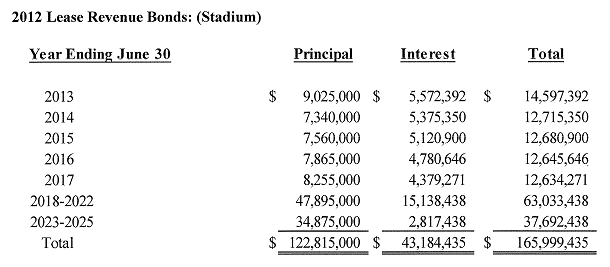
Payment schedule of Coliseum bonds

Payment schedule of Coliseum bonds

Last year the Coliseum JPA sought to refinance the stadium debt in order to switch the debt from variable to fixed rate. New bonds were issued in September.

It can’t be emphasized enough that whatever is planned in the future for the Coliseum, this debt has to be factored in. The City and County will want to repackage the debt in a way that takes the burden away from their respective general funds. Naturally, the A’s and Raiders probably want no part of this, considering how expensive it already is to privately build anything. Even if nothing gets built until 2018, $100 million in debt will remain, making that a sort of tax on any new stadium(s). The JPA is asking the A’s to pay more in rent, reportedly up to $3 million a year. Even then a substantial subsidy will be required. Ultimately, no deal on Coliseum City – no matter the size or scale – will go anywhere unless the outstanding debt at the Coliseum is addressed to all parties’ satisfaction. That’s a challenge as towering as Mt. Davis itself.

—–

Added 11:30 AM – Matier and Ross have an item covering the JPA’s ongoing lease negotiations with the A’s and Raiders. 

The tug-of-war for the five-year extension is over the $3 million in parking taxes that Oakland says the team owes, and over the A’s claim to about a third of the beer sales at the Coliseum – be they at an A’s game, a Raiders game, a U2 concert or any other event.

The tightrope is with the Raiders, who don’t like giving the A’s the beer money and don’t appreciate the A’s request for ballpark “improvements” that may come at the Raiders’ expense.

The parking tax referred to in the piece dates back to 2009, when Oakland unilaterally decided to enforce a long-dormant 18.75% tax per car at the Coliseum. The A’s hiked up parking fees from $15 to $17, and the price stayed there ever since. However, the A’s sat on the additional revenue while other details shook out, such as a revenue split between Oakland and Alameda County that was only settled last year. Assuming that a 2014-18 (or longer) lease extension can be worked out, the parking tax would be yet another detail to negotiate. The beer revenue split goes back to when the A’s sued the Coliseum Authority and received lease concessions, including a split on pouring rights for all events and some advertising revenues. As for the baseball-specific improvements that the Raiders may be resisting, I’m not clear on those. I’ll try to dig that up. All I know at the moment is that Lew Wolff has wanted an escape clause if the Coliseum undergoes changes for the Raiders. 

Finally, M&R end on a vague note – MLB might look favorably on Oakland if a short-term deal can be worked with Wolff/Fisher or “a new set of local owners”. Perhaps, but let’s be clear on a couple of things. First, even if Wolff were to declare today that the he and John Fisher were putting the team up for sale, the actual process to vet prospective bidders (such as a Don Knauss & Co. bid) and then complete the sale would take the better part of a year or more to complete, which is of no help to the A’s immediately as they try to work out a short-term extension. Second, MLB won’t approve a sale to an East Bay-focused group unless there is an ironclad ballpark deal in place. Otherwise there’s no point because the A’s would remain revenue sharing recipients indefinitely, even though it’s written into the CBA that they’re supposed to be off revenue sharing in the next several years. Third, MLB has offered to insert itself into the lease discussions, only to be told no by Wolff. Wolff’s making a leverage play here. He did well in getting a ton of flexibility in the last two lease negotiations. This time, talks are sure to be more rancorous. If MLB wants to float a feel good item to help soften up the JPA, I’m sure Wolff won’t mind. Finally, there’s the issue that appearing to help the A’s and MLB may send the wrong message to the Raiders, who are the only team directly working with the JPA and Oakland at the moment. It’s a very fragile, fluid situation. No one said it’d be easy.

Stern goes Mutombo on Mastrov bid, rules out expansion in Bay Area

NBA commissioner David Stern made a trip out to Oakland to talk up the Warriors as a “model franchise” and the team’s trip next fall to China, where they’ll play preseason games against the Lakers. Stern’s event had another large contingent of media from Sacramento, who wanted to hear Stern’s take on last week’s bid to save the Kings by Mark Mastrov and company. NBA Commissioner David Stern says Sacramento bid is “not quite there” financially compared to Seattle. He’s hopeful it will be eventually. To ensure that Sacramento lines up its (final?) bid properly, the NBA will hold a meeting on April 3 so that everyone has their ducks in a row in advance of the Board of Governors meetings on April 12-13.

That, folks, marks the end of the short period of Stern as bystanding non-arbiter. In case anyone thought that this was about anything other than getting the biggest, best bid possible for the sale of the Kings, it isn’t. The owners want to see their franchise values grow. If the McCourt disaster did it for baseball franchises, the Maloof debacle could certainly do it for hoops. Earlier this week a rumor was floated that the Hansen-Ballmer group might have to pay a $75 million relocation fee, instead of an amount closer to the $30 million Clay Bennett paid to move the Sonics to Oklahoma City. The owners want their piece, and David Stern’s last major effort as the commissioner will be to facilitate that. The man has played the whole thing perfectly. Now, the NBA and the bidders have kept the details close to their respective vests, so we can’t say for certain how low the bid was or how much it needs to be raised. I know this much: Mastrov put in a $420 million bid for the Warriors nearly three years ago. Stern and the owners know that Mastrov can raise capital, whether they’re bidding for 100% or 65% of the Kings. Fortunately for the Sacramento bid, there’s a few weeks left to raise the bid. Now it’s a lot like competing bids for a house in a seller’s market. The best offer with the most cash wins. You know what they say on the court: Come strong or don’t come at all.

Stern was also asked about the chances of a second Bay Area team coming via expansion if the Kings left, and he swatted that notion away. Stern left it to the Board of Governors (owners) and his successor to wrestle with that concept.

“I don’t think that we’re in for expansion of the league, any time soon. That’s just the way it is. … There are no territorial rights barriers. The only barrier is a vote by the NBA’s Board of Governors, but they’re being convened to consider the application to sell the Kings and to move the Kings.”

There’s no incentive to entertain talk of expansion as long as this bidding war – and it is indeed a bidding war – is on. Maybe after April the NBA and the losing city/bidder can talk about a framework to get an expansion or future relocated team. Chances are that even then, that losing city/bidder will be left to lick their wounds, and if it’s Sacramento/Mastrov, after having being on the losing end twice (last year for Sac when the Maloofs reneged, Mastrov in 2010 with the W’s), everyone may want to take some time to determine how much effort they want to put into this yet again. There’s just as much emotion that goes into these efforts as there is money.

I’ve thought that the horse race mentality that some of the Seattle and Sacramento partisans recently have taken on was silly, but this news  certainly makes the proceedings feel like a horse race. One of these cities will have a lot of broken hearts in early April.

Big fish, small pond (and vice-versa)

USA Today NBA writer Sam Amick has a 2-for-1 today in the form of a solid interview with USC Sports Business Institute’s David Carter prefaced by a recap of the ongoing Seattle-vs.-Sacramento drama. Carter tries to get to the heart of the issue facing NBA owners next month: Is it better to be the 5th team in a larger market (SEA) or the only team in a smaller market (SAC)? Carter doesn’t take sides, instead choosing to lay out the cases for both. He also expanded the discussion to include the implications of trying to build something in California, where public funding for stadia is difficult to attain. The end of the interview has a response that encapsulates the issues in Sacramento and throughout the state so well that I had to quote it here. (Questions come from Amick, answers from Carter)

Q: I’ve been hearing a few things about the public subsidy coming into play with Sacramento’s offer, potentially around $255 million that they would put into the arena, and the idea that the NBA has concern about walking away from that type of public contribution – especially in California – where it’s so tough to get public contributions. If they walk away from it, they lose a blueprint they’d like to use moving forward. Does that pass your smell test?

A: “That’s a great observation. We’ve seen that with not just teams, but teams and venues throughout the state – from San Diego to obviously now Sacramento. The Bay Area is a good example, and LA has been at the center of it. These leagues want to be able to extract public subsidies, and if they don’t do that then it gives other cities the opportunity to point the finger and say, ‘Well they didn’t kick in tax dollars over there, why should we here?

“If it’s a quality, free-standing business that’s going to be competitive in the marketplace, then it should be able to survive on its own. That would be one side of the argument. The other side of the argument, from these owners – and it’s a good one – is that there are a lot of people who are enjoying our product and not paying directly for it. You have a sense of pride in your city, even if you don’t attend a game or you don’t watch too many of them on television. Someone needs to pay for that externality, for that benefit that the community is getting for having this company in town. You could argue that that subsidy is supposed to cover that benefit people are getting from having the team there. Maybe it’s more of theoretical bump than anything else, but it’s fair to say, ‘What’s Green Bay without the Packers?’ That’s truly a sports company town.

“Maybe if it’s an amenity, or if it’s a resource that a lot of people want and can identify with, then maybe people should be paying for someone living vicariously through their product but not paying for it.”

Take that into your weekend. I’m going to refrain from commenting on it for now, as I’d like to see what responses are elicited first.

Carolina (Panthers) on everyone’s mind

Before you read the rest of this post, head over to Deadspin and read about the Carolina Panthers’ leaked financials from the last two years.

Then read the Charlotte Observer’s piece, which includes a response by the Panthers.

—–

The leaked document came from Deloitte, and there’s nothing to indicate that it’s inaccurate. In fact, the Panthers didn’t deny the report, only saying that the document presented “an incomplete picture” of the team’s profitability. According to the team, the missing context was the uncertainty surrounding the league lockout preceding the 2011 season. It’s not unusual these days for teams to considerably shrink operations during a lockout, establishing a sort of bunker mentality. The consequences can be cruel, as it usually means laying off dozens if not hundreds of “non-essential” personnel. In the Panthers’ case, they decided that they’d be best off reducing player payroll. And so they did with a $77 million roster, $43 million short of the $120 million salary cap set for 2011. Philosophically all of this probably made sense back then, as the team was in rebuilding mode with #1 draft pick Cam Newton and Ron Rivera replacing John Fox at head coach. Newton’s Rookie-of-the-Year campaign juiced the loyal fanbase enough to boost the following year’s payroll to $100 million. Despite that uptick, the Panthers’ record only improved by one win last season. The team finished 3rd in the NFC South, going 7-9. The NFLPA predicts that the 2013 cap will be $123 million.

Carolina Panthers 2011/12 balance sheet from leaked Deloitte & Touche audit

Carolina Panthers 2011/12 balance sheet summary from leaked Deloitte audit

The Panthers are ranked #16 in the Forbes NFL valuations list with an estimated revenue of $269 million for the 2012 season and a valuation of just over $1 billion. Not knowing Forbes’ exact formula and numbers, I imagine that the discrepancy is mostly a matter of accounting, depending on whether partner distributions (profit-taking) and other maneuvers with team revenue are counted. Distributions amounted to $12,228,541 for both years, or roughly a 6% return on the original $206 million franchise price. That leaves a rather large net income amount that they can do whatever they want with.

One of those things they can do with the money is fund the improvements they are requesting for Bank of America Stadium. You may remember that a month ago, the team struck a deal with the City of Charlotte and Mecklenburg County for a package of improvements that would total $300 million. This week the state balked at giving the share it was expected to provide ($62.5 million), and the leak certainly won’t help Panthers owner Jerry Richardson’s case for a handout. It’ll be interesting to see if new pressure mounts to have the local public funding aspect of the deal reversed, since it’s clear that the team can pay its own way. To do so may require scaling things back a bit, but really, why on earth is $250-300 million necessary for a stadium that’s only 17 years old and is one of the better designed and maintained facilities in the league? The Panthers had expected to pay $96 million of the project cost. If the City/County reneg on their part, Richardson could be forced to scale back the project to, say, half the size and cost at $125 million. That amount in a loan for 25 years at 6% runs $9.3 million per year. With what we’ve learned this week, Richardson and the Panthers can afford it. Of course, this news didn’t come in time before Atlanta officials announced that a deal has been struck for the Falcons’ $1 billion retractable dome plan, which will include $200 million in public funding.

—–

What does this mean for the Raiders? Politically, it’s terrible. Not only will the memory of the Mt. Davis debacle not go away, now comes this news that should cast doubt on any team crying poor and looking for a public handout.

Except for one thing. When the Raiders cry poor, they are in fact, poor. Not poor as in sleeping on the street, but poor in terms of losing money on a regular basis. Forbes noted that the Raiders posted losses last year and in 2009. The Oregon professor consulted by Deadspin for the article, Dennis Howard, mentioned that when he looked at league financials a decade ago, the Raiders lost money then. Considering how bad a deal Mt. Davis has been for all concerned parties, it could be the worst all-around stadium deal in the history of sports. Nevertheless, the fundamentals are that the Raiders continue to come up short in the revenue game in Oakland. Worse, they don’t have the cash reserves or cash flow to bankroll a significant new stadium project. Perhaps they don’t even have enough to fund a revamped Coliseum as I’ve suggested. Season ticket rolls going into the new tarped-off Coliseum were lower than another Raiders team – the Texas Tech Red Raiders, who hit over 30,000 season tickets last year – and that’s an also-ran program in the Big 12.

The NFL is giving the Raiders guidance and the Raiders are taking steps to boost revenue, but as we know in the Bay Area, they’re not going to see big returns unless the team starts winning as it did a decade ago. It’s hard to see how this can be turned around as long as the dependency is there. No wonder the NFL is skittish about earmarking G-4 money for a Raiders stadium project. We know that in the short term the Raiders will have two choices: stay at the Coliseum while working out a venue deal in Oakland, or go to Santa Clara for 5-10 years. I wrote a month ago that the costs could prove prohibitive in Santa Clara if they were to pay for the true cost to stage the games, compared to continuing to get a large subsidy from Oakland/Alameda County. Ultimately, the cheapest option may be for the Raiders to limp along in the Coliseum as is while the parties wait for the fanbase to grow as the team improves. Hopefully, this doesn’t also mean that the A’s will have to keep sharing the Coliseum indefinitely. That’s not something that either the NFL or MLB want.

=====

Added 11:00 AM – Deadspin just completed a reader chat with University of Michigan sports economics professor Rodney Fort. Some of it is good reading.