Report from Modesto Bee suggests A’s could move AAA affiliate to Nashville

Here we go again. After May’s report about the River Cats looking to switch affiliations from the A’s to the Giants, we’ve got a new round of rumors to deal with. This time they come from Modesto Bee sports writer Brian VanderBeek, who has heard an even more sordid, complicated switch.

VanderBeek checked with “four sources within the Giants and A’s organizations” for his report. If it’s to be believed, the Giants and River Cats will hook up. However, he notes a huge difference from the May rumors in that the A’s would be pushing to leave the River Cats, not the other way around as was originally reported. In May, Susan Slusser reported that the River Cats were initiating the move, which would stop the renewal of the PDC (Player Development Contract) with the A’s.

There’s little the A’s can do if the River Cats want to drop the A’s (or vice-versa). Every couple years there’s something of a free-for-all in terms of PDC renewal. Most teams renew, but if major or minor league clubs find competitive or financial reasons to change affiliations, they’re well within their rights to do so. However they must make changes within a very narrow, specific window in September, and no earlier because discussions before September could be considered tampering. By rule MLB teams aren’t allowed to sweeten deals to provide more cash or assistance to affiliates other than the normal underwriting of baseball operations.

Currently there are 9 Pacific Coast League franchises and 4 International League teams whose PDC’s end this year. Teams that have a long-standing relationship or geographical convenience (Tacoma-Seattle, Colorado Springs-Colorado, Pawtucket-Boston) are likely renewal candidates. Other cities like Las Vegas or El Paso aren’t so steady. VanderBeek floated a three-way swap, which would have Sacramento pair with the Giants, Fresno with the Brewers, and Nashville with the A’s.

I’m at a loss to understand why such a swap would be helpful to the A’s or Brewers. Nashville, like Milwaukee, is in the Central time zone and the two cities are less than 500 miles apart. Shuttling players equates to a simple commuter flight, though that’s not as good as the 90-minute drive from Sacramento to Oakland. Nashville to Oakland is nearly 2,000 miles with few direct flights between the two. If anything, Nashville seems like a prime opportunity for the Mets to get their AAA affiliate out of Las Vegas. The Sounds are playing their last season at Nashville’s barebones Greer Stadium, home of the most uniquely shaped scoreboard in baseball. A controversial new ballpark is scheduled to open in 2015.

Should September turn into a game of AAA musical chairs, Fresno and Las Vegas would probably be the most up-in-the-air locales. Fresno’s ownership situation has not been stable, and the Grizzlies have frequently claimed losses and begged for enhanced stadium subsidies. Las Vegas is stuck for now with old, desert hot Cashman Field, which the A’s know a little too well as a temporary home. If the A’s are unable to willingly pair up with a minor league city/franchise, MLB and MiLB will step in and make a short-term assignment. The A’s Midland (AA-Texas League) and Beloit (A-Midwest League) PDC’s are also up for renewal in September. Historically, affiliations at the lower levels have been more volatile than at the AAA level.

Changing the affiliate to Nashville would make the team a little more difficult to follow for A’s fans, plus it would reduce the undersold, underappreciated convenience of having the MLB team and two affiliates within 60-90 minutes of one another. Anything’s possible, though this move doesn’t seem likely. It’s hard to see the A’s getting frozen out since the River Cats’ outstanding records throughout their tenure in Sacramento are something of a feather in the A’s cap. Yet if the A’s were to end up paired with Vegas, boy oh boy would that start the franchise move talk all over again. Former mayor Oscar Goodman may be retired, but he’s still alive and his wife is now mayor. The outspoken retired politician just had a new Vegas restaurant inside a casino named after himOscar’s Beef, Booze & Broads.

Female A’s fan knocked unconscious trying to break up fight after A’s-Giants game (Update: 1 suspect arrested)

Update 7/11 2:30 PM – The female victim, an Oakland resident, has been released from the hospital. The male victim had chipped teeth. 

Update 7/11 9:30 AM – SFPD is holding a news conference. KTVU is carrying it live. The suspect is 31-year old Francisco Lopez of Sacramento. He was arrested for aggravated assault and conspiracy. The second suspect remains at large. The truck they got away in is registered to the Sacramento area. The incident is described as random and had nothing to do with one team’s fans fighting another’s.

Thankfully, the victim is reportedly responding well to treatment this morning. 

Update 7/11 9:00 AMKPIX is reporting that a suspect has been arrested in Sacramento:

A suspect was arrested Thursday night in connection to the injury of a woman after a fight outside AT&T Park earlier during the day, police said.

Sacramento police took the suspect into custody at 11: 46 p.m. in the 1000 block of Glenrose Avenue after a pick-up request was placed by San Francisco police, Sacramento police spokeswoman Michele Gigante, said.

The suspect, who’s name has not released, was taken into custody without incident.

—-

What was supposed to be a generally joyous day for A’s fans as the green-and-gold heroes trounced the Giants yet again turned tragic as a fan was beaten outside AT&T Park on King Street following the game. The victim, whose name has not yet been released, was wearing an A’s hat. Details are limited, but apparently she was trying to break up a fight between two men when she was hit in the face. She was knocked unconscious.

KTVU has the best description of the incident so far:

At approximately 5:50 p.m., officers responded to the intersection of 2nd and King Streets after receiving reports of an aggravated assault.

In the incident, two male suspects, a black male age 30 to 35 and a Latino male of approximately the same age, got into a verbal altercation with the victims. One of the suspects then punched the male victim in the face.

The female victim then tried to break up the fight when one of the suspects punched her in the face, knocking her unconscious.

Both of the assailants then fled the scene.

According to CBS 5, the assailants took off in a gold Toyota Tundra truck.

The incident comes a day after Bryan Stow was awarded $18 million in his lawsuit against the Dodgers and the two men who severely beat him at Dodger Stadium. Another incident occurred after the final home game of the Giants’ 2013 season, when a Dodger fan was fatally stabbed. Media attention will be focused on the Giants and any measure they may (not) take in response to this incident.

Prayers and thoughts are with the victim, who is being treated at SF General. The suspects have not been identified. Besides the health and well being of the victim, the most important thing is to find these suspects and bring them to justice. If you witnessed this incident, please contact SFPD with any information you may have.

Incidents like these go beyond discussions about what teams’ fanbases are good or bad. It is only a game, one of 162. What makes this even more tragic is that the victim was trying to break up a fight. When I pointed this out on Twitter, several tweeps replied to me that they’ve been in the same situation and nearly didn’t get out of it. It’s very noble to try to play peacemaker, but unless you have specific training you may only be putting yourself in danger. Have fun out there. Be careful. Just because you’re a fanatic doesn’t mean you should lose your humanity. It’s just not worth it.

BayIG backs down on lease term, Quan endorses deal, Wolff denies move out of Bay Area

Ray Ratto has been giving the stadium situation a constant read this week. Wednesday’s piece may have been the best of all, though it can mostly be summed up by this:

halfass

Can we even give the City of Oakland credit for half-assing? May be generous.

Meanwhile, on the news front, the City received another letter Wednesday from BayIG’s lawyers, which indicated that the development mean could be onboard with a plan to provide the A’s 2 years’ notice if a replacement Raiders stadium came to fruition. That’s a backpedal from their original stance, which was to tear down the Coliseum immediately after the A’s 2015 season in order to make way for the new football venue. BayIG suffered a little blowback in the media and from fans, which may have led to this softening.

In that same article, Oakland Mayor Jean Quan continues to believe that the city can continue to host both teams, while endorsing the lease extension approved by the JPA last week. Quan doesn’t get to vote on the deal unless the 8-person City Council is deadlocked. Said Quan,

“I absolutely want the City Council to sign this agreement so that we can get on to negotiating a new stadium (with the A’s).”

We’ll see if she’s forced to break a tie. Several of the council members are undecided, perhaps hoping for concessions from the A’s that probably are not coming.

Word came yesterday morning from The Game’s Chris Townsend that the A’s could be willing to buy out the County’s portion of the JPA, which would allow the team to work on a new development plan for the Coliseum complex. I’m looking into the legality of such an arrangement. The bond issues are heavily tied into specific revenue streams and the property is jointly owned, not divided, so it’s unclear how a private developer could legally replace a public entity. It’s also important to note that BayIG has an Exclusive Negotiating Agreement (ENA) with the JPA for any Coliseum development. That agreement doesn’t expire until October, so any developer whether the A’s or a third party can’t formally engage in talks with the JPA until the ENA expires, assuming it’s not extended. Correction 5:37 PM – As was pointed out in the comments, the ENA is only between BayIG and the City of Oakland, not the JPA. Because of this, Miley or other JPA members could engage in discussions with the A’s over the future of the Coliseum complex.

—-

Once again, Lew Wolff had to speak publicly about someone else’s suggestion that the A’s could leave the Bay Area. CM Larry Reid suggested the team could go to Montreal or San Antonio, places that coincidentally had hosted exhibition games in March. As I’ve said before, MLB may wield the move threat, but it’s largely toothless without a deal for a new ballpark in a target city. No rumored candidate like Portland, Montreal, San Antonio, or Charlotte is close to having such a deal in place. In fact, Charlotte just opened its AAA ballpark, surviving numerous legal challenges by a local attorney who wanted to aim for MLB, not AAA. Sorry, no Timbuktu.

—–

A couple other blog posts are worth reading and come from completely different angles. The first is a piece by the Motley Fool advocating for a move to San Jose. It’s a skin-deep analysis, but may portend future San Jose articles in the media, especially if Oakland continues to be a circus. The other is from Death of the Press Box writer Andrew Pridgen, who calls Wolff the “last great owner in baseball.” Mind you, he sets the post up by calling Wolff a prick.

BayIG’s attorney argues against A’s lease extension, asks JPA to stay with ENA

BANG’s Matthew Artz has a story late tonight about Bay IG (the group working on Coliseum City) asking the JPA not to approve the lease and to allow the remaining study work to be completed through the end of the ENA period, which is this October. For whatever reason the letter doesn’t come from BayIG or its members, Colony Capital or JRDV, but rather from the law firm of Wendel, Rosen, Black & Dean. Strangely, the lone signatory is a lawyer at the firm, R. Zachary Wasserman, not one of the regular BayIG representatives. Regardless, the letter sends a strong message to not cave in to Lew Wolff’s and MLB’s demands, citing the ongoing Coliseum City work and the money already spent on the project, which has been all public money so far. The letter:

Re:A’s Lease Extension Negotiations and Coliseum City ENA

Dear Mayor Quan,  Council Members and Mr. Gardner:

We have had a chance to briefly review the proposed new lease with the A’s released by the JPA this week. The “out clause” as it is written in Section 7.2.2 will make it impossible to complete the obligations of the development under the Exclusive Negotiating Agreement (“ENA”) with the City.  The ENA requires our team to produce a deal with at least one of the teams.  As you know, the only team that has been willing to engage in active negotiations with us is the Raiders.

The City has spent three years and $4 Million to adopt a plan and an EIR that would allow a major new development at the Coliseum site creating a new environment that can keep both the A’s and the Raiders in Oakland.  The City entered into the amended ENA with our client Bay Investment Group and JRDV and HKS.  Our clients relied on the City’s good faith for almost six months in continuing to fulfill their obligations before the ENA was executed.  We do now have a fully executed ENA and the proposed A’s lease will make it impossible to fulfill the ENA development team’s responsibilities under that agreement.

The A’s have until the last few weeks expressed no interest in talking about the Coliseum Project.  The Raiders who have clearly said they want to stay in Oakland in a new facility have been meeting regularly with representatives of the ENA team.  We believe that we will have an agreed upon term sheet with the Raiders making the Raiders the anchor of a new multi-use football stadium on the Coliseum Site by the end of the summer.  This will allow the ENA team to meet its obligations to have an agreement with the City in October.

As you know, it is the Raiders desire and plan to play in a new facility in Oakland for the 2018 football season.  They are making arrangements to play elsewhere for the intervening time. It will be critical to demolish the existing stadium in 2015 not only to construct the new multi-use Raider’s facility but also to simultaneously construct the associated developments including a hotel, retail and office buildings.  These ancillary developments are critical to support both the developer’s ability to fill the gap on the cost of the multi-use Raider’s facility and to create the necessary tax benefits for the City and the County and create a new major economic engine for Oakland.

The approval of the new lease as proposed, allowing the A’s to remain on the site would frustrate these negotiations with the Raiders, frustrate the  purpose and language of the ENA and prevent the effective development of the Coliseum City Project.  It is not necessary to choose between the teams.  The goal of the ENA and the goal of our team is to provide the necessary support for both teams – and much more.  The ENA, which is valid through October 2014, provides the City and ENA team a period of time for preliminary study and exclusive negotiations over a proposed project at the Coliseum site (which includes and encompasses the area subject to lease negotiations with the A’s).  Terms requiring a two year “Out” notice in the A’s lease will violate the ENA agreement between our clients and the City of Oakland.  All we are asking is for the time to perform that is provided in the agreement you have approved..

The “out clause” in the proposed A’s lease would be triggered by the presentation of a “Raider’s Construction Plan” – this term is not defined.  If it means a detailed engineering plan, then this would allow the A’s to remain in place for two years beyond when the developer and the Raiders would be ready to start construction – which clearly does not make sense.  In addition, the A’s would not be required to leave until 60 days after the conclusion of the second baseball season following the notice – so if notice were given in September of this year, based on the current design plans, the A’s would not have to vacate until late summer of 2016, which means that the new facility and the ancillary development could not be completed until fall of 2019.  But if there were any serious thought of giving notice this year, the new lease – including the economic terms – makes no sense at all.

The City has spent over $4 million dollars in a far sighted and thoughtful effort to create a new, amazing, and absolutely possible development that will create a major new tax base for the City and County, produce thousands of jobs and make it possible to retain at least two teams in Oakland.Permitting the A’s to remain in the existing facility beyond 2015 under the terms of this proposed lease would make the City’s expenditures and efforts a waste of public funds.  The current proposal also simply allows the A’s to buy more time to find a site outside of Oakland.  frustrate Bay IG’s efforts to develop the site and disrupt the ability to deliver a stadium for the Raiders and the ancillary developments adjacent to that stadium.

We ask you to honor the terms of the ENA and allow the development team the time to meet its obligations in October.  Approving the A’s lease as proposed now will make that impossible.  Any decision on this proposed lease should not take place until the ENA team and the Raiders have been allowed the agreed upon time to perform and to create the opportunity that will benefit the A’s as well as the Raiders, their fans  and the entire City and County.

Along with the City, the ENA team wants the A’s to remain in the City of Oakland and at the Coliseum site.  We welcome the opportunity to discuss this with you and any representatives of the JPA and we are certainly open to discussions with the A’s about how we can work together.


Very truly yours,

WENDEL, ROSEN, BLACK & DEAN LLP

R. Zachary Wasserman

The “Raiders Construction Plan” is defined in the lease terms, under section 44.32:

“Raiders Construction Plan” means a bona fide plan for construction of a new football stadium for the Oakland Raiders on current Complex property, adjacent to the current Complex property, or otherwise located sufficiently near to the Stadium such that it will materially impact Licensee’s operations, which bona fide plan must include, as pertains to such stadium project, a fully executed development agreement with a third-party developer and the Licensor for development of a new Raiders stadium, supported by a non-refundable deposit from the developer and received by the Licensor of at least Twenty Million Dollars ($20,000,000.00).

Now, the term “bona fide plan” is subject to some interpretation. Basically it refers to the Disposition and Development Agreement for the land, Master Lease, and any other supporting documents needed to produce the deal. The 49ers and Santa Clara went through the same thing for Levi’s Stadium, so it’s not as if there’s some mystery here. Wasserman is a well-known, respected real estate and land use lawyer. He knows full well what all of this entails.

Matier and Ross have a new item up regarding this letter, including some key quotes. I’ll just present them here.

Nate Miley: “We (the City/County) still owe about $180 million on the stadium. This is either smoke and mirrors, or they are on crack.”

A’s VP Ken Pries: “From our position, we just don’t think that (Raiders project) is going to happen – we are betting it doesn’t.”

After 2014, the amount owed on the Coliseum will be closer to $138 million, much smaller than Miley states but still quite sizable. Miley has been the biggest skeptic on Coliseum City among the JPA board, and has shown no signs of wavering. Larry Reid noted that BayIG has the backing of the City, but not the JPA, so it appears that the two are at loggerheads over more than just a lease agreement. It makes me wonder how the two could come to any kind of consensus. Miley could also step up his rhetoric on having the City buy out the County, though the City doesn’t have the funds (a recent budget surplus isn’t nearly enough).


Speaking of funds, the BayIG letter mentions $4 million in public (JPA) funds spent on Coliseum City studies. To date, I am unaware of any money that has been spent by BayIG other the funds that have been released to them. Colony Capital, the financial muscle behind the plan, hasn’t raised a single red cent. Maybe the biggest objection, not mentioned in the letter, is the A’s lease agreement’s demand of a $10 or 20 million, non-refundable deposit from the eventual developer. Such a deposit would show BayIG had real skin in the game.

As for Pries, it’s the first real statement we’ve heard from the A’s that they don’t think much of Coliseum City’s prospects. It’s really nothing more than to confirm why they had no interest in the project as it’s being conceived. The A’s have laid down their cards – they’re calling out BayIG and seeing if they can deliver. It’s yet another way to shake up the tree. BayIG says it will have all of the lingering questions answered by the end of the ENA period. The A’s are betting they don’t. The Raiders? Well, Mark Davis seems content to go with the flow. For now, at least.

Miley and Reid stir up A’s relocation talk

If you’re Bud Selig or Lew Wolff, sometimes you don’t have to play your own cards when others play them for you. Case in point: Oakland CM Larry Reid and AlCo Supe Nate Miley both brought up the specter of the A’s leaving Oakland, perhaps for San Antonio or Montreal. Nevermind the likelihood of it happening, it’s part of the threat, and the City of Oakland should take it seriously. Even sports economist Andrew Zimbalist says so, though the relocation doesn’t have to be as far as Canada. Zimbalist:

“What they could do is make a short-term arrangement to share AT&T Park with the Giants, and you know that could go on for a couple years until they found an alternative stadium situation.”

MLB wielded the move-to-AT&T card last November and the Giants were mum about it. MLB could move the A’s there temporarily while something was worked out elsewhere. Over the last few weeks I saw some discussion about whether the Giants’s Charter Seat License program could muck things up because CSL holders may have first dibs on any regular season games at China Basin, not just the Giants. I’m not so sure about that, since the license agreement indicates that “Home Games” are specific to the Giants. There’s a gray area in how another home team’s games would be handled, but since there are already provisions for offering and distributing tickets for non-Giants game events (“Classic” events), I figure this isn’t a huge obstacle.

That aside, relocation outside of the Bay Area should be taken much less seriously. Field of Schemes’ Neil deMause lays out the difficult cases for each market and includes San Jose, which has the Giants’ territorial rights claim as its because hurdle. If MLB wants to go through the same charade for the A’s as it did for the Expos, there isn’t a huge pot of gold at the end of the rainbow. Oakland is in no position to give up a publicly financed stadium to the A’s. Portland, San Antonio, Charlotte, and Montreal can be best described as mid-level markets, and while some of those cities don’t have problematic stadium T-rights situations to deal with, a relocated team will still be invading existing TV territories, which are arguably just as valuable if not more so. Hell, it’s been a decade and MLB is still trying to unwind the O’s-Nats TV mess.

So for now, there’s nothing to see here. There’s little real action, only theatrics on the part of the JPA and Oakland. If the City calls the Wolff/Selig bluff and sends back a revised offer, then we’ll see the threats fly in earnest. Or not.

P.S. – Keep in mind that until November and last week, MLB has been playing nice with Oakland. They allowed Oakland to entertain the Howard Terminal concept. They didn’t nudge Oakland to choose the A’s over the Raiders. Now all of that has changed. Howard Terminal has been shut down via the lease talks. MLB is waiting for Oakland to partner with the A’s after the dissolution of Coliseum City. If that doesn’t happen, MLB will have a clear indicator of how Oakland wants to proceed.


Huntington Park, Columbus

After a visit to the Pro Football Hall of Fame in Canton, I drove the 2+ hours southwest to Columbus to catch a game at Huntington Park. Traffic and a late start made it so that I didn’t get there until the 4th inning. Nevertheless, there was sufficient time to take the whole scene in.

This slideshow requires JavaScript.

Joe Mock wrote a particularly glowing, exhaustive review of Huntington Park back when it opened in 2009. If you want the full scoop, read that. I prefer to highlight a few things I saw during my brief visit.

First, it should be noted that Huntington Park (named after an Ohio bank) is one of the first ballparks done by 360 Architecture, the same firm working on the Earthquakes Stadium and Cisco Field. 360 is known more for its work on several indoor arenas, including Nationwide Arena across the street from the ballpark and Sprint Center in Kansas City. With 360 and not Populous (HOK) doing this venue, there was a question about how much the architects would stray from the script. While it doesn’t look all that different from a Populous design from the outside, on the inside there’s plenty of new and innovative thinking.

Like many urban parks, Huntington Park uses all available space within its city block. The brick facade along the right field fence runs up against into Nationwide Drive, a small street running through Columbus’s arena district. Instead of a complete wall, there are openings approximately every 20 feet, allowing for numerous places to view into the park. Near the right field corner this area is a short, double-deck walkway that’s also 20 feet wide. Beyond right-center the walkway ends. The sidewalk on Nationwide Drive ramps up to the concourse level and carries the theme further, providing “portholes” for spectators along the street. Many minor league parks have a Knothole Gang-type feature, but Huntington Park is perhaps the most innovative in how to design it. It’s very reminiscent of AT&T Park’s arcade/promenade feature, yet very unique on its own. Visually, the stadium’s two-story design means the colonnade has little impact. The impact would be much greater on a taller stadium such as Cisco Field.

The setup dictates that there’s no 360-degree concourse, which is ironic given the architecture firm’s name. This apparently was a conscious choice, since the team and architects figured that the wandering around the concourse novelty effect would wear off over time as fans got used to the venue. This was an apt decision, as fans seemed to have settled into spaces they like the most. A $7 ticket is good for the bleachers, berm, or standing areas, most of which have drink rails. Families may like the bleachers or the small berm in left. Fans wanting good views of the game might choose the drink rails down either line. And if you get there early enough, you and your friends can hang out in that right field colonnade, where there are stools and extra side rails that allow you to “claim” your own space. If there ever was an effective argument against the wraparound concourse, this is as close as it gets.

Along the main bowl, the benefit is an enormously wide concourse, which I estimated to be 66 feet not including the wheelchair row. That’s over twice the width of the Oakland Coliseum’s lower concourse. With all that space, 360 broke up the concourse, similar to the way part of the lower concourse at Jacobs Field* is split. They even took it a step further by including a completely open-air concession stand that serves from three sides. It’s a particular ingenious way of using the space while also providing views of the action. The concession stands are full service, with taps, soda fountains, grills, and deep fryers. It’s not a design that should ever be attempted if the concourse is not sufficiently wide enough since it could cause severe congestion. Even with the 66-foot width, congestion has been reported at Huntington Park, though I didn’t see it when I went and there should be easy ways to manage it when it happens. Restrooms and other services are set into buildings along the concourse.

Behind the plate in the seating bowl are the club seats and loge boxes. Loge boxes, while de rigueur in 2014, weren’t so commonplace in 2007 when Huntington Park was being built. With 4 chairs each, tables and full service, loges fit the gap between individual club seats and luxury suites. I can see why they were incorporated into the Cisco Field design and Dodger Stadium.

I had heard and read many recommendations about Huntington Park, and was pleased to find out that they were very much on target in their assessments. I haven’t even gone over several other features, or discussed the general niceness of the crowd. For now, it’s good enough that Huntington Park is a solid evolutionary step of ballpark design, and I hope that they’re allowed to evolve it even more at some point.

Why would Mark Davis want to build at the current Coliseum site?

Infrastructure costs, plain and simple.

Ever since people have talked about building another venue on the Coliseum site, that talk has gotten shut down by the costs associated with relocating utilities, most famously the power lines that run through the complex. While such costs are a low percentage of the overall project cost, the fact is that they would have to be dealt with upfront. And since upfront costs often have to be borne by the team while the public financing piece gets squared away, it’s a budget item that no team owner wants to deal with if he can avoid it.

CC-easements

Utilities running through the Coliseum area. Orange are power lines, green are sewer

According to the infrastructure study released in the spring, the estimated cost to relocate the power transmission lines is $15.8 million. Another $1.4 million would be allocated towards relocating a sewer line (green dotted line). Both of those changes would be necessary to accommodate a football stadium on the D lot south of the existing Coliseum. The good thing is that the relocations would help a ballpark in the A lot as well, so it’s a one-time project cost.

A stadium built within the existing Coliseum footprint would require none of this infrastructure work. Should Coliseum City be developed down the road it would have to be addressed, but that would be the within the purview of the developer, not Mark Davis. There would still be the cost of demolishing the Coliseum, which is unknown at this point (could run into the $10 million range), which would be done whether the stadium was built on the site of the existing Coliseum or adjacent to it.

The cheapest alternative would be to re-do the Coliseum. Even then there would be an unknown cost of partial demolition of the Coliseum, so there’s a cost there. Ever wonder if Davis would be okay if the Coliseum simply didn’t have a baseball infield on it?

Selig pulls out move threat card, Oakland folds like cheap tent, JPA approves lease

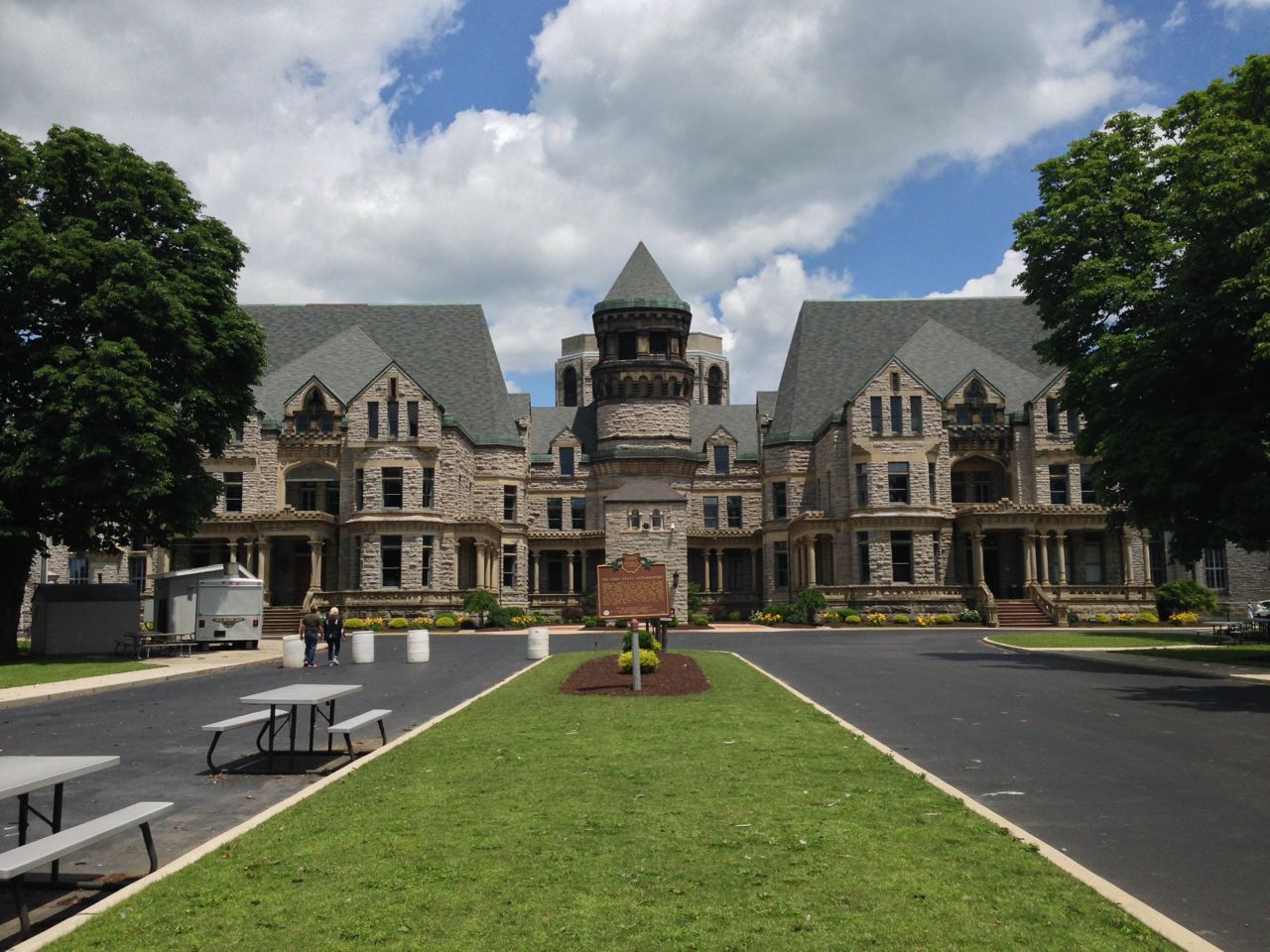
Today had me driving from Toledo to Pittsburgh, so much of the time I was out of pocket or unable to catch up on news. Fortunately, I arrived at my planned midpoint as the JPA was convening for a vote. This is the place I visited:

The Ohio State Reformatory

The Ohio State Reformatory

Look familiar? It’s not a college campus or an old hospital. It’s the old Ohio State Reformatory, located in Mansfield, Ohio. It’s better known as the site for the filming of The Shawshank Redemption, the great Stephen King-Frank Darabont picture that no one saw in the theaters but everyone saw on cable. I toured the prison, which would’ve been demolished if not for the film’s production and belated popularity. Like the Coliseum, much of OSR is in a steady state of decay. And like the film’s climactic scene, our own green-and-gold clad heroes at times have forded a river of sewage to escape the facility. I recognize that forcing a team of millionaires owned by billionaires to stay in mediocre conditions is nothing like actual prison. The point is that writing this blog at times is my own personal prison, one that I seemingly can never escape (especially the comments section or fools on Twitter). However, I made a promise to see this through, so it’s being done. Every so often I allow myself to feel a little hope, the dangerous concept that Red cautions Andy to squelch. Even after 9 years and with no end in sight, I still hope. I can’t allow myself to be completely consumed by cynicism. There’s already one Miserablist in the Bay Area, no need for two.

My own vacation activities aside, there is reason for hope to come out of today. First, let’s recap.

  • Yesterday, the prevailing sentiment was that the City representation on the JPA board would form a bloc and oppose proposed lease agreement, killing the deal and allowing the City to provide a counteroffer.
  • That tactic was quickly trumped by last night’s letter from Lew Wolff to the JPA, which was reported during the JPA session. Wolff indicated that if the JPA did not approve the lease, Bud Selig would grant Wolff immediate permission to move the team out of Oakland.
  • In fear of Selig’s threatened reprisal, the JPA board met in closed session to discuss the lease. Eventually the lease was approved 6-2, Rebecca Kaplan (who helped construct the lease terms) and Aaron Goodwin (who dissented on the current lease).

Now for the deal terms. The redone lease includes concessions made by both sides. Note: the deal must be ratified by the Oakland City Council and Alameda County Board of Supervisors before August 1.

  1. The A’s will be in the Coliseum through at least the 2017 season, with opt-outs available to both the team and the JPA until the 2024 season.
  2. $5 million in back parking fees that were up for arbitration in the fall are now wiped away.
  3. The A’s will pay $1.25-1.75 million in annual rent. They will be obligated to pay this through the end of the lease, unless they are able to work a deal to build another stadium in Oakland.
  4. The A’s will pay at least $10 million for a new scoreboard/ribbon board package. They will keep all revenue from the boards during A’s games. The JPA/Raiders will get revenue for football games. If the new system costs less than $10 million, the remainder will be paid to the JPA.
  5. The JPA will put together a $1 million/year maintenance fund, for use when things break. The JPA is not obligated to spend $1 million every year if maintenance spending is not required.
  6. A’s will have good faith discussions about building a future ballpark at or near the Coliseum, depending largely on what the Raiders do.
  7. The Coliseum area is the only site under consideration for a ballpark, with Howard Terminal dropped.

However you feel about the parking matter, this is a large number of concessions from the A’s. As Interim City Administrator Henry Gardner pointed out, this won’t stop the big subsidy that the City and County have to pay to keep the Raiders and A’s at the Coliseum. Then again, the counteroffer wasn’t providing any relief for that subsidy either.

The A’s have also asked for any developer interested in the Coliseum to put up $20 million towards a redevelopment project. You can call this “earnest money.” It may sound like a lot, but it’s an important form of skin in the game for the developer, something that Colony Capital isn’t providing right now. Wolff certainly isn’t afraid of dropping that kind of coin, since he bought some Fremont land in advance and paid for the CEQA study work in advance. $10 million is a good amount to keep pretenders from engaging in talks.

This type of deal was available in November, before the last time the A’s and the JPA hit a stalemate. Selig and Rob Manfred then stepped in and negotiated the to-be-superseded short-term deal. For whatever reason, the City of Oakland hasn’t recognized that until now, Selig has treated the City with kid gloves. That explains their shock and outrage to Selig’s power play. Sorry Oakland, this is how Selig normally operates. It’s part of the standard commissioner’s playbook. At some point the hardass version of Selig was going to show up and back his owner. To expect different wouldn’t just be unrealistic, it would be downright delusional.

Things are not going to get better for Oakland. The other shoe to drop will be the reactions of Mark Davis and the NFL. Since the Raiders and A’s are effectively competing for the Coliseum, both leagues are likely to play tug-of-war with the City in order to get them to commit to either entity. That should provide Oakland with some amount of usable leverage, but that’s negated by the City’s lack of non-land resources and their concerns about the feelings of the other team/league. What you’re seeing right now is Oakland in paralysis. The NFL and MLB are only happy to shake Oakland out of it. Both leagues are gearing up their preferred and contingency plans. If Davis decides this is it and gives up on Coliseum City, the complex is all Wolff’s to negotiate. If Davis truly wants Coliseum City and sees a way to make it work, Oakland will have a tough decision to make. Which team, league and developer should they partner with? It’s a decision that no politician wants to make, especially during an election year. Yet that’s Oakland destiny. Get busy living? Andy Dufresne had to decide that he had enough of Warden Norton’s hijinks in order to plan his escape. Oakland has two Warden Nortons, and it will have to screw one of them. Otherwise Oakland could find its teams, like Norton’s money, all gone.

A’s, JPA ink lease extension

Press release from the JPA:

Oakland-Alameda County Coliseum Authority

For Immediate Release

July 3, 2014 Contact: Dan Cohen

Oakland-Alameda County Coliseum Authority Reach Agreement with A’s on Ten Year Extension for Team to Stay at O.Co Coliseum site

Terms of deal positive for Oakland taxpayers, sports fans, public entities, and the team

OAKLAND, CA – Today, the Oakland-Alameda County Coliseum Authority announced that it has reached an agreement with the Oakland Athletics on a ten year lease extension for the team to remain at the O.co Coliseum site through 2024. Terms of the deal, which were shared with Major League Baseball and released earlier this week, include a financial commitment from the A’s for new HD video scoreboards, termination clauses for both parties, and continuation of “good-faith” discussions on a new baseball stadium at the current site. The deal will be finalized after approvals from the Oakland City Council and Alameda County Board of Supervisors in July.

“This is truly a fantastic day for Oakland A’s fans, Oakland taxpayers, public entities, and the team,” said Coliseum Authority Chairman Nate Miley, who serves as an Alameda County Supervisor. “By reaching this agreement, both the franchise and the community have charted a course of stability for the next decade and more than doubled the revenue generated from the site. We know that the A’s and their loyal fans will be connected for years to come at the Coliseum site.”

The lease agreement settles all outstanding issues between the Coliseum Authority and the team. Additionally, if progress occurs on the development of a football stadium, the contract ensures that a variety of next steps would be considered to ensure maximum flexibility for both parties.

“This is about more than just a baseball team and a stadium, added Miley. “From early spring until early fall, families and friends head to O.Co Coliseum to spend time together, relax, and have fun. The A’s are part of the fabric of this community and have a rich tradition in Oakland. We’re thrilled to have a deal that ensures these experiences will continue while safeguarding the interests of all Oakland taxpayers. It’s a win-win.”

The Coliseum Authority notes this agreement means that the jobs, recreation, and entertainment the team and O.Co Coliseum provide for Oaklanders will remain an integral part of their lives. Additionally, in 2018, the A’s will celebrate their 50th anniversary in Oakland.

“Oaklanders can celebrate today, knowing that the A’s will continue to play their winning brand of baseball at the Coliseum,” adds Oakland City Councilmember and Vice Mayor Larry Reid, who also serves as Vice-Chair of the Authority. “The agreement makes sense for all parties, for everyone that calls Oakland home, and for every Oakland sports fan. As a city and as a tight-knit community, we are stronger with this deal secured.”

“After much diligence and cooperation from both parties, we are delighted to make this announcement today,” said A’s Owner and Managing Partner Lew Wolff. “We believe this agreement works well for city and county taxpayers, the team, A’s fans and all involved. It provides stability for the A’s while also improving fan and player experience with significant upgrades and improvements at the facility.”

The agreement calls for improvements to the Coliseum over the next ten years, most notably installation of new HD video boards, ribbon boards, and the associated control room equipment by Opening Day 2015. The A’s commit a minimum of $10 million to these improvements and the Coliseum Authority will pay for any necessary structural work and install improved lighting. This is on top of improvements made prior to this season, including new concessionaire and food items, remodeled dugouts, and an updated press box.

###

About the Oakland-Alameda Coliseum Authority:

The Authority is a public partnership between the City of Oakland and the County of Alameda (owners of the Coliseum Complex) that manages the Complex on behalf of City and County. The Authority subcontracts the day-to-day operations of the Complex to AEG. An eight-member Board of Commissioners governs the Authority. Alameda County Supervisor Nate Miley currently serves as the Chair of the Board, and Oakland City Councilmember Larry Reid serves as the Vice-Chair.

Excerpts from Proposed Lease Agreement

Ed. – I’ve highlighted what I consider relevant sections of the proposed lease agreement and put them in this post. If you want to look at the whole thing, I’ve converted the original Word doc into PDF format. The conversion preserves the numbering within the document. The excerpts total over 4,500 words, the full document runs more than 22,000. I’m putting this below the summary post for brevity. Eventually the lease will be linked in a new section on the left sidebar.

—-

4.7 Revenue Generation.

4.7.1 Revenues. Licensee shall control, collect, receive and retain all revenues deriving from its operations, including but not limited to all revenues from ticket sales and distribution, merchandise sales, product and other retail sales, concessions (subject to Paragraph 12), novelties, parking (subject to Paragraph 6), telecast and broadcast rights, pouring rights, advertising, sponsorship, promotional and signage rights (subject to Paragraph 11), asset-specific branding rights to internal Stadium areas, luxury suite sub-licenses and any other revenues, consideration, barter, trade, in-kind or other benefits however derived or generated by Licensee, the Team and/or by Licensee Events and Other Events. Licensor shall control, collect, receive, retain or permit licensees other than the Licensee to retain all other revenues, including but not limited to all revenues from ticket sales and distribution, Stadium naming rights, merchandise sales, product and other retail sales, concessions (subject to Paragraph 12), novelties, parking (subject to Paragraph 6), telecast and broadcast rights, advertising, sponsorship, promotional and signage rights (subject to Paragraph 11), luxury suite sub-licenses and any other revenues, consideration, barter, trade, in-kind or other benefits however derived or generated by Licensor and/or Licensor Events, Arena Events and/or retained rights under Paragraph 11.3.3.

4.7.2 Operations and Contracts. Licensee, in its sole discretion and subject to this License and applicable law, may take any and all actions and utilize any and all processes it deems appropriate to exercise its revenue generation rights, including but not limited to hiring third parties, to whom Licensee may grant a limited sub-license to enter the Areas Licensed to perform tasks as directed by Licensee. Licensor, in its sole discretion and subject to this License and applicable law, may take any and all actions and utilize any and all processes it deems appropriate to exercise its revenue generation rights, including but not limited to hiring third parties or assigning or otherwise transferring its revenue generation rights to third-parties, and in doing so, Licensor may grant any and all licenses or delegate any and all powers or privileges that, as the operator and manager of the Complex for the City and County, it may wish to grant or delegate.

5.7.1 Stadium Maintenance Fund. In each year of the Term, Licensor shall provide in its budget for a “Stadium Maintenance Fund” in the amount of at least One Million Dollars ($1,000,000.00). The Stadium Maintenance Fund shall be used for Licensor’s Maintenance and Repairs required hereunder. Following the first year of the Term, Licensor shall increase the amount of the Stadium Maintenance Fund by increasing the preceding year’s budgeted amount by at least five percent (5%). Subject to Licensee’s obligations under Paragraph 5.8, which obligations Licensee must continue to discharge at its own cost, for each year of the Term Licensee may direct Licensor’s use of budgeted Maintenance and Repair funds up to One Hundred Fifty Thousand Dollars ($150,000.00) for Maintenance and Repairs requested by Licensee to be performed by Licensor (including that Licensee may “earmark” all or part of such funds for work to occur in future years; provided, however, that no more than $150,000.00 may be earmarked for any particular future year). To facilitate and enable Licensee to exercise its right to direct the use of certain funds each year, Licensor will provide quarterly reports to account for the uses of budgeted funds in the Stadium Maintenance Fund in the preceding quarter.

5.7.2 Stadium Maintenance Fund. Not a Limitation or Cap. The Parties agree that the Stadium Maintenance Fund is an annual budgeting mechanism designed to ensure that a certain amount of funds is available each year for Maintenance and Repairs and to facilitate tracking of Maintenance and Repair expenditures. Licensor acknowledges that the existence of the Stadium Maintenance Fund does not limit its Maintenance and Repair obligations or put a maximum limit on the amount that it must spend for Maintenance and Repair work. Licensor further acknowledges that compliance with those obligations may require expenditures exceeding the amount in the Stadium Maintenance Fund in any given year.

5.7.3 Licensor Responsibilities.

5.7.3.1 Maintenance and Repair. Licensor, at all times during the Term, shall perform all Maintenance and Repairs of the Stadium (except such items as Licensee Maintains and Repairs as specifically provided herein), including specifically Maintenance of and Repairs of the following associated areas, structures and equipment:

  • All structural parts of the Stadium including the roof, windows, walls, floors, pillars and columns;
  • The electrical system including all electrical light standards, light fixtures and wall sockets but not including light bulbs or moveable electrical equipment;
  • The heating, ventilating and air conditioning systems;
  • The plumbing systems including without limitation all pipes and plumbing fixtures such as sinks, toilets and water fountains;
  • The Parking Area and underground utilities (to the extent such utilities are under the direct or indirect control of Licensor) subject to Paragraph 6 and its subparagraphs;
  • The Stadium seats;
  • The field drainage system;
  • All elevators and escalators;
  • All sound systems and related equipment, except in connection with any new audio components that Licensee installs as part of the Display Equipment Project, which shall be Maintained and Repaired by Licensee as provided within Paragraph 11.4;
  • All Stadium televisions and all amplifier and other systems feeding to such televisions;
  • All cabling of any nature within the Stadium except cabling installed and used exclusively by Licensee;
  • Licensee’s office space and storage provided pursuant to this License and all items and systems of the type listed in subparagraphs (a) through (k) above that affect and/or are used within Licensee’s office space and storage; and
  • All other property, systems, equipment and fixtures currently maintained and repaired by Licensor, owned by Licensor or installed at Licensor’s direction.

Licensor’s Maintenance and Repair obligations shall not include the furniture, fixtures, computers or other equipment of Licensee or of any concessionaire. Licensor shall not charge Licensee any amounts related to Licensor’s obligations, but in the event that Licensor is required to Repair any of the items described above as a result of Licensee’s negligence or willful misconduct, Licensee shall pay the costs of such Repair.

5.10.3 Exclusive Right to Stadium Use. Licensee shall have the exclusive right to use the Stadium throughout each Baseball Season, but shall use its best efforts to influence MLB to ensure that there are at least two scheduled open weekend dates (i.e. Friday, Saturday, or Sunday) during the NFL pre-season each year for Raiders’ preseason games. Except for scheduled dates of Raiders’ games, which is a use of the Stadium for which Licensee must work in good faith to permit and have a reasonable basis for declining during Baseball Season, Licensor may use the Stadium during the Baseball Season only upon Licensee’s prior written approval, which approval Licensor acknowledges may be withheld in Licensee’s absolute discretion for the date of any Licensee Event and for any dates including and between the day before the commencement of and the last day of any of the Team’s homestands. In connection with the development of each baseball and football schedule, Licensor, Licensee and the Raiders will attempt to accommodate the reasonable scheduling requirements of each other and of the respective leagues and will work in good faith to resolve any disputes arising therefrom. The Parties acknowledge that MLB may not allow Licensee to commit to make the two football weekends available in each of August and September non- consecutively, nor, because of playoffs and the World Series, will MLB commit to make any weekend in October available for scheduling of a football game. Subject to all of the above, the Raiders shall have scheduling priority and the absolute right to use the Stadium for its games from the end of Team’s Baseball Season each year through the end of the following January.

5.10.4 Protected Dates. Not later than January 15th of each year within the Term, Licensee may designate to Licensor in writing up to five (5) Home Games on which dates Licensor agrees not to schedule any Licensor Event or to permit any Arena Event (other than a Warriors game) unless it (a) concludes at least two (2) hours prior to the scheduled start of a Home Game; or (b) commences at least six (6) hours after the scheduled start of a Home Game.

7.2 Early Termination Rights.

7.2.1 By Licensee. Beginning January 1 of the second full year of the Term (January 1, 2016 – December 31, 2016), Licensee shall have the right to terminate this License prior to expiration of the Term by providing Licensor written notice of intent to terminate on or before December 31st of any year during the remainder of the Term, with the effective date of termination occurring as of December 31st of the second year following notice. If Licensee terminates this License in connection with any move to a stadium outside of the City, Licensee shall pay on the effective date of termination, in lump sum, all annual license fees pursuant to Paragraph 8.1 below for the remainder of the full 10-year Term, as if this License were operative throughout the Term and had not been terminated. Licensee shall not be obligated to pay such annual license fees if Licensee terminates this License in connection with a permanent move to a new or re-built stadium on or adjacent to the Complex site or to a different stadium within the City.

7.2.2 By Licensor. Licensee acknowledges that a plan may develop for construction of a new football stadium for the Oakland Raiders. Licensor shall keep Licensee reasonably informed of any information related thereto. If Licensor presents Licensee with a Raiders Construction Plan, Licensor and Licensee shall, for a period of thirty (30) days thereafter, negotiate in good faith for an amendment to this License that will account for the financial, operational and other consequences that Licensee would suffer from the construction and operation of such planned football stadium. Such negotiations shall not be necessary if the Raiders Construction Plan includes substantial demolition of the Stadium. If such good faith negotiations are unsuccessful or unnecessary, Licensor may terminate this License upon written notice of intent to terminate to Licensee, such termination to take effect sixty (60) days after the conclusion of the second (2d) Baseball Season that commences after such notice. (By way of example, if Licensor provides Licensee with such termination notice on June 15, 2016, this License will terminate sixty (60) days after the conclusion of the 2018 Baseball Season.) Between the time notice of termination has been given and the date of actual termination, Licensee shall cooperate in good faith with any activities by Licensor or its designees that may be necessary to prepare the site in advance of construction, including by providing reasonable access to any areas for which Licensee has exclusive use rights, so long as no actions are taken by Licensor or its designee and nothing is required of Licensee that unreasonably interferes with Licensee’s operations. For the sole purpose of a possible termination to accommodate a Raiders Construction Plan, the Parties agree to amortize on a monthly, straight-line basis (i) Licensee’s total verified cost reported to Licensor under Paragraph 11.2 for the Display Equipment Project, plus any amount paid directly to Licensor thereunder, and (ii) all other amounts paid by Licensee during the Term for mutually agreed upon improvements to the Stadium or Complex (“Additional Licensee Improvements”) under Paragraph 5.9, provided that Licensee’s costs for Additional Licensee Improvements will be subject to amortization hereunder only if Licensor shall have acknowledged to Licensee in writing at the time of Licensor’s approval of such Additional Licensee Improvements under Paragraph 5.9 that such improvements will be subject to the provisions of this Paragraph 7.2.2. Amortization shall occur from the last day of the month in which the particular improvement is completed throughout the remainder of the planned 10-year Term. Following termination by Licensor in connection with a Raiders Construction Plan, Licensor shall pay Licensee the entire unamortized balance of such improvement costs as measured from the date of completion of installation of the improvements being amortized to October 31st of the year in which termination is to take effect. Licensor shall make such payment not later than December 31 of the year in which termination becomes effective. By way of example, if (a) the Display Equipment Project is completed during March 2015 and the total verified project cost is $11,020,000 and (b) Licensor provides proper termination notice on June 15, 2016, then (x) the $11,020,000 will be amortized on a monthly schedule from March 31, 2015 through October 31, 2024, with $95,000 amortized on the last day of each month beginning on March 31, 2015, (y) this License shall terminate effective sixty (60) days after the conclusion of the 2018 Baseball Season and (y) Licensor shall pay Licensee, no later than December 31, 2018, the lump sum of $6,840,000 ($11,020,000 minus (44 months times $95,000)), plus whatever sum may be due for the costs of Additional Licensee Improvements, utilizing the same amortization methodology. The Parties acknowledge, however, that subject to Paragraph 16, Licensor’s obligation to pay Licensee under this Paragraph 7.2.2 may, and likely would, be passed through to any third-party developer that undertakes the Raiders Construction Plan.

8. LICENSE FEES

8.1 License Fees. Licensee shall pay to Licensor an annual license fee of One One Million Seven Hundred Fifty Thousand Dollars ($1,750,000.00) for 2014, One Million Two Hundred Fifty Thousand Dollars ($1,250,000.00) for the first full year of the Term (January 1, 2015 – December 31, 2015), and after that, One Million Five Hundred Thousand Dollars ($1,500,000.00) for each of years two through five of the Term (2016 through 2019), and One Million Two Hundred Fifty Thousand Dollars ($1,250,000.00) for each year of years six though ten the Term (2020 through 2024). Except for fees in 2014, when payment was due June 30, 2014, the full and timely payment of which is a condition of the Parties’ entry into this Agreement, Licensee shall make each annual payment April 1st of each year of the Term. Each payment shall be due and owing immediately upon each payment date and shall be considered payment in advance for all use and other rights granted under this License during the subsequent twelve months. Subject to Licensee’s right to cure under Paragraph 22.1.2, any late payment shall be subject to a late fee of two thousand five hundred dollars ($2,500) per day and any accumulated delinquency shall carry interest at a daily compounded interest rate of ten percent (10%) per annum.

8.2 Prohibition on Deductions. Licensee shall not deduct, offset or otherwise withhold any amounts payable by it to Licensor under this License Agreement except to the extent expressly authorized under Paragraphs 17.1, 17.2, 17.3, 20.2, 23.2 or 27.2 herein. Any payment delinquency uncured under Paragraph 22.1.2, including any unauthorized deduction, offset or other withholding (a) shall (in addition to the late charges and interest under Paragraph 8.1), accrue pre-judgment interest at the maximum statutory interest until paid in full, (b) shall trigger a payment owing to Licensor to compensate it for difficult-to-calculate harm in the amount of all remaining Annual License Fees under Paragraph 8.1, and (c) shall give Licensor the right, at its option, to seek declaratory and injunctive relief in court or in arbitration (notwithstanding Paragraph 38) terminating the License and all of Licensee’s rights thereunder, including its rights of use and occupancy under Paragraph 4, effective immediately if the delinquency takes place outside of the Baseball Season, or otherwise effective on the day after the conclusion of the last Licensee Event during the Baseball Season in which the delinquency took place. Monetary recovery for any such delinquency may be sought in court or in arbitration, at Licensor’s option, notwithstanding the provisions of Paragraph 38 herein. Should Licensor file an action seeking monetary relief for any delinquency under Paragraph 8, Licensor shall be entitled to recover its entire attorney’s fees and costs upon entry of judgment in its favor or in the event that any of the delinquency is paid or ordered paid prior to entry of final judgment.

11.2 Stadium Display Equipment. Licensee shall, no later than October 31, 2014, commit to spending not less than Ten Million Dollars ($10,000,000.00) to purchase and install (i) two (2) new digital video/score boards, a new digital ribbon board or boards on the Stadium Plaza Level Façade (the video/score boards and ribbon boards will be referred to collectively as “Digital Displays”), and, if Licensee chooses to do so, in its sole discretion but subject to Licensor’s approval below, a new integrated audio system, and (ii) and associated new control room equipment capable of programing, controlling and storing digital content for the new Digital Displays along with associated audio (collectively, all components, equipment and systems comprising and related to the new Digital Displays, the new audio system, if installed, and the associated new control room, will be referred to as the “Display Equipment”). Licensor acknowledges that, by agreeing to undertake the purchase, installation, maintenance and repair of the Display Equipment (the “Display Equipment Project”), Licensee will be relieving Licensor of substantial future Maintenance and Repair costs that Licensor would otherwise be required to bear. The Parties agree that time is of the essence for the completion of the Display Equipment Project. As soon as possible after the Signature Date, Licensee commits to provide to Licensor detailed costs, plans and equipment specifications for the Display Equipment and to seek Licensor’s approval for the Display Equipment Project under Paragraph 11.4 after providing that information, which approval shall not be unreasonably withheld or delayed. The Parties agree to cooperate and use mutual best efforts to achieve completion of the Display Equipment Project by April 1, 2015. Upon completion, Licensee shall provide Licensor with a report detailing the equipment purchased, work performed, and total cost (as measured by the total project cost without reference to whether Licensee obtained financing for the Display Equipment Project), together with copies of reasonable backup verification of such costs including invoices, cancelled checks or other proof of payment or payment obligation. If such total amount is less than Ten Million Dollars ($10,000,000.00), Licensee shall pay Licensor the difference within thirty (30) days after Licensor’s written acceptance of the contents of such report.

11.2.1. Licensor Consultation. Licensee shall have absolute discretion on the selection of all Display Equipment and shall perform all work required to purchase and install the Display Equipment (excluding any necessary structural work to the framing cabinet structures and support beams that will house and support the Display Equipment (“Display Equipment Structural Work”), which shall be Licensor’s responsibility), but shall consult with Licensor in connection therewith. Licensor shall cooperate with Licensee during the entire Display Equipment Project, including without limitation the installation of all Display Equipment, in connection with which Licensor shall perform any Display Equipment Structural Work reasonably necessary to facilitate such installation. The Parties shall confer in good faith and seek to agree about whether any Display Equipment Structural Work is required for installation of the Display Equipment, and if they cannot agree, shall follow the procedures for resolution set forth in Paragraphs 5.7.3.4 and 5.7.3.5.

11.2.2. Structural Work. The Parties recognize that, if Display Equipment Structural Work is necessary for the Stadium Display Project, that work could potentially delay the projected April 1, 2015 completion date for the Stadium Display Project. As soon as reasonably possible after the Signature Date, Licensee will identify specifically in writing the particulars of the Display Equipment that Licensee plans to install in order for the Parties jointly to determine the extent of any Display Equipment Structural Work. So long as Licensor works diligently and in good faith to complete any Display Equipment Structural Work as soon as possible after receipt of Licensee’s writing, Licensor shall have no liability for any losses attributable to delays in meeting the April 1, 2015 completion date (including without limitation in any instance where Licensor works diligently and in good faith but Licensee by its own conduct interferes with, delays, or impedes Licensor’s process of evaluating or undertaking such work).

17. DAMAGE AND DESTRUCTION

17.1 – Major Damage – Repairable. In the event of the damage or destruction of the Stadium so that Licensee cannot reasonably use the Stadium for Home Games, and there are insurance proceeds available to Licensor to pay eighty percent (80%) or more of the cost of repairing the damage, such repairs can be performed under applicable governmental laws, rules and ordinances, the design and construction work can be reasonably completed within eighteen (18) months after the date of damage, and will enable Team to play at least one complete Baseball Season at the Stadium during the remaining Term as the same may be extended by mutual agreement of the Parties, and Licensor delivers notice to Licensee within one hundred twenty (120) days of the date of damage that such repairs can be so completed, then this License shall remain in full force and effect, and Licensee shall have no liability to pay any fees or perform its other obligations hereunder with respect to the Stadium during any such period when Licensee is unable to use the Stadium, and Licensor shall refund to Licensee a portion of annual fees under Paragraph 8.1 already paid by Licensee based on the rights lost by Licensee as a result of the damage and repairs. Licensor shall collect and expend all funds required to repair the damage at the earliest possible date. During the period that the damage is being repaired and Licensee cannot reasonably use the Stadium for Home Games, Licensee shall have the right to play Home Games in any other one or more comparable stadiums located in the Licensee’s Home Television Territory and acceptable to MLB or, if no such stadium is available on commercially reasonable terms, then in the stadium available as close to Licensee’s Home Television Territory as is reasonably possible and acceptable to MLB that is available on commercially reasonable terms for use by Licensee until the Stadium is again ready to be used for Home Games; provided, however, that the Parties acknowledge that MLB may relocate affected Home Games to the stadiums of the Team’s respective opponents. Subject to any scheduling requirements of MLB, and subject to the repairs being reasonably acceptable to MLB, Licensee shall recommence playing Home Games in the Stadium from the date specified by Licensor in a written notice delivered at least thirty (30) days before the first Home Game to be played in the Stadium stating that the repair work has been completed to the extent where the Stadium can reasonably be used for Licensee’s Home Games.

17.2. Major Damage – Not Repairable. In the event of damage or destruction of the Stadium so that Licensee cannot reasonably use the Stadium for Home Games, and there are no insurance proceeds available, or insurance proceeds are available but are less than eighty percent (80%) of the cost of repairing the damage, or the repairs cannot be performed under applicable governmental laws, rules and ordinances, or the design and construction work cannot be reasonably completed within eighteen (18) months after the date of the damage, then for a period of thirty (30) days after the facts regarding the insurance proceeds and governmental laws are known to Licensor (which Licensor shall promptly communicate to Licensee) but in no event more than 120 days following the date of damage, Licensor shall have the right, exercised by written notice to Licensee within such period to terminate this License or to keep the License in force and proceed to repair the damage at Licensor’s cost. If Licensor fails to notify Licensee of its election within the 30-day period then Licensor shall be deemed to have terminated the License at Licensee’s election and immediate notice to Licensor. If Licensor elects to repair the damage and the work cannot reasonably be completed or in fact is not completed within eighteen (18) months after the date of the damage, then Licensee within thirty (30) days after notification from Licensor of its election to repair the work (if the repairs cannot be reasonably completed within eighteen (18) months) or within thirty (30) days of Licensee being notified (if the repair work will not be completed within the eighteen (18) months) that the work will not be completed within the eighteen (18) months, shall have the right to terminate this License by written notice to Licensor. If Licensor elects to repair the damage, then the provisions of Paragraph 17.1, dealing with the repairs and 17.3 dealing with the obligations of Licensee during and after the repairs are made, shall apply. To the extent that Licensee has paid annual fees in advance under Paragraph 8.2 for the right to use the Stadium, and as a result of Major Damage, that use is no longer possible during such quarter, Licensee shall be entitled to a pro rata refund or credit of fees for the number of months remaining in the quarter for which Licensee has paid fees. During the time period beginning with the damage and destruction through either the re-opening of the Stadium or termination of this License, Licensee shall have no liability to pay any fees or perform its other obligations hereunder with respect to the Stadium.

17.3. Less Than Major Damage. In the event of damage or destruction of the Stadium and there has not been a material reduction of the seating and/or parking capacity and the playing field can be configured to meet MLB standards so Licensee can reasonably continue to use the Stadium for Home Games, then Licensor at its cost shall promptly repair the damage to the extent possible under applicable laws and shall do all acts required to protect users of the Stadium from any hazards created by the area damaged or the repair work. During the period of any such repairs Licensor shall continue to perform all of its obligations hereunder and to the extent areas of the Stadium are used by Licensee shall use its best efforts to provide temporary additional areas in the Stadium or Complex where Licensee can continue to perform the activities previously engaged in the damaged areas. In the event Licensor is unable to reasonably provide sufficient temporary areas, it shall be Licensee’s responsibility at its cost to obtain such facilities as are required outside the Complex. Licensee’s obligations to pay fees for such unusable areas shall be reduced on a pro rata basis, and Licensee’s other obligations hereunder with respect to such unusable areas shall be abated, until the date repairs have been completed.

20.1 Property Taxes and Assessments. The Parties acknowledge and agree that the appropriate City of Oakland or County of Alameda entity shall pay any and all real property Impositions including, without limitation, any transaction privilege tax or other similar Imposition (collectively, “Real Property Taxes”) now or in the future levied, assessed or otherwise payable in respect of the Stadium or Complex or any part thereof. Licensee shall have no responsibility for any Real Property Taxes.

20.2 Licensee’s Responsibility to Pay All Taxes. Licensee shall pay and is responsible for all federal, state, City of Oakland and County of Alameda Impositions, including all income, sales and use taxes, payable on account of revenues reserved to or retained by Licensee from the operational and use rights granted to, and exercised by, Licensee under this License.
43. CONTINUED STADIUM DISCUSSIONS
Licensee and Licensor (or Licensor’s designee) shall continue to engage in good faith discussions concerning the development of a new baseball stadium for use by the Licensee that would be a permanent home for the Oakland Athletics, provided that such discussions shall solely focus on the development of a new baseball stadium that would be located on land within or immediately adjacent to current Complex property. If agreement is reached on development of such a stadium, the Parties will renegotiate any terms of this License Agreement that may need to be modified or eliminated in order to facilitate the construction of the new stadium. The Parties’ discussions concerning a possible new stadium will continue during the Term until Licensee communicates to Licensor that Licensee has made a decision on a permanent baseball stadium at another location or until Licensor provides Licensee notice of early termination (as provided in Paragraph 7.2.2.) in connection with a Raiders Construction Plan.