Raiders withhold Coliseum rent as leverage play vs. Oakland

Mark Davis doesn’t have a ton of cards to play against Oakland, other than the usual “I’ll take my team elsewhere” card, which has half-played by entertaining talks with LA and San Antonio. He pulled one out this week, refusing to play the $400,000 rent bill on the Coliseum for the 2014 season. We covered the lease terms in November 2013, when the last Raiders lease deal was made.

According to Matthew Artz, the Raiders are paying rent on their Alameda training facility, which makes withholding rent a rather petty move. What kinds of concessions could get from Oakland/Alameda County at this point? They’re certainly not going to sign over development rights to the Coliseum over a measly $400k. Though somehow Davis has been depicted as a “more willing partner” for Oakland than Lew Wolff, his actions say differently: meetings in LA/SA, repeatedly talking about how he’s doing his best while not creating his own plan until very recently.

It would be one thing if Davis were angling to move to LA for the 2015 season. The NFL has put the kibosh on such a move for 2015, so what reason would Davis hold out? The answer probably lies in the current lease. Besides the rent for the Coliseum and training facility, there’s also the matter of the parking revenue split between the JPA and the Raiders. At the moment that’s a 50/50 deal, with regular parking prices capped at $35 per car, per game. The opening of Levi’s Stadium has bumped the going rate to $50, so Davis may be eager to up the charge, a move that’s accounted for in the current lease. Even if that were the case, it can’t make much of a difference:

  • $15 hike * 10,000 parking spaces * 10 games = $1.5 million, split 50/50

The Raiders would net less than $750,000 after the City collects its parking tax. It’s truly a piddly amount of money for a pro football team.

If it’s something else, like a cut of concessions revenue, Davis should’ve acted before allowing Wolff to take it off the table for upcoming years. He’ll get a chance to sell ads on the new scoreboards without having to spend a dime on the project. It’s a head scratcher why Davis would do this.

Then again, maybe this is all a bluff to see how the reciprocal and related parties act. Would Oakland and Alameda County start getting ugly with Davis the same way they did with Wolff last year? Would Davis try to see what the NFL might do to back him (or not)? Davis has already said he doesn’t want to have the Raiders play in Santa Clara, and that’s the obvious local Plan B for Roger Goodell if negotiations got tense. He won’t be able to use this issue to force an LA move because that doesn’t fit into the league’s plans. If Davis is trying to score points in order to get a premier spot in LA, it’s an odd way of doing it.

I doubt that this discord will turn into anything protracted. The A’s-Oakland parking dispute turned into a $3 million issue because Wolff preferred to let it fester until the next lease negotiations, three years down the road. Davis doesn’t have time to let anything fester. The Raiders have to play somewhere in 2015, and preferably beyond. There are no indications that public officials want to to stick Davis with a locked-in multiyear lease, as they’ve been perfectly willing to go year-to-year for the time being as the larger Coliseum City deal is worked out.

Oakland, and especially the Coliseum, is a sort of economic paradox for both the Raiders and the A’s at the moment. Deals there are potentially the most frictionless, yet it can most realistically happen if one of them steps aside. Yet each team has its eye on more lucrative markets that they might consider worth the friction. If one of them “wins” Oakland, the other will get to go to the more lucrative alternative. The “winner” will have the challenge of remaking the Coliseum to benefit not only themselves, but also the City and nearby communities. Oakland as both prize and booby prize? Somehow it makes sense.
Program Director Jason Barrett to leave 95.7 The Game in June

I travel a lot. I’ve been to 49 states, nearly all of them on business. I’ve rented cars in all of these markets, which has given me a chance to sample sports radio everywhere: California and the Northeast, the South and the Midwest. Thanks to the internet you can do the same now via streaming. Most people aren’t going to go out of their way to do that, except to follow distant team coverage. Having listened to so many different sports talk stations, I can give you one complete immutable fact about them.

THEY ALL SUCK.

The programming is disposable and predictable. The talent is largely marginal. It’s the low hanging fruit of media. There really isn’t much difference from one station to the next. Listeners may latch onto one or two hosts because of their style, or listen to a particular station mostly because it’s a team’s flagship. 95.7 The Game launched with the idea that it was the A’s flagship, but would give thorough coverage to all of the Bay Area’s teams.

Jason Barrett came in as the program director shortly after the station’s launch in 2011. Not surprisingly, the New Yorker brought in a New York host, Brandon Tierney. That didn’t go over so well – with A’s fans especially. Some worked well for a small but loyal audience, like The Rise Guys until they were unceremoniously canned, or Damon Bruce most recently. Chris Townsend has been the one constant on the station, taking numerous time slot changes like a pro that he is. If the maxim of radio is know your audience, Barrett didn’t. He brought an East Coast sensitivity to the Bay Area under orders from an East Coast corporate parent, and it showed.

I don’t think it’s possible to make truly good sports talk. It is possible to make sports talk that sucks less. One way to reach that not-so-lofty goal is to hire hosts that really know the local teams. When a guy doesn’t know much about a team’s history or players it’s glaring. It gives one more reason for a listener to change the station. For whatever reason Barrett wasn’t terribly concerned about that, figuring that outside talent had a natural learning curve and would adapt quickly. That brought at best mixed results. Even bringing in guys with a clear specialty and without broad sports knowledge can be dangerous, as we saw with Ric Bucher (basketball) and now John Middlekauff, whose discomfort level rises when venturing outside football.

Whether it was Barrett or the higher-ups at Entercom, the push to get Giants fans has proven highly divisive to A’s fans, though it has probably led to The Game’s firm 2nd place among the three Bay Area sports radio stations. A’s fans are willing to stomach some amount of Giants talk, but not the beyond-equal-time treatment frequently on display. Though I’ve heard a lot of things about what Barrett did to meter topic time, I don’t have any interest in doing any measurements or protesting loudly. Mostly because of the aforementioned reasons, I simply don’t care that much. Fans can choose to be inundated by coverage in many forms, from traditional beat writers and columnists to bloggers and fan sites to podcasts and live streams. I watch all four major pro sports, multiple college and individual sports, pretty much anything competitive. I don’t worry too much about how well-executed sports radio is, I’m only concerned that the A’s have a proper station. So if the station’s execution improves by having better hosts or a better program director, great. It probably won’t affect might listening much, it might affect yours.

If anything, my criticism is reserved for Entercom’s disinterest in boosting the station’s signal. As a Class B station with less than 7,000 watts of power, the coverage footprint was limited. East Bay coverage could be sparse at times, North Bay coverage a big fade. Maybe Entercom wanted to wait until the station stabilized. Whatever the reason, the signal has left many unsatisfied, though game broadcast availability through MLB apps has helped. There’s no way The Game will ever come close to challenging KNBR-680 without a boost to cover more of the Bay Area.

Then again, maybe second place is good enough. I have a sneaking suspicion that it is. They could go totally cheap by turning automatic and simulcasting ESPN Radio’s shows from Bristol, then supplementing games with pre/post-game coverage. They could boost the signal, get into a real bidding war with 680, and get into a real war with The Leader. Or they could go in generally the same manner as they’ve been going, but with a better PD and more hyperlocal focus. I don’t know that such a move will seriously improve ratings. It would at least reduce the bad PR associated with Barrett.

Other articles:

Barrett’s blog, citing his desire to spend time with family as his reason for leaving

Bay Area’s Sports Guy’s anecdote about meeting with Barrett

FanFest 2015

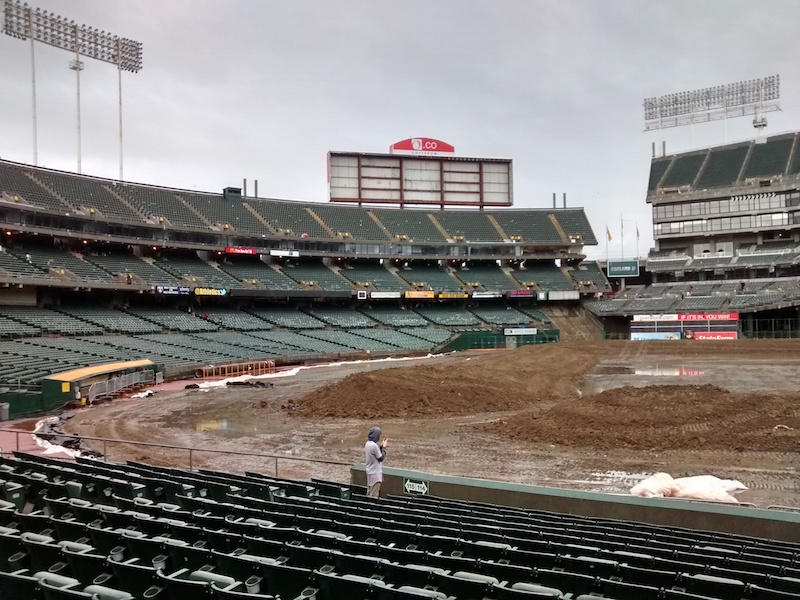
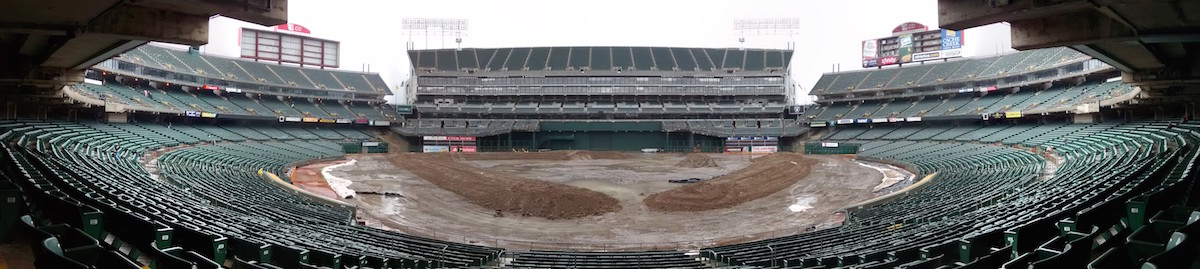
Rain has become a constant at FanFest, the Coliseum was at its muggy, leaky best. That’s probably just as well, since it motivates the players (and hopefully many fans) to head down to the desert for Spring Training. If only this rain came more frequently…

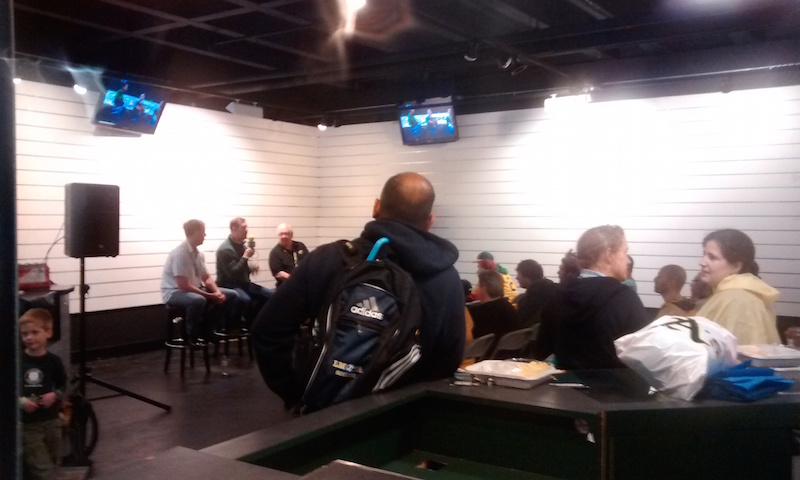
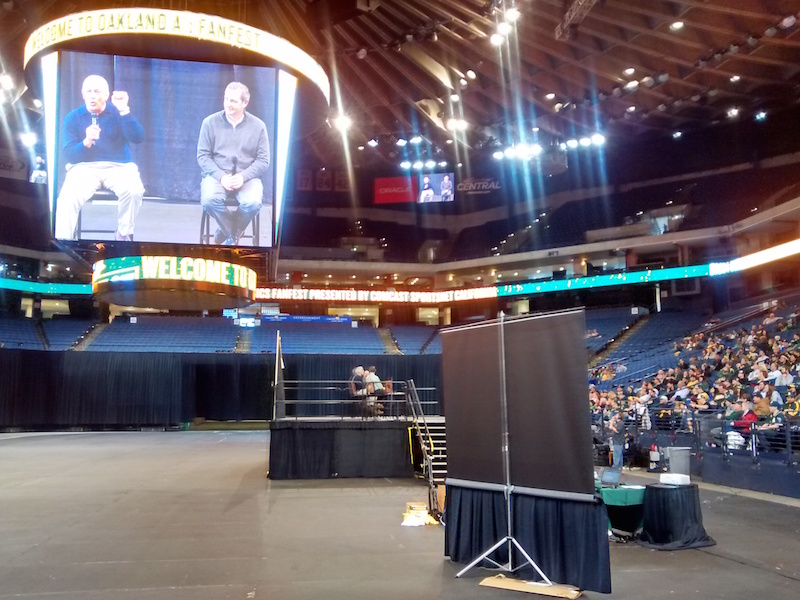
Anyway, if you’ve been to FanFest since its 2011 reboot, you know how this works. The main event is held inside the arena, which can hold thousands for the numerous Q&A sessions. The first two sessions involving player intros, Billy Beane and Bob Melvin draw a huge crowd. Unlike previous FanFests, the crowd was restricted to sitting in a third of the lower bowl. The arena’s upper level had VIP events.

fanfest2015-10-plumbers_crack

Ray Fosse and Glen Kuiper telling a broadcasting anecdote about on-camera plumber’s crack

Most everything else was held in the Coliseum, especially the East Side (Mt. Davis). FanFest may well be the only event that stretches the East Side’s facilities to its limits. Concessions were open along the regular concourses, and smaller Q&A sessions were held along the lower concourse near the foul poles. An interesting backstory is that for several weeks, today’s date was held for another event, a concert at the arena. Only late in the year did the arena become available for the big sessions. If the arena wasn’t available, the big sessions would have been held in the stadium somewhere, even though there were no TVs and the scoreboard system was not available.

fanfest2015-52-pano_117back

Panorama from back of section 117

fanfest2015-03-baseball101-forst

“Baseball 101” set up for intimate Q&A sessions, this one with David Forst

The project is underway, though the teardown of the old one isn’t complete. The fascia signage along the plaza level hasn’t been removed yet. Much of the work is being done in the press box, where the control is being retrofitted and expanded. The expansion is larger enough that the A’s have to install a server room of sorts above the press box, in some free space along the value deck. For some reason, the scoreboard project was delayed two weeks by the City of Oakland, who for some reason took some extra sweet time with the permits. Apparently no one told Permits the project was coming. #welp

fanfest2015-08-scoreboard_frame

State of the scoreboard project

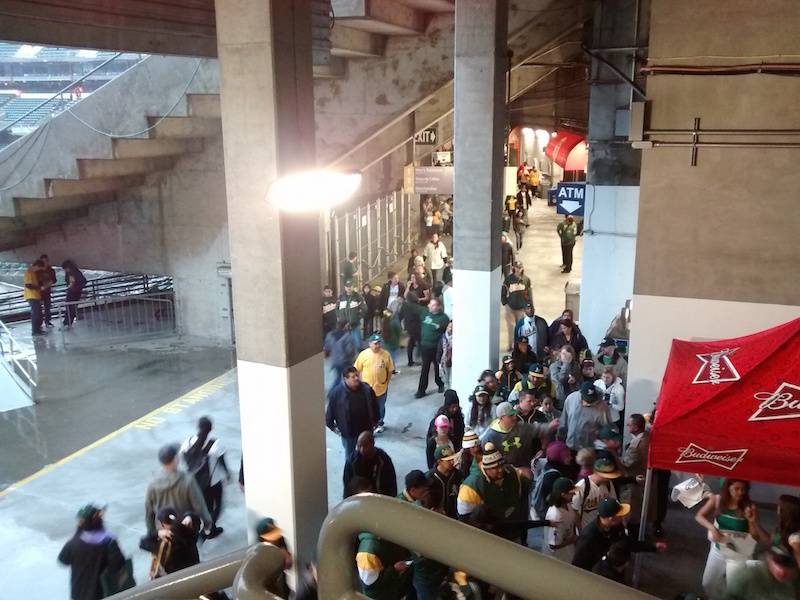
The rain and winds threatened to wreak havoc on the whole affair, but thankfully they lightened up significantly midway through FanFest. With so many autograph lines shifted indoors to the East Side, it was much easier to move between the stadium and arena.

fanfest2015-02-eastside_lines

East Side had many of the autograph stations and fan booths

fanfest2015-09-facade

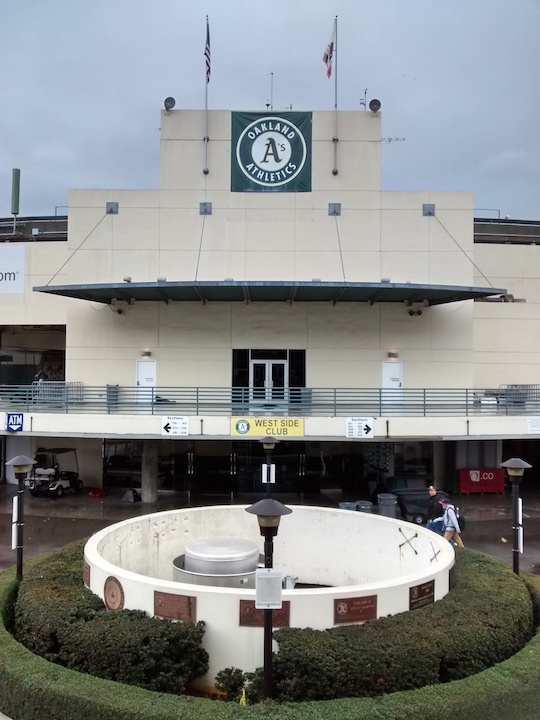
Plaza of Champions cleaned up thanks to better circulation between the two venues

fanfest2015-01-autograph_line

Autograph line

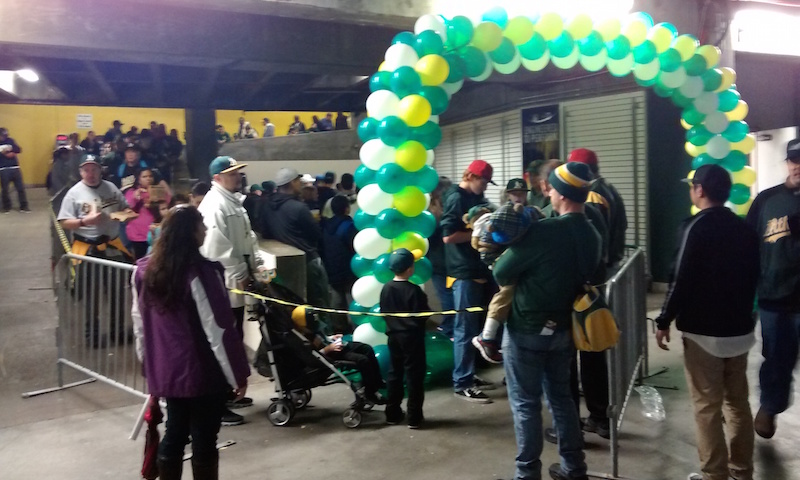
That left one major line behind home plate, the one leading to the Clubhouse Tour. For most of the duration of the event it was quite long, so I passed. Even though I’ve been in the clubhouse many times over the years, I still like walking through there because it takes me back to Moneyball.

fanfest2015-05-clubhousetourline

Line for clubhouse tour

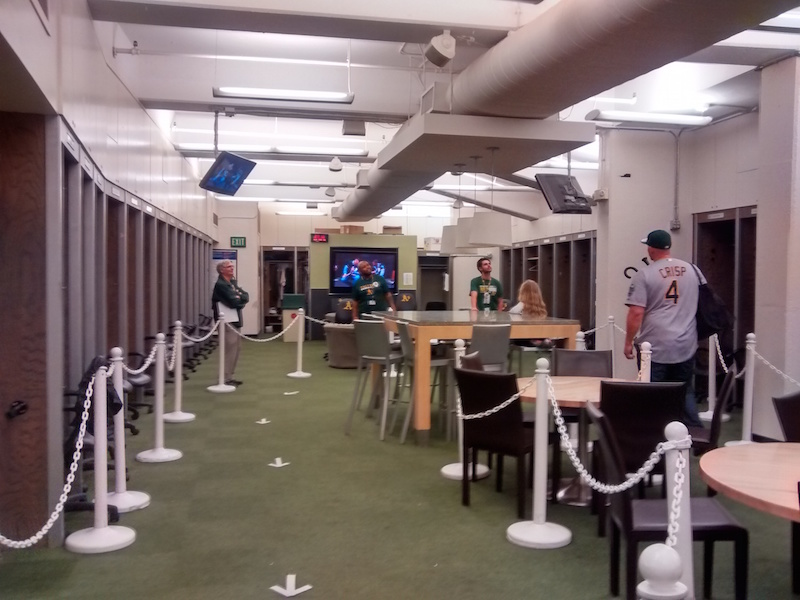
The line died down when the marquee last Q&A session started at 3, so I rushed across to the stadium to quickly walk through the clubhouse. Why? Well, I wanted to provide a comparison between the Coliseum clubhouse and the new clubhouse at Hohokam Stadium.

fanfest2015-07-clubhouse

Coliseum clubhouse

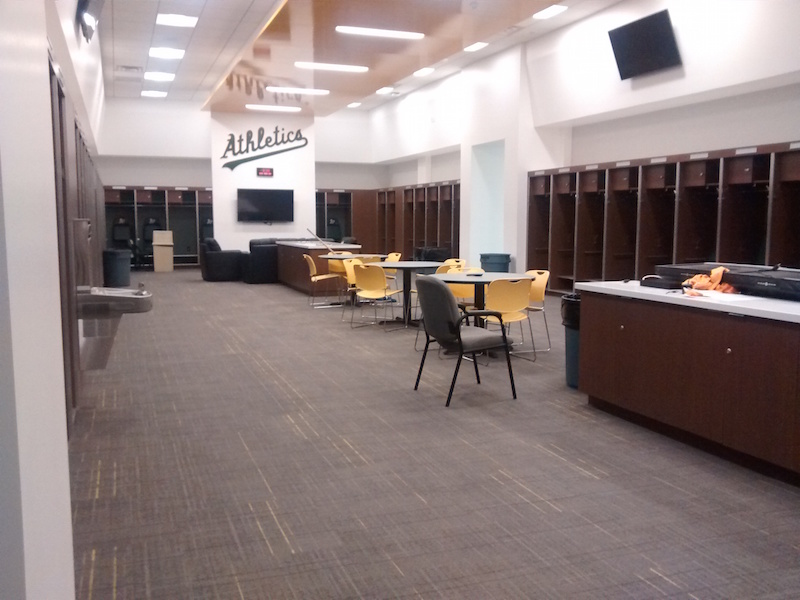
Clubhouse

Hohokam clubhouse

Do you get a sense of how much bigger the Hohokam clubhouse is? It’s much wider and perhaps 50% larger.

This FanFest, I came too late for the BlogFest interview sessions, not that it matters much since I don’t write about the team much. Instead I floated between the two venues, catching up with fans along the way and making observations. A big thank you to Zak Basch for getting the credential to me after the deadline, even if I didn’t use it to its fullest.

My last tidbit is some advice a fan solicited from Coco Crisp, meant for all the new A’s this year.

The more things change, the more they stay the same.

P.S. – The A’s posted on social media that FanFest attendance was 15,000 today.

Coliseum City Specific Plan Final Draft Released

The City of Oakland released the Final Draft of the Coliseum City Specific Plan last week. It’s 211 pages long, packed with information about how Coliseum City fits within Oakland’s broader planning initiatives, as well as important guidelines for future development at the Coliseum area that any project, whether it’s 120 acres or 800 acres, will have to comply with. A 216-page staff report for a February 4 Planning Commission meeting was also made available. Consider that the addendum to the Specific Plan. Note, however, that the EIR was not released. The EIR will be released around February 20. No reason was given as to why the documents are being released separately this time, as the Draft versions were made available as a two-part concurrent release in August.

I’ll recap what I consider important details.

CC-easements

We keep talking about infrastructure, and it’s no less important this time around. Moving those eyesore power lines stretching around the complex will cost up to $32 million (up from $16 million). Two overhead and two underground relocation options were given. The most elegant solution, which would run the power lines underground parallel to the sewer interceptor, would require the creation of an additional 75-foot easement (each line needs 15 feet of separation from the next one, there are four). Combined with the sewer interceptor, that’s 100′ x 0.6 miles of easements. The other alternatives called for relocating the power lines above ground along either the west perimeter and either keeping them above ground or running them underground near Hegenberger. While running underground next to the sewer line would be the most visually pleasing option, the loss of 5+ acres of developable land right in the heart of the complex makes me think it’s a potentially difficult sell, especially since it would cut into land set aside for the football stadium or the existing arena footprint. The finished product could be made better by putting a pedestrian-friendly boulevard and grassy median there, a new community space sort of like the Panhandle next to Golden Gate Park. Naturally, it could serve as additional parking during events. The power lines in the south parking lots would also need to be temporarily relocated to accommodate construction of the football stadium.

pge-relocations

Infrastructure cost estimates have been revised. Area A, a.k.a Coliseum District, has a price tag over $236 million. Area B, the area immediately on the other side of the Nimitz, is estimated to cost $135 million.

Additional important line items:

  • New BART Bridge – $12.7 million
  • New and improved Transit Hub (BART platforms, Amtrak, bus) – $75 million total
  • Site/block development costs (demolition, utilities for new development) – $36 million
  • Streetcar system – $23 million
  • Bay Cut/Estuary Park (outside new arena) – $11 million

That’s $370 million, not including the revised estimates for building out Areas C, D, and E. Putting that in “120-200 acres only” terms, the cost is $236 million not including additional necessary land acquisitions.

Funding for infrastructure could come from the creation of a Community Facilities District or Infrastructure Financing District, Mello-Roos property taxes, and possible revenue from the venues themselves. Hotel and sales taxes are also being considered. Other types of districts and even general obligation bonds are in the discussion, though I would expect that such ideas won’t travel far (Chapter 7, Pages 159-166). And of course, there are various types of local, state, and federal grants that may be available – though they won’t cover anywhere near the required amount.

Speaking of Areas C, D, and E, land ownership has been a topic of interest throughout this process. A current map showing all publicly owned and privately owned parcels is on page 27. It illustrates how much of a patchwork the area is, and the challenge in finishing the project outside the core area A. A strategy to acquire the private properties has not yet been articulated. There are approximately 100 private property owners within the full project area. No indication was made that eminent domain would or should be used.

land_ownership

—-

Based on a set maximum of vehicle trips within Area A, the projected amount of ancillary development is envisioned as follows:

  • 4,000 residential units
  • 408,000 square feet of retail
  • 1,500,000 square feet of R&D/commercial

If residential development were cut back, the other two categories could be increased proportionately. Depending on the total number of residential units built, some percentage (15%) is expected to be set aside as affordable housing. At this point it is unclear what kind of subsidy (public or private) would be required to support the 600-860 affordable units.

—–

To protect against a 16-inch sea level rise (most of the area is barely above sea level), a new storm drainage and flood protection plan will have to be instituted. This could include a seawall at the Union Pacific railroad tracks. It also probably means that the fields for both outdoor venues would not be sunken as the Coliseum is. Instead they would be at grade or higher.

——

Here’s a surefire win:

“Sports teams should be encouraged to provide ad hoc transit between the game venues and other transit stations, in order to avoid congestion at maximum event times.”

The teams’ parking is already being compromised. Surely they’ll lap this request for team-provided shuttles right up.

——-

Much of the rest of the Specific Plan is devoted to detailed zoning changes. I’m not going to get into that, we all know what the big picture is here: sports and mixed-use. The EIR is due in two weeks. Expect a much longer post for that, along with a lot of questions from community groups.

Hohokam Stadium & Fitch Park Update, Early February 2015

This post is split into three slideshows, check the captions for comments. I’ll do a more verbose post after the Open House on the 21st, and the Spring Training Home Opener on March 3rd. First off, Hohokam Stadium pictures taken yesterday. Apologies if this post takes longer than usual to load because of all the pictures.

This slideshow requires JavaScript.

Next, Fitch Park photos also taken yesterday.

This slideshow requires JavaScript.

Finally, pictures from today’s sneak peek inside Hohokam.

This slideshow requires JavaScript.

A couple notes on the scoreboard:

  • Unlike the boards at the Coliseum which use 13 mm LEDs, Hohokam’s board uses 16 mm. Each Coliseum board (36′ x 145′) is nearly 5 times the size of the Hohokam board (26′ x 56′).
  • Resolution of the board is 552 x 1104 pixels. There are two auxiliary score-only boards behind first base and third base.


San Jose City Council approves taking antitrust case to Supreme Court

Despite losing handily twice in federal courts, the City of San Jose won’t relent, voting unanimously today to take its antitrust case against Major League Baseball to the Supreme Court. While its chances of overturning baseball’s antitrust exemption remain slim, the City’s game plan is simply to have the Supremes take the case, which could cajole MLB into settling. Even that outcome is a long shot, as Wendy Thurm explained at Deadspin two weeks ago. Regardless of the long odds, Mayor Sam Liccardo seems to be spoiling for a fight:

We may know the Court’s decision by summer.

FanFest and BlogFest on Sunday 2/8

It’s that time of year again. The Super Bowl takes over the nation’s imagination, followed by baseball, waking from its annual hibernation. That means FanFest, which will be held on Sunday, February 8. Last year’s FanFest was also held on February 8, which was a Saturday. The Giants chose to hold their FanFest on February 7 this year, so this avoids a date conflict.

BlogFest will also be held again, starting at 10 AM. Like last year, bloggers will be taken to a suite on the East Side, where we will be interviewing:

  • David Forst
  • Jesse Chavez
  • Ike Davis

Oh, the questions for Forst will come aplenty. The blogger interviews are usually held after the regular media session. And of course, there will be the regular player interviews and introductions held inside Oracle Arena. Tickets are still available online. Since the event was restarted in 2011 it has sold out. The Coliseum will also be used again, which will give everyone an opportunity to check out the state of the scoreboard project – though the system is not expected to be fully built or operational by Sunday.

A fairly heavy storm is forecast for the weekend in the Bay Area, so the soggy FanFest day tradition should continue. Check the weather reports and plan accordingly.

If anyone wants to meet up inside the Coliseum (not the arena which will be cramped) to talk stadia and Coliseum City, let me know.

CBS Sunday Morning profile of Daktronics

Runaway success scoreboard manufacturer Daktronics was profiled today on CBS Sunday Morning. The segment covered Daktronics’ humble beginnings as a company started by two engineering professors who simply wanted to keep students from South Dakota State from fleeing the region. It’s a classic tale of American innovation and ingenuity.

Daktronics makes all three new scoreboards going up for the Earthquakes and A’s, at Avaya Stadium in San Jose, Hohokam Stadium in Mesa, and O.co Coliseum in Oakland. The 49ers had a graphic created comparing the sizes of other NFL scoreboards to theirs. While the displays at Levi’s Stadium are labeled “Sony,” they are in fact Daktronics products. The Coliseum scoreboards should ultimately bump the Patriots’ Gillette Stadium out of the top 10. It doesn’t make up for the Tuck Rule game, but it’s something.

scoreboards

Enjoy the Super Bowl, everyone.