John Fisher and the Art of Equivocation

A’s and Quakes co-owner John Fisher was on hand at the Avaya Stadium ribbon-cutting ceremony in San Jose today. He was obviously there to celebrate end of the Quakes’ long journey to their own home. Fisher is known as the “soccer guy” in the ownership group, and Elliott Almond’s article sheds some light on that soccer background.

However, the Merc’s headline writer saw fit to make this about baseball with the title, “A’s owner John Fisher: Baseball team’s turn for new stadium.” Fisher was indeed asked about a ballpark for the A’s, and as you’d expect, he provided no new information. Instead he said this:

The Bay Area deserves great facilities. We live in the greatest area in the world and we have incredible teams that have performed tremendously well.

Whether you think Fisher was being intentionally vague or simply choosing to focus on the accomplishment at hand, it was Fisher’s first real statement about anything as part of the ownership group. That in itself is pretty big. I don’t necessarily expect more from him or a more visible role, though his presence at an earlier meeting with Libby Schaaf is perhaps promising. Keith Wolff was also at the Avaya Stadium ceremony, while Lew Wolff has been in Mesa for spring training activities.

Now take a look at these quotes.

This has been my biggest thing, ingress and egress for the (venue) and the parking are the two most important things to me.

In these focus groups we’ve had in there in the last week or two, the first question seven out of eight groups asked is, ‘Where is the parking?’

They’re showing all this grand building, a baseball stadium, there’s a football stadium there’s the arena, there’s all these residential things. And there’s no parking.

Did that come from Mark Davis? Or Lew Wolff?

And this one:

Parking is a key issue for us. We want surface parking surrounding the (venue) wherever we build it unless we’re in the heart of a downtown.

Davis? Or Wolff?

Now consider the the reaction to these quotes. The first set received little blowback at the time. The second had a lot of negative reaction. The content and sentiment were essentially the same. They have problems with how Coliseum City is conceived because it could cause problems with the way they operate their respective franchises. Then why such dramatically different reactions?

With Davis, many assume that either he’s more-or-less earnest about most everything: his handling of the stadium issue, his management of the Raiders, right down to the establishments he chooses to patronize. (That shouldn’t be confused with success.) Wolff, on the other hand, is considered forever the schemer looking for any excuse to leave. He’s the absentee owner, even though both guys are based in LA. Wolff has the anti-Oakland track record. His timing is spectacularly bad at times. Davis is Tommy Boy, all about honoring his dad. Whatever indiscretions or failures Davis has can be chalked up to being the family black sheep. He’s not really supposed to be here.

It just goes to show that even when two men have the same message, the prevailing narrative takes over. At some point these men will have to make deals, and those narratives will fade away. Or maybe they’ll be reinforced.

A’s and 95.7 The Game extend through 2018

It started with a four-year run, and will now go another four.

There hasn’t been any drama leading up to this renewal, with The Game on hand at both FanFest and this week at Hohokam Stadium. While the A’s are no ratings bonanza, the team is by far the biggest constant in The Game’s programming. Now that the station will be going through its own form of regime change, perhaps Entercom will see fit to grow the station’s brand and the A’s brand together, instead of being at odds as they were at times. No matter, at least it’s stability, the most fans have seen since the KSFO days.

My only suggestion at this point is to work on boosting the signal. East and North Bay fans have been clamoring for this since Day one.

Wolff wants surface parking over garages and development at Coliseum

Here we go again with that nasty word: infrastructure.

Lew Wolff told Matthew Artz today that not only was he not interested in Coliseum City, he felt there isn’t enough space at the 120-acre Coliseum for development the City desires and the surface parking the team needs. That’s a major revelation because Wolff’s vision not only precludes other development in what’s considered a potentially high-density transit hub area, it goes against the City’s goals for the Coliseum.

There’s a lot that’s being unsaid by Wolff, who demurred on questions about financing and multiple venues. Let’s focus on what he said.

The only way it could work, Wolff said, would be to build multilevel parking garages, but that would leave fans waiting in long lines to exit the garages and begin their drives home.

‘Parking is a key issue for us,’ Wolff said. ‘We want surface parking surrounding the ballpark wherever we build it unless we’re in the heart of a downtown.’
‘We said it before he even came on the scene that we are going to 100 percent control our own destiny, period,’ Wolff said. ‘We don’t need a third party involved.’

First off, let’s be clear about how much land is available: 141 publicly owned acres in the area bounded by 66th Ave, Hegenberger Rd, 880, and Damon Slough. Take away 18 for the existing Coliseum or its replacement, and 8 for the arena if it stays. There’s other stuff like the sewer interceptor and power lines, but we’ll leave that out for now. The remaining land totals 115 acres.

As Andy Dolich notes in the same article, garages are ill-suited because they’re expensive and don’t get utilized well. Parking garages cost around $20,000 per space to build. ROI can be difficult to achieve unless those garages can be filled nearly everyday. But the City is supposed to fund infrastructure like garages at Coliseum City, so why is this such a big deal? The surface parking requirement, which Raiders owner Mark Davis has also communicated at times, stands in the way of the City’s plans for Coliseum City, whether you’re talking 120, 200, or 800 acres. The Coliseum City plan has 13,000 event parking spaces in it, only 4,200 of which are surface spaces mostly in the south lots out to Hegenberger.

Blue and dark gray are garages, medium gray is surface parking

From the Coliseum City Specific Plan: Blue and dark gray are garages, medium gray is surface parking

Shouldn’t 4,200 (or maybe 5-6,000) spaces be enough for most A’s games when taken with a few thousand new garage spots?  Especially if the TPMP (Transportation & Parking Management Plan) were conceived in a way to manage traffic from these various lots and garages? Especially if it’s only a single venue such as a ballpark? Let’s say that the A’s average 30,000 in attendance at a new ballpark. According to BART, 15-20% of fans take the service. Let’s make it 20%. That means 24,000 will come in cars. At 3 per car, the A’s would need 8,000 spaces. So they’d need some 2-3,000 additional spaces, maybe half of those in garages, the rest in a remote lot on the other side of the complex where people would have to walk through the retail/commercial area to get to the game. That way you have everyone covered:

  1. Fans who want direct access to the ballpark and the quickest in-out (4,200 surface spaces adjacent to ballpark, south)
  2. Fans who want to have dinner/drinks at a restaurant nearby (3,000 garage spaces, perhaps with validation, center)
  3. Fans who want cheap parking and don’t mind walking through the business district (3,000 remote surface spaces, north)

If you look at the parking depiction above, it’s not hard to see how that would come together. Put the ballpark where the football stadium is and the remote parking where the ballpark is and you have the basic concept. The idea presupposes that the arena is no longer there either.

The problem, as ever, is that no one wants to pay for any infrastructure like parking. A 2,000-space garage is bad enough, and it’s merely a piece of the $300 million of infrastructure. Wolff has suggested that he’d take care of the Mt. Davis debt, but if he has to pay for infrastructure too it starts to become too much. The City has suggested a slew of taxes that would pay for it through huge Mello-Roos and infrastructure financing districts, but that isn’t certain. Some of those taxes would eat into A’s revenues, so again it becomes a question of cost-benefit for the A’s.

In the end, if the A’s and the City/County are going to make this work they’ll have to come to a compromise. Whether the A’s claim a large piece of the land for ballpark and parking and leave the rest for the development, or the A’s control development rights to the whole thing, they’ll have to come half way. That also means the City will have to dial down its pie-in-the-sky dreams of a bustling second downtown anchored by multiple sports venues for something a little less ambitious. There probably is a way to accommodate both Wolff’s and Oakland’s goals. It’ll take a lengthy negotiation, which I should remind you, hasn’t happened yet. In fact, we’re not even close to negotiating yet.

P.S. – Would you believe that until last year, there were no major pro sports venues in the Bay Area with adjacent or nearby garages? It’s true. The Coliseum, which houses three teams, obviously has no garages. Neither does AT&T Park, which has surface parking across Mission Creek from the ballpark. SAP Center has multiple surface lots, including an elevated lot next to the arena that some might mistake for a garage. Candlestick Park had a small peninsula of parking next to it.

That changed when Levi’s Stadium opened last year. As part of the deal, an 1800-space garage was built directly opposite the stadium on Tasman Drive in Santa Clara. That garage has been notorious for excruciatingly long waits to leave, thanks to its single point of entry/exit. Wolff knows this because his Earthquakes opened Levi’s last summer, Quakes fans as guinea pigs. As we saw with the Sharks-Kings Stadium Series game over the weekend, parking and transportation is still a puzzle that hasn’t been figured out by the 49ers, Santa Clara, and VTA.

Other ballparks in suburban locales (Dodger Stadium, Angels Stadium) also don’t have garages. PETCO Park, Chase Field are downtown ballparks with attached garages that work well in concert with other nearby parking options. Coors Field has practically all surface lots available as parking. Downtown ballparks not only have garages or plenty of nearby parking infrastructure, they have the proper street grids and built-in traffic management needed to support large events. The Coliseum City plan is not set up like a new downtown with many ways in and out. It’s essentially the same plan as before, which has led to poor level of traffic service (LOS) grades in the Coliseum City EIR. It’s natural for Wolff to want to avoid the Levi’s situation.

Dolphins show off $400 million renovation project

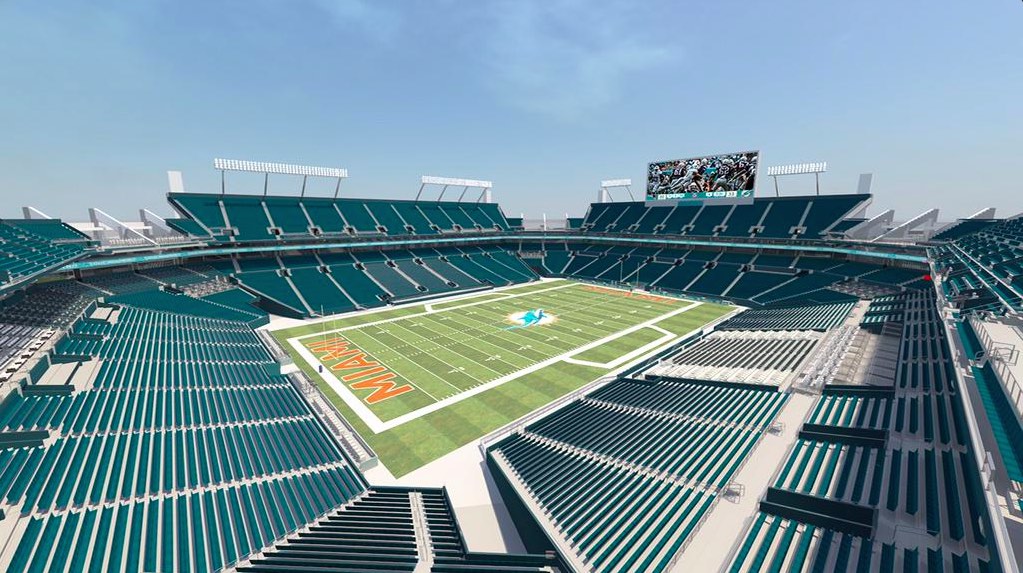
Not long after the Orange Bowl was played on New Year’s Eve, the Dolphins embarked on an ambitious, $400 million plan to rip apart about one-third of Sun Life Stadium. Dolphins President Tom Garfinkel has been regularly posting photos of the progress.

The plan is being carried out in two phases. The first takes off the upper corner sections permanently, leaving the structural raker beams behind. The lower sideline sections are also being removed, to be replaced with new sections that will eventually bring the first row 24 feet closer to the field than before. All of the seats will be replaced with bigger, all-turquoise versions. The lower deck renovation will allow the Dolphins to offer new luxury seating types between the usual club seat and suite choices. Some will be mini suites at midfield, others will be behind the end zone. Concourses are also being redone.

First phase renovations to be ready in time for 2015 NFL season

First phase renovations to be ready in time for 2015 NFL season

Second phase improvements include new scoreboards in the upper corners where the seating sections used to be, and the big reason for the project: a huge open air canopy that will cover virtually the entire seating bowl and outdoor concourses. Given the often rainy and hot weather in the first half of the NFL season, this was considered a necessary addition. The canopy is also a must for the NFL if future Super Bowls are to be held there (the last was held in 2010).

sunlife-2016-outside

Final renovations including seating canopy

Final capacity is projected slightly above 65,000, a cut of 10,000 seats. Despite the reduced seat count, the venue is better positioned to bid for the Super Bowl and the College Football Championship game, which is up for bid separately from the normal bowl rotation (the stadium already hosts the Orange Bowl).

Most importantly, this project is being financed privately, mostly through luxury seat/suite sales, not through bonds, PSLs, or other unsavory means. Stephen Ross campaigned for public funding for the better part of 2 years, threatening that the Super Bowl wouldn’t come back without yet another South Florida giveaway. He eventually gave up his quest, seeing that it would be better to get started on the project and get the Super Bowl. Finally, Miami-Dade County held firm and wasn’t ripped off the way they were by the Marlins and Heat.

In May I covered the much more modest, $200 million renovation at Orlando’s Citrus Bowl. While that project lacked much of the luxury amenities being added to Sun Life, the actual teardown and rebuild was more extensive, gutting and replacing the entire lower bowl. I wondered why the Raiders weren’t pursuing this path at the Coliseum. I can say the same now that the Dolphins are going down a similar, albeit more NFL-appropriate path. A Raiders renovation would be a sort of hybrid of the two, not as swanky as Miami nor as basic as Orlando. Over time I ballparked the cost at $500-600 million, basically the same amount as the funding gap the team and Oakland/Alameda County face at Coliseum City.

So why is no one talking about a Coliseum renovation? Maybe the image of the Coliseum is beyond repair even with a renovation. Maybe the fact that the field is 20 feet below sea level makes it a bad choice for forward-thinking CEQA guidelines about sea-level rise or storm-related flooding. Neither of those is a good excuse. If everyone involved in wanting to keep the Raiders (team, government, fans, investors) isn’t merely about playing games, there’s no reason why this kind of option wouldn’t be investigated thoroughly. It’s cost-effective, proven, and preserves the very site that so many Raiders fans hold dear.

P.S. – While we’re at it, why didn’t the 49ers incorporate some of these amenities into Levi’s Stadium? We’ve already seen these put into arenas and some stadia over the past few years.

P.P.S. – The Dolphins are applying for $50 million in sales tax revenues. A decision to provide that funding along with funding for other sports venues has been delayed by the Florida legislature. Even if that’s approved, Ross is funding $350 million of the project, a better ratio than most American stadia. At least Ross dropped the charade and got started on the project.

Manfred talks Coliseum ballpark

MLB Commissioner Rob Manfred made a few comments about the A’s and the Coliseum. The comments are in the 2nd item of Susan Slusser’s daily spring training update from Monday night.

In addition to confirming that the Coliseum is the best site for the A’s (as opposed to Howard Terminal, which was not mentioned), he also spoke out about the Raiders’ and the NFL’s role in the Coliseum drama.

‘I think that there is a lot of activity that could clarify the situation, and I’m not going to go beyond that, that I think could create an opportunity to move things along in Oakland. I think the A’s are willing to explore Oakland if they can find a workable arrangement and it’s always been our preference to keep clubs where they are.’

My immediate reaction was to read into his quote a little:

Slusser agreed with my assertion, as did Howard Bryant. Ray Ratto cautioned against reading too much into Manfred’s quotes, as he’s just starting his gig and lacks to power base to make any major decisions. But that’s kind of the point of the Raiders-leave-and-A’s-take-control scenario, in that MLB doesn’t have to make a decision. They effectively back into a solution for the A’s without having to do anything. They wouldn’t even have to take a vote. Follow the Twitter thread and it becomes a fun little discussion about this ballpark business, including replies from John Shea, Wendy Thurm, and the LA Times’ Bill Shaikin.

While it’s pretty good reading, no one should get any ideas that the A’s are about to get the keys from dad. There’s a long way to go until that happens, and the A’s housemates will have something to say about it before long.

M&R: 30 days or bust for Raiders in Oakland

It’s a short article and a rather incendiary headline from Matier & Ross, but it’s not like we haven’t seen this coming.

‘If we don’t have significant progress within the next 30 days, I’d say one party or the other will call an end to it.’ That’s how one source close to the Raiders stadium negotiations in Oakland characterizes the on-again, off-again talks.

Okay, I guess. This doesn’t mean that Coliseum City is dead. There’s a lot of context we don’t have here. Is the anonymous source only talking about the new stadium, or does the lease extension also have something to do with it? Remember that as of now, the Raiders have nowhere to play for the 2015 season. If the only issue is the stadium discussion, that’s an awful way for the Raiders to go about things. Besides not having a place to play and no approval from the NFL to make a move, there’s little concrete evidence that the framework of a deal can be reached in 300 days, let alone 30. Maybe, as Larry Reid said, the work is 90% done. So what’s keeping the rest of the 10% from being done? The Raiders? Maybe. New City? Floyd Kephart said that the ENA runs through April. The ever-balking Alameda County? Who knows?

To me it sounds like yet another bluff. Last week’s reveal that the Raiders and Chargers are working on their own plan was characterized as a bluff by many. Scratch the surface and you’ll see that the Carson site is nearly ready to go after a great deal of cleanup, according to the State. Again, there are so many moving parts here with all the different players and deliverables that it’s hard to know what progress really is. Frankly, if this is coming from the Raiders, I’d like to see what happens if they leave the table. It’s always been up to the Raiders to make the first move. Mark Davis may actually have the courage to push that first domino. And if that happens, expect everyone else – the public sector, the A’s, the NFL and MLB – to start moving in kind. Eventually.

A Day at the Diamond, Hohokam Stadium Preview

The parking lots filled up fast, so that by the time I arrived at Hohokam Stadium around 11 I was directed to park in the grass soccer fields south of the ballpark. With the construction debris gone and systems in working order, it was time to show off the renovated ballpark to the community.

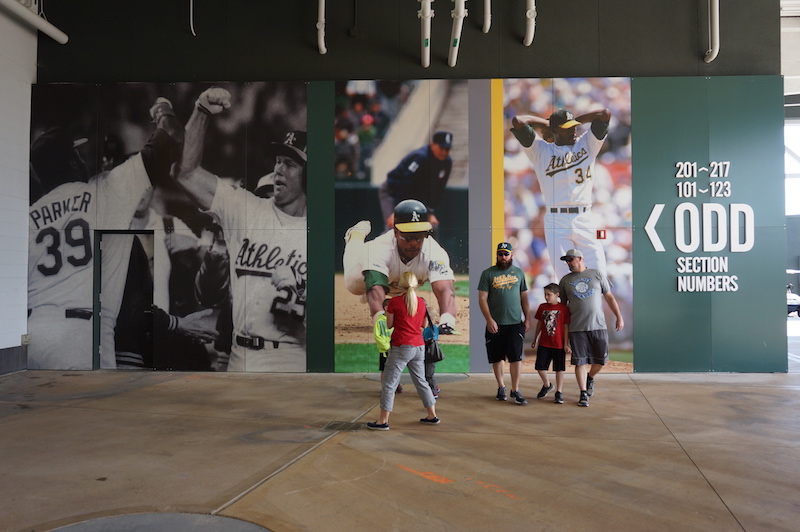
Fans walking in front of the clubhouse mural

Fans walking in front of the clubhouse mural down the 1B line

There were no surprises for me. I’ve checked out the place throughout various stages of construction over the last two years. What I wasn’t quite ready for was how it looked with a bunch of people in it, sitting in seats, traversing concourses, hoping for home run balls. For me that’s when it became more than a bunch of features and improvements upon Phoenix Muni or even the Coliseum. That’s when it became real.

Back row behind the plate

Back row behind the plate

From the top of the stadium you’re afforded views of the McDowell Mountains to left, Four Peaks and Red Mountain to right. Down low it’s all baseball. While the A’s have sold ads in the outfield, don’t expect the same kind of ad explosion you typically see in minor league parks and other spring training parks. The big scoreboard in left will probably be used for getting those messages across.

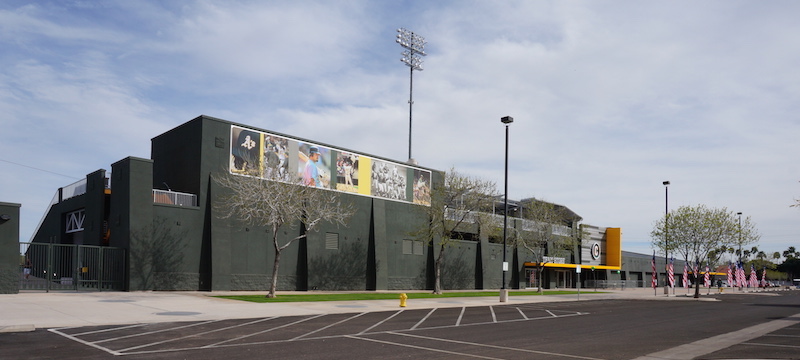
Exterior outside 3B

Exterior outside 3B

If you had visited Hohokam at any time since its 1998 renovation, you know about the edifice’s underwhelming blandness. A 90’s  ode to beige stucco, there were only the most minimal nods to the Southwest. Under the A’s, the Gensler-designed makeover is all green and gold. The exterior walls are the forest green we as A’s fans are very familiar with, perhaps darker than you might expect at first glance. Gold painted aluminum panels line the gates and box office. Originally the gates were to have famous player numbers, like 24 for Rickey Henderson. This was scrapped sometime in the last year, probably because having gates named in a “random” manner would look confusing to non-A’s fans. Not that the gate naming system matters, it’s unlikely anyone will get lost here. One bit of technology not available in the 90’s was large format, photorealistic vinyl, which was put to good use depicting major events in A’s history on the outside of the stadium (above) and throughout the concourse.

This slideshow requires JavaScript.

The inner concourse felt somewhat cluttered with numerous memorabilia sales tables on both sides. Only a few concession stands were open, so the space was made available. Most of the concourse is white, with gold accents to highlight fan amenities, from tunnels to the grandstand to restrooms and concession stands.

Ferguson Jenkins was even on hand, as he used to be when Hohokam was the Cubs’ home. Jenkins usually makes the rounds at every Cactus League park, so if you want to meet the Hall-of-Famer you’ll have your chance.

This slideshow requires JavaScript.

Unlike Phoenix Muni, at Hohokam fans will now be able to walk completely around the park. As a 90’s-era Cactus League park, there’s no 360-degree concourse like the kind you’d see at the newest parks: Salt River Fields, Camelback Park, Sloan Park. Even so, you can get your full stroll on, and the upper tier is elevated enough above the walkway that you won’t have to worry about obstructing views.

This slideshow requires JavaScript.

When Hohokam was redesigned, the Cubs made sure to get a large canopy placed over much of the seating area, as the old Hohokam had no shade whatsoever. That feature was carried over to Cubs/Sloan Park, and while the shade isn’t truly necessary for March in Arizona (75-80 degrees, dry heat) it’s welcome. If you want shade from the start, sit in the upper sections on the 1B side or behind home plate. The A’s also removed large bleacher sections down each line and replaced them with shaded patios, one a family and kids area, the other a beer garden. Along with the downsizing, all of the seats and bleachers. The plastic fixed seats are 19 or 20 inches wide, provided by Hussey Seating. Bleachers are contoured and have backs.

This slideshow requires JavaScript.

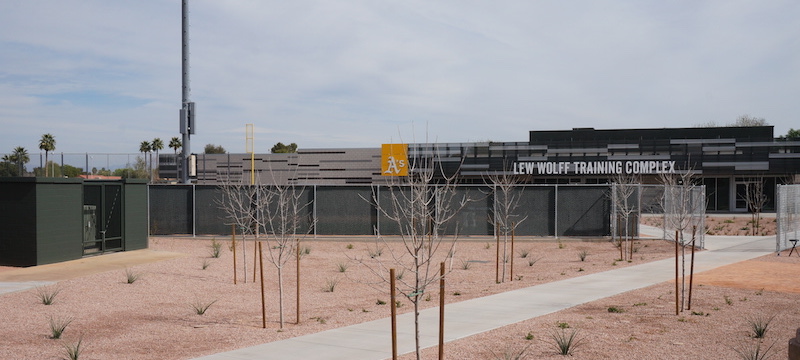
A's training facility at Fitch Park

A’s training facility at Fitch Park

Hohokam is 0.6 miles north of Fitch Park, home of the Lew Wolff Training Facility. The facility was not named LWTF in the initial drawings presented by Gensler nearly a year ago. Whether Wolff decided to do this at the last minute or was pushed to do so because of the drawn out Coliseum lease negotiations or other factors, the Wolff name is unmistakably on the A’s building in Fitch Park and on way finding signs outside Fitch. Wolff’s name is nowhere to be found at Hohokam, and both Hohokam and Fitch have retained their original names. Wolff turns 80 this year, so I can’t blame the guy for celebrating an achievement, no matter how distasteful it may look to many Oakland fans.

This slideshow requires JavaScript.

The outfield berm areas at Hohokam are arguably the largest in the Cactus League. In right, the berm is so large that it’s split into a good-sized lower part and a large upper hill, descending to a second walkway next to the warmup fields. The A’s have plans to rework these areas to include a food truck alley and a grotto in left, but for now they’re being left alone. In any case, you’ll have plenty of area to stretch, and maybe the team will add more kid-friendly attractions with all the space, as is seen at Peoria.

It's huge

It’s huge!

Last but not least, there’s the new scoreboard, which I’ve talked about previously. The A’s are experimenting with different graphics and sound packages, and from what I hear they’re not final, so you if you have suggestions chime in. One dilemma I heard about was whether to bring the “A*Team” theme and graphics over from Oakland or trying something different for Hohokam. I have a bunch of lawn tickets for games in March, and I made sure to plant myself in front of the display to see if I could stand the up-close pixelation. It looked fine to me, so I’ll make LF semi-permanent instead of RF, where I thought I’d be sitting prior to today.

The final price tag on Hohokam Stadium was $27 million, $17 million from the City of Mesa and $10 million from the A’s. The original budget was $20 million. Some of the extra $7 million went towards technological improvements, such as proper wiring for broadcast video throughout the park. While the A’s and Comcast don’t broadcast a ton of games during the spring, it’s good to know that the capability is there. Visiting teams will be able to take advantage as well.

A spring training ballpark is only used for a month every year. Games held there don’t count in the standings. It is more intimate than regular season baseball, more accessible. Every fan should take the opportunity to visit his/her team’s spring training home at least once. It’s warmer in more ways than one.

Coliseum City EIR Final Draft now available, JPA postpones lease extension vote, Saperstein comments

The Coliseum City EIR Final Draft was made available around lunchtime today. It’s 17 MB in size and worth looking through. As I run through it I’ll post my observations on Twitter with the hashtag #ColiseumCityEIR.

(Update: As pointed out by Floyd Kephart, the vote was over the lease. The JPA isn’t a party to the ENA, only the City and County can be among public entities.)

Over at the East Bay Express, Steven Tavares reports that the Coliseum JPA postponed a vote (again) to approve the Raiders’ lease extension. Tavares got comments from various JPA Board members, including outgoing and incoming Board Presidents Nate Miley and Larry Reid. While neither said why the postponement occurred, both indicated that certain aspects of the deal don’t look favorable to the county. Miley went on to talk about some of the Coliseum City issues we have talked about on this blog many times: hundreds of millions in infrastructure costs, the Coliseum’s outstanding debt, and the value of the land. Miley even indicated that some public contribution may be required for a Raiders stadium, which should raise some eyebrows in the East Bay.

Larry Reid characterized New City as “90% there” in terms of getting a team commitment, that team being the Raiders. Yet the Raiders’ joint announcement with the Chargers about a shared stadium in Carson took everyone by surprise. Reid still believes Mark Davis wants to keep the team in Oakland, and really, what choice does he have? The only shocker at this point would be if the JPA, City, and County kicked the Raiders to the curb after spending so much time, money, and energy on Coliseum City.

About that time, money, and energy:

Meanwhile, local officials met with NFL officials in January, said Reid. Their assessment was the city and county had made no progress in efforts to build a new stadium since a similar discussion between all the parties a year and a half ago. ‘They made it clear that the city and the county wasted the last eighteen months,’ said Reid.

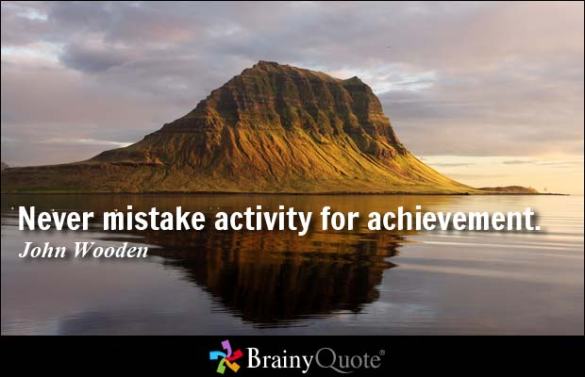
Again, don’t pay attention to what people are telling you about how Coliseum City is progressing. When teams commit, when real actions happen to advance the ball, then you’ll know. As a wizard once said,

johnwooden380232

Last item today comes from a commenter on the blog named “Let’s Go Oakland,” who snipped a piece of a Facebook thread and dropped it in the comments.

wow

Guy Saperstein is a minority partner in the A’s ownership group

Assuming this is the real Guy Saperstein speaking, it sure sounds like the ownership group is still in lockstep in their position on San Jose, despite San Jose being off limits for the foreseeable future. Saperstein has long been based out of Oakland/Piedmont. Regardless, the only group the A’s can actually make a stadium deal with at this point is the Oakland/Alameda County/JPA triumvirate. As the fog enshrouding the Raiders and Mark Davis recedes, maybe they’ll actually make a decision on their future. Hopefully it doesn’t hurt the A’s in the process. If Davis can make a deal with Kephart, there will be a Raiders stadium at the Coliseum and the A’s can slide down to San Jose. If the Raiders can’t work something out, they’ll jet to LA while the A’s work out a new ballpark deal at the Coliseum complex. Those are the two most realistic scenarios that can be sussed out at this point. Anything else is wishful thinking.


Raiders, Chargers announce shared stadium plan in Carson – huge leverage/hedge play

The Chargers have expressed real frustration with the City of San Diego over the last several days. So announcing an LA stadium plan seems like the next logical step. But the Raiders? Say it ain’t so, Mark!?!?

It's like the 49ers' digs, only 400 miles south

It’s like the 49ers’ digs, only 400 miles south

The LA Times’ Sam Farmer has the scoop, describing the deal as a Plan B for both teams if they can’t work out “publicly financed” stadium deals in San Diego and Oakland, respectively. The teams quickly followed up with their own joint statement, explaining their plans with a surprising amount of detail – at least at this early stage. The statement:

  • We have both been working in our home markets to find a stadium solution for many years, so far unsuccessfully.
  • We remain committed to continuing to work in our home markets throughout 2015 to try to find publicly acceptable solutions to the long-term stadium issue.
  • We also both understand and respect the NFL’s relocation process, and we intend to adhere strictly to the relocation procedures that the League has set forth for Los Angeles.
  • In particular, we respect the right of the NFL’s owners to decide on all Los Angeles-related relocation issues and understand that any relocation application that is filed for Los Angeles must obtain the approval of three-fourths of the NFL’s owners.
  • Both teams have kept the NFL owners’ committee on Los Angeles, and the Commissioner, fully informed about our joint efforts.
  • We are pursuing this stadium option in Carson for one straightforward reason: If we cannot find a permanent solution in our home markets, we have no alternative but to preserve other options to guarantee the future economic viability of our franchises.
  • In short, for the remainder of 2015, we intend to move down two tracks simultaneously:
    • On track one, we will continue to work in our home markets to find permanent stadium solutions that are publicly acceptable.
    • On track two, we will work in Carson to preserve our options, and the future economic viability of our franchises, in the event that our efforts in our local markets fail.
  • Throughout this process we will respect the rules and procedures set forth by the League and defer completely to the ultimate decision of the NFL’s owners.

There’s a lot to unpack here, so let’s start from the top. The first five bullets are meant to curry favor with the true audience for this statement, the NFL and its constituent team owners. It’s Dean Spanos and Mark Davis saying to the owners, Look, if you want someone who’s going to play by the rules, who won’t go rogue *cough*Kroenke*cough, it’s us. Stan Kroenke’s actions have taken much of the leverage over LA away from the NFL despite the league’s protestations, so the play here may be that if Kroenke gets stuck in litigation with the league, Spanos and Davis may benefit by getting the two LA slots. By the time the dust settles, the Chargers and Raiders will already be in LA and the Rams may be stuck in St. Louis. Most importantly, Farmer’s report revealed that the Chargers and Raiders bought the 168-acre plot of land in Carson on which the stadium would sit. That’s more than a mere verbal threat, that’s real action.

Kroenke, who didn’t buy land in Inglewood to sit on it, probably anticipated this, while having talks with Spanos and Davis about partnering up in The Wood. He claims to have a privately financed stadium there. Spanos & Davis claim to have a privately financed stadium in Carson. Let’s be clear, though, TWO privately financed stadia in LA don’t work. Even with a market the size of LA, that’s too many suites to sell, too many sponsorship commitments. Two stadia would compete with each other for Super Bowls, NCAA playoff games and any number of other big events, effectively cutting into each other’s profitability and feasibility. If we want to term this a race to LA, there are at most two teams that can win and one stadium plan that can win.

That’s the hedge part, or so we’re being led to believe. The leverage play from Spanos and Davis is that they’re still working on plans in their hometowns. Spanos has allowed team lawyer Mark Fabiani to be the bulldog, quickly getting into a war of words with San Diego Mayor Kevin Faulconer. Davis, who appeared to say the right things only a month ago when he said he wanted to pursue his own stadium plan, is now running back to Floyd Kephart and Coliseum City. If Davis wasn’t on board with CC before, what’s going to change now to make him sign on, besides being backed into a corner? Having LA as an option is a hedge against that very possibility. If you look at what’s been happening in both cities, there isn’t much progress. Neither city wants to to provide any public funding. Both cities’ greatest asset is land, which isn’t nearly as good as money. The Chargers are being aggressive, whereas the Raiders are waffling.

The Chargers’ attacks on San Diego can be considered the first blink after Kroenke’s plan was unveiled. This joint-stadium plan is the second blink. Who blinks next? San Diego and/or Oakland, in order to force everyone to the table? Or is it Kroenke, who may want to accelerate his plan in order to keep others from taking his leverage away? Or perhaps it’s Roger Goodell, who is in danger of losing control over the process?

The boldest move would come from either Faulconer or Oakland Mayor Libby Schaaf. These cities don’t have to be pawns in the stadium extortion game, one that has gotten exponentially more complex because of the number of factors involved. They could call this bluff. The only winning move is not to play, right? It’s one thing for the teams have land. It’s another to actually assemble a shared stadium deal that works for both teams. While MetLife Stadium can be considered a success for the Giants and Jets financially, in use it’s a lifeless gray mess, terribly lacking in home field advantage and absent either team’s character or signature. Do Spanos and Davis really want to go down that path? The LA stadium renderings, done by Warriors’ SF arena firm Manica Architecture, look like Levi’s Stadium 2.0 – similar caste system bowl layout, red seats, and no façade. At least there’s a partial roof.

In the end, the promise of a huge valuation raise may prove too alluring to dismiss for these teams. It’s easy to give lip service in trying to build at home, but it may be the toughest challenge to stay. Even with things moving as fast as they are in 2015, it’s still too early to predict how this is all going to shake out. There are many, many moves left in this game. It’ll be fascinating to watch, that’s certain.

Davis wants Alameda County at the table, but…

This is not unexpected, yet strange.

If memory serves, Davis still hasn’t paid the minuscule 2014 rent at the Coliseum, all while currently making improvements to the Alameda training facility. Seems like there’s a quick way to get everyone on the same page, especially if Davis’s request is just a first step towards completing a Coliseum City deal.

More from BANG’s Matthew Artz:

Looks like Davis’s go-it-alone strategy isn’t going so swimmingly, hence the pivot back to Kephart. Plus now Ron Leuty of the SF Business Times sheds additional light on the County’s resistance to Coliseum City.

‘Currently, (Alameda County) is not at the table,’ said Floyd Kephart, the lead executive of New City Development LLC told an Oakland business group Thursday, though he planned to meet Thursday afternoon with Alameda County Supervisor Scott Haggerty.

The City’s priority is clearly to work out the future of the Coliseum area, beyond the complex. The County’s appears to be fixated on the debt issue, which, while small in the grand scheme of things ($2-3 billion in total development), is plenty large enough to trip up any plan. Few entities can afford to write off $100+ million of debt. Packaging that debt creatively is a monumental task in and of itself. If the County wants to get tough on this, it’s their right and responsibility. Because without the County, there is no deal even if an EIR gets certified. So much for everyone being on the same page.

More comments from Kephart and reaction from Haggerty via Artz:

‘Just come to the bloody table and make a reasonable and fair attempt to see if we can keep the Raiders, build a stadium and do this development,’ said Floyd Kephart, a San Diego-based businessman who is trying to finance the city’s multibillion Coliseum City project, which envisions new stadiums for both teams at the Coliseum site.

Kephart’s remarks before a meeting of the West Oakland Commerce Association, didn’t sit well with Alameda County Supervisor Scott Haggerty who said the county was doing its due diligence. “I don’t know why people are insinuating that we are not at the table,” he said in a phone interview before a scheduled meeting with Kephart. ‘Just because you are asking questions doesn’t mean you are not at the table.’

So many moving parts. Davis wants to try his own bid, then gets back together with Kephart (how willingly is unclear). Haggerty, who is now the President of the Board of Supervisors, is taking on the role of chief inquisitor. Hey, nobody said it would be easy.