AB 734 signed by Governor Brown

I figured that with the sheer number of bills waiting to be passed or vetoed by Governor Jerry Brown, he might take the entire month to sign AB 734 (D-Bonta) into law.

On that count I was right. There was not much worry about a veto for this and similar bills, because the issues are so local that they weren’t likely to encounter broad opposition. It is somewhat interesting, however, that the Clippers’ CEQA streamlining bill, AB 987, had former US Senator Barbara Boxer lobbying against it. At the end, both AB 734 (A’s, Howard Terminal) and AB 987 (Clippers, Inglewood) were both signed before tonight’s midnight deadline. AB 987 happens to have a signing statement from Brown, which should equally apply to AB 734 and Howard Terminal. From Gov. Brown:
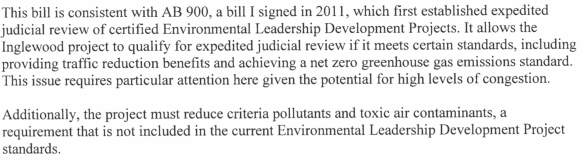
While most fans and HT proponents have focused on issues such as the distance from BART and the dearth of parking and other traffic infrastructure immediately available at HT, it should be made clear that a ballpark project will have to pass certain (CEQA) standards to be approved and certified – before a shovel hits in the ground. Although the Warriors and Kings had the benefit of their own CEQA streamlining bills, legal challenges still delayed the eventual groundbreaking for Chase Center for at least a year. On the other hand, the ballpark is projected to have a much smaller capacity than the current Coliseum at 30-35,000 seats. That and smart design should help the project meet some environmental standards. As for the usual arguments about gentrification and displacement (mostly of industry) that will likely come up, I’ll just say that I’m glad this discussion is finally taking place.
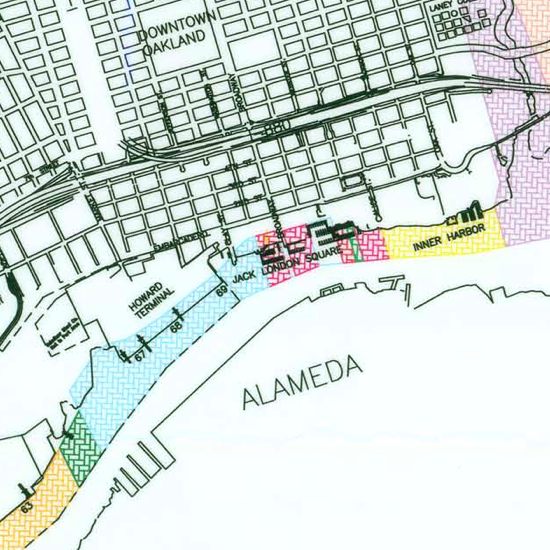
Tidelands Trust map of Howard Terminal and Jack London Square area
Time again for AAA Musical Chairs

It’s September in an even-numbered year, so you (should) know what that means: The biennial ritual of matching AAA franchises to new cities has begun. According to the Chronicle’s Susan Slusser, that includes the A’s affiliate, the Nashville Sounds, who are discontinuing their player development contract (PDC) with the parent club.

In this new era of improved regional consolidation, the pairing of a Central time zone-based AAA club with a Pacific time-zone based parent was never going to be the most convenient of situations. While the Sounds were reasonably competitive under the A’s stewardship, the transient nature of player movement makes it more likely for fans to root for the front of the jerseys than the names on the back.

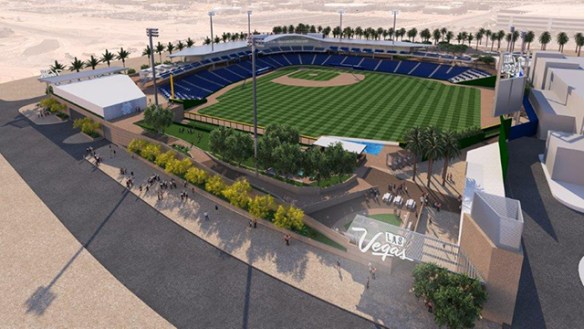
Las Vegas Ballpark planned for Summerlin, NV

The Sounds could hook up with the Washington Nationals. The Nats will no longer be the parent of the Syracuse Chiefs as the Chiefs were bought by the New York Mets. In turn, the Mets are ditching the Las Vegas 51s, a team undergoing its own transformation. Additionally, the Round Rock Express are expected to switch back from an affiliation with the Texas Rangers to the Houston Astros. As a result the Fresno Grizzlies’ affiliation would be up for grabs. So it would appear that the A’s have Las Vegas and Fresno as potential affiliate candidates. The Rangers could also switch to Nashville or San Antonio.

For potential west coast affiliates, air travel is easier coming in and out of Las Vegas than Fresno, so Sin City has a distinct advantage based on logistics. Fresno’s airport is small compared to other major cities and doesn’t have the kind of demand that teams can use to their advantage for pricing. Fresno is closer to Oakland than Vegas, only a four-hour drive (six on Amtrak) from Fresno to the Coliseum. If Reno extends with the Dbacks, another candidate in the Pacific time zone goes away.

Las Vegas and Nashville have one thing in common. HOK was the architect for First Tennessee Park in Nashville, which opened in 2015 in time for the A’s. HOK is also working on the new ballpark in Summerlin, which will replace Cashman Field starting in 2019. HOK also has previous experience working the A’s, as the firm designed Avaya Stadium for the Quakes. And don’t forget, the A’s retained HOK’s Brad Schrock as a consultant on their new ballpark project in Oakland. Synergies abound!

P.S. – If you’re wondering if the new ballpark in Summerlin could host the A’s or another MLB club, take a look at the rendering in this post. Then get back to me on how you’d add 20,000 seats and a roof.

20+ years later, the process remains the same

I was going through some reading material as any good stadium geek does occasionally, when I came upon one of my favorite chapters in Sports, Jobs & Taxes, the Roger Noll and Andrew Zimbalist book that set the tone for future stadium discussions along with Neil deMause’s Field of Schemes. I then remembered that I wrote a post about this years ago. And then I noticed something else while I was rereading the chapter: a flowchart.

Well then, how does one go about making it work as the Giants did in China Basin? Thankfully, some very smart economists – John M. QuigleyEugene Smolensky, and Stephen J. Agostini – have gone to the trouble of diagramming the process.  The flowchart below comes from a paper titled Stickball in San Francisco. It’s better known as the San Francisco Giants’ case study in the book Sports, Jobs, and Taxes by noted sports economists Roger Noll and Andrew Zimbalist. Ready? Here’s the secret recipe:

stickball

Step-by-step instructions on how to follow the Giants’ plan. (click for larger version)

Back in 2012, I made parallels between the process China Basin went through and Victory Court, one of the last great ballpark concepts that went nowhere. I was amazed at how, 20+ years after the Giants navigated the political process and broke ground, how similar the process looks for Howard Terminal. While AB 734 sits on the governor’s desk waiting for his signature, the only procedural change it makes for the A’s is limiting the length of CEQA-related lawsuits to 270 days. So I’m presenting the flowchart again, to show you the path Howard Terminal must take to breaking ground. There are some differences, mainly the lack of Caltrans involvement in the land deal and the fact that Oakland doesn’t have a Board of Supervisors like the City and County of San Francisco (Oakland has a City Council instead), but most everything else is quite similar.

The A’s and their architects apparently have a trip planned to visit several urban ballparks towards the end of the regular season. I wonder if the junket will also include a visit to the next BCDC Commission meeting.

Dolich thinks A’s have secret plan

Now that the A’s have the not-heavy-lifting passage of AB 734 completed, we can focus on next steps.

That means the financial part of the deal. Besides picking the site (Howard Terminal or the Coliseum), the A’s have to arrange a deal to either lease or purchase the land. Andy Dolich thinks that the A’s will make a play for both, using one to offset the cost of the other.

When the green and gold can’t access enough infrastructure gold from the city, county and Port of Oakland, they might introduce their Hidden Ball Trick.

It goes something like this: You (public entities) pay for Howard’s infrastructure with this ball over here, and we (the A’s) and a DTBNL (Developer to Be Named Later) will pick up your debt load of $137 million on the Coliseum. Of course, you’ll have to make us the exclusive owner of that site.

Any guesses as to whether or not that’s an even trade? When the community activists start to speak out, we’ll soon find out the answer.