The Ballad of Mark Davis

Imagine that you’re Raiders owner Mark Davis. It’s December and your team is already out of the playoff hunt, headed towards a losing season and a top 10 draft pick. The team has one more season on its lease at the Oakland Coliseum, and while negotiations and studies are ongoing with Oakland and Alameda County, it’s not like you’re not taking calls from interested parties in LA. The 49ers are progressing quickly on their own stadium, which could be a decent temporary landing spot.

In other words, you have options. Prudent financial planning on your parents’ part appears to have kept the controlling interest of the team within the family, though there isn’t the money to put up a huge share towards construction of a new stadium. You could work a two or three-year deal to keep the team in Oakland while things are worked out, or experiment in Santa Clara for a few years.

At the same time, government handouts for stadia have all but dried up, at least in California. The growing number of minority partners will want their piece of whatever deal is made. The Raiders are currently the third least valuable team in the NFL, mostly due to the lack of revenue generated at O.co Coliseum. The 49ers, who were in similar straits a few years ago, are now worth $1.2 billion thanks to their coming stadium and a deep playoff run that generated enough interest and upfront sales to help pay for the stadium. Those upfront sales, which include an alleged $500k/year for high end suite leases, are the replacement for the big government handout.

That’s all well and good when you’re the 49ers and can tap into wealthy San Francisco and Silicon Valley, and have first-mover advantage to boot. When you’re Mark Davis, only a fraction of that kind of money is available to you – at least in the Bay Area. The 49ers are sucking much of the air out of the market. In Los Angeles that money’s there in spades. And with Phil Anschutz exiting stage left, negotiations with a stadium operator may not be as difficult as they were with Anschutz on board.

Problem for you, Mark, is that if you want to be a first mover on LA, you might want to act when the NFL opens its six-week relocation application window on New Year’s Day, 2013 (or if no one applies in 2013, 1/1/2014). Acting first could provide distinct advantages, such as better lease terms and preferred scheduling if a second team (Chargers, Rams) were to come in. Of course, other teams will be thinking the same thing so that may want to move early too. There’s also the problem of playing one or two years at an interim facility like the LA Coliseum. If you apply for an LA move, it’s almost a certainty that Oakland officials will cease work on Coliseum City, at least the football-centered version of it.

Better to keep your cards close to the vest. Good job on that, for now.

Tampa Bay developer presents ballpark vision

.

View from beyond outfield, within greater footprint

Today’s the day that the Tampa Bay Rays and the City of St. Petersburg were scheduled to hear about a ballpark plan that is located within the city, yet is more convenient to Tampa and Clearwater. The site is in Carillon, a mixed commercial development at the foot of the Sunshine Skyway Howard Frankland Bridge. Because of Carillon’s proximity to Tampa and Clearwater (north of downtown St. Pete), nearly double the population is within a 30 minute drive of the ballpark site compared to Tropicana Field.

Carillon site within the Tampa Bay metro

Carillon is already largely built out, and the developer, CityScape, has only 17+ acres on which to build the ballpark. Since regional public transportation is severely limited, the ballpark will require a significant amount of existing or new parking to meet potential demand. To that end, _ has identified 14,000 parking spaces within the Carillon development. As we’ve seen with Fremont’s Pacific Commons, negotiating parking rights can be very tricky.

Fixed roof Carillon ballpark option

Five ballpark configurations were presented, two with a fixed roof, two with a retractable roof, and one that’s open air. The roof options have either a fixed or retractable outfield wall, the latter of which adds an estimated $8 million to the cost. Open air is the cheapest option at $424 million, whereas the retractable roof/wall version will cost an estimated $577 million.

Various options for outfitting the ballpark

Within those 13 acres is one of the more interesting ballpark concepts presented recently. Hotels and offices loom above and behind the upper deck. A large parklike area sits beyond the outfield, surrounded by more offices. If Rogers Centre (SkyDome) mated with Rangers Ballpark, the offspring might look something like this. At only 35,000 seats it would be the smallest ballpark in MLB, depending on Cisco Field’s final capacity.

Retractable roof option

The proposal is being pitched by a third party, not the City or the Rays, so there’s an extra element of complication if something like this were to be executed successfully. Both the team and developer will want to make the most money possible, yet there’s a $250 million funding gap – and that’s if St. Pete allows the Trop tax to fund Carillon. At the moment Carillon appears to be the only new ballpark option emerging from St. Pete and has some support from the mayor and some members of the city council. Will that be good enough for Stuart Sternberg, who has wanted to explore Tampa along as St. Pete? We’ll see.

Hearing to compel deposition (S4SJ lawsuit)

Today’s hearing was brief at only 20 minutes. Attorneys for the City/A’s and S4SJ/Giants made their cases to Judge Joseph H. Huber. Quick rehash: City/S4SJ requests a deposition of the lawsuit petitioners (S4SJ and 5 individuals) to determine if they have standing. S4SJ/Giants believe that because of CEQA law, standing is already there. A secondary argument is whether or not the business relationship the Giants have with S4SJ represents a conflict of interest.

Judge Huber will decide if the deposition request will be granted. The decision will be made in the next couple of days. Regarding the business relationship, the judge noted that many cases involve outright competitors even if a legal challenge was first made on non-competitive grounds. I suspect that he’s leaning to allow the case to move forward without narrowing the scope to just CEQA issues. As for the deposition, we’ll just have to wait for his ruling.

Again, I have to question the wisdom of the City striking the discounted land deal with the A’s. If the land option were granted at “fair market value” S4SJ wouldn’t have been able to add that issue to the case. Assuming that the redevelopment land transfer legality matter were resolved in the near future, that would’ve left only CEQA and the referendum question as the main tenets of the case. As it stands it’s a muddled mess, with the judge wondering what the next steps are as there are no additional hearings or procedural items scheduled at this point. The wheels of justice only turn so swiftly.

—–

Side note: The attorney for the City/A’s mentioned that one of the lawsuit petitioners actually supported the A’s move to San Jose during a previous hearing. Curious.

Two tickets to paradise, if by paradise you mean a suite with Dave Stewart (Update: Winner announced)

Update 9/26 9:47 AM – The winner of the two tickets is Jeff Dvorak, whose down-on-his-luck story proved too hard to resist. Jeff, please email me in the next few hours at ml @ newballpark . org to claim the tickets, so that I can mail them to you in time.

Thanks to everyone who participated. Many entries were entertaining, some were downright heartwarming. Maybe we’ll do this again in the future…

Update 9/25 3:54 PM – Got confirmation that former A’s curveballer/Cy Young winner Bob Welch will be joining Stew in suite with the fans on Saturday.

A few weeks ago I finally bit and plunked down deposit for 2013 season tickets. In the process I had the option to get postseason strips (which I declined), and a little perk of two tickets to a suite for Saturday’s game against the Mariners. Unfortunately, I already have other plans for Saturday, so I won’t be able to make the game. So I have two tickets and I’d like to give them away.

To make this interesting, we’ll run a little contest. If you’re interested, either tweet me or reply to this post. I’ll take the best, most interesting response and give you the tickets. The subject matter of the comment or tweet has to be A’s related. I will not reveal my criteria for choosing the the best response. I’ll only say that it’s largely arbitrary and subject to change.

Interested? Fire away. You have until 11 PM on Wednesday night. I’ll mail out the tickets on Thursday.

Oh that evil, horrible dynamic pricing!

Tomorrow, Giants fans who are not season-ticket holders will finally get the chance to buy postseason tickets. Because of the continuous demand on Giants games, the team was able to leverage its large premium season ticket base to sell out much of its postseason inventory. That was followed by lottery for other season ticket holders, and tomorrow’s lottery winners (general public).

Contrast that with the A’s, who have a season ticket base that’s less than half the size of the Giants’. The A’s started selling tickets to the public a week ago, which followed a multi-week postseason strip/season ticket sale campaign. A week in and there are still plenty of tickets available via the primary market (Tickets.com) for a potential Wild Card game and Divisional Series. Just now I saw two tickets for the Wild Card game in Section 217, Row 15 for $46 apiece. Groups of 4 tickets are still available for ALDS Game 3. StubHub is full of overpriced choices if you didn’t act quickly enough a week ago, and while the dynamic pricing model has raised prices a bit above the A’s published baseline prices, it’s not nearly the gougefest that some had feared.

Comparison of 2013 postseason ticket prices using A’s pricing tiers and similar sections at Giants games

When you compare it to what the Giants are doing, there’s practically no comparison. Even with dynamic pricing, A’s playoff tickets frequently come in at 1/2 or 1/3 the price of similar seats across the bay. Even though the events of this excruciatingly long road trip have dampened spirits a bit, there’s still plenty of enthusiasm for the team, enough that these playoff games should sell out if the A’s qualify for the postseason (with the possible exception of a Home Game 3 that may never be scheduled). The notable trend to me is how, just as with regular season games, the “value-priced” Plaza Club simply fails to move the needle.

I also included the Orioles prices since they’re a team with a much smaller season ticket base as of late. The O’s don’t practice dynamic pricing, so the face value price is pretty much it except for some tickets that the team is selling as a package food-ticket deal.

When compared to other teams, it’s all a pretty good deal for A’s fans.

The 2014 MLB TV Windfall

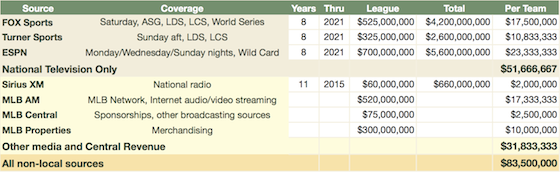
Today’s report from Sports Business Journal’s John Ourand indicates that MLB’s national television deals are just about locked in. We’ve discussed this a couple times now. I’ve done some rough math on it, and the financial picture looks even healthier than I previously projected. Sure, the TV deals will more than double in value, from $660 million to $1.55 billion. But it’s when that figure is coupled with all other sources of national revenue that the picture starts to really brighten.

Come 2014, every team could rake well over $80 million per year without selling a single ticket.

Come 2014, every team could rake well over $80 million per year without selling a single ticket.

The table above reflects rising revenues from every source except for Sirius XM, whose deal was locked in years ago with the money paid in advance. MLB Advanced Media, the internet and broadcasting subsidiary of MLB, admitted last year that it was hitting nearly $500 million in revenue just for 2010. Combine each team’s share with other non-TV sources (adjusted for inflation), and each team comes away with $31.8 million per year. All told, that’s an estimated $83.5 million per year.

That doesn’t even include the dividend each team ownership group gets as an equity partner in MLB AM.

Every team is going to get this windfall, so it’s not as if the A’s or Rays are getting some great competitive advantage. It will allow both teams to be able to confidently offer FA-competitive long-term deals to their own free agents, though $100 million payrolls are still probably beyond reach. To get $100 or $110 million payrolls, both teams will need new stadia. The impressive thing about these bumps is that the A’s will get $10-15 million more via Central Revenue than they get from playing in the Coliseum. Add in local TV/radio and the usual $30 million or so in annual revenue sharing, and the A’s should net $180-185 million per year starting in 2014. Not rich compared to the other teams, but a far cry from destitute.

Entire 2013 MLB Schedule (Tentative)

Two weeks ago MLB circulated its tentative 2013 schedule. I took a look at the A’s slice and made observations. Now it’s time to look at the entire league’s schedule, which was broken down by region to assist traveling fans looking to plan ballpark future trips. I’m getting a better hang of this.

The schedule is in four formats: Excel, PDF, Google Drive spreadsheet, and comma-delimited. When possible, those formats have also been repackaged  along regional lines. One of the PDFs has the regions color-coded, plus I’ve put specific games in bold that I’ve highlighted for trip-planning. The recommended trips – which allow fans to take in an entire region’s games on consecutive days – show up as follows:

  • California (5 teams) – 6 trips
  • Lake Michigan (4 teams) – 8
  • Rust Belt (4 teams) – 7
  • Northeast (6 teams) – 5

There are plenty of other trips that can be planned if you’re fine with skipping one or more ballparks. And if you want to do a weekend, there are multiple places to make that happen: Missouri, Florida, Texas, and the two-team markets.

Two items of note: A split doubleheader is planned for May 27, with the Texas Rangers visiting the Arizona Diamondbacks. The second game is listed on May 28. Obviously that’s an off day. That’s a split (day-night) doubleheader, not the 2-for-1 doubleheader we had last year when the Angels visited the A’s. Also, one opening day game is expected to be moved to Sunday, March 31. The schedule is subject to change. As this post cycles out, I’ll add a widget to the right with updated links.

The files:

Game times for many teams are available, but not all. I may add them at some point. Feedback is welcome, as always. You are free to distribute as you see fit – and please, spread the word.

News for 9/22/12

We’ll start with the lede, courtesy of CBS Sports’ Danny Knobler:

A’s owner Lew Wolff said Friday that he believes his team’s quest for a new ballpark will be settled within the next year.

Does that mean a new ballpark is about to rise in San Jose, Oakland or somewhere far away?

Not necessarily.

“I do think this long trek will be coming to an end,” Wolff said, in an interview with CBSSports.com. “I can’t predict the end.”

Wolff did suggest that he has no interest in either taking legal action or doing something that would lead to legal action from the Giants (who claim the San Jose territory). He also said he’s not interested in either selling the team or moving it out of the Bay Area.

“We’re going to persist in the Bay Area as long as we can,” he said. “It’s not a journey we’re going to cut short.”

Wolff’s latest statements he has indicate less confidence in the process that he has supported all this time. Maybe he has the same resolve as ever about San Jose, but the constant drag by the commissioner isn’t helping. Either way it appears that no outcome is certain. At least there will be an outcome, which is better than the team being in limbo as it has the last three years. One thing’s for certain: at least one group of people is going away from this mess extremely unhappy.

Update 10:52 AM – While in New York to catch part of the A’s current roadtrip, Wolff had a chance to explain further to the NY Times’ Tyler Kepner what he’s trying to build in San Jose. In addition to confirming that he and the rest of A’s ownership has the money to build a ballpark, Wolff also talked about how the high-tech concessions stands would work.

“All of our concession signs will be digital, so when you’re supposed to stop serving beer, you just press a button and it disappears,” Wolff said Friday over lunch at a Midtown Manhattan hotel. “And then if you have extra hot dogs, you can reduce the price.

“I mean, I’m being silly about it, but we’ve had plenty of years to think about this. It isn’t like all of a sudden we get approved and now we’ve got to start thinking about how our ballpark’s going to look. We’re really ready.”

Additionally, Buster Olney hears that Bud Selig is working the room to get enough votes to grant South Bay T-rights to the A’s. (via MLB Trade Rumors)

Other news:

  • The Angels denied a report that they were negotiating with Ed Roski’s Majestic Realty for the NFL stadium site in Industry. Whether the Angels were actually talking or not is moot. Industry is now a potential threat, albeit one that’s not very practical. The site had numerous challenges when the plan was for a 10 games-per-season NFL slate, 80-90 games would turn the hillside location into a second Dodger Stadium from a parking/circulation standpoint. The site, near the junction of CA-57 and CA-60, is also situated on a hillside that slopes down from southeast to northwest. That’s a poor orientation for siting a ballpark. [LA Times/Bill Shaikin]
  • El Paso’s City Council approved the $50 million AAA ballpark deal that could bring the Padres’ affiliate to town by 2014. The combination of rent, a ticket tax, and sworn parking revenues should bring in around $500,000 per year, not nearly enough to pay off the stadium on its own. The final say belongs with El Paso’s mayor, who will have until Thursday to approve or nix the deal. [El Paso Times/Cindy Ramirez]
  • After 10 years of abject failure, the “ballpark village” plan next to Busch Stadium is finally a go, thanks to million in subsidies coming from the State of MIssouri. [St. Louis Post-Dispatch/Elizabeth Crisp]
  • In case you haven’t heard, the NHL is in a lockout. [Yahoo Sports/Nicholas J. Cotsonika]
  • Barclays Center, the first major pro sports venue in Brooklyn since the Dodgers abandoned Ebbets Field, had its ribbon-cutting ceremony on Friday. {NY Times/Howard Beck]
  • Next Friday the 28th, the hearing to compel discovery in the Stand for San Jose vs. City of San Jose lawsuit will be held at 9 AM at Superior Court in downtown San Jose. I plan to observe.
  • Still awaiting the State Controller’s ruling on the legality of the Diridon land transfer.

That’s it for now.

AEG sale could drastically change stadium landscape

Reports started to flood in Tuesday night that billionaire Phil Anschutz was looking to offload AEG, his privately held entertainment and sports conglomerate. The LA Times asked industry experts, who said that the value of the AEG portfolio is around $5 billion. A Reuters article has bidding going up to $6 billion, and that doesn’t include Anchutz’s film studio, Walden Media.

The octopus that is AEG is divided into various overlapping divisions:

  • Sports  – 50% stake in LA Kings, minority share of LA Lakers, 50% of Houston Dynamo, 3 minor league hockey teams, interests in 3 European football and hockey clubs, a minority stake in Golden Boy Promotions, plus the Bay to Breakers, Tour of California, X Games, and other properties.
  • Facilities – Staples Center, Home Depot Center are wholly owned by AEG. The company operates over 100 venues that put on 6,200 events per year, including games for all four major North American pro sports. The list includes major convention centers such as LACC.
  • Live – The concert tour promotion division, with offices and venue control from coast to coast. It also oversees the Coachella and New Orleans Jazz festivals.
  • China – A self-contained subsidiary of AEG, it operates like a miniature version of the big company, within China.
  • Digital Media – Online production and broadcasting for big events

AEG works because it one division can leverage others to lock down deals. Staples Center hosts two teams that AEG owns, benefiting the company by virtue of publicity and revenue. The same model works for live music, where AEG controls booking for many venues and the tours that would fill them up. This sort of vertical integration makes it seem as if the best deal would for the whole shooting match to take advantage of that leverage. Yet there will be many bidders that will find individual pieces extremely attractive, such as the Kings or the venue management contracts. There’s also the issue of finding a single bidder or consortium (in all likelihood) that can put up $6 billion for everything. The bidding process will run well into 2013, and it will be fascinating to observe how all of it works. Some bidders might try to put up a lower overall bid because the transaction could be cleaner and easier to pull off. On the other hand, the total price of all the properties sold separately could eclipse the value of a single complete bid. Even if the whole company was purchased intact, if that bidder were a private equity firm it’s likely that there would be a strategy to part out the divisions in sooner rather than later.

Much of the immediate reaction to the news centered around the prospects of the Downtown LA football stadium. While many felt the stadium deal was in peril, Times columnist T.J. Simers fantasized that a new owner is just what’s needed to bring the Chargers north. LA mayor Antonio Villaraigarosa knew that the sale was coming and kept it quiet. His underlings expressed confidence that the deal would continue without Anschutz, whose purse strings and willingness to accept a minority share of a team were keys to attracting a team. Front man Tim Leiweke is still onboard for the moment, but someone else would have to represent the money needed to fund Farmers Field, which will cost well over $1 billion to construct. If AEG were parted out and sold piecemeal, the strength of the football stadium plan would be severely diminished since there’s no vertical integration to incentivize the effort (the stadium is also meant to be used as an extra large exhibit hall for LACC).

Teams currently in leases with AEG-operated venues are unlikely to see any significant changes. There is at least one other project that could be seriously impacted by an AEG sale: the Coliseum City development. When AEG signed on to manage the Coliseum complex, they also got a contract to provide pre-development services. Oakland Mayor Jean Quan started talking about a convention center and a retractable dome on the Complex, which would be home to an LA Live!-style village. The uncertainty surrounding AEG and Farmers Field creates a very ironic situation in that despite an anti-poaching agreement, AEG would’ve loved to have the Raiders as a tenant at Farmers, yet Oakland could use a successful LA Live! with Farmers as an anchor to help promote a similar plan to its citizens. Without that kind of success under AEG’s belt, the mega-development becomes a harder sell and may force a major change in scope. The alternative could be a normal, outdoor football stadium replacement for the Coliseum, without a neighboring convention center or hotel complex. The problem with that kind of downsizing is that a football stadium and whatever smaller scale ancillary development accompanies it may not be able to generate enough revenue to drive visitors to the complex, and that may be a loser politically. Meanwhile, consider the idea that the 49ers stadium could be completed before studies on Coliseum City are. That’s how deliberative the process is.

Then again, it may be best if Oakland and the East Bay focus on opportunities that are less pie-in-the-sky. Whether they’re talking about a total replacement of the Coliseum or a modernization of the existing Coliseum, it seems much more feasible than a $2 billion convention center and stadium that would have competition not only from other facilities throughout the Bay Area, but also AEG’s own LACC.

The Sacramento Kings could also be affected, since AEG was supposed to be the partner in the Railyard ESC arena plan until the last moment. One of the possible outcomes of a sale is a refocusing and wholesale freeze of development activities, which would hurt both Coliseum City and Sacramento. Other companies could step up, but there is a reason why AEG won bidding in both cities: AEG has a built up an impressive level of experience managing and developing venues over the years. If AEG shifts its focus as the result of a sale, so will many of its clients.

—–

P.S. – One more log to add to the fire: The LA Daily News is reporting that officials that the Angels are talking with Ed Roski’s Majestic Realty about a ballpark at the City of Industry site Roski pitched for his own NFL stadium. Roski partnered with AEG to build Staples Center and buy half of the LA Kings. Surely these talks have gotten the City of Anaheim’s attention. Leverage – that’s how one successfully plays the stadium game.

Fosse talks ballparks

The highlight of Blog Day may have been a 25-minute discussion with Ray Fosse that spanned all manner of subjects: broadcasting, teams he played on. At one point Fosse started talking, unprovoked, about the need for a new ballpark. As a great player and broadcaster, his words carry far more weight than mine ever will. So here’s the snippet of him talking ballparks, which started as a question about comparing the current team to previous teams he played on or covered. Without further adieu:

This group of guys has a chance to be as good as (the 1989 squad), but the thing they have to do is stay together. There’s free agency and arbitration, and lots of money, the most important thing now is that the A’s somehow get a new stadium. Because as soon as a shovel is in the ground, they can keep all of these guys. Because they know what the revenue stream is going to be. Until that happens, they don’t know.

Q: Would you say you’re in favor of San Jose or in favor of a new stadium?

I’d say a new stadium, wherever it is. I don’t wanna upset people here… but unfortunately that monstrosity (points at Mt. Davis) killed us. If you can imagine when you watched games before, you could look out and see the Oakland hills, see the ivy up there.

This is the last remaining multipurpose stadium in all of baseball. Clay Wood does a great job, but he can only do so much. So to think about minimizing foul territory, which you can do when the pitchers are good enough… You can tarp the upstairs, tarp Mt. Davis, people complain – well you fill it up, and they’ll take the tarps off.

I don’t even like talking about excuses about, “Well, if we don’t leave…” Listen. To me, leaving and going to San Jose, if that’s where they go, that’s not leaving, folks. Leaving is going to another state or across the country. Staying in this area and (going to) a downtown – we’re fortunate to go to Baltimore and Cleveland in particular. Of course Boston’s downtown. Seattle. You get a downtown stadium, and what it does to revitalize a downtown area, it’s tremendous. To be honest, I’ve never been to a Sharks game but all I’ve heard are great things about downtown San Jose when the Sharks play. They support the team, it brings everyone out.

He also talked A.J. Griffin, Yoenis Cespedes, Scott Hatteberg, Chef Rodney, and more. I can’t post the audio here per the terms of the media credential (no podcasts), but these subjects and Fosse’s quotes should elicit a good amount of conversation. I’ll leave it at that.