I want to go to there

I could stay here forever. Or at least until the sprinklers come on.

So there I was lying on the Coliseum grass, just beyond the infield rim where Jemile Weeks normally mans 2B. The fog had invaded, covering up any stars. I saw closeup how well Clay Wood and his staff covered up all of the evidence of a football game just five days prior. Temperatures had dipped below 60 and the breezes were starting to kick up. At least a thousand fellow A’s fans were assembled on the field, most with blankets, some clutching cups of coffee. It was 10 o’clock, and we were waiting for Moneyball.

The movie itself was introduced by Scott Hatteberg, and just as we did in the pregame ceremony several hours earlier, we cheered players as they were announced or as they appeared on the smallish portable screen. Sound bounced off the still concrete bowl, creating an eerie, unintended echo effect. The stadium lights darkened, and for a moment everything was still, everything was perfect.

I’ve probably seen Moneyball seven or eight times now (three in theaters plus I own a Blu-ray combo pack), so the movie itself wasn’t the attraction. I didn’t go to the red carpet premiere at the Paramount, so this was as much about community as anything else. Yet I distanced myself from people and stayed way back, in an open spot as close to the cordoned off infield as possible. Every so often I would stand up and look back at the old seating bowl, where the safety lights were on and the media had cleared out of the press boxes. For better or worse, this is my second home, I said to myself.

The infield and warning track were off limits to the faithful. From what I could see in fans’ faces, no one cared.

As the movie ended, I gathered all of my things and, mindful of how long I had been there and how emotional the day was, felt absolutely exhausted. Many friends who I had seen in the Coliseum had left long ago. In light and in darkness Mount Davis stood, impressive in scale and magnitude. For once I didn’t hate the edifice. It was just sitting there, alone and somewhat forlorn, no lights on. As I started to walk toward the stairs I thought to myself, I wish one of those suites was my apartment so that I could head up there and go to sleep instead of driving home.

If I had the money and someone built it, I’d live in an apartment or condo overlooking an A’s ballpark. Not one with a postage stamp sized view like in San Diego, detached from the action. A place that was as far as the upper Mt. Davis suites are now, with a balcony. I could wake up, observe the grass get cut and the mound manicured over a cup of Aeropressed coffee. Watch as tour groups came through and wave to them in my robe smoking jacket. Head downstairs, where there would probably be some retail component, for a sandwich or pastry. And watch the game from the balcony, or head down to one of the field box seats that were mandatory to buy with the apartment lease or condo purchase.

None of this is possible at the Coliseum, of course, for myriad reasons. The Raiders need those suites to be used as suites. Mt. Davis was never built with this kind of mixed use in mind. It’s something I can still dream about at a new ballpark. Given the cost of developing a park these days, it’s not a bad way to help with the financing. Follow me on this.

When NASCAR was at its peak before the crash, several tracks built condo complexes that overlooked the action. Most often, it was rich racing aficionados who bought up the units, forgoing an RV weekend in the paddock for an pied-à-terre above the track. To me that sounds crazy, considering that most tracks will get one or two races a year plus various minor events. It doesn’t compare with 81-82 games plus concerts and whatever else the team can attract to a stadium. Yet the closest thing to a residential component we’ve ever seen is the hotel at Rogers Centre (formerly SkyDome), now a Marriott Renaissance property. Lew Wolff once had an interest in it, so he should know quite well how it’s run.

20120820-200104.jpg

Bay Street in Emeryville, a mixed residential/commercial development

If someone were to experiment with this kind of feature, one can’t expect a big, 400-foot long apartment building with 200 units facing the ballpark. There’d probably be a “boutique” style building with no more than 40 units, 20 facing the ballpark, 6 stories tall, roof deck with a pool on top. How would they be sold? Upfront as condos with high HOA dues, or extremely expensive apartments? Maybe fans who aren’t one-percenters could enter a lottery for one or two units, or perhaps for a year-long lease. 25 years ago the apartments on Waveland and Sheffield outside Wrigley Field could be rented by an average family. Now they’re all corporate suites, better than the ones inside the park. In either condo or apartment form the units could provide a not-small financing piece, up to $30 million towards the ballpark’s total construction cost after factoring in overhead. That’s about as much as anyone could expect from a seat license sale, and it wouldn’t come with the uncertainty or negative vibe associated with PSLs.

Taken as part of the growing number of luxury options, these could be considered as either complementary or competitive with regular suites. The biggest difference would be the view and the access, since suites are not normally available 24/7 the way a housing unit has to be. One could even see a player or two take advantage of the convenience, though he’d have to make sure his curtains are drawn at the proper moments. That is, unless he likes the attention.

Sharks ownership speaks out

Two great pieces on Sharks ownership by the Merc’s David Pollak. Regarding the team, lead owner execs Kevin Compton and Stratton Sclavos remain committed to keeping payroll near salary cap levels ($70 million in 2013) despite the ownership group losing money on an annual basis. We don’t have access to their books so we can’t validate ownership’s claims, but they are saying that they regularly make cash calls of the ownership group. If that’s the case then there is something to what they’re saying.

The second piece is a wide-ranging Q&A covering multiple off-field topics such as the possibility of competition in the form of a Warriors arena in San Francisco, a looming lockout, and a reaction to the A’s heading 35 miles south.

On the possibility of the A’s moving to San Jose:

Sclavos: “You can always look at these things as a problem or an opportunity. In our discussions, we’re led to believe there’s probably opportunity there for us. We do a lot of things really well in sports marketing and ticket sales and sponsorship sales. We think those assets could be leveraged other places.”

Compton: “Our big concern would be to see that the fan experience doesn’t change as far as parking and traffic and things like that. We’re not going to compromise on that.”

You have to think that the two ownership groups have been talking a good deal about how to share the sandbox that is downtown San Jose. It’s good to hear, and a stark contrast from the bile spewing from the Giants. Compton also had an honest take on the impact of a SF arena. It hadn’t occurred to me that HP Pavilion is now the 6th oldest arena in the league. It makes me wonder what could done to improve the arena in order to raise revenues. More clubby stuff in the rafters like MSG? Changes to the seating bowl?

Compton’s concerns about parking were partly addressed when the Sharks struck a deal with the City for a garage north of the arena. The approved Diridon ballpark EIR calls for no new parking to be built at the ballpark aside for a small amount dedicated for team use. I’m more interested in what could happen with the old San Jose Water property, since that contains the largest lot in the immediate area aside from the arena lots.

This really makes me hope that there isn’t a lengthy work stoppage in the NHL this season. It would be a shame if the only hockey we had to watch this fall were at the Cow Palace.

There’s also a sidebar listing all members of the Sharks ownership group.

The other kind of walkoff

The A’s made hay in July via a series of walkoff wins. It’s fitting that the team is capitalizing on a phenomenon coined by former Athletic Dennis Eckersley, almost karmic (I’d rather have won the ’88 WS). The A’s soccer brethren, the Earthquakes, have also gotten into the act, stringing together several winning and tying goals in the waning moments of numerous games this season. Let’s just say that the organization is no stranger to theatrics.

That comes in stark contrast to the neverending ballpark struggle, which has entered its 41st month according to our counter, but really has gone on for more than twice that long if you count back to when the Wolff/Fisher group took ownership. And if you believe Jayson Stark’s take coming out of the owners meetings this week, there’s no end in sight:

For about the 78th consecutive meeting of baseball’s problem-solving owners, there was no resolution this week of the A’s-Giants standoff. But if it wasn’t clear before now, it’s more obvious than ever that, in the words of one baseball official, that moving the A’s to San Jose is, most likely, “never going to happen.”

One sports attorney who has looked into this told Rumblings that the Giants have “a hell of a case” — centered around a document signed by the commissioner defining their territorial rights to include San Jose. And that’s critical, because any move by the A’s, or by the sport, to ignore or override those territorial rights could open a messy can of larvae for baseball.

How? Well, if the Giants’ territorial rights were suddenly deemed to no longer apply, it could set a precedent that might inspire some other team to attempt to move to New York or Southern California, by arguing the territorial rights of the Yankees, Mets, Dodgers and Angels were no longer valid, either.

So if the A’s aren’t bound for San Jose, what is likely to happen to them? Behind the scenes, baseball people are predicting they’ll eventually have to give up on this battle and settle for a new, Pittsburgh-size park in Oakland — and then do their best to beat up on the Giants in interleague play.

Stark didn’t articulate how this ballpark would be paid for. It’s a legitimate question. Oakland isn’t alone here. Field of Schemes’ Neil deMause pointed out in a recent Slate article that Seattle is facing the same dilemma.

Stanford economist Roger Noll pegs the operating profits of a typical arena at somewhere between $20 and $30 million a year. That could be enough—barely—to pay off $400 million or so in arena debt. But then Hansen and his as-yet-unnamed investors will still need to put down a huge amount of money to purchase an NBA franchise to play there. If every penny of revenue is going to pay off construction debts, that will leave nothing to offer his moneymen as return on their investment. “The gross revenues of an NBA team in Seattle could not possibly be sufficient,” says Noll, to cover the costs of both building an arena and buying a team.

Replace Seattle with Oakland and “NBA team” with “Athletics” and you have the first half of our local quandary. The crux of the argument to keep the A’s in Oakland is that some sugar daddy ownership group (Don Knauss & Co.) will swoop in, buy the A’s from Wolff/Fisher ($500 million) and pay for a new ballpark ($500-600 million). Using deMause’s corollary, which we’ve espoused here repeatedly, how does this new ownership make money, or even prevent themselves from being buried in debt? Even in San Jose a $500 million ballpark will require tons of upfront commitments to ensure that Wolff/Fisher aren’t leveraged to the hilt.

Moreover, this ongoing stalemate does no one any favors except the Giants, who must love the status quo – except for that pesky drug suspension thing. If the other big market teams are truly afraid of breaking precedent, then the naysayers are right, there is no way to San Jose. We’ve never heard anything directly from any owner to confirm this, so it’s just more grist for the mill. Funny thing is that there are protections in the Major League Constitution to keep the two-team markets safe. From Doug Pappas’ old article dissection the Major League Rules (emphasis mine):

Under Rule 1(c), either league can move into a territory belonging to a club in the other league, so long as (a) 3/4 of the affected league’s teams consent; (b) the two parks are at least five air miles apart unless the two clubs mutually agree otherwise; (c) the newcomer pays the existing club $100,000 plus half of any previous indemnification to invade the territory; and (d) the move leaves no more than two clubs in the territory. This provision dates to late 1960, when it was adopted to establish the terms for the expansion Los Angeles Angels to play in the territory claimed by the Dodgers in 1958.

That leaves Boston and Philadelphia as the only “vulnerable” markets, and any move to either city would face just as many political and logistical obstacles as the A’s face going to San Jose, if not more. Even with that technicality out of the way, the big market owners may be looking at T-rights as sacrosanct and untouchable, nevermind the actual language.

Bringing us back to Stark’s blurb, what can Wolff do? He seems content to play the nice guy role among the owners and not push the matter. If the Giants are lined up looking to sue, the A’s can do the same. San Jose is putting together its own legal resources should a decision come down not in their favor. But there is one maneuver, one trump card that Wolff can play that we’ve only skirted around, and it’s fairly simple.

Wolff could refuse to negotiate a Coliseum lease extension.

Fitting that this last bit of “inaction” could finally force action. It worked for the Minnesota Vikings. It most certainly won’t get the kind of results Zygi Wilf got (a publicly financed stadium), but it would at least force the powers that be to act. It would absolutely burn the last bridge Wolff had with Oakland and would be the worst PR move ever on top of many other missteps, but as we’ve seen in the Vikings’ case, it’s practically standard operating procedure for owners looking to get new stadia. Oakland pols have bragged that the A’s have nowhere to play besides the Coliseum. Do they really want to make that bluff?

Wolff’s refusal would create a nightmare for MLB. MLB could proceed one of two ways, either A) rule once and for all on the T-rights matter and let the franchise move forward, or B) try to assume control of the A’s by alleging that Wolff was not acting as a proper caretaker of the franchise in the market. The A’s can’t be contracted through the rest of the current CBA. Two teams would have to be contracted as a matter of practice and the Rays are locked into their lease, making contraction impossible in the near term. If MLB rules for the Giants, then at least Wolff would be able to decide if he wants to build in Fremont or give up completely and sell the team. And if MLB rules for the A’s, then Wolff will have gotten what he wanted, although he had to be a dick to Selig and the Lodge to make it happen, and Selig would have to deal with the Giants’ legal onslaught.

Selig could try to buy Wolff’s silence by subsidizing an East Bay stadium (also unprecedented) or having the other owners buy out the Wolff/Fisher group, which won’t be cheap. Wolff/Fisher are in a strong position in that they don’t have to sell, at any price if they don’t like.

Now, if MLB were to try to wrest control of the A’s from Wolff, the league would land in litigation hell. Wolff could easily point to Selig’s committee’s 41 months with no plan or decision, and it would drag out for a long time. Unlike the McCourt-Dodgers fiasco, the Wolff/Fisher group are more than solvent (underneath it all A’s ownership is the 4th richest in baseball). T-rights would finally be dragged out into the open, in court. Meanwhile, MLB would have to step in and negotiate lease terms with Oakland/Alameda County for some unknown period. They can’t go around Wolff to negotiate a lease while he’s still the franchise’s control person, since he still has to sign on the line which is dotted. MLB can’t get an injunction on Wolff not doing something. Can they force him to negotiate a lease? We’ll see. Beyond the Bay Area, there will be at least one mayor who’ll look at the ending lease and make a play for the A’s, even if the resources aren’t there. Effectively the A’s would turn into the Expos, a team in limbo for an indeterminate period.

All of that’s possible from Wolff making a simple declaration. He doesn’t have to make it now. He could wait until the end of the 2013 season if he likes. The chaos would put a great toll on the franchise and the fanbase, and you’d have to wonder if, in the end, it’s worth it. Walking away from the lease could be the first domino. At least someone would be playing. We’ve been talking about post-2013 for a while now. The closer we get to that point without a resolution, the more likely someone’s going to make a move out of desperation. Often large bureaucratic organizations don’t make moves until things reach crisis mode. If Selig wanted to end his tenure without drama, this definitely wouldn’t be a way to do it.

Oakland, Raiders, NFL have their own secret meeting

The Trib’s Matthew Artz reports that Oakland had another secret meeting, this time with the NFL about a new Raiders stadium in the Coliseum complex. Unlike the MLB-Oakland meeting, team ownership was on hand in the form of Mark Davis. Not much was revealed about the nature of the meeting, though we can guess that the NFL wanted to know more about how the feasibility study is going. The Raiders have chosen to be the only team to sign on with the Coliseum City project, which the City is pushing as a second downtown, anchored by one or more sports franchises.

Coliseum City/Oakland Live!

Coliseum City/Oakland Live!

What I’d like to know is how much the City and the Raiders are on the same page. Mayor Jean Quan seems to be pushing for a stadium-cum-convention center, with the stadium part possibly having a retractable roof. Does Davis also want that, or does he simply want an outdoor football stadium? The latter would presumably be much simpler to accomplish. The former would be much more expensive and risky, though it sets up the possibility that there could be more revenue streams to help pay off the new complex.

The NFL is no stranger to this process, as anyone who’s followed the exhausting saga of the Minnesota Vikings can attest. They hold the purse strings, and while I’m doubtful that the league will hand Oakland a fat nine-figure investment for a second Bay Area stadium, the NFL and the Raiders are at least going about their due diligence. We won’t know anything substantial until the feasibility study is released, which probably won’t happen until the end of this year or after the football season.

Another thing I’m interested in is how Raider fans feel about the team playing inside a retractable dome. I’ve seen 4 NFL games in domes, including one at Cowboys Stadium while the roof was closed. Even if the roof is open, it doesn’t feel like an outdoor game. And being in an enclosed space doesn’t guarantee that the stadium will be noisier. Arrowhead Stadium is one of the loudest stadia in the NFL and it’s almost completely exposed to the elements. Raider crowds at the Coliseum are among the most boisterous in the country, and the “sealed” environment of a dome can sometimes sap that energy. At other times a dome can enhance crowd noise (New Orleans). It’s one of the many issues the Raiders and Raider fans will need to discuss going forward, as the team and the league have made it clear that the Coliseum as it stands is not a long-term solution.

P.S. – Artz mentions that the Coliseum complex is 750 acres. It’s actually 100 acres plus the Home Base and Malibu lots, pushing the publicly-owned stadium complex to more like 120 acres. 750 acres is the size of both “redevelopment zones” on either side of 880, including the Coliseum complex.

Nothing to see here, move on

The owners meetings came and went with barely a peep. The only major news was the slam-dunk approval of the Padres sale. A single, solitary update on the state of the A’s came via MLB.com’s Barry M. Bloom:


That’s it, as expected. Good thing the game starts in a few minutes.

Regrouping for a new Bay Area Olympics bid

Now that the London 2012 Games has ended, it’s time to reflect on how the Olympics were held there. We can also start to consider how the Games would be hosted in the Bay Area, should that come to pass.

The 80,000-seat Olympic Stadium was never going to match Beijing’s Bird’s Nest as a great architectural work, and it wasn’t designed to. The stadium was meant to be scaled back to 25,000 seats after its Olympic/Paralympic tenure. There were plans to use it as a soccer stadium for either Tottenham Hotspur or West Ham, but neither deal could be worked out.

According to GamesBids, the London buildout for the 2012 Games was $4 billion. You may remember that the Bay Area made its own bid for these very games a decade ago. The bid then was a mere $211 million, with few new competition venues as part of the plan. Instead, nearly $1 billion would’ve been budgeted for the Olympic Village, which would’ve been located at Moffett Field. Like many other bids, venues were to be grouped in clusters, with the main clusters being in San Francisco and at Stanford University.

Spread of Olympic venues in BASOC 2012 bid

Spread of Olympic venues in BASOC 2012 bid

Since the 2012 bid lost out to New York, much has changed in the Bay Area’s sports venue landscape. The earliest a Bay Area Games could occur is 2024 because the USOC is not bidding on the 2020 Games. A quick review of sports and venues in the 2012 bid:

  • Athletics/Track and Field, Opening/Closing Ceremonies @ Stanford Stadium – A few years after the bid lost, John Arrillaga decided that it was time to revamp Stanford Stadium. The track and 36,000 seats were removed, making the new Stanford Stadium a compact, football/soccer venue. For any new Olympics bid, the Olympic Stadium would need to be located elsewhere – in the Bay Area.
  • Soccer @ Candlestick Park, Oakland Coliseum, other stadia – Candlestick would be replaced by the 49ers Stadium in Santa Clara, whereas the Coliseum could be refurbished or be replaced by a new Raiders stadium. A new Candlestick was to be the centerpiece of a 2016 Olympic bid, but the 49ers never signed on and the bid died with the stadium. Stanford Stadium can now function solely as a soccer venue. The Earthquakes’ stadium could also be used as a secondary venue. This is one sport where the Bay Area is as strong as any worldwide in terms of hosting, though some games would be held in LA or San Diego (Stanford hosted some group and elimination games during the 1984 Summer Games).
  • Baseball & Softball @ AT&T Park & Sunken Diamond – No longer needed since both sports are no longer Olympic events. That could change in the next decade or so.
  • Boxing @ Cow Palace – By the time 2024 rolls around, the Cow Palace will be 83 years old with few renovations during that lifespan. It could remain a venue, or it may not be standing in a dozen years. If it’s still operational it’d be fine for boxing or one of the other arena sports such as handball, or as a backup basketball or volleyball venue.
  • Basketball @ Oracle/Oakland Arena & Leavey Center/SCU – Whether or not the Warriors are still in Oakland, the arena is perfect for basketball and should stay a basketball venue. Leavey Center is somewhat small and should be replaced by either Maples Pavilion or Haas Pavilion. If built, a new waterfront SF arena could replace Oracle as the venue of choice, perhaps pushing volleyball to Oakland.
  • BMX Racing @ N/A – BMX wasn’t an Olympic sport when bids were being accepted in 2002. It is now, and it shouldn’t be too difficult to figure out where it should go. Since the Olympics are held during the summer and building a BMX track requires moving a lot of dirt, it probably wouldn’t make much sense to put it in a baseball stadium since it would be highly disruptive. Either Spartan Stadium or Memorial Stadium could work, though both may have too many seats. A temporary venue may make more sense, or perhaps Kezar Stadium. If we’re looking at expanding facility, the Santa Clara PAL BMX track is a possibility. It would require expansion and the installation of seating.
  • Cycling, Track @ Mather Park Velodrome, Sacramento – Plans originally called for a new mostly covered velodrome at Mather, a former Air Force Base. It’s another case where either a new temp-to-perm venue would have to be built, though it could conceivably go anywhere, not just Sacramento. Another planned site for a velodrome was Santa Clara, where the Soccer Park adjacent to the 49ers stadium/headquarters is located. The only other velodrome in the region is at Hellyer Park in San Jose, and it would require a major expansion to be Games-ready.
  • Equestrian @ Monterey Horse Park – Located on the former Fort Ord, it’s a bit far from San Francisco but is much larger than Bay Area facilities such as the one in Woodside. An successful Games bid would probably provide enough money for the nonprofit group overseeing the Horse Park to get its vision completed.
  • Field Hockey @ Spartan Stadium – The prospects for Spartan have only improved now that the stadium is using Field Turf instead of grass. Cal’s Memorial Stadium is also an option since it also uses artificial turf.
  • Gymnastics @ HP Pavilion/San Jose Arena – There’s a long tradition of excellent support of gymnastics, up to and including this year’s Olympic trials. Unless the SF arena came into play, HP Pavilion should continue to be the gymnastics venue.
  • Modern Pentathlon @ Maples Pavilion/Stanford – Shouldn’t change. Venues are in close proximity to each other.
  • Swimming/Diving @ Stanford temporary facility – The Avery Aquatics Center at Stanford and the George Haines Int’l Swim Center in Santa Clara’s Central Park are both good facilities, but neither has the space for the 10,000 or so seats that would be needed in the future. Spieker Aquatics Complex at Cal barely has seats. This gives rise the the idea of a new swim center somewhere in the Bay Area with enough space to add temporary seats, the same way “wings” were added to London’s aquatic center.
  • Tennis @ San Jose State South Campus – Fortunately, the Bay Area won’t have to follow up on London’s use of the Wimbledon and its world-beating facilities. Instead, it’s likely that Stanford’s Taube Tennis Center, which was expanded since the bid, would be used. Taube hosts an annual WTA tournament, but it lacks a really large stadium.
  • Volleyball, Beach @ Edwards Stadium, Cal – I never understood this choice when the bid was released. You’d think that, unlike many Olympic cities, we have beaches, we’d want to host beach volleyball on the, well, beach. Here’s hoping that if a bid is made, a change is made to use either Ocean Beach or Santa Cruz Main Beach as the venue. The latter at least has the infrastructure to handle the event. If the Brits can make a beach volleyball stadium happen behind 10 Downing Street, we can certainly put a venue on a freaking beach.
  • Volleyball, Indoor @ Haas Pavilion, Cal – No need to change things here. At 11,000+ seats, Haas is perfect.
  • Water Polo @ George Haines Int’l Center – Would require temporary seating to double arena size to 5,000, the same size as the London temporary venue. Probably worth it. Stanford’s Avery Aquatics Center could also be used, though it too would require additional temporary seating.
  • Weightlifting @ Henry J. Kaiser Convention Center, Oakland – With no budget money available to operate the venue, it seem like HJKCC would be ripe for the kind of investment needed to host weightlifting. Then again, the Bill Graham Civic Auditorium across the bay seems like just as good a fit and it wouldn’t require much work at all.

Other indoor events would be held either at Moscone Center or San Jose Convention Center, which makes sense given their flexibility and capacity.

New venues to be built

Without a large stadium with a track, the Bay Area would seem to be at a disadvantage compared to competing cities. Then again, maybe it’s not. The other American cities, Chicago and New York, also don’t have such stadia. Chicago’s bid was based on a temp-to-perm stadium to be built in Washington Park, near the University of Chicago on the South Side. New York’s 2012 bid was based on a Jets stadium on the West Side of Manhattan that got blown up by Cablevision, the company that also owns Madison Square Garden and the Knicks and Rangers. Houston and Philadelphia could also compete, but they’d have to build more venues than the Bay Area, Chicago, or NYC.

The Olympic stadium dilemma is simple. Track and field is only popular in most countries during the Olympics, making any large stadium with a track a white elephant. Even USC got rid of the track at the LA Memorial Coliseum to make it more football friendly, though it could in theory be converted back at some point. Since 2002, several undeveloped properties such as SF’s Mission Bay and San Mateo’s Bay Meadows have been developed, reducing the number of potential sites. Lennar still has a parcel for a stadium within its development footprint at Hunters Point, but that could disappear in time. Oddly enough, the best idea may be to float a stadium on barges in the bay. It could be docked next to the SF arena on Piers 30/32, and like Chicago’s stadium plan, could be built to have a permanent capacity of only 10,000. The Olympic capacity would be 80,000, almost all of it temporary. The low-profile permanent stadium could be floated around the Bay or even outside the Bay for other regions to use.

Moffett Field’s Olympic Village is a good concept in that it has plenty of space and is self-contained. It also has Google as a next-door neighbor to provide a huge amount of technological infrastructure if needed. Unfortunately, it’s not close to SF or many of the venues. Preferably, I would’ve liked to have seen Treasure Island used as the Olympic Village. As the Navy cleans up the land, developers are waiting to build new housing there as some of the last large development within SF city limits. Hunters Point could also work, but it’s already spoken for. Other possibilities include Alameda NAS, which would require new transportation infrastructure, and Golden Gate Fields.

An Aquatic Center has to be one of the big ticket items and is practically unavoidable. Santa Clara may be a possibility, but it’s plagued by numerous problems: limited space to expand, little parking, and its location right next to a residential neighborhood. A temp-to-perm facility would be best. From what I gather, there is only one pool that approaches Olympic size in all of San Francisco, inside the Koret Center at USF. There should be room for a facility somewhere in SF. If not, the East Bay or Peninsula may be good fits.

London put the BMX track and velodrome next to each other, which was a good move from a planning standpoint. Future cities may not have enough room to colocate the two sports in that manner, so it shouldn’t be a requirement. Either way, prep for both sports should be cheaper than the aquatic center or main stadium.

The issue that hurt BASOC in its 2012 bid was the geographical spread of the venues. The IOC prefers venues to be within 16 miles of each other with good transit links. In both cases, the Bay Area falls short. London made it work by putting venues right in the middle of the city and limiting the spread, even if it meant that the athletes often faced gridlock going to venues and the Olympic Village. Even though 2024 seems far away, it’s not likely that much of the needed public transit infrastructure being planned now (BART to Silicon Valley, High Speed Rail) will be completed by that point. And with some venues in far-flung places like Monterey or Folsom (rowing), accessibility will not be one of the bid’s strong suits. If anything, the IOC could be swayed by the need for fewer new venues, even temporary ones. A Summer Games in the Bay Area would be a crowning achievement for the region, and the political climate may have changed over the years to make the region’s plusses (available venues, lower cost, sustainability) even more important next time around.

P.S. – Not to be forgotten, Lake Tahoe and Reno are mulling a joint bid for the 2026 Winter Olympics.

News for 8/10/12

We’re overdue for a news roundup. Now seems like a good time for one.

From BANG’s Joe Stiglich:

Last week’s visit to Oakland and San Jose by Bud Selig’s three-man panel foreshadowed this.

Update 1:04 PM – Stiglich has a writeup with quotes from Wolff, such as:

“It’s up to the commissioner’s office,” Wolff said. “… This is a process that unfortunately is taking longer than I hoped, but it’s a fair process.” 

Other news:

  • Janet Marie Smith, who oversaw the construction of Camden Yards and the renovation of Fenway Park, is moving out west to Los Angeles to take a similar role with the Dodgers. If her previous work is any indication, she will keep it classy all the way. [Dodgers press release]
  • NHL Commissioner Gary Bettman has set a deadline of September 15 to wrap up labor negotiations before the league imposes a lockout. The NHL and NHLPA are always playing catchup with the other leagues in terms of CBAs. They imposed a 57% player share in the last agreement as other leagues were dropping towards the 50% mark. Now the NHL wants to drop it to 46%. It’s going to be a long winter. [AP]
  • A developer is proposing a ballpark for the Tampa Bay Rays in the Gateway area of St. Petersburg, just over the bridge from Tampa. St. Pete’s stance has been to not allow the Rays to get out of their lease at Tropicana Field unless a new stadium were conceived in St. Pete, not Tampa. No financial details were available. [Tampa Tribune/Michael Sasso]
  • The 49ers and the City of Santa Clara settled a lawsuit with a County oversight board. $30 million in redevelopment money was at stake. In order to keep local school budgets balanced, the 49ers won’t get the $30 million for several years. Seems fair. [SJ Mercury News/Mike Rosenberg]
  • Get used to metal detectors at NFL games starting this season. [Oakland Raiders]
  • Speaking of the Raiders, they are using the league’s new 85% measure to determine sellouts this season. The way it works, a team has to sell out 85% of its non-premium seats by the usual deadline (normally Thursday for a Sunday game) in order for a game not to be subject to a blackout. The catch is that any tickets sold between the 85% and 100% marks are subject to higher revenue sharing. Teams like the Raiders and Bucs chose to use the new standard, the Bills and Jags went with the old standard, which required all non-premium seats to be sold by the deadline.
  • The City of Industry approved a deal to buy 600 acres within city limits for up to $26.7 million. The land is where the somewhat-forgotten Ed Roski/Majestic Realty stadium would be located. The parties still have to scramble to find a proper replacement for now-evaporated redevelopment funding. [Inland Valley Daily Bulletin/Ben Baeder]
  • MLB’s postseason schedule has been released (knock on wood). [Biz of Baseball/Maury Brown]

More if it comes.

Challenges Facing Howard Terminal

After yesterday’s game, I headed up to Howard Terminal yet again to snoop around and take a few more pictures. I also read up on SSA Terminals/SSA Marine’s lawsuit against the Port of Oakland. This post will contain an analysis of both.

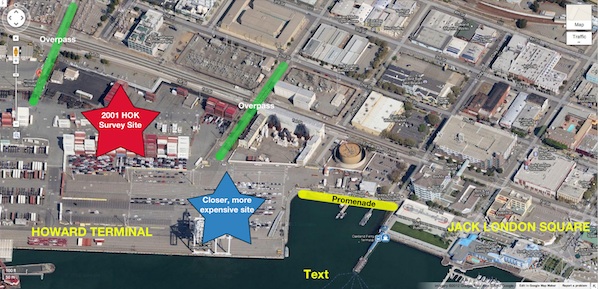
First, let’s start off a bird’s eye view of the site, with a few items labeled for further discussion.

howardterminal_birdseye-labeled-sm

Overview of Howard Terminal and Jack London Square

From right to left you see:

  • Jack London Square in the southeast corner. A one-block stretch of Broadway is visible.
  • One block over from the heart of JLS is Washington St, followed by Clay St. Broadway and Washington extend to downtown Oakland. Clay does not.
  • At the end of Clay Street is the Ferry Terminal, the Ferry Landing (10 Clay St.) commercial building and a small public plaza and green space.
  • A narrow promenade (10 feet wide in an important stretch) runs along the shoreline west to Howard Terminal. If a ballpark were built at Howard Terminal, the lightly-used promenade would have to be widened as it’s the safest and best pedestrian access from the Ferry Terminal and the JLS shoreline and marina.
  • Complicating matters is the Oakland Fire Department EMS Station, which is home to Fire and Police boats. The station would have to be reconfigured to widen the promenade.
  • The blue and red stars indicate the rough locations of ballpark sites. The blue star is the site I identified on Tuesday. It would probably be the most expensive site because it’s all piers, not land, and would make the foundation more expensive. The red star is the site surveyed in the 2001 HOK study. It is inside the original shoreline.
  • North of the blue star is the power plant, which can’t be moved without incurring great expense.
  • The green lines are possible locations for pedestrian and vehicular overpasses, lining up with MLK Way and Market Street, respectively. Both connect with North and West Oakland, as well as 980 and 880. At Howard Terminal, the streets are 900 feet apart.

Now I’ll explain why the overpasses (green lines) will be needed. A couple of pictures for comparison:

howard_term-26-view_east

View East from The Embarcadero and Clay toward Jack London Square

howard_term-26-view_east

View East from The Embarcadero and Clay toward Jack London Square

howard_term-27-view_west

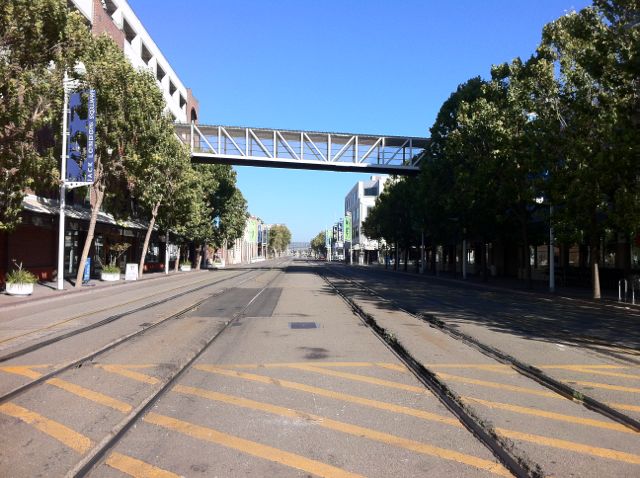
View west from The Embarcadero and Clay towards Howard Terminal

These tracks cannot be moved. They are a big part of what makes the port truly intermodal. If 40,000 people are going to cross these tracks and The Embarcadero to get to a Howard Terminal ballpark, it is paramount that safe methods for getting those people across are implemented. Gates and traffic cops aren’t going to stop stupid, drunken fans from playing chicken with an Amtrak or freight train. Unlike the light rail trains run by SF Muni outside AT&T Park, these trains don’t stop quickly even if they’re traveling fairly slowly.

The second picture also shows that there is little streetscape west of Jack London Square. The westbound car lane ends in another block at Jefferson, and the track area isn’t paved. It would make the most sense to completely shut down The Embarcardero near Howard Terminal to all traffic other than trains for a 6-8 hour window on game days.

How then, do you get people across The Embarcadero? It’s for all intents and purposes a moat. By building bridges, of course! The scale and number of bridges would be driven by the amount of parking that is made available adjacent to the ballpark. And that is largely driven by the amount of parking available in and around Jack London Square. Over 3,000 spaces in lots and garages are present, plus at least 500 on-street parking spots. However, only 1,250 spaces are within 1/3 mile of either HT ballpark site. Extend the radius to 2/3 mile, which is sort of the fringe distance that people are willing to walk, and you get 7,000.

parking_comparison

Comparison of parking near ballpark sites

Additional parking may be made available under the BART alignment or on street, but it’s clear that parking near Howard Terminal is a clear site deficiency. The obvious place for a new facility is next to the ballpark. 16 acres would yield 2,000 spaces, which should serve the dual purposes of filling the needs of the ballpark and satisfying current JLS tenants (restaurants, Yoshi’s, movie theater) that have depended on the existing infrastructure. For that much parking, whether it’s all surface or new garages, two entrances would be required, or rather, two overpasses. That’s why I drew the two overpass paths. Market Street is the main entrance to Howard Terminal and is already set up to handle heavy traffic with four lanes. MLK Way is also four lanes. The overpasses would also create two additional pedestrian overcrossings, netting four total along The Embarcadero.

The price for the overpasses? Around $10 million each. Add that to the promenade expansion, parking construction, and other site improvements to make Howard Terminal hospitable for a ballpark.

howard_term-19-corridor1

Promenade from Ferry Terminal to Howard Terminal

Before we get ahead of ourselves, it’s important to note that no ballpark at Howard Terminal will be possible without SSA Marine/SSA Terminal vacating the premises. And while Matson (partnered with SSA) provided support to Don Knauss in his efforts to either build a ballpark on the waterfront or buy the A’s (or both), it doesn’t appear that Howard Terminal operator SSA will be easy to move. While SSA’s container business is down in Oakland, the company is not blaming the downturn on the way Howard Terminal is configured. Instead, SSA has a problem with its lease at Berths 57-59, just over a mile west of Howard Terminal (Berths 67-68). SSA is suing the Port of Oakland over alleged violations of the federal Shipping Act. SSA alleges that the Port is giving preferential treatment to Ports America, a competing terminal operator at the Outer Harbor, Berths 20-26. SSA’s claim is that Ports America (PAOHT) is leasing its site for 45% less per acre than SSA, while not having to contribute much to infrastructure improvements. Due to the more expensive lease, SSA is saying that it’s losing business to lower-cost competitors like PAOHT to the tune of $46 million per year.

Renegotiating SSA’s lease to make it on par with PAOHT could negatively affect port revenue $10 million annually (offset somewhat by new lease terms), and while the two sides have talked they haven’t sat down to negotiate. The lawsuit will be three years old in December. SSA is being coy about what they want out of this besides a lease. The ballpark gives them a very convenient trump card that it wouldn’t otherwise have, now that we know that Howard Terminal is the only site in Oakland that MLB is investigating. It’s a very tough spot for the Port and City to be in. If the City doesn’t get the Port to renegotiate the lease along SSA’s terms, Howard Terminal is dead before it begins. It can’t kick SSA off the property as the lease goes until 2017, with two possible 5-year extensions that SSA will probably decline. Plus any changes to Howard Terminal like the ones I described previously have to work for the other tenants of the Port like PAOHT and other shippers, making the Port every bit as beholden to its tenants as it is to the City (from which the Port operates independently anyway). And if you want to make things even more complicated, the City of Oakland wants out of a bad bond hedge deal with Goldman Sachs. Who’s a major investor in Carrix, the parent company of SSA? Goldman Sachs.

Cost estimation is difficult, but back-of-the-napkin math has infrastructure at $50 million depending on site and foundation, and an ongoing loss of $10 million in fees to the Port with a redone lease and relocation costs. From the looks of things, SSA might play ball if they get their lease redone. If not, what’s their incentive? This reminds me a lot of what the City of San Jose did with AT&T on a rezoning deal near Valley Fair. Considered a quid pro quo deal, we may never know if it really is one unless a ballpark in San Jose is built. SSA appears to be in line for a similar enriching.

Howard Terminal Revisited (Again)

Yes, we’ve been here before. I suppose it’s time to discuss Howard Terminal yet again.

In June I attended a weekday afternoon Rangers-A’s game, followed by a ferry trip from Oakland to South San Francisco. San Francisco Bay Ferry was using that week to launch the new service, which to that point had its southernmost terminal at AT&T Park. I noticed many people who, when they learned of the free promotional ferry ride, decided to take a quick cruise across the bay.

While I was waiting for the ferry, I walked around JLS and near Howard Terminal to take some updated pictures just in case.

howard_term-07-overhead

Overhead view of Howard Terminal, with power plant and ferry terminal included for comparison. (via Google Maps)

The best place for a ballpark may be the southeast corner, where the two cranes are located. The cranes can be and often are relocated. The area designated for auto processing is about 9 acres and is surrounded by the rest of Howard Terminal, a power plant, the Inner Harbor, and OFD property. The Trib’s Matthew Artz reported yesterday that tenant/operator SSA Marine (Matson) is suing to get out of the 25-year lease it signed only 7 years ago. Howard Terminal was chosen as a site for consolidated operations by SSA Marine. A planned multi-story auto processing/storage facility had to be scrapped amid NIMBY concerns and Howard Terminal only runs at 55% capacity thanks to market changes. Those may be the biggest factors in SSA Marine’s decision to file suit. The issue there is that while SSA Marine may ultimately want concessions on the lease, they may not necessarily want to leave or downsize their presence there. If the site I described as ideal were to be reused for a ballpark, SSA could only stage one large vessel at a time as opposed to two now. If SSA were to agree to relocate to elsewhere on Port property, it’s likely they’ll require a huge cut in lease terms while trying to maintain the kind of consolidation they were able to enjoy when they first inked the current deal. They’d also want to be able to expand if their container shipping business improves.

howard_term-13-water_edge

View of Howard Terminal from Ferry Terminal pier

If the City and the Port wanted to use all 50 acres of Howard Terminal, the solution is simple: tear up the lease and start the process on alternative development (planning, EIRs, infrastructure, identified projects). From looking at the Port’s budget documents, SSA Marine provides a substantial portion of the $10 million in revenue the Port derives from Inner Harbor maritime activities. That figure isn’t broken out by location or by company, so it’s hard to speculate further on SSA’s impact. Regardless, any disruption or change to SSA’s operations has to be considered an opportunity cost, since the Port would be foregoing that revenue stream to take on a ballpark lease and other commercial lease revenue. Currently, Inner Harbor provides nearly as much revenue as the entirety of Commercial revenue at the Port.

howard_term-05-train_power

Train passing the power plant along The Embarcadero. Part of Howard Terminal is behind the plant. Intersection is Martin Luther King, Jr. Way and The Embarcadero.

In the picture above, you’ll notice that along this stretch of The Embarcardero, only one side of the tracks is paved street. The near side is gravel. This continues to Jefferson and Clay Streets, where the Jack London Square streetscape as we know it begins. If a ballpark were to be placed at Howard Terminal, a great deal of new street and pedestrian infrastructure would have to be planned and constructed in order to safely accommodate the anticipated large crowds. That includes at least one pedestrian bridge leading from MLK, Brush, or Market. Additional acreage at Howard Terminal could be repurposed for parking, though that’s a double-edged sword. If a large amount of parking is built there, streets will have to be beefed up to accommodate traffic increases. There’s no obvious place north of Howard Terminal where parking could be built without the demolition of existing structures.

howard_term-10-ferry_landing

Ferry Terminal with Howard Terminal in background

East of Howard Terminal is a stark contrast. Jack London Square dominates and has a great variety of mixed uses. The waterfront building at 10 Clay Street is largely unused and could make a great A’s museum, as slo_town identified in June. Some negotiation would also have to be done with Oakland Fire Department because Station 2, where the Fire Boat is located, sits between HT and JLS.

10 Clay Street

10 Clay Street

Finally, there is the issue of the impact of the ballpark itself. Besides increased traffic and the distance from BART (3/4 mile to the 12th Street/Oakland City Center Station), the visual impact of a ballpark will be up for much debate. If the field is oriented to face downtown (away from the water), there’s a risk of a having a 500-foot-long, 10-12 story tall edifice bumping up against the water. If the field faces the water, the visual impact is much less since the ballpark will be “camouflaged” by the power plant, but the impact of lights on Alameda becomes greater. Either way it’s no slam dunk.

howard_term-14-boat_view

View from departing ferry

Still, when you look at the picture above, it’s easy to see why someone would advocate for Howard Terminal, challenges and all.

No stone left unturned

Two articles from Sunday (Chronicle: Matier and Ross, Mercury News: Bruce Newman/Sharon Noguchi) point to a special trip made to the Bay Area last week by Commissioner Bud Selig’s three-person committee. The committee, which has been studying the A’s stadium issue for more than 40 months, met with San Jose officials on Tuesday, followed by Oakland officials on Wednesday.

The M&R report indicates that Oakland’s bid is moving towards a potential deal at Howard Terminal, anchored by a $40 million sale of land there to help kick things off. Present were Clorox CEO Don Knauss and Signature Properties’ Mike Ghielmetti.

The $40 million part has me confused. To whom would Howard Terminal be sold? To the A’s or some ownership group? To other developers like Ghielmetti? For years, the minimal entry for any Oakland site had to be to take care of the land and any infrastructure at the very least. But if that responsibility has to be shouldered by whomever builds a ballpark, the price to build the venue will only get higher. Remember that at Howard Terminal, some amount of reconstruction of the site’s foundation will be required to make it safe and suitable for a ballpark and perhaps other surrounding commercial development. If the ballpark costs $500 million just in construction cost, and the land acquisition and site preparation costs $140 million, the final price tag is $640 million!

It would’ve been interesting to find out how much time Knauss & Co. spent presenting themselves as ballpark backers first before jumping to a different role as would-be owners. Assuming that they pay the full freight on a ballpark and a minimum $500 million for the A’s, they’d have to come up with $1.14 billion for the whole package. That’s a tall sum just to keep the A’s in Oakland, no matter how it’s sliced. A downtown site such as Howard Terminal was expected to be more expensive than the Coliseum because of the added complexity in pulling off the deal, but is that difference (at least $100 million) worth it? It’s hard to pass judgment on Howard Terminal until we know more specifics. Nevertheless, at this point the committee is probably of many of these details, and that will be important for MLB’s continued evaluation.

Last Tuesday’s meeting with San Jose seemed to be a more ho-hum affair, with the exception of the presence of Brad Ruskin, a very prominent lawyer who has at one time represented all of the major pro sports leagues other than Major League Baseball (he has also represented some MLB clubs). One of his specialties is antitrust law, and he is a trial lawyer, so his presence may be to show that he could represent MLB in an antitrust case if push comes to shove. Opposing Ruskin would presumably be Allen Ruby, who the A’s brought on board earlier in the year.

For his part, Lew Wolff continues to be defiant in the face of questions about selling the team. His angle is that, unlike much outdated criticism about his previous efforts to put together a ballpark deal in Oakland and Fremont, his plan is simply to build a ballpark. Ancillary development using surrounding land is becoming more increasingly difficult to pull off, yet that’s the formula being espoused by all of the Oakland bids: Howard Terminal, Coliseum City, and Victory Court. The committee has to be taking all of this into account.

Another factor is State Controller John Chiang’s review of the land transfers between San Jose’s defunct Redevelopment Agency and the son-of-redevelopment San Jose Diridon Development Agency. If the transfers are upheld, Santa Clara County has indicated that it won’t make any further challenges to the land deal so the ballpark could conceivably move forward. If the transfers are ruled improper, the land would go to the the redevelopment successor agency, which would subsequently auction off the land. The land would be sold to the highest bidder, who may be someone other than Wolff. Keep in mind that San Jose would still hold the final trump card as it was would have any final determination over what could be done with the land. As much as AT&T claims that its land is of paramount importance to its service delivery model, they’d have sold the land years ago if it could’ve been rezoned to medium-density residential as was considered a decade ago. In any case, Wolff seemed confident that he’d be able to get the land however Chiang’s office ruled. That ruling is due in the next couple of weeks.

The cynic in me looks at this trip with a simple explanation. Summer owners’ meetings are scheduled for next week, and while there will be more pressing matters on the agenda (Padres sale, national TV deals, Nats-O’s-MASN deal) it’s expected that there will be some sort of update on the A’s-Giants ongoing saga. What better way to look like you’re doing something than to have a couple of meetings right before the owners’ sessions? It seems unlikely that Selig will be able to render a decision or bring up a vote based on whatever new information was gathered based on the trip since it’s so fresh, so it’s just one more opportunity to kick the can down the road – at least until November. In the meantime, whatever’s happening to the A’s on the field can take precedence, and that’s not a bad thing at all.