Now we know something is happening.
Sort of.
Yesterday, Assemblyman Rob Bonta (D-Alameda) submitted an amendment to AB 734, a bill working its way through the Assembly. Its purpose is to limit the number and length of potential legal challenges to an A’s ballpark and ancillary development. The language allows for the ballpark to be built at either the Coliseum or Howard Terminal sites.
(c) The city has identified two viable sites for the new baseball park, the Oakland-Alameda County Coliseum site principally owned by the City of Oakland and the County of Alameda, and the Howard Terminal site owned by the Port of Oakland. The city seeks to capitalize on the development of a new baseball park to maximize the economic benefit of the team and its facilities for the city, county, and port, including critical transit and transportation infrastructure, affordable housing, open space, and job creation. Essential to the success and feasibility of the new baseball park is the development of complementary adjacent mixed-use residential, commercial, and retail uses that will support the baseball park and further the city’s and region’s goals for sustainable transit-oriented development, including an increase in supply of housing, including affordable housing.
Bonta’s district includes most of Oakland including West and East, Alameda, and San Leandro, so he can’t be accused of playing favorites among the sites. Though it’s somewhat curious that Peralta isn’t mentioned. That indicates that all parties have moved on.
Elsewhere in the text is the definition of the project (for CEQA purposes), which the A’s haven’t yet publicly presented:
(3) “Oakland Sports and Mixed-Use Project” or “project” means the following components of a sports center and mixed-use project located at the Howard Terminal site in the City of Oakland or the Oakland-Alameda County Coliseum site in the City of Oakland, from demolition and site preparation through operation:
(A) A baseball park that will become the new home to the Oakland Athletics and adjacent residential, retail, commercial, cultural, entertainment, or recreational uses developed by the Oakland Athletics, and that meets all of the following:
(i) The baseball park and each new mixed-use building achieves at least LEED Silver certification or its equivalent for new construction after completion or the project achieves at least LEED Neighborhood Design Silver rating or its equivalent.
(ii) The uses are subject to a comprehensive transportation demand management plan to reduce single-occupancy vehicles and prioritize other modes of transportation, such as public transit, waterborne transportation, ride-share, bicycles, and pedestrians.
(iii) The project is located within a priority development area identified in the sustainable communities strategy Plan Bay Area 2040 adopted by the Metropolitan Transportation Commission and the Association of Bay Area Governments.
The particulars are designed to ensure that the stadium project would qualify for CEQA streamlining. The implicit deadline for opponents to challenge the project is July 1, 2019, slightly more than one year from today.
A previous version of the law, AB 900, allowed for a few major sports facilities to be built, including the Sacramento Kings’ Golden 1 Center and the upcoming Chase Center. It also tracked with three failed SoCal football stadium projects: Farmers Field, the City of Industry Stadium, and the revamped Qualcomm Stadium.
Should the A’s end up starting a project (one should hope so), they should be prepared for resistance from all manner of environmental and community groups, as they saw with Peralta. The worry there may be diminished with the Coliseum, which already went through this process when Coliseum City was approved. Howard Terminal doesn’t have that yet, and may never get to that point. It’s expected that A’s brass will pick the site by the end of the year, kickstarting the CEQA review in the process. But could they try both sites simultaneously?
—
The All Bay Collective, a group of policy planners and environmentalists, started looking at areas in the Bay that could use strengthening against sea-level rise. Their plan for the Coliseum/Airport area, renamed Estuary Commons, is fascinating.
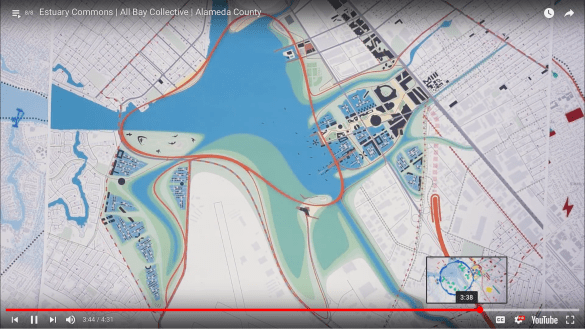
ABC’s Estuary Commons (Coliseum/Airport area)
Among the changes being considered are tidal ponds in the Coliseum parking area and a rerouting/tunneling of I-880 near Hegenberger Road and San Leandro Street. As far as I know these ideas are not being offered officially by the City of Oakland. Still, it’s interesting to consider the possibility of the Bay reclaiming part of the Eastshore as it’s doing with parts of the South Bay.


 newballpark.org