State rolls back San Jose ballpark land transfer

Update 7:30 PM – Added link to Controller’s report.

Yesterday we got word that the 49ers and Santa Clara prevailed in its lawsuit to reclaim $40 million in redevelopment funds. Today comes the news that the State of California has ruled that land transfers from the City of San Jose to the Diridon Development Authority were ruled illegal.

The Controller’s ruling on the ballpark land seems to hinge entirely on the fact that the City/RDA didn’t enter into a sale agreement with A’s ownership until November 2011, after the June 28, 2011 cutoff when AB 1X 26 took effect.

The RDA made unallowable asset transfers of $29,137,727 to the San Jose Diridon Development Authority (Authority), a joint powers authority made up of the City and the RDA. All of the property transfers occurred during the period of January 1, 2011, through January 31, 2012 and the assets were not contractually committed to a third party prior to June 28, 2011.

The graf above comes from the 12-page report released today, a draft of which was sent to the City on November 15, 2012 to allow for a response. The City argued that “there is no statutory or legal support” for the 6/28/11 cutoff to no avail. The Controller disregarded this argument and directed the land be turned over to County-appointed Successor Agency, whose oversight board will make the final determination of what to do with the land. City has cutely shortened “Successor Agency” to SARA and for good reason. What does SARA stand for?

Successor Agency to the Redevelopment Agency of the City of San Jose

If the Diridon Development Authority is the “son” of revelopment, SARA is the daughter. What does SARA make of this mess?

Ordering the City to return the assets to the Successor Agency only to have the Oversight Board direct that they be returned to the City is simply form over substance and wastes valuable time, energy and resources to arrive at the same result.

Regardless of what happened with the Controller’s decision (which was expected) the City still feels that the land will end up with the A’s. If they had inked the sale agreement in March 2011 instead of November, the transfers would’ve been in the clear. Now they could sue the State the same way the 49ers did, but since that would be even more costly and the City and County are already working on a proper land disposition agreement, that seems like a terrible idea.

What will happen next? My guess is that the land won’t actually be sold. Instead, the parties will work on a lease agreement that would allow the A’s to build on the public portion of the ballpark site while the A’s buy the rest over time. The alternative is to sell the land for “market value”, with a yield large enough to be approved by the Controller. The purpose of this is two-fold: get a sale so that funds can be sent to the state, and ensure that the land is assessed at a value high enough to get adequate proceeds to the state, county, and schools. Mayor Chuck Reed, who is on the SARA oversight board, released a statement in response to the ruling just a few minutes ago.

I am disappointed in the findings made by the State Controller regarding certain properties transferred from the San Jose Redevelopment Agency to the City of San Jose, San Jose Diridon Development Authority, and City Housing Agency.

The properties transferred to the City include assets that serve a civic or government function, and likely will fall under the government use provisions of the new redevelopment dissolution law and my expectation is that the Oversight Board will make the same findings.

With respect to the Diridon Development Authority properties, the State Controller failed to recognize an Option Agreement validly entered into between the JPA and the Athletics Investment Group. Any transfer of these properties to the Successor Agency would be subject to the contractual rights of the Athletics Investment Group as required under state law.

The City Council and County Supervisors have both made their desire to have a ballpark built on the site known through formal resolutions in the past. My expectation is that we will continue to work together to bring the Athletics to San Jose regardless of the ultimate ownership of the JPA properties.

Coincidentally, an oversight board meeting is scheduled for tomorrow morning at City Hall. While this news came too late to make the meeting agenda, I would expect the matter to be discussed. I’ll attend and report back.

What does it look like when the rich folks don’t show up?

It looks like this.

wbc-01-sections_top_sm

Club sections and suites were curiously empty for tonight’s WBC semifinal

For Sunday’s World Baseball Classic semifinal matchup between Japan and Puerto Rico, most of the suites at AT&T Park went unused, while both the field level and mezzanine clubs were full of fans disguised as empty seats. Announced attendance for the game was 33,683, at the low end of the Giants’ projections and well below the 36,000 I figured would show up. I went over some of the reasons why attendance could lag for the WBC in the last post, but I definitely didn’t expect to see no lights on in so many of the suites.

Considering that Japan was in the matchup and was expected to make it all the way to the final, I figured that there’d be more Japanese corporate presence in the park. That was evidently not the case, though Japanese fans seemed to outnumber Puerto Rico fans by a healthy margin. Monday’s game is expected to have lower attendance than Sunday, so a similar scene in the high-roller seats should play out.

A view from my seat early in the game

A view from my seat early in the game

Obviously, I’m oversimplifying things a little by only pointing to club seats and suites. Some well-to-do fans and perhaps some companies bought strips of regular seats. But it was clear from the start that all of facilities that the Giants and other MLB teams use to make their money weren’t in use tonight, including the aforementioned premium accommodations and the Virgin America Loft down the right field line. Some suites may have been used in Miami and Phoenix, but frankly I wasn’t paying that much attention since I hadn’t attended games in either location.

Some questions I have going forward:

  • Does this matter at all to the WBC and MLB?
  • Did the WBC overprice premium facilities along the lines of the advance ticket strips?
  • Are they even selling suites?
  • Who conceived the failed ticket pricing scheme?
  • What adjustments does the WBC need to make?

I took away two other observations from the game. First, even though the crowd was loud and boisterous, it may have also been the most polite, friendly baseball crowd of that size I’ve ever been in. The two nations were in it to win it, yet there was no visible animosity. Maybe that will change if PR meets the Dominican Republic in the final. It was a refreshing departure from some of the bitter Giants-Dodgers and A’s-Yankees crowds experienced over the years. Second, staffing for the game was much smaller than for a typical Giants game, suites notwithstanding. Even as the crowd was 8,000 smaller than for a sold out Giants game, it looked like up to a third of the concession stands were closed, especially on the View Level. I imagine that this had to do with the projected crowd. Maybe it also had to do with possible budgetary constraints set by the WBC for the host Giants. Either way, it was not something I was used to, and it looked similar to the upper deck(s) at the Coliseum. One of my friends in the upper deck left to get a craft beer in the 5th inning and had to go down to main concourse to find one, missing two innings in the process.

Did you watch the game on TV or in person? What did you take away from the game?

—–

I’ll be back Monday night for the Netherlands-Dominican Republic matchup. Bleacher tickets can be had for as little as $5.

World Baseball Classic tickets discounted to as little as $8

Tickets for the championship rounds of the World Baseball Classic at AT&T Park were priced quite heavily when they went on sale in December, often forcing fans to buy three-game strips for hundreds of dollars. That price gouging, in conjunction with Team USA getting eliminated last night by Puerto Rico, has caused the WBC to heavily discount numerous blocks of tickets in the last couple of days.

Prices for the two semifinal matchups were as low as $15 yesterday for nosebleed sections in left field and the back of the bleachers. Today the WBC dropped prices on better seats and locations for both games to just $8, a loss leader price if I ever heard of one. That is sure to upset folks who bought early, but it will delight casual fans and followers of the remaining teams (Japan, Netherlands, Dominican Republic, Puerto Rico) who are in town or are willing to make the trip cross-country.

wbc-late_pricing

Snapshot on 3/16 of severely reduced pricing on several sections with big unsold inventory

While premium sections are staying expensive, many areas that “fill out the bowl” have a good number of unsold seats, including groups of seats together. There’s a threat that AT&T Park will look empty without a contingent of US fans and the possibility that the DR/PR fans won’t be there in large numbers. The Bay Area doesn’t have a huge population of Dominicans or Puerto Ricans compared to the East Coast, so there’s reason for concern. A healthy number fans of Team Japan should be there, as we’d normally expect. Netherlands skipper and Giants hitting coach Hensley Meulens appealed to his fellow Dutchmen in the Bay Area to come out and support the Oranje, though they’re not expected to be there en masse.

On Friday I got a $15 bleacher ticket for Monday’s game between the Dominican Republic and the Netherlands. Today I snagged a $8 ticket for Sunday’s Japan-Puerto Rico matchup. A friend of mine who bought single game tickets in advance last month for Sunday’s game paid $72 for a View Box seat behind the plate. Yesterday those same seats were priced at $62, and now they’re $50. It’s possible that the prices could sink even further if there continues to be middling interest.

Running tournaments like the WBC can produce outcomes like this. Unlike the FIFA World Cup, which is assured of having the greatest players in the world playing for every participating country, the WBC is subservient to MLB, so fans aren’t treated to cream-of-the-crop competition due to pro clubs holding back players by rule or choice. Nevertheless, the competition has been excellent so far, with surprising pitching performances from the DR and an upstart club in the “Kingdom of the Netherlands” that threatens to be powerhouse for years to come.

If you have time and can spare a few bucks, the WBC semis are a steal on Sunday and Monday. And in the event that the final doesn’t sell that well, it may also be a good choice on Tuesday. Check it out.

Paid seat upgrades coming for A’s fans this season

As part of the growing trend towards e-ticketing, the A’s will start accepting admissions through Apple’s Passbook app on most recent iPhones. Erica Ogg of the tech site GigaOm reported that the program has expanded from 3 MLB parks in 2012 to 13 for 2013, now including the Coliseum.

Apple Passbook App with MLB e-ticket displayed

Redemption involves scanning a bar code much like the one shown above. Unlike my mostly positive experience with FanPass last year that involved scanning a credit card, the e-ticket should be sufficient and shouldn’t require a printed receipt for fans to have on hand in case an usher checks.

The SF Business Times’ Eric Young wrote yesterday that as part of this new wave of technology, for the first time the A’s will allow fans to purchase seat upgrades via MLB’s At The Ballpark app. Now that may sound like a joke considering the long history of “free” seat upgrades at the Coli, but really, Lew Wolff’s been planning for this since he unveiled the Coliseum North ballpark plan in 2006. During a game, fans can check in to the app and see an inventory of available seats. The inventory shown may not match what you see inside the seating bowl because it represents unpaid, available seats to purchase. When it’s really cold or there’s an unappealing opponent (or when the A’s suck), it’s common to have thousands of paid no-shows.

I look forward to using this several times this season just to see how dynamic it is. During some of the early April and May games when there are barely 10,000 fans in the house, it should show a ton of available seats. For Giants, Yankees, Cubs, and Angels games, the pickings should be much slimmer. Integration will be key. While scanning ticket will be done with Passbook (and presumably, Samsung Wallet on their Samsung phones), upgrades will be done through At the Ballpark. That lack of one stop shopping could be confusing for users at first. At the Ballpark is available for iPhone and iPad, as well as Android via the Google Play and Amazon Appstore.

As for the time-honored tradition of sneaking down? Well, when asked by Businessweek’s Brad Stone, MLB AM’s Bob Bowman had an answer for that:

“I think you’re harkening back to a slightly different day,” he says. “No matter what system you put in place, there will be people who do things like that. But increasingly in these stadiums that have opened in the last 15 years, you need to have tickets to get in there. This really isn’t for kids trying to sneak in on their own.”

It’s all part of the continuing drive for revenue, like it or not.

—–

Update 2:00 PM – I purchased a ticket for the second World Baseball Classic semifinal (TBD vs. Netherlands). The ticket was delivered to my Passbook. I’ll give it a shot on Monday and report back.

Sonics arena shows off some innovation

The Hansen-Ballmer group has developed a habit of releasing little bits of information every couple of days to stoke Sonics fans fires. A bit of arena info here, talk of season tickets there, a progress report down the road. It’s an effective way to keep those who are interested engaged, and should serve the ownership group well as they hit the home stretch in their effort to move the Kings.

Exterior shot with turbine-shaped cone representing arena footprint

On Wednesday several renderings of the SoDo arena were released. Previously, the public was treated to a planning document from 360 Architecture and some exterior renderings, but little was known about the interior of the building. Wednesday’s release borrows a few elements from baseball and football and integrates them into an arena concept, adding some new wrinkles along the way. I like what I’ve seen so far, and would love to see if these unique elements actually enhance the experience as arena backers think it will.

View from center court towards basket and end seats

View from center court towards basket and end seats

The lower portion of the above image doesn’t look much different from any other arena. Chris Hansen wants a hockey team to be roommates with the Sonics, so the arena has a longer multipurpose footprint to accommodate an ice rink. Above the upper deck seats are shallow rings of additional seats and standing areas, much like the mezzanine and upper decks in the end zones at Cowboys Stadium. It gives the appearance of an old theater layout with multiple balconies, and bears a passing resemblance to old McArthur Court at the University of Oregon. The idea is to better utilize the vertical space by replacing a dozen rows of nosebleed seats with overhanging mini-decks. Arena designers also claim that an additional 2,000 people can be brought in above the regular seated capacity via standing room admission for the ends. Before its replacement by the larger and plusher Phil Knight-funded Matthew Knight Arena on campus, Mac Court was well known as one of the loudiest, rowdiest, most intimate gyms in the nation. What this concept is trying to do might not succeed due to scaling, but there’s a better chance of making noise when more of the building’s volume is filled with people as opposed to just air.

Lower suites are 10 rows from floor and are not closed from each other

This next view shows some lounge-type areas behind the lower suites, which are a scant 10 rows up from the court. They remind me a lot of the patio suites at the Earthquakes’ stadium, which fit a gap between the exclusivity of suites and the openness of a club lounge. Since 360 is working on both projects, it’s not surprising to see concepts from one move into the other. I’d expect the same sort of borrowing for the final vision for Cisco Field.

View from “Sonic Ring”

There appear to be around 40 suites of differing sizes, along with two club levels along each sideline. The downside to this approach is that if a fan wants a sideline seat in the lower level, he has no choice but to buy a club seat of some sort. The corners and ends don’t have premium clubs, though it’s being hinted that the Sonic Rings may have their own special amenities. I can see that working extremely well for hockey.

Comparison of seating bowl cross-sections for Seattle arena and Staples Center

Another big claim is that the seating bowl will be steeper, which should improve sightlines for both hoops and hockey. To achieve this there’s only a single suite level between the “lower” and “upper” decks (the lower suite level doesn’t count because it doesn’t wrap completely around the arena). That allows for a greater rise for each row of seats. At the traditional upper deck, the steepness is similar to other arenas. Of course, those upper deck seats in other arenas don’t have three balconies above then. It’s a novel, albeit expensive, approach that from a cost standpoint is like building a fourth deck. Whether it’ll create the desired effect is unknown at this point. I’d love to take in a game when the place opens to see if it does.

Seating at the Fukuoka Dome

The whole package is a refreshing take on the boring, old oval arena. There’s a little Soldier Field in the way the Sonic Rings overhang each other, a little Cowboys Stadium and Qwest Field, and some Amway Center (Orlando) to boot. We haven’t seen interior renderings of the Warriors’ SF arena, but I hope they incorporate some of these ideas. It could be great for fans while allowing the W’s to boost revenues. During the early pool play of the World Baseball Classic, some games were played at the Fukuoka Dome. That venue has a novel seating arrangement with a single seating deck and three levels of suites above the seats. While there’s little else to love about the place, I kept thinking throughout watching games that the approach is something that could work in MLB in some modernization. The Fukuoka Dome seats 38,000, making it an ideal size. With some tweaking it could work for a new MLB ballpark.

Mesa approves A’s Hohokam deal

Update 8:40 PM – According to KJZZ’s Dennis Lambert, the Mesa City Council approved the deal. See y’all in Mesa in 2015!

Original post:

At tonight’s Mesa City Council meeting (can’t get enough of city council meetings), item 13-1321 on the agenda is simply thus:

Resolution – Approving and authorizing the City Manager to execute a Facilities Use Agreement with The Athletics Investment Group LLC, for use of Hohokam Stadium and Fitch Park as their Spring Training facilities.

The link above also has attachments so that you can say what’s under consideration. According to the East Valley Tribune, a Study Session was held last Thursday to go over the details. $8.2 million in funding from the Arizona Sports and Tourism Authority was approved and accepted last month, though the Hohokam renovations project will have to wait in line to receive the funding. We’ve talked about that funding mechanism and the improvements planned for Hohokam Stadium and Fitch Park in previous posts.

What will the A’s get for the roughly $20 million being spent? Exhibit B has the laundry list:

    HOHOKAM PARK
    EXHIBIT B FACILITIES IMPROVEMENTS

  1. RECONFIGURE OUTFIELD FENCE
  2. REPLACE INFIELD MIX & RESOD MAIN FIELD
  3. REPAIR EXISTING SECURITY FENCE & SUNSCREEN
  4. REPLACE FENCE/RAIL PADDING & PAINT FIELD WALLS
  5. RAISE & REPLACE DUGOUT BENCHES
  6. PAINT INTERIOR OF STADIUM BOWL & DUGOUTS
  7. PAINT ALL STEEL BOWL COL, BEAMS, SUNSCREEN
  8. PAINT EXTERIOR OF STADIUM
  9. PAINT & CARPET BROADCAST & OFFICES ADJACENT TO SKYBOXES
  10. PAINT INTERIOR OF CONCOURSE AREAS
  11. TEAM SHOP RENOVATIONS
  12. EXPAND PLAYER’S & COACH’S PARKING LOT
  13. ADD SKYBOX
  14. CARPET AND PAINT EXISTING OFFICES
  15. PAINT INTERIOR & EXTERIOR OF EXISTING MAINTENANCE BUILDING
  16. EXTEND OUTDOOR PATIO DECK AT TEAM SUITE
  17. OUTDOOR PAVILIONS AT RIGHT & LEFT FIELDS
  18. CONCRETE PATCHING & EPOXY COATING
  19. ASSESS GENERAL & FIELD LIGHTING & SOUND SYSTEMS
  20. ASSESS MECHANICAL SYSTEMS
  21. ASSESS ALL LOW VOLTAGE SPECIAL SYSTEMS
  22. NEW FIBER OPTICS AND CAMERAS
  23. STADIUM SIGNAGE ALLOWANCE
  24. NEW OAKLAND A’S MONUMENT ENTRY SIGN
  25. NEW TEAM ID 3D SIGN IN OUTFIELD
  26. OUTFIELD CONCRETE PATH
  27. NEW FAN BULLPEN AREA
  28. NEW FLAG COURT
  29. ADD MORE PRACTICE BULL PENS & EXPAND ROOF
  30. TAIL-GATE PATIO
  31. EXPAND LANDSCAPING AT OUTFIELD & BALLPARK FAÇADE
  32. GROTO (sic) BAR & SCOREBOARD W/GREEN ROOF
  33. FOOD TRUCK ACCESS ROAD
  34. REPLACE/ADD WINDSCREEN AT PRACTICE FIELDS
  35. REPLACE INFIELD MIX/SOD PRACTICE FIELDS
  36. NEW WIDER ENTRANCE AT EAST MAINTENANCE FOR BUSSES
  37. ASSESS BATTING CAGE LIGHTING, NETTING, ETC.
  38. NEW ID SIGNS ON TOP OF BATTER’S EYE
  39. RELOCATE HALF FIELD 35′ TO EAST
  40. REPLACE RIGHT FIELD BLEACHERS
    FITCH PARK

  1. RENOVATE & EXPAND EXISTING CLUB HOUSE
  2. PAINT EXTERIOR OF ALL EXISTING BUILDINGS
  3. RENOVATE OBSERVATION TOWER
  4. REPAIR OR REPLACE OUTFIELD WALL PADDING, SCREENING, & FENCING
  5. UPDATE BATTERS EYE SCREEN & FENCING
  6. GENERAL PATCHING & EPOXY COATING WORK
  7. FIBER OPTIC CABLING & CAMERAS TO FIELD & CAGES
  8. ASSESS ALL LOW VOLTAGE SYSTEMS
  9. ASSESS EXISTING MECHANICAL SYSTEMS
  10. NEW WAYFINDING, ENTRY, ID, & SPECIALTY SIGNAGE
  11. RENOVATE & PAINT EXISTING MAINTENANCE FAC.
  12. PROVIDE PHONE & INTERNET-TECH UPGRADES
  13. ASSESS FIELD LIGHTING – POOR LIGHTING
  14. REMOVE 10″, REPLACE SOD & INFIELD MIX – ALL FIELDS
  15. INFILL OPEN BATTING CAGES W/GARAGE DOORS
  16. REPLACE PITCHING MOUNDS WITH AGILITY FIELD
  17. PROVIDE NEW MEDICINE BALL CMU WALL
  18. REDUCE 10-PACK MOUND AREA TO 6-PACK
  19. RELOCATE BULLPENS OFF FIELD IN CHAIN LINK FENCE
  20. ADD BLEACHER SEATING & SHADE STRUCTURES TO FOUR FIELDS
  21. PATCH & SEAL CONCRETE DUGOUTS
  22. PROVIDE TWO MONUMENTAL SIGNS
  23. ASSESS FLOOD IRRIGATION & REPLACE
  24. ASSESS SCOREBOARDS AT ALL FIELDS
  25. REMOVE IVY FROM FIELD 1 & 4 CHAIN LINK FENCING
  26. RECONFIGURE OUTFIELD WALLS AT FIELDS 2 & 3
  27. PROVIDE NEW BAT & HAT RACKS IN ALL DUGOUTS

That’s a lot of small improvements among a handful of huge improvements. The work is expected to begin shortly after spring training ends, running through 2014 and finishing in time for the 2015 spring training session. I figure the bulk of the work should be completed long before 2015. 2014 will mark the A’s last season at Phoenix Municipal Stadium, with Arizona State’s baseball program moving in after the A’s and the Cubs leaving for Wrigleyville West in 2014.

The council session won’t be broadcast live except on local Mesa cable TV, so yours truly won’t have the chance to cover it as it happens. Nevertheless, there should be some news emanating from there shortly after the vote, so check back here later tonight for an update.

Wolff releases statement on antitrust lawsuit rumors

In case anyone was wondering if Lew Wolff was behind or approves of (tacitly) the recent antitrust lawsuit rumor (via the Chronicle’s John Shea):

20130304-170707.jpg
Draw what conclusions you will from that.

Playing the FUD game

Earlier today, a report from an Orlando sports talk show cast doubt on the Seattle Hansen-Ballmer bid, because according to the report, the $30 million nonrefundable deposit was never paid by the February 1 deadline. The “news” created a minor kerfuffle as fans and media in Seattle and Sacramento tried to make sense of it.

A few hours later, outgoing Kings co-owner Joe Maloof chimed in with his first statement to the media in months: The $30 million deposit was, in fact, paid.

The Orlando talk show host, David Baumann, hasn’t updated his story or tweeted any kind of response to this clarification. By the end of business Wednesday, the focus was on Sacramento Mayor Kevin Johnson’s State of the City speech on Thursday, during which he is expected to reveal names from the local ownership group (a.k.a “whales”).

Wednesday’s histrionics were a classic example of FUD (Fear, Uncertainty, Doubt). Someone misreports something or leaks info that could prove damaging to a competitor. The same thing happened last week with Deanna Santana’s gaffe regarding Lew Wolff’s Coliseum extension letter. Misinformation grabs headlines and spreads throughout the country and industry quickly. Timed strategically in an ongoing campaign, FUD can generate enough negative attention to sink many projects and initiatives.

That brings us to Andy Dolich, who has taken on the role of Comcast Sportsnet Bay Area’s “Business Insider”. As an experienced executive in the NFL, NBA, and MLB, Dolich is well-positioned to speak authoritatively on such matters. He’s seen it all – teams thriving (80’s A’s) and floundering (49ers, Vancouver-Memphis Grizzlies), franchise moves (Grizzlies again), and new venue development (also Grizzlies). He’s extremely well-connected and is still well-networked in the Bay Area, where he maintains his office in Los Altos.

At CSN, Dolich has taken on the role of Doubting Thomas regarding two of his former employers that are seeking new homes in different cities. The Warriors are planning their San Francisco waterfront arena, going so far as to ask for state legislation to help ease some of the red tape they’ll inevitably face on the road to a new venue. The A’s continue to be stuck in Lew Wolff’s quest to move the team to San Jose, dogged by the Giants territorial rights and uncertainty regarding the team’s (and city’s) ability to take all of the necessary steps to make the move. Time and time again, Dolich trots out claims that both projects, just like the 49ers stadium, will be too expensive, too fraught with legal booby traps, too difficult to pull off. He’s probably not intentionally doing this under some unsaid agenda, but what he’s doing right now is spreading FUD. It’s FUD that provides a glimmer of hope to Oakland fans and politicians hoping to keep teams at the Coliseum. Absent any real details for Coliseum City, it’s not difficult to see why some would latch onto negative notions of competing visions as hope.

For years, Dolich has been upfront in his desire to see teams stay in their cities, whether we’re talking about the Bay Area teams or the Sacramento Kings. Strangely, while he willingly presents a case for why a move can’t happen due to various obstacles, he nearly glosses over reasons why a team could stay long-term. Sure, Cisco Field could cost $600 million or more when factoring in all of the prep work. But an Oakland ballpark won’t? Howard Terminal’s costs will be huge and could spiral out of control just like Victory Court. A ballpark at Coliseum City, even if it’s by itself with no other tenants, will have to factor in the $100 million albatross of Mt. Davis debt. That’s not FUD. That’s reality. FUD comes from a vacuum of information related to any particular situation. Dolich even makes the mistaken claim that Cisco Field would require an EIR, even though one has been certified twice by San Jose to cover different capacities and use cases. That heavy lifting is over, with only an addendum required to address the actual stadium in finished form.

Going back to the money issue, that’s where we on this site frequently bang the drum against Oakland. It’s no secret that Oakland itself is an economic weak link compared to the powerhouses in San Francisco and the South Bay. When we talk about the uphill battle Oakland faces, that can be interpreted as FUD. Even so, it’s a consensus view that has been confirmed by city staff as recently as last week. Locals know it, the national media knows it, everyone knows it. It’s incumbent upon Oakland and its supporters to change that perspective – not by talking up the city, but by taking real actions to make people believe in the city. In the end, team owners need to figure out how to pay for their privately funded facilities. To cast doubt on Oakland may seem unfair, but it’s not as if it comes from a position of naïveté. Down in San Jose, we’ve talked about the challenges for some time: redevelopment, lack of city funds for infrastructure, territorial rights, land remaining to be acquired. Daunting as those may seem, they can be overcome via procedural means and nominal investment. That’s different from Oakland, where economic concerns make investors skittish about the market. It all boils down to a simple question: If you’re going to spend $500+ million on a stadium and you can’t depend on a public subsidy, wouldn’t you want to put the stadium in a place where you can ensure you can pay it off? If MLB has concerns about Wolff hitting projections on a San Jose ballpark, what must they think about the prospects of a ballpark in Oakland?

As long as we don’t see ground broken on a ballpark for the A’s, the war of words and FUD will continue. When San Jose Arena was built, the FUD surrounding the project quickly died. Same thing for AT&T Park and now the 49ers stadium in Santa Clara. The only way to kill FUD is to prove that that it’s baseless. By working. By thriving. By building.

Estuary Park Presentation on A’s Fan Radio

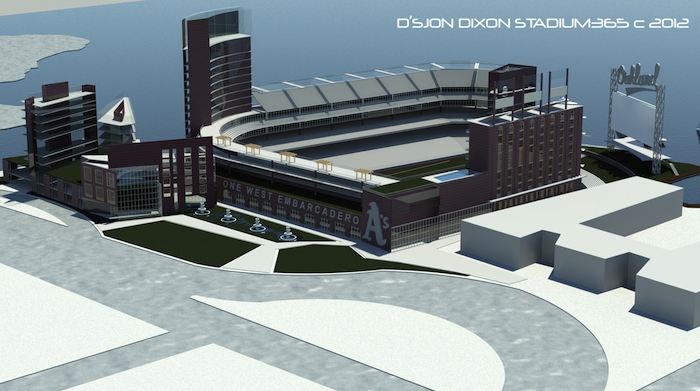
If someone – anyone – discovers a ballpark site is being discussed or presented, and he lets me know about it, I’ll take the time to cover it. Even though ownership is only focusing on one site and the City of Oakland has its own two sites in mind, it doesn’t hurt to be open-minded about others. We may find the best of breed or dismiss something entirely. Either way we’re getting educated and informed about it. I enjoy covering it, and I hope you enjoy reading about it. That brings me to the Estuary Waterfront Project, a ballpark concept by Oaklander D’Sjon Dixon. Dixon, a native East Bay guy by way of the University of Wisconsin (as he pointed out, like Bud Selig and Lew Wolff), is an excellent artist and has some brought some fresh thinking to the often static world of stadia. During his segment on A’s Fan Radio, Dixon frequently talked about his ballpark’s goals of sustainability and its ability to enhance both the waterfront and the city.

EstuaryPark-corner-med

D’Sjon Dixon’s Estuary Waterfront Project would place a ballpark on the site of Estuary Park and the Jack London Aquatic Center along the Embarcadero in Oakland

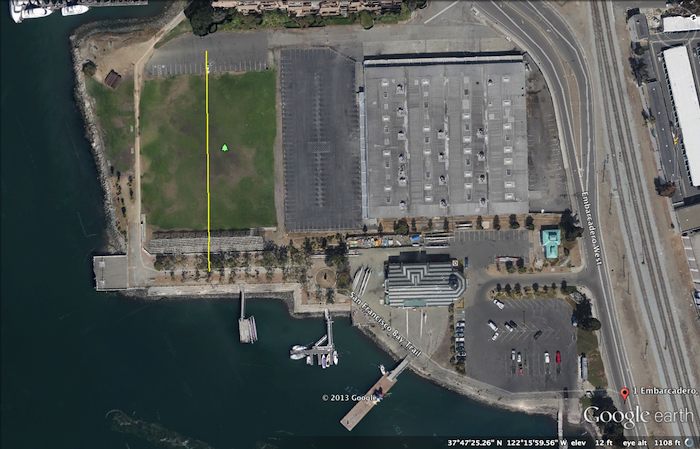
Over the years Estuary Park has aroused curiosity about its ability to work as a ballpark site. It’s located east of Jack London Square, across the tracks from Victory Court. I’ve gone there multiple times and several people have asked me about it over the years. My immediate answer to them is that it’s too small. The park measures roughly 400′ x 240′ plus some estuary frontage of varying width. The Jack London Aquatic Center, which opened in 2001, is a somewhat triangular piece of land that’s also 400′ long and 300′ wide at its widest point. JLAC has a boathouse with a community room that can be rented out for events. Rounding out the landscape is the old Cash and Carry warehouse, which the City bought through its old redevelopment arm a few years ago. That parcel, including a parking lot, measures 440′ x 340′. In all, the land (which is all city-owned at this point) totals just over seven acres.

EstuaryPark-overhead-med

Overhead picture of Estuary Park, the Jack London Aquatic Center (bottom right), and the vacant Cash & Carry building. Yellow line across field represents 400 feet.

It’s not small just because of the acreage, it’s small because of a single dimension. In the picture above, the yellow line represents a reasonable buildable width including mandated setbacks and easements for the water and the apartment complex to the west of the land (top). 400 feet is simply not wide enough to hold a ballpark. A grandstand including the concourse will measure around 170 feet deep. Add to that 50 feet from the first row to home plate, and then at least 300 feet for a short porch to right field, and the ballpark becomes 520 feet wide. There simply isn’t room for that kind of structure on the land, unless you do something unorthodox.

EstuaryPark-north-med

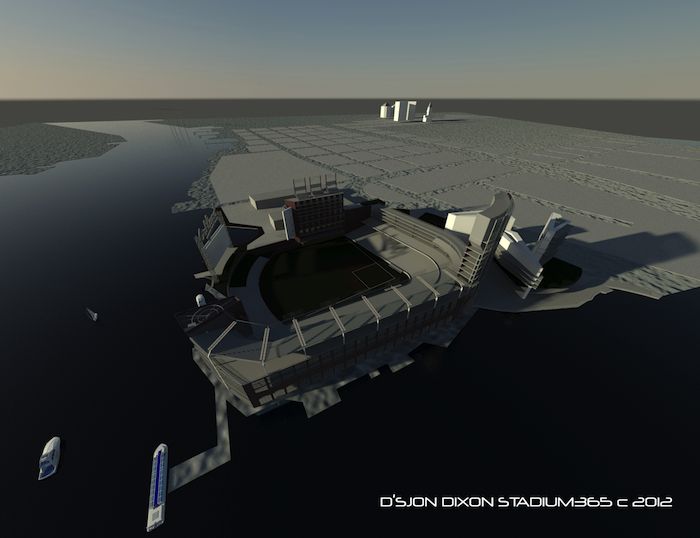
Water view shows footprint of ballpark extending beyond existing Estuary Park footprint

To address this, Dixon took two unorthodox approaches. First, he disregarded the Estuary Park limitations and simply built more of the ballpark out into the water. I didn’t notice this until I saw more images on the project website. Notice the second pic’s taper from JLAC to the park, and how that no longer exists with the ballpark. Anyone who has spent any time reviewing CEQA knows that building anything new over what is currently water is for all intents and purposes forbidden in California. Even the Warriors arena is getting a great deal of static for aiming to build on piers, which of course aren’t land. Additional creation of land in the Bay, regardless of purpose, practically requires an act of god to make it happen. Remember the plan to extend SFO’s runways a decade ago? That would’ve required bay fill. It died on the vine. A similar effort for this ballpark, even if it required only a 100′ x 400′ slab (1/2 acre), would be laughed out of committee or ripped to shreds by Save the Bay, Waterfront Action, or the BCDC if it ever got that far. The Bay is what makes our region distinct, and people and groups have shown that they’re willing to defend it endlessly and to the death. The other unusual step Dixon took that baseball fans noticed is that he oriented the ballpark west-southwest, so that it would face JLS, Alameda Point, and in the distance, San Francisco. As we’ve discussed several times, MLB prefers its ballparks to face east or northeast. In some instances such as domes it’s willing to have a ballpark aimed north or south. This is to ensure that the sun isn’t in the batter’s eyes during the day and to provide relatively predictable shadows during the season. Interestingly, Dixon tried to address this by placing an eight-story hotel tower in right field and a big scoreboard in center. Those measures will only work in certain sun-sky conditions. The ballpark could be re-oriented southeast to fix the sun problem, but it would take away from the view. Dixon couldn’t say what the ballpark’s capacity was or explain how much onsite parking would be there. The size of the ballpark would be “up to the developer”, though he also claimed he knew three people who could fund the ballpark. It all adds up to someone who has some great ideas and understands LEED, but knows next to nothing about CEQA. CEQA is the set of regulations that forces environmental review and places restrictions on what kinds of projects can be built in sensitive places. CEQA has led rise to hyper-NIMBYism in California. On the flip side, it has allowed our coasts to remain mostly in the public interest and not full of high-rises and private development. If this ballpark concept ever got off the ground, it would immediately have Bay and waterfront activists, open space and parks preservationists, boating enthusiasts, residents of the nearby apartment complex, and many others lined up to take it down. That doesn’t include the normal anti-stadium types or additional complications such as the PUC and other governmental agency interactions. This is the stuff that Lew Wolff talks about when he says that people can’t just point at a site and say that’s a site. There’s a ton of legwork that has to be done on each proposed site, and even more on the sites that actually get studied as alternatives. There are studies of noise and shade, seismicity and hydrology, cultural and paleontological resources, along with the more common traffic and transportation work. It’s a significant, seemingly endless amount of work, and the crazy thing is that a draft version of an EIR has not been finished for any ballpark site in Oakland: Victory Court, Howard Terminal, Coliseum City, this site or any other site. And it’s telling that Estuary Park, despite its rather prominent position where the Estuary meets Lake Merritt Channel, was never really considered a ballpark site in the past. That’s largely due to all of the issues identified in this post, and probably many more that I haven’t covered. Just a thousand feet across the Channel, HOK studied two sites at the Oak-to-Ninth (O29) site in 2001. That’s not to say that Dixon’s in the wrong. He has some great ideas, and the fact that he put he put his visual skills to use in fleshing them out can help a lot in terms of creating a real vision for Oakland going forward. If the concept ultimately serves as a catalyst, it would be incredibly productive for fans who want an Oakland ballpark and need a unified rallying point. This idea can be moved and modified to work at other sites. Dixon seems to like Coliseum City nearly as much as his own plan, as long as the A’s stay in town. If Save Oakland Sports and other groups can come to a consensus on one site that has energy behind it and has been properly vetted, they have a shot. If they stand by the City’s current vision of multiple sites being equal with no real consensus, there’s nothing to rally behind. They’re just circles on a map. —– Note: As I was writing this in the middle of the night, I did not ask Dixon for permission to use his images. I apologize for that in advance, though I also cite fair use as this is a review.

Shaikin stirs it up again

Amidst all of the Lettergate hubbub (credit to Mike @muppet151 for the term), now comes an article from LA Times writer Bill Shaikin called MLB gives tentative guidelines for potential move to San Jose. There’s nothing revelatory in the article, and nothing to indicate that anything would happen soon. Yet the headline, much like this headline, seems aimed to inflame or at the very least act as clickbait.

Then again, the information seems to back many of the assertions I made when I wrote about the territorial rights saga last month. Whether there’s real fire to this smoke or this is part of an ongoing misinformation campaign (also exercised by the other side), we won’t know for certain until it’s all over.

This got me thinking about how much compensation should cost. Shaikin notes that determination of any compensation award would be entirely within the purview of the commissioner’s office. Then it occurred to me that when Lew Wolff presented the San Jose concept, it was thought that the A’s might move to San Jose after the current Coliseum lease expires, or the 2014 season. With the A’s unlikely to be able to move until 2018, that’s four full seasons of forgone revenue at Cisco Field, while the Giants continue to lap it up at AT&T Park. That “opportunity cost” is offset somewhat by ongoing revenue sharing in Oakland, which would go away after the new ballpark opened.

With the Giants able to maximize their hegemony over the region and the A’s continuing to limp on at the Coliseum, any thought of the A’s being any kind of financial threat to the Giants has evaporated. And that, right there, may well be the compensation in a sort of unstated, off-the-books form. An extra $40 million to the A’s via San Jose doesn’t necessarily mean it’s $40 million less for the Giants. But it does mean that no money moves in the current situation, which is just fine with the Giants. $160 million for those four years, without Bud Selig having to make the tough decision? Sounds like how baseball would work.

What would happen in 2018? That would be up to whoever is the commissioner, probably not Bud Selig. Maybe there’s some nominal amount of compensation. My argument for a while has been that there won’t be, not because of what Wally Haas did for the Giants 20 years ago, but because MLB and the owners don’t want to set a price for a territory. Doing so would set a precedent for future moves into other territories. In the Giants-A’s case, the situation is unique enough to be difficult to duplicate, and by not setting a real price for Santa Clara County, the owners don’t create a market.

I’m not the only person who thinks compensation will be a trivial matter:


This is one of those times I wish I had a time machine so I could tell you how it works out. For now we wait. Forever we wait.