Diridon Walking Tour

Here in front of Diridon Station. Jeffrey, fc and Sam are on hand, along with Dennis Korabiak and Kip Harkness from City. Michael Mulcahy as well. 40-50 in total.

Someone just asked when the ballpark would open. Korabiak replied, “2015.” More on that as it comes.

Korabiak just said that the renderings will be officially released by City tomorrow.

Harkness mentioned that the water table is 14 feet below the street.

Mulcahy finished off the tour with a brief speech about supporting the plan.

At least two people asked about what happens if baseball doesn’t come. It’s way off in the distance, say Harkness and Korabiak. Developers won’t make a move until they know baseball and BART are coming.

Day 12: Portland (A Eulogy)

Take a good look, because it’s the last time you’ll see this beaver.

Originally, the last city on this trip was supposed to be Seattle, where hopefully the M’s would’ve gotten their brains smashed in. Sadly, they were scheduled to be in New York, making a it difficult to justify going so far for just a tour. Instead, I looked south to Portland, where MLB was at best a flirtation, pro baseball has happened in fits and starts.

Worst of all, when the city’s much loved USL-1 soccer franchise, the Portland Timbers, was granted promotion to the MLS in 2009, it was clear that the AAA Portland Beavers’ days at venerable PGE Park (née Civic Stadium) were numbered. In the last 18 months, every effort by Timbers/Beavers owner Merritt Paulson (son of former US Treasury Secretary Henry Paulson) has come up for naught. As mentioned in Jeffrey’s recent articles (I/II) on the subject, the Beavers will almost certainly leave Portland, probably south to either the San Diego suburbs or Tucson. With pro baseball shut out from PGE Park because of a soccer-specific renovation and no new venue in sight, it’s unclear if or when pro ball will return to Portland. Knowing this, I had to visit the old park in Goose Hollow one last time.

Built in 1925, Civic Stadium was always meant to be a multi-purpose stadium, and it shows. Its expansive wooden roof was intended for weather protection for fall and winter football games, not summer baseball (psst – for those that don’t know, Portland’s really nice in the summer). The J-shaped seating bowl offers suboptimal sightlines along the third base side, along with Coliseum-like foul territory. The field itself is field turf. Renovations to modernize the place with new suites and seating helped bring a third version of the Portland Beavers to life. Changes for the Timbers have started and the place will be cleared out in week, the last series to be played on Labor Day weekend.

Four-story stack of suites behind the plate.

It’s really amazing how things can change. Six years ago, Portland was considered a frontrunner to land the wayward Montreal Expos. $150 million in state funding was lined up, as well as a solid business plan and support from the business community. Little did Portland supporters know at the time the shell game that was about to be perpetrated in order to facilitate the Expos’ eventual move to Washington, DC (thanks a bunch, Detroit schools slasher Robert Bobb). In the end, MLB-to-PDX lost, momentum died, and it’s not clear what form pro baseball will take when it returns to Portland.

Image of Timbers-friendly PGE Park renovation.

Backstory aside, I was determined to enjoy myself at the game. After my long train ride from Minneapolis, I freshened up at the hotel and headed out. After a stop at The Kennedy School for some lunch and beers, I went downtown.

Getting there

Portland has one of the best light rail systems in the nation. It goes nearly everywhere you’d want to go in Portland, and within the downtown area it’s free. That’s right, within the downtown core and out to the Rose Quarter/Convention Center, riders don’t pay to ride the MAX or the Streetcar. The MAX stop for PGE Park is just barely outside the zone, but nobody really checks that close, do they?

It’s a good thing that public transit is so readily available near the ballpark, because parking is almost non-existent immediately around it. You could park at the Fred Meyer nearby, but that’s not nice to the shoppers who actually need the parking. You could also park downtown and walk 10 minutes to the ballpark, which is a much better choice. Downtown is not a particularly large area, so a walk from one of the many bars or restaurants in the Pearl district to PGE Park is not stressful in the least. A walk from the Deschutes Brewery to PGE Park took about 15 minutes.

I walked up at 5:30 PM and got myself a nice seat, 8 rows behind the plate, for $15.50. Had I gotten there earlier, I could’ve gotten a $5 general admission seat. Oh well. As with most minor league games, the atmosphere was relaxed. The results don’t carry as much weight as in the majors. While the Beavers have underperformed recently at the gate, this game was the last scheduled fireworks game of the year, bringing out an announced crowd of 9,983.

Most of the seats are covered by a large wooden roof. The football/soccer press box is tucked underneath the roof. Both are held up by columns along the walkway separating the box seats from the general admission benches.

Concessions

An 85-year old stadium, even with a revamp, isn’t likely to have wide concourses. True to form, PGE Park doesn’t. Even before the game, the concourse was jammed with fans in line at concession stands, creating serious traffic jams. That dissuaded me from getting anything at all from there. A better choice is usually the Widmer Beer Garden down the RF line (pictured above), though the lines for that place can be long as well.

Circulation

This picture is pretty much self-explanatory.

Other observations

When you get off the MAX from downtown, if you walk left instead of right, you’ll soon be walking along the open left field area. Cheapskates can watch the game here from behind a fence. Savor it, because when a new 4,000-seat eastside stand is built, that view is going away.

Even though they’re getting rid of the baseball configuration, they’re still keeping artificial turf. Why? The Portland State University football team plays there.

Wrap-up

I’d say it was really tragic if Portland didn’t have other kinds of entertainment to rely on. Still, the lack of effort on the city’s part to help the Beavers will surely not sit well with MLB if Portland were to ever engage in a new effort to get a team. The Blazers and some preservationists blocked a bid for a AAA stadium on the site of the old Memorial Coliseum. Several sites that were considered as potential MLB ballpark sites have already disappeared. The best one, the USPS facility near Union Station, is slated for different types of mixed development. PGE Park was important because it could’ve been a good transitional facility. Now there’s no telling how a franchise move could happen, so it’s probably expansion or bust. And while I’m an advocate for expansion (mostly for scheduling and realignment concerns), I’m one of the few and I have no pull. With that in mind, good luck, Portland. I hope my next summer pubcrawl there includes a baseball game. But I’m not counting on it.

Marine Layer’s Cisco Field Analysis

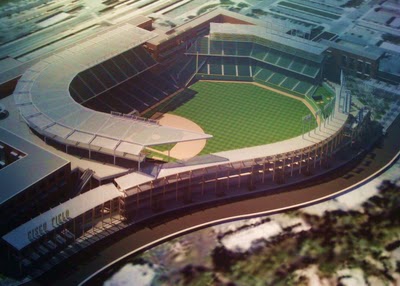
When the first images of the new Cisco Field @ Diridon came out, I decided to sit back and watch the reaction. Same thing went for the official images, released through Baseball San Jose. My initial thoughts haven’t changed: it’s quite radical. Now, I haven’t talked to anyone at 360 Architecture, Baseball San Jose, or A’s ownership about the images, so my thoughts are not influenced by anything or anyone. With that out of the way, let me explain what I mean by radical.

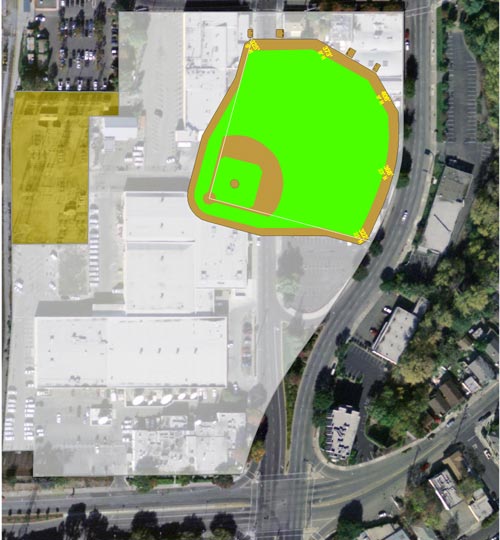
Let’s start off with where the field is placed within the site. First up, here’s what I drew up a couple of years ago.
newballpark1-export-sm

In my sketch, the RF wall hugs the Autumn Parkway contour. The aesthetic effect of that is that fans are confronted with a large wall when walking along Autumn. Additionally, the field is pushed up further north to have more “back of the house” space. By doing this, I effectively put a cap on the number of seats. That isn’t necessarily the case with this new drawing.

Assuming that the remaining land acquisitions go as scheduled, including a small land swap with PG&E, the field is likely to be situated as you see below, give or take 20 feet north or south (north is up). That orients the field pretty close to true northeast. Prevailing winds tend to come from the northwest, so they should move from the left field foul pole to its counterpart in right on a regular basis. At times, the winds will shift to NNW or WNW. However, the winds in San Jose tend to not be particularly strong, generally topping out at 10-15 mph. Oakland and San Francisco are generally more prone to onshore and offshore movements.

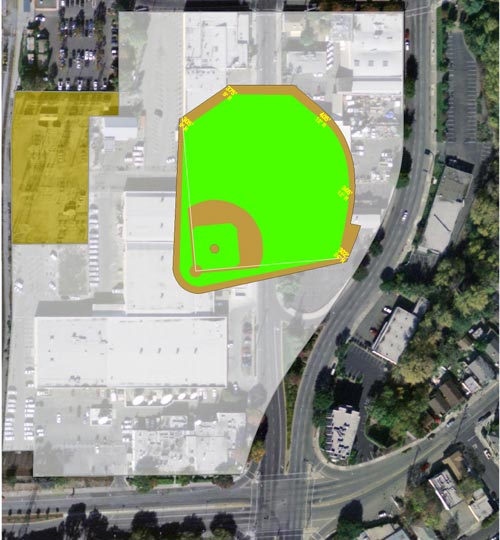
Now for the new 360 layout:
ThreeSixty1-export-sm

The way that Autumn Street/Parkway is contoured, it removes almost all of the RF corner from what would normally constitute a grandstand. And we can’t do an analysis without discussing those field dimensions, with the very short porch in right and a shallow corner in left. Neither of those dimensions are entirely necessary. You can see that there is some space to lengthen both of those out, and I figure that some version of Cisco Field has more “standard” dimensions in place.

Of course, standard dimensions aren’t possible in right if that “thing” is there. What is that thing, anyway? Well, I’ve searched far and wide for some context. It’s not an arcade as in San Francisco, as it doesn’t have arches. Instead, to me it’s, for lack of a better term, a contemporary take on a classic colonnade. To wit:

In classical architecture, a colonnade denotes a long sequence of columns joined by their entablature, often free-standing, or part of a building.

Normally, we think of colonnades as freestanding, such as those used at old LA Forum and Soldier Field. In this case, they house multiple levels of what appear to be minisuites. That’s the first radical step I noticed from the Fremont plan. At Pacific Commons, the minisuites were only 15 rows from the field along the infield. Now they’re part of the colonnades. I suspect the team reached out to potential minisuite holders to see what effect this would have on their interest. If the idea survived this long, the effect must have been minimal.

Depending on what the treatment for the colonnades is, they could become the signature element of the ballpark. There’s no other eye candy in the outfield besides the video/scoreboard, which lines up flush with the top of the colonnades and the roof. I don’t expect to see a neoclassical look, as in the two examples cited previously. Instead, it will probably be more modern and perhaps subdued.

Several sections of outfield seats jut out from the colonnade, creating the crazy 345-foot dimension in right-center. Either they really needed to get those seats in there, or it’s an affectation of sorts. Frankly, it’s unnecessary. The best thing to do would be to take off a few sections, chop off several rows of those seats and turn it into a family or picnic area. The resulting right-center length would be 360 feet or more.

Over in the LF corner, the line could be further extended, eating into more seats and creating a higher wall as a result. I don’t really have a problem with it. Every team should have a righty dead pull hitter who hits frozen ropes down the line. If they get an extra 10 HR that way, so be it.

Features

diagram1-sm

After my 2008 trip to the East Coast and the more recent trip to the Midwest, I came away with one absolute must-have: a majestic plaza for fans to enter the ballpark. AT&T Park has this behind the plate, but the ballpark itself turns its back to the plaza so there’s a sense of separation from the action. At Nationals Park and Target Field, the plaza is integrated into the outfield (Nats Park in left-center, Target Field in right), making the journey to the park all the more momentous. There’s something viscerally stimulating about seeing the grandstand and the field get larger with each step. It’s a reminder of what we had prior to Mount Davis, when the BART bridge walk brought a certain level of excitement. The plaza is large enough (nearly an acre) to hold the family-oriented entertainment options.

The third deck is the other major radical move. Notice how the seats in the first two decks are not defined or articulated, appearing to be benches. Obviously they’re not a bunch of bleacher planks, but the third deck has the same large yellow chairs with side tables next to each seat, just like the minisuites. This appears to be the club level. If so, that’s a marked departure from the club levels we’ve come to expect from most venues. There’s no expansive, separate concourse. There’s scant room for a bar. It’s not indoors. It’s not entirely behind the plate. Instead, it’s three rows of seats, served up with tables and drink rails. This is where I expect Cisco to make its mark. I expect each seat will have video and in-seat concessions ordering, making every seat in the club have diamond level-like wait service. There remains the possibility for a club restaurant down the LF line, and a perhaps another gathering area behind the plate. The seats themselves are at the same height and distance the Coliseum’s suites are, except with more baseball-friendly sightlines. The club will also have the benefit of a roof over the seats, whether it’s the mesh roof from the Pacific Commons version or something different. In moving in this direction, they’re trying to create distinct, separate markets and price points for premium seating that don’t exist elsewhere in the Bay Area, or even in baseball. At the same time, they’re doing what the Red Sox did at Fenway – put the premium stuff at the top of the stadium. It’ll be interesting to see how this pays off.
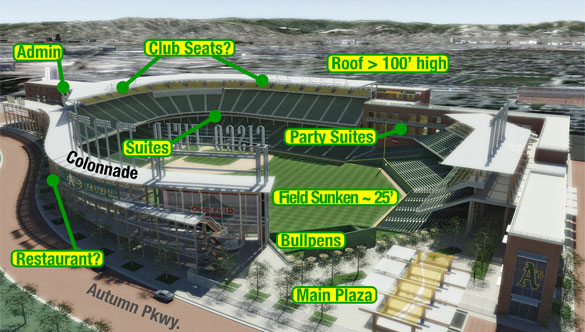
diagram2-sm

The field is sunken, just how I’d prefer it. One of the issues associated with building close to the bay (China Basin, Candlestick, Coliseum, any JLS site) is that to avoid the water table or keep from drainage issues, any stadium pretty much has to have its field at sea level or higher. Diridon is around 90 feet above sea level. There’s still the water table to deal with, but that’s largely an engineering issue that shouldn’t be a problem as long as digging doesn’t go too deep (in the area, the floor of HP Pavilion is also below street level).

The bullpens are sunken below the field and placed at CF. Makes sense to me. It explains why the fence is slightly taller at CF, as opposed to LF. Hell, the Giants should’ve put their bullpens there – oops, they forgot about the pens when designing the place.

The LF corner is where it gets weird. I count 4 different seating angles. First, there’s the normal grandstand. Then there’s a brief 2 sections that run 60 degrees against the grandstand. Slightly beneath that is the start of the outfield section, which follows the outfield wall. Finally, those seats straighten out and run parallel with San Fernando Street. A building in the LF corner houses party suites, and perhaps the aforementioned club restaurant.

I would be remiss if I didn’t point out that the two-deck grandstand would be the shortest in the majors by far. On the 3B side, the grandstand doesn’t go beyond 240-250 feet at best. On the 1B side, Autumn causes a tapering effect that puts the topmost upper deck or club seat just barely beyond the edge of the infield. To compensate, surely there will be more rows of seats in both decks, though it’s not clear how many.

More impressions:

  • The colonnade creates one more aesthetic positive: a net in RF won’t be needed. I figure the height of the roof will be 90 feet in the outfield, making it like a Tiger Stadium/Comiskey Park situation – if someone can get it out of there, he earned it.
  • One thing that’s missing is a view as you exit Diridon Station. I would’ve liked to have seen that. Will transit users have a gate there? Will they go to the main plaza? Or will they use that notch in left-center that lines up with Montgomery Street?
  • I’m still not sure how much of an impact columns in the grandstand will have on views. Columns in the grandstand appear to be recessed into the concourse, not in the seating bowl.
  • With the PG&E substation change, a new access road has to be established. That will probably come from Park Avenue, running by parking lots and/or garages.
  • The tight grandstand all the way around should seal in noise well.
  • 75-degree angle in the grandstand refers to the angle between the first and third base sides. Often in new ballparks, the initial angle is 85 or 90 degrees, with a kink on one or both sides to pull the seating bowl further in. The most severe example may have been old Yankee Stadium, which had a 55-degree angle. Foul territory down the lines was almost non-existent, but the implementation caused the distance from the plate to the backstop to be extraordinarily long (72 feet).
  • The Eric Byrnes sighting. It’s probably nothing, in that they used the first image they had lying around. Or it could be a sign that this thing has been in the oven for a while.

All that said, one question remains: Do I like it? On a scale of 1 to 10, I’d give it a 7 right now. The field dimensions need to be addressed, which is not easy since the only person who has spent more time looking at the land besides 360 and the A’s is probably me, and enlarging the field is a real head-scratcher. I like the back-to-basics design. I’m not sold on how the premium seating all fits together, but I’m not a customer for those so it isn’t my concern. I’m also not clear on what the façade will be. Brick is more commonplace in the Diridon area than just about any other material, yet Lew Wolff has said in the past that the design will not be retro, which should rule out brick. Will it be some marrying of the two?

Most importantly, this will surely be the most intimate major league ballpark built in the last 90 years. Unlike the swept-back HOK/Populous designs which are meant to be essentially inoffensive, this one’s not going to win everyone over. Some will think it’s too small. Others will not like how it’s set up. I suspect that once people get in the seats – perhaps the first open house or walk through – opinions will change quickly. They’ll wonder why the seats at AT&T, which they once thought were the best, are so far away from the action. Skylines are good. Bayviews are nice. San Jose doesn’t have outstanding versions of either, which means the A’s are turning to the original selling point – baseball. I don’t see that as such a bad thing.

Sorry Sin City, You’re Not Good Enough

Can we officially stop the FUD regarding Las Vegas? From the Las Vegas Sun:

Goodman, who has spoken about efforts to land a pro baseball team for the last three weeks at his press conferences, was up front about why the team, which he declined to name, turned down Las Vegas.

“We heard from one team that I was very interested in pursuing that our market is not big enough, our media market is not big enough and our economy is in such a state that they’re not interested in considering us at this time,” Goodman said.

It’s very simple. Oscar Goodman is Ahab. Major pro sports is his white whale. Can’t fault him for pursuing it, since landing a team would give him, his legacy, and his city a kind of legitimacy that isn’t achievable any other way. Remember that he’s the one pursuing teams, not the other way around. For now, it’s over. And there’s no telling when Vegas will have the kind of economic viability to support a team, especially a MLB team.

Game. Set. Match.

What makes a major league park?

Last night, Jeffrey published his thoughts on the new Cisco Field renderings, which naturally brought about some discussion. Before I get into what I think about the place, I want to get a sense for what you, the reader, feel defines a major league ballpark. Write a couple of sentences or a paragraph, submit it in comments, and I’ll put it in the post. I’d like to see if, based on the long history of ballparks and stadia in America, what kind of consensus exists, if any.

Dan:

I think a major league park is defined by having a nice, large, plot of green grass (that is mowed correctly, yes that’s a dig at SF) located in a central area of the city in which it lives (probably downtown). That grandstand should have large, open concourses allowing views of the surrounding city as well as the field. The stadium itself should be built from materials native to the rest of the buildings in the city or of materials native to the region (ie: Brick in Boston, Sandstone in San Diego, etc… (and yes that was another dig at SF’s brick ballpark in a city with almost no brick)). The stadium itself and the seats should have some relation to the color scheme of the team. There should be some museum(s), statute(s), etc… that pay homage to the team’s history.

Briggs:

Unity between fans, city and team.

It’s a privilege for any city/region to a MLB team. It’s also a privilege for MLB to operate in a major city, so each ballpark should be an appropriate cathedral to both its team and the city it’s in. Sometimes it’s gimmicky (Neon-fluorescent Liberty Bell/Big Red Apple) or classy (Bay Bridge/Gateway Arch). In either case, you need something that’s going to identify the ballpark with the city. The team’s history should be proudly and tastefully displayed. A family could go back with a team generations. Linking the players your grandparents cheered for with the players you’re cheering for is an important thing. Retired numbers, milestones and championships should be easy to identify. Sorry Coliseum, but a big yellow circle around “1989” on a tarped off upper deck doesn’t cut it and don’t get me started on how they display their appreciation for Ricky. The Braves have a good thing with their row of championship pennants.

Transportation.

MLB teams play 5-7 games a week, so if you’re going to a game, it should fit around your schedule. Depending on the day, you’re either leaving straight from work, meeting up with friends then trekking out or making a day of it. Trains, buses and cars should all be viable options. This isn’t just about convenience, it’s about the experience of traveling to/through the city or metro-area to get to the ballpark. Where ever you are in the area, getting out to the ballgame should be relatively easy. This ties back in with feeling the connection between the city, the team and the fans.

Location.

This ties in the top two points. Having a ballpark out in the middle of nowhere because land/construction is cheaper is very telling about the relationship between the city, fans and team is. Prime urban real estate is pricey for a reason. It’s valued. Having a ballpark on a prime piece of real estate includes the team with major activities around the city. I live a few minutes from AT&T park. The bars and restaurants around there light up with baseball camaraderie. The enthusiasm spills out over the city. Before and after games, you feel the highs and lows of your team along with fellow fans. If there’s time to grab a drink before an A’s game, I have to stop off 12th St. BART. Then I have to get back on BART and literally leave Oakland so I can go to an Oakland A’s game. It’s a buzz kill. I want to feel that A’s zeitgeist when I go to games. I want to get off the train and be surrounded with the anticipation, excitement and camaraderie for the A’s. DT Oakland, or DT SJ; it doesn’t matter as long as the fans has a place to be that’s worthy of their appreciation of the team.

jesse:

For me a stadium should do two things, take the fan to a different place once he/she walks through the turn style and second bring people together from all over a regional area to cheer, boo, and forget about any worries or concerns they may have for 2 to 3 hours.

gojohn10:

A major league park is more than a field that hosts a major league team. When the A’s played in Vegas back in April of 1996, they were major league team playing in a minor league park.

The criteria mentioned thus far are what make a good park great, but they  would exclude parks like the coliseum which, while not ideal, is certainly a major league park.
A major league park is a stadium with the capacity of >30-35k. Dogs and beers should readily be available. The park should have wall dimensions that roughly fall within the minimum standards required by MLB. Preferably, wall heights or distances in other portions of the park should compensate for regions that allow for “cheap” home runs. The park should have ground rules that don’t violate the flow of the game on a semi-regular basis. Finally, a major league park should host a MLB team, although even that is not technically a necessity. St. Pete had a major league park before they landed an expansion franchise.

Day 11: Target Field

8/16. Game time- 7:05 PM
Attendance: 40,702
Weather: 78 degrees, overcast
Matchup: Chicago White Sox at Minnesota Twins
Pitchers: Gavin Floyd vs. Francisco Liriano
Result: MIN 7, CWS 6, W- Manship (1-0) L- Floyd (8-10)
Ticket Purchased: Standing room only, $22
Beer of choice: Summit Extra Pale Ale – $7.50
Food: Pork chop on a stick ($7.25), Corn dog ($3.50)
Travel cost: $6 for a Day Pass, $4 for a Six-Hour Pass
Other: None
Total spent: $46.25

To understand the average Twins fan is to tell the story of a caged bird. Understand that Minnesota is a place where seasons are felt and appreciated, even endured. Contrast that with the average Bay Area citizen, who only knows wet and dry seasons, some of those wet seasons being not so wet at all. Don’t get me wrong, I love the mild, dry climate that is so great for nine months of the year, the other three being quite bearable. We just have a tendency to take such pleasures for granted.

The Hubert Horatio Humphrey Metrodome was a place where seasons couldn’t be felt. Sure, there were plenty of institutions built in the Twin Cities to protect citizens from the harsh winters, such as the Skyway and Mall of America. The Metrodome was different, as it belied every natural instinct any kid playing baseball grew up with. So when Target Field opened, it quickly became a celebration of baseball and of the rites of spring and summer. To that, I toasted with many a Minnesotan over their new jewel.

Getting there

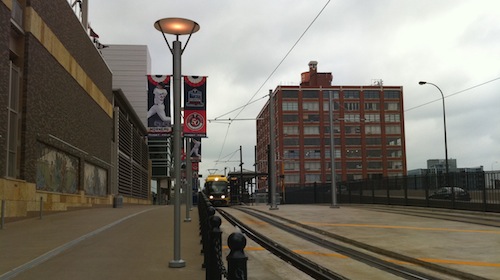
Target Field may be the most transit-friendly ballpark in the nation. It was designed as both a ballpark and a transit hub, with a light rail station alongside it, a commuter rail station underneath it, and weatherproof bus platforms adjacent to it. It’s an extremely clever and convenient arrangement, which paid off for me in a big way.

The local Amtrak station is called Midway, a location considered halfway between downtown Minneapolis and St. Paul. The cheap hotel where I stayed was three blocks away. A frequently running bus route which serves the University of Minnesota got me from Midway to Target Field in 25 minutes for $2. The major airport also links to the ballpark and the Metrodome via the light rail line. Parking at several garages within a few blocks of the ballpark ran only $5.

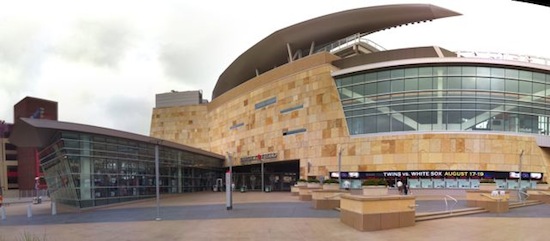
All of the buildings in the downtown area are connected by the Skyway, a series of elevated pedestrian bridges used by workers and shoppers to escape the snow. While the Skyway doesn’t connect directly to the ballpark, it does take fans to Target Plaza, which to me is the most dramatic entrance to a ballpark in MLB. Target Plaza has been likened to an arm reaching out to the city, which it most certainly is. Instead of blocking off vehicular traffic to make the plaza bigger, traffic is routed underneath while the plaza tapers to become a sheltered sidewalk underneath Target Center, the local arena. The mass of fan movement is entirely visible along 6th St N, as is the entrance to the stadium, which beckons fans to come inside. As much time as I’ve spent describing the experience, it doesn’t come close to what it means to experience it in person.


Ticketing

I had gotten to the ticket booths by 11 AM to see if I could take the tour. Alas, the Twins don’t hold tours on gamedays. Discouraged, I asked about tickets for the that night’s game against the second place White Sox. Only $22 standing room tickets remained, the seller said. That was fine with me, as I was going to spend most of my time roaming around the ballpark anyway.

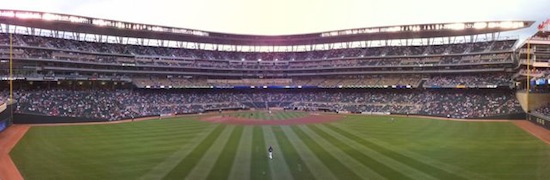
I returned to the ballpark at around 5:30, making sure to use the Target Plaza entrance as many others were. Once I had taken in the scene in the RF plaza, I walked along the 1B main concourse, where the views of both the ballpark and the city as a backdrop got progressively better. Amazingly, the concourse was 45 feet wide, not including the designated standing room and wheelchair areas. Then I took the escalators to the upper deck. I ascended to what I assumed to be the worst seat in the stadium, LF corner, last seat, top row (see top for panorama). The seat was better than what I had at Busch a few days earlier, in large part because of the diminished height.

Walking along the upper concourse, a few things stood out. The three-part columns that hold up the “floating” roof and upper deck differ from those at most other recent ballparks, which usually employ a column/beam/truss design. The roof is made of metal strips and holds the field lights and the speakers for the upper deck. That makes for a very clean implementation, though fans don’t get the benefit of heat as the lower deck folks do in some of the public areas. One way the Twins addressed the cold issue is to put an indoor bar, or rather a series of small bars, behind home plate along the upper concourse. If you and your friends have SRO tickets and get there early enough, you can set up a perch with a great view of the game, a drink rail, and a very convenient bar within a few steps. One of the bars even has the ballpark’s organist playing in the middle of it!

In their effort to keep the revenues at this smaller facility up, the team made a few unusual design choices. On television you’ll see a curved set of outfield seating sections in RF. Those seats, along with some signage, disguise a large parking ramp. A three-deck structure in LF is somewhat reminiscent of a similar structure at old Metropolitan Stadium and provides a few thousand seats. Along with the bars on the upper concourse, there are other spaces built out along the 1B line that belong to the Twins. Essentially, the team chose to move their stadium operations staff up there instead of making a larger press box along the mezzanine. By doing this, the team freed up more room for suites.

Concessions

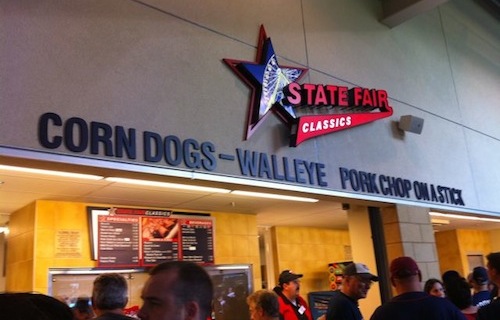
The stands of choice are the State Fair stands, which have a bunch of items you won’t find elsewhere, such as walleye or a pork chop on a stick ($11/7.25 respectively). Cheese curds ($4.75) are said to be popular, and I saw at least one person with a $9.75 turkey leg. 16 oz. domestic beers are $7, while premium beers are $7.50. I chose a Summit Extra Pale Ale, perhaps the most popular local craft brew, for the small 50-cent premium.

Everywhere, ice cream and gelato stands were packed, even though it wasn’t a really hot day. The lower concourse has its own Asian stir fry station and carvery, both of which were placed right next to each other and caused serious traffic jams. Most of the regular stands were quite efficient upon observation, which helped make the concourse look even better as a result.

Circulation

Ramps are not a prominent feature in terms of circulation, as the 8-acre footprint did not allow for large or sweeping ramps. Several people who wanted to descend from the upper to lower levels thought they could use elevators along the 3B side. They waited futilely for a while before using the hidden stairs nearby. Most everyone uses the escalators. The lower concourse has 360-degree view of the field, including the batter’s eye. Like Camden Yards’ wall in RF, it’s not for the vertically challenged. Still, I managed to peer over the top and catch a good view from dead center.

One demerit has to be charged to the PA system. While I was at the batter’s eye, I couldn’t hear the PA at all. Even in other spots along the seating bowl, the PA was more than a little subdued. It’s bad enough that the announcer is a tad bland. Somewhere along the line someone decided that they didn’t need volume, which sounds strange given Twins fans’ prior experience with the now passed announcer at the Metrodome, Bob Casey. Even on TV, Casey’s somewhat shrill delivery (“KERR-BEEEEE Puckett!”) added character to a largely character-less place. It couldn’t hurt to have more energy at Target Field.

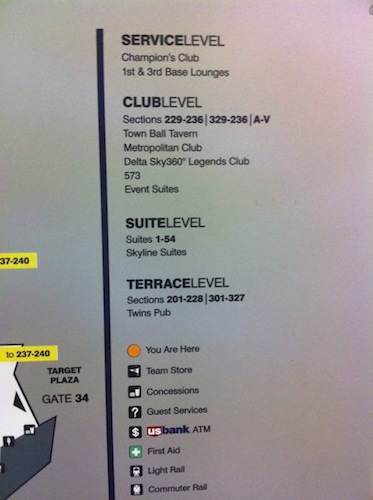
Another oddity is the naming of the sections. Here is another case where the neighborhood concept goes a bit awry. Along the Club level are 200-sections, but there are also non-Club sections named S through Z. Go up to the upper deck and there are both 200- and 300- numbered sections. What? If that doesn’t sound confusing enough, try to make sense of the legend below.

Other observations

  • I had mentioned the bars and the stadium ops buildings on the upper concourse. There appears to be room for additional buildout on the 3B side if they wanted. Access to the upper half of the deck is arranged via two sets of stairs and a catwalk. If there’s one thing I’d like to see stolen and put into Cisco Field, this is it.
  • The part of the Skyway that leads from Target Plaza to the downtown core actually runs through the Target Center arena. It even has its own gate for access to the arena, plus a view into what appears to be a practice gym.
  • Along the north edge of the park’s footprint is a queuing area for the light rail, bounded by a fence. That fence has a long series of mesh screen images of notable Twins in chronological order. That side is also open to the infamous garbage burning facility, H.E.R.C. I didn’t smell burning garbage while I was there.
  • Three bronze statues greet you along Target Plaza as you walk through it: Rod Carew, Harmon Killebrew, and Kirby Puckett. Players also have entry gates with their number. The Target Plaza gate is Gate 34. Kent Hrbek’s gate is Gate 14, with a sports bar inside it to boot.
  • I love how the ribbon board is organized, with a proper balance of advertising and game information.
  • The limestone facade is good, especially because it’s locally sourced limestone, but Populous did this kind of treatment before with Petco (sandstone), so no novelty there. If anything, PNC Park’s limestone treatment is much more substantial.
  • Along the parking garage wall facing Target Plaza is a kinetic sculpture by Sebastopol artist Ned Kahn. It is a series of hung “chain mail” panels that undulate with the wind, and is mesmerizing to watch. A similar installation can be seen at SFO’s BART station, attached to the International Terminal.
  • It would be nice if there were more places to sit on the concourses, but again – 8 acres. Not much room.

Wrap-up

Bill RIgney

There’s nothing fake about this place. It’s a ballpark, not an amusement park where baseball is played. Even with the new love affair with the Twins playing outdoors, I was asked by one fan how long the honeymoon will last, whether the glowing impressions of Target Field will be sustained over the long run. There’s still a palpable sense of wondering whether it was worth it, the natural Scandinavian sense of pragmatism, even austerity. I explained that the monetary value of an investment like this can only be measured many, many years down the road, and while I don’t like how the public financing part was arranged, it may well pay off for the public. As for the ballpark itself, a good place has good bones that stand the test of time. Target Field has good bones. Ride the wave and enjoy it, I suggested to him. Also, remember that Joe Mauer is a big reason this is here, and that this will be the reason Joe Mauer will stay here. By that measure, the Twins have already won many times over.

Juicy MLB team financials leaked

Deadspin received some very interesting, detailed financial statements from recent years for the Pirates, Mariners, Rays, Angels, and Marlins. As usual, Maury Brown already has an analysis up. Take a look at the docs if you have time, I’ll chime in shortly. Note: There is one team remaining to have its numbers leaked. Will it be the A’s?

I’ve taken the individual scans and put them into PDF format.

On a sad note, the great former KPIX anchor Dave McElhatton died earlier today from stroke-related illness. His jovial, normal guy nature was very different from the Tab Hunter-styled anchors we’re used to seeing. Condolences to his family.

Day 10: Wrigley Field

8/16. Game time- 7:05 PM
Attendance: 36,814
Weather: 77 degrees, partly cloudy
Matchup: San Diego Padres at Chicago Cubs
Pitchers: Kevin Correia vs. Tom Gorzelanny
Result: SD 9, CHC 5, W- Correia (10-7) L- Gorzelanny (6-7)
Ticket Purchased: Upper reserve outfield- $29.25 including fees
Beer of choice: Choice? What’s that? Budweiser 16 oz. – $8
Food: None
Travel cost: $5.75 for a Metrorail All Day Pass
Other: None
Total spent: $43

If you’re a true baseball fan, and you’re self-sufficient enough to foot the bill, you’ve probably already seen Wrigley Field at least once. If you were lucky, it was a day game, which in the baseball world is an almost transcendent experience. If you haven’t, you’re missing out. It’s the complete opposite of the Cowboys Stadium experience. It’s not showy or flashy. It’s pure. It anchors a community. Even with the redone bleachers and the addition of electronic signage, that purity hasn’t been lost.

Wrigley’s pleasures are not evident at first glance from outside. The exterior treatment is bland gray with metal fences and little color to accent it other than green beams. The red marquee is its most distinguishing feature. It’s funny that the two surviving old ballparks, Wrigley and Fenway, are not known for the façades or exteriors. Everything fans love about them is on the inside.

Getting there

For the love of everything holy, do not drive to Wrigley. If you must drive, head over to the DeVry University parking lot, which is 2 miles west of the ballpark. Parking is $6 and the Cubs operate a free shuttle to ferry everyone to and from Wrigley. Or instead of driving, take the “L” Red Line to the Addison stop and walk one block west with the streaming throng of Cubs faithful. The Red Line runs north-south from near Evanston to the Washington Heights, past US Cellular Field and the Loop downtown. Fares are $2.25 each way, or $5.75 for an all-day pass. For an even cooler experience, head down to Wrigleyville well before the game. Several sports bars and pubs call the area home, including Cubby Bear and Goose Island.

Ticketing

The Cubs have a perverse ticketing system that chooses to penalize people who want to sit in what are supposed to be some of the worst seats in baseball: the bleachers. Yes, the bleachers feel more like a crowd at a high school football game hanging out instead regular baseball bleacher bums. If you really want that, though, why not just go to a high school football game? It’ll be a lot cheaper than the 40 bones you’ll shell out for a bleacher ticket. Even with that $40, you’re still shut out of the rest of the park, and vice-versa. I’ve sat in the bleachers once, 14 years ago, for a day game. Marvelous. Also, $16, still overpriced but not grotesquely so. Things really didn’t get out of hand until a couple of years later, when the Sosa-McGwire saga brought fans back from the strike.

I got a $20 Upper Reserved seat along the first base side, half way up. The upper deck is split into two parts, box upfront and reserved in back. Some of the UR seats are truly obstructed view, whereas other seats behind them will also have obstructed views yet not be marked as such. Should the Wolff/360 vision for Cisco Field move forward, view obstructing columns will be a source of great debate. Many, perhaps most, will feel that there is no place for columns in a modern ballpark with modern building and engineering techniques. Some purists argue that fans in new ballparks are too far back from the action, so the use of columns to bring them closer is a welcome change.

In reality, there may be a much more banal reason for the introduction of columns: cost. If you look at the picture of one of the columns from the new Busch Stadium and compare it to one at Wrigley, the difference seems exponential. Wrigley relies and columns and a spiderweb of truss work to hold up the roof and upper deck. 100 years later and beefy I-beams are responsible for doing the lifting. Updated building code requires materials that can handle substantial earthquakes, but I suspect that in going with columns the team will save millions on structural steel, hopefully not so much as it will appear that they are cutting corners.

Concessions

I took one look at the lines and passed. As I always do here. I’d prefer to, I don’t know, not waste half the game in line for a hot dog. Instead, I waited in my seat for a beer vendor, who poured my a 16-ounce Bud for $8. Food variety has apparently improved over the years, and now there is a restaurant in the batter’s eye and a club area sponsored by PNC Bank (this is starting to become a theme).

Circulation

Ramps, ramps, and more ramps. Want to get to the upper deck? Take a series of ramps. Need food? Take a ramp. Potty break? Ramp. At first, it may seem like you’re in a M.C. Escher drawing, but after a while it starts to make sense. One thing that gets lost is that there is only one full concourse at Wrigley. Ramps connecting to the upper deck do not a concourse make. There is a small area behind the plate along the upper level with two concession stands and some carts. That’s it. And as the Cubs pursued even more revenue with the bleacher rebuild, they still didn’t make it possible to walk all the way around the ballpark from the inside.

Other observations

  • There is an in-game display below the old hand-operated scoreboard, though it only shows the batter and ads. LED displays are now down the lines. The display down the 1B line is longer and shows all pertinent in-game info, whereas the opposite display only serves up ads.
  • The batter’s eye is not as bad as I thought it would look in person, but it serves to highlight how way off the dimension markers in the park are. The 400 feet sign is well into right-center.
  • Generally when the Cubs suck, as they do this year, fans only stick around until the 7th inning stretch (and the guest rendition of “Take Me Out To The Ballgame”) are done. This night was no exception.
  • I snuck down to the front row of the upper deck by the 5th inning. From that vantage point, columns are welcome at Cisco Field.

Wrap-up

As much history and character Wrigley has, perhaps the best thing that could be said about it may be that it’s not going anywhere. When the Cubs were up for sale, there was talk of decoupling the team from stadium, mostly for financial reasons. Thankfully, it is part of the price Tom Ricketts paid for the team. So if you haven’t gone to Wrigley yet, there’s plenty of time.

Day 9: Miller Park

I have to admit that on my way back from Milwaukee, I was caught speeding by an Illinois State Trooper. I was going 82 in a 65 zone. I explained to the officer that I was coming back from a Miller Park tour, though I also neglected to mention I was also coming back from a Miller Brewery tour (no, I was not drunk in the slightest). Stopped on the I-94 shoulder, the officer asked why a guy from California with Michigan plates was in such a hurry. I replied that I was going to a game at Wrigley tonight, and while I didn’t expect any sympathy, I hoped that a brief local sports chat would loosen things up a bit. Thankfully, it did the trick, but not before the following exchange:

Officer: So how was Miller Park?
Me: Eh, it’s okay.
Officer: Just okay?
Me: I felt that it lacks the kind of intimacy you’d like in an outdoor park. The dome really dominates everything.

The officer turned around and walked back to his car, where he finished writing up my warning. I was curious about his reaction to my opinion, but I never got the chance to ask.

No doubt, Miller Park has far more to it than its predecessor, utilitarian County Stadium. It’s much bigger and luxurious, stays warm in the early months of the baseball season, and represents a signature architectural piece in area that lacks them. Still, one can’t get over the sense of sheer excess that went into creating the place. Driving towards the stadium, one can’t help but get the feeling that it overwhelms its landscape. Once (if) one gets past the sheer size of it, what remains is a very competent ballpark, one that is more than equipped to keep up with the big market teams.

Getting there

I figured the trooper as a Cubs fan, which made him likely to be one of thousands of Northsiders to enjoy heading 90 miles north every season to take in a game or a series at Miller Park. The Brewers get a good number of fans through the turnstiles this way, just as the A’s benefit from Giants, Red Sox, or Yankees fans invading their turf. Traveling to the park was simple enough, although a trip to make a midday tour is not the same as rush hour traffic to make a game. The stadium has its own freeway exit off I-94, making ingress and egress a breeze. Large parking lots around the facility celebrate the long history of tailgating in Milwaukee, accompanied by plenty of local brew and sausages. A few buses run by the ballpark, but it’s abundantly clear that this is a place for cars, not transit.

Ticketing

I had previously seen a game at Miller Park a couple of years after it opened. Impressions are much the same. Sure, the stated capacity is a bit shy of 42,000, but that didn’t stop the Brewers from spreading everyone out in nearly every dimension imaginable. The ballpark has four complete decks in foul territory 2 separate club levels, 2 suite levels, and multiple levels in the outfield. The fan-shaped roof has dual large columns at its pivot point, creating an unfortunate obstructed view situation in the upper deck ($1 seats helps make up for that). No wonder the Cubs fans come. If Wrigley Field feels like cramming people into a clown car, Miller Park feels like stretching out in a Town Car. Comparable tickets also cheaper, especially since there’s no insane premium attached to bleacher seats.

Then again, even with the roof and windows open, it still feels like it’s indoors, only someone left a door open to let in a draft. The often cool climate creates a situation where the team is more worried about heating the ballpark, not cooling it.

At nearly 10 years old, Miller Park has proven to be somewhat overbuilt, though not to the negative effect of Coors Field (too many seats). Suite demand fell off over the years, so the team responded by taking 4 suites on the third base side of the upper suite level and converted them into a separate club area.

Concessions
Renovations being done during an August off week indicate that the Brewers are quick to respond to market changes and new customers. The week that we took the tour, we informed that PNC Bank (yes, that PNC) will sponsor the mezzanine club level. New logos and rugs were already in place to celebrate the new sponsor.

Since I did not get to attend a game, I missed out on one of the legendary bratwursts with the secret sauce. I’ve had it before, and I have to say that while the sauce may be overrated, the freshness of the brat made it outstanding. When you turn over that many brats every home game, things are bound to be fresh. Beer selection has improved, with stuff other than Miller on tap. The Friday’s Front Row grill, which is open to the public year round, has two sets of 6-7 taps, one side for big domestics and the other for smaller and craft brews. I partook in Horny Goat’s Hopped Up and Horny, a not overly hoppy IPA. In any case, selection is better than at Busch, that’s for sure.

Circulation
Navigating four levels can be a pain, which makes that numerous ramps and escalators very useful. Concourses may be the widest of any domed ballpark, so getting around and queueing for concessions is easy.

Other observations

  • The real Bob Uecker seat in the broadcast booth is quite nice.
  • Did you know that ESPN broadcasts a national game, they require the use of 3 auxiliary press booths, often squeezing out alternate language broadcasters?
  • Behind the home plate gate there a touching monument to the three fallen crane operators, from whose accident construction was delayed.
  • Further out in the parking lot is Helfaer Field, a small diamond sited where County Stadium used to be. It came about as a result of a $3 million donation by the Helfaer Foundation, thus the name.

Wrap-up

The picture at the top of this article shows a blank pedestal, similar to ones built to hold bronze sculptures of Hank Aaron and Robin Yount. It is expected that this third one will contain a similar statue of one H.R. “Bud” Selig. While the team was handed to Selig’s daughter Wendy Selig-Prieb’s hands, it would be foolish to think that the commissioner’s power didn’t extend into how Miller Park was built, especially given that he moved the commish’s office to Milwaukee. While Selig has crowed often about a new or renovated ballpark in 28 of 30 MLB cities, this is surely the one that makes him proudest. In a sense it’s wholly appropriate. Miller Park is massive like the sluggers of the steroid era, when the venue was built. Whatever machinations went into getting it built, the end justifies the means. While Brewers and Cubs fans can luxuriate in the stadium’s opulence, it’s hard not to feel a bit awkward about the whole thing. For that, thanks Bud. It is truly in your image.
News tidbits from Week of 8/20

I’m at a train “layover” in Spokane. They’re splitting the train so that one part goes to Seattle, the other to Portland (my half). Three more days, it’s been great so far.

  • So far, home teams are 1-8 in the games I have attended (or in the White Sox case, was prevented from attending). The first win came Wednesday night, as the Twins beat the White Sox in Target Field. BTW, I’ve already written the longish post for that one, but it’ll have to wait until after the other Wrigley Field and Miller Park posts are up. Next game is a AAA game in Portland later tonight, perhaps one of the last pro games in PDX for a while.
  • Lowell Cohn has another hit piece on A’s ownership, this time focused on the Fisher family’s vast art collection, which indicates they love art more than sports. Then he claims that ownership should be “sportspeople” as George Steinbrenner was. You know how good of a “sportsperson” The Boss was? He got New York State to fork over $160 million in public money to pay for Yankee Stadium in the mid-70’s. Hundreds of millions more in tax-free bonds were rammed through the legislature for the new Yankee Stadium. Do you think that any Bay Area owner is going to get a deal anywhere approaching that right now, Lowell? Hmmm???? Revenue sharing receipts are not a license to spend willy nilly. Major free agents aren’t coming here to sign long term deals (Rafael Furcal). Hell, they aren’t even going to the Giants. Here’s an proper response to Cohn’s non-sequitur:
  • Both the Las Vegas Review-Journal and the Las Vegas Sun are reporting that Mayor Oscar Goodman and Vegas interests are once again interested in a MLB franchise, possibly an AL team. Haven’t we heard this song before? And didn’t Goodman say barely two years ago that he didn’t want to be used as leverage against another city, say, St. Petersburg? Once he opens his mouth on the subject, which he is guaranteed to do shortly after someone calls, he and Vegas become leverage. Can’t blame him for wanting that legacy piece.
  • Speaking of St. Pete, Pinellas County (FL) extended an existing 1% bed or TOT tax originally used for funding the Tropicana Dome. The tax, which was set to expire in 2015, could potentially be used as a $4 million/year source of funding for a new Other Bay Area ballpark.
  • Finally, Baseball San Jose is organizing a Diridon site walking tour on August 30th at 6 PM. Jeffrey and I are both scheduled to attend. If you’re available, it should be informative. The prior tour I attended was a city-run affair and couldn’t address much about the baseball team and design in general. I’m hoping that because BBSJ’s booster status, we might get a little more specific. Side note: I’d love to do a walking tour of an Oakland ballpark site, though I’ve been told that there are no artist renderings of a ballpark site, nor has a site been specified (even though Victory Court is the big frontrunner).
  • Oakland Mayoral Candidate Rebecca Kaplan will have a talk on August 25th at Linden Street Brewery about sports and keeping franchises in Oakland. Sure to be top discussion topics will be the A’s and Raiders.
  • I’ve been sitting on the new pics from the San Jose Jazz Festival found at the Baseball San Jose blog. My only comment for now is that the RF addition, which would presumably follow the contour of Autumn Street/Parkway, is a good one. It’s a proper way to mitigate noise while adding revenue generating capabilities and even cheaper seats. However, it would likely require a major reconfiguration of the PG&E substation, instead of minor changes as has been discussed by San Jose Redevelopment. I’ll be pleasantly surprised if they figure out a way to shoehorn it in there. 10:00 AM – Now that I’ve seen the overhead render, I’m changing my mind. It does look like they’ve managed to shoehorn it in there. Clever. I should add that my previous sketches on this are largely based on stuff HOK/Populous has done, not the more radical with-column treatment that 360 and the A’s are attempting. Doing that could reduce the footprint some 10-20%, by my semi-educated estimate.

Anything else to report? Drop it in the comments and it’ll be added to the post.