56,310

As part of the 1989 World Series anniversary celebration last night, the A’s chose to open up the top of Mount Davis (heretofore covered in tarps) to paying fans. Tickets were put on sale for $10, with some concessions offered for only $2. Nevermind that Mount Davis was only a mere twinkle in Oakland politicians’ eyes in 1989, the A’s decided to extend their goodwill even further by giving fans a chance to check out the views from WAY UP TOP.

During last night’s rather bizarre game I received a few questions about temporary seating and celebratory events. The general rule is that the capacity should stay the same for an entire season, with no temporary seating or platforms to abruptly add or subtract seats, or especially, to change the outfield dimensions. This was challenged by Charlie Finley when the A’s were in Kansas City. Finley chose to put in a short porch in right field at Municipal Stadium of only 295 feet with additional seats, the better to copy the old Yankee Stadium. The seats could be added or removed on a whim if Finley chose. MLB was not onboard with the idea, so they chose to nix it. That started Finley’s grumbling about Kansas City in general, which ended up in, well, you know the rest.

MLB commissioner Rob Manfred addressed the two currently pressing stadium issues during All Star week, the A’s and Rays. Both are status quo while permanent solutions are worked out. Prior to the start of the season Rays president Brian Auld presented a concept in which the team’s new home would played in a new roofed stadium in Ybor City, a trendy neighborhood of Tampa. It’s not yet determined if the roof will be fixed (like the current one) or retractable (like Safeco Field or Marlins Park). The planned capacity is only 28,216 seats, with an additional 2,600 standing or berm/beach admissions available. At 30,816 all told, the new park would be by far the smallest in baseball. We haven’t heard yet about capacities for either Howard Terminal or the new ballpark at the Coliseum site, but it’s safe to assume that either will be less that 40k.

There has been a clearly evident trend of “rightsizing” ballparks since I started this blog 13 years ago. Back then, anyone talking about 35,000 seats like Lew Wolff was considered anathema. Nowadays there is much less argument in favor of the big stadium, because the more you build the more expensive and less intimate the park becomes. The 30k Ybor City park is projected to cost $892 million, with less opportunity to fleece the public as the Marlins did in Miami. A’s president Dave Kaval is aware of this, as he has said repeatedly that the A’s park will be privately financed. Thanks to the A’s recently eclipsing the $1 billion mark in franchise valuation I believe Kaval, though I wonder about MLB’s debt rule and its impact on the A’s.

I’ll leave you with a quote from the Tampa Bay Times article linked earlier:

A smaller park means less spending on maintenance but not necessarily less revenue, said Mark Conrad, a professor and director of the Sports Business Concentration at Fordham University.

“The days of getting 50,000 or more people with the exceptions of major games are pretty much very limited,” Conrad said. “You don’t really need that many seats to be profitable if you utilize the seating you have based on different pricing structures, views and standing areas.”

Don’t get used to seeing the tarps off Mount Davis.
Assemblyman introduces CEQA-streamlining bill for future A’s ballpark village

Now we know something is happening.

Sort of.

Yesterday, Assemblyman Rob Bonta (D-Alameda) submitted an amendment to AB 734, a bill working its way through the Assembly. Its purpose is to limit the number and length of potential legal challenges to an A’s ballpark and ancillary development. The language allows for the ballpark to be built at either the Coliseum or Howard Terminal sites.

(c) The city has identified two viable sites for the new baseball park, the Oakland-Alameda County Coliseum site principally owned by the City of Oakland and the County of Alameda, and the Howard Terminal site owned by the Port of Oakland. The city seeks to capitalize on the development of a new baseball park to maximize the economic benefit of the team and its facilities for the city, county, and port, including critical transit and transportation infrastructure, affordable housing, open space, and job creation. Essential to the success and feasibility of the new baseball park is the development of complementary adjacent mixed-use residential, commercial, and retail uses that will support the baseball park and further the city’s and region’s goals for sustainable transit-oriented development, including an increase in supply of housing, including affordable housing.

Bonta’s district includes most of Oakland including West and East, Alameda, and San Leandro, so he can’t be accused of playing favorites among the sites. Though it’s somewhat curious that Peralta isn’t mentioned. That indicates that all parties have moved on.

Elsewhere in the text is the definition of the project (for CEQA purposes), which the A’s haven’t yet publicly presented:

(3) “Oakland Sports and Mixed-Use Project” or “project” means the following components of a sports center and mixed-use project located at the Howard Terminal site in the City of Oakland or the Oakland-Alameda County Coliseum site in the City of Oakland, from demolition and site preparation through operation:
(A) A baseball park that will become the new home to the Oakland Athletics and adjacent residential, retail, commercial, cultural, entertainment, or recreational uses developed by the Oakland Athletics, and that meets all of the following:
(i) The baseball park and each new mixed-use building achieves at least LEED Silver certification or its equivalent for new construction after completion or the project achieves at least LEED Neighborhood Design Silver rating or its equivalent.
(ii) The uses are subject to a comprehensive transportation demand management plan to reduce single-occupancy vehicles and prioritize other modes of transportation, such as public transit, waterborne transportation, ride-share, bicycles, and pedestrians.
(iii) The project is located within a priority development area identified in the sustainable communities strategy Plan Bay Area 2040 adopted by the Metropolitan Transportation Commission and the Association of Bay Area Governments.

The particulars are designed to ensure that the stadium project would qualify for CEQA streamlining. The implicit deadline for opponents to challenge the project is July 1, 2019, slightly more than one year from today.

A previous version of the law, AB 900, allowed for a few major sports facilities to be built, including the Sacramento Kings’ Golden 1 Center and the upcoming Chase Center. It also tracked with three failed SoCal football stadium projects: Farmers Field, the City of Industry Stadium, and the revamped Qualcomm Stadium.

Should the A’s end up starting a project (one should hope so), they should be prepared for resistance from all manner of environmental and community groups, as they saw with Peralta. The worry there may be diminished with the Coliseum, which already went through this process when Coliseum City was approved. Howard Terminal doesn’t have that yet, and may never get to that point. It’s expected that A’s brass will pick the site by the end of the year, kickstarting the CEQA review in the process. But could they try both sites simultaneously?

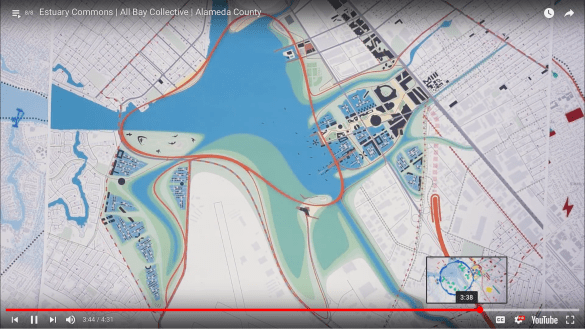
The All Bay Collective, a group of policy planners and environmentalists, started looking at areas in the Bay that could use strengthening against sea-level rise. Their plan for the Coliseum/Airport area, renamed Estuary Commons, is fascinating.

ABC’s Estuary Commons (Coliseum/Airport area)

Among the changes being considered are tidal ponds in the Coliseum parking area and a rerouting/tunneling of I-880 near Hegenberger Road and San Leandro Street. As far as I know these ideas are not being offered officially by the City of Oakland. Still, it’s interesting to consider the possibility of the Bay reclaiming part of the Eastshore as it’s doing with parts of the South Bay.

Battle of the dueling ENAs

So here we are, almost Memorial Day, and the A’s have entered separate Exclusive Negotiating Agreements with two potential ballpark sites in Oakland: the Coliseum and Howard Terminal.

That was followed by A’s president Dave Kaval’s response on Twitter to an inquiry about Howard Terminal:

First, it’s good to hear that the A’s will have (with the Port’s help) a weather station installed at Howard Terminal.

But where will it be located? And is one enough?

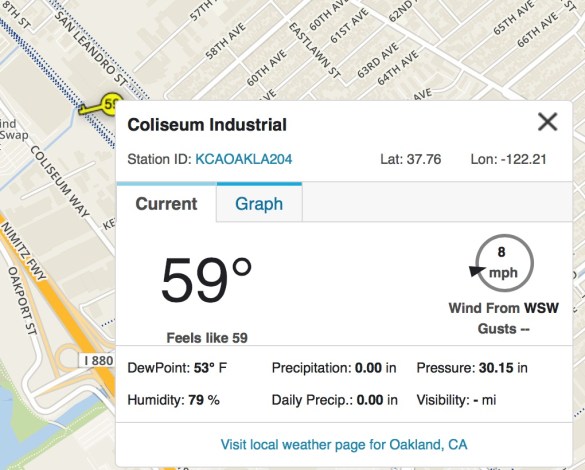
To gain some insight, let’s check with our friends at Weather Underground. Unlike last year, when it appeared that a station was installed on a buoy in the Oakland Estuary, this time it appears that it’s situated on the southwest corner of the Howard Terminal pier. That’s not the likely location of home plate or the grandstand, but it should provide a sense of the prevailing winds in the neighborhood.

Here’s what that station is registering as of 6:20 PM tonight:

Now let’s look at the Coliseum area at 6:23 PM:

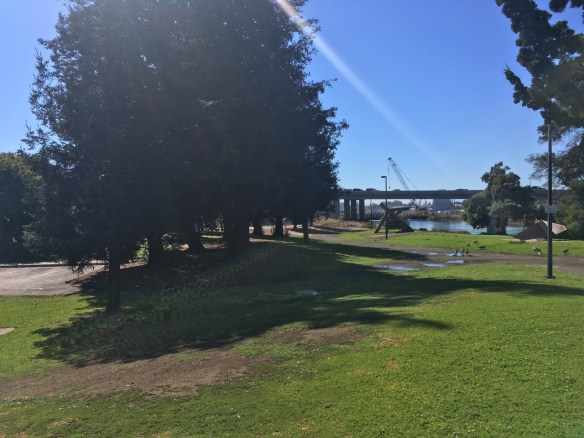
Now I’ve heard a lot about how Howard Terminal won’t be Candlestick, Part Deux. Let me point out that Howard Terminal is not Jack London Square, and while HT isn’t exactly Land’s End, it isn’t the most wind-protected area ever and it’s probably not going to be in the future. Even if a ballpark is built there, local and environmental groups will fight hard to keep the A’s from building a 100-foot-tall, 800-foot-long edifice on the waterfront. The A’s will probably unveil a design that orients the park more towards downtown and away from the water, to provide allow the ballpark grandstand to block the wind. Or, as the Giants found out:

The wind and temperature conditions aren’t necessarily going to be the gating factor that determines the viability of Howard Terminal. Economic factors and political process will.

Speaking of process, now that the ENAs for the Coliseum and Howard Terminal have been approved, the A’s now have given themselves a scant six months to figure out all of the details.

Say that Kaval makes an announcement in early December. Because of the normal City Hall schedule, a project won’t be brought up for City Council review, let alone planning commission review, until early next year. Then the CEQA process will begin. If you’re keeping track of how other recent projects have been affected, consider that the Warriors ownership group bought the site of the future Chase Center from Salesforce in April 2014. It’s scheduled to open in time for the 2019-20 NBA season, which starts in October 2019.

Then remember that the Coliseum, thanks to the aborted Coliseum City project, already is entitled for one or more stadiums and a slew of ancillary development. The Warriors ended up going with a backup plan. What will the A’s do?

Las Vegas AAA’s?

No, that’s not a typo.

BANG’s Jon Becker is reporting tonight that Las Vegas is opening up – but it’s not quite the threat you think.

Vegas, which briefly hosted the A’s at Cashman Field in the mid 90’s, will soon lose its AAA team, the 51’s, to Syracuse, where the Mets will better localize its minor league operations. The Mets purchased the Chiefs in 2017 and will officially change the affiliation starting next year.

Meanwhile, there is a new ballpark being built in the Vegas market. However, it’s not on the Strip or near downtown Vegas. It will be in suburban Summerlin, which feels much newer (and nicer) than the rest of Vegas. So nice, in fact, that the NHL’s Golden Knights built their practice facility, City National Arena, in Summerlin.

In the never-ending game of affiliate musical chairs, where does that leave a team in Vegas? Or Cashman Field, for that matter?

For starters, Cashman Field is being abandoned by baseball. A USL soccer team, Las Vegas Lights FC, started playing there earlier this year. Once a minor league team moves into the under-construction Summerlin ballpark, the soccer franchise should have Cashman all to themselves (unless they want to move to tonier Summerlin as well). There’s also talk that the XFL may choose Vegas as a city in its next iteration; chances are they’d choose the larger Sam Boyd Stadium instead.

After being ditched by Sacramento for the Giants, the A’s went to Nashville, which is far away but at least has a new ballpark. The A’s player development contract with Nashville ends this year, as do several others:

  • Fresno
  • Reno
  • Round Rock
  • Colorado Springs
  • Rochester
  • Scranton/Wilkes-Barre
  • Norfolk

Fresno may be a favorite because of its Central Valley location, but it has suffered for years for having a subpar airport, contributing to high travel costs for teams and players. Reno’s better in that regard, as is Vegas. The rest are likely to re-up with their existing MLB affiliates, with Colorado Springs always in flux because of its elevation.

Reno could happen because the MLS Earthquakes have a partnership with USL side Reno 1868 FC. It would be easier for ownership to make junkets to Reno to check out both the USL and PCL clubs.

We should find out towards the end of the season which way the AAA’s move.

P.S. – I took some pics of Cashman when I was in Vegas last year. Here’s one.

The A’s fortunes won’t turn on a dime

This sums up my thoughts on the Portland Oregonian’s John Canzano’s clarion call to recruit the A’s to Portland (or convince MLB to expand there):

The Portland Diamond Project group, which made two separate offers on land in the Portland area, is not considered a potential ownership group, according to Forbes’ Maury Brown.

Portland’s biggest problem is that it actively pushed aside AAA baseball to entertain MLS soccer years ago. No matter how much the market may have improved statistically, it’s still guilty of putting baseball on the back burner. Its only baseball team is the short season Hillsboro Hops, a team that pulls slightly more than 3,000 regularly in a stadium built to hold 4,500. PDX now has to go the Phoenix route, hoping that a spec-built stadium will be sufficient for an expansion team or a relocated team. In either case the club will have to wait at least three years for the stadium to be developed.

Brown also argues that any stadium in Portland should have a retractable roof like Seattle’s Safeco Field. After seeing from afar how inclement weather has affected early season games in the Northeast and the Eastern Seaboard, I have to agree. Teams can’t afford to lose revenue dates if they can help it.

Sure, it’s easy to crap on the A’s attendance so far in 2018. Those columnists don’t seem to understand the concept of loss leaders. That’s what last night’s 10-2 win over the ChiSox was. It attracted >20% fans who have never been to the Coliseum in its 50 years as a ballpark. Some of those fans may be the next generation of A’s fans, or those whose interest was recently piqued. The process to build a fanbase is a long, slow one, not triggered by one event or game date. The A’s have to earn the fan base’s trust, which will not happen overnight.

Mayor Schaaf to approve ENA’s for A’s on both Coliseum and Howard Terminal sites

During a joint announcement with Oakland Mayor Libby Schaaf today, Dave Kaval made this rather pointed statement about how he envisions the future home of the A’s:

Having just a destination ballpark with a sea of parking — that’s not a suitable sports complex for the 21st Century for millennials, for fans.

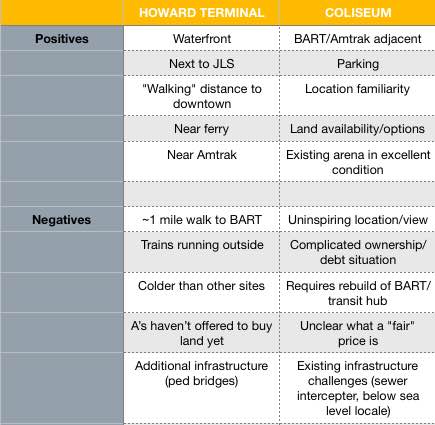
Based on ENA discussions with Schaaf, that could be at Howard Terminal or the Coliseum. Howard Terminal remains a sort of mirage: beautiful in pictures but a sort of illusion up close. The Coliseum is the practical albeit thoroughly unsexy choice. We all know that the A’s are lukewarm at best on HT. It’s Schaaf’s jewel on the waterfront. Whether the A’s will truly continue to fully evaluate or keep it on the board to placate Schaaf is unclear.

Let’s break down some of the key pros and cons of both sites:

The difference between the two sites is the HT is still essentially a series of drawings without a framework for execution, whereas the Coliseum has a framework but few cool concepts (renderings). To that effect, I expect the A’s architecture firm HOK to release something by the end of the regular season. The previous drawings envisioning a Raiders stadium as the anchor with the A’s ballpark in the periphery can be thrown in the trash. What we can expect next will be A’s-focused with no trace of football in sight. (I hope the team of HOK + Snohetta + T-Square are retained as they could create something truly eclectic and local-focused.)


If the A’s are going to use all 120-130 acres, I’d love to see the creation of an Athleticsland, a multipurpose, multi-venue complex that retains the arena for concerts, wrestling, and drone races with a street plan that ties it together with the ballpark. I’ve been to a few of these concepts that have failed in the execution (Atlanta), and the A’s can do better. As long as they focus on turning out future generations of fans and not just the currently well-heeled gentry in Rodeo or Pleasanton, they’ll be on the right track.

Official: Peralta/Laney Ballpark is Dead

Wash: “It’s incredibly hard.”
Beane: “Hey, anything worth doing is.”

About six months ago I wrote the tweet below, not knowing yet which ballpark site the A’s were choosing:

Reality is here, and it is a bitch.

Feeling pressure from faculty and students alike, the board for the Peralta Colleges abruptly ended ongoing discussions with the A’s about building a ballpark at the current district headquarters next to Laney College. There was to be a Board vote next week to decide whether or not the district would enter formal negotiations with the A’s. Not anymore. With tepid support from Oakland City Hall, the A’s were facing an uphill battle for approval even at this lowest level. They didn’t even get to the first switchback on the trail.

The decision was followed by a series of reactions from relevant parties, including the A’s using 280 characters instead of a screenshot:

This doesn’t require much analysis, and with the whole process being cut short after three months it doesn’t merit recriminations. The A’s underestimated the potential opponents, and the City was hands-off with no support. That’s often a quick recipe for failure, even as I hoped the parties to get through at least to next week. So much for that.

So what happens next?

Well, we’re in the holidays, so for now, nothing. Early in 2018 we should hear more, especially as the A’s will have to regroup leading up to FanFest, whenever that is. And unlike 2017 FanFest, when many fans interpreted the site as the A’s leaning towards Howard Terminal, maybe next year’s choice will reveal more about the A’s plans with Peralta fading away. The A’s led by Dave Kaval have shown that they’re willing to accelerate their process if they see an opportunity. Despite the missed opportunity at Peralta, I’ll be encouraged if the team shows the same urgency in 2018.

As for sites, they don’t suddenly change in value or potential now that Peralta has dropped off. Let’s look at them, December 2017 edition.

Howard Terminal

People are asking about this, naturally. I remain skeptical of the site because of the cost of infrastructure (transportation and parking), the cleanup costs that the site would incur, and the need for enhanced rail safety for cars and pedestrians. Oakland and HT proponents could salve the A’s wounds by offering a package of improvements that address the A’s concerns. Not so sure about any way to mitigate winds and temperatures at HT, which for the A’s were a few degrees cooler than at Peralta. (I informally saw this from looking at wunderground.com maps while watching late season games.)

Oakland-Alameda County Coliseum

There are several approaches that can be taken at the Coli. The most popular has the A’s playing there until a new ballpark is built nearby within the Complex. That’s clearly the least disruptive path. It doesn’t resolve who pays for the stadium’s or arena’s outstanding debt. Development of the remaining 100+ acres is already entitled thanks to the failed Coliseum City plan, but those entitlement can start to have developers attached to them with a revised plan and cleared land.

Kauffman Stadium

BANG’s Dieter Kurtenbach, who lives close to the Peralta site, suggests that the A’s renovate the Coliseum. While that could be the cheapest option, it would also appear to be the cheapest option, which MLB doesn’t want. Then again, Kauffman Stadium was brilliantly renovated, though it was originally built as a ballpark, not as a multi-purpose cookie cutter with a gazillion unfortunate compromises.

I can see the A’s reign in their approach at the Coliseum, given the comparably limited economic potential there. Instead I suspect they’ll focus on the old Malibu/HomeBase lots along Hegenberger, which are somewhat separate from the original Coliseum complex in terms of access and ownership. The A’s may proclaim that there’s no “Plan B” – a classic Lew Wolff tactic – but they’ve always had the Coliseum plans in the desk drawer ready to quickly revise and present at a moment’s notice. Why? They’ve talked with the JPA about the Malibu/HomeBase site on-and-off since 2003, before the City even bought the land.

Malibu (triangle) and HomeBase (rectangle) lots at south end of Coliseum

Lest you forget, there were other sites under consideration!

Somehow part of the Oakland Army Base near the Bay Bridge was rumored. If Howard Terminal was too windy, OAB has to be disqualified just for the wind alone. There were no other serious contenders.

And whatever happened to San Jose? In normal Silicon Valley fashion, Google is about to swallow much of Downtown SJ whole, as it is planning with San Jose a sprawling, 240-acre campus by the Shark Tank that could bring in 20,000 additional employees to Downtown everyday. Google and its real estate partner have already bought a bunch of the land previous set aside for the ballpark, including the old AT&T facility on Montgomery. Amazing what happens when you just wave a bunch of cash in an landowner’s face.

Even Scott Ostler put a new (old) site in the hat, Victory Court! He even wondered how it didn’t work, I “chronicled” it for you Scott. Or in one two words: Redevelopment Died.

It’s been a long journey, and it’s far from over.

I am a poll… And so can you!

A’s projected development timeline for the ballpark

Since the A’s announced that the Peralta site is the preferred location of the new ballpark, there has been precious little actual news about the park. Other than talks with community groups and potential stakeholders, the only release of note is the announcement of a team of architecture firms to work on the ballpark concept. As expected, the lead for the ballpark structure will be HOK, which also worked on Avaya Stadium, the Earthquakes’ stadium in San Jose. They also worked on the “twin” venues in Columbus, Huntington Park and Nationwide Arena. The principal for the A’s ballpark, Brad Schrock, who previously worked on Coors Field and Safeco Field while part of HOK’s previous sports practice. Schrock later started 360 Architecture with George Heinlein, while the HOK sports practice eventually split off to become a separate company named Populous.

The other architecture partners may be familiar as well. That includes Norwegian firm Snøhetta, which Chronicle architecture writer John King pointed out was behind the

“ill-fated arena that the Golden State Warriors proposed for the city’s Piers 30-32, where the firm emphasized the public space aspects of the private building.”

Seems as if there is a parallel in that like Piers 30-32, there are harsh critics on the other side of the bay who are against the ballpark at Peralta full stop, though for clearly different reasons. In SF’s case the Piers were considered part of the Bay, not land, so they faced an uphill battle towards approval versus a well-heeled political gentry. The Peralta land borders Lake Merritt Channel, which will require its own special approvals, though not to the extent of anything built on the shores of the Bay proper. Snøhetta is also notable for having just finished the SFMOMA expansion, which was funded and overseen by one John Fisher, a.k.a. the A’s owner.

The rest of the team will work as follows:

“The public aspect of planning efforts will kick into full gear in early 2018. Sasaki and Studio T Square will be at the front of such efforts. The ballpark design itself will be handled by HOK in partnership with Snøhetta, which also will take part in the urban design work.”

Sasaki is expected to work on how the ballpark works within the context of Lake Merritt and the Oakland Estuary. Studio T Square, an Oakland firm, is slated to handle the relationship of the ballpark with the delicate Chinatown, Eastlake, and San Antonio neighborhoods.

On the heels of this news are a pair of polls. The Oakland Chamber released a poll in which of 500 likely voter respondents, the ballpark was supported 2-1. A week later, another poll by Oakland Rising indicated that 80% respondents prefer that the new ballpark be constructed at the site of the old Coliseum instead. How do appraise these polling efforts?

We don’t.

The polls are for the news cycle and public relations, nothing else. There’s nothing to vote on, only vague promises and threats. Most of the dealmaking will be done by the A’s and Peralta CCD, and only after Peralta decides it’s worthwhile will the project be planned and debated in earnest. And even then, there’s no promise of an actual vote, referendum, or any other plebiscite. After all, Oakland voters never voted on Brooklyn Basin (Oak-to-9th), the most transformative project to hit the city in years. If anything gets voted on at all, it will be for funding some package of to-be-determined infrastructure improvements.

Let’s see the vision take form before approving or dismissing it out of hand. A project this iconic deserves a proper, full evaluation. Oakland residents deserve it. A’s fans deserve it.

(Apologies to Stephen Colbert for ripping off the title of his 2012 children’s book.)

Peralta Board Meeting and Discussion

Tonight’s Peralta Community College District Board of Trustees meeting went as I would expect for a typical Bay Area stadium forum. It was frontloaded with a dozens of pro-stadium speakers including building trades and union supporters. That was followed by residents of Chinatown and Eastlake, most of whom were opponents of the park. That was followed by faculty and students of Laney College, largely against the park as well. Most of the grievances that were aired in previous reports are repeated tonight, with no new information revealed.

View south of Peralta HQ lot

The Board made it clearer that no decisions were going to be made tonight. Sharon Cornu, who is acting as a consultant for Peralta as the district explores the project, gave a presentation on the history of the site. An overview of the unique environmental aspects and the socioeconomic status of the neighborhood wrapped up the presentation, leading into the aforementioned speakers. Those speakers, by the way, didn’t include any representatives from the A’s. That’s not unusual since there is no formal project submitted to the district to support.

A lot of FUD was spread tonight, including plenty of talk about about the unholy alliance of “labor and financial capital.” Many students and local residents fully believe that this is the first step to the A’s taking over all of Laney, shuttering it in the process. Perhaps that’s the usual slippery slope argument, but it doesn’t make a lot of sense when you think about it. Peralta is not exactly rolling in dough, and the district is looking towards the future, when it has to deal with increased upkeep and maintenance costs. Laney has trouble paying its instructors, so the district has to start looking at other ways to deal with these problems. Yet there’s still a charter at Laney where the mission remains education, so however well or poorly that is going, it’s still going to be the most important thing for the district, not cashing out for a quick payday.

The A’s have to thread the needle on this project. They are aiming at developing the Laney College parking lot across the channel from the Peralta HQ site. To what extent? Cornu’s specialty is affordable housing. The A’s want to build their own village around the ballpark, and that lot may or may not be the extent of that. The A’s may end up kicking some parking revenue to Laney. They could build something 4-6 stories tall there, or 8-12 stories including a hotel. They have to build as much as they can to pay for the ballpark and satisfy whatever is called for in a future community benefits agreement. Yet the growing wish list of items needed to complete the agreement may well render the whole project unprofitable. The A’s are making a lot of claims about what they can do for Oakland. Those claims may end up forcing the A’s bite off more they can chew. I like how the sister-team Earthquakes started which a much less ambitious project and added features as they went.

View west across Lake Merritt Channel

Chinatown developer Carl Chan also spoke. I’m curious about his delineation of “good” traffic from “bad” traffic. “Good” traffic brings visitors to restaurants and shops housed in his properties. “Bad” traffic doesn’t do that. I have to think there will be a good amount of both if a ballpark opens nearby.

Many of the residents of Chinatown and Eastlake have been there for multiple generations. The two neighborhoods have been hit less by Oakland’s encroaching gentrification than others, and the g-word is their chief concern, making up a large part of their opposition. I tend to think, though, that gentrification can only be somewhat mitigated, not avoided completely. A 2017 report on the state of housing stock showed that only 6% of housing under construction is considered affordable. That’s despite goals of 20-28% in past years. Affordable housing has taken a hit since redevelopment ended and local pools of property taxes for such housing dried up. That affordable housing is going to be built in these places, and then all the way east down International Boulevard and San Leandro Street (some is already near the Coliseum and Fruitvale stations). What creativity could be worked into the deal to pay for the affordable housing “subsidy?”

The recent news that a plume of pollution has been sitting and spreading underneath the Peralta land could provide an impetus to act. The cost to cleanup the land is unknown and requires study. If the cost runs into the millions Peralta won’t be able to do nothing, including turning off monitoring of groundwater underneath. If high cleanup costs forces the district into a deal, the A’s as developer indicated that they’d cover it. If this scenario sounds familiar, it was one of the main worries about the Howard Terminal site. The pollution is bad enough that, according to BANG’s David DeBolt, there are actually two plumes. The second is coincidentally enough underneath Laney College’s baseball field. Would the A’s be willing to pay for that as well?

It can be scary to listen to the comments, go through the laundry list, and figure out the project costs. I’ll try to get into that more next year as the project solidifies. Until then, understand that mitigation means compromise. It’s gonna take some work, and some negotiation.

MLB 2018 Travel Grid

For those who were waiting for next year’s travel grid, it’s ready. Thanks for your patience. I’m not planning any trips next year, so I don’t have many comments on the schedule itself. If you have questions or would like some guidance, comment below or ask me on Twitter.

Formats:

As usual, tips (advice and $) are always welcome. The PDFs contain both alphabetical and regional layouts. Use the first sheet in each file for the appropriate layout.