They’ll get around to it

Remember that press release from the beginning of the season that trumpeted all of the fan-friendly improvements that were done at the Coliseum? There’s another set of improvements coming that are also pretty important. Check out the bottom of this list:

aeg-gm_coliseum

AEG Management report detailing improvements and repairs for the Coliseum complex

Glad to see that the JPA is getting around to dealing with that clubhouse sewage problem.

The $978 million, 50,000-seat NFL stadium

Yesterday the second of two public outreach meetings for Coliseum City was held at Oakland City Hall. I was flying in during the afternoon, so I wasn’t able to make it. Thankfully, @greenkozi (the macinator) put together a Storify compilation of tweets related to the meeting. It should give you a good sense of what was being discussed during the meeting.

Unable to attend, I’ve focused over the last few days on the just-released Coliseum City Football Stadium Revenue Study. The 177-page document covers a variety of funding scenarios for the Raiders stadium, including public and private options. Some of the key takeaways:

  • The full development could generate $22-26 million of annual tax revenue for the project, including ticket, sales, property, and hotel taxes.
  • That tax revenue would support $120-140 million of public debt for the project.
  • Ancillary development, even with three teams remaining at the Coliseum, looks rather modest.
ancillary

Ancillary buildout potential at Coliseum City

  • Economic impact for the both the stadium and ancillary development is estimated at $2.8 billion.
  • Operating income (private) for the development is estimated at $49 million per year, which would support $300 million in debt. Combined with the public portion, a total of $420 million of debt could be supported. That would leave a nearly $700 million funding gap.
  • The stadium would have a capacity of 50,000, including 75 suites, 4,700 club seats, 200 loge seats, and would cost $978 million to construct.

AECOM’s previous study from last summer had the stadium also at 50,000 including premium seats, a number that was debated. This confirms the number, though the stadium cost has jumped from $700 million to $978 million (and rising) in a matter of months.

A 50,000-seat stadium is a rather alarming figure. People should be asking why the team and market can’t support a larger stadium. 50,000 seats won’t bring in a Super Bowl, and any new stadium has already lost the prestige battle with Levi’s Stadium, which will have a Super Bowl, bowl game, Wrestlemania, and a number of other events. While this study has looked into a number of new development scenarios involving 1-3 new venues, there is no discussion of incorporating any part of the existing Coliseum, nor is there any mention of the existing Coliseum debt. The most cost-efficient route for the Raiders for a “new” venue would be to rebuild the old bowl of the Coliseum and refurbish Mt. Davis, while lopping off the upper deck. That could be done for less than half the cost being considered, while providing an opportunity for ancillary development with an A’s stadium or something else.

A renovated Coliseum could be done in phases in a much more economical manner than a $1 billion new stadium

Maybe the NFL and the Raiders have considered this idea a nonstarter, so the JPA and BayIG aren’t going there. The aesthetics of the Coliseum aren’t great for transit-oriented development. But considering the growing funding gaps and the enormous obstacles to getting just the stadium built, it’s crazy that a renovated Coliseum isn’t under consideration. All they’d have to do is build roughly half a new stadium. There’s no situation where that’s more expensive than, oh, a whole new stadium. Seriously, am I missing something here?

Warriors, Coliseum JPA dispute arena debt

It just keeps happening this week. Shortly after the flareup regarding the A’s and JPA’s dueling 10-year lease offers, the Warriors get into their own little fracas with the JPA. After the team announced their Mission Bay arena plans, they were also asked what would happen to the current Oracle Arena, which will have its debt retired in 2027, nine years after the W’s plan to leave. Through team spokesperson Raymond Ritter, the team denies it has any additional obligation to pay off the arena after the team leaves. The JPA countered that the team is fully obligated to pay off the full remaining debt, even if they leave after the 2017 season.

Just as with the “A’s owe back rent” allegation, I figured it was best to look through some documents to figure out the truth. It’s pretty simple:

From the arena bond filing

From the arena bond filing

In case you don’t want to read all of that, the language from the MoU is:

“After June 30, 2007, the Warriors may terminate the license by paying the Authority a termination payment in an amount sufficient to retire all of the then outstanding Bonds, as well as other debts associated with the Arena Project.”

It’s highly unlikely that concert revenue or other non-game receipts will make up the difference in the meantime, so chances are that the W’s will be liable for $61 million. Here’s the payment schedule for the remaining arena and stadium debt:

schedule

Arena and Stadium bond payment schedules

And that’s that.

Press Release War: The Aftermath

Well, nobody in a position of power took my advice. Oh well. In fact, just as I was heading out to lunch and my left front tire blew out, I received an email announcement that Coliseum JPA board President Nate Miley and Vice President Larry Reid would have a media availability session at 12:25, right before the start of the final game of the homestand. The session was accompanied by another press release, claiming among other things that the A’s want a large annual subsidy and still owe five years of back rent at the Coliseum:

Oakland-Alameda County Coliseum Authority Issues Statement Regarding Oakland Athletics 10 Year Lease Proposal Negotiations

Authority committed to keeping baseball at O.co Coliseum but concerned about serious issues that could harm taxpayers

OAKLAND, CA – Today, the Oakland-Alameda County Coliseum Authority issued a statement regarding negotiations with Oakland Athletics on a ten year lease to remain at O.co Coliseum. The Authority remains committed to working with the Athletics; however, they believe there are pressing issues that must be addressed as negotiations continue.

“Yesterday, the Authority made an offer to keep the Athletics at O.co Coliseum that safeguarded city and county taxpayers while addressing the team’s concerns. Unfortunately, it took less than a few hours for them to reject that offer. Despite this, we are still committed to negotiating a fair deal,” said Coliseum Authority Chairman Nate Miley, who serves as an Alameda County Supervisor.

Among the issues cited by the Authority are that the Oakland Athletics owe the City and County more than $5 million because they have not been paying their rent for over five years. While the team is asking that this debt be written off, the Authority insists that this money could be used for public purposes such has hiring more police officers or funding public health services.

Additionally, the Athletics are demanding that the Authority give the team rent subsidies of $3.5 million per year. This is despite the team being an MLB franchise with a market value of nearly $1 billion.

“We look forward to addressing these issues and are committed to negotiations,” stated Oakland Councilmember and Coliseum Authority Vice-chair Larry Reid. “We agree with the A’s that they should stay for at least ten years, and we are staying at the bargaining table. We look forward to continued discussions and to coming to an agreement on a mutually beneficial lease.”

The Authority added that it wants to keep baseball in Oakland, and a ten year extension, lasting through the 2024 season, gives the Athletics a place to a call home and fans an opportunity to cheer a great team.

That was followed up during the game by A’s President Michael Crowley, who refuted the back rent allegation:

Statement by A’s President Michael Crowley Regarding Today’s Announcement by the Oakland-Alameda County Coliseum Authority

“First, we owe no back rent or any other amounts. We did deduct rent payments in the past for items that we are allowed under our lease, but that was our negotiated right.

Second, there is absolutely nothing in either our lease offer to them or their counter proposal to us that mentions any kind of subsidy. In fact, under our final offer we would immediately invest no less than $10 million in the facility and our rent would rise from the amounts that we have paid over the last decade.

We have nothing additional to offer and as a result there will be no further negotiations.”

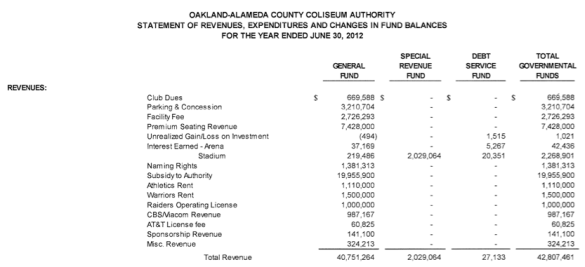
Of course, all of this happened as I was changing a tire and switching out a rental car at Hertz, so I wasn’t able to factcheck right away. Eventually I got back to my laptop and took a look at the JPA’s annual financial statements, which are a matter of public record. The 2013 report isn’t available, but the previous years’ versions are, and it took a quick look to figure out who was right. See for yourself, from the 2012 report:
jpa-revenue_2012

Accounting of revenues and expenses for the JPA’s 2012 fiscal year

See that line item named Athletics Rent? Sure looks like a payment of $1.1 million to me. Same goes for 2011. And Crowley’s right that the A’s have the right to deduct maintenance items – such as patching up concrete leaks or fixing plumbing issues – but it appears they haven’t done that for a while. The 2011 report even acknowledges the A’s rent payment. From page 6:

  • Lease revenue increased $225 (thousand) or 10 percent primarily due to rent revenue from the Oakland Athletics because of an increase in the rent for the last fiscal year.

What I think happened is that the JPA is conflating the parking fee matter with rent. In 2009, the City of Oakland enacted an 18.5% parking tax at the Coliseum, which the A’s withheld but chose not to pay while it was determined if such a tax was enforceable (it was). As part of the most recent lease extension through 2015, the A’s and the JPA chose to use arbitration to determine the final payout by the A’s. Again, that tax started collection in 2009, which might explain why the JPA thinks the issue goes back five years. (Update: An ABC 7 report indicates that the JPA sees the “rent” matter going to arbitration in June. That’s when the parking revenue matter is expected to go to arbitration.)

Assuming that others factcheck this properly, the JPA will be forced to walk back this goof the same way the City of Oakland has several other allegations. Now do you see why it’s a bad idea to negotiate in the press?

The worst part is that Miley revealed that the JPA has been in talks with Lew Wolff about a Coliseum land deal, one that presumably would supersede the Coliseum City project once that plan hits its probable demise.

I wouldn’t hold my breath waiting for that land proposal, Supervisor Miley. From the sound of Crowley’s comment, sure seems like the JPA is getting the silent treatment for the immediate future.

All farce, no agreement

You may be familiar with a term called “business hours.” It usually runs during the daytime, 9-5 or thereabouts, the proper time for normal business to be conducted. The A’s have business offices that operate during normal business hours. The Coliseum Authority does as well, scheduling regular board meetings during the day. Despite all of the rancor and discord involving the A’s and Oakland, most of the stadium talk (with the exception of Lew Wolff appearing on a game broadcast or pro-Oakland groups doing night pep rallies) has happened during business hours. It’s a way to compartmentalize everything, just keep the business side separate from the baseball side.

Last night that line separating the two was crossed in a most disgusting manner. It started when, after weeks of Wolff saying that he made a lease extension offer to the Coliseum Authority (JPA), the JPA responded with its own offer to Wolff. It took mere minutes for Wolff to reject the JPA’s offer by having A’s PR man Bob Rose write up a terse press release to that effect. All of this, and the subsequent teeth-gnashing of fans, happened DURING THE GAME. Why? Because both sides knew that the assembled media in the press box and watching the game elsewhere would report on this. Wolff then asked for further negotiations not to be done through the media, even though he has talked several times in the past about this very problem. Neither side produced their lease offers, so we can’t evaluate them, but MLB has copies of everything. MLB is the true audience here, not us.

It’s not hard to see the motivations at work. Wolff wants to show MLB that the JPA prefers the Raiders over the A’s by a large margin, and their inaction on the lease extension offer along with previous stalling on previous offers is proof of that. The JPA is also trying to score points with MLB, providing baseball with a copy of their own agreement as a sort of make good. The JPA is already dealing with bad news related to Coliseum City, so there’s a chance for deflection. Meanwhile, MLB’s own track record has been to avoid these two parties like they were lepers, only coming in when talks completely broke down after the 2013 season. You have to wonder what kind of effort is being wasted by both sides, and what effect if any this is all having on MLB’s thoroughly inscrutable decision-making process. Adding to the confusion was the A’s citing an Athletics Nation article about Oakland Mayor Jean Quan, going so far as to saw that A’s ownership was in full agreement with it. Then earlier today, Wolff walked that back the same way Quan had to walk back her Crown Prince of Dubai claim.

All I can ask to both sides is: Was it worth it? I can’t imagine that this constant back-and-forth is creating any traction for your respective causes within The Lodge. MLB isn’t going to suddenly give San Jose to Wolff, and MLB has little power to force Wolff to sell as the pro-Oakland crowd desires. Since nothing actually came out of last night’s revelations other than the two sides pointing fingers yet again, how about a moratorium on interviews, press releases, and any other kinds of dispatches to the public until you actually get a lease extension done? I don’t think that’s too much to ask. I personally don’t mind if I have slightly less to write about, because at least I won’t be writing about nothing. Which is exactly what this 600-word post is about. Nothing. Thanks.

P.S. – If you do a Google News search on this subject today, there are a whopping two national articles providing no real information. Nobody cares outside of the Bay Area.

Coliseum Authority makes 10-year lease offer to A’s (updated with A’s response)

Update 9:11 PM – And… rejected by the A’s. From the Chronicle’s John Shea:

“The A’s received the Oakland-Alameda County Authority’s proposal earlier this afternoon. While the proposal was for 10 years, it did not address all of our issues. Consequently, we cannot accept the terms of the offer. We have tried to negotiate in good faith for the past several months. As the Authority knows, it is still our preference not to negotiate this agreement through the media.”

Okay, now set up your talking points. I guess that all that texting by Lew Wolff during the game was about the lease. As you were, everyone.

Following talk from the last few weeks about Lew Wolff offering to a 10-year lease extension to the Coliseum Authority, the JPA replied with its own offer to the A’s. Here’s the press release:

Oakland-Alameda County

Coliseum Authority

For Immediate Release Contact:

April 22, 2014

Oakland-Alameda County Coliseum Authority Provides Oakland A’s and Major League Baseball with 10 Year Lease Proposal

Authority responds to private and public requests to create a decade-long agreement at the O.co Coliseum site

OAKLAND, CA – Today, the Oakland-Alameda County Coliseum Authority announced that it has offered the Oakland Athletics a ten year lease to remain at the O.co Coliseum site. The terms, though not released publicly, were also shared with Major League Baseball.

“We wanted to send a clear statement to the A’s, the fans, Lew Wolff, and Major League Baseball that we want the A’s at the O.co Coliseum and want to keep baseball in Oakland,” said Coliseum Authority Chairman Nate Miley, who serves as an Alameda County Supervisor.

“A ten year extension, lasting through the 2024 season, gives the team a place to a call home and our fans and sponsors a window to continue investing their time and passion in this team. We are also working to ensure this deal safeguards county and city taxpayers. We are meeting the A’s management where they say they want to be and hope to conclude these negotiations quickly,” he added.

The Oakland Athletics were recently welcomed back on Opening Day with a series of upgrades including:

New look: The Oakland Coliseum has been fully re-painted and new Kentucky blue grass sod has been laid on the field as it is each year before the season. New investments in groundskeeping machinery, including industrial lawnmowers and a “laser-leveling system,” will allow the Authority to maintain the field more easily and effectively.

New concessionaire & food items: The Oakland A’s, which are in charge of the concessionaire contract, have brought in an exciting array of new items and are upgrading the concession experience/facilities. Fans will now have access to even more premium beers and new food items like wood-fired pizzas, and more!

Improved “Ring” Road: The Coliseum Authority will repave the road that circumnavigates the stadium after the initial homestand.

Improved security: The Authority will provide state-of-the-art magnetic screening equipment that fans can quickly pass through as they enter. The Oakland’s A’s will provide personnel to manage the screening.

For the players, umpires and media, improvements include:

Remodeled dugouts: Both the home team and visitor dugouts have been upgraded with new padded benches, upgraded flooring, new dugout phones, water fountains, and new bathroom fixtures and paint.

Upgraded lockers: The home team, visitor, and umpire locker rooms all have new rubberized floors and showers.

Updated press box: Members of the press will now have access to flat screen televisions, and new tables, carpets, restrooms and ceilings.

These improvements demonstrate the Authority’s continued efforts to address the needs of players and fans, and more improvements are planned.

“O.co Coliseum is the place for fans to watch great baseball, and we believe that we can reach an agreement so that local fans can continue to be part of the next decade of Oakland Athletics baseball,” added Miley.

###

About the Oakland-Alameda Coliseum Authority:

The Authority is a public partnership between the City of Oakland and the County of Alameda (owners of the Coliseum Complex) that manages the Complex on behalf of City and County. The Authority subcontracts the day-to-day operations of the Complex to AEG. An eight-member Board of Commissioners governs the Authority. Alameda County Supervisor Nate Miley currently serves as the Chair of the Board, and Oakland City Councilmember Larry Reid serves as the Vice-Chair.

With both sides making offers, the negotiation has begun in earnest. Obviously the fact that the JPA made their own offer means that the terms are different from what the A’s offered. Whether those differences are related to Wolff’s desired escape clause, planned improvements to the Coliseum, or other details, is not known. We’ll find out in due course.

One thing to remember about this is that there is no real deadline other than the end of the 2015 season. This may or may not lead to further negotiations. I hope it does. The real question is how much flexibility the JPA is willing to allow in the lease. Mayor Quan has talked tough. The JPA has not always been unified in its approach, with some members preferring to tie the lease to Coliseum City while others are less inclined to do go that route.

Key Coliseum City deadline passes with no Raiders letter of interest

Added 2:43 PM: Now dead Piers 30/32 development schedule.

About two-thirds of the bubbles in this chart are no longer needed

About two-thirds of the bubbles in this chart are no longer needed

Important documents for the Coliseum City project were due Monday. While some needed reports were apparently submitted just before the deadline, a signed letter of intent interest from Raiders ownership did not, according to CSN’s Scott Bair. The letter of interest was a requirement for development group BayIG, though it’s not known what will happen now that the deadline has passed. Important informational documents from BayIG were received, which could include the long-awaited funding and revenue sources analyses. Those will be important for determining the feasibility of the project.

Given the paucity of information available at the moment, it would behoove Raiders owner Mark Davis to proceed cautiously. But the bar for commitment was set extremely low, as BayIG was not required to get a Letter of Intent from the Raiders. Instead, BayIG only needed to get a Letter of Interest. While a Letter of Intent is generally non-binding in matters such as these, at least it lays out basic terms for a deal. A Letter of Interest is an entirely speculative document, only promising future discussions (sort of like an ENA without the “E”). If Davis hasn’t even provided a response for a much lesser requirement, you have to wonder what he really thinks about the project. 

Then again, the Letter of Interest is so weak that it can’t really make or break Coliseum City anyway. If there are consequences for BayIG not delivering, we certainly have no idea what they are. And it seems highly unlikely that BayIG and the JPA won’t move forward because of this. They’ve already engaged the Raiders in preliminary discussions and submitted several reports, so halting the project now would be tantamount to throwing in the towel. That wouldn’t go over well considering some $3 million was previously approved for studies.

For now, we’ll await any documents that are made available. Raiders fans can hope that Davis was simply too preoccupied the Terrelle Pryor trade or with the Warriors-Clippers series to respond. If the week ends without the LoI from the Raiders, there will be a lot of questions about that subject at Thursday’s and Saturday’s community meetings. People will be wondering how committed to Oakland Davis really is. Meanwhile, Lew Wolff will be sitting back, watching everyone involved with Coliseum City twist in the wind.

“Flood game” rescheduled as part of May 7 doubleheader

The infamous game from two weeks ago which is postponed on account of a flooded field will be rescheduled for Wednesday, May 7. The date, which has a 12:35 PM “businessperson’s special” already scheduled, will now be a regular doubleheader with a single admission for both games. The second game will start 30 minutes after the first. And there’s more. Read this Season Ticket holder release for the details:

April 4 Make-Up game now part of May 7 Doubleheader, apply ticket value to any future 2014 Regular Season Game

Complimentary Tickets Below For Seattle Series

The postponed Oakland A’s game originally scheduled for Friday, April 4 will be made-up on Wednesday, May 7 as part of a Doubleheader vs. the Seattle Mariners starting at 12:35 p.m. One ticket will be valid for admission to both A’s games on May 7. Tickets which have April 4 printed as the game date will not be valid for the Doubleheader.

The first game on the May 7 Doubleheader is scheduled for 12:35 p.m. (gates open at 11:05 a.m.). The second game is scheduled to be played approximately 30 minutes after the conclusion of the first game. Valid tickets to enter O.co Coliseum to either or both games on May 7 are tickets that are printed for May 7 at 12:35 p.m.

Fans attending the 12:35 p.m. game on May 7 will be able to attend the second game of the Doubleheader with the same ticket in the same seat. Tickets printed for May 7 will be the only tickets accepted for admission that day.

The paid value of your Season Tickets for the April 4 game will be automatically credited to your account in the coming days. To redeem your paid ticket credit from April 4 for a future 2014 regular season game, visit the A’s Ticket Services Office, or call Ticket Services at (510) 568-5600.

As a thank you to A’s Season Ticket Holders that were inconvenienced by the cancelled April 4 game the A’s are offering complimentary tickets to a game day during the May 5-7 series vs. the Seattle Mariners. The complimentary tickets can be used for May 5 at 7:05 p.m., May 6 at 7:05 p.m., or the doubleheader on May 7 starting at 12:35 p.m. Season Ticket Holders will receive four (4) complimentary tickets per account to one of the above mentioned games.

To access your My A’s Tickets account and redeem your complimentary tickets, please follow these steps:

  1. Visit My A’s Tickets online »
  2. Click on “My A’s Tickets” to get to the login screen.
  3. Login using your Season Ticket account number and password. If you do not know your password, please contact Ticket Services at (510) 568-5600. If you have used My Tickets in the past but have forgotten your password, please contact Ticket Services to have your password reset.
  4. Once you have logged in to My A’s Tickets, please click on the “Special Offers” tab in the upper middle of the page to access your May 5-7 complimentary ticket offer.

The deadline to redeem your Season Ticket Holder May 5-7 complimentary tickets is Wednesday, April 30 at 11:59 p.m. PT.

The important thing to remember is that the old tickets will need to be redeemed at the box office for new tickets for the doubleheader, even if you’re only going to only one game. I had April 4 on my schedule and put it on Stubhub, so whoever got my tickets now have an even better deal at their disposal. I’m in the process of switch this Sunday’s game for May 7, assuming that tickets are available.

A’s lease extension comes up again

Update: Oakland Mayor Jean Quan has a response.

Stop me if you’ve heard this one before.

Matier and Ross are reporting that Lew Wolff has requested a lease extension at the Coliseum of up to 10 years.

That would be news, except that we heard it last week. And last month. And back in December.

There is literally nothing new to report here. More importantly, what’s not being reported is that this follows a pattern. The previous lease ended after the 2013 season, but Wolff asked for an extension as early as 2011, knowing that a new ballpark was not forthcoming. The JPA was in the tough spot of negotiating new leases for both the Raiders and A’s because both leases ended in 2013. The stalemate between the A’s and the JPA forced MLB to broker a new, two year deal that solved little. It merely kicked the can down the road. Meanwhile, the Raiders secured an even shorter one-year lease, with the idea that the Coliseum City project would at least be accelerated. While that process moves on its own, Wolff continues to call for the lease.

The difference between Wolff’s requests now and from 2011-12 are that they are being reported. Headlines show as A’s willing to stay in Oakland for 10 years look good at a glance, but as long as the JPA is reluctant to work out any deal that would jeopardize its future with the Raiders, that lease will go nowhere. Yet you should expect reports like this to surface on occasion throughout this year and next, since it looks good for the A’s from a PR standpoint.

Another thing that’s being ignored is the fact that Wolff has included an escape clause if the Raiders build a stadium at the Coliseum. I haven’t seen the language, so I can’t say if the clause would be triggered by the Raiders coming to a deal with the JPA or if groundbreaking would trigger it. Either way, Wolff has been consistent in that he’s only looking out for the franchise – he wants a place for the A’s to play locally, even if that means a temporary facility. While updated plans for Coliseum City show separate stadia for the A’s and Raiders being ready by 2018, we’re not nearly at the point of determining how that would happen. Numerous questions would have to be answered, such as:

  • As the two new stadium sites are prepped and stadia constructed, how does the JPA replace all of the lost parking?
  • Will the Warriors object to the lost parking?
  • What if the numbers pencil out only for the Raiders? Or only for the A’s? Or not at all?
  • What if neither team is interested in Coliseum City as it’s being presented?

Wolff and Mark Davis are going at this stadium business in different ways. Wolff wants a lease extension, while taking that time to figure out the future either in San Jose or in Oakland. Davis is taking an opposite tack, declaring last year that it was time to stop delaying and get the stadium deal in place before any new lease. That puts the JPA in a very delicate spot. They’re already working with the Davis, though he hasn’t been satisfied with the pace or the information he’s getting. Both owners, whether in league or not, are forcing Oakland to make a difficult decision between the two franchises. Both know that it’s incredibly hard to build one stadium, let alone two right next to each other. Public resources are increasingly scarce. Fred Blackwell’s leaving before he can get any blame for this. Smart move on his part.

On a related note, two public workshops will be held next week for Oakland citizens to discuss Coliseum City. Here’s part of the flyer:

Schedule for upcoming Coliseum City workshops

Schedule for upcoming Coliseum City workshops

At some point in the next 2-3 months, the Coliseum City Specific Plan (which will cover the Coliseum complex area or Area 1) and the draft environmental impact report will be released. Review and comments for both will dovetail nicely with the ongoing lease discussions and could shape the future of the Coliseum, and pro sports in Oakland.

Coliseum City infrastructure cost estimated at $344-425 million

One of the Coliseum City deliverables due in February was a public infrastructure costs report. That report is now available (report/cost tables) thanks to BANG’s Matthew Artz. Sometime ago I half-joked that the amount of infrastructure needed to build out Coliseum City is so much that it would be like adding a fourth venue in terms of cost. It’s no joke anymore, as the numbers are in. Infrastructure cost, which for some reason doesn’t even include the cost to demolish the old Coliseum, ranges from $344 million to $425 million.

Unlike the previous phasing report, which had the Raiders stadium being built for 2018 and the Athletics by 2022 or later, this report has both venues being constructed and opening in time for their 2018 seasons. Much of that total includes relocation of utilities that run through the complex, including nearly $16 million to move overhead power lines and $1.4 million to move the sewer interceptor.

Surprisingly there is no estimate for the cost of demolishing the old Coliseum. The report states that demolition of the Coliseum “will only marginally affect the costs of the new facility.” For large concrete structures like the stadium, that could easily run into the low eight figures, especially because of how massive Mount Davis is. If that’s considered marginal, it’s only because it’s about 3-5% of the total project cost.

CC-easements

Utilities running through the Coliseum City project area

The price escalates quickly when accounting for all the stuff that would make the City part of Coliseum City work. About $24 million would go into BART station improvements. The big addition is a side platform that would allow fans to more directly access the BART bridge without having to go down into the station, only to go up again. That would be a welcome improvement regardless of how much of Coliseum City gets built, since the station can be a huge bottleneck during high-attendance games. There are also initial plans for a streetcar, which at $25 million seems awfully low considering that it would eventually go across the Nimitz and out to Edgewater. $175 million covers all transit, traffic, and infrastructure changes, with another $45 million going towards optional enhancements. $21 million of that total would go towards a new loop road (boulevard) that would serve Coliseum City.

New side platform and access to BART pedestrian bridge

New side platform and access to BART pedestrian bridge

Another $20 million is estimated for a parking garage for the NFL stadium. Such a garage seems antithetical to Mark Davis’s fan experience with tailgating as a major feature, so I’m curious to see if he would balk at that piece. At the very end of the reports table is an estimate for NFL stadium only infrastructure, nearly $55 million. Naturally, Davis and the NFL might look at that figure with more interest than the total for the whole development. It’s also worth pointing out that a stadium built on top of the current Coliseum footprint would be even cheaper from an infrastructure standpoint, since it would probably require no utility relocation.

This slideshow requires JavaScript.

The estimates provided aren’t indicators that the project will proceed. The project could be transformed again or scaled down depending on team or developer interest. The City and Alameda County will seek out TOD grants for much of the transit hub improvements package. It’s also likely that the JPA will look to create an infrastructure financing district (IFD) to fund the rest of infrastructure. If they can pool together enough funding through grants and future assessments to make it all pencil out, Coliseum City has a chance. Nevertheless, these costs have added some $400 million to the various venue construction costs. All told we’re talking about $2.5 billion and counting.

Towards the end of the report was Phase I of the Market Data Analysis, which was also expected in February. The findings go against previous studies that showed weak demand for premium seating. There seems to be an effort to show that a larger stadium with the capacity of the 49ers’ Levi’s Stadium or the Vikings’ new dome in Minneapolis will be worth the escalated cost. The study also indicates that the ticket-buying fan base is far more geographically widespread than merely the East Bay, with many coming from the Central Valley, Reno, Las Vegas, and even Phoenix.

It’ll be interesting to see if the Raiders and Davis concur with these survey findings. Davis has been leading the charge for a smaller stadium with 56,000 seats instead of 68,000 that BayIG is pursuing. Obviously, BayIG wants the bigger stadium for a future Super Bowl, an event that wouldn’t be possible in a smaller stadium. BayIG is emboldened enough to want to pursue the development further. Does Davis like what he sees? Only three weeks ago Davis expressed frustration about not getting information from BayIG or the JPA. Did he receive this report after the comments he made during the NFL owners meetings, or before? If BayIG and Davis can’t get on the same page, there is no Coliseum City.