I want to go to there

I could stay here forever. Or at least until the sprinklers come on.

So there I was lying on the Coliseum grass, just beyond the infield rim where Jemile Weeks normally mans 2B. The fog had invaded, covering up any stars. I saw closeup how well Clay Wood and his staff covered up all of the evidence of a football game just five days prior. Temperatures had dipped below 60 and the breezes were starting to kick up. At least a thousand fellow A’s fans were assembled on the field, most with blankets, some clutching cups of coffee. It was 10 o’clock, and we were waiting for Moneyball.

The movie itself was introduced by Scott Hatteberg, and just as we did in the pregame ceremony several hours earlier, we cheered players as they were announced or as they appeared on the smallish portable screen. Sound bounced off the still concrete bowl, creating an eerie, unintended echo effect. The stadium lights darkened, and for a moment everything was still, everything was perfect.

I’ve probably seen Moneyball seven or eight times now (three in theaters plus I own a Blu-ray combo pack), so the movie itself wasn’t the attraction. I didn’t go to the red carpet premiere at the Paramount, so this was as much about community as anything else. Yet I distanced myself from people and stayed way back, in an open spot as close to the cordoned off infield as possible. Every so often I would stand up and look back at the old seating bowl, where the safety lights were on and the media had cleared out of the press boxes. For better or worse, this is my second home, I said to myself.

The infield and warning track were off limits to the faithful. From what I could see in fans’ faces, no one cared.

As the movie ended, I gathered all of my things and, mindful of how long I had been there and how emotional the day was, felt absolutely exhausted. Many friends who I had seen in the Coliseum had left long ago. In light and in darkness Mount Davis stood, impressive in scale and magnitude. For once I didn’t hate the edifice. It was just sitting there, alone and somewhat forlorn, no lights on. As I started to walk toward the stairs I thought to myself, I wish one of those suites was my apartment so that I could head up there and go to sleep instead of driving home.

If I had the money and someone built it, I’d live in an apartment or condo overlooking an A’s ballpark. Not one with a postage stamp sized view like in San Diego, detached from the action. A place that was as far as the upper Mt. Davis suites are now, with a balcony. I could wake up, observe the grass get cut and the mound manicured over a cup of Aeropressed coffee. Watch as tour groups came through and wave to them in my robe smoking jacket. Head downstairs, where there would probably be some retail component, for a sandwich or pastry. And watch the game from the balcony, or head down to one of the field box seats that were mandatory to buy with the apartment lease or condo purchase.

None of this is possible at the Coliseum, of course, for myriad reasons. The Raiders need those suites to be used as suites. Mt. Davis was never built with this kind of mixed use in mind. It’s something I can still dream about at a new ballpark. Given the cost of developing a park these days, it’s not a bad way to help with the financing. Follow me on this.

When NASCAR was at its peak before the crash, several tracks built condo complexes that overlooked the action. Most often, it was rich racing aficionados who bought up the units, forgoing an RV weekend in the paddock for an pied-à-terre above the track. To me that sounds crazy, considering that most tracks will get one or two races a year plus various minor events. It doesn’t compare with 81-82 games plus concerts and whatever else the team can attract to a stadium. Yet the closest thing to a residential component we’ve ever seen is the hotel at Rogers Centre (formerly SkyDome), now a Marriott Renaissance property. Lew Wolff once had an interest in it, so he should know quite well how it’s run.

20120820-200104.jpg

Bay Street in Emeryville, a mixed residential/commercial development

If someone were to experiment with this kind of feature, one can’t expect a big, 400-foot long apartment building with 200 units facing the ballpark. There’d probably be a “boutique” style building with no more than 40 units, 20 facing the ballpark, 6 stories tall, roof deck with a pool on top. How would they be sold? Upfront as condos with high HOA dues, or extremely expensive apartments? Maybe fans who aren’t one-percenters could enter a lottery for one or two units, or perhaps for a year-long lease. 25 years ago the apartments on Waveland and Sheffield outside Wrigley Field could be rented by an average family. Now they’re all corporate suites, better than the ones inside the park. In either condo or apartment form the units could provide a not-small financing piece, up to $30 million towards the ballpark’s total construction cost after factoring in overhead. That’s about as much as anyone could expect from a seat license sale, and it wouldn’t come with the uncertainty or negative vibe associated with PSLs.

Taken as part of the growing number of luxury options, these could be considered as either complementary or competitive with regular suites. The biggest difference would be the view and the access, since suites are not normally available 24/7 the way a housing unit has to be. One could even see a player or two take advantage of the convenience, though he’d have to make sure his curtains are drawn at the proper moments. That is, unless he likes the attention.

Regrouping for a new Bay Area Olympics bid

Now that the London 2012 Games has ended, it’s time to reflect on how the Olympics were held there. We can also start to consider how the Games would be hosted in the Bay Area, should that come to pass.

The 80,000-seat Olympic Stadium was never going to match Beijing’s Bird’s Nest as a great architectural work, and it wasn’t designed to. The stadium was meant to be scaled back to 25,000 seats after its Olympic/Paralympic tenure. There were plans to use it as a soccer stadium for either Tottenham Hotspur or West Ham, but neither deal could be worked out.

According to GamesBids, the London buildout for the 2012 Games was $4 billion. You may remember that the Bay Area made its own bid for these very games a decade ago. The bid then was a mere $211 million, with few new competition venues as part of the plan. Instead, nearly $1 billion would’ve been budgeted for the Olympic Village, which would’ve been located at Moffett Field. Like many other bids, venues were to be grouped in clusters, with the main clusters being in San Francisco and at Stanford University.

Spread of Olympic venues in BASOC 2012 bid

Spread of Olympic venues in BASOC 2012 bid

Since the 2012 bid lost out to New York, much has changed in the Bay Area’s sports venue landscape. The earliest a Bay Area Games could occur is 2024 because the USOC is not bidding on the 2020 Games. A quick review of sports and venues in the 2012 bid:

  • Athletics/Track and Field, Opening/Closing Ceremonies @ Stanford Stadium – A few years after the bid lost, John Arrillaga decided that it was time to revamp Stanford Stadium. The track and 36,000 seats were removed, making the new Stanford Stadium a compact, football/soccer venue. For any new Olympics bid, the Olympic Stadium would need to be located elsewhere – in the Bay Area.
  • Soccer @ Candlestick Park, Oakland Coliseum, other stadia – Candlestick would be replaced by the 49ers Stadium in Santa Clara, whereas the Coliseum could be refurbished or be replaced by a new Raiders stadium. A new Candlestick was to be the centerpiece of a 2016 Olympic bid, but the 49ers never signed on and the bid died with the stadium. Stanford Stadium can now function solely as a soccer venue. The Earthquakes’ stadium could also be used as a secondary venue. This is one sport where the Bay Area is as strong as any worldwide in terms of hosting, though some games would be held in LA or San Diego (Stanford hosted some group and elimination games during the 1984 Summer Games).
  • Baseball & Softball @ AT&T Park & Sunken Diamond – No longer needed since both sports are no longer Olympic events. That could change in the next decade or so.
  • Boxing @ Cow Palace – By the time 2024 rolls around, the Cow Palace will be 83 years old with few renovations during that lifespan. It could remain a venue, or it may not be standing in a dozen years. If it’s still operational it’d be fine for boxing or one of the other arena sports such as handball, or as a backup basketball or volleyball venue.
  • Basketball @ Oracle/Oakland Arena & Leavey Center/SCU – Whether or not the Warriors are still in Oakland, the arena is perfect for basketball and should stay a basketball venue. Leavey Center is somewhat small and should be replaced by either Maples Pavilion or Haas Pavilion. If built, a new waterfront SF arena could replace Oracle as the venue of choice, perhaps pushing volleyball to Oakland.
  • BMX Racing @ N/A – BMX wasn’t an Olympic sport when bids were being accepted in 2002. It is now, and it shouldn’t be too difficult to figure out where it should go. Since the Olympics are held during the summer and building a BMX track requires moving a lot of dirt, it probably wouldn’t make much sense to put it in a baseball stadium since it would be highly disruptive. Either Spartan Stadium or Memorial Stadium could work, though both may have too many seats. A temporary venue may make more sense, or perhaps Kezar Stadium. If we’re looking at expanding facility, the Santa Clara PAL BMX track is a possibility. It would require expansion and the installation of seating.
  • Cycling, Track @ Mather Park Velodrome, Sacramento – Plans originally called for a new mostly covered velodrome at Mather, a former Air Force Base. It’s another case where either a new temp-to-perm venue would have to be built, though it could conceivably go anywhere, not just Sacramento. Another planned site for a velodrome was Santa Clara, where the Soccer Park adjacent to the 49ers stadium/headquarters is located. The only other velodrome in the region is at Hellyer Park in San Jose, and it would require a major expansion to be Games-ready.
  • Equestrian @ Monterey Horse Park – Located on the former Fort Ord, it’s a bit far from San Francisco but is much larger than Bay Area facilities such as the one in Woodside. An successful Games bid would probably provide enough money for the nonprofit group overseeing the Horse Park to get its vision completed.
  • Field Hockey @ Spartan Stadium – The prospects for Spartan have only improved now that the stadium is using Field Turf instead of grass. Cal’s Memorial Stadium is also an option since it also uses artificial turf.
  • Gymnastics @ HP Pavilion/San Jose Arena – There’s a long tradition of excellent support of gymnastics, up to and including this year’s Olympic trials. Unless the SF arena came into play, HP Pavilion should continue to be the gymnastics venue.
  • Modern Pentathlon @ Maples Pavilion/Stanford – Shouldn’t change. Venues are in close proximity to each other.
  • Swimming/Diving @ Stanford temporary facility – The Avery Aquatics Center at Stanford and the George Haines Int’l Swim Center in Santa Clara’s Central Park are both good facilities, but neither has the space for the 10,000 or so seats that would be needed in the future. Spieker Aquatics Complex at Cal barely has seats. This gives rise the the idea of a new swim center somewhere in the Bay Area with enough space to add temporary seats, the same way “wings” were added to London’s aquatic center.
  • Tennis @ San Jose State South Campus – Fortunately, the Bay Area won’t have to follow up on London’s use of the Wimbledon and its world-beating facilities. Instead, it’s likely that Stanford’s Taube Tennis Center, which was expanded since the bid, would be used. Taube hosts an annual WTA tournament, but it lacks a really large stadium.
  • Volleyball, Beach @ Edwards Stadium, Cal – I never understood this choice when the bid was released. You’d think that, unlike many Olympic cities, we have beaches, we’d want to host beach volleyball on the, well, beach. Here’s hoping that if a bid is made, a change is made to use either Ocean Beach or Santa Cruz Main Beach as the venue. The latter at least has the infrastructure to handle the event. If the Brits can make a beach volleyball stadium happen behind 10 Downing Street, we can certainly put a venue on a freaking beach.
  • Volleyball, Indoor @ Haas Pavilion, Cal – No need to change things here. At 11,000+ seats, Haas is perfect.
  • Water Polo @ George Haines Int’l Center – Would require temporary seating to double arena size to 5,000, the same size as the London temporary venue. Probably worth it. Stanford’s Avery Aquatics Center could also be used, though it too would require additional temporary seating.
  • Weightlifting @ Henry J. Kaiser Convention Center, Oakland – With no budget money available to operate the venue, it seem like HJKCC would be ripe for the kind of investment needed to host weightlifting. Then again, the Bill Graham Civic Auditorium across the bay seems like just as good a fit and it wouldn’t require much work at all.

Other indoor events would be held either at Moscone Center or San Jose Convention Center, which makes sense given their flexibility and capacity.

New venues to be built

Without a large stadium with a track, the Bay Area would seem to be at a disadvantage compared to competing cities. Then again, maybe it’s not. The other American cities, Chicago and New York, also don’t have such stadia. Chicago’s bid was based on a temp-to-perm stadium to be built in Washington Park, near the University of Chicago on the South Side. New York’s 2012 bid was based on a Jets stadium on the West Side of Manhattan that got blown up by Cablevision, the company that also owns Madison Square Garden and the Knicks and Rangers. Houston and Philadelphia could also compete, but they’d have to build more venues than the Bay Area, Chicago, or NYC.

The Olympic stadium dilemma is simple. Track and field is only popular in most countries during the Olympics, making any large stadium with a track a white elephant. Even USC got rid of the track at the LA Memorial Coliseum to make it more football friendly, though it could in theory be converted back at some point. Since 2002, several undeveloped properties such as SF’s Mission Bay and San Mateo’s Bay Meadows have been developed, reducing the number of potential sites. Lennar still has a parcel for a stadium within its development footprint at Hunters Point, but that could disappear in time. Oddly enough, the best idea may be to float a stadium on barges in the bay. It could be docked next to the SF arena on Piers 30/32, and like Chicago’s stadium plan, could be built to have a permanent capacity of only 10,000. The Olympic capacity would be 80,000, almost all of it temporary. The low-profile permanent stadium could be floated around the Bay or even outside the Bay for other regions to use.

Moffett Field’s Olympic Village is a good concept in that it has plenty of space and is self-contained. It also has Google as a next-door neighbor to provide a huge amount of technological infrastructure if needed. Unfortunately, it’s not close to SF or many of the venues. Preferably, I would’ve liked to have seen Treasure Island used as the Olympic Village. As the Navy cleans up the land, developers are waiting to build new housing there as some of the last large development within SF city limits. Hunters Point could also work, but it’s already spoken for. Other possibilities include Alameda NAS, which would require new transportation infrastructure, and Golden Gate Fields.

An Aquatic Center has to be one of the big ticket items and is practically unavoidable. Santa Clara may be a possibility, but it’s plagued by numerous problems: limited space to expand, little parking, and its location right next to a residential neighborhood. A temp-to-perm facility would be best. From what I gather, there is only one pool that approaches Olympic size in all of San Francisco, inside the Koret Center at USF. There should be room for a facility somewhere in SF. If not, the East Bay or Peninsula may be good fits.

London put the BMX track and velodrome next to each other, which was a good move from a planning standpoint. Future cities may not have enough room to colocate the two sports in that manner, so it shouldn’t be a requirement. Either way, prep for both sports should be cheaper than the aquatic center or main stadium.

The issue that hurt BASOC in its 2012 bid was the geographical spread of the venues. The IOC prefers venues to be within 16 miles of each other with good transit links. In both cases, the Bay Area falls short. London made it work by putting venues right in the middle of the city and limiting the spread, even if it meant that the athletes often faced gridlock going to venues and the Olympic Village. Even though 2024 seems far away, it’s not likely that much of the needed public transit infrastructure being planned now (BART to Silicon Valley, High Speed Rail) will be completed by that point. And with some venues in far-flung places like Monterey or Folsom (rowing), accessibility will not be one of the bid’s strong suits. If anything, the IOC could be swayed by the need for fewer new venues, even temporary ones. A Summer Games in the Bay Area would be a crowning achievement for the region, and the political climate may have changed over the years to make the region’s plusses (available venues, lower cost, sustainability) even more important next time around.

P.S. – Not to be forgotten, Lake Tahoe and Reno are mulling a joint bid for the 2026 Winter Olympics.

Challenges Facing Howard Terminal

After yesterday’s game, I headed up to Howard Terminal yet again to snoop around and take a few more pictures. I also read up on SSA Terminals/SSA Marine’s lawsuit against the Port of Oakland. This post will contain an analysis of both.

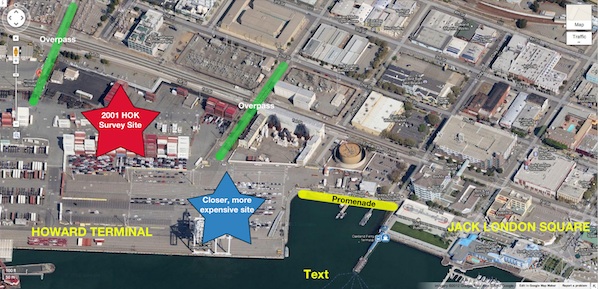
First, let’s start off a bird’s eye view of the site, with a few items labeled for further discussion.

howardterminal_birdseye-labeled-sm

Overview of Howard Terminal and Jack London Square

From right to left you see:

  • Jack London Square in the southeast corner. A one-block stretch of Broadway is visible.
  • One block over from the heart of JLS is Washington St, followed by Clay St. Broadway and Washington extend to downtown Oakland. Clay does not.
  • At the end of Clay Street is the Ferry Terminal, the Ferry Landing (10 Clay St.) commercial building and a small public plaza and green space.
  • A narrow promenade (10 feet wide in an important stretch) runs along the shoreline west to Howard Terminal. If a ballpark were built at Howard Terminal, the lightly-used promenade would have to be widened as it’s the safest and best pedestrian access from the Ferry Terminal and the JLS shoreline and marina.
  • Complicating matters is the Oakland Fire Department EMS Station, which is home to Fire and Police boats. The station would have to be reconfigured to widen the promenade.
  • The blue and red stars indicate the rough locations of ballpark sites. The blue star is the site I identified on Tuesday. It would probably be the most expensive site because it’s all piers, not land, and would make the foundation more expensive. The red star is the site surveyed in the 2001 HOK study. It is inside the original shoreline.
  • North of the blue star is the power plant, which can’t be moved without incurring great expense.
  • The green lines are possible locations for pedestrian and vehicular overpasses, lining up with MLK Way and Market Street, respectively. Both connect with North and West Oakland, as well as 980 and 880. At Howard Terminal, the streets are 900 feet apart.

Now I’ll explain why the overpasses (green lines) will be needed. A couple of pictures for comparison:

howard_term-26-view_east

View East from The Embarcadero and Clay toward Jack London Square

howard_term-26-view_east

View East from The Embarcadero and Clay toward Jack London Square

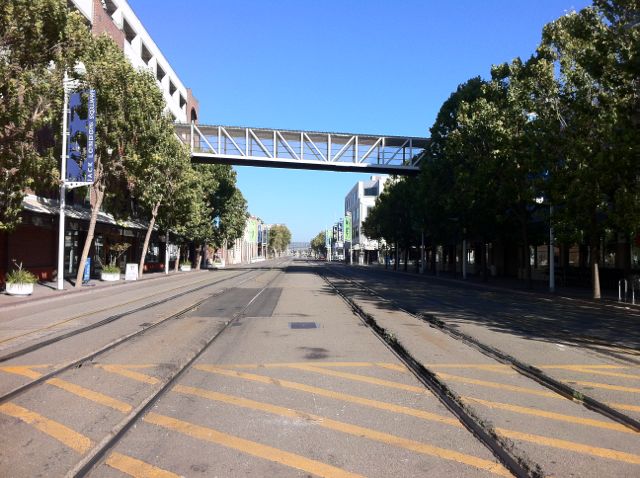
howard_term-27-view_west

View west from The Embarcadero and Clay towards Howard Terminal

These tracks cannot be moved. They are a big part of what makes the port truly intermodal. If 40,000 people are going to cross these tracks and The Embarcadero to get to a Howard Terminal ballpark, it is paramount that safe methods for getting those people across are implemented. Gates and traffic cops aren’t going to stop stupid, drunken fans from playing chicken with an Amtrak or freight train. Unlike the light rail trains run by SF Muni outside AT&T Park, these trains don’t stop quickly even if they’re traveling fairly slowly.

The second picture also shows that there is little streetscape west of Jack London Square. The westbound car lane ends in another block at Jefferson, and the track area isn’t paved. It would make the most sense to completely shut down The Embarcardero near Howard Terminal to all traffic other than trains for a 6-8 hour window on game days.

How then, do you get people across The Embarcadero? It’s for all intents and purposes a moat. By building bridges, of course! The scale and number of bridges would be driven by the amount of parking that is made available adjacent to the ballpark. And that is largely driven by the amount of parking available in and around Jack London Square. Over 3,000 spaces in lots and garages are present, plus at least 500 on-street parking spots. However, only 1,250 spaces are within 1/3 mile of either HT ballpark site. Extend the radius to 2/3 mile, which is sort of the fringe distance that people are willing to walk, and you get 7,000.

parking_comparison

Comparison of parking near ballpark sites

Additional parking may be made available under the BART alignment or on street, but it’s clear that parking near Howard Terminal is a clear site deficiency. The obvious place for a new facility is next to the ballpark. 16 acres would yield 2,000 spaces, which should serve the dual purposes of filling the needs of the ballpark and satisfying current JLS tenants (restaurants, Yoshi’s, movie theater) that have depended on the existing infrastructure. For that much parking, whether it’s all surface or new garages, two entrances would be required, or rather, two overpasses. That’s why I drew the two overpass paths. Market Street is the main entrance to Howard Terminal and is already set up to handle heavy traffic with four lanes. MLK Way is also four lanes. The overpasses would also create two additional pedestrian overcrossings, netting four total along The Embarcadero.

The price for the overpasses? Around $10 million each. Add that to the promenade expansion, parking construction, and other site improvements to make Howard Terminal hospitable for a ballpark.

howard_term-19-corridor1

Promenade from Ferry Terminal to Howard Terminal

Before we get ahead of ourselves, it’s important to note that no ballpark at Howard Terminal will be possible without SSA Marine/SSA Terminal vacating the premises. And while Matson (partnered with SSA) provided support to Don Knauss in his efforts to either build a ballpark on the waterfront or buy the A’s (or both), it doesn’t appear that Howard Terminal operator SSA will be easy to move. While SSA’s container business is down in Oakland, the company is not blaming the downturn on the way Howard Terminal is configured. Instead, SSA has a problem with its lease at Berths 57-59, just over a mile west of Howard Terminal (Berths 67-68). SSA is suing the Port of Oakland over alleged violations of the federal Shipping Act. SSA alleges that the Port is giving preferential treatment to Ports America, a competing terminal operator at the Outer Harbor, Berths 20-26. SSA’s claim is that Ports America (PAOHT) is leasing its site for 45% less per acre than SSA, while not having to contribute much to infrastructure improvements. Due to the more expensive lease, SSA is saying that it’s losing business to lower-cost competitors like PAOHT to the tune of $46 million per year.

Renegotiating SSA’s lease to make it on par with PAOHT could negatively affect port revenue $10 million annually (offset somewhat by new lease terms), and while the two sides have talked they haven’t sat down to negotiate. The lawsuit will be three years old in December. SSA is being coy about what they want out of this besides a lease. The ballpark gives them a very convenient trump card that it wouldn’t otherwise have, now that we know that Howard Terminal is the only site in Oakland that MLB is investigating. It’s a very tough spot for the Port and City to be in. If the City doesn’t get the Port to renegotiate the lease along SSA’s terms, Howard Terminal is dead before it begins. It can’t kick SSA off the property as the lease goes until 2017, with two possible 5-year extensions that SSA will probably decline. Plus any changes to Howard Terminal like the ones I described previously have to work for the other tenants of the Port like PAOHT and other shippers, making the Port every bit as beholden to its tenants as it is to the City (from which the Port operates independently anyway). And if you want to make things even more complicated, the City of Oakland wants out of a bad bond hedge deal with Goldman Sachs. Who’s a major investor in Carrix, the parent company of SSA? Goldman Sachs.

Cost estimation is difficult, but back-of-the-napkin math has infrastructure at $50 million depending on site and foundation, and an ongoing loss of $10 million in fees to the Port with a redone lease and relocation costs. From the looks of things, SSA might play ball if they get their lease redone. If not, what’s their incentive? This reminds me a lot of what the City of San Jose did with AT&T on a rezoning deal near Valley Fair. Considered a quid pro quo deal, we may never know if it really is one unless a ballpark in San Jose is built. SSA appears to be in line for a similar enriching.

Not every idea is a good one

Over the weekend, the Santa Rosa Press Democrat’s sports columnist Lowell Cohn entertained a concept for privately-financed stadia at the Coliseum for both the A’s and Raiders. Put together by Sacramento developer Rick Tripp, the plan is neither new nor novel. In fact, we’ve heard it here several years ago, when the Lew Wolff trying to build a ballpark first north of the Coliseum and later in Fremont. The venue(s) would be paid for by a combination of surrounding area development entitlements and stadium revenues such as naming rights and concessions. During the housing bubble in 2005, it sounded like a decent plan since it wouldn’t have required a bond issue or  new taxes on Fremont’s or Oakland’s part. Of course, once that bubble burst, such a plan was no longer feasible.

Tripp revives that plan and adds a wrinkle in that “unconventional” sources such as real estate brokerage fees are also used. Tripp admits that he hasn’t lined up all of the necessary money, some of which could come from Middle East financiers. He has also pitched his plan unsuccessfully twice – first in San Diego for the Chargers, then in his hometown, Sacramento, for the Kings’ railyards arena. In both cases, his respective bids were rejected. No explanation is given as to why, but I have a few guesses as to why which I’ll get to in a minute.

Before that analysis, first let me turn your attention to a small article which also surfaced over the weekend. The Arizona Diamondbacks are pushing to have ownership of Chase Field changed from one public entity (Maricopa County) to another (City of Phoenix). The point? To allow the D-backs to exert more control over Chase Field’s revenue streams, which are currently somewhat split between the team and Maricopa County. The team pays $4 million per year in rent and maintenance costs, a decent amount compared to other leases throughout baseball. No new money is being raised by virtue of the D-backs’ proposal, and it might net the team a few more million per year. That’s enough to make the request worthwhile. It’s of utmost importance to team ownership that it gain control over as much of its local revenue stream as possible.

It’s in that light that if you read Tripp Development’s San Diego stadium proposal that you can see why it didn’t pass muster. The plan, which included a $900 million NFL stadium and a $400 million arena, would charge $15 million per year to the Chargers and $10 million per year to a relocated NBA team. Given the somewhat similar cost between a ballpark and an arena, let’s suppose that the A’s would lease a new ballpark from Tripp for $10-12 million a year. That’s three times as much as the D-backs, a team that is at best a mid-market franchise and is trying to scrape up every bit of revenue it can. Worse, the terms have the A’s (or Raiders) with precious little control of stadium revenue except for games. While it sounds nice that the A’s would get a “free stadium”, their inability to control revenue streams would leave them only marginally better than they are now, especially in years when attendance isn’t impressive. It’s a deal that, if presented to either Lew Wolff or Mark Davis, would be politely declined by both. It’s not something that would be approved by either the NFL or MLB. Similar lease terms helped allow the Seattle Supersonics to leave the Emerald City, and they’re making it easy for the Warriors to look across the Bay towards San Francisco – even though the price tage for a new arena will be huge.

Now, that isn’t to say that Tripp’s concept is bad. If you’re an Oakland-only partisan or someone who doesn’t scratch the surface like Cohn, it might sound great. And at least Tripp is being fairly transparent about the substance of the deal, whereas we have few clues about Oakland Mayor Jean Quan’s Coliseum City plan other than federal transit money or the exotic EB-5 visa program (neither of which will provide much money to build any stadia). The problem is that so much revenue has to go towards paying off the project that it severely limits the amount that can go to the tenant teams. That puts the teams at a handicap relative to their division and league competitors. Both owners and the leagues are going to agree to deals that give them the highest levels of revenue and control. A large mortgage for the A’s is somewhat mitigated by the fact that it can be deducted against revenue sharing. Any deal that doesn’t give the team revenue control is inferior, even if a high-revenue/control deal means creating greater risk (see: 49ers).

Moreover, while the plan doesn’t say redevelopment explicitly, it’s effectively a redevelopment plan when it talks about entitlements. That may be the most risky thing of all. Tripp and his investors probably have a target in terms of real estate sales and fees associated with those sales that will help pay back the debt ($90-100 million per year if separate football and baseball stadia are built). If they don’t hit those targets because of an Oakland real estate market that trails the rest of the Bay Area, what does it mean for the teams? Investors want to counterbalance risk with return and protection if possible. With limited government help, the risk may be excessive. Remember that former New Jersey Nets owner Bruce Ratner faced several delays in trying to move the team to Brooklyn, which eventually forced him to sell the team and the development to Russian billionaire tycoon Mikhail Prokhorov. Bailout guys like Prokhorov don’t grow on trees.

Tripp’s plan is the first of many such proposals for Coliseum City, and he admits that he’ll know if it’s workable in 18 months, around the time several studies regarding Coliseum City are due. If nothing else, his proposal should stimulate discussion within Oakland about how Coliseum City can get accomplished – not just to keep the teams in place, but to allow them to thrive. For any team to stay in Oakland the financial terms need to make the teams more than merely competitive. As long as the teams face revenue limitations from any proposal, they’ll keep looking for better deals elsewhere. That said, if Tripp is able to successfully get commitments from one or both teams, he’ll deserve extreme kudos. Third time would be the charm, I guess.

New National TV deals are the tide that lifts all boats

Come 2014, the A’s will be a much richer team, a team capable of fielding a $100 million payroll. And they won’t have to build a ballpark, negotiate any new local media deals, or raise ticket prices to do it. That’s because new national television deals will be in place for the 2014 season, and they promise to make every team a good deal richer.

A flurry of stories have come out in the last week to trumpet the coming broadcast rights war. All of the current national broadcast deals expire at the end of next season, making this next set of TV rights negotiations a total free-for-all. I’ve assembled some of the articles for your perusal.

Currently every team gets around $24 million per year in national TV money via three contracts (Fox, ESPN, TBS) plus international and digital media revenue. All told, it’s at least $33 million per team per year from baseball’s central revenue, or $1 billion for MLB total annually. According to many industry observers, the new TV rights deals should net MLB around $2 billion per year by themselves, at least doubling if not tripling the amount each team will get. That won’t mean all that much to the Yankees or Red Sox, since they’re often up against the luxury tax threshold. For a team like the A’s, however, it’s manna from heaven. A bump to $2.1 billion (a reasonable guess at this point) will put $70 million in every owner’s pockets, every year.

Let’s look at this at the micro level. Estimates have the A’s 2011 revenue at $160 million, though Lew Wolff will argue that it’s less. With greater ticket sales this year and other incrementally growing revenues, I’d wager that $160 million is a realistic number for this year (Forbes might say that it’s $165 million or more). Now add $42 million in fresh national TV money, and suddenly every team in baseball, including the A’s, is a $200 million revenue franchise. Use the typical 50/50 ratio of payroll to revenue, and the A’s payroll is $100 million. Simple, right? ($230 million doesn’t seem so far away anymore.)

Ah, but there’s more to it than that. Chances are the digital media and international broadcast money will also grow. Several teams will approach $300 million in revenue, which means that $150 million payrolls will become more commonplace. Again, all without raising the price of a single ticket. The A’s will continue to be a have-not relatively speaking, but that extra money should make it easier for ownership to sign a young slugger past arb years, or more than one. While we currently think of $75-80 million as the practical upper limit for payroll when Billy Beane feels the team is in contention, that amount should be the lower limit for payroll in the coming years. Giants ownership grumbled loudly about keeping this year’s payroll to $130 million. That figure should be their lower limit in 2014.

Exploding TV money will have one other important effect on teams: franchise valuations and sale prices should continue to grow. The Padres sold for $600 million plus $200 million for their share of the new Fox Sports San Diego network. I figure that puts the A’s at $500 million now, and that’s without the benefit of the new TV money. In 2014, the A’s should be worth $600 million easy. Knowing the gravy train that’s coming, Wolff/Fisher would be crazy to sell the franchise anytime soon, regardless of what happens to their San Jose ballpark pursuit in the near term. On the flip side, the growing franchise value will only make it that much more difficult for an outside group (Don Knauss & Co.) to buy the franchise and finance a stadium, soon to be a combined $1.1 billion price tag. If we’re looking for an event to burst the valuation bubble or dissuade Wolff/Fisher from continuing to own the team, the new TV contracts definitely aren’t it.

The most fascinating part of this will undoubtedly be the negotiations. When the last rights were negotiated, baseball was considered a sport on the decline among the networks, best relegated to regional sports networks and ESPN. Since then, NBC and CBS have launched their own sports network competitors to ESPN. Fox may convert Speed to all sports instead of just motorsports, the same way NBC converted OLN and CBS did CSTV. All three would want baseball as a tentpole for their fledgling networks and for their cable bundling efforts, the better to wring ever higher subscriber fees from consumers.

  • Today’s youth probably have no idea that NBC was once the network that carried baseball, with Vin Scully and Joe Garagiola announcing Saturday’s Game of the Week. The peacock has now gone over a decade without baseball, and their desire now is hot and heavy. Baseball is just what NBCSN needs to gain traction among viewers, in addition to the Game of the Week. Keep in mind that because NBC’s big tentpoles are Sunday Night Football, the Olympics, Notre Dame football, and the NHL, there are huge swaths of weekend daytime programming for NBC that have no pro sports at all. That might lead people to think that when it comes to sports, NBC is out of sight, out of mind. Is NBC/Universal/Comcast will to spend money on MLB the way the company never would under Jeff Zucker? We’ll see. Pros: Better integration with Comcast Sportsnet properties. Cons: An even larger Bob Costas soapbox.
  • CBS has rarely had MLB on TV over the last few decades, the exception being a financially disastrous gig in the early 90’s (thanks, Toronto Blue Jays). The Tiffany Network also owned the Yankees during the 60’s. That was about as far as they went. CBS likely has the same motivations as NBC. Under Les Moonves, the network has tended to stay away from baseball, so either they saw the light if they’re interested or it’s purely a carriage play. Pros: The unlikely yet possible resurrection of the MLB on CBS theme, which had a “The Natural” 80’s-style majesty. Cons: Potential re-teaming of Sean McDonough and Tim McCarver, one of the worst announcing tandems in broadcast history.
  • Fox is the incumbent, and frankly, they’ve been shit the entire time. At the outset, Fox declared war on ESPN, claiming that its “tribal” approach to sports by grabbing RSNs would allow it to integrate well with the national broadcast. That never happened, and Fox has only retreated ever since. Not that I liked the now-discarded theme song, but to replace it unceremoniously two years ago with the NFL on Fox theme clearly showed where the network’s thinking is. The move to 4 PM broadcasts this season is a good one because it opens the afternoon slots for teams, but I can’t help but think Fox just did it because they didn’t have any primetime programming on Saturday nights for the East Coast. Pros: Can’t think of any except maybe Ken Rosenthal. Cons: Fox may get even lazier in its handling of MLB.
  • ESPN may have the most to lose. They absorbed the hit that came with the launch of the MLB Network (not part of the conversation BTW), and focused on making sure their web and news coverage stayed solid in the face of new competition, though they let go of quite a few talents along the way. They still have Sunday and Wednesday night games and little good to replace them if they lost those properties. Try as it might to jam as much NFL news into its summer programming, ESPN can only go so far with football. The network has reduced the number of games per week it broadcasts. It may be forced to bid to broadcast more games per week if the other cable sports networks are willing to do the same. Pros: Webgems. Cons: Chris Berman.
  • TBS will probably get outbid on its little property, Saturday Night Baseball. They tried to transition from the Braves to all teams using all of their Atlanta-based talent and production and have generally done poorly or have been ignored in the process. Handling of the playoffs, which Turner tried to do similarly to the way it handles NBA games, was confusing and  generally abysmal. Clearly, national baseball broadcasts weren’t in Turner’s wheelhouse. Pros: Eck in studio. Cons: Dick Stockton.

There’s a decent chance that MLB will structure bidding so that a network can bid on a specific league, the way the NFL splits broadcasts for its two conferences. That would be an interesting twist, though it would create an inherently unequal situation due to the popularity of the Yankees and Red Sox. I’m certainly not digging the idea of AL nights and NL nights. Digital carriage also has to enter the picture. Streaming of national games may be part of every deal, though you can bet that they’d still be subject to those frustrating blackout rules.

How do think this new windfall will affect the A’s in the future? How should broadcast rights be distributed? Do you have a favorite channels on which you’d like to see national broadcasts?

Museum concept

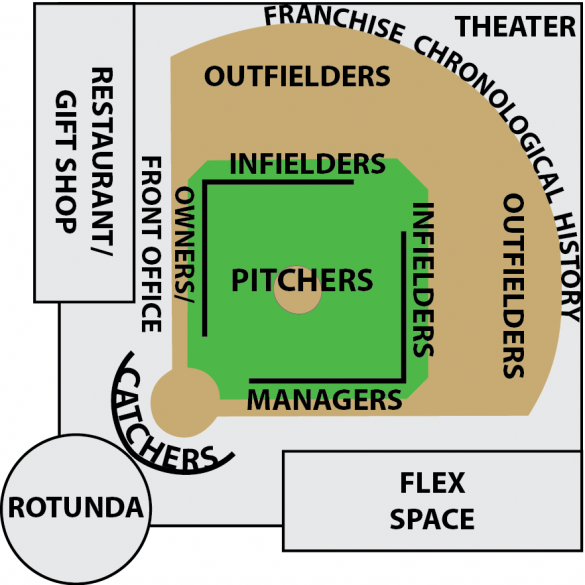
I’ve been kicking around this idea for the better part of a decade. It took until this week for me to jot it all down. The principle is simple. Like most museums, circulation is meant to flow in specific directions, though it’s not rigid.

The premise is simple. You start off in the rotunda area, which would be paved with bricks of leading donors. You enter to the right and reach the on-deck circle. Once there, you can either go to the restaurant or forward into the main hall. Follow the diamond to check out the franchise’s great managers, or go left to check out catchers and pitchers. Dressed-up lockers would contain exhibits for hall-of-famers or other greats. Round first and you can split off into either infielders or outfielders. End the tour with exhibits for owners and general managers (does Connie Mack get two exhibits?), or walk along the outer wall to go over the franchise’s entire history. Various islands throughout would have educational information about baseball for children, and the whole experience would be accompanied by custom iPad/iPhone apps. There’s also a theater for multimedia presentations.

While the layout is for a single-story building, it could be vertically aligned to as many as four floors with a smaller footprint if there were site size constraints. The flex space shown could be used for offices and for traveling exhibits such as those sponsored by MLB. There would have to be heavy coordination with the Bay Area Sports of Hall of Fame, which has no specific home and has spread out its inductee plaques at venues all over the Bay Area.

Then there’s the problem of running a museum. I don’t have any doubt that an A’s museum would be able to attract enough startup money or fill an endowment for the establishment of the museum. Ongoing operating costs to can be difficult to manage. It’s enough to create all sorts of financial difficulties 3, 5, 10 years down the road. It’s not realistic to expect the franchise to cover the budget, because franchises tend to throw most of their money and resources at the on-field product and run everything else as lean as they can afford to. Unless the museum makes money (an almost guaranteed “no”), there’s little reason to justify it. It’s with that sobering realization that I know that a museum isn’t terribly likely. Still, I can dream. And if shooting this high ultimately means settling for a great set of monuments at a future ballpark, that’s fine with me.

Now for some input from you. I’d like to frame this discussion around a set of questions. If I like your responses I’ll post them here within the post body.

Questions:

  • How would you organize the exhibits at an A’s museum?
  • How much attention would you pay to the franchise’s stints in Philadelphia and especially Kansas City?
  • How does the steroid era and its A’s notables get treated?
  • How large of an exhibit should each HoFer get?
  • Should there be an exhibit devoted to the designated hitter?
  • What kinds of kid-friendly exhibits and attractions should the museum have?
  • Should there be an exhibit containing other great Bay Area players who never played for the A’s?

If you have other questions you’d like to pose, put them in the comments and I’ll add them to the post.

A pretty cool museum idea

In 2006, when the economy was still strong, Adobe Systems bought 8 acres of land from the San Jose Water Company. The thought was that Adobe was expanding rapidly, so it might need the land for a future headquarters expansion. At that point, Adobe’s stock was at $40 and its position as a leading software vendor in the creative community was unquestioned. Now the stock is priced at $30, and there are a few questions about where the company is headed as it pushes its subscription software model on the public. Nothing has been built or even approved for the land, which is bisected by Delmas Avenue and fronts the Guadalupe River to the east.

Along with the land is the old San Jose Water Company headquarters. Built in 1934 and designed by prominent South Bay architecture firm Binder and Curtis, the building received landmark status in 1991. Any new development by Adobe will have to leave the building intact, and it’s likely that any master planner would work to integrate the HQ into the site plan somehow.

The corner of West Santa Clara and Delmas, Adobe HQ in background right

After several decades at the prime downtown location, SJWC felt that it was time to turn one of its vital assets into cash. It was the right move on the company’s part since it came right before the real estate crash. Now Adobe has the land, which should factor into its future plans, and the building, which could be used for some commercial purpose, but not in a way that would impact its landmark status. Currently there is no tenant.

Closeup of building highlights its mix of styles

The building is a mishmash of styles, done with enough subtlety to not appear gaudy. There are neoclassical elements in the columns, bas relief carvings throughout, and a Spanish revival tiled roof. Its location is prominent in that it’s at the bend in Santa Clara Street where you can either go east towards downtown or west towards the arena and The Alameda. The site is at the confluence of the Guadalupe River and Los Gatos Creek. It also happens to be right under a landing approach to Mineta Airport, which makes it a poor spot for a ballpark (if you’re wondering).

Looking across the Guadalupe River towards the SJWC building

When I asked Lew Wolff last year about having a museum at Cisco Field, he indicated that a museum would be hard to incorporate due to the lack of space at the site. He said that John Fisher may be interested in a museum tailored to the art of sports, though not necessarily an A’s museum. At 15,900 square feet, the SJWC building is a good size for a museum, whether it’s specifically for the A’s, Fisher’s sports art pursuits, or maybe both. Inside the Santa Clara Street entrance is a large, high-ceiling space, formerly cubicles, now empty. I haven’t been anywhere else in the building, so I can’t comment on what the rest of the interior looks like. Offices are located upstairs. Museums tend to run on very lean budgets due to their revenue sources, so a space this large may be too expensive unless Adobe cuts the museum a deal.

Nearing 80 years old, the building would undoubtedly require some amount of renovation work and continued upkeep to keep it going for the next several decades. The interior would have to be changed to fit a museum use better. Other than that, it should be good to go. It has dedicated parking (for now), and it’s fairly close to the ballpark. Is it close enough? You be the judge.

Location of Adobe/SJWC properties in relation to Cisco Field site and other nearby landmarks

At the northeast corner of the Adobe/SJWC site, the building is 1/4 mile from the nearest point at Cisco Field. It’s a shorter walk to the arena from either the ballpark site or SJWC. Perhaps that’s too far to bring gameday traffic in on a consistent basis. On the other hand, SJWC’s location on Santa Clara Street is on the way to the ballpark from many points within downtown proper. It’s likely that if/when Adobe builds something there, a large public parking structure will have to be built to keep up with demand for the arena and ballpark. There’s also a chance that Adobe partners with someone like the A’s on a mixed-use development that takes advantage of the Wolff family’s development experience while helping to defray some of the cost of a new corporate campus for Adobe. And there’s always the possibility that Adobe sells the land to Wolff or other San Jose interests if they decide that a new campus isn’t in the cards.

Skyline view from San Fernando light rail station at sunset

One other interesting piece of news about Adobe may come into play. For years Adobe was a key sponsor of the San Jose Giants, the company logo emblazoned in the outfield. I haven’t been down to Muni yet this year so maybe someone can confirm this, but it appears that Adobe is no longer a sponsor (or at least a key one). That may have something to do with Adobe’s place as one of the SVLG 75, and the group’s opposition to the Giants’ continued roadblocks of the A’s efforts to move south. Perhaps Adobe and the A’s have already had discussions about how to move forward. The loss of redevelopment has meant the death of publicly-assisted development efforts. As for entirely private projects, there may be something there. Hopefully that something includes an Athletics Baseball museum, one worthy of the 112 years (and counting) of the club’s legacy.

P.S. – I intend to keep writing and rallying support for an A’s museum until it comes to fruition, whether it’s in San Jose, Oakland, or Timbuktu. The next post will about what should be in such a museum, so save any comments about content for that post. Thanks.

P.P.S. – Yes, I’m aware of the Philadelphia Athletics Historical Society and Museum. There should be some way to partner with those folks. If you know of a site that would fulfill this purpose in Oakland and is within walking distance of one of the downtown/JLS ballpark sites, I’d like to write about it.

Trends from the Stadia EXPO 2012

A general rule about going to conventions is, “don’t go only on the last day”. Exhibitors are usually wrapping up, often people are tired and just want to go home, and chances are that whatever energy that pulsated through the show has dissipated by that final day. Still, Thursday was the only day I could go to Stadia EXPO 2012, so I went. Expectations set, I wasn’t too disappointed by the sight of entire booths being taken down and put away. I was hoping to get a sense of what technology was being pitched to stadium builders and operators, and as far as that went I wasn’t disappointed in the slightest.

Camatic seats mounted on beam

Three years ago I wrote a post about the seats that are going into Cowboys Stadium. Made by Australian manufacturer Camatic, at the time they were unique because the seats and standards weren’t mounted directly onto concrete risers. Instead, crews drilled metal beams into the risers, then mounted the seats onto the beams. This allows the stadium operator to expand or contract seating capacity by adding one or two seats to each row for high-demand games. Now it’s not only Camatic who makes this solution. I saw at least three vendors who had a beam-mount system. It’s not for every situation, but if you’re building or running a retractable roof stadium or arena it’s very compelling.

An assortment of LED modules from Daktronics. Top: indoor, bottom: outdoor

Occasionally on this site we hear some grumbling about the scoreboards at the Coliseum. Well, there’s no news on that front, but I can tell you that what’s out there is only getting better and better. Scoreboard maker Daktronics was on hand, and what they showed was incredible. The new thing is a LED panel where the individual pixels are only 4 mm apart. Normally you’d think of these types of displays as used in a large arena or stadium, where the crowd is a good amount of viewing distance away from the display. A display with 4 mm elements results in a 1080p/Full HD display size of just over 25′ x 14′, or a 4K cinema display size of 54′ x 25.5′. What that means is that you can put this technology in a movie theater, which is astounding. Last week I went to see a 2D presentation of The Avengers in a popular San Diego multiplex, and the auditorium had a screen close to that larger size. It used a standard Sony 4K projector. Obviously, this technology is too expensive to use in movie theaters compared to projectors, but can you imagine if it was price competitive? The quality would be amazing, the technology easily serviceable, and the brightness second-to-none (you can’t use projectors outside).

Plus, imagine if the part of a scoreboard or video board stopped working, which is something that happens with the ancient DiamondVision CRT panels at the Coliseum frequently. A technician could simply take the broken panel and replace it while the display is running, as you can see in the video below.

The last booth I visited was Nike Grind, which was pitching their recycled-shoe-rubber solution for artificial turf fields. A great takeaway from it is that the color of fill can make a huge difference. If you watch a slow-mo replay of a running back cutting on Field Turf or a similar surface, you’ll often see little rubber bit kicking up from the ground as he plants his foot. Most of the time that fill is made of recycled tires, which are all black. If you’re playing on that surface outdoors in the Midwest or South on a late August day, that fill can act as an insulator that can make the ambient temperature above the field as much as 120 degrees. Since shoes have different colored soles/parts, it can make the fill multicolored instead of black. Nike Grind claims that the multicolored fill can drop the ambient temperature up to nine degrees.

Cool as the technology was, there were things I did not see:

  • Anything to make 25,000 seats disappear or otherwise make baseball and football co-exist easily.
  • Much in terms of new American stadium projects (we’re in a slump).
  • Arena renovation case studies.

For that last part, check back here tomorrow.

As for attending Stadia EXPO 2013 next year, I’ll pencil myself in. Next time, I’ll go on the first day.

The Coliseum that never was

What’s the pic? It’s a ramp leading to an underground service tunnel for the abandoned stadium next to ARCO Arena/Power Balance Pavilion. Overgrown with grass and trees, the foundation is practically invisible except for unfinished rebar columns sticking up from the concrete foundation.

Exposed rebar from the stadium's foundation is camouflaged by the environment. View from north, arena in background.

The arena and its stillborn brother would never have come to fruition without the vision of Gregg Lukenbill, a developer who lured the NBA’s Kansas City Kings from the Midwest in 1985 with promises of a new arena and a growing community. The Kings played in a converted office building (ARCO Arena I) for three seasons before moving to their “permanent” home in the largely undeveloped Natomas area north of downtown along I-5. Even as the money game of owning a franchise passed Lukenbill by, he remained a cheerleader of the city, as well as a critic of both Sacramento politics and the Maloofs.

View north from ramp outside arena's northwest entrance. More of the foundation is visible.

Lukenbill almost managed to lure teams from elsewhere in California as well. He lobbied hard to pull the Raiders from Los Angeles, as Al Davis entertained offers from numerous cities and played all of them off each other. The Sacramento Raiders plan would be based on a $120 million, 53,000-seat stadium next to ARCO Arena. Though it would’ve looked a lot like Anaheim Stadium in its football era, the stadium would’ve been different from either The Big A or Candlestick Park in that it would’ve been built first for football, and later baseball (43,000 capacity) if everything came together. The rising costs of competing in the major sports space eventually caught up with Lukenbill, who was not nearly as rich as many others entering the game, and tried to construct venues on the cheap – a practice that would become unsuitable once Camden Yards opened.

Model of a finished multipurpose stadium north of ARCO Arena

The big coup, though, would’ve been if Lukenbill had brought the Giants up I-80 to the Capitol. Bob Lurie’s ongoing dissatisfaction with The ‘Stick was well known, and Lukenbill was well poised to pounce on the opportunity. Just as the Giants are politically involved in the A’s stadium situation now, Lukenbill thrust himself into what the Giants were doing then by funding a mailer against Proposition P, the original China Basin ballpark plan championed by then-SF Mayor Art Agnos. Proposition P was defeated in 1989 in the wake of Loma Prieta, causing serious turmoil for the Giants over the next few years, while allowing San Jose and Santa Clara to enter the picture. Lukenbill was subpoenaed after the election, but nothing came of it.

Plans to bring the Giants (or any other baseball team) never gained much traction, and Davis turned his attention back to LA in short order. Still, it’s interesting to think about Sacramento having three major sports franchises in its midst: Kings, Raiders, Giants. Would Lurie or Davis have been satisfied with the stadium in the long run? Probably not. As the Kings, Giants, and others chose not to go to Sacramento, Lukenbill ran out of money and sold the arena to one of his co-owners and the Kings to Jim Thomas.

The greatest legacy of the failed stadium is a closed-off tunnel which leads north from the arena and connects the two. It’s only accessible from the bowels of the arena and has gotten some interesting uses over the years. It doesn’t quite have the flexibility of the Exhibit Hall setup at the Coliseum, yet it’s emblematic of Lukenbill’s vision: bold, big, and ultimately, unfinished.

Tomorrow: A (probably) final visit to ARCO.

A way to Sacramento

A year ago, Giants CEO Larry Baer hinted that it would be good for the A’s to look somewhere outside the Bay Area for a new ballpark, if a deal for an East Bay park couldn’t be worked out. I wrote three years ago that an expansion to Raley Field would cost at least $250 million. It would be hard for the A’s to make a large contribution towards the expansion project because Sacramento’s government town status makes the corporate revenue pickings slim. If the A’s are going to pay for it, and MLB isn’t going to pay for it, who will?

The Giants, of course.

Now, I’m not actually suggesting that the Giants will pay for the stadium directly. They’re coming to the end of their own mortgage, so why would they saddle themselves with someone else’s? They wouldn’t. Yet if the A’s were forced to vacate the Bay Area, the Giants would likely pay the A’s to surrender the territorial rights to the East Bay. Such money which could be used to build or expand a stadium elsewhere. The Giants would end up indirectly funding the A’s stadium as a result.

We’d start with the MLB standard compensation package: $75 million, half coming from the commissioner and half coming from the paying team. That’s too small of compensation for the 2.5 million-strong East Bay, especially when you consider that the Giants’ franchise valuation could get a 2-3x boost from the A’s leaving. $150 million is probably a fairer package with the same 50/50 terms.

By the time the A’s were able to consider such a move in 2016-17, the $250 million cost could easily balloon to $300 million. That puts the Giants/MLB contribution at half. The A’s might be able to contribute $75 million on their own (via a new lease and revenue share), meaning the rest would have to come from a public source. This is absolutely important so that the A’s don’t get relegated to being another small market team. If the A’s move to Sacramento and have to pay a fat mortgage, that’s not an improvement upon staying in Oakland. The A’s best chance to thrive in Sacramento is if their stadium costs are as minimal as possible.

For Sacramento’s part, the plan only makes sense if the Kings are gone. The A’s still need corporate support to sell out premium offerings, and it’s expected that the Railyards Arena will suck up all of those customers. Involvement of AEG will only enhance that. The controversial parking revenue play won’t work because the plan is to expand Raley Field in West Sacramento, which is out of the Capitol City’s jurisdiction. A joint powers agreement between Yolo and Sacramento Counties sounds like a possibility.

At the actual stadium, the hard work includes taking down the press box and suites, ripping up the concourse to put in new columns, and putting in new facilities under the concourse such as modern, MLB-standard team clubhouses and a kitchen/commissary. Then the A’s could focus on putting in a club level, new suites, an MLB-standard press box, and a third deck to bring in those extra needed seats. The scope of work reminds me of this:

Mount Davis added 10,000 seats in a three-deck grandstand, an expansive indoor club, and 96 suites. The scope of work is similar to what would be required at Raley Field (sans tarps).

Would $300 million be enough in the end? It’s hard to say. It would be easy to argue that MLB wouldn’t want to skimp on amenities, or else Raley Field could be viewed as a cheap, temporary solution. Terms published for Nationals Park showed that MLB wasn’t interested in cost effectiveness – except in terms of external finishings. Marlins Ballpark is a testament to excess with its bizarre center field sculpture and aquarium behind the plate. The “wedge” in the Railyards dedicated for the arena isn’t large enough for a ballpark, so if MLB weren’t satisfied with Raley and wanted to look in Downtown Sacramento, it would have to use another plot within the project area for a completely new stadium, and a $500+ million price tag to go with it. Unless MLB was really desperate (which they usually aren’t), it seems iffy for baseball go along with the expansion plan when Sacramento was willing to foot a large part of the bill for a brand new arena.

There’s also at least one inside baseball consideration. MLB is fully aware of what Sacramento’s market limitations are. If the Railyards arena deal falls through, it won’t look good to MLB that the City couldn’t put together either a cohesive local or regional plan to retain a team. Sacramento wouldn’t show up on the top of anyone’s “viability” list, even though the resources to support a baseball team alone are there. Yet if the arena deal were successful, the market is too limited to exploit for a second major sports franchise, especially one whose economic requirements are much greater than those for a basketball or hockey team. It’s definitely a strange paradox.