San Jose City Council approves taking antitrust case to Supreme Court

Despite losing handily twice in federal courts, the City of San Jose won’t relent, voting unanimously today to take its antitrust case against Major League Baseball to the Supreme Court. While its chances of overturning baseball’s antitrust exemption remain slim, the City’s game plan is simply to have the Supremes take the case, which could cajole MLB into settling. Even that outcome is a long shot, as Wendy Thurm explained at Deadspin two weeks ago. Regardless of the long odds, Mayor Sam Liccardo seems to be spoiling for a fight:

We may know the Court’s decision by summer.

Could cities use eminent domain to acquire teams? Don’t hold your breath

Field of Schemes‘ Neil deMause has an intriguing article at VICE Sports today positing the idea of teams buying teams via eminent domain. It’s not an entirely original idea. You see it on a message board every so often, and the City of Oakland famously tried to use ED to keep the Raiders from moving to LA (it failed). deMause doesn’t consider any eminent domain proceedings to be a slam dunk, as their efficacy could vary wildly based on jurisdiction. Instead, deMause looks at the ED threat as a cudgel to use against another threat, the move threat teams often wield over cities. Whether or not teams actually talk about moving to other markets, the possibility of being tied up in court, having to open the books, etc., might make team owners think twice about it.

As for eminent domain actually having teeth, it’s difficult to argue for it. California already has two cases on the books that support teams and leagues over cities, and of the teams that have recently built or are looking to build new venues, none are using that extortion weapon – except perhaps for Arte Moreno against Anaheim.

The Green Bay Packers are often touted as the model for publicly-owned sports franchises. The franchise was stabilized nearly 90 years ago when they became run as a public corporation, with real stock sales. Once issued, shares cannot be resold except back to the franchise, and the stock doesn’t offer any sort of dividend or significant voting rights, so they’re mostly for stadium improvements or for financially supporting the team, which struggled through the Great Depression.

Let’s say Raiders fans wanted to try such a model in Oakland. They’d have to raise $1 billion, or 10 million shares at $100 each. A new stadium would also cost around $1 billion, so make that 20 million shares. If the NFL was amenable to the idea (they have disallowed publicly owned franchises except for allowing the Packers to be grandfathered in), it might work. 20 million shares at $100 with no tangible returns is pretty hard sell, though cheaper than Coliseum City when you think about total costs. deMause floated the idea of cities using eminent domain, then raising bonds for the team purchase. Cities don’t have the cash to competitively outbid private parties in today’s escalating franchise sales wars. If eminent domain were considered legal for this purpose, it’d probably be the only way a city could buy a franchise.

You may consider the concept of cities attempting to own sports franchises a serious overreach of government power and responsibility. On the other hand, you might see it as a reasonable alternative to the increasingly money-driven, greedy ownership model we currently see. A third way might be the public stock offering, which worked in Green Bay and is also in use to a much greater degree in European soccer. Whatever your take, the very rich men who plowed nine or ten figures into their sports franchise investments have zero desire to change the current ownership model. If that is legitimately threatened, you can be sure that they’ll fight to the bitter end to protect those investments. While I wouldn’t expect it to happen, challenging the status quo can often be a good thing. I’d like to see what happens. It’s not my retainer, after all.

Stand For San Jose lawsuit returns

In August I posted a note about the Stand for San Jose-vs-City of San Jose lawsuit. The lawsuit, which was actually the product of two consolidated cases, had been disposed in late July. No explanation was given as to why, though the timing was curious.

On Friday Stand for San Jose filed yet another suit against the City. Fangraphs’ Nathaniel Grow has more:

Curious indeed. SFSJ drops the suit after the A’s sign their 10-year lease at the Coliseum, then objects to the option agreement and files suit thereafter. I’m certain there’s no coincidence. Brent Mann followed up with a couple tweets:

We knew about the blood ties with Pillsbury, but a SF PR firm too? Couldn’t source locally, eh? That’s so Giants.

It should be abundantly clear by the ties to the Giants, along with SFSJ’s actions always happening on the heels of what the A’s do, that S4SJ has about as much legitimate interest in San Jose as the Giants do. With SFSJ’s use of Giants fans to prop up the lawsuit and the Giants’ sage advice to Jean Quan in trying to push for a waterfront ballpark in Oakland, this legal battle has become a complete farce. And if the A’s sign a deal to develop a ballpark at the Coliseum, any bets on how quickly this lawsuit will also evaporate?

All hail the SF Giants, great guardians of the welfare of San Jose.

90 Days Or Bust

The last post had some fortuitous timing, as a breaking Chronicle item came in just as I was about to hit publish. That was followed by articles in the Tribune and SF Business Times, so read those to get the full (for now) scoop.

In short, the City Council voted 6-1 to approve a 90-day extension. That’s a marked departure from the 6 months that was previously expected. Motivation for moving up the deadline is unclear. It could be confidence on the new investor group’s part. It could be the need for Oakland to show something before the February NFL relocation window opens, which only a 90-day timeline would accomplish. Perhaps it’s a little of both. In any case the City of Oakland and the new working group, New City Development LLC, will have until MLK Day to prove itself.

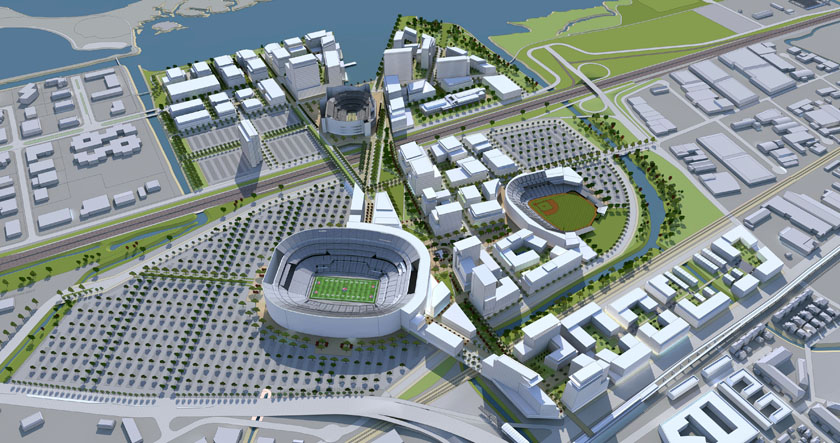
Raised park concourse that runs through Coliseum City

Raised park concourse that runs through Coliseum City

New City will be headed by Floyd Kephart of Renaissance Companies in San Diego. Renaissance is a consulting and advisory firm. Kephart’s main task will be to bring in the remaining money required to bridge the funding gap. He’s also responsible for signing up a master developer to oversee the entire 800 acre project. There are only a handful of companies that have experience doing projects of this size and scope. Forest City was expected to be the master developer originally, but they backed out when they saw the costs and potential returns. Miami Dolphins owner Stephen Ross runs Related Companies, another experienced firm for such work. Related is heading up the massive, $6.5 billion development north of Levi’s Stadium in Santa Clara. What does Kephart see that Forest City didn’t? We should soon find out.

The lone dissenting vote was CM Rebecca Kaplan, who pointed out that several deliverables are still missing, including the deal terms and financing model. Both of those items were expected over the summer, and when BayIG was pressed for them, were promised again in August (and apparently not delivered). Kaplan’s ties to the A’s extension and Lew Wolff’s recently returned campaign contributions make her moves somewhat suspect, but lack of follow-through on BayIG’s part is rather disappointing and unsettling when you consider the lead time they had to assemble the deliverables.

A big surprise to come out of the session was CM Larry Reid’s complete 180 on the project. He has been a fervent critic of the plan for at least a year now, and his effusive praise of Kephart is quite startling. That said, the project is in his district, so he stands to benefit if it comes through. He’s also not up for reelection this year, so he doesn’t have to back either Kaplan’s or Mayor Jean Quan’s visions. Reid remains Vice Chair of the Coliseum JPA Board.

Three months is an awfully short time to get the deal done. It’s not a matter of tying up loose ends. There are major deal points that have to be addressed.

  • Sign at least one tenant, preferably the Raiders to start
  • Engage the A’s and Warriors (even though neither team is interested)
  • Provide deliverables and reports that haven’t been completed yet (deal terms, financing, 2nd phase market analysis)
  • Bring in a master developer
  • Line up needed capital for stadium phase and ancillary development phases
  • Figure out who pays for the remaining debt at the Coliseum and Arena (if necessary)
  • Gather support of the JPA and Alameda County

It all feels like it’s going to get severely rushed, which could end in a horrendously bad deal for Oakland if they’re not careful. Quan’s calling the announcement a victory, though she neglected to mention that she said several times throughout the year that a team – the Raiders – would be a signed partner, at first during the summer, then late summer, then fall. Problem with trying to sign the Raiders is that because of the lack of concrete information on financing, investors, and viability, there’s no reason for the Raiders to sign on, and national reports echo that. Every time someone in Oakland talks up how the Raiders are getting ready to officially be a part of this, Mark Davis knocks that notion down. With the season almost half over and the NFL’s relocation window looming in February, there’s no reason for Davis to commit to anything before he feels it’s the right moment. The best deal for Davis comes with having the most options open, and that includes Oakland, Los Angeles, and maybe even San Antonio. He at least has limited leverage in that scenario. As for the the A’s, Lew Wolff is standing as far away from this as humanly possible, not wanting to make it anymore complicated, and not wanting to draw the short straw.

The JPA is busy getting ready for life after the Coliseum too. Last week they were ready to hire Republican Guy Houston, but the vote on his hire was delayed amidst renewed scrutiny into legal issues Houston had while in the State Assembly. The JPA did make a hire on Tuesday and his name will be familiar: former Oakland City Manager Robert Bobb. Bobb’s consulting firm is consulting the JPA on stadium and other development at the Coliseum, whether it’s Coliseum City or a Wolff-developed alternative. The cost to the JPA? $25,000 a month. Check out this org chart showing Bobb, Houston (or someone else), and the JPA.

Org chart supplied by The Robert Bobb Group

Org chart supplied by The Robert Bobb Group

The JPA doesn’t have the power to make any planning or zoning decisions. Only the City does. The County is co-owner of some of the land and could provide resources, so it also has a say in whatever happens. All I can say is that when you look at the above chart and all the different parties involved in Coliseum City, it’s a lot of cooks for one kitchen.

Tweets and commentary from 10/1 Oakland Planning Commission meeting

The public came out of the Planning Commission meeting with more questions than answers, and that’s a good thing. When the EIR comment period ends, it’s up to City staff and consultants to provide answers to the many question posed by the public.

A presentation was given to start. Early discussion focused on affordable housing as part of the plan. The plan calls for 5,750 housing units to be built. 25% of those are supposed to be affordable, whether via rental or purchase. The Bay Area’s ever-skyrocketing housing market makes that 25% a growing subsidy (public and/or private) with each passing month. According to trulia, the median price for a home in Oakland is $475,000, up 8% from September 2013. Oakland uses a HUD formula to calculate affordable housing on a regional basis. In essence, 25% of housing would have to be affordable for households making $72,000 or less per year. However, the median income in Oakland is less than $52,000/year. To make it work, the City and developers would have to crunch some serious numbers to determine the proper mix of pricing and subsidies, not to mention addressing low income residents and senior citizens – both groups represented by commenters at the meeting. Chances are that most of it would come out of developers’ pockets, though Governor (and former Oakland mayor) Jerry Brown has been working to get rid of affordable housing set-asides. This puzzle has to be solved by all residential developers in California, so it would affect Coliseum City’s principals or Lew Wolff and partners if they were given the opportunity. One East Oakland resident got straight to the point.

As the Commissioners took their turns picking apart the plan, one asked about the status of discussions with other parties that need to be involved. The responses?

That third tweet is interesting. We haven’t covered the bay inlet much. That’s a reference to the new part of the bay that would approach the new arena (assuming the Warriors stay at Coliseum City).

Inlet at top

Inlet at top

You might think that the inlet was designed for a ferry terminal or for boats with a dock. You would be incorrect. It’s merely a shallow extension of the estuary, a tidal mudflat not meant for recreation. It’s meant to provide an additional habitat to go with all of the new construction, but it seems like a wasted opportunity. Of course, providing a ferry terminal would bring about an even greater environmental review since some dredging would be required. A couple commissioners seized on the fact that of the various development options the no-build alternative was barely touched except to say that the various venues would be demolished and other development would fill in at some point. Since this is a Specific Plan and not just a small project-level EIR, it’s within the Planning Commission’s right to ask about what happens if the teams leave, since it’s a distinct possibility. The scenario should be addressed in more detail in the final EIR.

A few Raiders fans showed up to provide their support, including Dr. Death and Godfather Grizz. They were largely outnumbered by local residents who expressed concerns about the aforementioned housing problem, gentrification, the need for improved police and fire services in the area, and questions about the effects Coliseum City could have on the rest of Oakland. One thing I’m surprised to not hear was a question about what impact a second downtown (which is what CC represents) would have on the current downtown/uptown area. While that’s a question that goes broader than the existing project, it’s well within the Planning Commission’s purview to take on that kind of dilemma – if it’s a dilemma at all.

Coliseum employees who want to see their jobs protected were well represented. One resident noticed the streetcar that runs through the complex and wanted to see it expand all the way out through East Oakland and up International Blvd. If a streetcar is going to be put in at all, that’s the way to do it. A commissioner noted that while BART and the new AirBART are getting a lot of attention, very little is being paid to how AC Transit and Amtrak will be integrated. AC Transit is as important as anything, because while buses aren’t sexy, they will be responsible for providing transit for many of the low-wage workers that will be working at the hotels in the plan, especially at odd hours.

Overall, there was a large undercurrent of sentiment that Coliseum City is being conceived as an island, not well integrated with East Oakland. That itself is a dilemma, because developers don’t want their shiny condos associated with East Oakland’s rep while community groups and residents are desperately hungry for the opportunities the project represents. As part of Mayor Jean Quan’s 10K-2 plan, Coliseum City represents a big piece of a goal she’s trying to reach.

The Coliseum area had lost a few hundred jobs over the decade from 2000-10. Now it’s being counted on to retain three sports franchises – two of whom have no interest in the plan, along with around 4,000 new jobs throughout the 800-acre development. Developers tend to make big promises about such economic growth which get lost in market realities. Perhaps it’s time for more scrutiny of these estimates.

Oakland Planning Commission meeting (October 1st, 6 PM)

Tonight’s monthly meeting of the Oakland Planning Commission may be of interest to you, since the third item on the agenda is Coliseum City. Some relevant links:

This session comes on the heels of Coliseum City presentations made for the JPA Board and Port of Oakland’s Board last week. I’ll live tweet when the item comes up for discussion and do the wrap-up in this post after they’re done. Apparently there will be numerous Raiders fans there in support of the project. If you’re interested in the subject, I suggest watching.

San Jose’s uphill battle against MLB continues in 9th Circuit court

This is how oral arguments started today.

For San Jose, it pretty much went downhill from there. City of San Jose Attorney Philip Gregory was up first, and he had a very tough time against the three man panel of judges: Chief Judge Alex Kozinski, Judge Barry Silverman, and Judge Richard Clifton. Gregory asserted that the Portland Baseball case limits the antitrust exemption to the reserve clause. Kosinski and Clifton took issue with that. Gregory argued that the prior cases often cited (Portland, Curt Flood) are more about minor league-major league system interactions/transactions than major league franchise movement. The judges didn’t appear to be swayed. Gregory was left to argue that the case shouldn’t be dismissed at this early stage, and should go to discovery.

MLB lawyer John Keker was next, and he had a much easier time. He was able to go at least 2 minutes without being interrupted, which indicates that the judges had little to question.

The most resistance Keker got into was a hypothetical that Kozinski put forward. The judge first asked Keker if baseball has an antitrust exemption, doesn’t that mean that this case automatically doesn’t have standing? Keker agreed. This was also a key tenet of MLB’s filings going into today’s hearing. There was even a playful back-and-forth between Kozinski and Keker, in which Kozinski prodded, “Just between you and me…” That was followed by a chuckle from the much larger-than-normal gallery. Keker kept to his argument.

That left the rebuttal to Joe Cotchett, who brought props. That led to this exchange:

Cotchett tried his best to take down MLB, calling the territorial distribution as outlined in the Major League Constitution one that builds an “economic wall” around San Jose (Santa Clara County) because no team is allowed to move in there. He also brought up the recent decision in a US District Court to allow an antitrust case to move forward against MLB and broadcasters over TV blackouts and exclusive territories. Judge Clifton didn’t appear to be swayed by this either.

Despite the poor outlook for San Jose, Cotchett got to hold another presser outside the courtroom after adjournment, which for him is just as important as the actual proceedings inside. Even if he loses this case in the Ninth Circuit, he aims to bring it all the way to the Supreme Court. The way things look now, getting there would be the equivalent of a six-run home run.

Courthouse coverage comes from the Merc’s Howard Mintz and Fangraphs’ Wendy Thurm.

What happened to the Stand for San Jose case?

I really should check into these court cases more than once every couple weeks.

While many eyes will be focused on the City of San Jose’s Ninth Circuit appeal against Major League Baseball this Tuesday, another case appears to have been resolved. That would be “citizen group” Stand for San Jose’s lawsuit against the City in Santa Clara County Superior Court. A hearing was scheduled for the end of this week, August 15. However, that was wiped away as the court vacated the hearing. In fact, the court now has the case status as disposed as of July 24. In other words, the case is resolved, over, done. Big hat-tip to Wendy Thurm, who alerted me to this on Friday.

The only recent action leading up to that point was notice that the Oversight Board of SARA (Successor Agency of the Redevelopment Agency) would file its own motion to dismiss by July 25. The idea was that since the Oversight Board was given the power to dispose of the Diridon ballpark parcels however it saw fit as long as it took care of financial obligations to the state. That was to lead for a motion for pleadings on August 15. Then suddenly, the dismissal on July 24. It’s important to note that it’s a dismissal without prejudice, so it could come back at some point. Regardless, it’s a surprising move for all concerned. I’ve asked around to understand what happened, and haven’t gotten any answers yet.

Besides the legal maneuvering, one other thing has happened this summer that might have brought all parties to the table. That would be the A’s and the Coliseum JPA approving an extension at the Coliseum through at least 2018 (up to 2024). Obviously that’s speculation, and the filings may reveal something else, which is why I’m heading to Superior Court tomorrow afternoon. Be forewarned: I don’t expect to get much out of my inquiry. When cases are resolved in a non-public manner as this was, the parties can sometimes choose to reveal little about the motivations to do so.

Then again, there’s this update which came in on Friday:

081414

Some day all this legal stuff will end and there will be a ballpark under construction. Maybe.

Wake up, Oakland

“Better a diamond with a flaw than a pebble without.” – Confucius

There are any number of ways to rephrase the idiom above. Some might use “A bird in hand is worth two in the bush,” though the meaning is not the same. Voltaire coined the phrase a little more directly.

The perfect is the enemy of the good.

As I listened to Don Knauss make yet another sales pitch about the virtues of Howard Terminal (and Damon Bruce’s softball handling of it), I started to write a point-by-point rebuttal of everything he said. Then, thanks to BANG’s Matthew Artz, I read a 6-page letter from Lew Wolff to Oakland Interim City Administrator Henry Gardner. The letter outlined Wolff’s desire for a lease extension at the Coliseum before leading into the questions surrounding the future of the Coliseum.

Two pages of the letter are devoted to a section called “The Raiders”. Instead of pointing fingers at the Raiders or Mark Davis, Wolff mostly pans BayIG, the Coliseum City plan, and all of the work that has gone into it so far.

I contrasted words from both Knauss and Wolff. The Clorox CEO talked about a transformative project that could hugely benefit downtown Oakland, which it could. A similar description has been made about Coliseum City by its proponents, comparing it to LA Live among other developments. Then there was Wolff, going detail by detail about the process, the difficulty, tedium, and the obstacles. He even lashed back at “Negative Forces” agitating at every possible turn, which could be construed as a critique of Don Knauss or others allied with Knauss.

The argument, which has stretched as long as Wolff and John Fisher have owned the A’s, comes down to Voltaire’s quote. Wolff’s #1 job this entire time has been to get a ballpark. Let’s understand some of those efforts.

  • 2003 – Wolff was hired by Steve Schott and Ken Hofmann to be the VP of Venue Development. During that brief tenure, Wolff proposed building in the Coliseum’s A Lot and at the Malibu/HomeBase lots. The A Lot option went nowhere because Schott was only willing to put up $100 million for the ballpark. The Malibu option was not available because it was not JPA-owned land. Eventually the JPA bought the land in order to assemble a larger complex for what would be become Coliseum City.
  • 2005 – Wolff exercises an option to buy the team, phasing Schott & Hofmann out and bringing Fisher and numerous associates of Wolff in. Wolff soon proposes the Coliseum North (66th/High) plan, which would redevelop a large swath of industrial land north of the Coliseum complex into a ballpark and mixed-use (residential, retail, commercial) plan. The plan received great fanfare at first, but quickly died as numerous existing landowners showed no interest in selling.
  • 2006 – The Fremont Baseball Village plan is proposed in south Fremont near the Santa Clara County line. A compromise plan of sorts, the idea was to court Silicon Valley corporate interests without crossing into the Giants-held territory of Santa Clara County. Again, there is great immediate enthusiasm, this time from Fremont city leaders. This time, a combination of the Great Recession and big box stores vetoing any developments they didn’t approve of killed the plan. Another attempt in 2010 was made to put the ballpark near the NUMMI (now Tesla) factory across the Nimitz. That was met with hostility from well-heeled residents on the other side of I-680 and fell apart quickly.
  • 2009 – San Jose becomes the next plan, with a partially-acquired site downtown, major corporate and civic support, and a certified environmental impact report ready to go. Again the plan stalled as the Giants remained intransigent about their held territory. A lawsuit filed by people associated with the San Jose Giants (eventually a SF Giants-owned property) threatened the project and is still ongoing. The City of San Jose became frustrated and launched its own lawsuit in 2012 against MLB. That too is ongoing.
  • 2009 – Let’s Go Oakland launches with support of three sites in downtown Oakland: Victory Court, JLS West, and Howard Terminal. Victory Court becomes the preferred site in 2010. LGO promoted Victory Court as much as possible, backed by local developers. No significant activity occurs in 2011, and by the beginning of 2012 the site is dead due to the death of redevelopment and spiraling site acquisition costs.
  • 2012 – Not long after Victory Court goes away, murmurs about Howard Terminal becoming the new preferred (not by A’s ownership) Oakland site begin. In 2013, the Port of Oakland negotiates a settlement with SSA Terminals to vacate the site in order to consolidate facilities and kill a lawsuit against the Port. That allows the Port to look into non-maritime uses such as a ballpark, which it does in spring 2014. A new investor/support group, OWB (Oakland Waterfront Ballpark), emerges, led by Knauss and former Dreyer’s CEO T. Gary Rogers.
    While Wolff has been trying to deal with the on-the-ground demands of planning and building a ballpark, many in Oakland have been fixated on grand concepts like Coliseum City and the far-off promises of Howard Terminal and Victory Court. Even yesterday, Knauss couldn’t help but bring San Francisco into the discussion, talking up how a HT ballpark would have better weather and views than AT&T Park. Coliseum City would be a transformative project that could attract Super Bowls and give Oakland new cachet.

Oakland’s desires to become something bigger and better are completely understandable. But they’ve been so pie-in-the-sky, so big, that there’s always been huge doubts about what, if anything, the City could pull off. I’ve mentioned before that Oakland has never built anything by itself, and that it needed the County and the business community to come together to make the Coliseum work nearly 50 years ago. That need hasn’t changed, but the sense of teamwork has. In Oakland’s attempt to keep all three teams in place, it has gotten away from what got them the teams in the first place: strong partnerships and sensitivity to the teams’ needs. Nowhere is that more evident than in Coliseum City, where the County is playing the realist role in questioning the project and in looking to the A’s, while the City brings in big names with no commitments, entirely footing the bill along the way.

Oakland keeps searching for the perfect project, the ultimate solution, the one that will finally vault them past the City beyond its rival across the Bay. Some politician(s) would take credit when it gets done, a legacy-defining moment. So they keep dreaming, keep hoping, clearly not worried about the little details that need to be addressed or the problems that arise when undertaking big projects. At some point, someone in Oakland will recognize that the dreams need to be tempered with what can realistically be done, and understand the work that will be required to get it done – establishing partnerships with the teams and stakeholders for starters. If not, the teams will get frustrated and give up. Those dreams will die. The biggest pro sports Oakland will be able to get will be minor league (which for some is okay). And the Coliseum, home of six world championships, will end up unused, even more unloved, and ultimately, something generic like a shopping center. That’s what happens when the well-intended keep pursuing the ever-elusive perfect instead of understanding that good is actually pretty great.

Lew Wolff is getting ready to offer what could be a pretty good deal. If Oakland wakes up, they may be able to react in time to take it.

—-

P.S. – I’m removing comments from the site for the time being. It’s not because of the commenters or specific comments – although they can be especially inane at times – it’s because those comments and the constantly attacking spambots (which you don’t see) are causing heavy server load, for which I’ve been warned by my provider. I hope that by having no comments there will be less server load. Thanks for your patience.

Oakland City Council Meeting 7/16 Open Thread

If, like me, you can’t make it to the meeting tonight, you can watch the stream here. You’ll need Silverlight or Real Player to watch. If anyone knows how I can embed one of these old Granicus streams, I’ll post it here.

The comments are open if you want to have a civil, on-topic discussion. I’ll also be live tweeting and mirroring here.

Reference documents (PDF):
Agenda
Coliseum Lease