90 Days Or Bust

The last post had some fortuitous timing, as a breaking Chronicle item came in just as I was about to hit publish. That was followed by articles in the Tribune and SF Business Times, so read those to get the full (for now) scoop.

In short, the City Council voted 6-1 to approve a 90-day extension. That’s a marked departure from the 6 months that was previously expected. Motivation for moving up the deadline is unclear. It could be confidence on the new investor group’s part. It could be the need for Oakland to show something before the February NFL relocation window opens, which only a 90-day timeline would accomplish. Perhaps it’s a little of both. In any case the City of Oakland and the new working group, New City Development LLC, will have until MLK Day to prove itself.

Raised park concourse that runs through Coliseum City

Raised park concourse that runs through Coliseum City

New City will be headed by Floyd Kephart of Renaissance Companies in San Diego. Renaissance is a consulting and advisory firm. Kephart’s main task will be to bring in the remaining money required to bridge the funding gap. He’s also responsible for signing up a master developer to oversee the entire 800 acre project. There are only a handful of companies that have experience doing projects of this size and scope. Forest City was expected to be the master developer originally, but they backed out when they saw the costs and potential returns. Miami Dolphins owner Stephen Ross runs Related Companies, another experienced firm for such work. Related is heading up the massive, $6.5 billion development north of Levi’s Stadium in Santa Clara. What does Kephart see that Forest City didn’t? We should soon find out.

The lone dissenting vote was CM Rebecca Kaplan, who pointed out that several deliverables are still missing, including the deal terms and financing model. Both of those items were expected over the summer, and when BayIG was pressed for them, were promised again in August (and apparently not delivered). Kaplan’s ties to the A’s extension and Lew Wolff’s recently returned campaign contributions make her moves somewhat suspect, but lack of follow-through on BayIG’s part is rather disappointing and unsettling when you consider the lead time they had to assemble the deliverables.

A big surprise to come out of the session was CM Larry Reid’s complete 180 on the project. He has been a fervent critic of the plan for at least a year now, and his effusive praise of Kephart is quite startling. That said, the project is in his district, so he stands to benefit if it comes through. He’s also not up for reelection this year, so he doesn’t have to back either Kaplan’s or Mayor Jean Quan’s visions. Reid remains Vice Chair of the Coliseum JPA Board.

Three months is an awfully short time to get the deal done. It’s not a matter of tying up loose ends. There are major deal points that have to be addressed.

  • Sign at least one tenant, preferably the Raiders to start
  • Engage the A’s and Warriors (even though neither team is interested)
  • Provide deliverables and reports that haven’t been completed yet (deal terms, financing, 2nd phase market analysis)
  • Bring in a master developer
  • Line up needed capital for stadium phase and ancillary development phases
  • Figure out who pays for the remaining debt at the Coliseum and Arena (if necessary)
  • Gather support of the JPA and Alameda County

It all feels like it’s going to get severely rushed, which could end in a horrendously bad deal for Oakland if they’re not careful. Quan’s calling the announcement a victory, though she neglected to mention that she said several times throughout the year that a team – the Raiders – would be a signed partner, at first during the summer, then late summer, then fall. Problem with trying to sign the Raiders is that because of the lack of concrete information on financing, investors, and viability, there’s no reason for the Raiders to sign on, and national reports echo that. Every time someone in Oakland talks up how the Raiders are getting ready to officially be a part of this, Mark Davis knocks that notion down. With the season almost half over and the NFL’s relocation window looming in February, there’s no reason for Davis to commit to anything before he feels it’s the right moment. The best deal for Davis comes with having the most options open, and that includes Oakland, Los Angeles, and maybe even San Antonio. He at least has limited leverage in that scenario. As for the the A’s, Lew Wolff is standing as far away from this as humanly possible, not wanting to make it anymore complicated, and not wanting to draw the short straw.

The JPA is busy getting ready for life after the Coliseum too. Last week they were ready to hire Republican Guy Houston, but the vote on his hire was delayed amidst renewed scrutiny into legal issues Houston had while in the State Assembly. The JPA did make a hire on Tuesday and his name will be familiar: former Oakland City Manager Robert Bobb. Bobb’s consulting firm is consulting the JPA on stadium and other development at the Coliseum, whether it’s Coliseum City or a Wolff-developed alternative. The cost to the JPA? $25,000 a month. Check out this org chart showing Bobb, Houston (or someone else), and the JPA.

Org chart supplied by The Robert Bobb Group

Org chart supplied by The Robert Bobb Group

The JPA doesn’t have the power to make any planning or zoning decisions. Only the City does. The County is co-owner of some of the land and could provide resources, so it also has a say in whatever happens. All I can say is that when you look at the above chart and all the different parties involved in Coliseum City, it’s a lot of cooks for one kitchen.

Coliseum City ENA likely to be extended at closed session

Update 5:30 PM – Looks like this turned into a nice pre-election announcement for Mayor Quan.


Original post:

Today’s the “big” deadline day for Coliseum City. Or maybe not. Consider the following closed session agenda item, to be taken up this afternoon:

b) Property: Coliseum City properties (various properties bounded by San Leandro Street, 66th Avenue, Edgewater and Helgenberger)

City Negotiators: Fred Blackwell, Gregory Hunter, Larry Gallegos, Daniel Rossi

Negotiating Parties: Bay Investment Group, JRDV Architects Inc., HKS Architects, Inc.

Under Negotiation: Price and terms for disposition of the property

Not much to go on, is there? We know that the deadline is there thanks to previous documents about Coliseum City which specified 10/21:

ENA Timeframe: The Negotiation Period under the ENA is hereby extended to run until October 21, 2014, and may only be extended an additional six months with administrative approval.

October 21 also marks the 360-day point of consideration of the project, during which BayIG was supposed to provide a set of deliverables. A quick recap of some of the major deal points:

  • Tenant sign-on from one, two, or three current sports franchise tenants (Raiders, A’s, Warriors) – None so far
  • Market Data Analysis – The lengthier second part was supposed to have been released by now, has not been made publicly available
  • Infrastructure Study – Completed
  • Investor Business Case – Reportedly late, not publicly released

Last week there was news that a new, previously unknown investor may come in to save the project. Word was that it would be Perry Capital – a hedge fund with two recent executives who have a minority share of the Raiders – they and the City are going to great pains to keep their involvement under wraps until/unless the ENA is extended. Now Matier and Ross report something different:

Council members privately told us they were encouraged by the team’s 11th-hour addition of new deep-pocket investors being represented by San Diego asset manager adviser Floyd Kephart, chairman of the board of Renaissance Cos. Kephart is expected to take the lead role in the newly reconstituted group, New City Development LLC.

So goodbye BayIG, hello New City Development LLC? Okay.

Also last week, we saw a new website promoting the project, Coliseum City Now. I looked into it and found out that the domain was only acquired on September 26. A companion Facebook page started up during the summer. Assuming that both are under the purview of BayIG/JRDV, the timing seems a little suspect. Coliseum City never bothered to have an website outside of the City’s project page for a year. Why have one now? There’s also a Twitter feed, which has never made a post and has less than 20 followers. Chances of a post coming after 5 PM today? Excellent.

birdseye-view_north

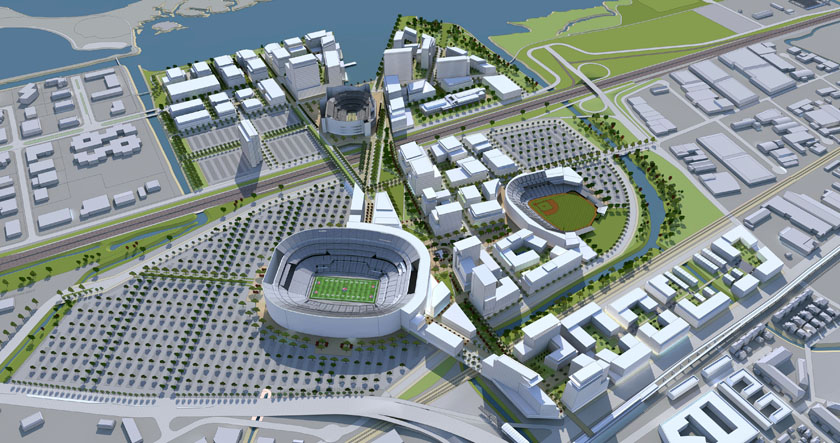
Coliseum City in full buildout

In anticipation of the extension, some unnamed City officials reached out to Raiders fans to make a show of support at the open session at 5, during which the decision is expected to be announced. Keep in mind that it’s basically up to the City Administrator, not the City Council. Also understand that not extending the deadline would effectively kill the project, giving Mark Davis every excuse to go to Los Angeles. What other choice does Oakland have?

If the City announces the ENA extension and the new investor, the mountain to climb for them will be steeper that the Mt. Davis upper deck. They’ll need to wrap up the basic terms of the deal, have the Raiders sign on before they decide to move, and start work with the JPA and Alameda County to put together the DDA (Disposition and Development Agreement), which would allow the project to move forward in earnest, in whatever form it takes. In reality, Coliseum City has 4 months to work out the details, not 6.

On a related note, the comments period for the Draft EIR expired on Friday, October 17. The City will take all the comments and get questions answered from stakeholders and other groups that need to provide answers (Caltrans, PG&E, and the PUC for starters). The EIR runs on a separate track from the business side of the deal, though both need to be resolved/approved before any dirt can be turned.

As for the news impact on the A’s – as I’ve said for some time, the funding gap ($600 million) makes the inclusion of a ballpark extraordinarily difficult to pull off in a way that would satisfy both the baseball team, the public sector, and the private investors who are looking for a healthy return. Moving to more far-off forms of financing makes the likelihood of a ballpark even less.

I’ll be checking into the live stream of the open session while watching the World Series. The mix of tweets promises to be entertaining and at times quite confusing.

Kaplan returns Wolff campaign donations; Coliseum City courts hedge fund

Last week the Trib’s Matthew Artz asked Oakland City Council member and mayoral candidate Rebecca Kaplan about $2,100 in donations that came from Lew Wolff, his wife and daughter. There was a suggestion of impropriety, as an Oakland law prohibits campaign contributions from any party that has done contract negotiations with the City during the prior six months. After huddling with her staff over the legality of the donations, Kaplan decided to return the checks. Wolff appeared to be unaware of the law. You may remember that Wolff donated a much more eye popping sum of $25,000 to a committee backing Don Perata’s mayoral campaign during the 2010 election, a move that may have helped cost Perata the election. Perata admitted that he wasn’t going to waste time or money trying to keep the A’s in town.

That’s a much different stance than Kaplan today, as she has staked a claim to helping save the A’s by spearheading lease extension talks. Kaplan has also supported Coliseum City, though the project is considered Mayor Jean Quan’s baby, at least politically. The now returned donations are under investigation by the California Fair Political Practices Commission, as is another $1,000 that was donated to a Kaplan committee whose fund has been liquidated under similar concerns.

Kaplan has been the frontrunner in recent polls, beating Quan in a projected ranked choice voting scenario. It’s unclear what damage the donation investigation could cause the Kaplan campaign, which is only three weeks from the election.

Matier and Ross reported over the weekend that Coliseum City is getting cozy with yet a hedge fund to potentially finance the project. The SF Business Times revealed that the target is Perry Capital, a fund managed by Paul Leff and Dan Golding. They purchased a non-voting, minority share (20%) of the Raiders for $150 million from Al Davis before his death. The fact that Perry already owns a share of the team gives the story more credence than previous stories about the Crown Prince of Dubai. Then again, let’s keep in mind the rather unimpressive amount of financial support for the project so far:

Forest City backed out because they didn’t see the numbers working out. Colony/HayaH has purportedly been hesitant to fully commit for similar reasons. The Dubai story was just that, a story, and Perry Capital? Well, at least there’s an existing relationship there. There’s a $500-600 million funding gap that needs to be addressed. If Perry is going to assume a large percentage, they’ll want their pound of flesh in return. That could mean a larger slice of the team, though Mark Davis is reluctant to drop below a controlling percentage, which in the NFL has been 30% for a family and 10% for a controlling partner in that family. Davis and his mother own 50-51%, so there’s some room to drop. The NFL may also be looking to lower the requirements for legacy family ownerships.

It’s hard to judge based on the limited information we have, but we can assume that trading in a share of the team for a private stadium subsidy (to be paid back by a rise in team equity and development revenues) is an option available in both Oakland and Los Angeles, and perhaps in San Antonio as well. Leff and Golding have seen their investment appeciate 29% since their 2007 purchase, which seems impressive enough except when compared to the skyrocketing values of many other NFL teams. The Raiders for now are a low revenue team in a low value market, with the only obvious recourse being the construction and selling out of a new stadium. Leff and Golding could push hard and try to bring in even more partners to spread out the risk. The problem is that Coliseum City is clearly a long game, with significant profits going to pay for the stadium and ancillary development. Rental and real estate sales revenue are the prize that will take years to materialize.

The struggle to attain financing for Coliseum City highlights how different Coliseum City is from other NFL stadium development plans. The NFL and the Raiders at first wanted to focus on the stadium, with further development coming down the line and not necessarily tied to stadium loans or bonds. The league has a very sophisticated financing structure in place. It gauges the size of the stadium project, assesses the ability of the applicant team to pay for its share, and doles out loans from its G-4 program. The league also plays matchmaker, hooking team owners up with huge financial institutions like Goldman Sachs and BofA. Those banks are there to manage that funding gap, the same kind that Coliseum City is trying to fill for the Raiders. When Oakland decided to move in their own direction, the NFL decided to play wait-and-see with the project. If JRDV and the other CC principals can pull it together, the NFL can give the project its blessing and untie the G-4 purse strings. If not, Oakland’s future will look very bleak on the Raiders front. It makes one wonder why they’re going to so much trouble when there is a tried-and-true method to financing a new NFL stadium. It limits the number of potential partners in favor of a high-risk strategy with a low chance of success. And if they’re having to resort to working with a hedge fund, the usual avenues for funding may all be exhausted.

There is some historical symmetry to this effort, as the original Oakland-Alameda County Coliseum Complex was privately financed after Bob Nahas and others went to some far-flung places to secure that funding. The ENA deadline is October 21, and news of a new partner may allow Oakland to extend the period six months, though such a transparent move isn’t likely to gain Mark Davis’s support. The development team has spent three years and $5 million on Coliseum City. What do they have to show for it? So far, not much beyond the 3,500 pages in the EIR.

LA smoke = NFL’s fire

So far this year I’ve mostly held off from commenting the routine every-six-weeks rumors about a NFL team or two moving to LA. Buttressed by nothing but anonymous sources and a whisper campaign, I chose to sit back and wait for real news to come forth. Unfortunately for the three cities in line to have potential relocation candidates – San Diego, St. Louis, and Oakland – there’s now too much going on to dismiss it all as mere rumors. Something else is happening, and chances are the NFL is directing the whole affair.

Could Dodger Stadium be a temporary NFL home? The NFL isn't dismissing the idea.

Could Dodger Stadium be a temporary NFL home? The NFL isn’t dismissing the idea.

It always starts out with the NFL leaking info to two national reporters, NBC Sports/Pro Football Talk’s Mike Florio and CBS Sports’ Jason La Canfora. “Fresh” rumors will cycle about the aforementioned teams, or even the Bills, Jaguars, and Vikings prior to their respective ownership or stadium changes. The nature and frequency of such leaks – with little subsequent activity to make them pay off – made them easy to dismiss. Now, I’m not so sure. Last week AEG asked the City of Los Angeles for a six-month extension to bring in a team. The current agreement is set to expire next week, on October 17. An additional six months would allow AEG to cover the postseason window during which teams are allowed to declare their intent to relocate, usually in February. That could easily happen with the Rams and/or Raiders, who are unencumbered by leases past this season.

Then yesterday, LA Times football reporter (and former Merc scribe) Sam Farmer revealed that the NFL may consider Dodger Stadium as a temporary stadium. That would put three venues in play in LA: the Rose Bowl, LA Memorial Coliseum, and Dodger Stadium. Each comes with a sticking point, even for temporary use. The Rose Bowl has a restriction on the number of large events that can be held there, yet the City of Pasadena wants to encourage additional events that could help it pay for $168 million in recent renovations. The LA Coliseum is controlled by USC under a new lease agreement. An NFL team having to play tenant to a college is not something the league prefers, and the size and condition of the venue are not ideal either. Dodger Stadium, not previously considered as a temporary venue, has a hard cap on the number of seats inside the venue at 56,000. That’s small for NFL’s taste, and it’s obviously not a football stadium. However, Dodger Stadium has plenty of suites and luxury amenities that any team could use to make up for the lack of capacity by jacking up prices. Previously Dodger Stadium had been considered as a potential football venue, with new construction either adjacent to or replacing the current venue with the baseball team moving downtown. That’s an extremely far-fetched idea that has far too many moving parts (AEG, Guggenheim, City) to take seriously at the moment.

One idea that seems possible is the NFL making agreements with two or perhaps all three venues to host some numbers of games. This is especially important if two teams come to LA. The NFL would be able to play matchmaker, juggling three teams and three venues. Eventually one team and one venue will lose out, creating a competitive environment largely controlled by the league. They already wield control in the form of the G-4 stadium financing program and the associated hookups with banks and large financiers such as Goldman Sachs. Those hookups are just as important as G-4 because they mean that the bulk of the stadium construction cost wouldn’t have to be bonded through an open market (read: more expensive) process. Stan Kroenke is certainly rich enough to build a stadium at Hollywood Park himself, but he’s not going to turn down savings of several million per year in order to do it.

Moreover, the NFL has assigned an executive to oversee the LA market. From the LA Times:

Eric Grubman, an NFL executive vice president, said the league was guardedly optimistic about its discussions with AEG and supported the company’s request for an extension of its agreement with the city.

“The discussions are very preliminary, but we are encouraged enough by recent progress that we share AEG’s view that continued conversations would be worthwhile,” he said in a statement. “An extension could well provide the time necessary for us and AEG to determine whether the downtown site can be considered by our membership during our next off-season period.”

AEG’s seemingly dead Farmers Field project has suddenly gotten a boost and some level of validation from the league. The NFL probably still doesn’t like the terms (AEG gets piece of relocating team in exchange for building stadium), but such an exchange may be unavoidable in the future. It certainly doesn’t hurt or cost the NFL to keep Farmers Field in play for now. Ed Roski’s City of Industry plan, a frontrunner several years ago, appears beyond dead though the land remains available if the NFL is willing. There’s even the crazy concept of the NFL building a stadium on its own and housing two teams within. It would be the ultimate in control, though the league would have to go through the lengthy, arduous CEQA process to get it done.

Finally, there’s the very basic notion of teams and the NFL using LA as a stalking horse, which it has done successfully for nearly two decades. While that card will always be in play, inaction on the local level by San Diego, Oakland, and St. Louis make the tactic less effective than it has been previously. If the NFL can use scare tactics to cajole one of these cities to pony up for a stadium, I imagine that they’ll consider it a success. The other two can relocate under the NFL’s guidance and supervision. Relocation fees would probably be baked into the stadium deals and a sale of an ownership stake, with the payoff coming in the form of a 2X franchise valuation.

Now that the FCC has struck down local market NFL blackouts, the ratings-related advantages for keeping teams out of LA will disappear after the current broadcast agreements expire in 2022. It’s a good time for the NFL to act.

Tweets and commentary from 10/1 Oakland Planning Commission meeting

The public came out of the Planning Commission meeting with more questions than answers, and that’s a good thing. When the EIR comment period ends, it’s up to City staff and consultants to provide answers to the many question posed by the public.

A presentation was given to start. Early discussion focused on affordable housing as part of the plan. The plan calls for 5,750 housing units to be built. 25% of those are supposed to be affordable, whether via rental or purchase. The Bay Area’s ever-skyrocketing housing market makes that 25% a growing subsidy (public and/or private) with each passing month. According to trulia, the median price for a home in Oakland is $475,000, up 8% from September 2013. Oakland uses a HUD formula to calculate affordable housing on a regional basis. In essence, 25% of housing would have to be affordable for households making $72,000 or less per year. However, the median income in Oakland is less than $52,000/year. To make it work, the City and developers would have to crunch some serious numbers to determine the proper mix of pricing and subsidies, not to mention addressing low income residents and senior citizens – both groups represented by commenters at the meeting. Chances are that most of it would come out of developers’ pockets, though Governor (and former Oakland mayor) Jerry Brown has been working to get rid of affordable housing set-asides. This puzzle has to be solved by all residential developers in California, so it would affect Coliseum City’s principals or Lew Wolff and partners if they were given the opportunity. One East Oakland resident got straight to the point.

As the Commissioners took their turns picking apart the plan, one asked about the status of discussions with other parties that need to be involved. The responses?

That third tweet is interesting. We haven’t covered the bay inlet much. That’s a reference to the new part of the bay that would approach the new arena (assuming the Warriors stay at Coliseum City).

Inlet at top

Inlet at top

You might think that the inlet was designed for a ferry terminal or for boats with a dock. You would be incorrect. It’s merely a shallow extension of the estuary, a tidal mudflat not meant for recreation. It’s meant to provide an additional habitat to go with all of the new construction, but it seems like a wasted opportunity. Of course, providing a ferry terminal would bring about an even greater environmental review since some dredging would be required. A couple commissioners seized on the fact that of the various development options the no-build alternative was barely touched except to say that the various venues would be demolished and other development would fill in at some point. Since this is a Specific Plan and not just a small project-level EIR, it’s within the Planning Commission’s right to ask about what happens if the teams leave, since it’s a distinct possibility. The scenario should be addressed in more detail in the final EIR.

A few Raiders fans showed up to provide their support, including Dr. Death and Godfather Grizz. They were largely outnumbered by local residents who expressed concerns about the aforementioned housing problem, gentrification, the need for improved police and fire services in the area, and questions about the effects Coliseum City could have on the rest of Oakland. One thing I’m surprised to not hear was a question about what impact a second downtown (which is what CC represents) would have on the current downtown/uptown area. While that’s a question that goes broader than the existing project, it’s well within the Planning Commission’s purview to take on that kind of dilemma – if it’s a dilemma at all.

Coliseum employees who want to see their jobs protected were well represented. One resident noticed the streetcar that runs through the complex and wanted to see it expand all the way out through East Oakland and up International Blvd. If a streetcar is going to be put in at all, that’s the way to do it. A commissioner noted that while BART and the new AirBART are getting a lot of attention, very little is being paid to how AC Transit and Amtrak will be integrated. AC Transit is as important as anything, because while buses aren’t sexy, they will be responsible for providing transit for many of the low-wage workers that will be working at the hotels in the plan, especially at odd hours.

Overall, there was a large undercurrent of sentiment that Coliseum City is being conceived as an island, not well integrated with East Oakland. That itself is a dilemma, because developers don’t want their shiny condos associated with East Oakland’s rep while community groups and residents are desperately hungry for the opportunities the project represents. As part of Mayor Jean Quan’s 10K-2 plan, Coliseum City represents a big piece of a goal she’s trying to reach.

The Coliseum area had lost a few hundred jobs over the decade from 2000-10. Now it’s being counted on to retain three sports franchises – two of whom have no interest in the plan, along with around 4,000 new jobs throughout the 800-acre development. Developers tend to make big promises about such economic growth which get lost in market realities. Perhaps it’s time for more scrutiny of these estimates.

Oakland Planning Commission meeting (October 1st, 6 PM)

Tonight’s monthly meeting of the Oakland Planning Commission may be of interest to you, since the third item on the agenda is Coliseum City. Some relevant links:

This session comes on the heels of Coliseum City presentations made for the JPA Board and Port of Oakland’s Board last week. I’ll live tweet when the item comes up for discussion and do the wrap-up in this post after they’re done. Apparently there will be numerous Raiders fans there in support of the project. If you’re interested in the subject, I suggest watching.

Former Assemblyman & Dublin Mayor Guy Houston in running for JPA Exec Director position

Rumors bubbled up last week on the inter webs about the Coliseum JPA potentially filling its vacant Executive Director position. BANG has reported further on it, lending the story credence. The leading (only?) candidate is Guy Houston, a Republican lobbyist who spent 6 years in the Assembly. Prior to that he was the mayor of Dublin.

Guy Houston

Deena McClain has been the Authority’s Interim Executive Director for some time, also serving as legal counsel. During the lease discussions over the summer, you may remember that she was the point person for any and all questions about the current lease terms, outstanding debt, and operations of the Coliseum complex. McClain, in concert with outside counsel, negotiated the A’s lease on the JPA’s side. That would be Houston’s role should he take the job.

Should the Raiders elect to stay in Oakland for however many additional years, Houston’s first task would be to negotiate that lease extension. Beyond that, he’d have to lead talks for the future of the complex, whether it’s Coliseum City or a successor plan. The position has been vacant for so long that it’s easy to forget its importance. Take a look this excerpt from the still-relevant-albeit-outdated job description:

The ideal candidate will:

  • Be a strong and visible leader;
  • Have very strong analytical and problem solving skills;
  • Be able to evaluate, analyze and interpret complex financial statements and reports;
  • Be able to develop, present and defend financial reports/profit loss statements;
  • Have excellent communication abilities both orally and in written form;
  • Be able to draft, interpret, negotiate and apply complex contract language;
  • Have strong facilitation and mediation skills;
  • Be a consensus builder;
  • Understand the political process and public meeting dynamics and requirements;
  • Identify and present the best business decisions and practices in a political environment;
  • Understand sports franchise businesses and the dynamics of their operation;
  • Understand comparable stadium/arena/entertainment facility operations;
  • Will know or be able to learn the market and the best practices;
  • Be able to build and maintain a good organizational public image;
  • Develop and maintain positive media relations.

Before any of you start emailing your resumes, there are also some specific requirements for the job:

MINIMUM REQUIREMENTS

  • A degree in business administration, public administration, economics, or another closely related field. An advanced degree is desirable.
  • Experience managing a similar revenue generating enterprise owned by a public entity or managing a facility comparable to the Coliseum Complex.
  • Experience demonstrating successful application of the abilities and traits of “The Ideal Candidate”.

If you’re still in college, or you work some midlevel position in the private sector, you need not apply.

Having served in the public sphere for well over a decade, Houston’s certainly qualified. The real questions are about his station within the JPA and his designs on the job. Houston was termed out of his Assembly District 15 job in 2008. He then ran for Contra Costa County Supervisor and lost, then went for the GOP chair job and lost. Since then he’s been a lobbyist, continuing to work out of Dublin. If he wanted to get back into elected office at some point, successfully negotiating new deals as the JPA’s Executive Director would be an excellent feather in his cap, though it’s unclear what elected offices he could capably shoot for as a Republican in Alameda County.

Houston’s reputation is very pro-business, developer-friendly. In the mid-2000’s he was caught up in a scandal involving his father, Fred Houston, who was accused defrauding senior citizens to the tune of $340,000. Fred Houston was also the longtime head coach of San Ramon Valley High’s football program. Zennie Abraham noted Guy Houston’s close ties to Alameda County Supervisor Scott Haggerty, who is also known as very pro-business.

The Executive Director serves at the behest of the JPA Board of Commissioners, so it’s not as if he/she can create an agenda and start dictating terms. However, the ED could certainly steer negotiations one way or another, based on ongoing evaluations of potential deals. As divided as the JPA has shown itself to be over the future of the Coliseum, it’ll be more important than anything for the ED to build consensus. Should Houston get the job, it’ll be no small feat if he gets everyone rowing in one direction.

Welcome to the Toto Neorest Center

The Warriors and Snøhetta continue to provide sketches and renderings of the planned Mission Bay arena. Socketsite showed them first. The overwhelming impression most everyone gets from these renderings is that it looks like a toilet. A fancy toilet, to be sure, but a toilet nonetheless. The “back” with its two wide supports definitely doesn’t help.

This slideshow requires JavaScript.

For reference, here is the product I referenced in the post title.

neorest_600

Toto Neorest

It used to be that most arenas were simple ovals or circles with some sort of façade. No more! In order to accommodate the growing need for auxiliary spaces inside each arena (offices, practice facilities, special hospitality areas, restaurants), just about every new arena has had a side section or wing grown onto it. The “appendage” trend started with Staples Center.

Staples Center with administrative building “appendage”

Architects have to solve the problem of integrating such structures into the arena footprint. Inevitably it all looks like some variant of an oval with something on the back. From the top Staples Center kind of looks like a record player. The new arena in Edmonton (architected by 360 Architecture) looks like a skillet. And then there’s the Warriors’ arena, whose resemblance to a toilet is rather uncanny.

new-edmonton-arena

Rogers Place in Edmonton is warming up for an order of sunny side-up eggs.

A big reason why a fairly up-to-date arena like Oracle is being dumped for a new home is this. And there’s a consistent effort to make such buildings less monolithic, a hallmark of many 60’s-80’s arenas. Different materials, surfaces, glass, and angles are designed to soften the appearance while making it an object of demand (if not desire). Most arenas are utilitarian in nature and don’t bring up the kinds of feelings of nostalgia or place as ballparks do so successfully. Really beautiful, transcendent works are few and far between. Even though Staples is only 15 years old, every time I pass by it I feel that it has aged 25 years.

Perhaps the role of an arena is to be of an era, to represent a time. I only hope that Snøhetta somehow gets rid of the unintentional comedy element in this design. There’s still time to do so.

Lew Wolff and Mark Davis meet with Coliseum JPA

The second item in the most recent Matier and Ross column is short albeit promising one.

It was a rare sight indeed — A’s co-ownerLew Wolff, Raiders owner Mark Davis and their advisers in the same room with members of the Oakland-Alameda County Coliseum Authority, talking about building separate stadiums on the Coliseum site.

Not much was said beyond that, especially from anyone on the JPA. Still, it’s an encouraging sign that the JPA and the two teams are on the road to a viable Coliseum City alternative. Even with this rather small step, it’s better partnership than Coliseum City, which has at been given a lukewarm response from Davis and a decided nay from Wolff.

I don’t expect any plans soon, but the winter would be a good time for an unveiling. Oakland would be past the election craziness and its holiday recess. Barring a lengthy last-minute ENA extension, it’s also likely that we’ll know the fate of Coliseum City.

If you want to dream about an Oakland ballpark in earnest, now’s a good time to start.

AAA Affiliate shuffle: Love the one you’re (not) with

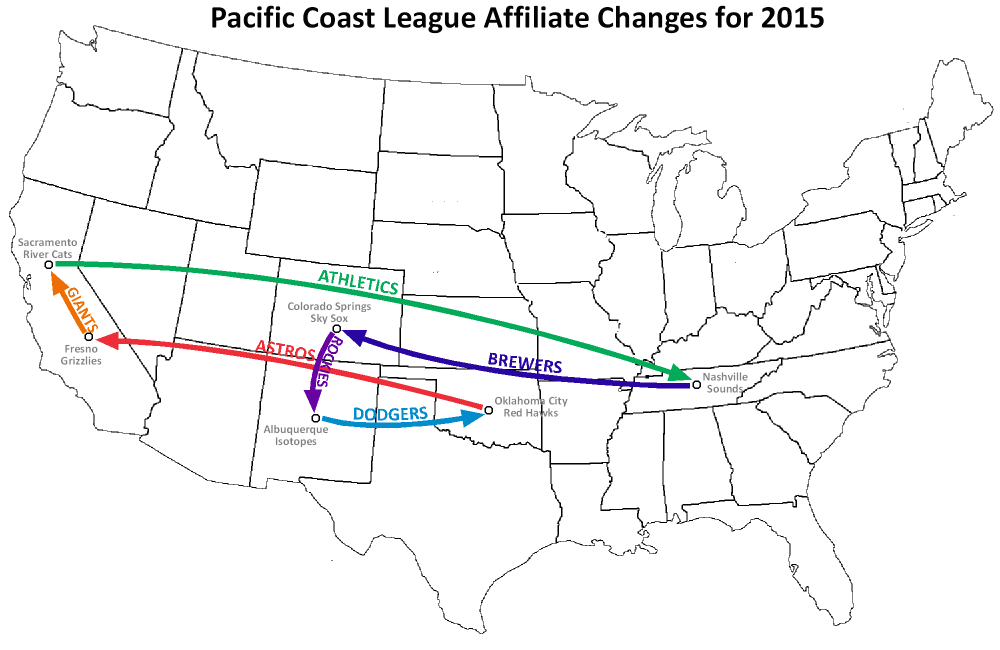
A flurry of PDC agreements came throughout the day. It seemed that the A’s kicked things off before 10 AM with their 4-year PDC with the Nashville Sounds. However, the Giants and Sacramento River Cats scheduled their own press conference, also at 10, to talk about their 2-year PDC. Then all the other affiliates and PDCs got in line, finishing with a hastily agreed upon agreement between the Brewers and Colorado Springs.

Brewers GM Doug Melvin even sounded like a spurned lover:

“Very disappointing. We gave them 10 years there. A number of times we had a chance to move and we were patient with (the Sounds). I’m just disappointed they wouldn’t have given us two [more] years for what we put up with there.”

There happens to be Greer Stadium, the aging, 36-year old ballpark south of downtown Nashville which is being replaced by shiny First Tennessee Park. The agreement’s only for 2 years, which may allow the Brewers to try another city, since Colorado Springs is only slightly above the seventh circle of hell when it comes to desirable affiliate cities because of park factors. That doesn’t explain why the Rockies were so eager to bolt for Albuquerque, a city that is more than a mile above sea level. The game of musical chairs, which was truly kicked off by the Dodgers when co-owner Peter Guber bought a 50% interest in the Oklahoma City Red Hawks last week. OKC will be the new AAA affiliate of the Dodgers, which left the Astros to hook up with the Fresno Grizzlies.

All of this was done in the last 24-48 hours

All of this was done in the last 24-48 hours

Sooooo…. Nashville? It’s nearly 2000 miles from Oakland with nary a direct flight link them together since neither city has a major hub airport. Nevertheless, the River Cats-turned-Sounds will be playing in a fabulous, Populous-architected ballpark next year. First Tennessee Park will be at Sulphur Dell, the site of an old ballpark (also named Sulphur Dell) that dates back to 1870. Like Sacramento pre-River Cats, Nashville had a lengthy gap in 60’s with no pro baseball in town after Sulphur Dell closed in the 60’s. Herschel Greer Stadium opened in 1978. The Brewers came calling in 2005 and have been there ever since. The Brewers, Sounds management, and civic leaders have been trying to get a new ballpark in Nashville since 2007 (sounds familiar), finally putting together a deal that raised $65 million in public bonds while tying Sounds ownership to some $37 million in private development surrounding the ballpark. It’s a deal similar in structure to Petco Park, though there is some fuzziness on whether that private investment truly has to come in and when. Construction only started in earnest in March, making the development time very short, much like El Paso, Reno, and Sacramento.

Certainly the A’s front office was attracted by a brand new ballpark, as it would make for an easy transition for players who don’t make the big club. Sounds owner Frank Ward was probably salivating at the prospect of a winning, contending team playing in his new digs, as the Brewers-affiliated Sounds haven’t gone to the postseason in eight years, a cumulative .504 winning percentage since becoming a AAA city in 1985. Coincidentally, the Sounds finished with a 77-67 record this season, good for second in the American Southern division, but the team has generally been inconsistent.

FTP is bounded by 5th Avenue N, 3rd Avenue N, Jackson and Harrison Streets. While a 1,000-space parking garage will be built next to the ballpark, the site is only three-quarters of a mile from Printer’s Alley, Nashville’s well known downtown nightlife area. Numerous hotels are located downtown, with several more located along Music Row to the southwest. Catch some live music, maybe a Predators game at Bridgestone Arena, or take a tour of legendary Ryman Auditorium, the former home of the Grand Ole Opry.

This slideshow requires JavaScript.

After going over several different design options, it was decided that the ballpark would be oriented south-southeast. The northern edge would have an entry gate behind home plate, but otherwise there wouldn’t be the usual contour following the seating bowl that you usually see at most minor league parks. The idea is that ancillary development would occur to the east and south, between the park and downtown. If done correctly, a “ballpark village” of sorts may emerge, capturing visitors and locals who may park downtown and walk to the park. Again, there are shades of Petco Park in the site plan, although at a much smaller scale.

The full Sounds 2015 schedule is not yet available on the team’s website. When it is I’ll put together some sample ballpark trips you may consider. Next summer I’d like to do a AAA trip consisting of Nashville, Memphis, Indianapolis, Louisville, and perhaps Columbus again. The closest cities (within a 4 hour drive) are Atlanta, Cincinnati, and St. Louis, so putting together trips that involve MLB teams, especially the A’s, will be tough. If you’re planning a trip, you may find yourself flying through ATL, so that may work to your advantage.

As for the River Cats? I wish them luck. Their PDC with the Giants is only 2 years, a somewhat surprisingly short term considering the fan cultivation effort that is obviously the goal of the affiliation switch. They should do fine in 2015 thanks to a honeymoon period of sorts. The River Cats have a good promotional machine that should crank up into high gear with the Giants involved. If they can regain some of the attendance losses they’ve suffered the last few years, the change will have been worth it.