News for 9/6/12

Update 9/6 10:30 AM – Several items added.

Not much to celebrate on the field, so we’ll focus off it.

  • Sure, the A’s didn’t draw well Tuesday and Wednesday. Neither did the White Sox, Nationals and Braves. Yet league attendance is up 3% over last year. Nothing changes overnight.
  • Brodie Brazil wrote a goofy column about stuff that should carry over from the Coliseum to a new A’s ballpark. [CSN Bay Area]
  • Good to see that the regular media (Merc, NBC BA, KQED) picked up on the recent S4SJ lawsuit activity. I’ve heard that S4SJ is expected to respond with its own motion by Monday 9/10, followed by another response by the City by 9/14. If nothing else it keeps the case in the news.
  • Forbes NFL team valuations are in right on schedule. #1 is the Cowboys at a whopping $2.1 billion, followed by the Patriots and Redskins. The 49ers are at #9 with a $1.175 billion, thanks to the team’s playoff run and the start of stadium construction. The Raiders came in at #30 with a $785 million valuation, and were one of two teams to have an operating loss (according to Forbes). [Mike Ozanian]
  • We’re 9 days from the NHL’s lockout deadline, and there’s no telling what will happen. The two sides are reportedly very far apart. [SB Nation DC/Ted Starkey]
  • With ESPN’s TV deal signed, MLB may be looking for $800 million per year for the combined Fox/Turner schedules. Combined with ESPN, MLB would net $1.5 billion per year, translating to $50 million per team. Add other central revenue to that (merchandise, MLB AM, XM, etc.) teams should be able to get $70 million in national revenue every season starting in 2014. That figure doesn’t include revenue sharing (local redistribution). [Sports Business Journal/John Ourand]
  • So I guessed wrong on 95.7 The Game getting the Warriors and switching to NBC Sports Radio. The station stayed with Houston-based Yahoo! Sports Radio, and the W’s chose to renew their deal with KNBR, apparently feeling that the signal coverage was worth the third-tier status on the stations. That’s a bad loss for Entercom, though it highlights the biggest problems with The Game: its ratings aren’t going to get much better until they get more local pro teams and boost the station’s signal. The new deal runs through the 2015-16 season.
  • The good news for The Game is that the station posted a 1.1 rating for August, the highest since the programming change. The A’s haven’t moved the needle at The Game for well over a year. Perhaps this is a sign that now they are effecting change. [BA Sports Guy/Scott Willis]
  • Legislators are attempting to bring back redevelopment through various bills that have just reached Governor Brown’s desk. I won’t give the bills much attention unless Brown signs them into law. In the meantime, some groups are applying for federal tax credits to help foot the bills for projects. [ABC 7/Kendall Taggart; 10 News San Diego]
  • Save Oakland Sports has a profile in the Tribune. When talking about the upcoming fundraiser, co-founder Jim Zelinski said, “A cynic might laugh … but it all adds up.” Sure it does. Fundraisers like this, which has no set fundraising goal, can help – about 1 PSL’s worth at a time. [Oakland Tribune/Matthew Artz]
  • The federal government will lose up $4 billion in tax revenue ($146 million annually) thanks to tax-exempt bonds used on many stadia, including the Coliseum and the new 49ers stadium. [Bloomberg Businessweek/Aaron Kuriloff and Darrell Preston]

More as it comes.

City of San Jose seeks to depose Stand for San Jose

Update 9/5 10:30 AM – If you haven’t seen it yet, the Merc’s John Woolfork has picked up the story and gotten quotes from San Jose City Attorney John Doyle.

Activity regarding the astroturf group Stand for San Jose‘s lawsuit challenging the A’s Diridon land deal appears to have picked up in the last week, as the respondents, the City of San Jose and the A’s, have submitted a request to depose Stand for San Jose and its members. I’ve uploaded a copy of the motion (6 MB PDF) for your perusal.

The thrust of the City’s argument is that it complied with S4SJ’s numerous information requests, while asserting that it has the right to request information about S4SJ’s inner workings to determine if S4SJ has standing. The motion asks for relevant documents related to the operation of S4SJ, as well as a person to represent the group in a deposition. This maneuver comes after repeated requests made by the City for this information. Through attorney Geoffrey L. Robinson from the A’s-hired firm Perkins Coie, the motion asks for some in-depth information.

The matters on which the deponent will be examined include the following:

  1. The standing of Stand for San Jose to assert any or all of the claims raised in the First Amended Petition in this case.
  2. The nature of the beneficial interest held by Stand for San Jose in the subject matter of this litigation and the extent to which those interests differ from those of the general public.
  3. The origin and formation of Stand for San Jose.
  4. The organizational purpose, structure, functions and activities of Stand for San Jose.
  5. The governance, direction, control and/or leadership of Stand for San Jose.
  6. Taxes paid by Stand for San Jose to the City of San Jose or any other public entity.
  7. The funding or financing of Stand for San Jose’s activities.
  8. The legal or financial relationships between Stand for San Jose and its members and/or any persons or entities funding or controlling its activities.
  9. Any actual or proposed use of this litigation to impose regulatory burdens on the City or Real Party in Interest.
  10. The “fees and costs, including reasonable attorneys” fees and expert witness costs” (sic)…

Named individuals in the motion include Michelle Brenot, Robert Brown, Karen Shirey, Fred Shirey, Robert Shield, and Eileen Hannan, who initially didn’t know she’d be a plaintiff in the lawsuit. Just in case you’re wondering where her allegiances lie, here’s her Facebook profile picture.

At least we know where Ms. Hannan “stands”

The challenge is a technical one – if the plaintiffs don’t have standing, the suit can be dismissed. S4SJ claims they have standing by the nature of the suit (originally an EIR challenge). The tax issue is interesting, in that the City is arguing that if the plaintiffs aren’t taxpayers in San Jose they have no standing. The motion will be made on September 21 at 9 AM. (Come on people, I’m supposed to be in an iPhone 5 line at that time! You’re killing me.)

Seriously, this is the first real sign that the legal team that the A’s were assembling in the spring is breaking out some weapons to use in could be a lengthy legal battle. Could the lawsuit blow up if it’s found that the Giants were behind the whole thing (snicker)? I guess we’ll find out.

P.S. – I look forward to reading the various lawyers’ assessments of this motion in the comments. Also – I’m not a lawyer or legal reporter, so forgive my butchery of the legalese.

California Memorial Stadium Reopening

Six years ago I went to the first game at the new Stanford Stadium. Yesterday I went to the first game at the renovated California Memorial Stadium on the UC Berkeley campus, eager to compare and contrast the experiences. Both home teams lost their respective first home games. Both stadia received major upgrades in terms of amenities and comfort. That’s where the similarities end. Stanford Stadium is a modern facility that bears little resemblance to its forebear. Memorial Stadium was painstakingly renovated to maintain as much of its early 20th Century charm as possible. It’s with that key difference that I’ll start my review of CMS.
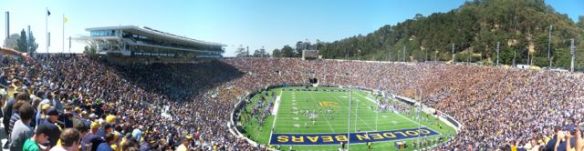
cal_memorial-16-panorama2_sm

Panorama from top of South End of California Memorial Stadium

Like many stadia built 80-100 years ago, CMS was a testament to classical form and simplified function. Slightly less than half of the oval seating bowl was built atop a hill on the east side. The other half was a concrete structure with arches and a single narrow concourse. All of the seats were wooden bleachers. A small press box was affixed at the top of the west side of the bowl. At one time 80,000 could be packed sardine-style into CMS.

Over the years CMS deteriorated noticeably, with huge cracks in the concrete and bleachers splintering everywhere. The stadium was situated directly on top of the Hayward fault line and the west half was not considered safe by modern seismic standards. Many calls were made to replace or refurbish the old girl, with nothing happening until the UC Board of Regents approved a $300+ million plan to rebuild the west side. The new half would contain three club areas, a new and wider general concourse, a large press box, and a training center for the athletic department that would be competitive with other major college sports programs.
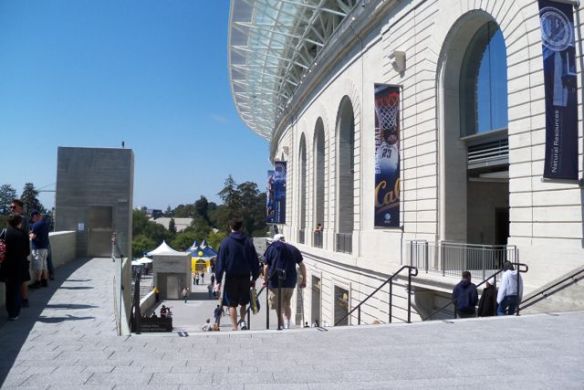
cal_memorial-23-stairs_down_southwest

Area outside West façade descends into additional public spaces, press box hanging above the bowl

The debate over whether the upgrades were worth it will continue for years to come, as Berkeley continues its internal struggle over academic priorities and costs to attend keep rising. What the fan is left with is a sense of history and legacy preserved, with modernity accentuating itself in specific areas.

The three level press box and club building is the big nod to the new landscape of college football, where everything is driven by intense media coverage and alumni with fat wallets. The building is a glass-and-steel structure, its frame forged and delivered in pieces and put together on top of the new concrete support structure that holds up the rest of the west bowl. There’s even a space beneath the press level where the camera positions are located that makes the building appear to float. Chicago’s Soldier Field renovation may come to mind, but the work done at CMS isn’t nearly as imposing or potentially upsetting.
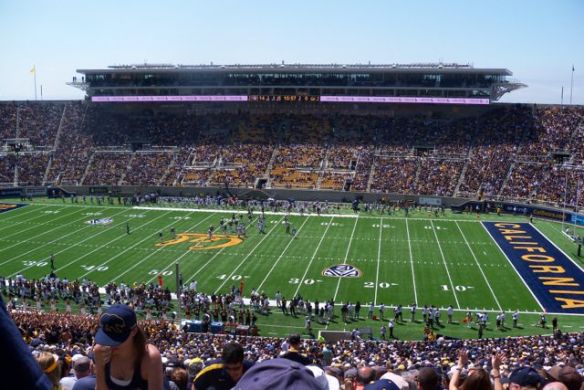
cal_memorial-13-student_side-wide

Press box “floating” above stadium bowl

What was once a single, dark concourse with water seemingly dripping from every crack and opening is now two: the swank lower club level (which I didn’t visit) and the regular concourse, which now lines up with the elevation at Gate 6. The result is that large areas were opened up, allowing natural light coming through the arches to flood the concourse. It also creates numerous scenic vistas of other parts of the campus and the Bay. As the morning fog receded, I was able to see all the way to San Francisco and the Golden Gate Bridge.

The main concourse is 30-45 feet wide depending on where you are. Concession stands alternate with much improved restrooms everywhere you look. Blue tiles of different shades mark the restroom locations, while the concession stands are adorned with names like “Oski’s Place” and “The Fault Line”. Oski is, of course, the beloved bear mascot at Cal, whereas “The Fault Line” playfully notes that it’s located right on the Hayward fault.

Walking through the concourse, it’s hard not to notice the many expansion joints dividing roughly 100-foot sections of the stadium. These joints and piston shocks will help absorb motion in the event of a major earthquake, with as much of six feet of travel allowed. Flexible conduits are located in areas with expansion joints, which should reduce the chances of data or electrical disruption. Concrete columns are spaced every 20 feet, giving an appearance that the structure is overbuilt.
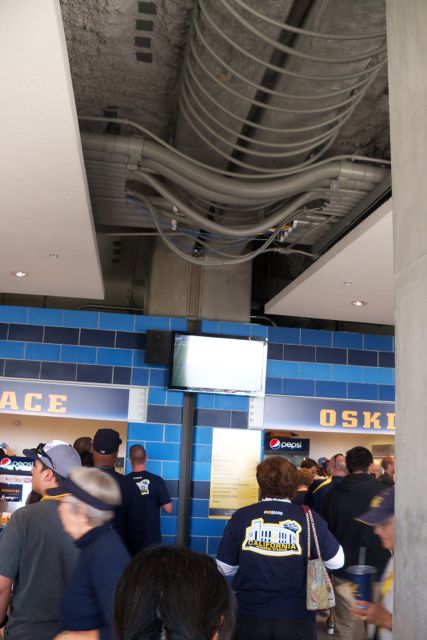
cal_memorial-18-expansion_joint2

Expansion joint with additional support for utilities

Lines for food were long towards the north and south ends of the stadium. Between the 20 yard lines the lines aren’t so bad. Crowds will figure that out by the end of the season. The fare was pretty standard, with a regular hot dog and a Saag’s polish on the menu. Prices were cheaper than at pro games, but noticeably more than at other college venues I’ve been to. Top Dog has three stands on the East upper rim, and those had 20 minute lines from the looks of it. The club most certainly has pricier options.

The only obvious change to the east bowl was the replacement gold aluminum bleachers, matching the rest of the stadium. Padded seat cushions with backs were available for rent. Down near the field where I sat, four rows were ripped out and replaced with ADA-compliant wheelchair locations. The old south tunnel is now just access to two ADA restrooms, from which security had a hard time shooing confused fans. The new Field Turf playing surface was also lowered four feet, which helps sight lines immensely. Way up above the field, Tightwad Hill is still there, with its spectators almost close enough to touch.

On the north side the tunnel remains intact, allowing for a pre-game procession through the campus into the stadium. A ceremonial ribbon-cutting ceremony was held, with Walter Haas III doing the honors in memory of his father, the much-loved former CEO of Levi Strauss, one-time owner of the A’s, and philanthropist whose name is emblazoned on Cal’s arena, a staircase at CMS, and the business school (which faces the north entrance Gates 1 & 2).
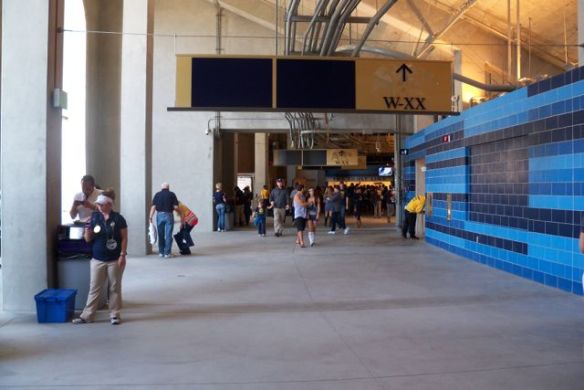
cal_memorial-20-concourse1

Much improved main concourse

Just about all of the flat areas of the Berkeley campus are packed with academic buildings, athletic facilities and other structures, making open space rather scarce. There was some question going into the planning and construction phases for CMS about whether or not there would be places for fans to mingle or even tailgate before games. Some effort has been made in this vein by creating plazas outside the arched façade with tents for additional concessions or grills. It’s not quite the same as tailgating, yet these are spaces that can find a purpose in the future.

All told, Cal and HNTB did a wonderful job of holding true to the idea of maintaining California Memorial Stadium’s architectural and structural integrity. There’s no telling if Cal will be a good football team anytime soon. Nevertheless, Memorial Stadium is a beautiful place to watch a game and a reminder of how stadia don’t have to be overly utilitarian. It’s worth a visit.

News for 8/30/12

Here we go. We’ll start off with some minor league news.

  • The Santa Cruz Warriors continue to work with the City of Santa Cruz to get their tent arena built in time for the 2012-13 D-League season. Final approval hasn’t happened yet, let alone construction, so the D-League put the Surf W’s on a loooo-o-ng road trip before the team’s first home game around Christmas. That gives the two parties 16 weeks to get the arena approved, built, and buttoned up. No pressure. The Surf W’s could play on the road for additional games until the project is completed, or if there are extensive delays or the project isn’t approved, hopefully there’s a backup plan like the San Jose Civic Auditorium. Cost for the downtown arena have already ballooned from $4 million to $5 million because of foundation issues that were identified. Ticket prices have also been released. [Santa Cruz Warriors; Santa Cruz Sentinel/J.M. Brown]
  • Head north on Highway 1 and you’ll eventually get near the Cow Palace, where the San Francisco Bulls are quietly fixing up the old arena. $2 million of updates will be paid for by the team, including a center-hung scoreboard, a first for the Cow Palace. A schedule and ticket prices have also been announced. I may have to ring up the Bulls to see if I can get a sneak peek of the place. [CSN Bay Area; SF Bulls]
  • The first debate for the at-large seat on the Oakland City Council happened last night, and the two main candidates, incumbent Rebecca Kaplan and challenger (and current D5 council member) Ignacio De La Fuente both had something to say about the tenant teams at the Coliseum complex. [East Bay Citizen; Steven Tavares]

On the issue of the city’s professional sports teams, Kaplan and De La Fuente differed, if not, in terms of their priorities for retaining the A’s, Raiders and Warriors in Oakland, with Kaplan being more optimistic. “Let’s face it, the A’s don’t know the way to San Jose,” said Kaplan, and adding the current Coliseum City proposal will bring shop owners, bars and restaurants to the city along with fans and conventioneers to the area, said Kaplan, while also creating jobs.

De La Fuente was less sanguine saying he would only turn his attention to the Coliseum once crime in Oakland is sufficiently quelled. “I learned from my mistakes,” he said, referring to the botched return of the Raiders in 1995. “They are in the business of making money,” De La Fuente said, believing the public sector should no longer have a role in financing stadiums.

  • The Earthquakes announced their general seat pricing and posted a seating chart. The big ticket item is the establishment of a 1,400-person supporters section in the closed end, which will have its own bar and storage area for the flags and banners they use during the game. Interestingly, the language is “1,400-person”, not “1,400-seat”, which leads me to believe that this area will be a standing terrace. That’s fine since fans in the supporters sections are expected to stand anyway. I’m pretty sure it’s the only to fit 1,400 people in what looks like a pretty small space between the elevated seating bowl and the pitch. [SJ Earthquakes]
  • The Quakes also announced today that they are negotiating with three Fortune 100 companies on naming rights for their 18,000-seat stadium. Fortune 100, eh? Club president said that some of these companies are tech or Silicon Valley firms. Recently, new MLS stadia have netted $2-3 million per year in naming rights, which if matched by the Quakes would go a long way towards paying off the stadium. FWIW, I don’t think any local tech company should be ruled out, including Cisco (and no, that doesn’t mean Cisco is dumping the A’s). [SJ Mercury News/Elliott Almond]
  • On Saturday I’ll be in Berkeley for the first Cal football game at the rebuilt Memorial Stadium. I’ll be sure to get there early to take lots of pictures and document the experience. Somehow I was able to buy one of the last available $19.32 tickets for the opening game. I’ll be in the south end zone, a mere 5 rows up. As an aside, I was somewhat surprised at how many tickets remained for the game. I expected a sell out long ago. One thing to consider is that we’re the only market with three FBS (D-I) college football teams. Combine that with small or not-terribly-fervent fanbases and two NFL teams, and it’s easy to see why our general reaction to college ball is a collective “Meh.” [UC Berkeley]
  • On a related note, the Pac-12 Network launched two weeks ago and is still negotiating carriage deals. Comcast is not an issue since the cable provider is a partner. The issue is working out a deal with DirecTV, which is not only the provider with the most regional sports and college networks, but also the provider of choice in most bars throughout the country thanks to NFL Sunday Ticket. DirecTV purportedly rejected a deal of $0.80 per subscriber/month, leaving many fans up and down the left coast without many opening week games. Dish Network, Verizon FiOS, and AT&T U-Verse customers are also affected. [SF Business Times/Eric Young]
  • The State Controller reversed a slew of land transfers between the cities of Milpitas, Morgan Hill, and their respective (and now defunct) redevelopment agencies. That doesn’t bode well for the Diridon ballpark land transfer, though it has to be pointed out that the Controller has already ruled once in San Jose’s favor, saying that Santa Clara County went to far in holding tax increment funds that were due to the City. [Merc /Tracy Seipel]

Finally, I have to thank a reader out there for giving me four prime tickets behind the A’s dugout for Wednesday’s day game against the Angels. I’m only going to use one, so if anyone’s interested in joining me and talking baseball and ballparks or economics, reply with a comment or send me a tweet.

More tomorrow.

Radio switcheroo

Adding to the intrigue regarding last week’s reshuffling of 95.7 The Game, several radio announcements have been made in the last week or so. First, KNBR’s Tom Tolbert will contribute a minute-long segment at the top of every hour on CBS Sports Radio. (The segment is much like ESPN Radio’s Sports Minute with Mike Tirico, which is heard in other markets with ESPN Radio stations.) The new network was announced in June and will launch on September 4, anchored by numerous CBS and Cumulus stations, including the two KNBRs.

This CBS Sports Radio is different from the previous one, which was syndicator Dial Global’s (Westwood One) mostly game broadcasts with the CBS brand. The new CBS Sports Radio is a 24/7 sports talk network with no carriage of the four major pro sports at the outset. That’s no big deal for the KNBR twins since they have the Giants and 49ers. They’ll be fine, although I’m curious to see how much ESPN Radio remains in the lineup.

You may also remember that, back in March, Dial Global cut a deal with Entercom to switch its game broadcasts from KNBR to 95.7 The Game, coinciding with the NCAA tournament. Dial Global has the NFL, It’s additional sports programming to help bring in new listeners, though it’s not the same as landing a team like the Warriors or Raiders.

Turns out that Dial Global and NBC Sports are also launching their own network. They’ve announced a flurry of new hosts to fill their talk lineup, including the oft-traveled Erik Kuselias (meh) and former NY Giants (and De La Salle Spartan) Amani Toomer. Toomer’s show will be in the late night Eastern (10 PM – 1 AM ET) slot. Current NFL TV analyst Rodney Harrison will get his own weekend show. The interesting thing about NBC Sports Radio is its launch date: also September 4.

That lines up with The Game’s scheduled programming changes, which have a few details remaining to hash out. For now, Dial Global hasn’t said whether it’ll go whole hog with the NBC branding, but it stands to reason that it will. The name Dial Global has no recognition outside of the radio industry, and NBC has been thorough in having the NBC Sports moniker permeate all of its TV sports properties, from the former Versus network (now NBC Sports Network) to the Comcast SportsNets, which have NBC Sports as part of their tagline with every broadcast.

I’m merely connecting the dots, but it makes sense, doesn’t it? Come Tuesday, fifth tier Yahoo! Sports Radio will be ditched for NBC Sports Radio, which has much stronger recognition despite its startup status. Funny thing is that for decades, KNBR-680 was the NBC affiliate for Northern California, a stint that only ended as the station switched to the sports format full time. Throughout the 2000’s the A’s shuffled between CBS-owned affiliates before signing with The Game. Remember how I remarked how cozy the relationship was between The Game and CSN Bay Area/California? That may well have been a prelude to something much bigger. And there’s still the Warriors situation to shake out. September could be a banner month for 95.7, as The Game literally changes.

ESPN keeps MLB rights with $700 million/year deal

Six weeks ago we discussed here the implications of MLB negotiating new TV contracts, with up to $40 million in new national revenue going to each team as a possible outcome. Today the first domino has fallen, as Sports Business Journal’s John Ourand reports that ESPN and MLB are re-upping their deal.

The current deal calls for ESPN to pay $306 million per year ($10 million per team) to baseball for the rights to games on Sunday and Wednesday, occasional Monday nights, and immediate highlights and live look-ins on Baseball Tonight. Digital rights to select games were also added for $50 million per year. The new deal has ESPN paying $700 million per year ($23 million per team), which now includes digital and international rights along with domestic cable. The international rights piece is another coup, because it should clean up some rather disparate pieces. The “Worldwide Leader” will also get one wild-card playoff game per year as part of the deal.

Of course, this is ESPN we’re talking about, so there has to be a downside, and it’s that Bristol asked to carry more Yankees-Red Sox games (imagine that!). They got it. Now it can be written: ESPN pushed to expand their East Coast bias. Next thing you know they’ll have a Mark Sanchez-Tim Tebow reality show ready for Week 8 of the NFL season.

Remaining to negotiate are the deals for the Saturday Game of the Week (FOX), and the Sunday afternoon game (TBS). Both of those networks also have playoff series, so the stakes are just as high, even if the coverage is not as vast. NBC/Comcast wants in, and CBS is also in the running. Ourand thinks those rights will stay with their respective holders, so we’ll see about that.

As for the A’s, anything that can help the team keep players and start with a higher baseline payroll ($70-75 million), the better.

“Bernie” to throw out first pitch on Saturday

That’s right. The A’s announced today that Terry Kiser, the veteran actor who played the titular dead boss Bernie Lomax in the Weekend at Bernie’s movies, will throw out the first pitch at Saturday’s game as part of “Bernie Weekend“. The versatile Kiser’s film and TV career goes back to the late 60’s, with guest spots on Golden Girls and The Fall Guy among his many credits. Personally, my favorite work of his was his repertory role in Carol Burnett’s short-lived, long-form sketch comedy show, Carol & Company. The rep cast also included Richard Kind (Spin City), Peter Krause (Sports Night, Six Feet Under), and Jeremy Piven (Entourage). Anyway…

If you’ve been under a rock, you may have missed the team’s homage to the Bernie character. The craze was inspired by the song Moving Like Berney by rapper ISA and started on the team by Coco Crisp, Jerry Blevins, and Brandon Inge. Several players can be seen doing the Bernie dance in the dugout after a home run or while celebrating a walkoff win. What is the Bernie, you ask? It originates from the sequel, Weekend at Bernie’s II, and a momentous scene where a reanimated (yes, reanimated) Lomax leads a conga line.

Frankly, I don’t know why the A’s are even doing this. I thought ownership was a bunch of soulless bean counters who only own the team to leverage real estate. Reveling in the team’s winning? Selling tickets to boost attendance? Sharing some fun with fans? Inconceivable. It’s almost as if Lew Wolff enjoys owning a baseball team. Nah, that wouldn’t fit the evil owner narrative. Silly me. /s

Side note – The A’s are pretty good at cashing in these movie tie-in’s.

“Oakland Loves Its Sports Teams” Pep Rally

Let’s be clear about one thing. This was a pep rally. No more, no less. Rick Tittle set the tone as the emcee, talking about how teams are private entities, yet fans can make their voices heard through rallies like this. True to form, no official representatives from any teams were on hand. Tittle did his best to gin up the 200 or so people in attendance, talking up how Oakland is the only city in California with NFL, MLB, and NBA franchises. He also taunted a little, getting the crowd to respond when asking if certain other cities were “big league” (hint: one of them has the initials S.J.). Tittle finished his opening remarks by rattling off the names of numerous political and community leaders that were at the rally.

Oakland Mayor Jean Quan announces the upcoming “Oakland Loves Its Sports Teams” week of events

The podium was handed off to Oakland Mayor Jean Quan, who started off by giving a non-update on talks between the City and teams/leagues, not that anyone expected an update. She then talked about the “Oakland Loves Its Sports Teams” week, which will start with the Raiders’ home opener against San Diego on 9/10, a Monday Night Football game. The bookend event is the 9/14 A’s game against Baltimore, which is both the Star Wars fireworks night and an A’s blogger night set up by the team’s media relations department. Quan encouraged fans to sell out both events, which given the circumstances, should not be too difficult. During the week will be other events, including a fundraiser. Curiously, the Warriors were only mentioned in passing by Chris Dobbins and perhaps one or two other speakers, and none of the new signage (see pic above) references the W’s. This may have something to do with how the W’s preseason doesn’t start until October. Yesterday’s revelation of the team hiring an architect for their dream SF arena probably doesn’t help. Still, the W’s are the one team whose practice facility is located in downtown Oakland. You’d think there’d be more than a token mention.

A number of others took the podium, including City Council member Rebecca Kaplan and a person from Rep. Barbara Lee’s office. Throughout the 40-minute rally, there were frequent mentions of Coliseum City and how the project can help revitalize Oakland. Strangely, I didn’t hear a peep about Howard Terminal. Now that the Port is onboard, I was surprised that Howard Terminal wasn’t discussed even a little bit. Maybe I missed something while I was tweeting during the event, but “Howard Terminal” is a phrase that would’ve gotten my attention. (Ed. – I did miss Kaplan’s Howard Terminal reference while I was tweeting.) Now that I think about it, no one from the Port was there either. In the grand scheme of things the omission doesn’t matter much, yet it remains notable. It seems as if the two efforts, such as they are, are running in parallel and there’s no effort to unite them. It sends a mixed message.

Since we’re talking about mixed messaging, I got something else from the tone of the event. On one hand, Oakland supporters talk about how devastating losing the sports teams would be, how much of an impact they make economically, civic pride, etc. At the same time the City is treating the W’s somewhat cavalierly and the A’s in a standoffish manner. It’s what a jilted lover sounds like, and it makes little sense. Don’t get me wrong, events like this and the upcoming weeklong affair are important to elevate the topic among civic discussion. There’s a feeling that this is more of the same, wake me up when you have something new.

Throughout much of the event, there was a protester on the other side of the still-fenced off Frank Ogawa Plaza who was decrying the event, yelling, “Save Oakland, Not The Raiders!” The undercurrent of protest remains, even as the City announced this event on a Friday and held it at 11 AM the following Monday. What would happen if a rally like this were held on Monday during rush hour, with Occupy protesters ready to go? I can’t imagine it’d be pretty. As much as the City keeps claiming that these new sports investments (that’s what they are) won’t require voter approval, they are kidding themselves if they think the City’s residents won’t put serious pressure to put any stadium project to a vote. That’s why this stage is so easy and positive. There are no details. No costs. No sacrifices to make. Unfortunately, the placards and pom-poms have to be put away at some point. Quan ended her remarks referring to her attendance at the recent 15-inning game saying, “It may take a while, but we’ll win in the end.” If I’m a league commissioner in a New York high-rise, I can’t think of a more confidence-inspiring message.

Warriors choose Norwegian firm Snøhetta to design SF arena

This one’s out of left field. The Warriors announced today that the firm they’ll have design their waterfront arena is Snøhetta, a Norwegian firm. Snøhetta’s an interesting choice because according to Joe Lacob, they were chosen for their waterfront expertise. Snøhetta doesn’t have extensive sports venue experience, but they are doing one local project of note – the expansion of SF MOMA.

SF MOMA expansion rendering by Snøhetta

As far as waterfront buildings, the two most cited are the Oslo Opera House and the Bibliotheca Alexandrina in Alexandria, Egypt. Both are notable in how they seemingly “slide” into the sea adjacent to the buildings. Both of these  venues are not arenas, obviously. What they are for Joe Lacob and Peter Guber are shining examples of how to make iconic venues on the water. That’s what they’re going for. Most arenas in the U.S. are utlitarian in nature, little more than concrete, steel, and glass boxes. If Lacob and Guber are trying reaching to attain Sydney Opera House (another Scandinavian-designed venue) status, they are to be applauded.

Oslo Opera House along the Oslofjord

Making an arena truly iconic is no small task. Most arenas have façades consisting of repetitive patterns of cladding over concrete or glass and steel. Recent attempts to break up arenas into multiple spaces using additional exterior elements and different types of materials have had mixed results. From a distance, an arena is squat, not tall, and often slab-sided. No new renderings or sketches came with the press release. Nevertheless, I look forward to what Snøhetta has to offer. In particular, I hope that Snøhetta finds a way to accentuate the Bay and the SF skyline, as I suggested in May. In a town where just about anything can become instantly controversial, the Warriors’ arena concept is destined to provoke lots of discussion. I imagine that Lacob and Guber wouldn’t have it any other way.

Snøhetta won’t be alone in this endeavor. They’re partnering with AECOM, a huge design and management company that acquired sports architecture firm Ellerbe Becket in 2009. Ellerbe Becket worked on 14 NBA and NHL arenas over the last 20 years.

Earthquakes Stadium Groundbreaking on 10/21

Prior to tonight’s Quakes-Rapids game at Buck Shaw, the Earthquakes announced that the long-awaited, oft-delayed groundbreaking will finally occur on October 21, before the home finale against the LA Galaxy.

20120825-182147.jpg

Quakes President David Kaval makes the big stadium announcement. San Jose Mayor Chuck Reed (in blue) was also there in support.

Knowing how long the fanbase has suffered waiting for the Quakes’ permanent home to be built, the team is making the groundbreaking a big public event. They’re inviting every fan to come to the ceremony and participate, in hopes of breaking the Guinness record of 4,532 simultaneous “groundbreakers” at a similar ceremony in India. Sounds like fun. Will the Quakes have enough hard hats on hand?

Update 7:00 PM – The San Jose Earthquakes have put up a press release for the event, which will be at noon on October 21. Fans can RSVP for the ceremony here.