A’s look to the future, keep HOK ballpark architect Schrock as consultant

This is what I’ve wanting to hear.

The quote of the week comes from A’s President Dave Kaval, courtesy of Don Muret, the former venue reporter for Sports Business Journal who last year went to VenuesNow. To wit:

“It’s a good pairing,” Kaval said. “We’re intent on developing a truly game-changing ballpark. There have been so many derivations of Camden Yards, we feel it’s time for a new direction.” 

Kaval was referring to the partnership of BIG and Gensler, as we discussed last week when the big announcement was made. Yet as I pointed out last week, BIG hasn’t architected a baseball stadium. Ever. There appeared to be a missing piece in the ballpark equation. Muret revealed the answer:

The hiring of BIG and Gensler does not sever the relationship between the A’s and HOK, specifically Brad Schrock, a principal with the firm and a veteran sports architect. Schrock has been working on a ballpark project for the A’s over the past 15 years, first with 360 Architecture and later HOK. He remains involved as a design consultant for the privately-financed facility, team officials said.

Schrock previously worked on Safeco Field when he was a principal in Heinlein Schrock, the firm that eventually became 360 and then HOK’s sports practice after Populous split off on their own. For more on Schrock, check out the post I wrote in 2014, which featured former SVBJ writer Nate Donato-Weinstein’s interview with Schrock.

The partnership of BIG, Gensler, and HOK (Schrock) should bring in a diverse range of concepts, though I imagine that each will be responsible for specific pieces. For instance, BIG might plan the entire development, while Gensler does the interiors, and Schrock provides the baseball expertise.

Ideas are swimming in my head. Before I get to those, let’s see what happens tomorrow in Sacramento, where the scramble is on to pass AB 734, the ballpark village bill for the A’s. Tomorrow is the deadline for the bill, which was amended to focus mostly on Howard Terminal. This was, as I mentioned earlier, because Howard Terminal needs the attention and focus. The Coliseum, as unsavory as it is to some, is already entitled for a stadium and has CEQA certification for the very kind of mixed use development the A’s are seeking.

It’s shaping up to be a very laborious Labor Day weekend.

A’s bring in architectural rockstar Bjarke Ingels to helm ballpark village project

There’s a scene in the Netflix documentary series Abstract: The Art of Design, where the subject of the episode, Danish architect Bjarke Ingels, describes one of this first projects. The site is in the Copenhagen docklands and was previously used for painting ship hulls. The original plan was to remediate the site by removing polluted topsoil. Sound familiar, Howard Terminal fans? The problem was that it would’ve cost a third of the allocated budget to clean and remove the soil. Ingels submitted a solution: build over the top of the site with a wooden skin, so that the soil doesn’t endanger anyone.

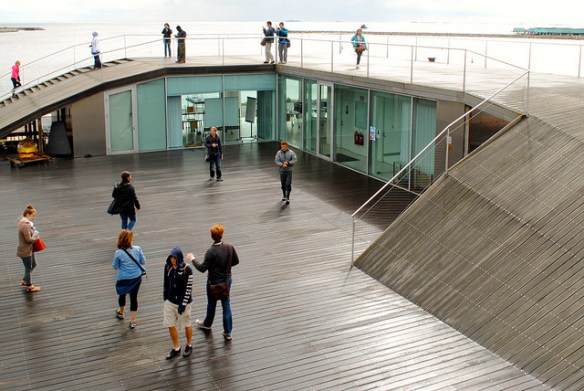
Maritime Youth House in Copenhagen

The result was a facility that serves dual purposes: a storage area/workshop for boats, and a playground/boardwalk area for children and families. I imagine that example, and some of Ingels’ more provocative work as part of BIG, Ingels’ architectural firm, helped attract A’s owner John Fisher and his staff.

Now, I do have some doubts about how scalable the methods used at the Maritime Youth House are. Both Howard Terminal and the Coliseum are on dangerous liquefaction zones, so some measures would have to be taken to anchor and strengthen whatever is built on top of them. I mean, no one in their right mind is going to build a massive stadium on wooden stilts.

The profiles of BIG and Ingels have grown exponentially over the past decade, with BIG winning numerous design competitions and the firm’s work featured all over the globe. However, there is a notable missing piece from the BIG’s portfolio. A young firm with designs on the world, it hasn’t yet completed any sports architecture work. That’s right, Fisher went with a rockstar architect with no stadium or arena experience. Maybe that will come with the to-be-located replacement stadium for FedEx Field in the DC area. Austin may finally being getting the Columbus Crew MLS franchise (tough week, C-bus), but apparently BIG’s design for a stadium at East Austin’s rodeo grounds isn’t in the cards. Mind you, I don’t mind hearing new voices in the sports architecture world. Given how Populous has dominated American sports for decades, Americans could use some fresh thinking.

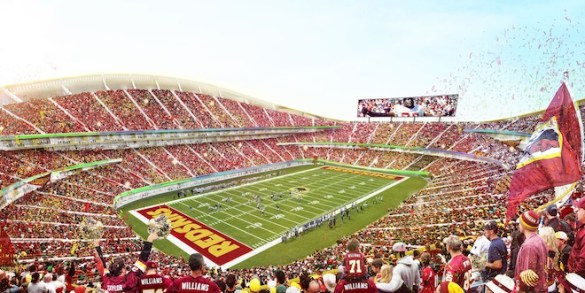
It’s less clear when the new Washington football stadium will be built. The exterior of the stadium is funky, with a mesh skin and a moat that could serve as an ice rink in the winter. Inside it looks, well, like an updated version of Arrowhead Stadium. Which brings me to a greater point: I suggest not judging whatever BIG delivers until they present it in terms of renderings or sketches. Right now there’s a huge debate in social media over retro-vs.-modern design that BIG is “definitely” going to provide even though we haven’t seen slide 1 of their presentation. While it’s true that BIG’s work leans futuristic, that doesn’t mean that a futuristic ballpark is in the works. Since BIG is the master planner for the whole site, their idea may be to make the ballpark less of a centerpiece and more in service to the rest of the development. Open air ballparks aren’t all that tall or garish, anyway. And since I suspect Fisher will have a tight rein over the budget, a grand architectural gesture may be too rich for even Fisher. One thing I think is for certain: another retro design with manual scoreboards and bric-a-brac like lighting cues or a frieze probably aren’t happening.

You’ve probably heard of the other firm in the announcement: Gensler. They’ve done a lot of work for the GAP over the years, so you have to figure Fisher (known in the media as “Baby GAP”) knows them well. They were also tapped to provide design services for the A’s ballpark village in Fremont. You remember Fremont, right? Right near where there was a fire at the Tesla factory earlier today. Gensler also oversaw the refresh of the A’s spring training facilities in Mesa, so they know something about baseball.

I look forward to seeing what kind of innovation BIG puts forward. Because if we know anything about Howard Terminal, it needs a lot of innovation to make it work.


Oakland’s thirst for football runs into a hArd limit

As construction on the Raiders’ new Vegas palace continues, Oakland keeps trying to get some kind of football team to take the Raiders’ place at the Coliseum. Thankfully, on Thursday the Coliseum JPA ended their pursuit of a new XFL franchise for the 2020 season. The XFL, the once and future brainchild of WWE head Vince McMahon, previously played during the winter and spring of 2001, with a franchise at what was then named Pacific Bell Park (now AT&T Park). The next iteration of the XFL is supposed to launch a 10-week season around the time of the 2020 NFL playoffs.

The A’s ended up being a big factor in the decision, as the grounds crew takes much of each winter to get the field ready for baseball, which starts every April. To be fair to the JPA, the XFL appears to be ones who tried to push the issue, knowing how well the league did with the SF Demons last time around. But despite the Coliseum’s multipurpose nature, it’s still hampered by some old decisions – some 20 years old, some 50 – that make conversions expensive while compromising the playing surface quality for either sport. It’s smart for the JPA to pass on this.

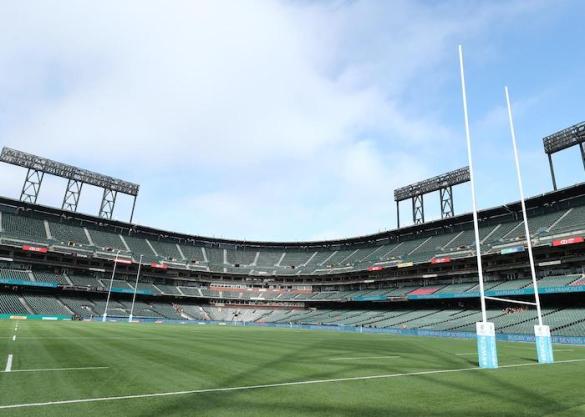
Hesitance on the JPA’s part caused the XFL to look north, to Berkeley and Memorial Stadium. That entreaty was also refused, leaving the XFL with no obvious alternatives. Why didn’t the XFL hit up the Giants to use China Basin again? After all, AT&T Park recently hosted the Rugby World Cup Sevens successfully. Perhaps like the A’s, the Giants wanted to keep the field pristine during their offseason. Can’t blame them for that.

Hey, where’d the infield go?

Another option that won’t be available for Oakland is the other startup football league, the Alliance of American Football. That league, whose franchises are mostly placed in the South, has set a 2019 launch date.

The Coliseum may not be the best baseball stadium in creation, but at least we can rest assured that the JPA is paying more attention to preserving the Coli as at least a half-decent place to play. The Raiders have every incentive to get their new digs ready for fall 2020, which would benefit the A’s even more as they determine where the future ballpark will be built.

A’s to drop season tickets for more flexible subscription model

Even as the A’s await a new ballpark, they’re not afraid to try new business concepts that one would expect them to deploy at a new ballpark. To that end, A’s COO Chris Giles announced today that the team is doing away with the traditional season ticket, instead replacing it with a membership plan that offers greater flexibility for all buyers.

The idea here, as foreseen by many in the industry, is that fans want the ability to go to every game, but don’t want to be tied a season ticket plan that could cost upwards of $2,000 for a whole season. Like the Treehouse plans introduced before this season, the new A’s Access plans will provide general admission to all 81 games, plus reserved seating for 10, 24, half-season or full-season of games if you choose. Included will be digital seat upgrades and a number of subscriber perks. Prices start at $240.

The highlights:

  • All plans include admission to every home game including reserved seats (View level)
  • Seat upgrades via the Ballpark app are available on a per game basis
  • Better seating locations are available in advance as well (before the season begins)
  • $10 parking available; Gold and Platinum members can get parking passes included
  • Half-price concessions, such as $3 hot dogs and $4 20-ounce beers
  • 25% off merchandise at A’s team stores
  • Monthly subscription fee option
  • Guaranteed promotional giveaway items

To me this is the culmination of the initiatives laid out by MLB AM a few years ago and executed on a phased basis by the A’s and other teams since. If I still lived in the Bay Area I’d jump all over this. Maybe I’d get a plan if I only make it back occasionally. Who knows, maybe I’ll move back?

56,310

As part of the 1989 World Series anniversary celebration last night, the A’s chose to open up the top of Mount Davis (heretofore covered in tarps) to paying fans. Tickets were put on sale for $10, with some concessions offered for only $2. Nevermind that Mount Davis was only a mere twinkle in Oakland politicians’ eyes in 1989, the A’s decided to extend their goodwill even further by giving fans a chance to check out the views from WAY UP TOP.

During last night’s rather bizarre game I received a few questions about temporary seating and celebratory events. The general rule is that the capacity should stay the same for an entire season, with no temporary seating or platforms to abruptly add or subtract seats, or especially, to change the outfield dimensions. This was challenged by Charlie Finley when the A’s were in Kansas City. Finley chose to put in a short porch in right field at Municipal Stadium of only 295 feet with additional seats, the better to copy the old Yankee Stadium. The seats could be added or removed on a whim if Finley chose. MLB was not onboard with the idea, so they chose to nix it. That started Finley’s grumbling about Kansas City in general, which ended up in, well, you know the rest.

MLB commissioner Rob Manfred addressed the two currently pressing stadium issues during All Star week, the A’s and Rays. Both are status quo while permanent solutions are worked out. Prior to the start of the season Rays president Brian Auld presented a concept in which the team’s new home would played in a new roofed stadium in Ybor City, a trendy neighborhood of Tampa. It’s not yet determined if the roof will be fixed (like the current one) or retractable (like Safeco Field or Marlins Park). The planned capacity is only 28,216 seats, with an additional 2,600 standing or berm/beach admissions available. At 30,816 all told, the new park would be by far the smallest in baseball. We haven’t heard yet about capacities for either Howard Terminal or the new ballpark at the Coliseum site, but it’s safe to assume that either will be less that 40k.

There has been a clearly evident trend of “rightsizing” ballparks since I started this blog 13 years ago. Back then, anyone talking about 35,000 seats like Lew Wolff was considered anathema. Nowadays there is much less argument in favor of the big stadium, because the more you build the more expensive and less intimate the park becomes. The 30k Ybor City park is projected to cost $892 million, with less opportunity to fleece the public as the Marlins did in Miami. A’s president Dave Kaval is aware of this, as he has said repeatedly that the A’s park will be privately financed. Thanks to the A’s recently eclipsing the $1 billion mark in franchise valuation I believe Kaval, though I wonder about MLB’s debt rule and its impact on the A’s.

I’ll leave you with a quote from the Tampa Bay Times article linked earlier:

A smaller park means less spending on maintenance but not necessarily less revenue, said Mark Conrad, a professor and director of the Sports Business Concentration at Fordham University.

“The days of getting 50,000 or more people with the exceptions of major games are pretty much very limited,” Conrad said. “You don’t really need that many seats to be profitable if you utilize the seating you have based on different pricing structures, views and standing areas.”

Don’t get used to seeing the tarps off Mount Davis.

AB 734 works its way through legislature

While the A’s have a team of people working on future concepts for a new ballpark…

… legislation to blunt the impact of potential legal challenges continues to progress through the California legislative calendar.

Here are the simple facts you need to know about what’s happening.

  • The two items above are only tangentially related for now. As mentioned in the previous post, the Coliseum site is already entitled, in that a new stadium is already approved there once everyone figures out what to do with the old stadium and the rest of the land. Howard Terminal has a ways to go before it’s entitled; that’s why the legislation is being considered – to limit the ability of those seeking to create roadblocks. Planning for the actual ballpark structure and its features is a different discussion and will take months to years regardless of site.
  • The legislative calendar is on a pretty tight schedule. You may have heard that AB 734 made it through two committees so far, the Finance and Judicial committees. The bill has been referred to the Appropriations committee next. The idea here is that by having the bill sponsored and through to this point, the heavy lifting for it has already been completed. There shouldn’t be any showstoppers from here, though that doesn’t mean the A’s could start clearing either site once the season ends. If you want to keep track, here are the key dates for the bill:
    • July 6 (last week): Legislature went into a monthlong recess
    • August 6: Legislature goes back into session
    • August 31: Last day for legislature to pass bills
    • September 30: Last day to get governor’s approval for any bill

    There are a few more rules to this, but I’d rather keep focused on the key dates and not burden you with a bunch of legislative mumbo-jumbo. If you need more details, please ask.

White line is the extent of the complex for potential sale

One other thing I wanted to point out. The Coliseum land being considered for possible sale to the A’s is only the original Coliseum parcels which include the stadium and arena, assuming the arena’s own financial responsibilities are settled. The land doesn’t include the Malibu or HomeBase lots near Hegenberger Road, which were long assumed to be part of planning for the aborted Coliseum City project.

Last thing to mention is that in AB 734, the bill specifies LEED Gold certification by the National Green Building Council as part of the package. To me this is exciting and could make the A’s a sort of trailblazer, because most baseball stadia built over the last few decades have been certified Silver, not Gold or Platinum. Getting to Gold or Platinum often requires greater conservation efforts, though I sometimes wonder about the scoring on that. For example, Mercedes Benz Stadium in Atlanta was certified Platinum last year, though it is a heavily air-conditioned domed stadium that employs artificial turf. Outdoor grass baseball parks haven’t been able to reach that standard.


Assemblyman introduces CEQA-streamlining bill for future A’s ballpark village

Now we know something is happening.

Sort of.

Yesterday, Assemblyman Rob Bonta (D-Alameda) submitted an amendment to AB 734, a bill working its way through the Assembly. Its purpose is to limit the number and length of potential legal challenges to an A’s ballpark and ancillary development. The language allows for the ballpark to be built at either the Coliseum or Howard Terminal sites.

(c) The city has identified two viable sites for the new baseball park, the Oakland-Alameda County Coliseum site principally owned by the City of Oakland and the County of Alameda, and the Howard Terminal site owned by the Port of Oakland. The city seeks to capitalize on the development of a new baseball park to maximize the economic benefit of the team and its facilities for the city, county, and port, including critical transit and transportation infrastructure, affordable housing, open space, and job creation. Essential to the success and feasibility of the new baseball park is the development of complementary adjacent mixed-use residential, commercial, and retail uses that will support the baseball park and further the city’s and region’s goals for sustainable transit-oriented development, including an increase in supply of housing, including affordable housing.

Bonta’s district includes most of Oakland including West and East, Alameda, and San Leandro, so he can’t be accused of playing favorites among the sites. Though it’s somewhat curious that Peralta isn’t mentioned. That indicates that all parties have moved on.

Elsewhere in the text is the definition of the project (for CEQA purposes), which the A’s haven’t yet publicly presented:

(3) “Oakland Sports and Mixed-Use Project” or “project” means the following components of a sports center and mixed-use project located at the Howard Terminal site in the City of Oakland or the Oakland-Alameda County Coliseum site in the City of Oakland, from demolition and site preparation through operation:
(A) A baseball park that will become the new home to the Oakland Athletics and adjacent residential, retail, commercial, cultural, entertainment, or recreational uses developed by the Oakland Athletics, and that meets all of the following:
(i) The baseball park and each new mixed-use building achieves at least LEED Silver certification or its equivalent for new construction after completion or the project achieves at least LEED Neighborhood Design Silver rating or its equivalent.
(ii) The uses are subject to a comprehensive transportation demand management plan to reduce single-occupancy vehicles and prioritize other modes of transportation, such as public transit, waterborne transportation, ride-share, bicycles, and pedestrians.
(iii) The project is located within a priority development area identified in the sustainable communities strategy Plan Bay Area 2040 adopted by the Metropolitan Transportation Commission and the Association of Bay Area Governments.

The particulars are designed to ensure that the stadium project would qualify for CEQA streamlining. The implicit deadline for opponents to challenge the project is July 1, 2019, slightly more than one year from today.

A previous version of the law, AB 900, allowed for a few major sports facilities to be built, including the Sacramento Kings’ Golden 1 Center and the upcoming Chase Center. It also tracked with three failed SoCal football stadium projects: Farmers Field, the City of Industry Stadium, and the revamped Qualcomm Stadium.

Should the A’s end up starting a project (one should hope so), they should be prepared for resistance from all manner of environmental and community groups, as they saw with Peralta. The worry there may be diminished with the Coliseum, which already went through this process when Coliseum City was approved. Howard Terminal doesn’t have that yet, and may never get to that point. It’s expected that A’s brass will pick the site by the end of the year, kickstarting the CEQA review in the process. But could they try both sites simultaneously?

The All Bay Collective, a group of policy planners and environmentalists, started looking at areas in the Bay that could use strengthening against sea-level rise. Their plan for the Coliseum/Airport area, renamed Estuary Commons, is fascinating.
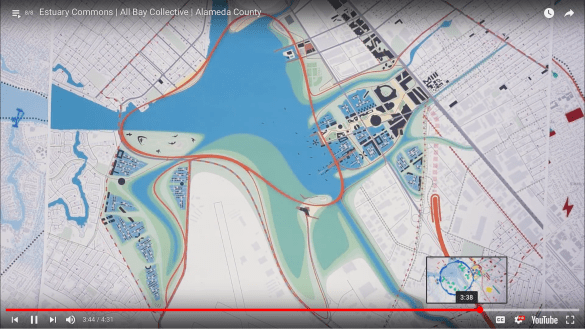
ABC’s Estuary Commons (Coliseum/Airport area)

Among the changes being considered are tidal ponds in the Coliseum parking area and a rerouting/tunneling of I-880 near Hegenberger Road and San Leandro Street. As far as I know these ideas are not being offered officially by the City of Oakland. Still, it’s interesting to consider the possibility of the Bay reclaiming part of the Eastshore as it’s doing with parts of the South Bay.
Schnitzer Steel fire sends dark cloud over Oakland

Just before 4 PM today, a fire broke out at the Schnitzer Steel metal recycling plant immediately to the west of Howard Terminal. This followed a similar fire in March, and other fires that have hit the facility over the last several years. Thankfully, the blaze came under control shortly after six, after help came from Alameda and San Francisco fireboats.

Schnitzer and the A’s met before the season started as the A’s renewed interest in Howard Terminal. Schnitzer clearly warned the A’s that if the A’s were to build there, either the metal plant or the team would be impacted because the plant’s operations have already changed to overnight hours to help reduce the impact during regular business hours. While this fire occurred on a Saturday afternoon, it could happen at any time as long as there’s a pile of scrap metal ready to ignite at the plant.

That brings up a serious conundrum that may face the City of Oakland, the Port of Oakland, and the A’s if the three parties decided to go forward with the Howard Terminal site. Would they have to figure out a way to get rid of Schnitzer? The company likes their location, with access to freeways, rail, and the waterfront for shipping to other countries. That’s pretty hard to beat as long as the company can comply with environmental regulations. The plant is overseen by an alphabet soup of public agencies. California’s DTSC (Department of Toxic Substances watches what gets leaked into the ground or bay. The BAAQMD (Bay Area Air Quality Management District) tries to make sure that toxics aren’t released into the air as they were today. Moving the plant to another location – in Oakland or elsewhere – would require drawing up new toxics control agreements and invite protests from potential neighbors.

We have a couple of test cases to guide us through the process. AT&T Park was made possible by the closure and decommissioning of the Embarcadero Freeway in San Francisco after Loma Prieta, which allowed the city to remake the entire waterfront from Mission Bay to Broadway. In Minneapolis, Target Field was placed on a site next to a plant that not only recycles, it actually burns garbage and creates energy in the process. That’s not the same as a metal recycling plant whose main job is to recycle steel from old cars and appliances. At HERC the burning is controlled. At Schnitzer, fires can occur without warning.

To support their cause, Schnitzer enlisted from former State Senate President and East Bay politico Dom Perata. While Perata has seen his image disgraced and his power diminished, I don’t doubt for second that he still has some weight to throw around and that Schnitzer will use it to make any negotiations difficult. The question is, does Oakland and the A’s want to venture down this road? Schnitzer’s problems have been well known, but it provides a useful service for area. What is to be done about it? What if a fire broke out during a night game next door? How do you protect the fans, or evacuate them safely? These are among the many questions the A’s will be considering over the next six months.

Or, as Dave Kaval wrote in a letter to Mayor Libby Schaaf in March:

Of course, significant uncertainty remains on how the various challenges for Howard Terminal can be satisfied.

One thing’s abundantly clear: We can no longer wish away Howard Terminal’s challenges.

Update 6/4 7:23 PM – ABC-7’s Laura Anthony has further clarification on the incident.


Battle of the dueling ENAs

So here we are, almost Memorial Day, and the A’s have entered separate Exclusive Negotiating Agreements with two potential ballpark sites in Oakland: the Coliseum and Howard Terminal.

That was followed by A’s president Dave Kaval’s response on Twitter to an inquiry about Howard Terminal:

First, it’s good to hear that the A’s will have (with the Port’s help) a weather station installed at Howard Terminal.

But where will it be located? And is one enough?

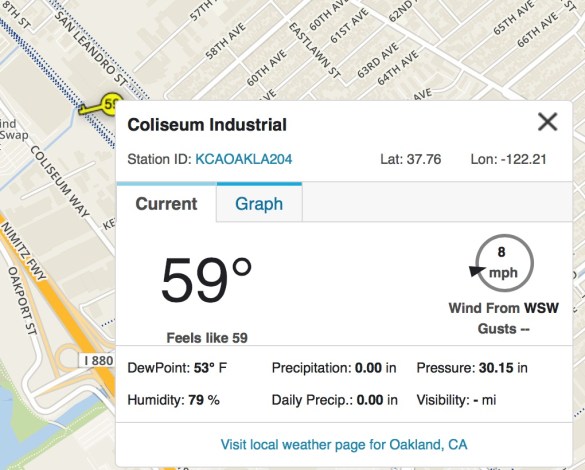
To gain some insight, let’s check with our friends at Weather Underground. Unlike last year, when it appeared that a station was installed on a buoy in the Oakland Estuary, this time it appears that it’s situated on the southwest corner of the Howard Terminal pier. That’s not the likely location of home plate or the grandstand, but it should provide a sense of the prevailing winds in the neighborhood.

Here’s what that station is registering as of 6:20 PM tonight:

Now let’s look at the Coliseum area at 6:23 PM:

Now I’ve heard a lot about how Howard Terminal won’t be Candlestick, Part Deux. Let me point out that Howard Terminal is not Jack London Square, and while HT isn’t exactly Land’s End, it isn’t the most wind-protected area ever and it’s probably not going to be in the future. Even if a ballpark is built there, local and environmental groups will fight hard to keep the A’s from building a 100-foot-tall, 800-foot-long edifice on the waterfront. The A’s will probably unveil a design that orients the park more towards downtown and away from the water, to provide allow the ballpark grandstand to block the wind. Or, as the Giants found out:

The wind and temperature conditions aren’t necessarily going to be the gating factor that determines the viability of Howard Terminal. Economic factors and political process will.

Speaking of process, now that the ENAs for the Coliseum and Howard Terminal have been approved, the A’s now have given themselves a scant six months to figure out all of the details.

Say that Kaval makes an announcement in early December. Because of the normal City Hall schedule, a project won’t be brought up for City Council review, let alone planning commission review, until early next year. Then the CEQA process will begin. If you’re keeping track of how other recent projects have been affected, consider that the Warriors ownership group bought the site of the future Chase Center from Salesforce in April 2014. It’s scheduled to open in time for the 2019-20 NBA season, which starts in October 2019.

Then remember that the Coliseum, thanks to the aborted Coliseum City project, already is entitled for one or more stadiums and a slew of ancillary development. The Warriors ended up going with a backup plan. What will the A’s do?

Port of Oakland set to vote on Howard Terminal ENA

Does this read like deja vu?

That’s because it is.

The Port of Oakland is getting ready to approve a one-year window for negotiating with the A’s on Howard Terminal. To help pave the way, they will also approve a feasibility study for the site. I know you’re asking, wasn’t a study done a few years ago? And I’m here to tell you, no, it was never done. Not one released in public, at least. The A’s shared their findings with the City and Port. Neither the Port nor City furnished their own study or EIR. Neither did Oakland Waterfront Ballpark, the group that championed Howard Terminal oh so long ago. Here’s the agenda item:

1. CLOSED SESSION (1:00 p.m.)
1.1
Closed Session discussions and materials may not be disclosed to a person not entitled to receive it, unless the Board authorizes disclosure of that confidential information.
CONFERENCE WITH REAL PROPERTY NEGOTIATOR – (Pursuant to California Government Code Section 54956.8)
Property: One Market Street, Oakland, CA (Howard Terminal) Negotiating Parties: Oakland Athletics and Port of Oakland
Agency Negotiator: Pamela Kershaw, Director of Commercial Real Estate Under Negotiation: Price and Terms of Tenancy
Property: Oakland International Container Terminal (Berths 55-56 and Berths 57-59) and Matson Terminal (Berths 60-63 – Port of Oakland
Negotiating Parties: SSA Terminals (Oakland), LLC; SSA Terminals, LLC, and Port of Oakland
Agency Negotiator: John Driscoll, Director of Maritime Under Negotiation: Price and Terms of Tenancy
File ID: [141-18]

Not much has changed in the intervening years. Obstacles remain for any project at HT. There’s the lack of BART serving the area. It’s still polluted. It’s still on the wrong side of the tracks, as mentioned by former city administrator Dan Lindheim:

“The reason was it was on the wrong side of the tracks,” Lindheim, now an assistant professor at the UC Berkeley Goldman School of Policy, said recently. “Major League Baseball feared in the event of a catastrophe. their illustrious fans and players would be stuck. They didn’t want 40,000 people stuck over there.”

And don’t forget the A’s finding that Howard Terminal is appreciably colder than other sites in Oakland. Or the constant pounding noise coming from Schnitzer Steel at night.

Maybe the A’s-led effort will resolve the myriad issues plaguing the site. You have to give the parties credit for giving this a good old college try. However, I’m afraid that thanks to MLB backing the A’s into a corner, the team will have no choice but to kick the can down the road. We’re all familiar with that routine by now.

—-

P.S. – You noticed how third parties came out of the woodwork to hopefully bid on the Coliseum, but none have done the same with Howard Terminal? I wonder why.