The A’s are NOT an obstacle to the Raiders

In the 2014 A’s Coliseum lease, the process for the A’s to vacate in compliance with a new Raiders stadium project was quite clear. Here’s how the stadium project was defined:

‘Raiders Construction Plan’ means a bona fide plan for construction of a new football stadium for the Oakland Raiders on current Complex property, adjacent to the current Complex property, or otherwise located sufficiently near to the Stadium such that it will materially impact Licensee’s operations, which bona fide plan must include, as pertains to such stadium project, a fully executed development agreement with a third-party developer and the Licensor for development of a new Raiders stadium, supported by a non-refundable deposit from the developer and received by the Licensor of at least Twenty Ten Million Dollars ($10,000,000.00).

And the terms for the A’s to leave:

Licensor may terminate this License upon written notice of intent to terminate to Licensee, such termination to take effect sixty (60) days after the conclusion of the second (2d) Baseball Season that commences after such notice. (By way of example, if Licensor provides Licensee with such termination notice on June 15, 2016, this License will terminate sixty (60) days after the conclusion of the 2018 Baseball Season.)

Basically, the Coliseum Authority has to give the A’s at least two full MLB seasons notice, so that they can plan for their next home. To build a stadium, the Raiders and their chosen developer partner would also have to provide a real plan, not just a couple drawings and some empty promises for studies. The point is to ensure that the Raiders and the developer are committed to the project, instead of wavering while pushing harder for alternatives outside the market (Las Vegas, Los Angeles, etc.).
IMG_0359

That’s it. The A’s don’t have any rights or right-of-refusal to develop the Coliseum land, to dispose of the Coliseum debt, or anything else besides playing baseball games at the Coliseum. It is not up to the A’s to determine what land the Raiders can or should use. If the Raiders want to submit a plan to develop the entire complex, part of the complex, or even tear down and rebuild the Coliseum only, nothing is stopping them, especially their co-tenants the A’s. Anyone who say otherwise is lying.

Today, Oakland Mayor Libby Schaaf took steps to correct a report by Matier and Ross from the weekend. Here’s her statement:

‘Today’s San Francisco Chronicle contains inaccurate information I need to clarify. On May 23, I proactively contacted NFL Commissioner Roger Goodell to update him generally on what we’ve felt have been productive conversations with Raiders’ negotiator Larry MacNeil.’

‘Having learned from what I believe was a past mistake of awarding an exclusive negotiating agreement to a developer not approved by the Raiders, I wanted to assure the Commissioner of my commitment to keeping the Raiders and NFL at the center of our efforts.’

‘I did express to the Commissioner my interest in continuing discussions with the Ronnie Lott/Rodney Peete group and asked how the Commissioner would view my taking more meetings with them.’

‘The Commissioner encouraged me to explore all avenues for partnership that might result in a successful project for Oakland, the Raiders and the NFL, assuming we not give away any rights without clear Raiders’ support. That is my intention in resuming discussions with them.’

‘I continue to believe the Raiders can develop a new stadium in Oakland that is responsible to the team, its fans, the NFL and the taxpayers of Oakland. Oakland has worked hard to contribute the entitlements, development opportunities and infrastructure funding to our shared vision of a stadium-centered development at the Oakland Coliseum. I’m committed to continuing to work hard to realize this vision.’

Smart move by Schaaf not only to get ahead of the story, but to also control the messaging. This statement doesn’t waver from any previous public statements made by Schaaf since the demise of Coliseum City. Certainly there are other talks happening in private. The City and County still haven’t finished the the buyout plan for the Mt. Davis debt. She knocked down the characterizations in the M&R piece, instead positioning the talks as part of an ongoing process instead of a chess match.

A Raiders stadium is not going to proceed on a ridiculously fast track as we’ve seen in Cobb County for the Braves or in Vegas for the UNLV-Raiders stadium. There are too many details, too much complexity. That’s why the whole Raiders are stuck because of the A’s lease reeks of an exercise in blame assignment. It’s going to take a while. The process of untangling all of the agreements and leases while minimizing impact on current tenants will be messy. Besides, Davis doesn’t have the coin to accelerate a project the way the Yorks did in Santa Clara. Maybe, just maybe, that’s a good thing. We have seen what happens when a project is improperly rushed.

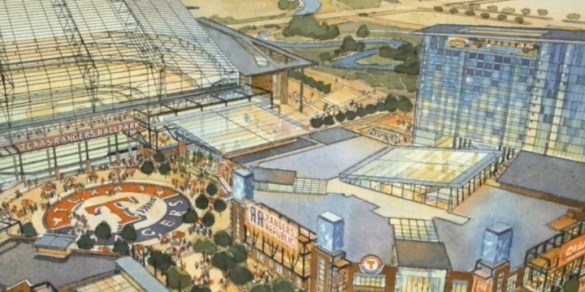
Rangers and Arlington Working On Third Ballpark

Third? You ask. The Ballpark in Arlington was the first true ballpark in Texas. Arlington Stadium was an overstuffed minor league park not worthy of full MLB bonafides, right?

Arlington Stadium was an overstuffed minor league park, true. But it held up for 22 years in an era where ballparks were not as obscenely specced as they are today. Arlington Stadium was redone during the time of the cookie cutter stadia. It was a round bowl. A bare bones facility. It had no roof. There were no cantilevered decks, and the press box attracted the North Texas winds like a vacuum. It was odd and disproportional, yet I had a slight affinity for it when I saw the A’s play road games there. Perhaps that’s because I never had a chance watch a summer game there.

Arlington Stadium (photo by Mike Fitzpatrick)

In 1994 the Stadium was replaced by The Ballpark in Arlington (review), an early entrant in the new era of retro-classical ballparks. TBiA (now Globe Life Park) was built to hold 50,000 fans, a bunch of offices in center field, and the new standard of club seats and suites. What TBiA lacked was any kind of roof with an air conditioning system. A fixed roof was not really in the cards, and the only retractable roof at the time was at the hulking SkyDome, far too expensive for the $191 million budget. So to compensate, the Rangers built ultra large covered concourses with an open facade. It felt airy, and felt pretty good in April and sometimes September. July and August were punishingly brutal thanks to the humidity. George W. Bush, who was looking for a trophy to propel his burgeoning political career, didn’t have six years to wait until the retractable technology evolved to the point of affordability, as it did for the Astros. So TBiA was built, Dubya became governor, and the Rangers stayed in Arlington.

Recently, Rangers ownership, now changed twice, started looking for a more technologically modern home, citing the need for a retractable dome thanks to the heat and humidity problems. A dome over the top of TBiA was considered problematic because of the lack of a support structure (and infrastructure) to carry the roof’s load. Prominent Dallas interests quietly started talking up a ballpark within the city, perhaps close to American Airlines Center. Arlington pulled the rug out from Dallas by working with the Rangers on an eventual replacement for TBiA, even though eight years remained on the lease.

rangers1

What will be the price tag for improved climate control? A cool $1 billion, half of it charged to the citizens of Arlington via extensions of existing sales/hotel/car rental tax hikes. Arlington pols feel confident about the plan because they may pay off the debt at the Cowboys’ AT&T Stadium 10 years early. Sure, they’ll outfit the park with more restaurants, bars, club levels, different types of suite boxes, and custom bat/bear/doohickey booths. And there will be a huge fan plaza with retail and a hotel, finally giving the immediate area something else walkable from the park. That mini ballpark village will be called Texas Live!, located kitty corner from the current ballpark to the southwest.

rangers2

There are a few sobering takeaways from this whole exercise.

  • Public money makes a stadium project move faster. Once those coffers are open, stakeholders are willing to move heaven and earth to make these projects happen. This is the #1 reason why no stadium is happening in Oakland right now, why San Jose’s ballpark fizzled, and why the Earthquakes’ stadium was delayed. Owners and leagues want municipalities to have skin in the game or a pound of flesh, whatever you want to call it.
  • There is little virtue in paying off a stadium early. Just as AT&T Stadium is projected to be paid off early, Phoenix’s Chase Field had its debt retired early. For Phoenix, all that meant was that the Diamondbacks asked for a new ballpark earlier than planned. Same goes for the Rangers in Arlington. Considering how so many sports venues don’t pay for themselves, such moves take a lot of chutzpah.
  • The next wave of ballparks is here. Cobb County’s park for the Braves will open next year. The Rangers are shooting for 2021. Arizona is asking for their own smaller, more intimate park. Arte Moreno has been saber rattling Anaheim for years. Other teams will call for extensive renovation plans. This new era may not have the same wholesale turnover of venues as it did during the Selig era, but whatever happens promises to be very expensive, and for most teams, largely unnecessary.

Sometimes it feels like the world is passing the A’s by. This is no more clearly evident than in the stadium game. At least the Rays are here to keep us company.

Raiders ink 1-year lease with options, hire former 49ers CFO MacNeil

The Raiders agreed in principle to a one-year lease at the Coliseum, with the potential for extensions in 2017 and 2018. Specific terms were not revealed at today’s press conference, but the main reveals are that the Raiders will pay more in rent than they had in the most recent lease, and that Larry MacNeil, former 49ers CFO, was hired to work with the City/County/JPA on a new stadium deal. Davis touted MacNeil’s experience in developing Levi’s Stadium.

Towards the end of the press conference, Davis challenged A’s ownership to “commit to Oakland”:

Right now there’s 120 acres. There’s parking, there’s an arena. We like the gameday experience of tailgating on that parking lot. We don’t want to give that up. Now, there’s two teams that play in that Coliseum. One’s the Oakland A’s, one’s the Oakland Raiders. People have not listened when I said I do not mind if there are two stadiums on that site. The A’s stadium would take about 12 acres, the Raiders’ stadium would take about 15-17 acres. That’s fine with me, but I do not want to give up the parking.

If, in fact, the A’s do want to stay in the Coliseum site, they need to commit A.S.A.P. so that we can go ahead and design and take down the Coliseum, provide all the infrastructure necessary to build two new stadiums in Oakland, and two teams will then come back in and play in two new stadiums. What I do not want to do is build a football stadium in the corner of the parking lot while the Coliseum is still standing, and then once we have a brand new stadium we begin to tear down – or build a new baseball stadium – and then tear down the Coliseum, disrupting the ingress, egress, and parking, tailgating experience for Raider fans on gameday. What it’s going to take is for the A’s to make a commitment to Oakland and tell the people what they want to do.”

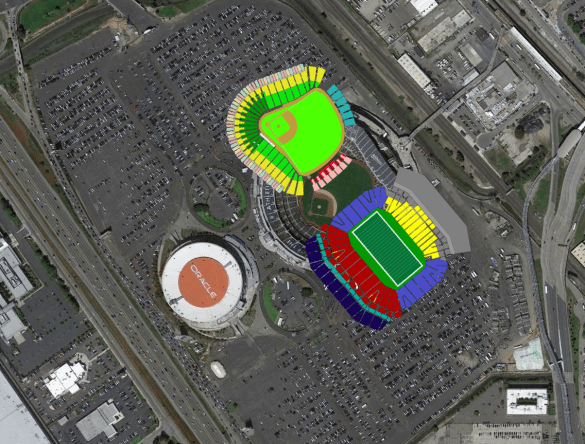
You mean something like this, Mark?

Two new venues on a slightly larger footprint than the original

Two new venues on a slightly larger footprint than the original

The A’s response did not waver from their ongoing evaluation process:

Let’s, for a moment, follow Davis’s argument all the way through to its hypothetical end. He is right that he’s been consistent about this. For nearly two years he has wanted the Coliseum torn down immediately, to be replaced by either a football stadium on the original footprint, or two venues next to each other. As you can see from my drawing above, it can be done while taking up only slightly more land than the original Coliseum did. There would even be some advantages in that a grand plaza could be built between the two stadia, leading to the arena.

But is it realistic? Let’s consider how this would progress. Assuming that Lew Wolff and John Fisher could be convinced to go along with this plan, the Coliseum would be torn down and the site graded shortly after the end of the Raiders’ 2017 season – let’s call it a year from now, February 2017. From that point new infrastructure would have to be put in place, followed by actual construction. If they started by the summer, the A’s couldn’t move into their new home until the 2020 season because of a very compressed schedule for an early 2019 opening. The Raiders could potentially open in 2019, but consider that 2019 is the projected opening for the Rams’ stadium in Inglewood – and that site is ready to go, demo already completed. For all intents and purposes, both the Raiders and A’s would be out of Oakland for three years – the A’s probably to AT&T Park, the Raiders to Levi’s or somewhere else. Throughout all of this, Davis would have final say on any development on the 120-acre Coliseum site.

Is there anything in Davis’s history or actions that makes anyone believe Davis is the person to make this happen? He has no experience in development or in the kinds of complex legal and business arrangement requires. His sudden ability to rattle off catchphrases like “opportunity cost” like he just rolled out of a basic microeconomics class isn’t impressing anyone. MacNeil is a good hire, but his presence alone isn’t going to convince investors to subsidize a stadium. And Davis’s desire to stick with ingress/egress/parking as his most important issues in Oakland is downright bizarre. Preserving parking has some nobility to it and is a good way to pander to Raiders fans, especially when compared to the mess that is Levi’s Stadium parking. That argument can’t possibly impress the other 31 owners, who have demonstrated repeatedly that they want deals that improve revenue for teams and for the league as a whole. Parking is worth maybe $4 million a year in revenue. Davis has somehow neglected to talk about revenue as a rationale as every other owner seeking a new stadium has done. Raiders ticket prices will be frozen again for 2016, keeping prices and local revenues essentially flat for the several years since he took the reins. And Mt. Davis will remained tarped to boot. If the Raiders’ revenue position is going to improve, the Raiders will have to charge much higher prices at the new stadium, and in the intervening years they’ll have to test out those higher prices on fans at the Coliseum, the same way the Warriors are doing now in preparation for their new arena. Without a major revenue boost, there isn’t even a business case for building a new stadium, even a small one. The $500 million (+$100 million gift) Davis frequently talks about comes from stadium revenues. If he can’t hit the targets in those loan programs he’ll have hell to pay from the other teams’ owners and his own investment group, in large part because he’ll end up bleeding his golden goose (the NFL’s TV contracts) to pay everything off. And we still don’t know how the $300 million funding gap would be filled.

Historically, none of the old multipurpose stadia have been redeveloped in the manner Davis is suggesting. There generally was a sequence with one tenant staying in the old building while another was built next door, then the old one was demolished and replaced. That was a successful model in Pittsburgh, Cincinnati, and Philadelphia. While the Bay Area has the luxury of high quality venues that could host the two Oakland teams in a pinch, you’re also allowing them to take both feet out the door for three years. Either team (or both) could back out of any stadium deal at any time (really, please try to force a team to build a stadium when the city is providing no money for it). The only leverage Oakland has is that the Coliseum still exists and remains functional, allowing MLB and the NFL to maintain its inertia regarding both teams. Without the Coliseum, Oakland is practically a non-entity for pro sports. I’m not sure if the politicians gathered around Davis at the presser believe in Davis’s vision. The presser certainly wasn’t the venue to argue against Davis. The theme of the event was unity, even though all they were talking about was a short lease extension. Well, unless we start to see hard numbers and actual advantages for the A’s and Raiders besides preserving parking, we’re a long way from actual unity.

P.S. – Davis is trying to play some sort of PR game by claiming that the Raiders are “hamstrung” by the A’s lease. That’s only true if the only way to build a stadium is to do it Davis’s way. Otherwise the A’s lease can be terminated with two years’ notice. That’s it. It’s not unreasonable for the A’s to ask for some time to get their affairs in order. Unless you’re Tommy Boy, I guess.

Manfred addresses ballpark topic

Yahoo Sports’ Jeff Passan held a wide ranging interview with MLB Commissioner Rob Manfred, published earlier today. Included in the questions were a couple about the stadium situations for the A’s and Rays:

Two NFL teams are about to move. Baseball is the sport that has gone the longest since a franchise relocated. Are you nearing that situation with Tampa Bay or Oakland?

It remains my strong preference, because I think it’s a policy that has served baseball really well over time, to stay in the markets where we’re located. We’re going to exhaust every possibility to get stadiums done in Tampa Bay and Oakland. But clearly you would think I was sort of la-la if I didn’t recognize at some point in time it may be necessary to consider alternatives.

No one should be terribly encouraged or discouraged by this. Manfred will clearly let this process play out and see where it leads, even if that means a dead end in either market. When that runs its course, we’ll see what (if anything) opens up. San Jose partisans may look at this as good sign for them, but that’s waaaaaaaayyyyyyy down the road.

I’m more encouraged that Manfred is clear about his position. He’s not mincing words like his predecessor, or saying “it’s complicated” or uttering expletives when asked. Manfred’s too early in his tenure to be worn down about the issue as Bud Selig. Check in again in five years. Manfred is happy that the Rays will get to explore all of the Tampa Bay area, even if the financing picture there remains bleak. As for Oakland, there’s this:

News for the week: Tommy Boy Edition (1/16/16)

While Mark Davis drowns his sorrows with some beer and wings, pondering his next move, we should consider what else has been happening this week. After all, unless either the Chargers decide to stay in San Diego, Davis is more-or-less stuck in Oakland. He could conceivably apply to move to a vacated San Diego or San Antonio, but that require going through this rigmarole again with a much smaller payoff. So we’ll let whole football thing settle down for a few weeks. If you want to understand what Oakland is getting ready to offer the Raiders, read my post from November.

Matier and Ross reported earlier this week that Oakland Mayor Libby Schaaf is pushing Howard Terminal hard for a new ballpark, which is no secret. Included was this nugget:

The city would probably also have to come up with at least $90 million in infrastructure improvements, including funding for a car and foot bridge connecting Howard Terminal to Market Street east of the railroad tracks.

That $90 million figure is no accident. Schaaf is offering the Raiders the same amount for infrastructure at the Coliseum. She’s trying not to play favorites with either team. Of course, there is the danger of spiraling costs, and Oakland is putting itself in the position to carry the debt burden all by itself, since it’s nearing a deal to buy out Alameda County. As costs rise, the question will linger over how much Schaaf is willing to support before the projects become untenable. At least her staff has acknowledged the need for an overpass at Market Street, which was a major issue for me. Frankly, I think they need two overpasses because of Market Street’s location well away from Jack London Square. If you want to get reacquainted with Howard Terminal, read my various posts about the site.

Other news:

  • The City of St. Petersburg’s City Council approved by a 5-3 vote to allow the Rays to explore other stadium sites outside the city limits. That includes all of Pinellas County (St. Pete is the county seat), and neighboring Tampa and Hillsborough County. It’s too early to tell whether this will ultimately lead to the end of the Rays’ tenure in St. Pete, but proponents are at the outset painting this as the team’s best chance to stay in the 4.3 million-strong Tampa Bay Area, which has proved poor for attendance and excellent for TV ratings. As always, the biggest issue is figuring out how to pay for it. Head over to Noah Pransky’s Shadow of the Stadium for complete coverage.
  • The Warriors are pushing back the opening of their arena to 2019 to accommodate the legal challenge by the anti-arena Mission Bay Alliance. MBA also sued UCSF’s Chancellor and now has two lawsuits against the arena project in different jurisdictions. It’s a legal Hail Mary that will largely depend on whether the arena will be afforded an expedited legal review. (SFGate, LA Daily News)
  • The new arena near the The Strip in Las Vegas has a $6 million per year naming rights deal with wireless carrier T-Mobile. (Las Vegas Review Journal)
  • Hartford’s downtown ballpark is delayed and has $10 million, for which no one has figured out how to pay. Thanks to the delays, the AA (Eastern League) Yard Goats will be forced to play on the road for the first six weeks of the season. (Hartford Courant)
  • Walmart announced a slew of store closures, including a store in south San Jose and the Oakland store on Hegenberger near the Coliseum. The store will close Sunday, which led @fanpledge to wonder if it could work as an A’s ballpark site.

Most importantly, the In-N-Out in the northeast corner can stay intact. I’ll cover this site in greater depth later.

Setting Terms: A Commitment to Exodus

Okay, there was real news about the Raiders and Oakland today, not rumors, so I feel compelled to write about it. I’m over the soap opera news cycle of the last year, looking forward to January, when something LA might (not) be resolved to the NFL’s satisfaction.

As St. Louis and San Diego provided stadium financing plans pledging $350-400 million in public funds for their respective stadia, Oakland officials offered a mere five-page letter promising no public money for construction, hoping that the NFL’s respect of legacy and history would help keep the Raiders in the East Bay. The NFL’s reaction was that the letter was expected, while Mark Davis expressed befuddled disappointment.

At this point, you have to think that based on the efforts City of Oakland and Mark Davis, few people within the NFL believe that any new stadium is going to happen in Oakland. The City has no will to do it, and Davis has spent far more time and effort on Carson than Oakland. The NFL will have to gauge the owner’s interest in resolving the Raiders’ situation against resolving the dilemma in Oakland. Of course, many within the league previously preferred to have the Raiders share Levi’s Stadium with the 49ers, the same way the Giants and Jets share MetLife Stadium. Even with Davis continually dismissing the idea, the concept remains a viable backup plan should nothing continue to happen at the Coliseum.

But again, my beat isn’t the Raiders except in how the Raiders’ plans might affect the A’s. From today we got a big list of deal terms the City is willing to make in the pursuit of the Raiders’ new stadium. Whether or not the Raiders stay, regardless of the Coliseum’s future as the home of the A’s, the numbers are effectively setting the bar for future stadium deals for either team. What is Oakland willing to provide? Let’s take a look at the “concepts” presented to the Raiders.

  1. 69 total acres in and around the Coliseum, including the “South 60” consisting of the B & C parking lots, plus the Malibu and HomeBase parcels. Also included are 9 acres of publicly owned land near Coliseum BART could be used for a hotel or other commercial development adjacent to an expanded BART station and transit hub. The Raiders and a partner developer would receive development rights based on the Coliseum City rezoning effort.
  2.  $90 million in infrastructure, to be designed and approved by the City of Oakland.
  3. No public money towards construction of the $900 million, 55,000-seat stadium. The Raiders would be responsible for all stadium construction costs, including overruns.
  4. At least 8,000 surface parking spots with minimal ancillary development.
  5. Raiders would own the stadium, City and/or County would own the land underneath. That would set up recurring ground lease and possessory interest tax (PIT) payments.
  6. Raiders would take in all stadium revenues while assuming all operating costs.
  7. City’s promised defeasance of the outstanding Coliseum debt (worth $100+ million now, goes down over time).
  8. Construction to start in 2017, stadium opening in 2019.

Per the A’s current lease at the Coliseum, if they are to be evicted because of new stadium construction for the Raiders, the Coliseum JPA has to give the A’s at least two full seasons at the Coliseum while they figure out where to play next. The lease terms also call for the A’s to be compensated for the scoreboards and for lost revenue associated with new football stadium construction.

If we’re to assume that the A’s should get a similarly valued deal to the Raiders in order to stay in Oakland, the deal would be worth $200 million straight away because of the debt and infrastructure costs, plus the value of any development rights wherever the A’s end up, whether that’s at the Howard Terminal, Uptown somewhere, or the Coliseum. That’s the price Oakland will have to pay, and MLB will be happy to press Oakland hard on that. The A’s are expected to build their ballpark entirely with their own money, so it should in theory be a pretty clean deal with no intrusions or complications created by new, single-purpose quasi-governmental agencies like stadium authorities.

Just to be clear, that’s $200 million in value, not cash. The A’s would never see that money except in terms of the completed infrastructure. It could be that certain sites have such high infrastructure costs that they could approach $200 million on their own. New parking garages, the community benefits agreements and PITs Mayor Libby Schaaf mentioned during tonight’s press conference – they’re all worth something. Will Oakland show as much restraint for the A’s as they have displayed with the Raiders? I imagine they would, though it’s far too early to speculate. For the time being, let’s continue to watch how the NFL-LA business shakes out, and see where the Raiders end up as a result.

NFL’s LA relocation committee meeting upstaged by Iger-Carson announcement

Oakland Mayor Libby Schaaf went to NFL headquarters in New York to present her city’s case for keeping the Raiders in town. While no decisions are immediately forthcoming, it was important for Schaaf to keep Oakland in the game. Schaaf and the Oakland contingent arrived shortly before Oakland’s scheduled slot, then left the building by taking the back entrance after she was done, avoiding the assembled press in the process. Maybe the Mayor had to catch the next JetBlue flight back to Oakland or she had tickets to Hamilton, I don’t know. In any case Oakland gave its modicum effort, which was better than literally nothing.

A slide from Mayor Schaaf's presentation

Actual slide from Mayor Schaaf’s presentation

Shortly after the meeting ended, Schaaf’s office proffered this statement:

NEW YORK, NY – Mayor Libby Schaaf released the following statement following the City of Oakland’s presentation to the NFL on November 11 in New York City:

“Today’s meeting with the NFL reinforced that Oakland is correct in continuing to work directly with the team and the NFL to keep the Raiders in Oakland where they belong.

We were very grateful and excited to have the opportunity to make Oakland’s case to the NFL today. I felt it was a positive discussion and that we were well-received by the Raiders’ leadership and the other NFL owners. They were engaged and asked great questions.

Moving forward, the City of Oakland is working to defease the current bond and purchase Alameda County’s stake in the land and existing facilities. We are also beginning to analyze ways that we might monetize future revenue that could be generated from a stadium development.

We remain committed to responsibly keeping as many of our sports teams as possible. My focus continues to be on forging a partnership that supports a team-centered effort to build a new stadium for the Raiders in Oakland that will be successful for the fans and the team and responsible for the city and its taxpayers.” (11/11/15)

What was in the presentation? Mostly it rehashed the work done for Coliseum City. The preso emphasized that the Coliseum land was publicly owned and properly entitled, with a completed EIR in hand. There’s also $40 million in funding available for the planned $140 million expansion of the Coliseum BART transit hub. Beyond that there was little to crow about deal wise. Even though Schaaf isn’t promising any public money for construction, there’s still a laundry list of issues to resolve before any kind of groundbreaking. Among them:

  • Financing for an estimated $100 million in additional infrastructure
  • The buyout of Alameda County
  • Terms to cover the outstanding Coliseum debt (a City/County issue, not the Raiders’)
  • Potential funding sources: tax increment and lease revenue bonds

Those funding sources are what’s expected to pay for the infrastructure at the very least, perhaps more. Keep in mind that the top three items could cost Oakland $400 million or more depending on when the deal happens. It will difficult enough to raise those funds before even considering how to bridge the stadium’s funding gap.

St. Louis and San Diego also had their turns and made their proclamations. But before they even had a chance to plead, an announcement from 3000 miles away sucked all the air out of the room. The Carson Holdings group overseeing the joint Chargers/Raiders stadium project announced that Disney CEO Robert Iger would become a non-executive chairman, with the option to buy a minority stake in either team. Iger, who ran ABC/Capital Cities during the height of ABC’s Monday Night Football run, is a trustworthy known quantity among the league’s owners. That said, Iger is not a billionaire, with a net worth said to be somewhere in the $100 million range. If Iger were to want a piece of the team, he would probably bring in some private equity partners from elsewhere to put up whatever was needed to take care of the project cost in Carson.

For months I have stayed away from the all-too-easy horserace aspects of this story. I won’t handicap any project’s chances now. As a strategic move, the Iger announcement worked like gangbusters. The play was for legitimacy, which is impossible to deny as of November 11. Last week many in Oakland were satisfied in believing that Stan Kroenke’s Inglewood project was superior enough to Carson that the Raiders would be forced to stay by the Bay. Now only a fool would say that.

NFL Town Halls: Three days of talking around a problem

They came, they saw, they empathized.

As part of NFL’s relocation evaluation process, the league is required to hold public meetings in the cities from where incumbent teams are threatening to move. Despite the fact none of the three teams considered part this discussion – Raiders, Chargers, Rams  – have actually filed a request for relocation (they aren’t allowed until January), the NFL decided to hold these meetings well in advance of all three teams’ expected applications to leave.

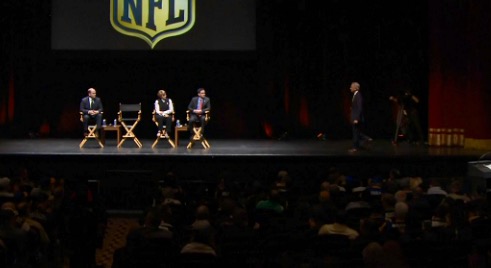
That left the NFL to announce three weeks ago that they would send a team of executives, fronted by Eric Grubman, to the threatened cities to hear from fans and discuss each city’s situation. Grubman was accompanied at each stop by fellow VPs Chris Hardart and Cynthia Hogan, plus league attorney Jay Bauman. All four sat in directors chairs on a blacked out stage, while fans sat in the lower auditorium levels, waiting to speak at podiums placed in each aisle. Politicians and team owners, even Raiders owner Mark Davis, sat among the riffraff.

St. Louis and San Diego share a common problem, in that their respective teams have not participated at all in recent stadium development efforts at home. Local sentiment reflected that, with fans lustily booing the Rams’ Kevin Demoff and the Chargers’ Marc Fabiani, both of whom have openly pooh-poohed those 11th-hour attempts in favor of stadium projects in the LA area. Feeling powerless, fans in both cities sang a common refrain: bring Stan Kroenke and Dean Spanos back to the table so that we can make stadium deals in STL/SD. And as each story about generational bonding or heartbreak was heard, the more it sounded like groveling. That’s what the owners and the NFL have reduced fans to doing: begging to keep the team in town. It’s a common story, at least in North American pro sports, and this won’t be the last time it happens. Some guy within NFL Films will be tasked with editing the combined nine hours of testimony down to probably 30 minutes that will be consumed by the collective 32 NFL owners at a future league meeting. I don’t envy that person one bit.

upintheair

George Clooney and Anna Kendrick in 2009 film “Up in the Air”

Grubman, who made most of the responses to fan questions, reminded me a lot of Ryan Bingham, the slick, well-compensated corporate hatchet man from the Walter Kirn novel Up in the Air. The film adaptation in 2009 starred George Clooney as Bingham, a man who lived a thoroughly hollow personal existence while obsessing over a quest to reach one ten million frequent flyer miles. That’s not to say that Grubman’s like Bingham personally. From all appearances Grubman is a family man. He even joked in Oakland that he was missing his wedding anniversary for that night’s hearing. Nevertheless, Grubman’s ability to empathize with every fan and speaker was amazing to watch. Veterans and government employees received laudatory Thank you for your service salutations. Several times he prefaced a remark with, I know what it’s like to be a fan. It was as breathtaking and sickening a performance as I’ve ever seen – including Clooney’s, which netted him an Oscar nomination. Then again, Grubman apparently gets paid at least $4.4 million a year as an executive VP in the NFL. Like Bingham with his delegating boss, Grubman is compensated well to, among other responsibilities, take Roger Goodell’s arrows.

Davis has also been an active participant in the joint stadium effort in Carson, though Raider fans and city officials have given him some credit for participating to a degree with the now shitcanned Coliseum City project. He received a largely warm reception from the roughly 400 Raiders fans at the Paramount Theatre in Oakland. He made some opening remarks, stating that the Raiders wouldn’t answer questions at the session. Couple that with Grubman’s admission that the NFL had no solutions for Oakland, and you might think that the whole thing was a charade. You would be mostly right.

When challenged about the Raiders paying only $300 million (plus the NFL’s $200 million in G4 money) towards a $900 million stadium, Davis responded.

That’s basically what Davis has been saying for the last six months. He’s not willing to stake additional stadium revenues to make an Oakland stadium deal happen, as the 49ers did with Levi’s Stadium. Hard selling with ultra-expensive seat licenses and ticket prices works as long as the team is good, but as we’ve seen so far in the 49ers’ tenure in Santa Clara, fans will ditch the team in droves if the team isn’t competitive. Even the Raiders had trouble selling out until the upper deck of Mt. Davis was tapped off. No one wants to be left with the check at the end of the night, whether it’s Davis and his ownership partners, the City of Oakland and Alameda County, or stadium financiers. This is not a trivial amount of money – $400 million – that we’re talking about. Fans need to stop treating this issue like it is.

Yet there were calls for crowdfunding to help bridge the funding gap. Before anyone creates a Raiders stadium Kickstarter, you all should know that there already exists a sort of primitive form of stadium crowdfunding. It’s called a brick campaign. Fans buy custom engraved bricks that end up in a plaza or on a wall at the stadium. Even successful brick campaigns won’t pull in more than around $25 million, a relative pittance compared to the total project cost. The Green Bay Packers held a stock sale in 2011 to finance renovations at Lambeau Field. That effort raised $64 million, from sales of 280,000 shares costing $250 each. If the NFL allowed Raiders fans to make a similar effort (even though the Raiders are not a publicly-owned corporation), the effort would have to sell around 1.8 million shares at $250 apiece to raise $400 million (after overhead and fees). That’s simply an infeasible goal for any team, not just the Raiders.

NFL exec VP Eric Grubman stands on stage while answering a question at the Oakland Town Hall

NFL exec VP Eric Grubman stands on stage at the Paramount Theatre while answering a question at the Oakland Town Hall on Thursday

Last but not least, Oakland Mayor Libby Schaaf was in the house. Schaaf thanked the NFL and fans for showing up. Yesterday, Matier and Ross led off their column with a note about yet another consultant being brought in to put together a package that might sway the Raiders and the NFL. That package could provide infrastructure and potential tax breaks for a stadium deal. While that might sound promising, it’s really just formalizing what Oakland’s willing to offer, which is limited help and no public money. That won’t work for the NFL because the league considers infrastructure and free land little more than table stakes. St. Louis and San Diego are providing real public money towards construction, just as every previous NFL stadium project has in the past. If public money isn’t on the table, there’s little reason to expect the NFL to respond positively. Grubman explained that every stadium deal has three financing parts: the team, the league, and the local piece. Historically that local piece has consisted of public loans or bonds. The NFL has already rejected the Coliseum City plan. The NFL has its script and it’s sticking to it. Oakland is no special case here. If Oakland really wants to keep the Raiders, they need to put some skin in the game. Given what happened with the Mt. Davis debacle, that skin may end up being Oakland’s scalp. Schaaf is right to be cautious and not desperate as her counterparts have been. How do those positions get reconciled? Someone will have to give in, and the NFL has not shown a track record of making concessions.

NFL to hold town hall meetings in St. Louis, San Diego, Oakland

Image from Barcroft Media

St. Louis on Tuesday, Peabody Opera House, 7 PM CT

San Diego on Wednesday, Spreckels Theatre, 7 PM PT

Oakland on Thursday, Paramount Theatre, 7 PM PT

Stream should be available at nfl.com/publichearings.

Commentary to come after final session in Oakland. Watch the Twitter feed for live coverage.

Swingin’ A’s Podcast Interview

Sometimes it’s easier to ramble on a podcast than to write and edit a couple thousand words on a topic. Actually it’s a lot easier. If you’re wondering how all the stadium business with the A’s and Raiders is going to work out, head over to today’s Swingin’ A’s Podcast at Hardly Serious. I talked for nearly an hour with host Tony Frye about the fallout from the SCOTUS decision, how the Raiders are holding everything up, and what I think is going to happen over the next few months. I even explain how a ballpark deal could get done. Take a listen, and try not to focus on how many times I pause while delivering an answer. It’s a podcast, I’m allowed.