The public came out of the Planning Commission meeting with more questions than answers, and that’s a good thing. When the EIR comment period ends, it’s up to City staff and consultants to provide answers to the many question posed by the public.
A presentation was given to start. Early discussion focused on affordable housing as part of the plan. The plan calls for 5,750 housing units to be built. 25% of those are supposed to be affordable, whether via rental or purchase. The Bay Area’s ever-skyrocketing housing market makes that 25% a growing subsidy (public and/or private) with each passing month. According to trulia, the median price for a home in Oakland is $475,000, up 8% from September 2013. Oakland uses a HUD formula to calculate affordable housing on a regional basis. In essence, 25% of housing would have to be affordable for households making $72,000 or less per year. However, the median income in Oakland is less than $52,000/year. To make it work, the City and developers would have to crunch some serious numbers to determine the proper mix of pricing and subsidies, not to mention addressing low income residents and senior citizens – both groups represented by commenters at the meeting. Chances are that most of it would come out of developers’ pockets, though Governor (and former Oakland mayor) Jerry Brown has been working to get rid of affordable housing set-asides. This puzzle has to be solved by all residential developers in California, so it would affect Coliseum City’s principals or Lew Wolff and partners if they were given the opportunity. One East Oakland resident got straight to the point.
East Oakland resident: “As you make your plans to build your (Coliseum) City, remember OUR city.”
— newballpark (@newballpark) October 2, 2014
As the Commissioners took their turns picking apart the plan, one asked about the status of discussions with other parties that need to be involved. The responses?
Concerns about having housing next to Airport Business Park, not enough parks and parkland in Specific Plan. #ColiseumCityEIR — newballpark (@newballpark) October 2, 2014
Presentations have been made to County/JPA and Port, no buy-in yet. Planners insist it’s flexible enough to accommodate. #ColiseumCityEIR — newballpark (@newballpark) October 2, 2014
EB Parks rep is concerned about bay inlet, sees #ColiseumCity as an opportunity to enhance parks & rec throughout area.
— newballpark (@newballpark) October 2, 2014
That third tweet is interesting. We haven’t covered the bay inlet much. That’s a reference to the new part of the bay that would approach the new arena (assuming the Warriors stay at Coliseum City).
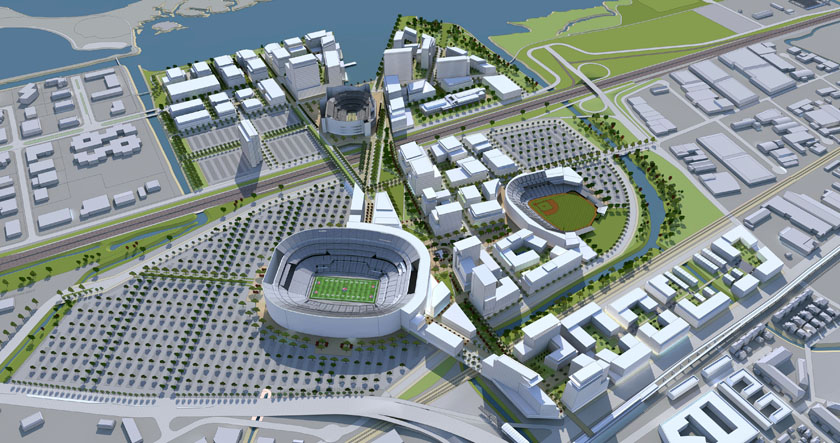
Inlet at top
You might think that the inlet was designed for a ferry terminal or for boats with a dock. You would be incorrect. It’s merely a shallow extension of the estuary, a tidal mudflat not meant for recreation. It’s meant to provide an additional habitat to go with all of the new construction, but it seems like a wasted opportunity. Of course, providing a ferry terminal would bring about an even greater environmental review since some dredging would be required. A couple commissioners seized on the fact that of the various development options the no-build alternative was barely touched except to say that the various venues would be demolished and other development would fill in at some point. Since this is a Specific Plan and not just a small project-level EIR, it’s within the Planning Commission’s right to ask about what happens if the teams leave, since it’s a distinct possibility. The scenario should be addressed in more detail in the final EIR.
Commissioner Coleman: “If we lose the teams, I am really fearful of how this will all turn out.” #ColiseumCityEIR — newballpark (@newballpark) October 2, 2014
A few Raiders fans showed up to provide their support, including Dr. Death and Godfather Grizz. They were largely outnumbered by local residents who expressed concerns about the aforementioned housing problem, gentrification, the need for improved police and fire services in the area, and questions about the effects Coliseum City could have on the rest of Oakland. One thing I’m surprised to not hear was a question about what impact a second downtown (which is what CC represents) would have on the current downtown/uptown area. While that’s a question that goes broader than the existing project, it’s well within the Planning Commission’s purview to take on that kind of dilemma – if it’s a dilemma at all.
Coliseum employees who want to see their jobs protected were well represented. One resident noticed the streetcar that runs through the complex and wanted to see it expand all the way out through East Oakland and up International Blvd. If a streetcar is going to be put in at all, that’s the way to do it. A commissioner noted that while BART and the new AirBART are getting a lot of attention, very little is being paid to how AC Transit and Amtrak will be integrated. AC Transit is as important as anything, because while buses aren’t sexy, they will be responsible for providing transit for many of the low-wage workers that will be working at the hotels in the plan, especially at odd hours.
Overall, there was a large undercurrent of sentiment that Coliseum City is being conceived as an island, not well integrated with East Oakland. That itself is a dilemma, because developers don’t want their shiny condos associated with East Oakland’s rep while community groups and residents are desperately hungry for the opportunities the project represents. As part of Mayor Jean Quan’s 10K-2 plan, Coliseum City represents a big piece of a goal she’s trying to reach.
“This project is necessary for Oakland to meet its jobs growth goals.” #ColiseumCity accounts for 25% of future Oakland jobs.
— newballpark (@newballpark) October 2, 2014
The Coliseum area had lost a few hundred jobs over the decade from 2000-10. Now it’s being counted on to retain three sports franchises – two of whom have no interest in the plan, along with around 4,000 new jobs throughout the 800-acre development. Developers tend to make big promises about such economic growth which get lost in market realities. Perhaps it’s time for more scrutiny of these estimates.



 newballpark.org