Sacramento, Kings, & NBA announce new arena deal framework

On Saturday I took a drive up to Sacramento. I went to Raley Field and took in part of Sacramento State Hornets baseball game. While I was up in the capitol I dropped by the train station, which is immediately south of the Railyards, the site of the proposed arena entertainment and sports complex. 240 acres of dirt and old buildings will make way for an arena, a new intermodal transit facility to go with the historic rail depot, and future ancillary and related development.

Looking east across Tower Bridge towards downtown Sacramento. The Railyards is off-picture to the left.

So I guess I was fortunate to get a glimpse of things before today’s announcement by the City of Sacramento, NBA, and the Kings about a Railyards arena deal (City press release). The $387 million arena plan has been in the works for the last year, with a complete term sheet to be put up before the City Council by March 6. Details have been coming out in the last week as negotiations between the City, team, league, future arena operator AEG, and Sacramento County have caused the numbers to shift considerably as all parties rushed towards the league’s deadline (originally March 1).

When I wrote about the project two weeks ago, I opined that as usual, the devil would be in those details. Now it appears that the deal is on fairly solid footing because of the Maloofs and AEG providing more money to bridge known funding gaps. Those raised contributions, when taken in conjunction with the selling off of parking rights throughout downtown, should provide enough money to get the plan off the ground. The tenets of the deal are these:

  • $190-200 million from selling future parking revenues to private operators. To make this work, the City will have to guarantee some $9-10 million per year in revenue, which means the City may have to make up a shortfall if revenues don’t come in as expected. Sacramento County has apparently pledged revenue from three lots it owns for the effort. Existing debt the Maloofs owe to the City would be refinanced. The “cash” the Maloofs are pledging may actually come some kind of loan, though the loan wouldn’t come from the league.
  • $75 million upfront from the Maloofs, plus $75 million from future rent payments and perhaps a revenue sharing deal. Part of the upfront contribution would be $25 million in land in Natomas near ARCO/Power Balance.
  • An unknown amount from AEG. Initially this was speculated to be $50 million, but the fact that AEG will probably split gate and concession money with the Kings makes this more difficult to assess. There was also talk that AEG’s contribution would actually be part of the Kings “cash” share, but I’ve seen nothing to confirm this. AEG’s updated contribution is expected to be $60 million.
  • A 3-5% ticket surcharge being assessed by the City will not be used to pay off the arena. Instead it will go straight to the City’s general fund in order to offset the lost parking revenue. (Back of the napkin math has this at $3-5 million in revenue annually.)
  • ICON/Taylor, the developer planning the arena, is pledging to handle cost overruns.

From what I know of the area, I have to believe that for the project to get through the CEQA process at least one additional exit/interchange on I-5 between J Street and Richards Blvd. will be necessary. 7th St to the east of the Railyards is merely two lanes wide, so it’ll probably have to be widened to handle traffic not just for the arena but also for the other area development. Remember the Cal Expo plan floated in 2010? There were tons of traffic concerns associated with it, with no clear way to deal with it. Fortunately the Railyards arena will be very close to light rail and Amtrak service.

Now that the plan has been hammered out, it’s all process from here on out. The project EIR started in October, which means a draft should come out of it in the next six months. The tricky part of sequencing everything is that if the parties are all still aiming for opening in May 2015, they’ll have to certify the EIR in only 15 months in order to start building in January 2013. If the project goes to a public vote, there’s little chance that vote can happen before the EIR certification. It would seem more prudent to aim for a October 2015 opening to coincide with the start of the NBA season.

Will this get the job done? It’s a lot better looking plan than any I’ve seen for the Kings in the past decade. That’s a major improvement over the sense of impending doom that shadowed the team last April. It’s clear that this is the final shot for Sacramento to get something done for the Kings, and it’s a decent shot at this early juncture. The losers at this point are Seattle and Anaheim, both of whom were looking to poach the team. If there’s a winner, it’s David Stern, who has somehow come off looking magnanimous while not loaning or otherwise spending any league money to get the ball rolling. A year can make a lot of difference, though Kings fans should be cautiously optimistic. The Railyards arena plan is fragile at best, and while Mayor Kevin Johnson characterized today’s news as hitting the front end of a one-and-one (free throws), plenty of players and cities have bricked that second free throw.

Sacramento, Seattle prep arena proposals

The March 1 deadline for the City of Sacramento to present a complete new arena proposal for the Kings and the NBA to consider has pushed at least one city to react in anticipation. Last year it was Anaheim, this year it’s Seattle. Seattle has been rumored for the last few weeks to have a big-money white knight getting ready to lure a team to the Emerald City. That white knight’s name is Chris Hansen, a Seattle native and SF hedge fund manager.

Seattle and King County held a joint press conference today to give details on the plan. Mayor Mike McGinn’s website has the presser and some backing info. The arena would cost up to $500 million, with $290 million by Hansen and his team(s). The big key to the plan is that unlike KeyArena on the other side of downtown, the new arena would be designed to house both NBA and NHL franchises. While there aren’t specifics about the financing, it’s clear that the arena deal would only work if teams from both leagues relocated there so that revenues would be high enough to cover debt service. Naturally, ensuring 82 regular season games, 3-4 preseason games, plus a good likelihood of at least one playoff series every year, would go a long way towards covering the loans that will be necessary. KeyArena would serve as a temporary home while the new arena was under construction.

Seattle and King County would partner up for $200 million in public financing, which would be backed by ticket and sales taxes. While they didn’t get specific, both City/County and Hansen and public financing as it relates to I-91, the 2006 ballot initiative that only allowed for such financing if the City could get a reasonable ROI (3.1% currently).

Hansen and associates have bought a three acre property south of Safeco Field in the city’s SoDo district. Three acres isn’t large enough for a new arena, so additional land will have to be acquired. The unacquired land includes Showbox SoDo, a warehouse concert venue. It would appear that Showbox SoDo, which was purchased by Showbox in 2007, would have to make way for the new arena.

Comparison of Seattle and Sacramento arena proposals

For its part, the City of Sacramento has put out some basics from its new arena term sheet, which is still in the works and to be presented to the City Council on February 28. The upshot from the $387 million proposal is that the Kings owners, Joe and Gavin Maloof, will have to put up $60 million in cash and donate $25 million in land to make the deal work. It’s unclear if the Maloofs, who already have sold off numerous assets and remain in debt to the City, have the resources to pull this off. The total cost of $387 million also feels rather low, at least by California standards. $200 million in public financing would come from the advance sale of downtown parking revenues.

Both plans have major questions attached. Besides the Maloofs’ outlay, there is a question of whether or not the NBA would sign off on such a deal, especially if the Kings’ low revenue position coupled with debt keeps the team at a competitive disadvantage. The Seattle plan’s dependence on having both NBA and NHL teams in-house sounds looks like a major potential stumbling block due to the complexity of catering to both. Both leagues currently have teams up for sale (NBA’s New Orleans Hornets, NHL’s Phoenix Coyotes), but both would prefer to keep them local if at all possible. Seattle’s plan makes the most sense if there’s only a single ownership group for both teams, as that would prevent competition between two ownership groups from derailing negotiations.

Chances are good that among the Hornets, Coyotes, and NBA Kings, at least one of them will move in the next few years, perhaps two or all three. When that happens it’ll be a tragic day for the adversely affected fans. The cycle of heartbreak continues.

SJ Mayor Reed faces ethics complaint over pension reform

Tonight, San Jose Mayor Chuck Reed is expected to give his annual State of the City address at the Civic Auditorium. He will deliver the speech in the shadow of an investigative report by NBC Bay Area, alleging that Reed and staff misled public employee union negotiators over the direness over the so-called future pension “crisis”. Apparently staff used fuzzy projections of $650 million by the 2015-16 budget year, which could be $250-300 million more than the actual cost of the program. It was those projections that Reed was using to push a pension reform ballot initiative this summer, one that the City Council approved to go on the ballot.

In light of the news report, an ethics complaint has been lodged against Reed, which could result in a full-blown investigation of whether or not Reed and the City fudged the numbers. The police officers union, which has been at odds with Reed, may be sharpening the knives for the mayor, who has been playing hardball with the unions over the last couple of years. Whatever happens, you can at least expect the death of the ballot initiative, which even if passed may not be constitutional. Although it is generally acknowledged by union reps that some kind of pension reform was needed, Reed’s draconian measures probably weren’t. Now it looks like those tactics may come back to bite him.

As far as the ballpark goes, it’s not related to this issue except for the possibility that referenda for both could be on a future ballot. Will Reed finally back down? It’s all up to him.

Nothing from nothing

First, a hat tip to two great legends who left the world much too soon.

If you haven’t done it already, read Nina Thorsen’s KQED interview with the Trib’s Oakland reporter Angela Woodall. Then read Ray Ratto quick opinion piece at CSN Bay Area.

Then sit back and consider what happened. If you’re struggling to come up with anything to describe it, you’re not alone. Because nothing actually happened. No forward progress, all spin, posturing, and gesticulation. Oakland fakes like it’s doing something, then shrugs its shoulders when nothing happens. MLB says nothing and does roughly the same. San Jose tries to do something and is blocked by MLB and the Giants.

I’m going to follow the Coliseum City project because it’s my duty. As long as the City of Oakland and Alameda County make plans for it to any degree, it’s worth covering. I don’t think it has legs. I’ll explain why:

  • Unless there’s a public financing component, a Coliseum ballpark will have a very difficult time paying for itself.
  • MLB wanted a downtown, waterfront site for an A’s ballpark. The Coliseum fits neither criteria.
  • The “City” part of Coliseum City will require its own large public investment. It is by design its own redevelopment district. Oakland will try to leverage existing and future TOD (transit oriented development) grants to help developers, but it’s a pittance compared to the overal cost (<5%). For instance, a 4-star, 800-room, full service hotel would cost $160 million to build, based on a $200k per room construction cost. That leaves out the other retail and commercial development costs. How much of that will the city/county have to subsidize to lure a developer?
  • The Raiders appear to be entirely site-agnostic in their search for a new stadium.
  • The chance that the NFL will award two $150 million G-4 loans to the Bay Area teams instead of spreading the love around to LA, Buffalo, and Minnesota is slim at best.
  • The Warriors are going to play Oakland and San Francisco off each other to get the best possible deal.

With so much uncertainty and so many variables, who is going to take the lead and make that heavy first investment? Private developers won’t do it unless the teams are committed first as the anchors. Teams won’t do it unless they can get something to help them pay for their new venues or give them revenue down the line. That’s the very least they should get considering the amount of construction upheaval that the project would create. The city and county can only act as facilitators. They don’t have the money to shoulder much of the development cost.

Ratto indicates that Oakland is actually playing for the Warriors and Raiders at this point, with the A’s practically out the door. That’s pretty much what I’ve been saying for years. Sadly, Oakland would be best served trying to make the best play possible for only one of its tenants. Otherwise, it might half-ass the efforts for both. Based on what we’ve seen coming out of Oakland so far, it’s quite good at half-assing. Or in the A’s case, no-assing.

Official: Victory Court is dead

And that’s how the drive for a downtown Oakland ballpark ends – with a whimper.

vc-f

Yet another dream dies.

The Trib’s Angela Woodall reports that as a result of redevelopment cuts, the Victory Court ballpark site is now officially dead. We called it before the New Year, so it’s no surprise. But wait, weren’t there two sites near Jack London Square?

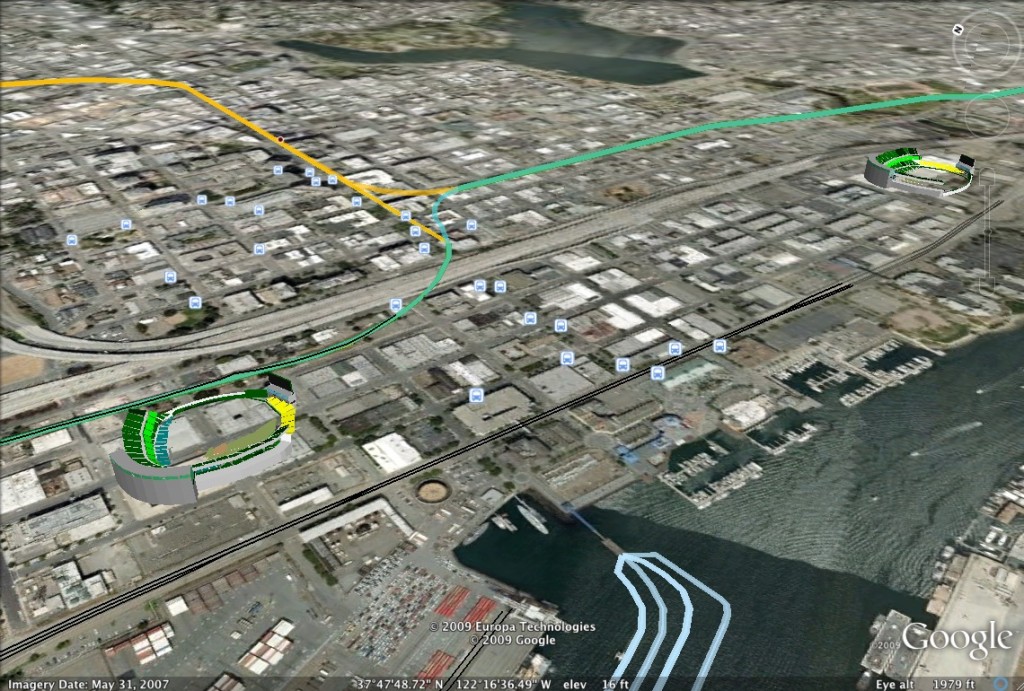
oak-aerial-1024x691

Left: JLS North. Right: Victory Court

JLS North was dropped quickly. Perhaps it was too expensive to acquire. Or maybe there weren’t enough business interests pushing for the site. Whatever the reasoning was, it wasn’t disclosed. Now Victory Court has also gone quietly into the night with little explanation by those who pushed for it.

Let’s step back through memory lane on Victory Court. Our time writing about it, your time reading about it, gone forever:

I guess it’s Coliseum City or bust. Or something.

News for 1/23/12

As usual, we’re in a quiet period leaving the January winter meetings and a month before pitchers and catchers report. At least we have FanFest coming up this weekend. Speaking of FanFest, if folks would like to meetup at FanFest, I think we can meet just inside whichever entrance they use, probably the Plaza Club entrance (lower) or East entrance (upper). I’d love to meet at a great restaurant or bar within walking distance, but… you know the problem there.

Now the news:

  • The Merc’s Tracy Seipel has a roundup of effect the shuttering of redevelopment will have on numerous South Bay redevelopment agencies, including San Jose’s. As has been written previously, SJRA has been winding down over the last year or so, making the shutdown less painful and abrupt than it is for other cities, many of whom are trying to extend the deadline from February 1 to April 15. While San Jose remains in an good position with regard to getting its planning and preparation together on a ballpark, its ability to acquire additional land for the ballpark is gone, leaving A’s ownership to take care of the rest.
  • Also in the Merc, columnist Scott Herhold makes the political calculation that if San Jose Mayor Chuck Reed continues to be aggressive if pushing for a pension reform referendum, he may find a lot of enemies of the ballpark in the form of public employee unions. Personally I know a few who are already opposed and are blaming the ballpark effort, so this is no joke. The simple fact of the matter is that with the unions providing givebacks and lower projected costs leading to a smaller budget deficit, the City is not in the kind of fiscal state of emergency that requires such drastic action on the Mayor’s part. Cooler heads should prevail.
  • St. Petersburg pols think a light rail system connecting their city with Tampa could help jumpstart attendance.
  • Apparently there is a Florida law which dictates that any stadia built with some amount of public funds requires those facilities to be used as homeless shelters when games aren’t being played. This includes huge football stadia, domes like Tropicana Field, even spring training ballparks. Now two legislators are trying to enforce that provision, which until now has remained dormant.
  • Chron’s Leah Garchik has an entertaining account of 49er fans being stuck on a bus in gridlock for three hours even though it was only going within city limits.
  • Added 12:07 PM – Lawrence Berkeley Lab has picked the site for its second campus: Richmond. The land was already owned by UC, so LBL needed to be bowled over to pick a different site in Oakland, Alameda, or Emeryville. In the end, that apparently didn’t happen. Sites proposed by Oakland included the Zhone property across 880 from the Coliseum, and the Oak-to-Ninth site east of Jack London Square.
  • Added 8:30 PM – The City of Oakland released a proposal that would layoff only 105 full-time employees as part of the redevelopment shutdown. That figure would be slightly more than half of the 200 layoffs that were expected.
  • Added 11:35 PM – The Santa Clara County Registrar confirmed that the 4,500 signatures gathered in a petition effort for a new referendum were good. This sets up a situation where the City Council, which has been firmly pro-stadium, will probably reject the petition effort, setting up a court battle. The interesting new twist to this saga is that the current Mayor is Jamie Matthews, a staunch opponent of the stadium plan. Matthews, who replaced Pat Mahan (proponent) last year, was merely a dissenting vote on the Council when the original vote passed in June 2010. Matthews seems emboldened enough now to turn the stadium effort into a real war. Correction 1/25 9:00 PM – Councilmember Jamie McLeod is a dissenter, not Jamie Matthews, who has been a longtime supporter of the stadium plan.

More if/as it comes.

Oakland focuses on EB-5 program to replace redevelopment funding

We now know how Oakland will replace all of those lost redevelopment dollars: Foreigners! At least that’s the program according to today’s Trib report by Angela Woodall.

Before I go further, I have to give credit to Oakland Mayor Jean Quan for going this route. It has some potential, and it’s something that we’ve discussed on the blog previously as it pertains to a foreign investment in a new Sacramento Kings arena. While it’s unfortunate that neither she nor the City Council have had the “adult conversation” I argued for in the post, at least Oakland’s been resourceful enough to identify a path forward.

It makes sense for Oakland to look for creative, out-of-the-box methods to attract investment to the City, and the federal government’s EB-5 program is one of them. Quan has gone to China to look for investors, and may be onto something with EB-5. The program allows immigrants a green card if they put $1 million or more into a new or “troubled” American businesses. Investors also have to create 10 full-time jobs with each application. That money requirement goes down to $500,000 in the case of rural or high unemployment areas, Oakland being one of the latter. Pool enough of these together and a company may have enough capital to move forward.

The Bay Area Regional Center is a government-certified investment firm whose charter is to bring in foreign investment under the EB-5 program. Its service area is most of the Bay Area and Sacramento. Yet the projects it identifies as most ready for investment are three in Oakland. That’s not surprising because BARC is based in Jack London Square, with one of its principals being Oakland developer Jim Falaschi. In fact, BARC is trying to bring in nearly $70 million for Signature’s stalled Oak-to-9th project. (Signature is also trying to get Lawrence Berkeley Laboratory to build its next campus there too.) The Trib article notes that BARC was involved in the $8 million Tribune Tower deal, though records of actual foreign investment in the project are murky. An admission that BARC “is still looking” for a project 2 1/2 years after opening, while honest, is not encouraging.

That’s not to say that EB-5 programs don’t attract investment. Chinese investors put $249 million into the Atlantic Yards project in Brooklyn, though that money didn’t go directly into the Barclays Center arena. According to Bloomberg Businessweek, $1.5 billion has come into the U.S. from foreign investors through EB-5. Like any government program, it’s rife with bureaucratic delay. Applications have often taken months to process. One report this week indicates there are some kinks to work out as the program grows. It can be difficult for foreign investors to separate the good investments from the poor ones based on sales pitches from needy businesses who could easily inflate their projects’ potential.

As cities start to look for alternate avenues for investment, the market for foreign investment will start to get competitive. For Oakland, the biggest issue may be, well, Oakland. Foreigners can understand investing in New York, Los Angeles, or San Francisco. They also get things like ski resorts or wineries. Oakland, for obvious reasons, is a tougher sell. It’s possible that Oakland will need to claim multiple success stories before they can attract enough investors for a major project like Coliseum City. There’s still the problem of getting team owners and leagues to buy in. They’re the head while the foreign investors are the tail. Every application is an investment, not just $500k for a green card. It’s going to take a lot of selling – and even more believing – for Oakland to pull off major funding with EB-5. Or as economist Scott Barnhart, writing for EB5info, wrote in response to a NY Times editorial:

For example, if the 34 floor tower typically used for retail, office space and/or residential purposes did not qualify in New York, one can be assured that states with the highest unemployment levels are not likely close substitutes for a Manhattan address for either the developer or prospective investors, so this project would likely be shelved. Similarly, a large condominium in Florida will not sell if located in a high unemployment area away from the coast instead of a lower unemployment area on the coast, yet the labor will be imported to the site.

There’s a reason why O29 isn’t taking off. And it’s the same reason why Victory Court and Coliseum City probably won’t take off either. It’s still worth a shot, at least from the City’s perspective.

Finally, the EB-5 program is limited to 10,000 approved visas per year, potentially limiting investment. Compared to going the regular (and now shuttered) redevelopment route with its self-contained process, EB-5, with all of its marketing, multiple stakeholders, and delay, may be tantamount to climbing Mt. Everest.

.

To read more about EB-5, check out the EB5news site and Twitter feed, and EB5info.

KQED Forum talks franchises

Last week I got a call from the folks at KQED’s Forum program to see if I’d be interested in being on today’s show. Then yesterday, I received word that their panel was full so I wouldn’t be needed for the show. That’s just as well, because it was a pretty good show hosted by Joshua Johnson and with guests Susan Slusser, Mark Purdy, and Glenn Dickey. Giants CEO Larry Baer also chimes in later in the hour. If you haven’t listened to it yet, do so. Below are the embedded player and an MP3 link.

MP3 Audio

A couple of observations:

  • Purdy mentioned that he talked to sources on the MLB panel. According to them, the Giants’ contractually are not tied to South Bay territorial rights.
  • Baer is content with a two-team market as long as the market definitions stay as is. Pressed on what defines the South Bay, Baer hemmed and hawed, finally mumbling that it includes San Mateo and Santa Clara Counties. He also talked Warriors, saying that he’s going along with the process to evaluate options in both Oakland and San Francisco.
  • The 49ers and the potential for a new referendum on the revised stadium deal were discussed, especially by callers. I don’t think there’s enough political will to make that happen, but you never know.

I need to do a full relisten to see if there’s anything else, as I didn’t bother to take notes.

Taking stock as the post-redevelopment era begins

It’s never too early to declare winners and losers that were made as a result of today’s earthshattering news.

First the losers:

  • Backers of the Victory Court site. The site was heavily dependent on tax increment (redevelopment funds) to buy the land and pay for improvements. Now that’s out of the question.
  • The City of Oakland. Strategically, it chose to sit back and wait for the originally passed “pay-to-play” ransom plan, which was scuttled today. Now they not only have no way to do redevelopment, they’re stuck trying to figure out how to fill in major holes that have just opened in the City’s budget that were filled by a large redevelopment operating budget.
  • San Jose Redevelopment Agency. As far as old school redevelopment goes, the City is now handcuffed with no way to raise funds. Of course, the City had already been choking the life out of SJRA by finishing several projects, laying off staff, and not taking on new projects. One word: prescient.
  • Affordable housing advocates. Not directly related to stadium building, but it’s a big point of emphasis for redevelopment backers. And consider this: any large mixed-use plan including residential development in any major city in California would require an affordable housing component. Who’s gonna subsidize that now? Already, San Diego is looking for a legislative means to bring back a scaled down version of redevelopment with a focus on affordable housing.
  • Oakland Raiders. Any options the Raiders may have been considering elsewhere in Bay Area (aside from the Coliseum and Santa Clara) have to be considered nonstarters at this point.
  • Redevelopment agency employees. Many agencies had planned for the “pay-to-play” scenario. This is armageddon. Good luck to them.
  • Anyone with a downtown gentrification initiative. Those projects are now for the birds.

The winners:

  • Lew Wolff and Baseball San Jose. If Wolff and his people were secretly rooting for redevelopment to wither and die, they certainly weren’t showing it. But the decision today has such wide ranging, powerful effects on municipalities throughout the state, that’s it’s easy to envision Lew Wolff sitting in his office, thinking, Okay, that narrows the field. With the MLB panel’s report distributed prior to today’s news, they probably laid out several scenarios, and the owners have to be aware by now the ramifications – if not by the panel’s report, then by the news reports. And that plays right into Wolff’s plans. If there was ever a tipping point event for a decision on San Jose, this is it.
  • San Jose Mayor Chuck Reed. It was Reed who oversaw the winding down of SJRA and the creation of SJDDA (SJ Diridon Development Authority) to sidestep the state raid. There may be a legal challenge against SJDDA, but where will it come from? The State doesn’t have the resources to start going after dozens, if not hundreds of redevelopment agencies. Santa Clara County might, but it seems the County got what it wanted by having redevelopment eliminated. Everything else is a matter of negotiation. As noted before: prescient.
  • San Francisco 49ers and Santa Clara. They got their tasks done before the end of the year. Now it’s a matter of selling suites and seat licenses, plus getting the Raiders on board.
  • Your local municipality’s General Fund and local schools. While the State will get a portion of the newly realized tax increment, part of it will be returned to cities, counties, and school districts. For cities with very large redevelopment areas such as San Jose and Oakland, this could actually mean a windfall of sorts, or at least a way to shore up their budgets. How much will it help? That’s for the bean counters to figure out.
  • Governor Jerry Brown. The beautiful irony of this situation is that Jerry Brown used redevelopment in Oakland as a stepping stone to get him back in power in Sacramento. Now he’s killed redevelopment. That’s an experienced politician.

Too early to tell:

  • San Francisco Giants. The death of redevelopment may tip MLB in the A’s favor. Then again, it may not. One thing to consider: the Giants overtures towards the Warriors about getting an arena in Mission Bay may be negatively affected by the ruling.
  • Backers of the Coliseum City plan. The Coliseum is part of a separate joint-powers agreement which allows the Coliseum Authority to raise money for its own projects. The track record isn’t great (Mt. Davis) but the power remains. Still, Coliseum City came about as part of a major planning and redevelopment initiative in and around the Coliseum and Airport. Now at least half of that project has been rendered irrelevant, which could have cascading effects on the Coliseum. On one hand, the Coliseum could be considered one of the only places with land where something could get done. On the other hand, the Coliseum is still pretty much limited to contributing site and infrastructure improvements, with little ability to contribute directly to any new facility or refurbishment. It’s also at the mercy of private developers to flesh out Coliseum City, which given the area, is definitely not a given.

It was hard enough getting something built in California with the state of the economy. Now, if you don’t at least have something already underway or an existing facility or land from which to base improvements, you may as well not show up. Redevelopment as an industry is over. Now bring on the new industry of “creatively” financing traditionally redevelopment-oriented projects.

Official: Redevelopment is DEAD

This story will be updated throughout the day as analyses and reactions come in.

News links:

Added 3:37 PM – A brief blurb of my interview with KQED-FM is now up.

Added 3:40 PM – Fremont Mayor Bob Wasserman passed away today at the age of 77. Condolences go out to his family.

.

The Supreme Court just came down with an 83-page ruling on the legality of ABX26 and 27, the redevelopment killing and reforming bills passed during the summer budget battle. Here’s the nitty gritty:

We consider whether under the state Constitution (1) redevelopment agencies, once created and engaged in redevelopment plans, have a protected right to exist that immunizes them from statutory dissolution by the Legislature; and (2) redevelopment agencies and their sponsoring communities have a protected right not to make payments to various funds benefiting schools and special districts as a condition of continued operation. Answering the first question “no” and the second “yes” we largely uphold Assembly Bill 1X 26 and invalidate Assembly Bill 1X 27.

Assembly Bill 1X 26, the dissolution measure, is a proper exercise of the legislative power vested in the Legislature by the state Constitution. That power includes the authority to create entities, such as redevelopment agencies, to carry out the state‘s ends and the corollary power to dissolve those same entities when the Legislature deems it necessary and proper. Proposition 22, while it amended the state Constitution to impose new limits on the Legislature‘s fiscal powers, neither explicitly nor implicitly rescinded the Legislature‘s power to dissolve redevelopment agencies. Nor does article XVI, section 16 of the state Constitution, which authorizes the allocation of property tax revenues to redevelopment agencies, impair that power.

A different conclusion is required with respect to Assembly Bill 1X 27, the measure conditioning further redevelopment agency operations on additional payments by an agency‘s community sponsors to state funds benefiting schools and special districts. Proposition 22 (specifically Cal. Const., art. XIII, § 25.5, subd. (a)(7)) expressly forbids the Legislature from requiring such payments.

Matosantos‘s argument that the payments are valid because technically voluntary cannot be reconciled with the fact that the payments are a requirement of continued operation. Because the flawed provisions of Assembly Bill 1X 27 are not severable from other parts of that measure, the measure is invalid in its entirety.

In short, the Court ruled that redevelopment was created by the legislature, so it can be taken away by the legislature at any point. This is the worst possible outcome for redevelopment agencies all over the state. They are effectively dissolved and have no mechanism for reconstituting themselves.

What does this mean for the various cities? Let’s do a roll call:

  • San Jose Redevelopment Agency is done. Dead. The agency owed the City $80-90 million and that’s gone. Start the procession.
  • San Jose Diridon Development Agency exists in a sort of gray area. Its charter is to oversee development in its defined area and it controls land, but it is not expressly a redevelopment agency. We’ll see if it gets (and withstands) any legal challenges in the future. As long as Lew Wolff maintains his stance that he can pay for the rest of the land/infrastructure and, more importantly, follows through on that pledge, the ballpark project is safe. Unfortunately for Wolff, the price tag continues to grow.
  • Oakland’s plans for Coliseum City and Victory Court have to go back to the drawing board, because they were largely dependent on ABX27 passing so that they could continue operation. Now that redevelopment is dead, they’ll have to come up with extremely creative ways to fund their infrastructure projects, and considering how large they are ($250 million for VC, a similar or greater amount for CC) there’s no telling how they’ll do it. That $36 million reserve that Mayor Jean Quan was crowing about? That’s all they have at this point.
  • Santa Clara is safe simply because they got a bunch of contract and lending stuff done before the end of the year. Now their only worry is the fact that their Stadium Authority is liable for $850 million in loans, despite assurances from the 49ers and NFL that they’ll take care of debt service.
  • Sacramento is in a slightly more advanced position than Oakland, because they’ve been exploring alternative ways to finance a Kings arena, such as selling advance parking revenue.
  • The downtown LA football stadium, Farmers Field, was not dependent on tax increment or redevelopment funds. It was to be paid for by increased convention center use and other events at the domed stadium.
  • The City of Industry football stadium was originally highly dependent on redevelopment money (mixed use). I had heard that the funding mix had been altered in light of the new political realities. It seems that with each passing month this project slips further into oblivion.
  • San Diego’s football stadium was also expected to use redevelopment funds. It’s hard to see how they’ll pull it off now.
  • Escondido’s AAA ballpark plan for the Padres is dead.

The only hope redevelopment has now is to lobby hard in Sacramento to reform it through the legislature. At this point, there’s no telling how or when that will happen. During the oral argument, the justices talked about a system in which projects would be voted on by their communities. That may be the future of redevelopment, not the mostly unchecked power of the past. It’s a new day in California. Good luck getting your stadium built.

Who said there’s no news at the end of the year, eh?

Note: I did an interview with KQED-FM shortly after the ruling was handed down. Hopefully part of it will show up later today or tomorrow.

P.S.: I have to clip something off the last Baseball Oakland post, full of sunshine and unicorns:

One final point about the money that would be used for Oakland’s plan. Much of it would come from redevelopment funds. Some of you might be concerned that the state will all destroy redevelopment agencies. However, I asked Fred Blackwell about this at the end of the press conference. He explained that, based on the expected upcoming ruling of a lawsuit filed by California’s cities, redevelopment agencies will continue to exist as normal and everything around ballpark financing would go as planned. If the cites lose, then they will have to make a payment to the state. Blackwell says that Oakland plans on making its payment and still can issue the needed bonds to complete its proposed projects. So, any concerns about the death of redevelopment agencies should alleviated.

Everything’s gonna be fine. Right?