SJ Mayor Reed faces ethics complaint over pension reform

Tonight, San Jose Mayor Chuck Reed is expected to give his annual State of the City address at the Civic Auditorium. He will deliver the speech in the shadow of an investigative report by NBC Bay Area, alleging that Reed and staff misled public employee union negotiators over the direness over the so-called future pension “crisis”. Apparently staff used fuzzy projections of $650 million by the 2015-16 budget year, which could be $250-300 million more than the actual cost of the program. It was those projections that Reed was using to push a pension reform ballot initiative this summer, one that the City Council approved to go on the ballot.

In light of the news report, an ethics complaint has been lodged against Reed, which could result in a full-blown investigation of whether or not Reed and the City fudged the numbers. The police officers union, which has been at odds with Reed, may be sharpening the knives for the mayor, who has been playing hardball with the unions over the last couple of years. Whatever happens, you can at least expect the death of the ballot initiative, which even if passed may not be constitutional. Although it is generally acknowledged by union reps that some kind of pension reform was needed, Reed’s draconian measures probably weren’t. Now it looks like those tactics may come back to bite him.

As far as the ballpark goes, it’s not related to this issue except for the possibility that referenda for both could be on a future ballot. Will Reed finally back down? It’s all up to him.

It’ll happen when it happens

Update 2/9 2:30 PM – KQED FM’s Nina Thorsen has posted a transcript of Wolff’s talk.

It seems that when Lew Wolff makes one of his frequent trips up from LA to the Bay Area, he tries to pack as many appointments as possible. I mentioned during the August interview that just after our discussion, he was going up to Oakland to chat with Mayor Jean Quan. When we met in 2009, it was just after he met with San Jose Mayor Chuck Reed. Today he discussed the A’s and Quakes at a San Jose Rotary lunch in downtown San Jose, a day after he appeared on Bloomberg TV. The better to save on jet fuel, I guess.

As usual, Wolff didn’t reveal in his talk with staunch ballpark proponent and Santa Clara County Assessor Larry Stone. Much of what he’s said we’ve written about, so I won’t both rehashing much of it. If you want a recap, read Merc scribe John Woolfork’s article. BANG A’s beat writer Joe Stiglich was there, as was KQED’s Nina Thorsen, mic in hand. The news of the day was this:

(Wolff) gave no indication why it wouldn’t go his way. But he also said nothing’s changed with regard to the Giants’ position that Santa Clara County is theirs alone. There’s been no discussion of a monetary figure for buying off the Giants’ territorial claims, though Wolff noted the Giants didn’t pay the A’s to acquire them.

Now I don’t expect MLB or Wolff to say anything about T-rights negotiations, however deep or frequent they’ve been. If the Giants hold fast to their no-negotiation stance, and the A’s believe that they shouldn’t have to pay for T-rights, then it’s difficult to see what Commissioner Bud Selig has to work with unless he decrees an amount or lets the matter go to arbitration.

Wolff also said that the team would be named the “San Jose Athletics”, which is no surprise. According to an AP report, there was Stomper doll on display with a San Jose Athletics uniform on. One unaffiliated company has gone as far as mocking up logos (non-MLB Properties infringing, of course) with San Jose and green and gold. The results look quite professional, I have to say.

Stiglich mentioned that Wolff would like to hear a decision in a couple of months. At some point we’re going to have to use Friedman Units or Kardashians in describing how long this is taking. Right now, it’s 6 FU’s. It’ll happen when it happens, I suppose. Wake me when there’s real news to report.

Strategery

The architectural firm HKS has some wins to crow about. The Dallas-based company designed Lucas Oil Stadium and Cowboys Stadium, hosts for the last two Super Bowls. Now they’re backing two Hail Mary attempts for the Bay Area NFL teams. A month ago an SFGate report had San Francisco planning commissioner Mike Antonini working with HKS and an unnamed investment company on a last ditch attempt to convince Jed York to keep the team in San Francisco. Today, Matier and Ross report that HKS has signed on to put together the Coliseum City plan with the hopes of keeping one or all of Oakland’s franchises in place.

To get the project going, Oakland is getting ready to authorize $3 million for a series of studies that will have to done on the entire Coliseum area, not just the complex. I wrote about this in detail last December. HKS won the winning bid, in conjunction with Oakland-based JRDV and Forest City, to master plan 750 acres of land on both sides the Nimitz. The project is split into two areas: Area 1 (Coliseum complex, BART, and surroundings) and Area 2 (nearly everything west of 880 to the airport). Knowing how much money goes into these types of studies, they’ll need every penny of that $3 million to complete the work.

Coliseum City/Oakland Live!

Based on the previous work these firms have done, I figure the responsibilities will be divided along these lines:

  • HKS – Design for the iconic stadium(s) and hotel
  • JRDV – Master planning and integration
  • Forest City Enterprises – Actual development

All of these pieces are important. HKS will work on the anchors for the project, and they have potential access to investment groups should things move along. So does Forest City, but their aims are lower since they’re focusing on ancillary commercial spaces that will have to be sold and/or leased to other tenants. JRDV provides the framework and the glue. Their responsibility is to make it work with Coliseum BART, figure out how to backfill parking that will be lost to construction, and make the whole thing look attractive. Their local portfolio is extensive, including plans for Uptown around the Fox Theater and San Jose’s San Pedro Square Market. Nothing JRDV has done in the US is as large as what’s being proposed for the Coliseum area, making this new project a special challenge.

As I wrote two months ago, this process is expected to be deliberate. Anyone expecting a new Coliseum complex to rise like it was being built in Shanghai is due for disappointment. The RFP lays out the time commitments the winning bidder will have to make to get through the entirety of the project:

  • 25 project meetings with city staff
  • 8 community workshops
  • 12 public meetings with the Planning Commission and City Council

The Coliseum area has an advantage in that it shouldn’t need a new EIR for a replacement or refurbished arena or a replacement football/baseball stadium since those uses are already in place. New EIRs will be needed for any other new construction. That would include:

  • A third sports venue, such as a baseball stadium alongside a football stadium
  • High-rise hotel
  • Commercial development, including office towers or a mall

In addition, the entire plan will need its own EIR. It’s all about impact, and if you introduce new elements such as the visual impact of a high-rise hotel or additional commercial traffic not associated with Coliseum events, it all needs to be studied. Likewise, a third venue will have to be studied simply because of the possibility that events could be held in the arena, ballpark, and football stadium simultaneously. That’s a lot of people and a lot of cars. There will have to be plans to figure out where all of these people will park since much of currently undeveloped Coliseum complex land will be claimed for future development. Lastly, there will need to be alternatives to show what impacts would occur if some of these concepts don’t come to fruition.

This is how big things get built in California. There’s a very good chance that none of it will ever get built. Oakland and Alameda County will have to be in lockstep to make this happen, and their collective resources are extremely limited. It’s telling that Oakland is footing the bill for this but Alameda County is not. They’ll need more resources to execute this plan to any successful completion. If they aren’t get on the same page, it’ll be Oakland’s $3 million down the drain.

Regime change? Not likely

In an interview with Bloomberg West, Lew Wolff mentioned that the upper management duo of Billy Beane and Michael Crowley will be extended through 2019.

Wow.

Here are a couple of clips from Bloomberg, story by Jon Erlichman and Rob Gloster:

Links

News for 2/5/12

Lots of got stuff for y’all to digest (along with your Super Bowl feast) today:

  • Two Bay Area sports families are at odds. According to Matier and Ross, the heirs to former Warriors owner Franklin Mieuli are suing the York family over the value of a 5% minority share of the 49ers. The Yorks say the team’s only worth $360 million, making the stake’s value only $18 million. The Mieuli heirs are pointing to Forbes’ recent valuation of the 49ers, $990 million, and want to sell the stake 5% of that valuation, or $49.5 million. Considering how the lowly Jacksonville Jaguars were sold two months ago for $760 million, you have to think the Yorks will come out on the losing end of this or settle before any trial begins.
  • The Detroit News has a new profile of Tigers and Red Wings owner Mike Ilitch. During his tenure as Tigers owner, Ilitch went from miser to saint. What changed? Strategic moves to properly build a team and bring in free agent talent after a new ballpark was built. It’s a clear case of a ballpark not being the panacea, but rather the foundation upon which a competitive team can be built, rebuilt, and sustained.

“They had an old ballpark in Tiger Stadium that was self-limiting in terms of attendance and revenue. There would be a Catch-22 to Ilitch’s early years: Until he got a new ballpark, he could not subsidize big contracts. Once he got a new ballpark, he was stuck with a bad team and heavy debt.

The combination punch was a haymaker, at least in the early years after Comerica Park opened in 2000.

But by late 2003, after the team had bottomed out, Ilitch made a series of Red Wings-caliber moves.

He expanded payroll at the same time a new front office was about to chart an upward plan in strategies that, coupled with investments in Rodriguez, Ordonez, etc., fueled a baseball revival in Detroit.

Once the stimulus package was in place, team fortunes — and revenues — soared.”

  • The Marlins are laying down grass at their 97%-complete ballpark, and they plan to grow it long to support an aggressive running team.
  • A San Francisco-based hedge fund manager, Christopher Hansen, is aiming to buy the Sacramento Kings and move them to his hometown, Seattle, where he and city leaders are working on a new arena deal. Two reports are in from the Sacramento Bee and the Seattle Times.
  • Yet another plan to replace the Metrodome is being “fast-tracked” through the Minnesota legislature. The plan would require playing as few as two games at the University of Minnesota’s TCF Bank Stadium after the Metrodome was torn down and while the new stadium was being built.
  • Did you know that Reno-Tahoe is putting together a bid for the 2022 Winter Olympics? A group has formed to explore a possible bid. Reno-Tahoe may be competing with Denver for the honor of representing the US for the 2022 games. Denver would seem to have the advantage in terms of facilities, though the distance between Denver and the region’s best ski resorts in Vail/Beaver Creek and Breckenridge is pretty long (though that didn’t stop Vancouver, whose 2-hour trip to Whistler was even longer). Preliminary cost estimates for the bids are around $1.5 billion, which would be less than Vancouver’s 2010 effort.
  • For some unknown reason, secondary ticket prices for today’s Super Bowl are down 50% compared to last year, even though the game is being played in a smaller venue.
  • The Nats are trying out a “Take Back the Park” campaign, in which they are pre-selling tickets to a single April series between the Nats and Phillies. The catch? They’re only selling to buyers with DC/VA/MD addresses, verified via credit card records. The Phillies, whose own ballpark is frequently sold out, often have fans take the 2.5-hour trip down I-95 or Amtrak to the District to catch their team drub (maybe not for much longer) the Nats.

That’s all I got. Enjoy the game.

Hosting a future Super Bowl

The last and only time a local (host) team won a Super Bowl was XIX (1985), when the 49ers beat the Miami Dolphins at Stanford Stadium. Although not technically a home game at Stanford Stadium, the game’s location within the heart of the Niner fanbase made it a de facto home game. As soon as 2017 (maybe 2015 but unlikely), we may once again have a Super Bowl held locally. As the popularity and TV ratings of the big game have only grown since its inception, so have the stakes and requirements to host the game. The 49ers and the City of Santa Clara have frequently touted the Super Bowl as a major reason to build the stadium near Great America, and from all appearances the Bay Area will have all of the infrastructural pieces in places to host the Super Bowl when the time comes.

But what are those infrastructure requirements? According to numerous sources, the requirements are these:

  • 70,000+ seat stadium
  • A dome or outdoor stadium if average January temperature is 50 degrees or higher
  • 24,500+ hotel rooms within an hour of the stadium
  • Up to 2 million square feet for the NFL Experience and related ancillary activities
  • Additional space for the new “Super Bowl Village” (multiple blocks if possible)
  • Host city or region must also have an NFL team

Stadium

The 49ers stadium is designed to hold 68,500 and appears to have the available space to easily expand up to and past 70,000. The upper deck and corners on the suite/press box side of the stadium are empty, making 1,500 temporary seats no problem. They might even be able to squeeze in double that number, which considering the likely face value of those tickets (>$1,000 per) is nothing to sneeze at. There isn’t quite the room for the 49ers to get greedy the way Jerry Jones did with Cowboys Stadium, when he tried in vain to eclipse the attendance record by stuffing in 30,000 extra seats. Eager to avoid another ticket scandal, the NFL let up slightly on 63,000-seat Lucas Oil Stadium, which added only 5,000 seats for the game.

Climate

Over the nearly 50 years of Super Bowl, the game’s locale has shifted from very large college football stadia (Rose Bowl, Orange Bowl) in warm climates (Southern California, South Florida) to domes (Superdome) and now, highly flexible retractable-roof stadia (Cowboys Stadium, University of Phoenix Stadium, Lucas Oil Stadium). 2014’s game is defying all previous conventions by being held in North Jersey’s MetLife Stadium, which lacks any kind of roof and whose average January temperature is barely above freezing. Whether the typical fan thinks the weather requirement is appropriate given the normal playing conditions throughout the regular season and playoffs is beside the point. Most attendees are high rollers and corporate bigwigs, and given the amounts they are paying to either sponsor the game or pay for the tickets (straight up or through a secondary seller) they should be getting a little comfort. In Santa Clara, the average temperature is around 50 degrees, with an average daily high of 60. If the weather is anything like what we’ve experienced this week in the Bay Area, game day should be a highly pleasant experience. If it’s rain, then break out the ponchos. One advantage the West Coast has over other potential sites is that here the game starts at 3:18 p.m., while it’s still light out and a little warmer to boot.

Hotel capacity

Three major hotels that provide a combined 1,540 rooms are within walking distance of the stadium: Hyatt Regency, Hilton, Marriott. The Marriott is the largest and oldest of the three, whereas the Hyatt Regency is the swankiest and is connected to the convention center. The Hilton is the smallest but also the closest to the stadium. Another 500-1,000 rooms are within five minutes. Clearly that’s not close to the NFL’s requirements. Not to worry, San Francisco and San Jose will be glad to pick up the rest of the demand. Downtown San Jose has over 2,000 rooms. Hotels near the airport have another 1,000. San Francisco has more than 33,000. Still more hotels are scattered throughout the rest of the Valley and up the Peninsula. Capacity is clearly not a problem. Logistics might be, though visitors will have a number of choices. Some may choose to stay as close to the game site as possible. Others may want to do the touristy thing in San Francisco and come down to Santa Clara only on certain days. The main issue is more the way the NFL demands blocks of hotel rooms. The league has been known to demand 95-97% of area hotels’ capacity for the event several years in advance, with the actual rooms booked a year in advance. For a city with a solid year-round tourist trade like SF, a Super Bowl can create chaos and even lost revenue if the Super Bowl doesn’t materialize. Regardless, if the 49ers get their new stadium are built, it’s practically guaranteed that they will get a Super Bowl, allowing all Bay Area hotels to either work with the NFL or compete for attendees on price.

NFL Experience

Now in its 20th year, the NFL Experience is considered a temporary football theme park adjacent to the Super Bowl. That makes it a bit ironic that there’s an actual theme park across the parking lot in Santa Clara, right? Usually, a convention center or arena is not available adjacent to the stadium. In Santa Clara, there will at least be 300,000 square feet of convention space (Indy has 400,000), plus plenty of parking lots for the tented structures used for the rest of the Experience. At currently $28 per person plus whatever money the NFL gets from merchandise and concessions, it’s a huge moneymaker for the league. Recently added to the attraction was a nighttime adult version with a clubby atmosphere and separate admission. In Santa Clara that’s probably a good idea, but it’s a poor substitute for the real nightlife happening 40 miles north. The attraction is seeing hockey-stick growth in popularity: attendance may top 750,000 according to some estimates.

What about Great America? Could Great America’s attractions be used? Sure, though negotiating a deal may be difficult. Great America’s season doesn’t open until late March, and its hiring practice doesn’t actually hire its mostly seasonal workforce until February, even for employees who have been working there for years. There’s also the issue of money. In the Super Bowl host bidding process, the NFL demands 100% of revenue from everything associated with the game. For 2012, a single adult ticket at Great America costs $56. How much more would the tickets be for Super Bowl week in order to satisfy both parties? And what kind of value proposition would it be for Cedar Fair to have its workers come in two months early, work only for a week, idle them, then work again when the season starts? It might be worth it, it might not.

Super Bowl Village

Unlike the NFL Experience, the Super Bowl Village is a free attraction. In Indy, it takes up three blocks of Georgia Street between the convention center and Bankers Life Fieldhouse (formerly Conseco). Like most street fairs it has its own vendors, concert stages, and an anchor in the form of ESPN’s massive broadcast facility. Again, there’s space for this to make this work in the parking lot.

Onerous terms

Cities promoting themselves to host the Super Bowl often point out that the economic impact of the event is up to $400 million (Indy’s projecting a more conservative $155 million in direct spending). Actual ticket and concession revenue for last year’s game was $109 million, this year it’s projected to be $72 million largely due to the smaller stadium. And of that ticket and concession revenue, virtually all of it goes straight to the NFL. Their terms are so demanding that there is no room for any municipality to squeeze out any direct revenue from Super Bowl week. I took a look at an old RFP the City of San Diego filled out in 2000 for a future Super Bowl. Here are a few choice terms that the NFL dictates:

  • The NFL requires at least: (1) 100,000 square feet for team city television satellite uplink truck units, newspaper darkrooms, cable TV remote studios, etc.; (2) an additional 100,000 square feet of space for an international television compound; and (3) an additional 200,000 square feet of space for the broadcast network compound. [ed. – All told that’s 9 acres.]
  • Is there space in immediate proximity to the stadium available at no cost for: (1) hospitality tents, and (2) the NFLP Tailgate party (a minimum of 1,250,000 square feet is required for the event)?
  • The NFL should be able to retain 100% of all revenues derived from the hospitality area and Tailgate party, including food and beverage and novelties sales revenues. Will the NFL be able to do so?
  • Is there a site at or adjacent to the Stadium which is authorized for use as a helipad to accommodate up to 400 landings and take-offs on game day and a lesser number on each of the 12 days before game day? [ed. – Note that the Santa Clara stadium is directly underneath the takeoff path for flights coming out of SJC, not sure how relevant this is to helipad placement.]
  • Will the NFL be able to cater a meal for the event without having to pay any fees to the lessor or any other concessionaire?
  • Is there an arena adjacent to the Stadium? If yes has it been secured in writing for the NFL’s use on game day and for 10 days before game day?
  • The NFL should have the right to determine and approve everything relating to Stadium operations on Super Bowl Game day, including the assignment of meeting rooms, tent space, parking lots, adjacent buildings, etc. Will this requirement be met?
  • The Stadium and all of the surrounding parking and other areas owned or controlled by the Stadium owner must be provided rent free for the entire period of occupancy by the NFL.
  • The NFL recommend staffing levels of at least 300% above normal sellout events. If the NFL is required to pay a portion of the Stadium staffing or operational costs, include a breakdown of the total cost of the NFL’s use of the Stadium and all of the surrounding parking and other areas owned or controlled by the Stadium owner. Will the NFL be required to pay any costs?
  • The NFL must have the unlimited right to use the existing scoreboards and video boards at no cost. Will this requirement be met?
  • The NFL requires that the Stadium provide a certificate of insurance evidencing comprehensive general liability coverage with a limit of liability of no less than $100,000,000, indemnifying and naming the National Football League and National Football League Properties, Inc., as additional insureds.
  • The NFL must have the right to control all ticket sales and to retain 100% of the revenues from ticket sales, and to control all other access to the Stadium (i.e., credentials).
  • A minimum of 50% of all suites (or no less than 45 total) should be allotted to the NFL.
  • At least 75% of the suites allotted to the NFL must be between the end-lines, and the allotted suites must include 50 yard line locations for the televising network, each of the competing teams ,the NFL Commissioner and the NFL President.
  • Is there any contractual obligation to existing suite holders for tickets to the Super Bowl Game?
  • The NFL should have exclusive, cost-free, use of at least 350 bus parking spaces in close proximity to the stadium, including 35 spaces for the media, 25 spaces for each team, up to 50 spaces for half-time personnel, 100+ spaces for NFL Properties, potential member club buses, etc. These spaces should be in a well-lighted area for post-game departures up to 5 hours after the Super Bowl Game.

After looking at the NFL’s demands, it’s not hard to see why, despite raising $25 million to support Indy’s bid for Super Bowl XLVI, the city agency that owns and operates Lucas Oil Stadium is expected to lose $800,000 during the week. Let’s say that of the $300 million in overall spending, 10% of that is tax. That’s $30 million in taxes spread out over several counties and cities. That’s not a bad haul if the cost to bring the game in isn’t too high. Therefore it’s incumbent upon the 49ers and the City of Santa Clara (and Santa Clara County) to make the stadium and its surroundings as ready to host the Super Bowl as possible from the get-go. If they can pull that off, it’ll make them more likely to be considered for rotation into future Super Bowls. The whole thing sounds like a mini Olympic games. Speaking of Olympics… that’s for next week.

49ers get $200 million G-4 loan

Get ready for the ceremonial hard hats. The NFL has granted the 49ers $200 million in G-4 loan funds, the financial linchpin in the team’s Santa Clara stadium plan. That money, combined with the $800 million in loans put together by BofA, US Bank, and Goldman Sachs, should make it possible for the team and the city to move forward with a soft groundbreaking very soon. That would be followed by a modest demolition and clearing of the parking lot, which has little but asphalt and parking safety light poles running through it.

Not coincidentally, Santa Clara took a preemptive legal step and sued anti-stadium group Santa Clara Plays Fair to stop them from getting the stadium project on the ballot again. An unusual step, City Attorney Ren Nosky moved forward with this in order:

“to remove any uncertainty over this issue” and “establish once and for all” that the project can’t go back to the ballot.

It’s an interesting move, and probably a good one for all concerned. It puts SCPF on the defensive, because it’s likely that the city will have its legal argument at the ready and, depending on how quickly the lawsuit in Santa Clara Superior Court is heard and how much support SCPF gets from outside, the group may be ill-prepared. We’ll see if they get the requisite support from the ACLU, as advertised. Presumably Ralph Nader’s League of Fans should also be involved, though not from a legal funding standpoint.

The two sides will be arguing over the contents of the 400+75 page, two-part Disposition and Development Agreement (DDA). There’s a lot of stake, because if the court were to strike down parts or all of the DDA, the team’s financing could be at risk. SCPF wants a new referendum, so if a judge rules that the DDA were partially or wholly improper compared to the terms passed with the 2010 referendum, it’s a huge delay that could, via the vote, kill the project entirely. For Jed York, the reasoning is probably simpler – he wants to open the place in 2014. Even with the staggering cost of the venue, it’s all the more reason to get a jump on being able to service the stadium’s debt. I figure if the lawsuit were heard in the spring, the judgment could be wrapped up by summer at the very least. Meanwhile, the city would be concurrently clearing the land. The stadium would take 27-30 months to construct, so they could hit their target if absolutely everything went right. If they experience a delay because of the lawsuit and/or referendum, it’s pretty much a 2015 launch unless the team wants to split the 2014 season between Santa Clara and The ‘Stick. I may be a fly on the wall for some of the hearings.

Moving away from the legal realm, the terms of the NFL loan are curious in that they aren’t forcing the Raiders to share the stadium in Santa Clara. The league is asking to 49ers to keep the Raiders in mind. This is something of a pivot, since last year I had heard that if both Bay Area teams were to stay, one facility somewhere was the best possibility. I suppose this is in keeping with the Raiders’ and Mark Davis’s city-agnostic stance. The Raiders in play for both Santa Clara and Los Angeles, and I have to believe that the NFL likes that kind of flexibility. The more teams that could move to LA the better. San Diego is one. The Vikings can’t get anywhere in the Minnesota legislature. Buffalo will probably opt for small improvements to Ralph Wilson Stadium, for which the G-4 program has a subset of rules for financing. Under new ownership, Jacksonville is not in play for the time being. The St. Louis Rams appear to be at the greatest risk of leaving, with onerous lease terms for the city and the team’s long LA legacy. It could play out several ways:

  • 49ers/Raiders in Santa Clara, Rams in LA
  • 49ers in SC, Rams/Raiders in LA, Chargers in SD
  • 49ers in SC, Raiders/Chargers in LA
  • 49ers/Raiders in SC, Rams/Chargers in LA

What I don’t expect to happen is for the NFL to hand out three loans of $200 million to Santa Clara, Los Angeles, and San Diego (or SC, Oakland, SD). For this CBA cycle and the number of teams that need new venues, the NFL is probably working with a $1 billion cap on G-4 loans, with some allowance for improvements to older venues. The previous CBA, which ran six years, had only three venues built during the period (Cowboys Stadium, MetLife Stadium, Lucas Oil Field) and one that opened just as the CBA period started (U. of Phoenix Stadium). The G-3 loan program then ran out of money in early 2007, which should be a signal to all teams that are looking for the NFL to pony up: he who hesitates is lost.

Nothing from nothing

First, a hat tip to two great legends who left the world much too soon.

If you haven’t done it already, read Nina Thorsen’s KQED interview with the Trib’s Oakland reporter Angela Woodall. Then read Ray Ratto quick opinion piece at CSN Bay Area.

Then sit back and consider what happened. If you’re struggling to come up with anything to describe it, you’re not alone. Because nothing actually happened. No forward progress, all spin, posturing, and gesticulation. Oakland fakes like it’s doing something, then shrugs its shoulders when nothing happens. MLB says nothing and does roughly the same. San Jose tries to do something and is blocked by MLB and the Giants.

I’m going to follow the Coliseum City project because it’s my duty. As long as the City of Oakland and Alameda County make plans for it to any degree, it’s worth covering. I don’t think it has legs. I’ll explain why:

  • Unless there’s a public financing component, a Coliseum ballpark will have a very difficult time paying for itself.
  • MLB wanted a downtown, waterfront site for an A’s ballpark. The Coliseum fits neither criteria.
  • The “City” part of Coliseum City will require its own large public investment. It is by design its own redevelopment district. Oakland will try to leverage existing and future TOD (transit oriented development) grants to help developers, but it’s a pittance compared to the overal cost (<5%). For instance, a 4-star, 800-room, full service hotel would cost $160 million to build, based on a $200k per room construction cost. That leaves out the other retail and commercial development costs. How much of that will the city/county have to subsidize to lure a developer?
  • The Raiders appear to be entirely site-agnostic in their search for a new stadium.
  • The chance that the NFL will award two $150 million G-4 loans to the Bay Area teams instead of spreading the love around to LA, Buffalo, and Minnesota is slim at best.
  • The Warriors are going to play Oakland and San Francisco off each other to get the best possible deal.

With so much uncertainty and so many variables, who is going to take the lead and make that heavy first investment? Private developers won’t do it unless the teams are committed first as the anchors. Teams won’t do it unless they can get something to help them pay for their new venues or give them revenue down the line. That’s the very least they should get considering the amount of construction upheaval that the project would create. The city and county can only act as facilitators. They don’t have the money to shoulder much of the development cost.

Ratto indicates that Oakland is actually playing for the Warriors and Raiders at this point, with the A’s practically out the door. That’s pretty much what I’ve been saying for years. Sadly, Oakland would be best served trying to make the best play possible for only one of its tenants. Otherwise, it might half-ass the efforts for both. Based on what we’ve seen coming out of Oakland so far, it’s quite good at half-assing. Or in the A’s case, no-assing.

Sticker shock for 49er fans becomes real

According to Team Marketing Report’s NFL Fan Cost Index for 2011, the San Francisco 49ers had, on average, the 9th highest priced tickets in the league at $83.54. That price was a 9.4% rise over 2010. Given the facts that the team was in the bottom 10 in terms of payroll, and the 49ers play in one of the more decrepit stadiums in the NFL, that’s a bit of a shock. But that’s nothing compared to longtime season ticket holders experiencing sticker shock when they found out how much their locations would cost in the new Santa Clara Stadium.

The 49ers have been preparing for the blowback for a while. It’s happened everywhere else seat licenses have been offered: Dallas, New York, and yes, Oakland. Priced at up to $80k per seat for the premier 50-yard line lower club locations, it’s clear that these seats aren’t for the guy who makes less than $80k per year. These seats are for the corporate crowd. Will they sell? Of course they’ll sell, just as suites are selling. Even so, don’t worry about whether they sell or not – the NFL doesn’t count club seats against its minimum ticket sales requirements for games.

I’ll put the stadium financing dilemma in the most basic terms. Let’s say you’re buying a $1 million house. You have 15% down, or $150k. You need a loan of $850k over 30 years. Your credit isn’t the best, so your interest rate is 8.5%. That puts your monthly mortgage payment at more than $6,000. Every month. Now add three zeroes to that payment and convert it into an annual payment. That’s more than $72 million per year.

Now let’s take the attendance the 49ers can expect every season. The Santa Clara stadium will have a capacity of 68,500. They’ll play eight regular season games and two preseason games, or 9+1 if the league ever gets around to moving to an 18-game regular season. That means that every year the team needs to 685,000 tickets to pay for that $72 million mortgage. Broken down per ticket, that’s $106.42 baked into the cost of every ticket. That’s 27.4% higher than the entire current ticket price.

Of course, the 49ers won’t be adding $106.42 to each ticket to cover the cost of the stadium. They’ll make it a more progressive payoff. The premium seats and suites will carry much of the burden. Sponsorships, naming rights, pouring rights, and other revenue sources will cover a piece. When I wrote an analysis in 2009 trying to suss out how the place would be paid for, the financing was fairly well separated, the public burden lower ($330 million then vs. $850 million now). Perhaps fans in some of the cheaper sections will only be stuck with $15-20 per ticket of stadium building costs. The truly interesting part hasn’t begun yet, as the team hasn’t announced prices for its lesser club and non-club seats, many of which will also have seat licenses attached. If those don’t sell, we may see a return of the dreaded OFMA. Of course, the Giants sold their seat licenses without much difficulty and a secondary market even thrived for a long period, so there are success stories to be found.

I still remain skeptical as to how to everything will be paid for, at least by the 49ers themselves. Having the Raiders onboard would help an enormous amount. Yet even if the Raiders had signed on at the outset, it’s unlikely that the 49ers’ seat license prices would be much different. They’d probably just pay down the debt earlier or plow the money into the team at different points. Without the Raiders, I wonder if it’s more sensible to have a domed stadium in Santa Clara despite the good weather. At least with a dome, it’s a more flexible venue that can hold all sorts of other events, including multiple Super Bowls and the NCAA Final Four. Then again, the Marion County (Indianapolis) Capital Improvement Board is expected to lose money at this year’s Super Bowl. Nevermind on the dome idea.

Official: Victory Court is dead

And that’s how the drive for a downtown Oakland ballpark ends – with a whimper.

vc-f

Yet another dream dies.

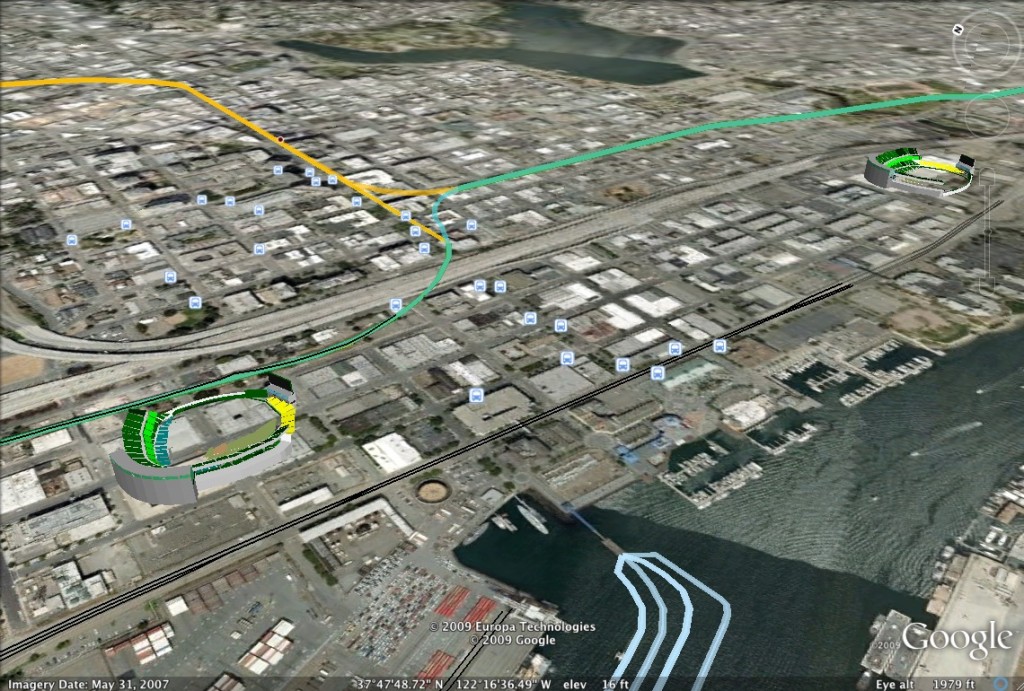
The Trib’s Angela Woodall reports that as a result of redevelopment cuts, the Victory Court ballpark site is now officially dead. We called it before the New Year, so it’s no surprise. But wait, weren’t there two sites near Jack London Square?

oak-aerial-1024x691

Left: JLS North. Right: Victory Court

JLS North was dropped quickly. Perhaps it was too expensive to acquire. Or maybe there weren’t enough business interests pushing for the site. Whatever the reasoning was, it wasn’t disclosed. Now Victory Court has also gone quietly into the night with little explanation by those who pushed for it.

Let’s step back through memory lane on Victory Court. Our time writing about it, your time reading about it, gone forever:

I guess it’s Coliseum City or bust. Or something.