Kaval pitches gondola to link Howard Terminal, Downtown Oakland

That’s right. Matier and Ross are reporting that, absent a BART link to Jack London Square and Howard Terminal, A’s President Dave Kaval is proposing a cable car or gondola to link the waterfront to Downtown Oakland.

Oakland and BART have experience working with this type of transportation before, having built the $500 million Oakland Airport Connector from the Coliseum to the airport. It was built by Doppelmayr, an Austrian firm with plenty of experience building similar systems for ski lifts and other urban environments.

The need for an alternative may be guided by this revelation:

then BART General Manager Grace Crunican recently slammed the door on the idea of building a new BART station near Howard Terminal, claiming it was technically infeasible — not to mention that the price tag would be in the stratosphere.

Many transit advocates were hoping for a Howard Terminal BART station to be useful for a second transbay BART crossing. It still remains to be seen if that will ever get beyond the planning stages. The 2004 JLS Feasibility study covered BART and streetcar links to JLS, but it didn’t investigate an aerial tram.

A possible JLS gondola would have to soar from 50-60 feet above I-880 as the freeway travels above downtown. That would make for a very scenic, but brief trip to and from the ballpark. The Airport Connector ride costs $6 each way atop your regular BART fare, so I would imagine that a ride for the shorter JLS line might cost $3-4 per person each way.

The question is, who pays for it? Riders could if they were locked into the fare gate system as they are at Coliseum BART. The experience would be different for JLS-downtown, as you’ll invite patrons who might want to park downtown and then take the gondola. An A’s ticket surcharge would help during games, but what about others who go to JLS/HT for other reasons? And who would foot the construction cost? This Cable Car is Over My Head, indeed.
Personal Update #2

Okay.

If you’ve been following my Twitter feed, you may know that I was discharged from the hospital a week ago. Since then I’ve been holed up in my twin brother Caesar’s house only a few blocks away – the better for making appointments.

While I still suffer some short and long-range effects from my stroke in late January, I’m working on becoming fully mobile and able-bodied. I can stand unassisted and can get in and out of bed, which is real blessing compared to three weeks ago when I wore a binder on my chest and bed straps on my arms (I had trouble processing the whole ordeal). Now my brothers are kicking my ass therapeutically, from advancing my walking to feeding me practically no carbs throughout the day. I joke that I’m walking like a newborn baby. I think that’s just because of lack of practice.

Mentally I feel like I’m working my way up a mountain. My sharpness is coming back quickly, though I’m still finding I have holes in short-term memory and vocabulary. I’ve made a lot of progress with speech therapy and so-called executive functions, but there’s still a ways to go. Unfortunately, my employer-provided health insurance has ended, so I’m having to do outpatient therapies via Arizona’s version of ACA, called MercyCare AHCCCS, or “Access.” Personally, I can say that I’ve been rather fortunate. So far the old health insurance has paid approximately 98% of my claims (percentages subject to change), leaving the YouCaring account (still open!) Caesar set up to pay for out-of=pocket costs. Thank you to all who have contributed, from old friends to baseball media backers to long-time readers I have only met through emails or the comments section.

The best thing that has happened so far is that after suffering a series of seizures with my stroke, I haven’t had a seizure since (or another stroke for that matter). That allowed the doctors to focus on two key problems: hypertension and adult-onset (type 2) diabetes. The blood pressure is under pretty good control thanks to the drugs and especially because of diet so far, and my blood sugar is so good one of the doctors started to wonder if I actually had diabetes (I do, don’t kid yourself). The point is that it’s becoming manageable with a single oral drug and no insulin injections so far. To me that means there’s hope. I was also taken off the seizure medication, which I was informed had weird interactions with the blood pressure meds.

That’s all the gory details I have so far. Have a good weekend everyone, and be good to your friends, family, even those you don’t consider friends or family. This game runs nine innings, and sometimes those innings take more than 2:30 to complete.

If you get a chance, watch the HBO documentary “The Zen Diaries of Garry Shandling.” Truly inspirational.

The Caldecott Derby

Folks, today we’re gonna talk about something I’m sure (only) some of you are interested in: minor league soccer.

In an interview with the SF Business Times’ Ron Leuty, East Bay developer Mark Hall made a full throated pitch to add not one, but up to two USL soccer franchises in the East Bay. One would be in Concord, the other in Oakland at the Coliseum.

The strategy is smart in that it has a built-in hedge. Perhaps Hall, who was granted both franchises, is only able to execute on one. So be it. If Hall can get two sites in the highly competitive Bay Area and get the support needed to fill both sets of stands, bully for him. He’s also bidding for the Coliseum arena, where futsal, the indoor soccer variant played on a court the size of a basketball court, could be a winner.

Hall could prove his teams’ worth now. The problem is all his talk so far is speculative. There is no USL team actively playing in Oakland or Concord, no futsal or lacrosse clubs. Hall doesn’t say if the clubs would start up right away or wait until their venues are built, whenever that is. Beyond that, these teams are decidedly peripheral or minor league. USL is the second tier pro soccer league in the US, and it is already experiencing growing pains given what’s happening in Cincinnati and Phoenix. There are success stories, such as Seattle and Portland. Even so, FC Cincinnati, Phoenix, and Sacramento have their eyes on a higher prize, an MLS expansion franchise, and roadblocks have been put up to stop them. FCC plays in the University of Cincinnati’s Nippert Stadium. Phoenix Rising and Sacramento Republic play in pop-up stadiums. All three franchises’ move to MLS (Major League Soccer) are pending the completion of new, permanent venues.

Does Hall endeavor to have a MLS team in the East Bay? Or stick with one or two teams that average 7k fans per game. The community cluster plan that Hall espouses has been done for decades – but not in American soccer. It’s the domain of high school football. That’s America’s community grown, grass roots sport. I admire the soccer crowd for trying to advance a community-based version of their sport, but it shouldn’t aim for 18-20,000-seat stadiums like Avaya Stadium or what Hall wants in Oakland. Manchester United just announced the 2018 pre-season tour, which will include a match and San Jose. At Levi’s. Which, when you think about, is the only stadium whose size and amenities could properly hold the match.

And with this soccer-related interest in the Coliseum site, there is interest from Tesla, which already has the 310 acres of the NUMMI plant in South Fremont. They want to expand, but they can’t make enough Model 3 cars to fend off their furious cash bonfire. What about the two groups who want to launch new pro football leagues, the reborn Vince McMahon-led XFL and the Alliance of American Football? Should Oakland and Alameda County keep options open for the Oakland Invaders? The AAFL will try to launch in 2019 after they pick their first eight franchise cities.

A Personal Update

Hello everyone. Your friendly regional blog runner here. A lot of you have wondered where I’ve been and what/how I’m doing.

It starts like this. I’ve been dealing with high blood pressure for some time though I haven’t done much about it. It finally caught up to me January 21, when I fell after having a stroke and multiple seizures. I’ll be the first to admit that I didn’t have the healthiest lifestyle out there, with all the bad foods and drinking. I was taken to the local emergency room and eventually transferred among three hospitals in the Dignity Health system in Phoenix. At the time I was 42 years old.

My twin brother Caesar, who is an occupational therapist at St. Joseph’s Hospital in Phoenix, has been watching me like an eagle the whole way through, including the part when I was placed in a medically-induced coma for a month, and my eventual ongoing recovery. I’ve been making good progress on the recovery, as my mind has taking leaps and bounds. My body is taking longer, as I’m too weak to walk long distances and I’m mostly wheelchair and walker-bound. It should all come back as my core recovers (not that I habitually work my core out). I’m getting discharged from the hospital today, and I’ll be staying at my brother’s place for a couple months-plus while I get the walking part down. During that time, you may see me more active on the blog and on Twitter as I’ve been this week. I’ll be doing that until I’m cleared to work again.

When I emerged from the coma, my body had atrophied so much I had a hard time moving in my bed. For the first week, I thought I was in better condition than I actually was, leading me to have a couple of accidents in my hospital room, one involving me kissing the business end of a commode when I tried to stand up. I eventually was restrained until I calmed down and was transferred to Barrow, the Neuro Rehab side of this sprawling complex. There I got some religion and have been nice, compliant patient ever since.

The lengthy hospital stay is likely to incur massive bills, so I’m going to refer you to the YouCaring Page that was set up on my behalf to help defray the costs. Hopefully existing insurance and ACA will help with some of that as well. I was working for a small startup business when the accident occurred, and they decided to let me go last week as it was getting too expensive and the timeline for my return was still unknown. (Arizona is an “at will” employment state.)

I expect to come back the Bay Area for an A’s series or two in the summer. I hope to meet many of you (again in many cases) when I do. You may notice that I have stopped drinking, as I need to do that on doctor’s orders, to prevent any adverse drug interactions, and because, frankly, it’s time for me to do so. I’m also considered a mild Type 2 diabetic, so I have to watch that, although my treatment for that isn’t nearly as invasive as you might think.

If you have already contributed, thank you very much. To those who are going to do so, thank you all for your support. If you questions about what I went through, comment below.

—-

P.S. – Thanks to the great team at Barrow, Select, St. Joe’s, and Scottsdale-Osborn for your patience and professionalism. I’ll be back sometime, hopefully walking in and joking around.

P.P.S – Additional thanks to my family, including both of my brothers who have been kicking my ass during recovering, my sister-in-law Andrea who has witnessed some of my rehab up close (and is expecting in a few months), and my various cousins and other relatives who have been sending support from afar.

Mayor Schaaf to approve ENA’s for A’s on both Coliseum and Howard Terminal sites

During a joint announcement with Oakland Mayor Libby Schaaf today, Dave Kaval made this rather pointed statement about how he envisions the future home of the A’s:

Having just a destination ballpark with a sea of parking — that’s not a suitable sports complex for the 21st Century for millennials, for fans.

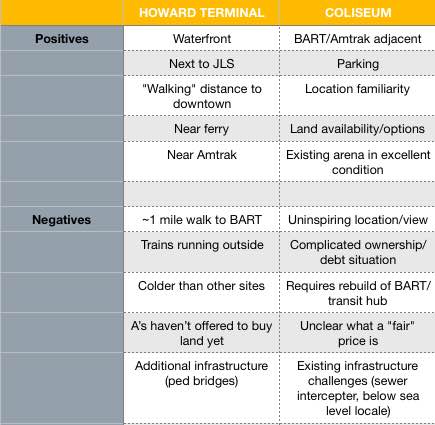
Based on ENA discussions with Schaaf, that could be at Howard Terminal or the Coliseum. Howard Terminal remains a sort of mirage: beautiful in pictures but a sort of illusion up close. The Coliseum is the practical albeit thoroughly unsexy choice. We all know that the A’s are lukewarm at best on HT. It’s Schaaf’s jewel on the waterfront. Whether the A’s will truly continue to fully evaluate or keep it on the board to placate Schaaf is unclear.

Let’s break down some of the key pros and cons of both sites:

The difference between the two sites is the HT is still essentially a series of drawings without a framework for execution, whereas the Coliseum has a framework but few cool concepts (renderings). To that effect, I expect the A’s architecture firm HOK to release something by the end of the regular season. The previous drawings envisioning a Raiders stadium as the anchor with the A’s ballpark in the periphery can be thrown in the trash. What we can expect next will be A’s-focused with no trace of football in sight. (I hope the team of HOK + Snohetta + T-Square are retained as they could create something truly eclectic and local-focused.)


If the A’s are going to use all 120-130 acres, I’d love to see the creation of an Athleticsland, a multipurpose, multi-venue complex that retains the arena for concerts, wrestling, and drone races with a street plan that ties it together with the ballpark. I’ve been to a few of these concepts that have failed in the execution (Atlanta), and the A’s can do better. As long as they focus on turning out future generations of fans and not just the currently well-heeled gentry in Rodeo or Pleasanton, they’ll be on the right track.

How much is the Coliseum complex worth?

Is the basis the debt? The buildings that exist on the land? the land and its potential?

M&R: A’s to talk buying Coliseum this week

UPDATE: The A’s are offering $135 million for the whole shebang.

——–

Matier and Ross are reporting this week that A’s brass are going to enter discussions about buying the Coliseum complex.

The 130-acre complex, which now includes peripheral lots to the south thanks to a swath of acquisitions, has the Coliseum and Arena currently residing there, both with sizable but dwindling debt (the city and county will pay both off over the next several years).

The new talks about the Coliseum come as the team discussed the Howard Terminal site with waterfront neighbor Schnitzer Steel. Schnitzer runs its recycling operation 24/7, and would likely create massive noise during night game. The logistics problem in terms of getting people to HT/Jack London Square from existing BART stations remains, and will probably remain a low priority when compared to larger regional transit problems.

The A’s are positioning this as a sort of defensive move to keep the Coliseum land away from encroaching developers, including the kinds that previously pitched a Raiders’ stadium. Now that’s gone by the wayside, some of those same devs could look at the Coliseum as a sort of land grab.

We don’t know yet what the A’s are offering, but it’s likely to be at best a slight premium above the remaining debt on the Coliseum/Arena. Oakland and Alameda County might have entertained such a deal 10 years ago, but it shouldn’t now. I worry that the A’s will run into a similar situation as San Jose, where they lowballed a land offer of the Diridon South land, only the be blown away when Google decided to buy the whole neighborhood including the ballpark site years later.

If anything, the A’s should focus on acquiring only the Coliseum South/Malibu site, which only comprises 20 of the 130 acres. Let the City/County figure out the rest.

50th Anniversary Game, A’s New JLS Offices

Tomorrow (January 10), the A’s will start selling free tickets for the regular season game on April 17 vs. the Chicago White Sox. That date is better known as the A’s 50th Anniversary game in Oakland. Tickets will become available at this page starting at 8 AM. Frankly, I can’t think of a better way to spend tax day than to go to a free ballgame.

The A’s showed off their new corporate offices to the media at Jack London Square today.

It has a lot of A’s history in it. It’ll be a much better place for doing business, interfacing with the public during non game days, and maybe even for players during the offseason if they decide to stay in town. It’s something they A’s brass were working on for at least a year, long before their announcement last fall.

It’s somewhat reminiscent of the Earthquakes’ set up at Avaya Stadium, where a separate administration building connected to the stadium also houses the locker room. It also reminds me somewhat of similar facilities at spring training ballparks.

While I suspect some sponsor events will be held at the building on 55 Harrison during Fan Fest, I hope that fans get a chance to look at some part of the building.

Speaking of FanFest, there’s another opportunity to check out Howard Terminal. I’ll probably be available for a “tour” and a drink at Plank if anyone’s interested. Pray that the weather is as excellent as 2017’s edition.


Looking backward to 2018

Square one.

That’s what we’re talking about. We don’t know what the A’s next steps are on the ballpark front. We may get a glimpse of it on Saturday, January 27, when the team will again host FanFest at Jack London Square. At FanFest 2017, Dave Kaval was coy about site choice, insisting that the A’s were still in the midst of studying site options. The Peralta site hadn’t been rumored yet, let alone publicized. Momentum built little by little throughout the spring, followed by the crash after the announcement.

The team has been licking its wounds since Peralta stopped talks with the A’s. Kaval has said nothing about next steps. Like last FanFest, visitors next month will be tantalized by visuals of Howard Terminal in the background. The Coliseum lingers in the background, though what can you say about a neighborhood that lost a Pak ‘n Save and a Walmart in the last ten years? Fans will be asking the A’s brass about both options, so I think this is an opportunity for the A’s to backers of both sites to start making their own efforts.

Howard Terminal, Coliseum JPA?

Let’s start bidding on the A’s. You want them? Really, really want them? Then show your hand. Present what you’re willing to offer. By that I don’t mean contributing cash for stadium construction. We already know that since the beginning the A’s have pledged to make the stadium part a privately financed affair. That leaves infrastructure, in terms of parking, improved roads, and enhanced transit options. Howard Terminal still has no estimate for what anything will cost to make it viable. The Coliseum still hasn’t figured out its ownership and debt situations, choosing to put those on the back burner. Any bids have to include those plans, respectively. Both plans effectively have to start with the City, because Oakland has to initiate the purchase of the half of the Coliseum land from Alameda County (the county would loan money to the city), or Oakland has the start the process of rezoning Howard Terminal to non-industrial port (or city) land.

Most of the details of any negotiations would be held in closed door sessions, as most municipalities do with real estate. But we can at least get some kind of framework to get started on either side. And that would give fans something to work with that’s more than a skin-deep debate over a pretty, impractical site vs. a cheap, dumpy one. A competitive approach is likely to yield better results than another one of Oakland’s aimlesss task forces.

The one wildcard to look at in 2018 is The Lodge. Commissioner Rob Manfred has stayed patient so far, preferring not to criticize Oakland while the A’s completed their search. Now that Phase One has ended with a thud, I’ll be curious to see if Manfred’s patience starts to simmer.

Blindsided Sacramento searches for billionaire savior for MLS bid

It all was going so well. The Sacramento Republic FC soccer club began life in 2012. They won a USL championship two years later. Raucous fans impressively filled the temporary stadium set on the Cal Expo grounds. Fan support combined with the grassroots community feel to present the club as a frontrunner for a future MLS expansion franchise. Everything was going as planned. This month was the champagne was meant to flow. They even had a private financing plan for the stadium, then broke ground over the summer.

Standing section at the future Sacramento Republic FC stadium

Then Wednesday, MLS announced that a late, money-heavy bid from Nashville won an expansion franchise, the 24th out of a planned 28 total teams in the coming years.

The next day, backers of the Republic FC bid announced that they’re looking for both a majority investor and multiple minority investors. HP Enterprise CEO Meg Whitman backed out. The York family (49ers) is involved, though they appear to be at best limited partners.

When asked why the bidding group was short on funds, CEO Kevin Nagle admitted that they were all pledged to cover the stadium financing. That’s fine, but the expansion fee rose in the last few years to $150 million. Meanwhile, the stadium cost has risen from $170 million to $250 million.

My back-of-the-napkin guess is that the club needs an infusion of $100+ million to be approved. The additional partner(s) would probably also need to have their checkbook(s) handy in case the franchise needed to cover cash calls for construction, initial payroll, and operating expenses. Keep in mind that we’re talking about $400 million to get started. By comparison, the LA Galaxy’s valuation this year was $315 million.

Just as with the Kings, Republic FC is reaching out to the millionaires and billionaires in the Bay Area. The difference between those efforts are fundamental: former NBA commissioner David Stern brought the tech money to the table, while stalling the Maloof brothers from selling the team to Seattle interests. In this case, MLS can provide some time, but Don Garber is no David Stern, and it would be inappropriate to have MLS involved any further while competing bids in Cincinnati and Detroit await their own appraisals.

While I considered the Sacramento MLS bid to be practically a done deal, I’ll have to watch it more closely now. By the way the team and city reacted to recent news, I’m nearly as floored as I was by the A’s-Peralta news. That’s not very hopeful, in case you were wondering.