Let’s Play Two for the Last Time

Last fall, when the 2024 schedule was released in preliminary form, I immediately circled May 8 on my calendar. As you probably saw on Wednesday, on May 8 the baseball version of an eclipse took place: a natural doubleheader. Not a doubleheader that included a makeup game from a previous rainout, or the dreaded day-night or split doubleheader that requires two separate admissions. No, this was old school single ticket double-dip, the second game coming thirty minutes after the first game ends. For me, it offered a satisfying coda to my time as an Oakland A’s fan. My first A’s game was itself a doubleheader in 1988 in which the A’s dominated the Cleveland Indians. And while the 2024 A’s is not the dominant force the Bash Brothers-era A’s were, they are showing promise after a couple of severe rebuilding seasons.

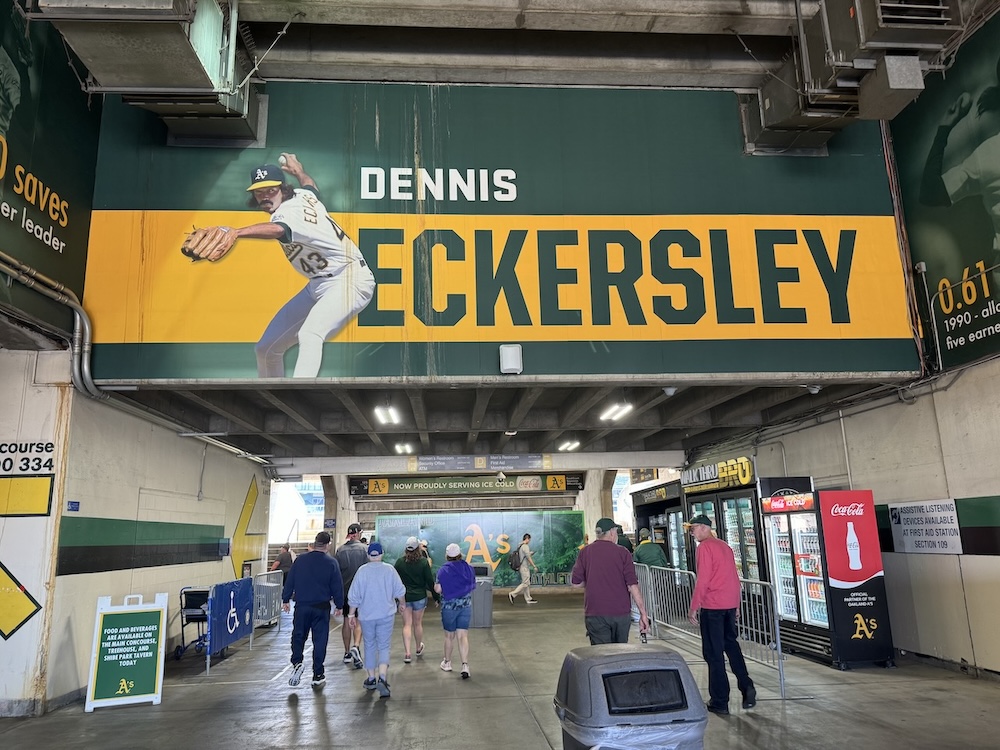
I left my house in Glendale at 6 AM, bound for a 8 AM flight to SJC. I chose to fly into SJC instead of OAK because I wanted to capture the experience of taking my old route from the South Bay. If BART was running all the way to Santa Clara, that would’ve been the choice. Alas, the downtown San Jose extension is still in turmoil, so I went with the Capitol Corridor train out of the Santa Clara station instead. As usual that experience was quite smooth, including a few lovely moments on the platform with an elderly woman who was traveling to Sacramento. I got off at the Coliseum station and took a few pictures of the old haunt from the Amtrak BART ramp. I also noticed an A’s security person stationed at the top of the ramp as it met the BART bridge. That didn’t strike me as particularly notable, but as I found out later, was something to consider as the season progresses.
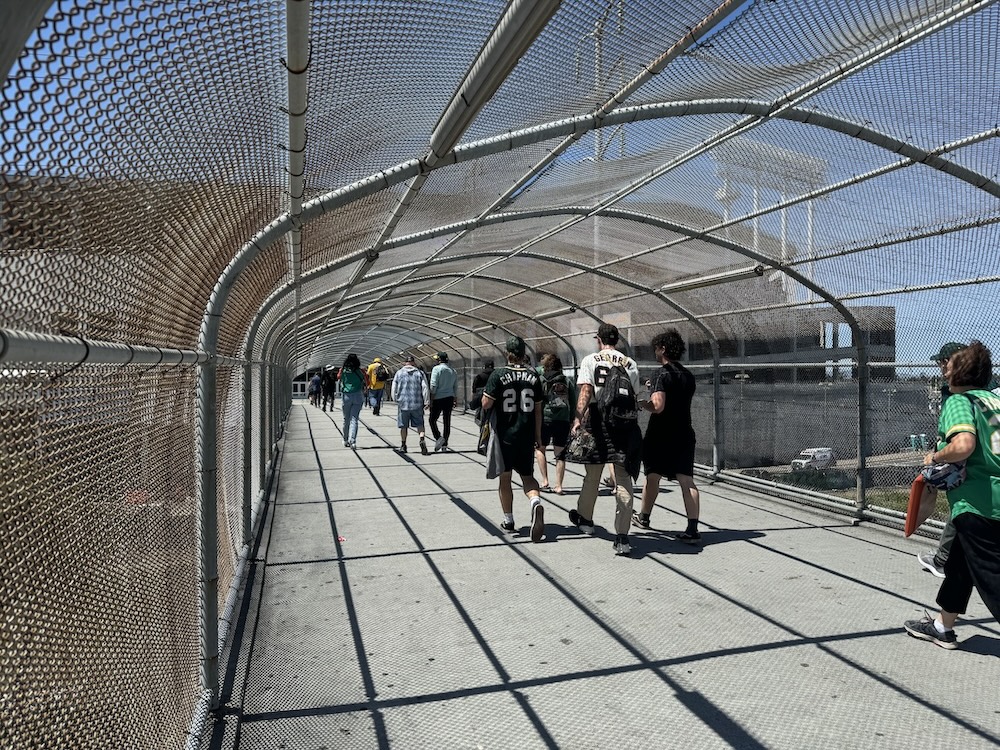
Warm weather and a double dip are perfectly good excuses to head out to the yard

A half hour before first pitch, there was a good stream of fans headed to the game. I didn’t expect a very large crowd even with the doubleheader, but it was nice to see some turnout. The announced crowd was 8,320. It was clear that there were plenty of no-shows because of the muted reaction to some of the announced groups that supposedly purchased tickets. On the other hand, there was a 2-for-$20 promotion on the field level which brought a number of casual fans, and there was actually a line for walkups at the BART plaza ticket window. 

I figured I had plenty of time to get concessions if I was hungry, so I went straight to my seat in 119, next to the Diamond Level section. I was perched above the A’s batting circle, with a great view directly down the first base line. That afforded me a “great” view of Mount Davis, which got me thinking about how the A’s announced a series of giveaways throughout the season, culminating with a replica model of the Coliseum on the final regular season home date ever in Oakland on September 26. Which version of the Coliseum will be given away? The 1966-1995 version with the ice plant in the outfield, or the 1996-present version with the hulking 10,000-seat eyesore? I decided that I wasn’t going to travel all the way to the Bay Area to get the crappiest version of the thing I loved so much. I wasn’t going to proudly place that thing on a mantel or shelf for posterity. While that game will allow for a sort of wake for the club’s time in Oakland, I’ve personally done enough grieving over the years.

Try as you might to minimize it, Mount Davis is immense and unavoidable

To understand my stridence about this, you’ll have to consider my past as a young man covering his childhood love the A’s and the Raiders in the media when the Raiders first came back in 1995. I was working through college, hired by a freelance Bay Area photographer to provide rudimentary copy along with pictures he sold outside the normal wire services. I read enough of the great columnists and the young upstart reporters in the Bay Area papers to provide a reasonable facsimile, so I eagerly took the gig, a wide-eyed 19 year-old sitting in the back row of every press box, but with an assigned seat and a printed name plaque nonetheless (shout out to the greats Al LoCasale and Debbie Gallas, btw). Those first couple of years were a whirlwind, as the Coliseum was in a constant state of upheaval. Were you aware that there were two seating configurations for Raiders games depending on whether the A’s season was still on? During the baseball season, the football field was configured to run from home plate to center field to limit field damage by the temporary football seats. After October, the field was reconfigured to run from foul pole to foul pole in order for the bank of football seats to be installed in the baseball outfield. That was never the most ideal situation for either team, so I was curious what the renovated Coliseum would look like. A month ago, Travis Danner posted a page from the A’s magazine touting the improvements:

In case you can’t read the bullet points, I listed them below
  1. Two large family and corporate picnic areas
  2. Additional rest rooms and specialty food service stands
  3. New BART walkway and entrance plazas
  4. New ticket box office and retail areas
  5. 20,000 square foot family entertainment center concourse
  6. Center field corporate club with outfield seating 
  7. New outfield seats to replace benches
  8. New computerized matrix scoreboards
  9. Two new high resolution video screens
  10. Improved access to the upper deck
  11. Additional plush Luxury Suites and renovated Suites
  12. Diamond level seats in two areas adjacent to dugouts
  13. New club seating – premier seating in an outdoor setting
  14. 20,000 square foot private air-conditioned baseball club with dining areas and two-story bay windows overlooking the field
  15. Six new elevators to all levels
  16. New and enlarged press box and enlarged media elevator
  17. All new armchair seating throughout the entire stadium
  18. Television monitors under overhangs for instant replays
  19. Improved sound system
  20. Premium catering for the Clubs and Luxury Suites
  21. Enlarged clubhouse for A’s players
  22. Refurbished visitor locker room
  23. New media interview room for players
  24. Indoor batting tunnel and pitcher warm-up mounds
  25. Enlarged weight room
  26. Expanded field storage
  27. Club concourse connecting eastern addition with existing stadiums

In hindsight it’s easy to see how the A’s and A’s fans were so thoroughly screwed by these largely football-centric improvements. More seats, more suites, and more clubs in the wrong places, plus no mention of how the baseball experience would be compromised, it was soon to be disastrous for everyone involved from the pols to the teams to the put-upon fans. Back in 1995, that wasn’t so obvious. The retro ballpark craze had just started with only four such ballparks open by the start of the season (Camden Yards, Progressive Field, Coors Field, and New Comiskey if you want to count that). At that point, the retro craze was still a nascent one. It wasn’t until the millennium approached that the trend became a craze.

Back in 1995, I still believed in the utility of the multi-purpose stadium. SkyDome was conceived as a multi-purpose dome (MLB & CFL) and was huge and glitzy. Mostly I was mostly excited that the Coliseum would get an expanded press box. During that early period the auxiliary football press box was set up in one or both of the open Loge areas beyond the original luxury suites in the outfield. There was still overflow press seating for baseball, such as the repurposing of section 317 for visiting writers during the postseason. For the most part, the bigger press box was an enormous improvement – and it wasn’t yet overrun by critters. I saw the image in the A’s magazine and thought that they were fully enclosing the stadium like some of the cookie-cutters (Busch II, Riverfront, Three Rivers). Unfortunately, fans and press were bamboozled. Even when Opening Day 1996 came we didn’t see the full effect of what would become known as Mount Davis, as they hadn’t fully poured all of the concrete for the upper deck. Remember, the A’s had to spend the first week of the season at Cashman Field in Vegas. The video below captures  the mix of joy and unease that came with seeing the monstrosity looming over everything else. (Among the other notable things from that video: it was Charlie Finley Day with Monte Moore handling the proceedings, and the otherwise infallible Roy Steele mispronouncing Jeff Reboulet’s name). As Mount Davis fully rose, all A’s fans got were some security guards doing the YMCA dance late in the season.

All of my coverage on this blog and elsewhere has been viewed through the lens of someone who witnessed first hand the short and long-term effects of Mount Davis. I’m aware of how ironic it is that I got my shot through covering the Raiders coming back and that someone else recognized something in me. I’m not now and never have been a Raiders fan, though I had no reason to hate them up to that point. Nearly thirty years later, the Raiders are obviously THE catalyst for killing pro sports in Oakland because the East Bay never properly recovered from the experience, even after the Warriors’ dynasty. I’m often viewed as an enemy of the East Bay, at least on social media. In fact, Steven Tavares wrote an article about it. Criticizing Oakland is not the main focus of this site. Instead it became a chronicle of the litany of missteps and strategic errors made in trying to get a ballpark for the A’s built, by both politicians and ownership. Some were in Oakland, others in San Jose or Fremont, more are destined to come in Las Vegas. In the end, I look at all of these moments as simple matters of timing and execution. Oakland got an AFL franchise because the AFL needed a second West Coast location, and Oakland pitched itself as a good landing spot. Similarly, the A’s came to town because Finley saw more opportunity in the Bay Area than he did in Kansas City. The Warriors were nearly doomed to barnstorming by Franklin Mieuli until the gleaming Oakland Coliseum Arena was built. When East Bay power brokers brought back the Raiders and didn’t tell A’s ownership, baseball noticed but they couldn’t do anything about it. The early 2000’s birthed a renewed effort to give the A’s a proper home. The timing was poor there because there was no support by then-mayor Jerry Brown. Subsequent mayors lacked either the gravitas or the drive to see a ballpark project through, or they were somehow convinced that they could accomplish the same thing at the Coliseum 40 years in even though prevailing trends were pushing teams away from each other. At the same time, post-Haas ownership groups were often focused anywhere but Oakland, to the point that Oakland’s only legitimate shot to retain the came only 6-7 years ago.

Think I’m blowing the Mount Davis effect out of proportion? Take a look at the dwindling number of Coliseum-themed collectibles that are available for sale on eBay or MLB Shop. Posters and photos often set their perspectives to minimize the visual effect of Mount Davis as much as possible. It remains an ugly reminder of how failure can last generations. It’s impossible to deny how East Bay stadium proponents were cowed from making big public investments asks as they squandered all of their political capital on both the Raiders (horrible deal) and the Warriors (a good deal that had a rough ending). That made any and all Oakland efforts focused on the A’s a race against time, a test of MLB’s patience. It’s not that the East Bay suddenly got religion about the folly of publicly-funded stadium projects. The problem was that they knew they couldn’t ask. It’s like trying to fight with one arm tied behind your back.

Mason Miller retiring Marcus Semien to end Game 1

After the A’s won the first game (including a surprise Mason Miller six-out, non-save exhibition of dominance), I made my rounds throughout as much of the Coliseum as I could. I traveled both the field and plaza concourses, went up to the View level, visited the Hall of Fame area, the bleachers, everything except the closed upper decks of Mount Davis. And that’s just fine. I used one of the trough urinals. I used a regular urinal behind left field, though I noticed that entire wall of urinals there hadn’t been flushed. Everything seemed darker and dingier than I remember in previous visits. On the bright side, I noticed that outside one of the concession stands there was a dispenser of various sealed cups of dips and sauces. I immediately thought that was a brilliant bit of convenience. Then I realized that if more fans were here those dispensers would be cleaned out by the second inning. It’s just human nature to take free stuff because it’s there. I have no idea what the vibe will be on September 26, the final game at the Coli. I can imagine that a lot of stuff that isn’t properly bolted down will quickly become souvenirs. That’s more than fair in a sense. Taxpayers paid for this, they might as well get something back. After all, the Coliseum’s not going to need all of those seats for an occasional Ballers or Roots/Soul game. The Coliseum is destined to go the way of RFK Stadium, which was finally cleared for demolition only last week. Then again, DC might bring the Commanders back from the wilderness in Landover/Raljon. Is a major team coming to Oakland anytime soon? Maybe, but first Oakland will have to spend some time in the wilderness. Brooklyn eventually got one, so it’s possible.

P.S. – On the way back to the BART station I noticed a pile of trash strewn on the BART bridge. In 36 years of going to the Coliseum I’ve never seen that. That brings me back to the A’s security guy I saw at the Amtrak ramp. It used to be there were either A’s staff at the BART station entrance, sometimes with a golf cart to take mobility-impaired fans in either direction. I saw golf carts circling the Coliseum itself as one of the drivers nicely offered me a ride, but none on the bridge. The Coliseum is not the epicenter of the Bay Area’s apparent doom spiral. The way things are going, it can’t help but get caught up in the cycle.

P.P.S.The origin of “Let’s Play Two.”

Some other pictures:

D Gate
Honestly, how often are you going to a trough urinal in the wild?
Bangeliers having a record day
You can’t steal all of the free sauce when there isn’t anyone around to take it
Mount Davis, minimized in a poster

Autumn: #DiscontentSZN

Play the audio while you read the following post

I suppose I can ask now: Was the A’s tanking in the second half of 2021 and all of 2022 worth it if a Howard Terminal deal happened? Seemed like a lot of fans were hoping for exactly that to occur.

What’s that? There is no deal? Well, that complicates matters a bit. City staffers and the mayor finally conceded in the last few weeks that no deal is coming this year, barring a miracle.Any deal would have to be consummated in 2023 at the earliest, with no assurances that would happen given the changing political and economic landscape, along with the deal’s increasing complexity and cost.

I wrote in July that Oakland pols were mostly motivated by the fear of being blamed for the last major pro sports team leaving, and to that end they mostly succeeded. The unenviable responsibility will fall to the next Mayor and City Council, to be decided in two weeks. While some of the media try to position this as a sort of baton-passing exercise, anyone paying attention knows that a different mayor, with a different city council, is bound to have priorities that stray away from a $12 Billion mega-development project. Though perhaps it’s not that far off. Vice Mayor/CM Rebecca Kaplan posted a slide from a poll taken by the Mayor’s office on Oakland’s priorities. Look at where Howard Terminal lands in there.

Among Oakland initiatives, Howard Terminal comes EIGHTH in urgency

Whatever happens, Oakland’s looking at some serious regime change when 2023 rolls around (mayor, 2-3 council members), and no one should expect business as usual on the Howard Terminal front. Then again, Kaplan’s slide shows that HT doesn’t have the juice that outgoing Mayor Libby Schaaf liked to project. Perhaps following the script of pushing for incremental movement while hoping for a big breakthrough is staying the course, because what choice does Oakland have at this stage? What might change is the messaging. The Oakland populace has felt largely ignored by the mayor in her second term. A return to a more realistic approach may be in order, which may mean putting Howard Terminal on the back burner. At this point, who can really say? The building trades unions are certainly pumping enough money into this election to expect some sort of ROI. But the unexpected can and sometimes does happen in Oakland’s ranked choice elections. Maybe Ignacio De La Fuente will somehow sneak in.

The City of Oakland continues to make its procedural push, a double-edged sword which thankfully is not paid for by taxpayers but is being bankrolled by the A’s, creating its own apparent conflict of interest. Again, what choice does Oakland have? This is the game. Oakland chose to play it.

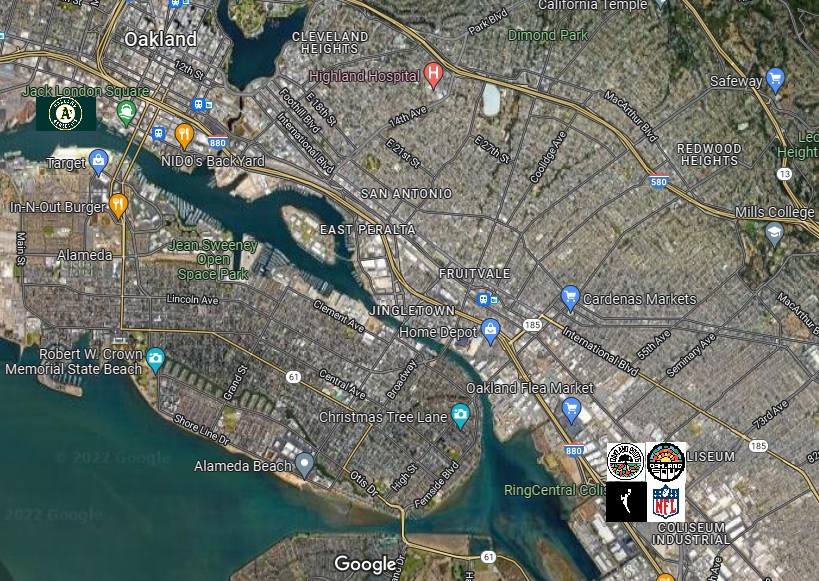
Now if you want a fully delusional view, I give you @As_Fan_Radio’s tweet from the summer, in which whichever account runner was working promoted FIVE teams in Oakland: the A’s, the return of the NFL to the Coliseum property, a WNBA team, plus the Roots and the Oakland Soul, a women’s pro soccer franchise owned by Roots ownership. Think about that for a moment. A city which 50 years ago made its name by being an easy-to-work-with landing spot for sports franchises spent the last decade running them out of town, yet still dreams it can easily retain or attract new ones. Sadly, they’re blind to two things: it’s harder to get things built now, and Oakland has been surpassed by many competing markets. Oakland is no longer a soft landing spot.

Looks a lot more like daydreaming than foresight
Renaissance? Perhaps trying to maintain relevance is a more achievable goal

Obviously, the NFL is in no hurry to come back to Oakland since the City’s Hail Mary lawsuit against the league was recently dismissed by the US Supreme Court. Oakland, like St. Louis, argued for monetary damages because of the way it lost its NFL team for the second time. Unlike St. Louis’s successful lawsuit, the Court didn’t buy that the NFL hurt Oakland on antitrust grounds. STL actually produced a funded stadium option for the Rams, which Stan Kroenke and the NFL ignored as their sights were focused on re-entry to the LA market. Oakland, which had an EIR in place for Coliseum City (sound familiar?), didn’t have a funding plan in place. STL took the Rams/NFL to court first in 2015, Oakland later in 2018. Despite regular defeats on the bench, ambulance chasing law firms kept taking Oakland’s case on contingency.

On the other hand, WNBA could happen in Oakland since there’s already an excellent modern – though expensive to operate – venue in the Coliseum Arena. The issue there, as is the case for most WNBA franchises, is a matter of who’s going to pick up the operating costs. I argued previously that it was curious that Joe Lacob, who gained credibility in the pro sports world via his foray in the ABL, so far has only teased his involvement with a WNBA franchise. If the argument against has to do with defraying operating costs, I have to point out that the Warriors’ luxury tax bill will run into the nine figures for the next several seasons thanks to upcoming contract extensions. If anyone can afford the freight of running a WNBA team and its piddly $1 million annual payroll, it’s Joe Lacob and his partners, though chances are he’d prefer to play most of the games in the arena he runs across the Bay.

As for the Roots/Soul, they’re using the same playbook the A’s briefly (and successfully until it became unsustainable) used when the Raiders left. Despite the Roots’ recent success in North American second-tier league USL Championship, there’s still a way to go to establishing a permanent home away from Laney College, where the football stadium is being rented. The franchise is in talks to build a stadium on the Malibu lot next to the Coliseum, which is City-owned and not subject to City/County/JPA co-ownership stakes. If the HomeBase lot is included, the total land is about 20 acres -more than enough for the stadium and some ancillary development. The requirements for USL Championship (10,000-person stadium capacity) is roughly half that of MLS (20,000). One thing you have to keep in mind for these fledgling franchises is that their plans have to manage growth. They can’t simply build a 5k or 10k stadium and call it a day unless they don’t plan to bring in more fans than that on a regular basis. If their plan is to eventually build something attractive for promotion to MLS, that’s a completely different set of requirements or challenges.

Look, if you’ve been reading this far and reading my posts for some time, you know I’m not a person to provide easy answers or empty rah-rah homerism. I care about the deal and how it gets done, who wins and who loses. I didn’t care much about how the EIR and related approvals came through because I knew those proceedings had limited impact and had tons of strings attached. If the A’s announce they’re leaving for Las Vegas tomorrow, it’s not like whatever tentative approvals are in place at HT can be transferred to a hypothetical new MLB team, a soccer team, or god forbid, a NBA or NFL team. What people fail to understand about Oakland’s plight is that none of these leagues are going to wait too long for Oakland to get its shit together, only as long as a team is bound to a lease. The leagues allowed two Oakland teams to find better options outside of city limits, the same way they allowed the A’s to do “Parallel Paths.” If you believe MLB or anyone will exercise a great deal of patience for Oakland to come up with a perfect deal (Opening Day 2027, hello?), history shows that strategy doesn’t pay off for The Town. Which is somewhat ironic, because as Oakland loses team after team and fades from relevance on the national stage (I didn’t forget that Mills College merged with Northeastern University), “The Town” may be a more apt nickname than anything an overpaid consulting firm could come up with.

There’s always next year. Until then…

P.S. – In the summer of 2021 there was an arbitrary deadline to get a deal done between the A’s and the City. They made fundamentally different proposals and agreed to work on them, punting the deadline TBD. Early this year, the EIR and BCDC decisions were also pitched as critical. November’s election, and the end of the year, are similarly sold. Now that these dates have elapsed, what are the consequences for miscalculating the impact? Do the HT proponents tire of buying these arbitrary deadlines whole? Healthy skepticism never hurt anyone, especially when so much money is on the line.

7/20 #oakmtg Live Thread

Oakland’s City Council passed the City’s term sheet on Howard Terminal (6 ayes, 1 no, 1 abstention). With that the A’s braintrust is off to Vegas while they and MLB decide what to do next.

You didn’t really think this would magically come together in the last few weeks, did you?

Tweet-by-tweet coverage

… and a snap poll for good measure:

There’s a baseball game on today. In Oakland. Enjoy it. I’ll provide feedback on the meeting later today.

Ghost of Blue Ribbon Panel Speaks Out in Favor of… The Coliseum

Former Giants VP Corey Busch, who was part of Bud Selig’s Blue Ribbon Panel to study the A’s future in Oakland (and San Jose) a decade ago, was interviewed by the Merc’s Shayna Rubin yesterday. And boy, did Busch had some thoughts.

The big reveal was Busch’s belief that former Giants owner Bob Lurie was never going to ship the team to Florida. Selling the team was, as Busch recounted, merely a ruse to motivate a local buyer for the franchise, which eventually happened when Peter Magowan stepped up. That’s not to discount the tremendous amount of drama at the end of Lurie’s ownership tenure, which involved St. Petersburg and dalliances with San Jose and Santa Clara. Exploration of the South Bay included A’s owner Walter Haas agreeing to cede Santa Clara County to the Giants, which was previously an unassigned territory for MLB’s purposes. The South Bay is now and forever San Francisco Giants territory, even though they will probably never play a game there.

Busch also went out of his way to defend the Coliseum, decrying A’s ownership’s desire for a downtown ballpark – and only a downtown ballpark – at Howard Terminal.

Busch determined the Coliseum site was viable in 2014 on Selig’s blue-ribbon committee to explore ballpark options. He still attests the A’s can build the ballpark village of their dreams around the site. MLB and the A’s declared this month that the Coliseum site “not viable” as a location for a new park.

“The notion that the Coliseum, if properly developed in its totality, is not acceptable is kind of silly. It’s nonsense,” Busch said. “I know for a fact there are people in the commissioner’s office who know the Coliseum site is a good site.”

All Bay Collective’s 2018 Estuary Commons concept (Coliseum/Airport area)

Right now the Coliseum is not in the conversation due to the stubbornness of ownership. At some point it will re-enter the picture, unless everything from this point forward falls in line for Howard Terminal. For all their posturing, the A’s still continue to attempt to buy the City’s half of the Coliseum. And even though Dave Kaval announced the A’s were on “parallel tracks” with Oakland and Las Vegas (I thought there was no “Plan B”?), it’s not hard to see a third path, one that brings them back home.

Brodie Brazil captured how I’ve felt this month

Just watch Brodie Brazil from NBC Sports California, dissecting the A’s relocation drama point by point, including some historical references. It’s excellent.

I’ll have more to say later today or tomorrow.

Three Oakland City Council Members Respond to A’s Demands

UPDATE 4:40 PM – A synopsis

UPDATE 3:30 PM: The squeaky wheel always gets the grease. Council vote on 7/20.

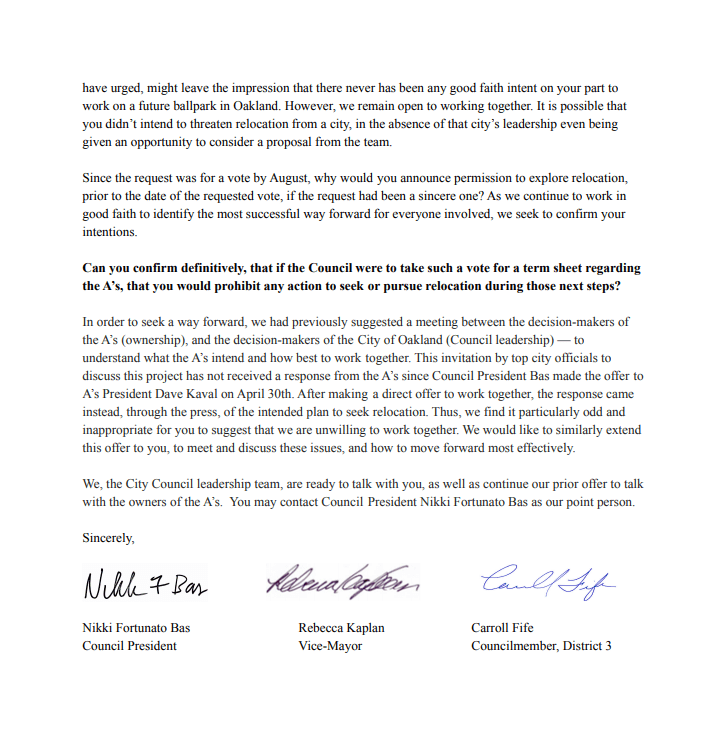
I’ll preface the following (from KRON) by pointing out that the three signatories to the letter are the most ardent skeptics of Howard Terminal. Read what you will into the letter.

The questions are fair. It reminds me of two bits of fairly recent A’s history.

..and…

In 2015 the City of Oakland released a Coliseum Area Specific Plan. Amazingly, it had real estimates for various types of required infrastructure. Imagine what could happen if the A’s let Howard Terminal goes through a full, proper planning process instead of rushing it.

There’s a lot of additional City-owned land to throw into the pot if they want to sweeten a Howard Terminal deal or nudge the team back to the Coliseum

Ongoing talks over whether the City will sell its half of the Coliseum complex to the A’s are scheduled for May 20. I had a response to that as well:

Howard Terminal EIR maybe in early ’21

Sometime before Thanksgiving, I reached out to Peterson Vollman, the City of Oakland’s planner overseeing the Howard Terminal ballpark project. I asked if there were any updates on the project. Vollman’s response:

We are anticipating publishing the DEIR in Q1 of 2021 pending AB734 Certification by the Governor.

Just so we’re clear, that’s the first quarter of 2021 for the Draft version of the document, pending the certification through AB734.

Anyway, those of you still on the HT bandwagon have the patience of saints.

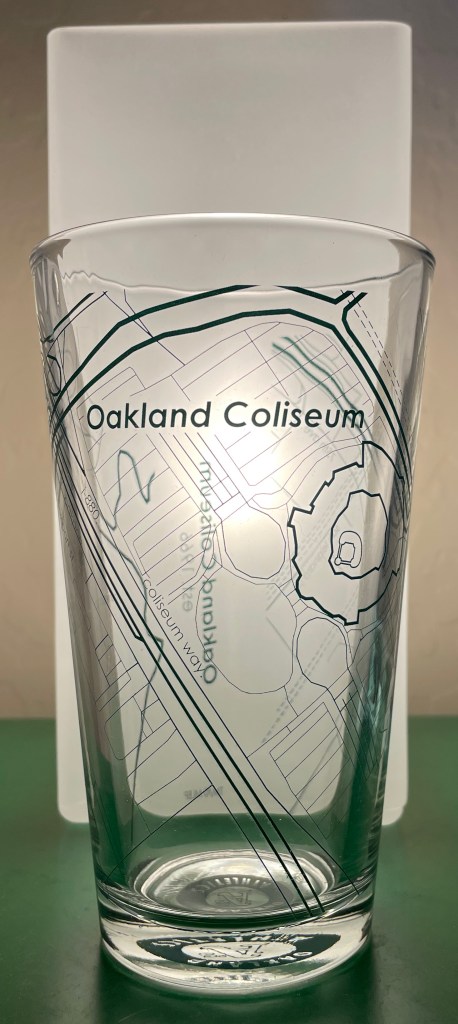
Thankgiving also happened to be my birthday. Somehow I managed to get presents, including this:

Coliseum pint glass
Pint glass from @welltolddesign

I would like to carry this pint glass everywhere I go, thank you very much.

One Horse Town

Say goodbye to the bad guy.

Over at NBC Sports Bay Area, Scott Bair reported yesterday that the Raiders, who had an option to play at the Coliseum in 2020 just in case Allegiant Stadium didn’t get completed in time, recently declined the option. They had until April 1 to renew.

With the Raiders leaving Oakland behind, we can officially leave behind silly concepts like this:

Or this:

And especially this:

It was never going to end well. At least one team had to leave which grew to two. There are lessons to be learned. Memories to savor. Once we get through the current crisis, Oakland can get back to what it was like when baseball ruled the town.

October 3, 2012

When the dust settles, the A’s and A’s fans will have to pick up the pieces. What world will we live in? What restrictions will be placed on our movement, or on limits to assembled crowds? It’s more than a little ironic that the cavernous Coliseum could work in an era of social distancing – at least if the crowds are limited to 20,000 or less.

MLB is saying for now that the start of the season is postponed until mid-May at the earliest. Until then confusion reigns, as teams are deciding where to set up camp for the season. A’s staff and players have it relatively easy, since they can easily shuttle between Oakland and Mesa. Players often have offseason homes in Arizona. Other teams have more complicated logistics. Take always-an-Athletic Sean Doolittle and Eireann Dolan, who described their living arrangements, which included the specter of dual concurrent leases.

Whenever the season starts, it will be truncated and condensed. You might see many more doubleheaders (hooray!) and expanded rosters, perhaps six-man rotations. Gotta get the games in somehow. Fortunately, there won’t be anymore $250k baseball-to-football-to-baseball Coliseum conversations to plan this year, maybe forever. There is also the matter of the Raiders locker rooms. The A’s will have about two months between now and the start of the season. Should the team choose to keep all their training in Mesa, they can continue to use the old cramped clubhouses with few complaints. If they choose to move more of the team to Oakland before the official start of 2020 season, they’ll need the extra space. And while a scant two months is a tough timeline to hit, that should be enough to make sure the plumbing works, install new carpeting, and slap a new green-and-gold paint job on the joint.

Modern NFL locker rooms are vast, perhaps overkill for the A’s (photo: Flickr user rocor)

The benefits would be enormous. It’s a larger space to house the entire 40-man roster and camp invitees if needed. The facilities on that level are newer and more functional than the old baseball clubhouses (insert plumbing joke here). The team will still run the shuttle between Oakland and Mesa as needed. Parts of each football locker room could be cordoned off for press use or other functions. And outside on the field, Clay Wood and his stalwart crew can focus on keeping the turf and infield as pristine as possible without much worry about divots, dealing with the gridiron, or 300-lb. dudes trampling everything.

It’s no vaccine for the coronavirus. It could help the team be more competitive with the rest of the American League, and if the theme this year is to strike while the iron is hot, I can’t think of a better way to prepare for this season.

Next Stop: Sin City

Another East Bay legend once said it best:

So take the photographs and still-frames in your mind
Hang it on a shelf in good health and good time
Tattoos of memories and dead skin on trial
For what it’s worth, it was worth all the while

.

.

.

.

Sooooooo…… when can the A’s claim the soon-to-be-vacated locker rooms?

The Adult Conversation, Aborted

I never intended to create a series of posts titled “Adult Conversation,” yet here they are:

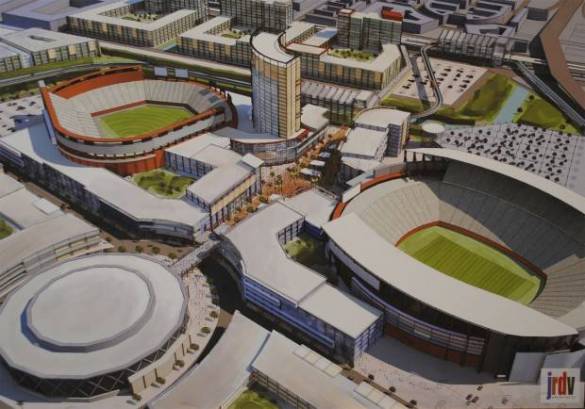
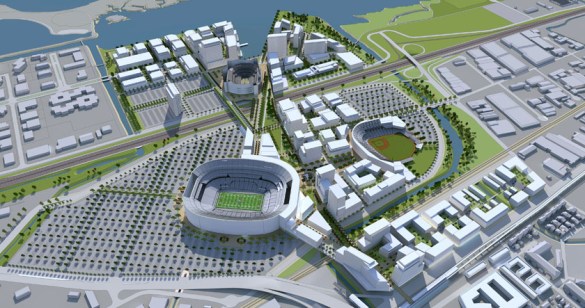
…plus there are other related posts that had to do with Coliseum City in 2015:

What happened since then? Besides the the Warriors leaving for SF and the Raiders’ announcement of their exodus to Vegas, not that much.

Now that the City and County are embroiled in a lawsuit over the sale of the County’s share of the Coliseum to the A’s, we’re stuck in a state of utter confusion. Quick recap: City sued County two weeks ago. Rob Manfred stepped in and threatened to move the A’s to Vegas if City doesn’t back down. This week, County threatens to stop negotiations on the Coliseum if City doesn’t back down.

Hold on a sec. Does anyone really know what the two sides are arguing about?

Remaining debt payments on the Coliseum after 2012 refinancing

According to the City of Oakland, Alameda County went and took the offer from the A’s without seeking a counteroffer from the City. The previous working plan was that the County would pay off the debt, and the City would pay back the County over time to regain control of the entire complex, allowing the County to exit the sports venue business. That was the essence of the adult conversation. The City didn’t (and reportedly still doesn’t) have the money to pay for their share and pay back the County, so that went nowhere.

However, the City is now revealing a different wrinkle to the A’s deal. According to City Council member Larry Reid, the County is allowing the A’s to pay off the County’s remaining debt installments, a pitch that the County didn’t in turn make to the City. That sounds a lot like what the City wanted, right? This is what doesn’t make sense to me. The City wasn’t able to take over the debt, yet they say the County didn’t give City the option to try? (As far as I know, neither City nor County have the option to accelerate the payments to pay off their share early.)

Either the City or County is interpreting the terms of the arrangement wrong. And that is what I find most disappointing about all of this. The two sides, after back and forth periods of acrimony and harmony, literally had years to iron out the details of the Coliseum’s dissolution. That is what was supposed to be the eventual product of the adult conversation. Perhaps they got distracted by the pipe dream that was Coliseum City. There were certainly other more pressing civic priorities over the years. But the important takeaway from all of this is that the Coliseum JPA is about to get out of all of this without going broke in the process, though they certainly got close. Whether the land is sold back to the City or is sold to the A’s, both City and County will be made whole, instead of incurring even more enormous debt via a new complex of stadia as they were ready to incur.

That all said, part of me is hoping for the November hearing to go as currently scheduled, as it could finally put the matter to rest. The two sides are having closed-door talks right now to settle out of court. Maybe that’ll finally result in something. They had a chance to settle for years. What should cause them to strike a deal now, after all this time? Sometimes, the only thing you know is litigation.